Well, may I present the Formerly-Named “Hulk”. (We’re working on his new name. Stay tuned.)
It’s funny how when you lose a dog, people wait a respectable amount of time before asking, “Hey, do you think you might get another?” We held off a bit because we didn’t want memories of Cane to color our expectations of and relationship with any new dog; plus, we figured that Carla had her own process to get through. Cane’s passing was a deeply difficult time, and we didn’t want to fall into any trap of failing to honor him properly by charging full speed into a “replacement”.
But, at the same time…eventually you just have to get back on the bicycle, you know? So eventually, earlier this year, The Wife reached out to the local greyhound adoption group. We were on the wait list for a while, but eventually a few dogs started trickling back into the area. It’s a lot harder now to adopt greyhounds, now that greyhound racing is down to just five states where it’s a thing. (They are Iowa, Alabama, Arkansas, West Virginia, and of course, Texas.) We brought one in as a foster…and it turned out that he was not going to be cat-safe. He was around for all of one weekend, and then we had to move him on. Other than that, he was a really nice dog and I’m sure he landed in a perfect home someplace.
A few more weeks went by, and another opportunity to foster came up: a full-brindle boy, just over two years old, who had a mediocre racing history and was now fully retired. His full racing handle was “V.J. Hulked Out”, with a call-name of “Hulk”; as we were fostering him, we were required to call him by that name. So we’ve talked about what to make his actual name once the adoption goes all the way through. I pushed, a little, for Vijay; those first initials made me get all geeky, because one of my favorite supporting characters in any James Bond movie is a guy named Vijay in the India sequences in Octopussy. My family didn’t warm to “Vijay”, and I didn’t feel strongly enough to push hard for it. You have to pick your battles, and “Vijay” was not a battle I wanted to fight. That would have been cool, though!
Since we were actually fostering “Hulk” for the last month or so, there were certain rules the adoption group required us to follow, all of which seem perfectly reasonable. The big one was that we weren’t to post anything about him on social media, until his adoption became official. Well, earlier today we filled out the paperwork and made a nice donation to the group, so now he’s properly official. He’s actually a member of the family now! Huzzah!
Oh, and how is Carla liking having a brother again, albeit this time a younger brother? Well, so far, so good. She’s teaching “Hulk” how to play, how to bug us for treats, how to pace about to let us know he needs to go outside…she’s teaching him to dog, basically. He’s got a good teacher.
Oh, that photo up top? Good picture, innit? I took that just this afternoon! After a few weeks with us he finally felt comfortable enough in the back yard and with us to start running, and he’s really fast–much faster than Cane was, which ought to be interesting if/when I take him to the big fenced dog run at Knox Farm. Unfortunately for him we had to get him neutered the week before last, and part of his healing regimen was no running for 10 to 14 days. Today was Day Eleven and he has shown zero ill effects or discomfort following the procedure, so today we let him have a run. And who just happened to be there with his camera, just waiting for a good opportunity to practice photography in shutter-priority?
More photos to come, obviously. As I write this the Flickr app on my phone is being picky about uploading, so some of the shots that I really want to share will have to wait. Soon, though! You haven’t heard the last of this guy, not by a longshot.
One thing I’ve noticed as I approach photography seriously is that it’s not just about learning new stuff, like all those technical aspects of photography. It’s not all learning about ISO and shutter speeds and aperture values and how to compose photos and more. It’s also about unlearning old habits that were ingrained from years of my cell phones being my primary photo-taking devices.
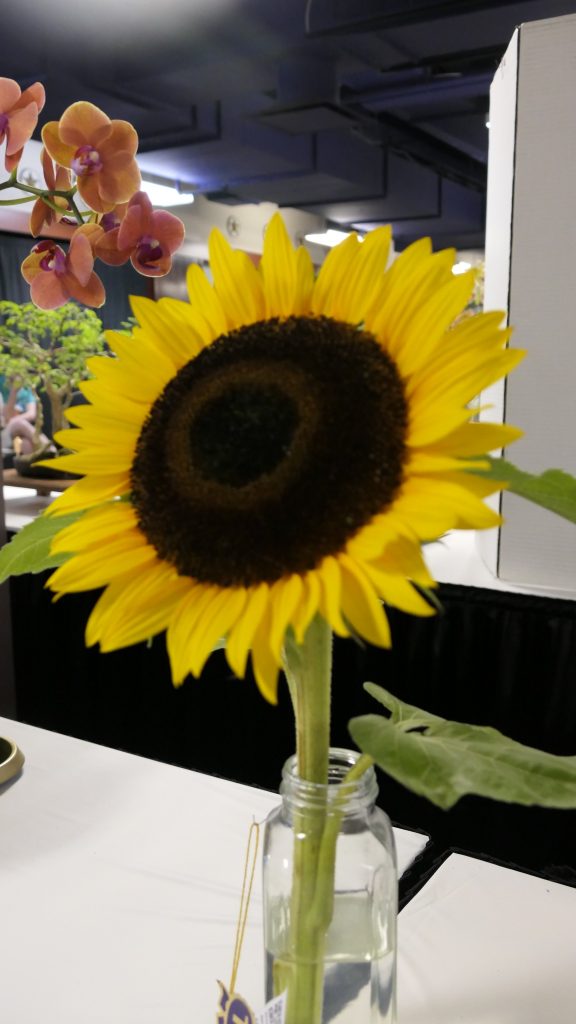
In the case of this particular photo, the lesson is that I can’t just take the “Whip out my phone and take the picture” approach to using an actual camera. I need to slow down, compose, and make sure my focus isn’t screwed up. The result was this particular photo of a winning sunflower blossom at the Erie County Fair (more on the Fair to come sometime soon). I didn’t compose a very good shot, and the subject is blurry.
Oh well, I’m sure I am far from the first person to combat these difficulties in this particular pursuit!
I keep having to remind myself of something that I’ve heard from numerous photographers since I’ve started actively studying it: that on any shoot they may take several hundreds, or even into the thousands, of exposures and only end up with a small percentage of those being “usable”. That’s heartening, a bit; even the pros likely have terrabytes worth of external storage full of photographs that will never see the light of day. I do end up wondering how on Earth anyone got good at this back in the days of film, but that’s a question for another time….
This, from 2011, is still my favorite of all the photos I’ve taken there over the years. Maybe I was a budding street photographer all those years ago, and I didn’t realize it!
I took these on a whim the other night: I opened up one of my Complete William Shakespeare collections to Henry’s Crispin’s Day speech from Henry V, laid my glasses on the book, and took a few photos. It was an experiment in composition. I’m not sure which I like better, to be honest! What say you?
I have a slight feeling, as I write this, that the second photo is better…but I’m damned if I can say exactly why….
Some shots from my photography session down at the Buffalo Outer Harbor this past Sunday:
I like how this one captures land and sea (lake, I should say) disappearing at the same vanishing point. The bird in flight was a happy unplanned element.
Here we see the jetskiers three! I like how their knees and the green trim of their Jetski form arrows pointing in the direction they’re going. I also wanted the lighthouse and the towers for the wind turbines in here as well. Again, the bird–flying low, the opposite direction–is a happy unplanned element.
Grain elevators. The dinosaurs, as it were, of the Great Lakes’ industrial past. I love these hulking old buildings.
More photos from that day, with full-size versions, in this Flickr album.
By the way, I think I am now going to start using HUE as an acronym: Happy Unplanned Element. I think Bob Ross (“There are no mistakes, just happy accidents”) would approve. “Accident” still sounds overly negative in my ears, though. So, a HUE is an element in my photo that I didn’t plan on capturing, either because I didn’t know it was there or because I couldn’t avoid capturing it.
Now that I have a camera where I can actually change pro-style photographic settings, I’m learning a lot about…stuff I never knew before. One of the biggest things I’m learning about is aperture control, and along with that, depth-of-field.
Put simply, depth-of-field refers to how much of the camera’s image is in focus at any particular time. Low depth-of-field means that only objects in a pretty narrow area will be in focus, while those in the background will be blurry; high depth-of-field means pretty much the opposite. Like any photographic effect, what degree of depth-of-field you want depends on what you’re trying to accomplish with the particular photo you’re taking, what kind of subject you have, and so on.
Before the FZ1000 II came along, I never had any real way of working with depth of field, and now I do. Huzzah!
But…the problem now is a simple one: I actually don’t know anything about depth-of-field and how to use it.
So I’ve done some experimenting here and there, and in all honesty, my initial efforts at adjusting depth of field and seeing the results were not helpful, because I simply didn’t understand what I was doing. This is where I picked on something from Simon d’Entremont’s videos (I mentioned him in my last photography post). He has a couple of little owl figurines, with fuzz and feathers, that he uses to demonstrate photographic effects in his videos. So I realized that I needed something similar: a test subject. In the case of depth-of-field, I figured what I needed to do was select a test subject and set it up in a spot where I could use the background to good effect.
Enter…Jerry!
Yes, that is a Funko-Pop figurine of Jerry Seinfeld, wearing the infamous “pirate shirt” from the Seinfeld episode in which Jerry, being polite to “the Low Talker”–a woman whose voice was so soft no one could hear her–inadvertently agreed to wear her newly-designed pirate shirt on a nationally-televised appearance on The Today Show. Look, the details don’t matter. What matters is that I set Jerry up in a spot where I could work my way through a series of aperture settings, called “F-stops”, noting the affect on depth-of-field.
It turns out that the higher the F-stop number, the smaller your aperture is, and the more depth of field you have, and vice versa. Thus, a high F-stop setting gives you a background that’s fairly clear, and a low one blurs the background.
Here is the sequence of six shots I took of Jerry. Note the progression of the background’s blur!
Aperture: f/11
Aperture: f/8.0
Aperture: f/5.6
Aperture: f/4.5
Aperture: f/3.8
Now, if you’re wondering what those numbers mean specifically, I’m afraid I haven’t the slightest clue as yet. I imagine I’ll get that in my head at some point, but I’m still at the very newest part of this particular hobby, when my head is swimming with details and possibilities. But I can’t help seeing in this exercise how the numbers affect the look of each photo, and this shows why low depth of field is used to make a specific subject really pop.
And that’s what I’ve been learning about this week. Hooray for apertures!
Your Humble Narrator, with his trusty Nikon Coolpix L840 digital camera. Taken October, 2020.
“But you know how it is. It’s like a hobby. Once you take up a hobby, the more interesting and fascinating it becomes.” –Tony Wendice (Ray Milland), Dial M for Murder
It may seem a bit weird using that quote to talk about my growing interest recently in photography (if you missed it, check out Part One of this series!), since in the movie Tony Wendice is referring to his growing fascination with the daily comings-and-goings of the low-life guy he’s soon going to be kind-of blackmailing, and kind-of paying to murder his wife, but the sentiment applies to all hobbies, doesn’t it?
Like most people, my “photography” consisted of snapping shots of things: places we went, stuff the cats and later the dogs were doing, and so on. I just…snapped lots of photos along the way. Sometimes I’d take something and say, “Whoa, that turned out nice!” Most times, though, my photos were strictly utilitarian, and if we were in particularly notable places that lots of people frequented, I suppose I ended up with lots of versions of the same photos that they were taking. And no, there’s not a thing wrong with that. And if I wanted to dress the photos up a bit, filtering apps like Instagram or Prisma came in handy.
But a while back–and I’m not even sure when, exactly–I found myself watching a video by a creator I like, who posts regular slice-of-life videos from her own daily existence, and she made casual mention of wanting to buy a new camera because her old one still worked but wasn’t really giving her the results she wanted anymore, given how technology has progressed along with her knowledge of how to make videos and such. And that point stuck in my head, because I thought of my old Nikon Coolpix L840 that I bought back in 2015. I’d used it a lot, and was still using it, but it was clear to me that I wasn’t going to get a whole lot more out of it.
So I did a quick search on something along the lines of “What camera should I buy”, and you know how you do one search and then all of the content you see online pertains to that? Yeah, that.
I didn’t choose a camera quickly, but I did suddenly start seeing tons of photography-related content. “What camera to buy?” will, on YouTube, pull up all manner of such videos, many of them made by actual photographers, and not just advertorial articles that seem to make a good case until you realize they’re written by and for the company that’s selling the thing recommended in the article.
We like to complain about how a single search fills our social media feeds with crap related to that one search, but sometimes…sometimes, that single search will make the stars align in a certain way that’s actually helpful.
Actual photographers started showing up in my feeds, most usefully in my YouTube feed. Suggested video after suggested video after suggested video, all from photographers offering various teachings on the subject of photography. I watched a few of these, and…I was ready to take the bait, particularly after one thing one of them said. Roughly paraphrasing:
“Do this week’s photos look an awful lot like last week’s photos?”
That was said by a creator named Simon d’Entremont, a professional wildlife and nature photographer from Nova Scotia. I watched some of his videos, and I’ve now subscribed to his channel and look forward to his content, even if not all of it applies to what I’m doing (more on that later). One thing that I’ve discovered in the online photography community, at least the small bit of it that I’ve encountered thus far, is that everyone seems more than willing to share their tips, tricks, and acquired wisdom because they love the craft and they want to see it spread and to have people succeed. M. d’Entrimont closes each of his videos with the hope that his advice can help you go out and take marvelous photos, and the words, “I know you can do it!” I love when people providing informational and educational content take that attitude. It reminds me of Martin Yan’s old cooking shows, in which he always signed off with, “If Yan can cook, so can you!”
More on other specific creators later (in another post). For now, I’ll just say that I did some research on a camera to buy. I thought about taking the full plunge into a DSLR, which would be my first, but I backed off for several reasons. First, my understanding (which may well be misplaced!) is that DSLRs are slowly being edged out by the newest technological advance, “mirrorless” cameras. (Here’s an explanation.) DSLRs still exist but mirrorless cameras are taking over, and I’m not educated enough in photography to know if the mirrorless tech is totally established yet. A major technological paradigm shift is a bad time to jump into a new hobby!
Secondly, DSLRs and mirrorless cameras are the types of systems where you buy a camera body and then lenses to use with it, switching out your lenses depending on what you’re doing. That means a lot of added expense; good lenses can run into four-digit territory by themselves! Now, I know that photography isn’t a cheap hobby, but it’s still one that…well…put it this way. At this point I am not comfortable enough with my knowledge and skill to justify spending a significant amount of money.
And there’s still a whole lot to learn! See, my good old Nikon Coolpix L840 takes nice photos and video (more on that below), but everything it does is through established modes and pre-programmed scene filters. And that is the biggest area of learning opportunity for me right now, when it comes to photography. In addition to continue challenging myself to compose my photos more skillfully and put some real thought into what kind of photographic content I want to create (and more on that in the next post as well!), I also need to learn the actual nuts-and-bolts of photography. I need to learn about the “exposure triangle”, about things like ISO, aperture settings, and shutter speed. I need to learn how to use those tools and manipulate them to get the image that I want…and I also need to strengthen my photo-editing chops as well, beyond applying this Instagram filter or that Prisma artwork AI application.
I took a lot of really good photos over the years with that trusty L840…but I wasn’t going to get better.
And since I decided there’s more than enough to learn without going fully into changing lenses and all of that, I decided to buy a bridge camera. What’s a bridge camera, you ask? It’s the in-between camera. A bridge camera is more capable than a simple point-and-shoot camera (which have become pretty damned capable in themselves, let’s be honest), but it’s not the full changeable-lens, shoot-in-manual-RAW camera either. (Well, it does those last things, but bear with me.) In short, a bridge camera is the ideal tool for me at this point in my decision to learn more about photography.
But which bridge camera to buy? Well, that took some research. I had a great experience with the L840, so when I need a new thing to replace something that worked well, I’m usually likely to look at the same brand again. And I was very tempted by the Nikon Coolpix P1000, a true behemoth of a camera that apparently boasts the biggest zoom lens in the bridge camera market. I mean, look at this camera! All together now, Star Wars fans: “Look at the size of that thing!”
Why didn’t I get that one? Size, basically, and a number of reviews indicated that if you need that much zoom, you’re really better off with a good DSLR or mirrorless system and a good, high-quality telephoto lens. And the P1000 apparently weighs more than three pounds, which is a lot to lug around. While I haven’t totally settled on the kinds of photography I want to do, I’m likely to be a camera-lugger. I’m wanting to travel more in years to come, and a 3.5lb camera isn’t the best travel option out there. I’ve read good reviews of the P1000 and I’m sure it’s a very fine instrument, but I decided it wasn’t for me.
I seriously looked into a camera by Sony, the RX10 IV (stay tuned another time for my extended rant on naming and numbering conventions for electronic devices; this shit is getting confusing), but while reviews of it seem to consistently rank it as the best bridge camera, it’s also expensive enough that if I’m spending that much, I might as well spend a bit more and commit to the changeable-lens game (which might well be in my future, but not for a while yet).
Through all this I found myself gravitating toward the Panasonic Lumix FZ1000 II, and when I found one on sale in a package deal on eBay that included a small camera bag, a cleaning kit, a pistol-grip tripod, a Gorilla-style tripod, and a couple of other goodies for a hundred dollars less than the camera’s suggested retail price, well then. That was the play.
And here it is, sitting alongside the old L840.
Oooh! Aaah! (Funny that I’m taking pictures of my cameras with my phone.)
Kind of reminds me of Star Trek III, when the Enterprise is dwarfed by the Excelsior! (Yes, I can make anything into a Trek or Wars reference. Anything at all.)
Oh, on video: one thing that I always found disappointing about the L840 was the video quality. Not the video itself; the footage looked great, and I thought at one point about using that camera to film videos if I started adding “vlogging” to my roster of content-creation habits. Sadly, the camera’s microphone wasn’t up to snuff for me. If recording inside, it was OK but not great, but recording outside wasn’t great at all. It would pick up wind noise something awful, and there is some footage I took with this camera that simply isn’t useable because of the wind noise the camera picked up. (Yes, one of these unreleased videos involves pies.) Worse, the L840 has no provisions for connecting an external microphone, so the workaround was to either use the L840 in conjunction with my phone, which does allow for external mike, and then sync the sound together in the editing process…or just use my phone for the entirety of whatever video work I wanted to do. I found that deeply disappointing, for various reasons. (Now, at the time I bought the L840 I wasn’t really thinking in terms of video, so I never looked into the microphone situation. I can’t blame the camera for not being great at something I didn’t really intend to do with it when I bought it.)
The FZ1000 II, however, does take very good video footage and it takes an external microphone, if desired. So I’m covered there. As of this writing, I have not looked into video recording yet…but I will. Oh yes, I will. Indeed!
I’ll wrap this up here, as this is getting long. Next time I’ll discuss and present some results from my first month or two with this camera. But before I go, here are two photos I took at Knox Farm State Park, where I went to do my first real “shakedown cruise” with this camera. This is a demonstration of the camera’s zoom, which is considerable, if not quite as jaw-dropping as the adore-mentioned P1000. For both of these photos, I was standing in the exact same spot.
Yes, that is a new camera. A Panasonic Lumix FZ1000 Mark II, to be precise.
What brought this on?
Well, I’ve loved taking pictures for years. I suppose I got bit by that particular bug in college, when all my friends had cameras. Growing up, my family was not much at all for picture-taking. I remember the last camera we owned being the kind that took the plastic film cartridges. Remember those? All-in-one cartridges so you didn’t even have to feed the film yourself at all? My memories of the camera itself are very vague, as I wasn’t allowed to use it (probably with good reason). We didn’t even get prints made when we used that camera; I remember that we had a slide projector so we’d get slides made, and once in a while we’d break out the projector and look at the slides on the wall. (No, we didn’t have a screen, so a white wall–which was usually textured–served as the screen.) Sometimes when we were on trips my father would buy a strip of pre-made slides from wherever it was we were visiting.
I don’t think we used that slide projector at all after our last move, the one to Allegany, NY in 1981…I don’t even know if the projector itself made the move with us. I know it wasn’t the kind of slide projector with the carousel in which slides traveled; ours had little cubes that held the slides, I think. It’s entirely possible that my memories here are completely bollixed, but the point is, I didn’t want a camera until I was in college. I asked for one for one of those Christmases, and my parents obliged; and thus I joined my classmates in chronicling my adventures on film.
Even then, though, I was just taking snapshots of stuff here and there. I had no interest in photography, much at all. This remained the case into our entries into the digital camera age. I bought our first digital camera in 2004 or 2005, roughly; being able to take pictures and transfer them to the computer without scanning them first was pretty amazing, as was the idea that you could see instantly if your photo sucked. Of course, we upgraded that digital camera, then we upgraded it again, and yet again. We went from an Olympus in 2004 to a Kodak in 2007 to a Canon in 2010 and finally to a Nikon Coolpix in 2015.
Along the way, of course, came our phones, which also took digital photos with increasing quality. I shudder at the terrible resolution of that Motorola Razr phone, all 1 megapixels of it…followed by a phone whose brand I don’t remember, followed by my Samsung S4, then my Samsung S8, and currently, my Samsung S21. When I bought my current phone in fall 2021, I wanted to upgrade my phone’s picture-taking as much as possible because of our then-impending trip to Hawaii, and this decision has served me well since.
Well, as my gear has improved over the years, so has my interest in taking better pictures–if not quite an interest in photography. I think those two things aren’t quite the same, to be honest. But…over the last year…I think the former has become the latter.