The quote in the title of this post is from the West Wing episode “In the Shadow of Two Gunmen”, the second season premiere, in which the present-day Bartlet White House is reeling from the assassination attempt on the President, coupled with flashbacks to the early days of the campaign. In one of the flashbacks, Leo McGarry says those words to then-Governor Bartlet, who is the good man who has not entirely signed onto the whole idea of running for President in the first place.
Jimmy Carter was absolutely a good man who got elected President. He chose his moment with incredible vision: when the country was still recovering from the excesses of Richard Nixon. It might have been the only time someone like Carter could come out of nowhere and become President of the United States.
Much as been written about Carter’s great humanitarian work after he left the White House; I won’t rehash that here. It’s been pretty much an accepted view that Carter was, at best, a lackluster President, but I’ve seen some interesting reappraisals of his time in office–here’s a good one–and honestly, he was followed by some of the most stupendously awful Presidents in American history, so he looks good by comparison to them, too.
Carter is also, to this day, the only President I’ve ever seen in person. I was seven years old when we were living in Elkins, WV, and Carter came to appear in the town’s annual fall festival, whatever it was called at the time. I remember going out, all our family, to sit in the stands and wait for the parade to start and for the sighting of the President. This was mumbly-mumble years ago, so I don’t really recall details at all…but I remember the moment he was there, right down there on the street, walking and waving and grinning that famous grin of his. Jimmy Carter, the President of the United States. The photo above is from that very day; just after he passed where we were, on foot, he got in the limo and popped up through the sun roof. The other man is Senator Jennings Randolph.
Jimmy Carter was a great man, and his commitment to humility and to service should be a model to everyone. Perhaps, one day, he will be.
…because surely we can add more, if we want. Seems to me it’s kind of the point.
Here’s a tribute film Disney made for its definitive songwriting duo, the Sherman Brothers. I don’t think I was aware that Richard M. Sherman died earlier this year; I knew that brother Robert had previously died in 2012.
Actress and singer Mitzi Gaynor has died. She was 93, and she was one of the very last remaining stars with ties to the great era of the Hollywood movie musical. Her biggest role was likely South Pacific, the Rodgers-and-Hammerstein classic (which I may have never actually seen all the way through, it’s not lodged in my memory all that well at all), which is set in–of course!–the islands of the South Pacific during World War II.
This particular song is the one from that show which I know best, though I am abashed to admit that it’s not because of the song but because a teevee commercial for a hair care product used the theme as the basis for its jingle: “I’m gonna wash that gray right out of my hair!” It was some years before I learned the truth.
Here is Mitzi Gaynor singing “I’m Gonna Wash That Man Right Out Of My Hair” from South Pacific.
This is a repost of what I wrote on the twentieth anniversary of 9-11-01. I find myself increasingly unable to think of anything new to say about that day. Maybe it has finally become a memory best expressed in older words than new.
I thought about writing a long remembrance of that horrible day, a walk-through of the weird mix of terror and business-as-usual that played out in the office where I was working at the time. I just…don’t want to do that.
I remember that for several days after I tried listening to music, and I just…couldn’t. It took, I think, until Friday when I was finally ready to listen to something. I chose one of the most emotional pieces of music I know, a work I played in my freshman year of college. It seemed, in terms of mood and title, appropriate: Elegy, by composer Mark Camphouse.
It was the saddest day I can remember as an American, and it’s even sadder now in retrospect as we went forth from that day and proceeded to learn all the wrong lessons and undertake all the wrong responses.
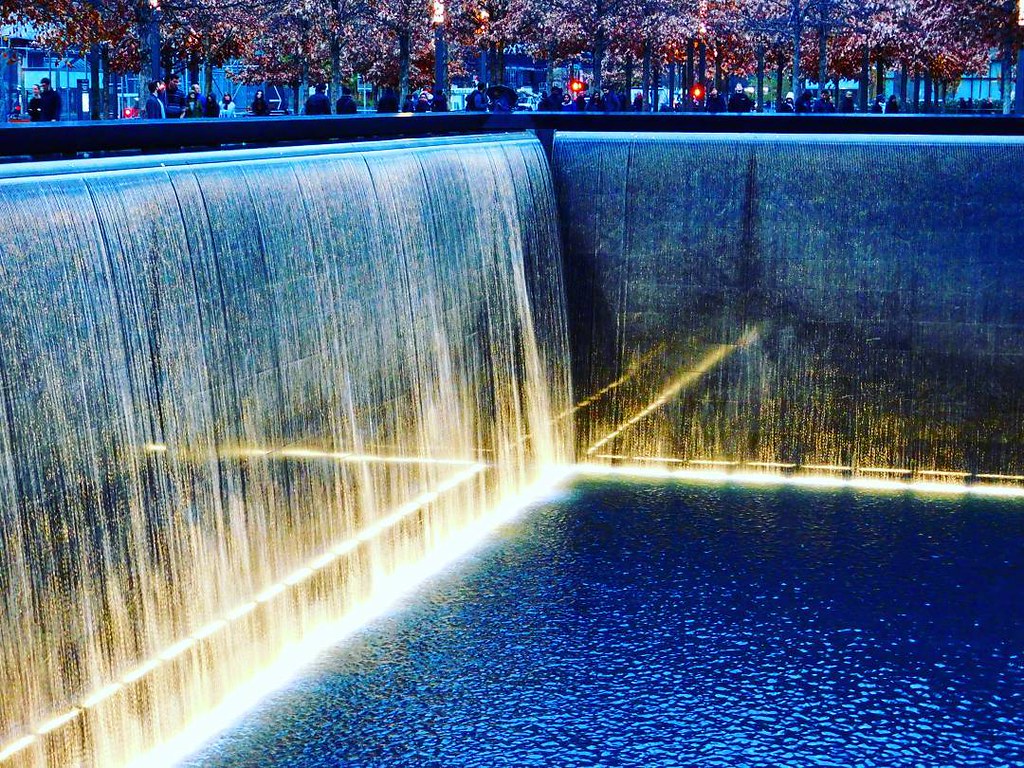
We went to New York City in 2015 for Thanksgiving, and we did go to “Ground Zero”. We weren’t there long, but we did want to see the place where this thing happened. It was a damp, cloudy, cold day…and for the location, somehow very beautiful.
There is always beauty to be found, eventually. I wish America would remember that more. Americans, myself included, are too quick to respond with anger and rage to the ugliness of the world.
This was sad news to see when I got home from work today: Joe Bonsall of the Oak Ridge Boys died the other day, after a battle with Lou Gehrig’s Disease.
The Oak Ridge Boys weren’t huge in my household, but I do remember that my father liked their sound and some of their songs a great deal. The Oak Ridge Boys really did vocal harmony incredibly well, and with Bonsall’s tenor voice rising above the rest, you always knew that’s who you were listening to. (Well, his tenor rising above and Richard Sterban’s bass diving below.)
I can’t say that I’m super familiar with the Oak Ridge Boys, but there are two of their songs that I do count among my favorite songs of all time. First is likely their biggest hit, “Elvira”, which dominated country radio for a few years in the early 80s. This performance may not be the best in terms of sound or video quality, but I love the 70s-80s vibe here: this is from the old variety show that Barbara Mandrell and her sisters hosted, and the variety-show aesthetic of the time is on full display here. You can just tell these guys are enjoying the hell out of themselves. (And note, in the early going, the guitarist just over Bonsall’s left shoulder. That’s how you get into what you’re doing.)
The other song (I’m pretty sure I’ve featured both of these songs before on this site, but not for quite a while) is one of my favorite songs set in a bar ever. The melody and the lyrics just do something magical here; I can picture the scene in my mind almost perfectly…the bar’s dark lighting, the scents of beer and cigarette smoke, the signs and mirrors on the wall, the pinball machine over there in the corner that nobody’s playing, and the little stage where this lovely woman whose messy-haired beauty isn’t the least bit lessened by her years and mileage, and the patrons watching her sing…with one watching her more lovingly than most, I suspect.
Here is “Y’all Come Back Saloon”. Bonsall isn’t the featured singer here like he was on “Elvira” (along with Sterban in the famous “papa-ooo-mow-mow” parts), but his tenor is still unmistakable.
https://www.youtube.com/watch?v=ggrGlVEe6pI
Thank you for the music, Mr. Bonsall, and condolences to those who knew and loved you. Your music meant a lot, to a lot.
Filmmaker Roger Corman died the other day. It was always easy to poke fun at Corman’s films, but he strove to make them as good as he could, and on his own terms. Corman’s studio was not only prolific but also a starting point for many filmmakers who later went on to great careers of their own.
Below is the text of a post I wrote a number of years ago, praising my favorite Corman film, the 1980 obviously-STAR WARS-inspired “Magnificent Seven In Space” flick, Battle Beyond the Stars. I stand by every word of this. Is the movie good? Yes, because while its objective qualities may be debatable, what cannot be debated is that it’s a freaking delight.
Battle Beyond the Stars is a movie that seems to confound expectations. If you watch it expecting a good movie, you’ll be disappointed. But on the other hand, if you watch it expecting a bad movie, you may be disappointed in the other direction.
Battle came out in 1980, one of a string of flicks to come out in the years after something happened in 1977 to suddenly make the entertainment industry think that there was a market out there for science fiction, especially in the form of explodey-spaceshippy-goodness. Battle was produced by Roger Corman, the king of the low-budget movie who nevertheless also served as a talent scout for later Hollywood geniuses, the most notable being a special effects artist who designed the spaceships for this movie and who later went on to bigger things. His name? James Cameron.
I saw Battle when I was in fourth grade. It was part of a double feature at the local movie house, the first film being a flick called Starcrash. I’ve never seen Starcrash since [UPDATE: After writing this post, I did in fact watch Starcrash again, the results of which you can read about here. Is Starcrash bad? Oh Gods, yes. Have I seen it once or twice even since then, because it’s lovably bad? Oh Gods, yes! –Ed.], although I do have a downloaded copy on one of my hard drives. Starcrash is legendary for being a bad movie, although I recall liking it when I saw it. Battle was the main event of the feature, though, and I was really looking forward to it, mainly because the nine-year-old me had thought that this trailer just looked awesome:
That trailer had run on a bunch of movies leading up to the release of Battle so I was really stoked when it came out. And when I saw it? Well, I was nine. I loved it. It had aliens and spaceships and lasers and things exploding and a cute girl. I got the soundtrack album, featuring music by a composer named James Horner, and I played that album a lot over the years, wearing it out and grooving to what I thought was the best explodey-spaceshippy movie music I’d heard outside of a Star Wars film. (Of course, my sample size was very small, I didn’t know film music enough to hear Horner’s huge debt to Jerry Goldsmith in the score, and I didn’t know enough about orchestration or performance to recognize a score that was recorded on a shoestring budget and which featured some really bad orchestrations, such as the track “Cowboy and the Jackers” which does things to the trumpet section that may be in violation of several international treaties.)
I saw Battle once more when it showed up on network teevee a few years later, and still liked it, and then I didn’t see it again for many years. I may have caught it in a cable broadcast sometime in the 1990s, but I’m not sure. I didn’t see it again in its entirety until just last week. How does it hold up? Well, movies like this don’t really “hold up” – that’s the wrong way to look at them. I had no illusions that it was some unheralded gem of SF moviemaking, but I was pleasantly surprised that it’s not that bad, either.
So, what about Battle Beyond the Stars, anyway? What’s it about? It’s very simple: The Magnificent Seven in space. That’s it. Literally.
We open with a giant enemy ship traveling through space (at a very slow pace, even though it has six enormous thrusters that are constantly firing).
The ship is ruled by our villain, Sador of the Malmori. Who are the Malmori? Are they a race of aliens? An empire? A family? We’re never told. Anyway, his ship approaches a planet called Akyyr (that’s how I’m spelling it, anyway), which, seeing that it is inhabited by peaceloving folk who only own one spaceship (which is a weather station), decides that he’s going to conquer it. So he hovers his enormous ship over them, projects his enormous face over their heads, and says, “I have come to conquer you.” (This he does after destroying the weather ship, just because he’s evil. The weather ship had been occupied by two guys who display the Akyyrian attitude by greeting an enormous and malevolent-looking spaceship by grinning, saying “Look! Visitors!”, and then contacting it by asking, “Could you identify yourself, please?”)
Anyway, Sador gives the Akyyrians seven days (“risings of your red giant”) before he’ll come back and finish conquering them. Why the delay? Who knows, but it gives the Akyyrians time to send one of their local young men, a boy named Shad (played by Richard Thomas as John-Boy Walton in space), off in the other ship they own, the secret one once piloted by the old blind guy who used to be an adventurer, to round up some help in the form of mercenaries.
The ship Shad flies is probably the single most famous thing from Battle Beyond the Stars. The ship is simply named “Nell”, and sure enough, it’s run by a computer by that name who speaks with the voice of a cranky lady. What’s most memorable about the ship, though, isn’t her personality; it’s her shape:
This ship is one of the more famed B-movie spaceships in movie history. You know you’re talking to a knowledgeable geek when the mention of the movie Battle Beyond the Stars draws the rejoinder, “Oh yeah, the movie with the ship that’s shaped like a pair of breasts!” The ship is more than that, though – it looks like a feline body with female breasts and then a couple of wings where the ship’s guns are, which sweep up and out, spread out to look like…well, it’s a very feminine ship. (And it was designed by a young filmmaker who was cutting his chops with Corman’s production crew, the afore-mentioned James Cameron.)
Anyway, Shad goes off in search of mercenaries he can hire to fight off Sador. On the way he meets a taciturn fellow named Gelt (Robert Vaughn), who only wants a meal and a place to hide from the apparent galaxy’s worth of folks who are after him:
He meets a ship commanded by a group of aliens who have third eyes on their foreheads and who use telepathy to do stuff:
He meets a “Warrior Valkyrie” named “St. Exmin”, played by Sybil Danning:
Given that her screentime involves her looking like this, it’s almost a crime that Danning doesn’t get more of it. She does, however, have one of the goofiest lines in movie history, and boy, does she deliver the hell out of it:
The other girl there is Nanelia (Darlanne Fluegel), who is every bit as naïve about people as Shad is, which makes her a perfect fit for him. She, too, gets far too little screentime, because she’s really cute. I remember her being one of the first females onscreen to impress me with her cuteness. I mean, look how cute she is in that clip, when she giggles at the prospect of learning how to “tingle, tangle, prangle” her new love interest from this warrior in the goofy headdress! Yeah, Nanelia is really, really cute:
Most memorable, probably, is the Space Cowboy Shad recruits who goes by the name “Space Cowboy”, played by George Peppard:
Cowboy is an arms runner who ends up leading the Akyyrian planet defense with the weapons he’d been running to a planet that Sador has just wiped out. Cowboy is extremely cool, although it’s hard not to expect him to grin and say, “I love it when a plan comes together!” But he does have one of the niftiest gadgets I’ve ever seen in a skiffy movie: he has a gizmo on his belt that dispenses Scotch and ice. (Why a Space Cowboy is drinking Scotch and not bourbon is never explained.)
And there are some aliens who are basically actors in rubber suits. You know how it is. Anyway, a big battle ensues (the Battle beyond the stars!), in which quite a few of the recruited mercenaries die heroically before Shad and Nanelia finally figure out how to do Sador in. I know, I just spoiled the movie, but what of it? Who would watch a movie like this and even consider the possibility of a bummer ending?
The clip above aside, there’s some witty stuff in the course of the flick, and one nicely done moment after Gelt (Robert Vaughn) dies, involving Shad’s bargain with him (a meal and a place to hide). There are also some exceedingly goofy moments, and like all B-movies, some of the stuff that happens isn’t explained very well at all (such as a scene in which the telepathic-collective aliens make their own stealth attack on Sador that involves sacrificing one of their own and a transplant of arms, believe it or not).
Of course, we have to have a romance between Shad and Nanelia, and it’s your typical awkward stuff (“Do they have kissing on your planet?”), but at the end, when victory has been won and all that are left are our hero and heroine returning to Akyyr, instead of ending with some neat dialog and some delightful snogging, we get Shad quoting at length from the “Varda”, the sacred text that the denizens of Akyyr are constantly quoting throughout the film. Weird stuff – the kid should be finally taking his big step into manhood, and instead he wants to recite from the holy book of a pacifist planet that sounds like The Art of War.
Battle Beyond the Stars is not a good movie. Nor is it a bad one. If you’re attuned to it and willing to go where it wants to go, it’s a fun little flick, if you’re into movies where the villain who is trying to conquer the planet Akyyr gets to shout in triumph at the end, shortly before his unimagined demise, “Akyyr is mine!”, followed by leading his entire bridge crew in sinister bad-guy-who’s-just-won-the-lottery laughter.
In other words, it’s the kind of movie that can only appeal to your inner nine-year-old. And that’s not a bad thing to be, is it?
First of all, a bit of administrativia: the post immediately below this one was supposed to run yesterday and I screwed up the publishing. Oops.
Now: not music, but a scene from a teevee show today: the closing scene from “The Unnatural” from The X-Files, an episode David Duchovny wrote and directed, in which his Agent Fox Mulder visits an elderly former FBI agent named Arthur Dales about a curious incident in Agent Dales’s past. It turns out that this Arthur Dales was actually the brother of the former FBI agent Arthur Dales, though both were named Arthur. Anyway, this Dales was a cop in Roswell, NM in the late 1940s, and was assigned to protect a black baseball player named Josh Exley. Of course, Exley turned out to be an alien who loved baseball, and a very strange period story emerges, in which the show’s decades-long alien conspiracy intersects the world of baseball. Honestly, it’s one of the show’s very best episodes.
One thing that makes it great is that the present-day Arthur Dales was played by the great character actor M. Emmet Walsh, who just died this week after decades of appearing in seemingly everything. Walsh was an outstanding actor, and he will be missed.
I couldn’t find the actual scenes of Walsh and Duchovny talking in the episode, so I’ll just share this scene, which concludes the episode as Mulder and Scully take a break from all their alien-chasing and conspiracy-pursuing to bond–pretty romantically, too–over a bit of batting practice. The song heard throughout the scene actually weaves through the entire episode; it turns out that the alien ballplayer in 1947 also had a great singing voice.
Ozawa was best known for his long tenure as music director of the Boston Symphony Orchestra, all twenty-nine years of that tenure–the longest of any of that great orchestra’s many amazing conductors.
In addition to his direct music-making, Ozawa was always deeply invested in teaching young musicians and young conductors. Here is a clip in which he steps in to correct a young conducting student on a matter of technique: “I try to understand you. I don’t do this…[conducts with a vague circular motion of the hand]…that’s like, ‘eighteen minutes, cook the spaghetti.'”
Here is how the Boston Symphony marked his passing:
And here he is, not too many years ago, looking perhaps a bit frail…but still able to bring the goods when Beethoven is on the program.
Thank you for all the music, Seiji Ozawa! You made the world better.