
Now that I’m living in Syracuse, I’m obviously out of touch with what’s going on in Buffalo. Thus, I have to wonder if any of that city’s “leaders” — the ones who are falling over themselves in trying to get an Indian-run casino built downtown, with promises of spawning lots of development and economic boosting of the Seneca Nation of Indians — have bothered to read TIME Magazine‘s cover story this week. I’m guessing, probably not.
Untitled Post
I’ve complained before about NBC’s habit of ruining surprises in episodes of its shows, by their insistence on doing promos that invariably warn us not to miss the last five minutes or to be on the lookout for a twist no one could see coming. (Well, now that I’ve been told about it, I can see it coming, can’t I?) Until yesterday, I was glad that this annoyance was confined to NBC. Sadly, FOX appears to have been bitten by the bug, based on their commercials prior to last night’s episode of 24. There was a surprise development at the end of the episode, involving the trunk of a car, which FOX was nice enough to telegraph in the promos, with a cop shouting “Open the trunk!” followed by a shot of one of the characters standing over the open trunk, screaming “Oh my God”, and the announcer then intoning in grand NBC style, “A twist you won’t believe”, or something like that. The problem is, as soon as I knew that this particular character was shocked about something in the trunk of this particular car, there was only one possibility as to what the item in the trunk could be. I had it figured out before the commercial was even over, much less before last night’s episode even began (I saw the ad during That 70s Show).
The worst part is that this development would have been shocking, had FOX allowed the surprise to be sprung upon us as the show’s producers clearly intended it to be. I actually was shocked by this plot twist, but why couldn’t FOX have let me be shocked during the damned show? For a surprise plot twist to really work, we have to first be unaware that there is a surprise plot twist in the first place. Of course, the networks don’t care about that; what they’re after is ratings and ad revenue, so they want to keep viewers from switching channels, so this is their strategy. But that doesn’t stop it from being completely annoying.
Share This Post
Untitled Post
Derek Bell, harpist for the wonderful Celtic music group The Chieftains, has died. He was a wonderful musician and will be missed. A fine tribute to Bell can be found here.
(Edited to remove photograph by request.)
Share This Post
Untitled Post
The Western has never been my favorite genre; for some reason, I always find it hard to relate to the concerns of the characters in them. That’s not to say that I dislike Westerns, though, as I’ve loved some of the recent ones: Dances With Wolves, Tombstone, Silverado, and most notably, Unforgiven. The older Westerns, though, usually don’t resonate with me very much — I admire their craft, and enjoy their stories, but as a whole they’re not really my cup of tea.
A case in point is The Searchers, which I just watched this weekend. To be perfectly honest, I probably would never have bothered to watch this film if not for the fact that a major subplot of Star Wars Episode II: Attack of the Clones is reportedly an homage to The Searchers: Anakin Skywalker’s search for his mother, who has been abducted by sandpeople. The story of The Searchers is fairly straight-forward: a frontier family is attacked by an Indian tribe (Comanches, I think), and the father, mother and son are murdered while the two daughters are carried off. A posse, of course, is formed to go after them, and after failing, two of the possemen closest to the family — the John Wayne and Jeffrey Hunter characters — go on alone, having a number of adventures before finally locating the tribe that has abducted the two daughters.
The film is fairly dark, with racism in its subtext. The Wayne character hates the Comanches with frightening passion, so much so that he also seems to hate the Jeffrey Hunter character, who is something like one-eighth Indian. Wayne barely treats Hunter like a person throughout the film, calling him things like “Blankethead” and refusing to let him drink in a saloon. He also makes clear that his intent, upon finding the missing girls, is not to rescue them but to kill them — because by that point they will have become Comanche themselves. Wayne portrays this character as a man whose soul is constantly roiling in anger, and Hunter portrays his in much the same way, but their respective angers are different, which creates a great deal of tension between the two men. This is the best aspect of The Searchers (along with the frequently stunning cinematography).
There are subplots along the way that did not engage me — prime among them, a love story between Hunter and, well, some woman. (I can’t recall the character names from this movie for the life of me….) This whole storyline felt like padding, interjected into the film to give it running time. It distracted from the dynamic between Wayne and Hunter, and it distracted from the main concern of the plot. Thus, a lean and taut film took on a flabby aspect. As to my failure to really relate to the concerns of the characters, as mentioned above, I’m not entirely sure what this family is doing in that spot in the first place. The land they live on appears to be smack in the middle of a vast desert, with no crops and no irrigation, and they don’t appear to be ranching (although I might well have missed this). I felt like their sole purpose was to be out in the wilderness, just to be kidnapped in the first place.
So, I’m reporting a mixed reaction to The Searchers. I can see some of why it is so highly regarded — but at the same time, I can’t admit to having really enjoyed it.
Share This Post
Untitled Post
You know what the difference is between hitting .250 and hitting .300? I got it figured out. Twenty-five hits a year in 500 at bats is 50 points. Okay? There’s 6 months in a season, that’s about 25 weeks–you get one extra flare a week–just one–a gork, a ground ball with eyes, a dying quail — just one more dying quail a week and you’re in Yankee Stadium!
— Crash Davis (Kevin Costner), BullDurham
It is now that part of the NFL season known as “crunch time”, when the playoff picture begins to solidify. This is when the best teams put their divisions away and shift their focus to securing home-field advantage or a first-round bye, and when a cluster of good teams start jockeying either for third (and, new this year, fourth) seed division titles and wild-card playoff berths. Each week sees more teams that have been “on the bubble” slide off it, into the ranks of the also-rans, and the worst teams start to play for pride and for the pleasure of being a spoiler. And for the teams on the bubble, this is when the season can become agonizing; this is the time of year where when the season is over, the players will look back and remember that one game or — in some cases — that one play that took them out of playoff contention. December is when a football season either becomes a success or a failure, and when the ones who fail look back and achingly wonder why they couldn’t get that one more first down, not lose that one fumble, not had that one ball that was batted into the air come down into the arms of a defender, that might have meant that one more win and a season in January. This is when they wish for the football equivalent of that “one more dying quail”.
:: For the Buffalo Bills, the end of their playoff hopes came yesterday with their definitive loss to the Patriots. It wasn’t as bad as the 38-7 debacle at home a few weeks back; they played tougher yesterday, on the road, and their defense actually acquitted itself fairly well, although the tackling still needs a lot of work. The fault yesterday was squarely on Drew Bledsoe’s shoulders: he threw four interceptions. Turnovers, as always, are the single thing most likely to utterly kill a football team. There isn’t really much more I can say about this game, except that the Bills have shown a lot of progress this year. Their remaining three games are for redemption; even if they win them all — an unlikely event — to finish 9-7, they would need a series of miracles to make the playoffs. Next week they are home for the Chargers, who are in the thick of the playoff hunt and will need a win; then they visit the Packers, who have clinched their division but need to keep winning to get home-field advantage; and then they wind things up with an exhibition game against one of the lesser college teams (the Cincinnati Bengals).
:: For further instruction on how turnovers can kill you, look at the Steelers game yesterday. Instead of beating an expansion team to join the eight-game winners in the AFC and solidify their position in first place in the AFC North, they lost 24-6 to the Texans despite gaining almost nine yards for every yard gained by Houston. (Houston’s 47 total yards is the lowest number of total yards gained by a winning team in NFL history.) The culprit? Five turnovers, three of those courtesy of Tommy Maddox. Now the Steelers are only a half-game ahead of the Cleveland Browns in the AFC North. If they want to make the playoffs (and keep my Super Bowl prediction alive!), the Steelers must win their division. I don’t see a wild-card team coming from this division.
:: My other Super Bowl pick, the Eagles, kept their pace by beating the Seahawks. The Eagles are one of three ten-win teams — all of them in the NFC — and a victory next week will give them the NFC East title.
:: The Chiefs won’t make the playoffs, but they are sure looking impressive in the last two weeks. They have won their last two games by the combined score of 98-10.
:: The road to the Super Bowl in the NFC may well end up going through Tampa. The Bucs appear to have the easiest remaining schedule of the three ten-win teams in the conference. And recent history may be on the side of the Bucs: four of the last five Super Bowl champions were teams that, at that point, had never won a Super Bowl before.
Share This Post
Untitled Post
I lived in one of Buffalo’s larger suburbs, and one that directly borders the city, for two years. In that time there was only one instance of crime in our vicinity, an isolated incident of domestic violence that did not recur. In that incident, some property was destroyed but there were no injuries.
Now, we’ve moved to a smaller suburb that is farther away from a city that is already half Buffalo’s size. We live in a moderately upscale residential community that has its own golf course and elementary school. Not a gated community, but still pretty nice and quiet and the town is small.
And two mornings ago, a murder occurred in a townhouse less than a quarter of a mile away from our apartment. There have been scant details released yet, so we don’t know if it was a domestic dispute gone wrong or a burglar who got interrupted in his break-in. The murder happened, apparently, around 10:30 Friday morning….when we were all at home. So while we’re home drinking coffee and surfing the Net and watching Sesame Street, a man was dying of a gunshot wound less than a thousand yards away.
It’s always frightening when the world decides to remind me that it can be a disturbingly random place.
Share This Post
Untitled Post
I’ve made some additions to “Other Journeys” at left.
:: Asymetrical Information (formerly Live From the WTC) by Jane Galt is always interesting, even when I disagree with her — hell, especially when I disagree with her. I’ve particularly enjoyed her recent posts about file sharing and the fact that even though it is likely to become more and more prevalent, it will have other effects that aren’t going to please the “Information wants to be free” folks who think that the end of intellectual property will lead to some kind of wondrous utopia.
:: CalPundit is, like William Burton, a particularly clear-minded liberal voice I’ve been enjoying for a month or so. His recent post about the coming Iraq war — ostensibly a review of the book The Threatening Storm — is superb, both in its logic and in its writing.
:: Reading and Writing, by Joseph Duemur, is a fairly intellectual blog by a professor at Clarkson University, located in Pottsdam, NY (roughly a three hour drive, I think, from Syracuse). It’s a good blog, and I have to support my fellow Upstate New Yorkers.
:: I wrote a few days ago about Piquant Rants and Sassy Impudence. As noted, I’m totally on the opposite side of her, politically, but I like her “voice” and I greatly admire the project she is now undertaking.
[Edited for an unfortunate misspelling of “Asymetrical”.]
Share This Post
Untitled Post
With December being a prime release month for movies, it’s also a prime release time for film score CDs. I’m eagerly awaiting this coming Tuesday, when Howard Shore’s score to Lord of the Rings: The Two Towers is released. Another big upcoming release is the John Williams score to the new Spielberg film, Catch Me If You Can, which is reported to be a more jazzy-sounding effort than Williams’s usual symphonic-style work. While I think that Williams’s output in recent years has made clear that he is no longer at the height of his powers (as far as film music is concerned), I’m looking forward to this one because it (reportedly) presents Williams working in an idiom that he hasn’t done much with since his early days as a jazz pianist in Hollywood.
The big new release that’s out now — it came out last week — is Jerry Goldsmith’s score to Star Trek: Nemesis. The reviews I’ve read of this one are almost unanimously positive, and some are amazingly so, stating that Goldsmith has turned in a classic. I bought the CD yesterday, and while I like a lot of it, I can’t say that I consider it a classic — in fact, it’s not even as good as Goldsmith’s scores to Star Trek: The Motion Picture (an undisputed classic, one of the finest SF film scores ever composed) and Star Trek V: The Final Frontier, a great score that was the best thing about the film most commonly named as the worst of the Trek films. I’d say it’s roughly as good as Star Trek: First Contact and better than Star Trek: Insurrection, based on the CD alone.
As is the case with many of Goldsmith’s score CDs, this release is fairly short, although it’s more generous than usual at forty-nine minutes or so. The result is that a good deal of music in the film did not make the CD, and according to reports an entire heroic aspect of the score has been left off the CD. What is on the CD is mostly comprised of quiet, suspense-type music and, toward the CD’s end, rattling action cues. It’s all pretty good stuff, displaying Goldsmith’s amazing ability to weave a single theme through an entire score in a kind-of inversion of traditional leitmotif-based scoring techniques, but the sequencing of the album makes, unfortunately, for a fairly “monochromatic” listening experience. Basically we get the same emotional texture for roughly half an hour, and then the action stuff kicks in, and we switch to full-bore exciting music and get that for fifteen minutes or so. Notable features of the score are its surprising use of electronics — Goldsmith is very good at incorporating electronic sounds into his orchestral textures — and his reuse of motifs from his previous Trek scores.
Then we get Goldsmith’s end-credits suite, which is identical to the last four he has done for Trek films: the Alexander Courage “Enterprise Fanfare” leading into Goldsmith’s classic ST:TMP/ST:TNG theme, and then a beautiful, lyric theme that is followed by the same coda. It’s a formula, and I find it more disappointing each time I hear a new iteration of it: Goldsmith does not even compose a transition into the “lyric” theme; instead, his Trek march simply stops and after a second of silence the lyric theme starts. I really wish Goldsmith would stop using this exact same arrangement each time out. Now, the lyric theme here is utterly gorgeous, so I’m forgiving to that extent, but the whole manner of execution still smacks of a bit of laziness. Goldsmith is a great composer; surely he could do more than simply slap a new middle section into the same End Credits music with each Trek film to come down the pike.
And I question the album’s sequencing and music choices. Goldsmith, more than any other composer for films, seems to fall victim to the devilish “re-use fees” that result in short CDs that leave a great deal of music off the disc. That said, Goldsmith is apparently responsible for choosing which music makes the CD and which does not. In this case, he has apparently not done a very good job, as he has left off a good deal of the score’s actual character, resulting in a CD that seems to get stuck on one mood for a long time, then another mood for a similarly long time, and then the End Credits.
Jerry Goldsmith’s work on Star Trek: Nemesis may prove to be his finest work for a Trek film, but how many of the reviewers out there can pronounce it so on the basis of this CD is a mystery to me. Of course, it’s a Goldsmith CD, so it’s good by definition. But I’m still disappointed.
Share This Post
Untitled Post
Steven Den Beste recently shooed a cadre of Ayn Rand cultists from his virtual doorstep, saying that he found the question “Have you ever read Ayn Rand?” to be equivalent, in some ways, to the question, “Have you spoken to Jesus lately?” I couldn’t agree with him more; I have always found Rand’s devotees to be a fairly scary bunch. Anyway, a good resource for people whose reaction to Objectivism (the fancy-schmancy name for Rand’s philosophical ideas) is to think “Something is rotten in the state of Denmark” can be found here.
Share This Post
Untitled Post
IMAGE OF THE WEEK
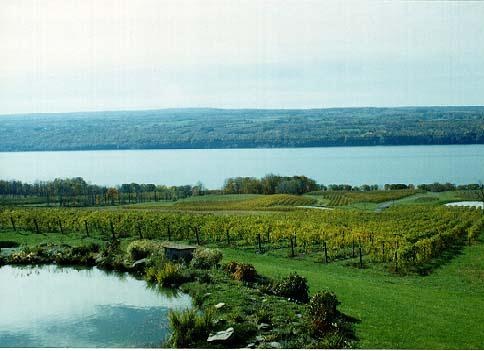
A vineyard on the slopes of one of New York’s Finger Lakes.
When the glaciers receded after the last ice age, deep valleys running roughly north-south were cut into the Central New York region, which then filled with water, creating the Finger Lakes. These deep, long and narrow lakes — reminiscent of the Lochs of Scotland, especially in winter — provide some of the most wonderful scenery in New York State, as well as a home to the bulk of the state’s wine industry. (New York is the second-leading wine producing state in the United States, behind California.) This is because of the steep hillsides along the lakes, where the vineyards reside, and the lakes themselves, which being as deep as they are moderate the climate in their immediate vicinity — keeping the summers cool enough and the winters mild enough for the grapes to flourish.
And here, as a bonus image, is a fascinating satellite image of the Finger Lakes Region. The large body of water at the photo’s top is Lake Ontario; the large lake at the upper right of the photo — spilling off the edge — is Oneida Lake, which is about twenty miles away from Syracuse. The city of Syracuse itself lies at the southern end of Onondaga Lake, which too can be seen in this image. It is the small lake, just south and west of Oneida Lake, that runs northwest-to-southeast.
