
I’ve added a new link under “Other Journeys”. It is the website of Charles Stross, a writer from Scotland who is one of the real up-and-comers in science fiction. His work appears frequently in SF magazines like Interzone, Asimov’s, and Odyssey, and he is becoming a standard feature in the annual “Year’s Best SF” collections. He also maintains an interesting online journal which is always interesting (especially today’s article about his views on the sustainability of the United States as a superpower).
Untitled Post
Just as I was convinced that my own writing is unredeemable crap comes the most wonderful restorative tonic: the 2002 results of the Bulwer-Lytton Fiction Contest, the whole point of which is to produce bad prose. None of my writing reads like this, so I am happy again.
Share This Post
Untitled Post
In every group of passionate devotees to any particular thing, there will be one topic that can instantly divide the group down the middle, leading to angry debate that is never resolved. It’s rather like gathering a bunch of baseball fans and asking, “So, should Pete Rose be in the Hall of Fame even if he never apologizes?” Film music fandom is no different, and their hot-button topic can be summed up in a single name:
James Horner.
Oh, how bringing up Horner in the midst of a bunch of film music afficionadoes can make the fur fly! When I was active on rec.music.movies, there were lengthy debates that cropped up every few months devoted to James Horner. They usually cropped up whenever any prominent film with a Horner score was released. It happened when Titanic came out; then it happened again when Deep Impact arrived. Ditto The Mask of Zorro, Enemy At the Gate, et cetera. They also cropped up in relation to the music of Star Trek (Horner composed the scores for Treks II and III), in discussion of music for fantasy films (Horner’s scores to Krull and Willow are popular examples, and both are hard to find scores on CD), and in the horribly morbid topics like “If John Williams dies, who should do the score for the next Star Wars movie?” I even remember a couple of instances where some individual trolled the newsgroup by posting a blank message whose subject line was simply, “Horner”; sure enough, those minimalistic trollings worked as the whole love-hate relationship with Horner reared its head.
Why, then, does James Horner arouse so much discussion in the film score community? It stems from a number of problematic aspects of Horner’s music. No film score enthusiast can ignore Horner; he is simply too big a name in the field these days. He is probably the biggest name in film music after the grand old men, John Williams and Jerry Goldsmith. His score to Titanic sold more copies than just about everything else. In a collecting area where special editions of long-awaited film scores can number less than 3,000 copies and still remain available for several years, the sheer numbers surrounding Horner’s success with Titanic are staggering. But his immense presence in film music cannot be ascribed to Titanic alone; he has scored more than 120 films since 1978. His body of work is among the largest in all film music, and he is still fairly young — he turns 50 next year — so Horner should be writing music for a long time. So why does his music inspire such fierce reaction, both pro and con?
I think that the pro-Horner side is easier to explain. His music, almost without exception, is immediately pleasurable. Horner has an almost-inexhaustible gift for melody, and his melodies vary from the quite simple (“My Heart Will Go On”) to the longer and more complex (the love theme from Braveheart). His orchestrations are usually lush and romantic, heavy on the strings and woodwinds; he does less with the brass than a Williams or a Goldsmith, using them more often for color or special melodic effect than as an overall part of his orchestral scheme. His orchestral writing is precisely the kind of writing that screams out, “This is beautiful music”, before one has even listened long enough to know if it is beautiful music. (Frequently, it is.) Finally, James Horner has probably the best sense of scene of any composer working today. He has an uncanny ability to home in on the emotional center of any particular scene, and he constructs his cues accordingly. The best illustration of this comes in Titanic, when Jack and Rose kiss while standing on the prow of the ship. His music for the scene doesn’t reach its climax with their kiss, but rather a few seconds later when Rose lifts her right hand to Jack’s neck in a gesture of desire. The result of all this is that James Horner comes up with wonderful melodies and uses them to lean on the emotional points of a story to a greater degree than any other contemporary composer. (I imagine that his approach would be thwarted thoroughly if he were to work with George Lucas, who has been known to not finish a scene, well, ever.) For a substantial portion of the film score community, film music is about highlighting the emotions in any story; thus, Horner receives high marks from them.
All this being the case, then, how could anyone disparage Horner’s work? If he is that good a musical dramatist, how can anyone not like him? The answer lies in the music. Despite all of his gifts for drama and melody (and despite the obvious talent in evidence in his best scores), Horner has a maddening tendency to be lazy at best and to outright swipe entire passages from his own music and others at worst. The more of Horner’s music that one hears, the more one realizes that he uses many of the same effects from one score to the next. One prime example is his use of the Japanese shakuhachi flute, which he first used in his score to Willow as a melodic instrument. Since then, he has used the shakuhachi in many of his scores to highlight transitions to tense scenes, many times in precisely the same way (the effect turns up in Legends of the Fall, Braveheart, and The Mask of Zorro), and to provide bursts of sound in the midst of his action sequences. When scoring scenes of mustering intrigue, he often uses the same motif from film to film: an ostinato snare-drum pattern coupled with raucous piano chords. (This can be heard in Sneakers, Apollo 13, and to a lesser extent in Titanic.) Then there is a special effect of his which I lovingly call the James Horner Rolling Chord of Melodic Punctuation. This occurs in scenes where he gives a long, slow statement of a melody; after each phrase a sepulchral chord is heard, rolling upward from the bass. (The best example of this can be heard in Braveheart, just before the Battle of Stirling when William Wallace gives the Scots his pep-talk.) So in Horner we frequently encounter the same effects, over and over again, sometimes unchanged entirely. Horner has also been known to lift entire passages of his own music and use them in other scores later on; examples include Cocoon (the film’s climax includes music taken from Star Trek II) and Apollo 13 (where music from Sneakers is used in spots).
The other problem many have with Horner is more serious. There are times in his music when, to be charitable, certain phrases are highly similar to phrases in other composers’ works. His early score to Battle Beyond the Stars (a B-grade sci-fi flick by Roger Corman) is basically a pastiche of the music that Jerry Goldsmith was writing during the same period — the middle and late 1970s — complete with the echoing trumpet calls from Patton. And then, there are times when they are virtually identical: the second phrase of Horner’s Willow theme (the heroic theme, not the lyrical one) is not similar but note-for-note identical to a phrase in Robert Schumann’s Fourth Symphony. His “Southhampton” theme from Titanic is eerily similar to Enya’s song “Book of Days”. Other works that have been cited as occuring in the Horner oeuvre are Prokofiev’s Alexander Nevsky and Britten’s War Requiem. (I’m not familiar with either work, but the people from whom I have heard these works mentioned are persons whose musical knowledge is far from suspect.)
James Horner strikes me as a composer who is more concerned with being prolific than with being truly good. Thus, he produces work that is almost always solid and workmanlike; and occasionally (these days less frequently than in earlier days) he comes up with something that is irresistable in spite of its borrowings and other flaws of derivation. Listening to Horner, though, puts me in mind of the scene in Amadeus when Mozart goes to Salieri for advice. “You put too many demands upon the Royal ear,” Salieri says. “Do you know that you didn’t even give the audience a good bang at the end of the numbers to let them know when to clap?” A James Horner film score always lets us know when to clap and when to cry, when to sit on the edge of our seats and when to reach for the popcorn. For many film music lovers, that is enough. For others, though, that is only the beginning.
Share This Post
Untitled Post
Urban development is one of the crucial issues that faces the city of Buffalo, even as the city faces immense budgetary constraints that are severe enough that police and fire precincts have been closed in the last year, and now the Buffalo Common Council is considering a plan to reduce its size by three districts to save the money otherwise paid to city legislators and their staffs. (A separate controversy is the fact that under the current plan, the three Council members who will lose their seats are African-Americans, but that’s another issue.)
Like just about every other Great Lakes or Northeastern city in the last twenty or so years, Buffalo has fallen on hard times with declining population, loss of huge numbers of manufacturing jobs, and the rapid growth of urban sprawl. The difference between Buffalo and Cleveland or Baltimore or Milwaukee is that those other cities have taken concrete steps to revitalize their urban centers, frequently making creative use of dormant waterfront properties, preserving and utilizing important architectural landmarks, and creating an atmosphere of development and entrepreneurship. These are all things that Buffalo has talked about endlessly, but somehow has never gotten around to actually doing. Consider waterfront development, just for one example. Buffalo’s waterfront should be a developer’s dream, with huge swaths of land formerly used as shipping docks and whatnot in the days when Buffalo was both an important port and a manufacturing center. Development plans for the waterfront have been proposed, scrapped, reproposed, redesigned, rescrapped, discussed, put on the back burner, put on the front burner, ad infinitum. The most recent grasp at waterfront development was the announcement that Adelphia Communications would build an office tower very near the waterfront district, which theoretically would spur all manner of development to take advantage of the large numbers of Adelphia workers there. Well, that project is near dead due to Adelphia’s corporate collapse. All those “accounting anomalies” don’t just hurt workers and their families, and they don’t just hurt the stock market and the portfolios therein. They also hurt cities, especially cities like Buffalo that have been punch-drunk for a very long time now. (With all respect to our President, it seems to me that things quite frankly are “black and white” when it comes to accounting procedures.)
Most depressingly, the questions surrounding urban development — what kind of city is Buffalo, and what kind of city does Buffalo want to be — are pretty much ignored in the Buffalo mainstream media (which is mostly comprised of three television stations and the city’s one major newspaper, The Buffalo News). The only place these issues seem to come up are in the alternative press, most notably in the weeklyArtvoice, which constantly runs articles offering suggestions as to what can be done with Buffalo’s bumper crop of vacant properties, scathing critiques on Buffalo’s insistence on trying to feed at the casino-gambling trough, and lately a fascinating series of features called Good Neighbor, Bad Neighbor in which two businesses are contrasted for the appearance of their facilities and the way in which they integrate into their local surroundings. Perhaps demonstrating that businesses can be attractive is a good place to begin in starting Buffalo’s self-renewal, which has been promised to be “just around the corner” for so often that it’s hard not to wonder if it is actually a carrot on a stick that has been strapped to our own heads.
Share This Post
Untitled Post
I’m shocked–Shocked!–to find that gambling is going on here!
(I nominate this as the most unsurprising news item in the last ten years.)
Share This Post
Untitled Post
Who knew, during all those years when we would all collectively groan something like “Oh my GOD, how many times can that kid save the Enterprise? Captain Kirk never needed some fifteen-year-old to bail him out when some horrible alien or computer-gone-awry was about to destroy his ship!” that Wil Wheaton was such a neat guy? His blog is just terrific. I’ve had him linked pretty much since I started Byzantium’s Shores, but I decided to give him an extra plug mainly because of this post. Funny thing is, the main part of this post is something that Wheaton didn’t write himself, but he gets credit for posting it. (For some reason I must be in a gallows-humor type of mood today….)
Share This Post
Untitled Post
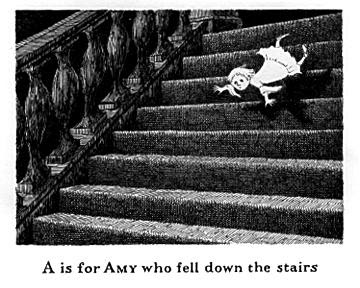
IMAGE OF THE WEEK

Page one of The Gashlycrumb Tinies, by Edward Gorey. (Image links to a sizable Gorey collection.)
Edward Gorey (1925-2000) is one of my favorite artists. His Gothic engraving style is very distinctive — Gorey’s work is almost always unmistakable — and his books and stories are frequently masterpieces of very dark comedy, of which The Gashlycrumb Tinies may be the finest example. The story is, quite simply, a series of twenty-six drawings detailing the horrible ways in which the Gashlycrumb children (one child for each letter in the alphabet) meets a dolorous end. He is also noted for the introductory animation for PBS’s Mystery series. Gorey’s work can be found in three noted collections, called Amphigorey, Amphigorey Too, and Amphigorey Also.
As a bonus image, this is what Gorey looked like.

Share This Post

Untitled Post
That horrible screaming sound you may be hearing now is your local Buffy the Vampire Slayer fan, because the Emmy nominations have been announced and Buffy only scored a couple of nominations in technical areas. As I noted a few days ago, I don’t watch Buffy, so I can’t join in the anger, but there are some other bones that need picking on this year’s Emmy’s. (Or is that “Emmies”?)
I mainly feel the need to complain about the acting nominees. The West Wing is my favorite show, but does it really deserve seven acting nominations? Dule Hill is a fine young actor, but this season was probably his least effective year on the show, mainly because he really didn’t have as much to do as he has in the show’s previous two seasons. He seemed to drop into the role vacated by Kathryn Joostyn when her character, the President’s beloved secretary Mrs. Landingham, was killed off at the end of Season Two. Now, though, Lily Tomlin is apparently going to be cast as Mrs. Landingham’s replacement, so perhaps Dule Hill’s Charlie Young will have more to do next year. Also, I have never much liked Mary Louise Parker — she seems, to me, to drawl her way through nearly every role she does with the same laconic tone. Richard Schiff (Toby Ziegler) and Allison Janney (C.J. Cregg) were excellent as always, and it was nice to see Emmy recognition for Bradley Whitford (Josh Lyman) and John Spencer (Leo McGarry). I guess what it comes down to is, even with the acting on The West Wing being as good as it is, is it really that much better than all the other acting on TV these days? On NYPD Blue, Dennis Franz and Charlotte Ross somehow managed to make believable what should have been one of the most unlikely TV romances in years. William Petersen is the core of CSI. On ER, Noah Wyle (John Carter) has executed his character’s growing maturity nearly perfectly (though his season was marred by another unbelievable romance and the greater attention paid to the departure of Anthony Edwards). And surely someone in the entire cast of Ed warrants a nomination. Ditto the cast of Scrubs — either John McGinley (whose Dr. Cox is the best new character on any show last year), or even Neil Flynn, whose psychotic janitor is just dead-on perfect. There is a ton of wonderful acting on television, and it seems a bit unfair to bunch up the nominations all for a single show (The West Wing), or to keep nominating the same people over and over again (Patricia Heaton, for example — though I violate this statement with my above mention of multiple Emmy winner Dennis Franz….).
Ah, well….the whole purpose of these award shows, as William Goldman has noted, is to give us something to talk about. There really is no “best”; just a lot of very, very fine work. Congratulations to all the nominees, and to those who deserved it.
Share This Post
Untitled Post
A Scottish music critic has collected a list of the top 100 music albums of all time. It’s a fascinating list, complete with commentary on each selection. (It’s also a testament to the awesome array of music out there that out of my slightly more than 600 CDs, I apparently own exactly three of this man’s picks.)
Share This Post
Untitled Post
The good news from the Tour de France is that Lance Armstrong has begun his usual tactic of using the mountain stages to seize first place; he assumed his first lead of this year’s Tour today and, if all goes according to plan, should begin adding to that lead as the more difficult mountain stages loom ahead.
The bad news, however, should come as no surprise to anyone who has watched coverage of the Tour on television, noting the hundreds (and sometimes thousands) of spectators that line the narrow roads traversed by the Tour and its escort vehicles. Huge numbers of spectators in reaching distance of a hundred plus bicyclists plus a number of cars, all traveling at respectable speeds, has always struck me as a recipe for potential disaster — which came to pass yesterday, when a small child was struck and killed by one of the automobiles in the Tour convoy. Apparently, something similar happened two years ago as well.