Once again the time has come to take stock, however briefly, of how thankful we are in our lives. I see that a number of large retailers who in recent years have been opening their doors for business at some point on Thanksgiving Day are actually remaining closed this time around. I like to think this is because of a realization that maybe allowing capitalism’s relentless push into one of our few holidays a year devoted to stepping back from the pursuit of Profit and Stuff (and don’t get me wrong! I love stuff! Y’all have seen pictures of my library, right?) was a bridge we shouldn’t cross, but let’s be honest here: I suspect this year’s “Let’s stay closed” brigade is more a function of tight labor and lingering supply chain issues and COVID insecurity in a country that simply won’t get to ninety percent of the population vaccinated. Still, I’ll take it. Maybe we can’t stop capitalism, but it’s a good idea to trip it up, once in a while.
As for other things I’m thankful for? Well, like everybody else, we’ve had a year of ups, downs, twists, and turns. I know we’re not alone on that score, absolutely. But we’re still here, still living, with things on the horizon that we’re greatly looking forward to (an upcoming trip has us very excited), alongside other things that we eye with trepidation (future developments for American democracy don’t seem encouraging).
So anyway, yes, I’m thankful for many things. The dogs, the cats, our house. My car, my job, my phone (yes, I love my phone!). Warm blankets and the rocking chair in my library. The fact that I have my own library. A decent kitchen with tools I know how to use. My job, also with tools I know how to use. Local parks, the public library, our favorite bakery, our favorite Chinese food joint, our favorite barbecue joint, our favorite deli. Hiking trails through the forests. Lakes: the Greats, the Fingers, and everything in between. Roads: particularly US 20A. Sirius XM radio in the car, and music services that have more hours of music available than I could hear in a dozen lifetimes. Mornings like this one: my coffee at the kitchen table, with my laptop, with only the ticking of the two clocks down here. Good movies, and not-so-good ones, too. Old cookbooks and new. British comfort teevee: The Great British Baking Show and The Repair Shop. A collection of glassware, assembled one piece at a time, because a kitchen full of matching items is kind of stodgy. Talented friends whose victories I can cheer, and smart ones in whose brilliance I can bask. Every book I’ve loved and quite a few of the ones I didn’t, because even they had things to teach me. Renaissance shirts, flannel shirts, overalls vintage and new. Blue denim overalls, Hickory striped overalls, herringbone and brown duck and black canvas overalls. ALL the overalls! The occasional pie in my face, and the friends who laughingly shove or smash them there. Friends online and offline and both. The characters in my books: Oh how they surprise me! The Daughter and The Wife, both of whom should be getting up soon, I would think.
And with that, I’ll wrap this up. I think The Dee-oh-gee is begging the next door neighbors for a cookie, and I need to get him in. He’s thankful, too.
Inside view of The Dee-oh-gee, begging for a cookie from the neighbors’ house. It’s OK, the neighbors are my parents.
Starting my ranking of all the James Bond movies (here’s the introduction to this exercise), starting at the bottom and working our way up to my favorite Bond movie of all time! Without ado, here we go:
26: LIVE AND LET DIE
This is the only Bond movie, the only one, of which I will say: “I do not like this movie.” I do not even own a copy of Live and Let Die, and any instincts I have toward completeness are insufficient to make me even want to get a copy of this movie. I find it a slow, boring mess, with unexciting action sequences, a villain’s plot that’s just dull, and for a series that is wildly problematic at times, this one ratchets all of that to 11. The attempt to have 70s-era Blaxploitation in a Bond movie now just seems racist.
Live and Let Die is a massive creative break in the series, and not just because Sean Connery finally left the role for good, yielding to Roger Moore. The creative tone, already pushed toward jokey parody in the previous Diamonds Are Forever, is now firmly in tongue-in-cheek territory, and world-threatening villains would give way for at least a couple of movies. This film makes Bond feel smaller. SPECTRE and Blofeld are gone, and Live and Let Die unfolds in a grungy 70s New York City and a fairly stereotyped New Orleans and bayou Louisiana. Our villain, Kananga, has a plot to corner the heroin market in the United States, and there’s stuff about murdering British agents, and there’s some voodoo stuff and our heroine (Jane Seymour) is a Tarot-card reading soothsayer. There is some good stuff in this movie: Yaphet Kotto as Kananga is terrific, the alligator farm sequence is neat, and Moore himself is quite good. But the rest of the movie is dull, mostly ugly to look at, and the action sequences just go on and on, and that’s before we meet Sheriff JW Pepper. This is a movie that I really don’t need to ever watch complete again; I can find my favorite scenes on YouTube and watch them in a combined ten minutes.
Oh, and Live and Let Die has a great song by Paul McCartney and Wings, and the score by George Martin is actually pretty good, bringing some funk that the movie desperately needs (this was the first Bond film not scored by John Barry). But that’s about it.
25. DIE ANOTHER DAY
The Bond series has several times in its run hit a point where it got so out of hand that the next movie was a kind of mild reset and a dialing back on the whackiness, but Die Another Day is so out of hand that even though it was a big hit at the box office, it still made the producers slam on the brakes and literally start the whole series over again at Square One with a full reboot of the franchise. Exit Pierce Brosnan, enter Daniel Craig a few years later.
But here’s the thing with Die Another Day: like all of Brosnan’s movies after GoldenEye, this one actually starts out pretty interestingly and actually has some good ideas. In fact, when you really look at Daniel Craig’s much more highly-regarded run of films and compare them to Brosnan’s, you may see how many ideas in the Craig films are actually much better executions of ideas already tried in the Brosnan ones. It’s like the main writers (Neal Purvis and Robert Wade) saw their chance when they got to the series reboot to revisit their favorite ideas without the baggage of the tried-and-true (and increasingly tired) Bond formula.
Yes, Die Another Day starts out very well indeed. But somewhere in the second act it goes completely off the rails. For me it’s when the film’s villain, whom we’ve already met as a North Korean military officer, has been changed via extensive plastic surgery into a British white guy. Or when Q presents Bond with his invisible car. Or when Bond parasails away from a collapsing glacier. Or when Bond and a bad guy have a high-speed chase through a giant building made of ice. Or…look, Die Another Day just goes off the rails entirely. Brosnan does what he can, and I love the movie’s gritty opening and its conceit of Bond being damaged goods who has to earn his way back into MI6’s good graces, but after a promising Act One, Die Another Day is an over-the-top mess.
The song by Madonna is an unpleasant listen by itself, but it actually works very well with the visuals of the title sequence, during which Bond–having been captured by the North Koreans at the end of the pre-credits sequence–is being tortured. David Arnold’s score is good, but it doesn’t really break a whole lot of new ground. One notable cue at the end, during the film’s coda, is actually a reworking of a cue from the previous film! Alas.
24. THE SPY WHO LOVED ME
Remember my method here: I ask myself, “If I’m channel-flipping and I happen across this movie, am I going to want to sit and watch the whole thing?” Many people rank The Spy Who Loved Me very highly, but for me it’s mostly slow and dull, with a villain whose demeanor is so understated as to be soporific, a terrible score, a heroine who is supposed to be Bond’s female KGB equal but who still spends the entire climax in true damsel-in-distress fashion tied to a chair.
Also, the movie’s plot is a complete retread of You Only Live Twice from ten years earlier. In YOLT, the bad guys hijack American and Russian space capsules to trigger a nuclear war between the US and the Soviet Union. In TSWLM, the bad guys hijack American and Russian submarines to trigger a nuclear–well, you get the idea. But first we have a long sequence in Egypt (no doubt a location selected for topicality reasons, as the Treasures of King Tut were on tour at the time) involving a submarine tracking system that goes nowhere (literally: once Bond and Agent XXX recover it, they discover that it’s useless). An evil henchman named Jaws shows up and is kind of menacing, but his attacks are mostly played more for laughs than menace. And…well, again, for me TSWLM commits the sad sin of being boring. The Egypt sequence goes on and on. An underwater sequence goes on and on. The final battle drags on and on. The climax drags on and on. The final confrontation between Bond and the villain is one of the worst in the entire series.
When I watch a Bond movie, this is never the one that I reach for, except to say, once a decade or so, that maybe I owe it a rewatch. Then I invariably rediscover why I never rewatch it.
Carly Simon’s “Nobody Does It Better” is a classic, even if I don’t think it’s really all that great (Simon’s own “Let the River Run” from Working Girl is a better movie song, for my money), and the disco score by Marvin Hamlisch just grates on my nerves. I do not like it.
ASIDE: Referring to the films by the name of the person playing Bond is a useful means of differentiating one sequence of films from another, but for me this should never be interpreted as a sleight or as an endorsement of a particular Bond actor! I’ve liked every Bond thus far, and when I note that on balance I think Pierce Brosnan’s era is the most lackluster, that is no statement at all on Mr. Brosnan. I bring this up now because we’re three movies into my ranking and I’ve already singled out two Roger Moore movies. I love Roger Moore!
23. GOLDFINGER
OK, this may get me some strange looks! Goldfinger is a classic, after all! It’s beloved! It’s the one that everybody knows! Roger Ebert even cited it for his “Great Movies” series! Goldfinger set the tone! Goldfinger had that car! Goldfinger had that gloriously wonderful exchange between Bond and villain:
BOND: Do you expect me to talk?
GOLDFINGER: No, Mr. Bond, I expect you to die!
So how can I rank Goldfinger this low? Well…sorry, but setting aside some issues I have with it on location grounds (the plot is to attack Fort Knox, so obviously part of the movie has to take place in Kentucky, but do we have to see a Kentucky Fried Chicken in the background of a James Bond movie?!), I have a whole damn lot of narrative issues with Goldfinger.
Sure, the Aston Martin DB 5 is an iconic Bond car, but look at that chase through Goldfinger’s factory complex: Bond is holding his own until he sees headlights coming right at him and he pulls aside, crashing the car. It turns out that there was a mirror there! The headlights were his own! Now, does that make any sense at all? “Hey, if a foreign agent is ever driving through here at night, we’ll hang a mirror here to foil him!” It’s utterly bizarre.
Or the scene where Goldfinger brings all his hoodlum financiers in so he can use his big scale model of Fort Knox to show them his plan. Bond manages to overhear this, and he writes a note to Felix Leiter and wraps it around a homing device and slips it into the pocket of one of the gangsters who is leaving. Meanwhile, Goldfinger kills all the other gangsters! Why did he bother explaining the plot to them, then?
Bond’s note? It never makes it to Leiter because Goldfinger has that gangster killed, too! And crushed in a junkyard, so that he later has to have someone extract the gold he paid to the guy from the crushed vehicle! Why not just have Odd Job drive that guy someplace, shoot him, and dump the body?
And then later on, Leiter and friends arrive to foil Goldfinger’s plot. Why? Because Bond, in a very cringey scene, forced himself on Pussy Galore and she apparently rats out Goldfinger to the Feds. Huh?
And even the big climax, with Bond fighting Oddjob in the vault while the nuke’s timer ticks down. Bond doesn’t even defuse the bomb–some other dude shows up and does it. So if you think about it, Bond could have just sat down, done nothing whatsoever, and still ended up winning. Bond’s fight with Oddjob? This has no effect on how the movie turns out at all. Sure, it’s a cool fight, one of those Bondian chess-match fights, but in story terms it accomplishes nothing at all. If Bond had just sat down, the folks outside would have opened the vault, streamed in, shot Oddjob dead, and then defused the bomb anyway.
Ultimately, in Goldfinger, we get what I consider unforgiveable in a Bond movie: a story in which James Bond is simply irrelevant. Nothing that happens in the movie is a result of anything Bond does. So no, I don’t like Goldfinger much. Sorry!
Goldfinger‘s song, by Shirley Bassey, is a total classic. So is John Barry’s score. If nothing else, this movie is musically top-notch.
22. DIAMONDS ARE FOREVER
Our second Connery film. This was Connery’s last “official” Bond film; he returned to the role after George Lazenby’s On Her Majesty’s Secret Service, presumably because the producers backed several Brink’s trucks up to his house. Diamonds also marks the end of the unofficial “Blofeld Saga” that comprises all of the first Bond movies except for Goldfinger, though SPECTRE is never mentioned in the movie, just Blofeld.
I enjoy Diamonds for a number of reasons, but it belongs down here for others. Connery obviously has zero investment in what he’s doing here; he doesn’t seem precisely bored, the way he does in Thunderball, but he is phoning it in. Also, the movie is a terrible sequel to OHMSS, completely ignoring the emotional state of affairs at the end of that film. We see Bond hunting Blofeld, but he might as well be hunting down any old villain.
Diamonds also starts the entire series down the direction of self-parody and winking at the audience that many blame on Roger Moore. Here you have all manner of goofiness, from Blofeld in drag to old stand-up comedians to Jimmy Dean–yes, the sausage guy–playing a reclusive billionaire a la Howard Hughes. (Weirdly, Dean is actually pretty good in the role!)
Diamonds isn’t bad, I must admit! Large parts of it are fun and watchable. Jill St John’s Tiffany Case is an interesting crusty American Bond heroine for two-thirds of the movie (the final act makes her into an idiot, which frustrates), and Charles Gray provides yet another interesting take on Ernst Stavro Blofeld. The scene where Bond climbs the outside of the hotel to reach the penthouse, discovering Blofeld, is a very good scene indeed, and the henchmen murderers Wint and Kidd are two of the series’s better henchmen murderers. Too bad the movie has a lot of bumbling action sequences that go on too long, a climactic battle that is just plain bad, and it bugs me to no end that the emotional tone of this movie completely clashes with that of the film to which it is a direct sequel. Imagine if Star Trek III had been the “comedy” Trek movie, right after Spock’s death. That’s what this one feels like.
Oh, and a great song and score by John Barry! Shirley Bassey returns, becoming the first artist to do two Bond title songs.
21. A VIEW TO A KILL
I have a real soft spot for this movie, OK? I can’t hate it. But I can’t really argue against the points its detractors make. It’s overlong, Roger Moore is visibly too old for the action-star thing, the age difference between him and Tanya Roberts is way too noticeable (I’ve read that Roger Moore really started thinking he was too old for Bond when he met the mother of the current “Bond girl” on set and he was older than she was), there are way too many “sacrificial lamb” deaths (the stereotypical French detective, Sir Godfrey, Bond’s CIA contact, a Russian agent), the visual effects occasionally stand out like a sore thumb, and the plot is a rehash of Goldfinger with computer chips instead of gold.
I like the convoluted plot, though: the Brits are working on a computer chip that will resist an electromagnetic pulse from space, but they discovered that the KGB is in on their work, so they investigate the guy who owns the chip factory, Max Zorin, who just happens to be into horse racing. While investigating, Bond discovers that Zorin cheats at horseracing with the assistance of an old Nazi doctor who did experiments in genetic engineering, and that Zorin has some weird plot going in which he’s hoarding computer chips. And he’s also trying to strong-arm some young geologist named Stacy Sutton into selling her company, and so on. It turns out that he’s going to trigger an earthquake that destroys Silicon Valley, making him the richest chip maker ever.
That’s a fun Bond plot, and there’s some entertaining stuff that happens along the way. And yes, it all goes on way too long and poor Tanya Roberts just stands around screaming “James!” for much of the last third of the flick. But there’s a lot of fun 80s cheese along the way.
I don’t know, I just enjoy this one. What are you gonna do. But I also don’t expend a great deal of effort defending this one, either.
Song: Duran Duran. It’s a mixed bag for me, as the lyrics make no sense. John Barry turns in another fun score, though it’s clear that he’s increasingly on auto-pilot here.
(Re-upping this one after a discussion of Stephen King on Twitter, and specifically this book, made me remember this post!)
One odd bit of Star Trek lore that I didn’t know about until I read one of William Shatner’s Star Trek Memories books is that, during the 1980s when the Trek movie series was in “another sequel every two years” mode, Gene Roddenberry had a pet idea that he kept trying to get Paramount to adopt for whatever the next movie happened to be. This notion had the Klingons taking over the galaxy by going back in time to Earth in 1963, and preventing President Kennedy’s assassination. In order to fix things, Kirk and company have to go back as well and make sure that JFK dies like he’s supposed to; according to this site, Spock himself is the shooter behind the grassy knoll. I’m not sure how that would have gone over – frankly, it sounds a bit dour and depressing. That worked in the episode “The City on the Edge of Forever”, when Kirk had to stand by and allow a woman with whom he’d fallen in love to die in order to preserve history, but this story, if what Roddenberry truly had in mind, somehow crosses a line. Maybe it’s by having Spock actually kill JFK. I’m glad that movie never got made.
There’s always been something compelling about the JFK assassination to alternate history types and time-travel writers. I think there’s a definite sense to JFK’s murder as one of those singular events in history that neatly separates what came before it from what came after, and as with all such moments, there’s a definite feeling that if the event could be changed, what came after would change, too – mainly for the better, I think the argument goes. Certainly the general opinion seems to hold that had JFK not died in Dallas, but gone on to reelection and a second term, the 1960s might not have been as turbulent as they turned out, with Vietnam possibly not escalating as it did, with civil rights possibly having an easier road to passage, and so on. Obviously there is no way to evaluate such beliefs, but the closest we’re able to come to doing so lies in the power of fiction.
(I wonder if 9-11-01 is going to replace the JFK assassination in the public mind as the most recent ‘focal point in time’. After all, the events of 11-22-1963 happened almost 50 years ago, well before the lifetimes of most Americans living today. I wonder if there will be time travel stories involving time travelers showing up at Logan Airport to prevent the boarding of Mohammad Atta and friends….)
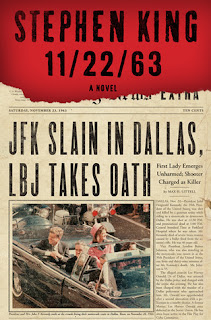
This brings me to Stephen King’s latest novel, 11-22-63. This is a time-travel story, in which a man from our time travels back with the intention of preventing the Kennedy assassination.
Jake Epping is a teacher whose marriage has just ended and who is apparently emotionally damaged in some way: he tells us up front that he simply does not cry, no matter what happens. Jake never cries, he tells us (the book is in first person, from Jake’s point-of-view), and he is haunted by the various injustices of history, such as the janitor who takes his adult education course and whose term essay smacks Jake between the eyes with a first sentence that refers to when the janitor’s dad ‘murdirt my mother and two brothers and hurt me bad’. This haunts Jake, and it’s all he can think of – even as his friend Al, who owns the local diner and who is going to die very soon of cancer, tells him of his own little secret.
In the basement of the diner is a gateway through time. Walk through it, and you emerge outside a factory in Lisbon Falls, Maine, on September 9, 1958. Walk back through, and you’re back in 2011 – exactly two minutes later than when you left. And if you go back in time again, no matter how long you’ve waited to do so, you go back to that exact same moment on September 9, 1958 – which means that any changes you have made to the past are now reset.
This limiting of the time travel possibilities is one of the masterstrokes of King’s novel. There’s no ‘setting a date and then hitting 88 mph’, no ‘slingshotting your starship around the sun’. You can only go back in time to a single place, to a single time, and you can only return to a single place, to a single time. And if you are ambitious enough – as Jake soon will be – to try and change history, if you want your changes to be permanent, you can never go back again. And if, like Jake, you decide that you’re going to try and keep JFK from being killed, that means that you can go back…and then you have to spend five years living there in the past until that fateful day. November 22, 1963.
King seems less interested in the various paradoxes of time travel stories, many of which have become clichees, than he seems to be in history as a force in itself. As he makes his life in the past, Jake – now going by the alias ‘George Amberson’ – frequently discovers ways that the past seems to be trying to right itself even as he messes with things. “The past harmonizes”, he tells us, again and again, and as the book goes on, the level of uncertainty involved in Jake’s self-appointed mission grows and grows and grows. Jake has to try and figure out if Lee Harvey Oswald was part of some kind of conspiracy, or if he acted alone; he has to try and decide if he should intercede earlier or later. He takes a ‘dry run’ early on, interceding on his janitor friend’s behalf when his father shows up to kill his family, and in such ways Jake discovers things about killing – even justified killing – that are troubling.
This is not a scary novel, but it is a haunting one. King masterfully keeps us aware of the onward march of time, so that the date of the title never really fades from memory, even as Jake is living out the five years he has to live out in the past, making a life for himself in a small town in Texas where he makes friends with local teachers and, in the ultimate complication, falls in love. Still, through all this there is a constant sense of growing doom, the constant ticking of King’s time bomb growing ever more and more insistent. Will he stop Oswald? If so, how? And will it matter in the end?
The time travel aspects of the story are, initially, pretty benign in nature, and we learn that Al is using the time portal to buy ground beef at 1958 prices, which enables him to sell his burgers in his diner for significantly cheaper than anyone else can manage. Jake discovers, though, that the past has ways of resisting change, and although King never really spells out much of the mechanism behind that sort of thing, it soon becomes clear that the bigger the change one is trying to make in history, the harsher the resistance one will meet.
11/22/63 is a thrilling King page-turner, loaded with emotional resonance, King’s keen eye for detail, and a bittersweet ending that is satisfying but not in an expected way. Parts of the book read as if Stephen King had written a mash-up of Back to the Future and Oliver Stone’s JFK. In other parts, though, the feel is pure King – especially in one section, taking place in Derry, Maine, where events bring Jake Epping into contact with two of the kids from IT. King is best at suggesting dark forces at work that we cannot understand – or perhaps I should say, forces that we cannot understand whose goals and priorities do not align with ours. Is history something we influence, or is it a force all to its own? 11/22/63 explores that question, even if it may not have a definitive answer.
(One final note: Throughout the book, Jake notes that ‘the past harmonizes’ – which means, history has a way of making things even out, of settling the books. A lot of times, what we call coincidence is this ‘harmonizing of the past’. Well, maybe fiction harmonizes, too; there’s a point in the book that actually features a pie fight. I read that just a day or two before my own pieing last week. How’s that for synchronicity!)
Some weeks I expend effort to engage my curiosity and find a work that I’ve never heard before and try to craft a good essay about a piece that’s new to me.
Other weeks, I figure that old favorites exist for a reason and sometimes that reason is to just throw an old favorite up here and say, “Here, listen to this. Enjoy!”
It’s one of the latter weeks. Lots going on! Much to do! But still…make room for music, would you?
Here’s the Overture to Prince Igor, by Alexander Borodin.
It’s only natural that with the arrival of a new James Bond movie, the eternal cottage industry of ranking all of the movies up to that point revs up production again. I’ve seen a whole lot of these articles popping up the last month or two, and as I start writing this I’m listening to a podcast that is generating a ranked list of the Bond films via a “draft” like a sports draft. That particular podcast is taking its sweet time: two episodes, each of which is more than four hours long! So we have a group of people taking around three or four entire Bond movies’ worth of time to rank all the Bond movies. This is serious stuff, folks!
Now, every ranking out there is going to feel deeply, deeply wrong to most other Bond fans, so it’s never worth ripping them too much…but there was one that I ran across that I’m not going to link here, but I did link it on Facebook with a “Wow, get a load of how awful this Bond ranking is!” comment, because if there’s one thing Facebook is good for, it’s ranting to a small pre-selected audience about the stuff that you, and only you, care about. But of course in the comments there, someone asked me the very obvious question:
“Well, Kelly, where’s YOUR official ranking of the Bond movies, for comparison?”
And wouldn’t you know it, I had no response. I wrote about all of the Bond movies way back in the early days of Byzantium’s Shores (it was one of the first things I did that got me any traffic), but I don’t recall ever actually generating a full ranking of all the movies. If I did, it was a while ago, and anyway, such rankings are sure to change as new movies arrive and as old ones either rise or fall depending on evolving tastes. So if there IS an old ranking that I did someplace, ignore it. This is the one.
For now.
The thing with James Bond is that he’s been around forever. They’ve been making these movies for nearly sixty years now, and the character predates the movies by a full decade. Bond has shifted with the times, many times over, and in this series of 25 movies (plus one–more on that later), we’ve seen vastly different styles of story, of storytelling, and even of genre, when the stories have not just veered close to the line of science fiction but actually crossed over it. This also explains why the rankings are always so wildly different: That many movies made over that many years are going to hit individual tastes in individual ways.
Nevertheless, my ranking is Right and Correct and will stand for all time. Until I revise it. And if you disagree, well…I’m sure you’ve been wrong before!
So, thus we begin with a full ranking of all of the official James Bond movies, plus the one unofficial film, 1983’s Never Say Never Again. I include this one because its existence is interesting to me. I do not include the 1967 Casino Royale spoof/parody/pastiche film, because I haven’t seen it and I don’t really plan to do so any time soon. This will probably span a number of posts, because this will get long-winded. I mean, we’re THIS far in and I haven’t actually ranked a single movie yet!
Also, some movies will get a longer capsule review in this series than others, because of factors like how I feel about certain films, what time of day I write these posts, and so on.
Before we get going, if anyone wants to know my personal history with James Bond, I wrote about that a bit here. Short version: I first encountered James Bond via Moonraker when it came out in 1979; I was 7 going on 8 and I have been a fan ever since. While I missed For Your Eyes Only in the theaters, starting with Octopussy I have seen every single Bond film since in the original theatrical run. Anyone passingly familiar with opinions I’ve shared online many times over the years won’t find my final destination in this series a surprise; I will basically corner strangers on the street to wax poetic about On Her Majesty’s Secret Service. But I hope there are a few surprises in getting to that point!
And one more proviso: with exactly one exception, I really do like each James Bond movie ever, on some level. Every one of them is watchable, I’ve seen every one of them multiple times (some of them dozens of times), and I’m likely to watch them all a few times more as the years continue marching by. Movies ranked toward the bottom are movies that I am unlikely to choose when I say “I’m in the mood for a James Bond movie”, or they’re movies I’m as likely as not to skip if I happen across them while clicking the remote. If it sounds like I’m ripping on some particular films, well…
Every Bond movie is almost certainly someone’s favorite, and every Bond movie is someone’s virginal Bond, the one they saw that made them a fan. So if I cast aspersions on your particular First Bond, well…I’m sure you’ll have things to say about mine.
Back in the 90s, The Gap (along with everyone else) made some really nice overalls. I still have some from that period, and they are now officially Vintage.
Maybe you wouldn’t have expected it, but Gap’s overalls from that period were actually pretty well made. They used denim of decent thickness and good quality hardware in the buckles (cheap buckles breaking is a thing, unfortunately), and they included standard details like hammer loops and side pockets on the legs. The bib pockets are large and functional, even if I generally don’t tend to keep things in my bib pocket. These are some favorite overalls of mine, so I have a saved search for them on eBay, if I ever spot pairs at decent prices. As time goes by the ones I like, in my size, show up less and less frequently, and the prices are higher and higher, but you never know. So I keep an eye out.
And then a listing caught my eye, and I couldn’t believe it. I had no idea, but back then Gap didn’t just make those overalls in blue denim; they had Hickory-striped pairs too! This I never knew. Hickory stripes have always been the also-ran in the overalls department, but I love the way they look. (Hey, Carhartt! You make Hickory striped overalls for women, so get a men’s version out there!) So I anguished a bit over these when the listing popped up, because the seller wanted a little more than I really wanted to pay, and because they are one size bigger than I really want. (I am not as big as I used to be, and I continue heading in the right direction: just yesterday I had a doctor visit that confirmed I’ve ditched eight pounds since my last visit several months ago. Huzzah!)
Ultimately I concluded that I couldn’t pass these up, so I grabbed them with the thought that I’ll just make sure to wear them under multiple layers. Especially multiple poofy layers. Like, a mock turtleneck and a nice warm sweater.
By the way, it continues to be obvious to me that a greyhound is an outstanding fashion accessory.
Here’s something weird: a cosmic-rock power ballad by a brother-sister duo known more for their soft-rock love songs, which is actually a cover of a song by a Canadian band named for the hero of one of the most famous pre-Star Wars science fiction movies. Intrigued? Naturally!
This began the other day whilst The Wife and I were driving around doing errands. We have Sirius XM in her car, and we usually tune to one of several classic rock stations, a 70s station, and an 80s station, depending on what’s on where. (The Wife, not being a fan of The Doors, is likely to change the station if they come on. Ditto me for various other groups that don’t trip my trigger.) On this particular morning we were on the 70s station, which in turn on Saturdays will play old episodes of Casey Kasem’s American Top 40.
This is always an entertaining listen. It’s an obvious time capsule, a very specific snapshot of the state of pop and rock in a single week, usually around 40 years ago. You get to hear Casem say things like “Rising up the charts this week is the newest song from that hit machine, the Steve Miller Band!” or “Still holding their place atop the Albums charts, it’s Fleetwood Mac with Rumours, now at week number 20 in the top spot!” It’s fun to remember that the hits that are now the indelible soundtrack of decades of our lives were once vibrant new songs that were still being heard for the first time.
But also fascinating are the songs that hit the Top 40 back then, hung around for a while, and then disappeared back into the rockiferous aether; songs that aren’t remembered except by superfans of these particular artists, or if it’s an artist that only had that one hit, might even be virtually forgotten today. We joke about “one hit wonders” all the time, but for every one-hit wonder we remember–Norman Greenbaum’s “Spirit In The Sky”, or maybe “Build Me Up Buttercup” by The Foundations–there are probably a dozen one-hit wonders whose hits aren’t remembered much at all. It’s nice to listen to the old American Top 40 shows and be reminded of these once-vital, once-new songs that only had one moment in time.
There’s yet another category of song you hear on old Top 40 broadcasts, though: hits by groups we know and remember for other, bigger hits, but which now are pretty obscure, having retreated from their original hit status to the hallowed title of “deep cuts”. This is one of those. I had never ever ever heard this song before I heard it the other day, and it’s just so, so weird!
The song? It’s by The Carpenters, that duo known for “Top of the World” and others, and who are heard each year on all the Christmas stations (their wonderful rendition of “Have Yourself a Merry Little Christmas” would be nearly perfect if it didn’t use the wrong lyrics, but more on that in December). This song is called “Calling Occupants of Interplanetary Craft (The Recognized Anthem of World Contact Day)”.
If you’re used to The Carpenters’ general sound of guitars and a soft drum, this is a bit mind-blowing as it includes a full rock band, a chorus doing background vocals, and a full orchestra. This is one of those big 70s tracks with oddly-long running time, an intro from a fake radio station broadcast in which aliens call a radio stations to make a request, and a very dense sound courtesy some obviously-intense work by the sound engineers.
“Calling Occupants” was a cover, though. It was written and recorded first in 1976 by a Canadian band called Klaatu. I’ve heard of this band, but I honestly couldn’t tell you when I’ve heard their work, or what of their work I’ve heard. They were around for a while (1973 to 1982, with several reunions since then), and according to Wikipedia, they were even occasionally called “The Canadian Beatles”. Ha! Suck it, Rush! (Unfair, I guess, since Rush was probably the Canadian Led Zeppelin.)
Klaatu was named for the hero of the great 1950s sci-fi thriller The Day The Earth Stood Still; Klaatu is the alien visitor who comes to basically tell humans to cut the shit regarding nuclear armaments. (He also has a robot guardian who, once unleashed, can only be commanded to stand down via the world “Klaatu barada nikto”.)
“Calling Occupants of Interplanetary Craft” is obviously rooted in 70s-era UFO mysticism, in which our putative alien visitors were seen as wise and enlightened beings of higher consciousness. Looking back at UFO culture of that period it’s pretty easy to see the influence of certain consciousness-altering substances of horticultural origin, but from this vantage point there’s a rather endearing innocence to it all. This song obviously comes from the same headspace that informs the most enduring classic from this particular subculture, Steven Spielberg’s great 1977 film Close Encounters of the Third Kind (and, to a lesser extent, his ET: The Extra-Terrestrial five years later). The era was rife with this sort of thing, though: for more “the aliens are benevolent beings”, see Escape to Witch Mountain, or a little-seen movie called Earthbound! For non-UFO related “heightened consciousness” stuff, many people my age might remember an after-school special or a book called The Amazing Cosmic Awareness of Duffy Moon.
All of this is precursor to the various kinds of “New Age” thinking that would later blend UFO lore with all manner of mysticism and parapsychology stuff. It’s all fun to think about and these ways of thinking definitely led to pop culture artifacts that are invariably fascinating to behold, many of which still influence the creative work of my generation (including me–look at all the “mystical powers of dodecahedrons” in my Forgotten Stars books!). So here are The Carpenters, with “Calling Occupants of Planetary Craft”. Sit back, turn the lights down, light a candle (or something else–ahem), and enjoy!
My workplace continues to move into the 21st century, this time by replacing the old pole lights in the parking lot with LED fixtures. White light replaces harsh amber. It’s quite a change.
LED pole light.
Share This Post
ForgottenStars.net
The official site of Kelly Sedinger: Reader, writer, photographer, and dreamer