
Speaking of Albums: “Frank Sinatra Sings For Only the Lonely”

Each place I go, only the lonely go
Some little small cafe
The songs I know, only the lonely know
Each melody recalls a love that used to be.

Look, for the purposes of this post, let’s just stipulate that there’s no way I’ve heard every single Frank Sinatra album, and therefore I cannot really justify having an anointed favorite Frank Sinatra album, OK? Let’s just talk about my favorite Frank Sinatra album: Frank Sinatra Sings for Only the Lonely.

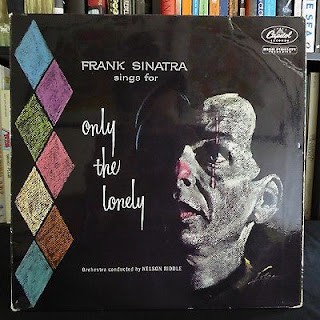
This album is a masterpiece of mood. It starts with that cover. There’s no cheerful Frank Sinatra with his crisp suit and his hat just-askew; here we see Sinatra as a sad clown, with the colored checked pattern of a Harlequin figure to the other side.

The album is a collection of torch songs, and what torches they are. This is the music of lonely ex-lovers, walking through foggy streets at night only occasionally illuminated by the light of a blinking streetlight as they pass beneath it. Maybe there’s rain, but not a soaking rain, just a constant drizzle that somehow soaks through no matter how many layers you wear.

This is the music of men whose only sartorial concession to their emotional state and the time it happens to be is a loosening of the neckties of their suitably dark suits. This is the music of cigarettes and glasses of Scotch into which too much ice has melted. This is the music of men who don’t want to go home because the person they were going home to isn’t there anymore, or because that was their home and now they don’t even have that.

Frank Sinatra’s voice was an amazing instrument, but I believe that his biggest gift was his unfailing instinct to find the emotional center point in any song. So many of the songs he recorded have an aspect of story, a sense of conveying things that actually happened, and when Sinatra was really on, you never had any other feeling than that he was the fellow to whom these things happened. So in Frank Sinatra Sings For Only the Lonely, he’s not singing words about loneliness. He is performing songs of loneliness. There’s a difference.

Sinatra and his collaborator, Nelson Riddle, who wrote the song arrangements for the album and conducted the orchestra, had both suffered personal losses as they adopted this project, but as always with Sinatra, it barely seems to matter, so completely does he always enter the content of a song.

Hey drink up, all you people!
Order anything you see.
Have fun, you happy people–
The drink and the laugh’s on me.

I try to think that love’s not around
Still it’s uncomfortably near;
My old heart ain’t gaining any ground,
Because my angel eyes ain’t here.

This album doesn’t sound like it should work. It’s an entire album of a single mood, an entire album of very little variation in tempo. Sometimes Sinatra keeps his register and mood subdued, but other times he does that wonderful “Frank” thing where he lets his voice climb into his almost operatic sound. Aside from that, though, the general tone of Frank Sinatra Sings for Only the Lonely stays steady throughout: slow songs of lost or unrequited love.

I first discovered this album in the late 1990s, when I “rediscovered” Frank Sinatra. He had been a staple of my house growing up; he’s one of the first singers I remember (more on that another time), along with John Denver and Bing Crosby. But you do have to discover things for yourself, don’t you? At some point you have to listen anew to the music you already knew for years and realize, all on your own, just how good it is. That’s what happened with me and Frank Sinatra. (I try not to feel too guilty about the fact that within months of me buying my first Sinatra album of my own, he died. Ouch.)

I listened to Frank Sinatra Sings for Only the Lonely a number of times when I was driving home from my job in Jamestown, NY. My commute during the year and a half I worked that job was about an hour long. It made for long days, but the commute home gave me ample time to get the day out of my system, and I listened to a lot of good music on that commute. (This is also when I discovered that I am not the least bit good at listening to audio books, but that’s a thing for another day.) Some albums worked well any time, but there were some that really lent themselves to the night time drive, when it was just me and my headlights on rural Interstate 86 in New York’s Southern Tier. Frank Sinatra Sings for Only the Lonely was one of the best for this…especially when the album’s last song rolls around.

“One For My Baby” is really the only song that can end an album like this, isn’t it? Is there a song whose mood, whose sense of place, is more perfectly evoked by its tempo, those sad tinkling piano chords that open it, and Sinatra’s opening words? I can see the dim light reflected in the backbar mirror, the guy mopping in the corners, the bartender barely listening to this one last gin-filled drunk as he washes those last glasses and eyes the not-quite-adequate couple of bills the guy has been weighing down with his ashtray. Frank Sinatra’s gift for musical storytelling was one of the greatest ever, and he almost never put his gift to better use than this song, right here, as he closes his greatest album with the anthem of the drunken loveless whose barkeep has said, “Last call.”

It’s quarter to three.
There’s no one in the place,
‘cept you and me.
So, set ’em up, Joe;
I got a little story I think you should know.

We’re drinkin, my friend,
to the end of a brief episode.
Make it one for my baby…
and one more for the road.

(cover image credit)

Share This Post

Happy Birthday to the Maker!

 Happy birthday to George Lucas!

Happy birthday George Lucas! #StarWars #GeorgeLucas

It’s no accident, or exaggeration, when I say that George Lucas is the biggest influence on my storytelling. Star Wars imprinted on me at a very young age, and it is still my guiding star, even with all the other influences that I’ve blended (and, let’s be honest, pillaged and stolen from).

I’ve gone so far as to dedicate The Savior Worlds to Mr. Lucas. In terms of the stories that are in my heart, I may not owe him all of them, but I owe him a whole damn lot of them.

Thank you, Uncle George!

The dedication page for THE SAVIOR WORLDS. I would not be the storyteller I am today without George Lucas's work. It's just that simple. #HappyBirthdayGeorgeLucas #StarWars

Share This Post

Something for Thursday

 I’ve made it one of my many missions in life to sing the praises of the United States Marine Band, because they’re great, but let’s not forget the other armed services! The United States Army Band is also really good. Here they are, playing the theme from The Mandalorian.

I love those recorders at the beginning! The recorder is often a first musical instrument for kids (I had one!), so it’s easy to forget that the recorder is a serious instrument capable of serious musicmaking.

Share This Post

Tone Poem Tuesday


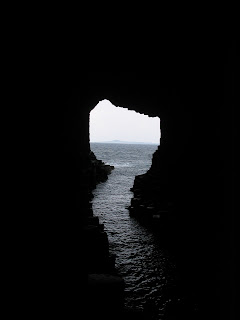
A repeat today (I think), but it’s been a while (I hope). Felix Mendelssohn’s The Hebrides is a concert overture, inspired by the composer’s journeys in Scotland and specifically his tour of the Hebrides islands and a basalt cavern called “Fingal’s Cave”, which is a place that would absolutely appeal to someone of Romantic mindset. The black basalt, the sharp columns, the waves of the sea…in Mendelssohn’s hands, all that became this wonderfully brooding and Romantic work of adventure and heart.

Here is The Hebrides by Felix Mendelssohn.

Share This Post

The Strooping of the Waffles! (Or is it the Waffling of the Stroop?)

 So, like many others in this COVID hellscape, the search for entertainment of a more cheerful kind, to take our minds off the dystopian virus-afflicted nightmare world in which we live, has led us to The Great British Baking Show. (Yes, I know that the BBC’s actual title for the show is The Great British Bake Off, but I live in America where Pillsbury has a trademark on the term “Bake Off” so the show has to be called something else, because heaven forbid we get in the way of somebody’s ability to make a buck while doing nothing at all, so Great British Baking Show it is for capitalism-addicted America.) I can, and might, wax poetic about the show at some point in the future, as we’ve now watched five seasons of it on Netflix, but for right now, I’m just going to talk about one item.

If you haven’t watched the show, it’s a cooking competition of the “Start with a dozen folks, make them cook stuff, judge them and eliminate one each week until you’ve got a champion” variety. It’s a lot more cheerful and kind-hearted than, say, Hell’s Kitchen, which is nice. The format each week is the same: the bakers are given three challenges, the second of which is a “technical” challenge in which they are instructed to bake something they may or may not have made before, which tests specific technical skills, and for which they are given a recipe with many key details left out. They are given the ingredients they need, and the first step might be “Make a dough with the ingredients.” That sort of thing.

One week, the technical challenge was to make Stroopwafel cookies (“biscuits” in British lingo). These are some of my favorite cookies (“biscuits” in British lingo). They’re a thin sandwich cookie (“biscuit” in British lingo), consisting of two waffles with some caramel syrup in the middle. I always figured they were made using two separate waffle cookies (“biscuits” in British lingo), but when the GBBO folks made them, it turned out that they only make one waffle for each Stroopwafel, and then they actually have to cut it laterally into two waffles, which are then used to make the sandwich! This takes some knife skills that I will admit that I do not have, and neither did some of the GBBO bakers, which is what made the Stroopwafel a good challenge.

Of course, the process for making Stroopwafels has been mechanized for scale, as it would have to be, since you can buy Stroopwafels in just about any grocery store these days. I found a video of the process, from the bakery attendant scooping dough into the machine to its final emergence as a complete cookie (“biscuit” in British lingo). I had to watch this video five or six times before I finally spotted the point at which the waffles are sliced laterally across their width. Let me know if you figure it out sooner! (Actually, don’t let me know, because then I’ll feel dumb.)

By the way, Stroopwafels go wonderfully with coffee (and, likely, tea). They make small ones, about the size of a silver dollar, but if you get the full-size ones, about four inches across, you can actually sit them atop your mug so they absorb some of the radiant heat energy from your hot beverage. The caramel gets all soft and the waffle takes on the heat and…well, that’s just a great cookie (“biscuit” in British lingo).

And also by the way, what do British people call the thing that Americans call biscuits, the salty buttery glob of wondrous flakeyness that pairs so beautifully with fried chicken? Just wondering….

Share This Post

Something for Thursday

 It’s fun to look up live performances of anime music on YouTube, because Japan takes this stuff very seriously but also does a lot of interesting stuff with this sort of thing. If you want just standard orchestral renditions, you can find that…but if you want to hear your favorite anime theme played by an orchestra and a marching band as it marches through a stadium, you can find that, too!

Here’s a concert performance of Joe Hisaishi’s main themes from Laputa: Castle in the Sky. This one is somewhere in the middle in terms of how flashy it is. I love this music and I’d love to hear one of these concerts one day!

Share This Post

Tone Poem Tuesday

The sky is beginning to show some streaks of light over in the East there, behind our mount’in. The morning star always gets wonderful bright the minute before it has to go,–doesn’t it?

-Stage Manager, Our Town (Act I) 

It seems a little strange to me that at this point in my life, as I’m six months away from turning fifty, that as ubiquitous as it is on amateur and school stages throughout the country, I have only seen the play Our Town produced exactly once.

It was in 1981 or 1982, thereabouts, when I was in fifth grade. The theater club at St. Bonaventure University, where my father was in second year of teaching, put it on, and that year my father was sharing an office with a guy who was very much involved with the theater, and who actually played the Stage Manager part in that production. I remember finding it an odd play at first: There were virtually no props, aside from the costumes. When one of the characters is supposedly in her kitchen making breakfast on May 7, 1901, she was pantomiming things like frying bacon and pouring milk from a pitcher. Later on, two high school sweethearts who live next door to one another are talking through their windows at night; this is done via two step ladders, which are placed side by side. And when the play’s final scene, set in the graveyard, rolls around, there’s just some chairs on stage. No stones, no backdrop other than the backstage curtain.

Ten-year-old me figured this was all because the college theater troupe couldn’t afford props and decided to do the play as best they could. I didn’t realize that this was quite deliberate on the part of playwright Thornton Wilder, who opens the play with the empty theater:

No curtain.

No scenery.

The audience, arriving, sees an empty stage in half-light.

Presently the STAGE MANAGER, hat on and pipe in mouth, enters and begins placing a table and three chairs downstage left, and a table and three chairs downstage right. He also places a low bench at the corner of what will be the Webb house, left.

After this, the Stage Manager begins addressing the audience in a monologue that literally introduces the play, starting: “This play is called Our Town.” He proceeds to slowly bring the audience into the scene, through Wilder’s meandering-by-design speech that creates the town of Grover’s Corners, New Hampshire. Even though he’s just set up the “set” that will be the houses of the two families we primarily follow, our Stage Manager gives a description of the town itself, pointing at things as though they’re really there: Main Street, the railway station, where the Polish neighborhood is, the various churches. Only after a bit of this–which, in the hands of a good actor, is quite engrossing–do we get to seeing actual characters on stage, actually acting like they’re in a play.

But that vacancy of physical props gives the whole thing a dreamy quality, which connected with the Stage Manager’s lengthy meandering monologues about the history of Grover’s Corners and what life there is like, keeps the audience feeling like they’re not witnessing a story so much as inhabiting a few moments in this town’s long life. Wilder knew what he was doing here: all the details he chooses for his town are familiar and somehow distant. Most of us probably think of our towns as having been like this, I suspect: an old town where nothing much happens, where people keep on living, and where no one notable ever really emerges. A few times Wilder presses the Stage Manager’s constant breaking of the “fourth wall” even farther, at one point even enlisting a couple of members of the audience (who are planted actors, obviously) to ask questions about Grover’s Corners (“What kind of culture is there?” and “Is no one in Grover’s Corners aware of social injustice?”)

Now, many years later, I see that Wilder’s metatheatrical approach echoes something that has vexed playwrights not just in his time, but for all time. Even Shakespeare had to grapple with the nature of his stage versus the stories he wanted to tell within it, as we hear in the first speech of the Chorus in Henry V:

O for a Muse of fire, that would ascend
The brightest heaven of invention,
A kingdom for a stage, princes to act
And monarchs to behold the swelling scene!
Then should the warlike Harry, like himself,
Assume the port of Mars; and at his heels,
Leash’d in like hounds, should famine, sword and fire
Crouch for employment. But pardon, and gentles all,
The flat unraised spirits that have dared
On this unworthy scaffold to bring forth
So great an object: can this cockpit hold
The vasty fields of France? or may we cram
Within this wooden O the very casques
That did affright the air at Agincourt?
O, pardon! since a crooked figure may
Attest in little place a million;
And let us, ciphers to this great accompt,
On your imaginary forces work.
Suppose within the girdle of these walls
Are now confined two mighty monarchies,
Whose high upreared and abutting fronts
The perilous narrow ocean parts asunder:
Piece out our imperfections with your thoughts;
Into a thousand parts divide on man,
And make imaginary puissance;
Think when we talk of horses, that you see them
Printing their proud hoofs i’ the receiving earth;
For ’tis your thoughts that now must deck our kings,
Carry them here and there; jumping o’er times,
Turning the accomplishment of many years
Into an hour-glass: for the which supply,
Admit me Chorus to this history;
Who prologue-like your humble patience pray,
Gently to hear, kindly to judge, our play.

In the end, of course, we start to get a hint of what Wilder is really driving at. Everything in our world is ultimately transitory, and all the remains is time and death. I suppose this is one thing that makes Our Town a staple of high school theater: along with being really cheap to produce, it’s got the kind of big theme that appeals to young people, its main characters actually are young people, and the whole meta-theater thing somehow feels more modern than it actually is (the play is now more than eighty years old). None of which is to suggest that Our Town should not be as common as it is…but its appeal is pretty easy to understand.

All of which brings me to the Tone Poem for today! Our Town has been filmed several times, for television and for the movies, and the 1940 film featured an Americana score by none other than Aaron Copland. Copland would later reduce his score to a ten-minute orchestral suite, which he dedicated to his friend, Leonard Bernstein. It’s a work of gentle sweetness, suggesting in its simple strains just the kind of town that Grover’s Corners is.

Most everybody’s asleep in Grover’s Corners. There are a few lights on: Shorty Hawkins, down at the depot, has just watched the Albany train go by. And at the livery stable somebody’s setting up late and talking.–Yes, it’s clearing up. There are the stars–doing their old, old crisscross journeys in the sky. Scholars haven’t settled the matter yet, but they seem to think there are no living beings up there. Just chalk…or fire. Only this one is straining away, straining away all the time to make something of itself. The strain’s so bad that every sixteen hours everybody lies down and gets a rest.

(He winds his watch.)

Hm…eleven o’clock in Grover’s Corners.–You get a good rest, too. Good night.

–Stage Manager, Our Town, Act III

Share This Post

And now, some space art!

 I saw this on the NASA Goddard Space Flight Center’s Flickr stream. It’s a cool illustration of the formation of a planet. All that lightning and whatnot is, I must admit, somewhat inspirational as “sensawunda space opera” pictures go.

Hubble Watches How a Giant Planet Grows

Description from the photo page:

Five million years might sound like a long time, but it’s a young age for a planet!


Hubble studied an exoplanet that’s grown up to five times the mass of Jupiter over a period of about 5 million years.


This illustration of the newly forming exoplanet PDS 70b shows how material may be falling onto the giant world as it builds up mass. By employing Hubble’s ultraviolet light (UV) sensitivity, researchers got a unique look at radiation from extremely hot gas falling onto the planet, allowing them to directly measure the planet’s mass growth rate for the first time.

Cool!

Share This Post

ForgottenStars.net

The official site of Kelly Sedinger: Reader, writer, photographer, and dreamer

Skip to content ↓