Forty years ago tomorrow, I got up to get ready for school. My mother had Good Morning America or Today or one of those on in the living room, which is when I learned of what happened forty years ago today. John Lennon, shot dead in New York City.
It would be many years before I would finally warm up to the Beatles’ music and the enormity of the act of cultural assault that Mark David Chapman committed that day.
One area of classical music I always tell myself I would like to explore, and yet never quite do, is the operas of Nikolai Rimsky Korsakov. NRK was a brilliant orchestrator, a musical colorist who also had a fine gift of melody. His music teems with the sense of exotic color and adventure and emotion; his Scheherazade is one of the enduring works of orchestral magic.
I have read that NRK’s operas constitute a treasure trove of storytelling and music, all based on the legends and fairy tales of Russia. The operas are not often staged, however, mainly because Russian is not one of the more popular languages for singers to learn, which is likely a pity. But we do have orchestral suites derived from NRK’s operas, like this one, from an opera called…Christmas Eve. A light romp, this is not; the story involves a plot by the Devil to steal the moon, and it proceeds from there in what I am sure is delightfully operatic fashion.
This is an orchestral suite derived from the score to Christmas Eve, and if it doesn’t make use of any traditional musical trappings of this season — no jingle bells here! — it nevertheless creates that wonderful sense of NRK’s grand orchestrations and music that is full of rhythmic excitement and emotion.
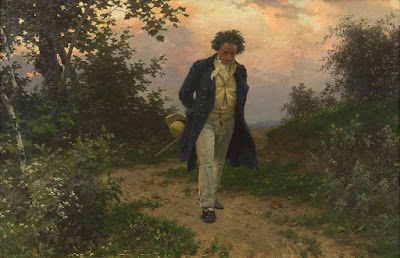
One thing that I have in common with Ludwig van Beethoven is that we both find creative rejuvenation in regular walks in the woods near our homes. I don’t know of any canine companionship that Beethoven might have enjoyed, but I have a dog with me at almost all times when I am walking through the forests of Chestnut Ridge Park, or Knox Farm, of Hunters Creek, or Sprague Brook, or Letchworth. Beethoven would escape almost daily to the woods around Vienna.
Even in Beethoven’s time, pollution was a problem in the city, and Beethoven likely felt it necessary to his physical health to get out of the city on a regular basis. I wonder how he applied those walks along forest trails to his musical life! Did he hum to himself, trying out musical ideas as he strolled? Did he take manuscript paper, quill, and ink with him so he could jot down ideas as they came? Or did he simply take a more meditative approach, using the walks to calm his often troubled soul so that when he returned to his chambers and his piano and his ink and paper, his mind was in a place to actually create?
It doesn’t precisely matter how Beethoven’s love of nature moved him to create; all that matters is that it did. His music abounds with examples of this inspiration, but the most famous and obvious is in his Symphony No. 6, the “Pastoral”, in which Beethoven uses five movements (not four!) to more suggest the emotions of walking in nature than musically depict it. This makes the Pastoral Symphony one of the earliest examples of “program music”, even if Beethoven’s desires were more impressionistic in nature. Nevertheless, in those five movements, Beethoven deftly creates a series of emotional moments–“melodic moments of feeling,” as Wagner would later say–that do suggest a natural setting.
The movements suggest the feelings of refreshment and delight upon arriving in the countryside, and then a scene by the side of a rushing brook. The third movement is a folk dance, followed by a storm and then by the feelings of rain-washed newness that follow a good summer storm. The entire symphony is lyrical and beautiful and at times even charming–note the folk dance in the third movement, which has a lively tune played off the beat by the oboe and a bassoon accompaniment that sounds like the bassoonist can only play three notes–and there’s real drama when the storm arrives, before peace settles again. The storm has been frightening, but also rejuvenating.
Here is Beethoven’s Symphony No. 6 in F Major, the Pastoral. Few works with more lyrical delight exist.
You know how sometimes a song will have a great tune and a great beat, but when you listen to the lyrics you’re kind of repulsed? For me one great example of this is the first of the 1980s pop music charity hits, “Do They Know It’s Christmastime”, by “Band-Aid”, a super-group made up of a whole lot of big names at the time. The song is basically asking if the starving Africans have any idea that it’s even Christmastime, so awful has their lot become. I’m always thinking, “Why wouldn’t they? They have calendars. Just because they’re dealing with a lot of shit doesn’t mean they don’t know what the date is.” And besides, there are a lot of Christians in Africa too. The whole song always bugs me (and not just for Bono’s lyric, “Well tonight thank God it’s them, instead of you!” Yikes.)
Anyway, yes, they know it’s Christmastime in Africa. Here’s some musical evidence.
So far this year we’ve had about an inch of snow altogether at Casa Jaquandor, and at the moment the grass is green and the woods are brown and everything is wet and muddy. Meteorologically, we just aren’t in the Christmas mood yet.
But anyway, here’s “Sleigh Ride”, in the original orchestral version and the Johnny Mathis version with words, because hey, it’s Buffalo! It’s gotta snow sometime, right? Six years ago we were still digging out from seven feet of the shit!
Anyway, here’s the music.
I wonder if Currier and Ives knew that this song was what would carry their names into the ages….
Oh heck, here’s another version, the short Roy Rogers and Dale Evans version that blends Sleigh Ride with Jingle Bells and if you listen to it you’ll walk around all day humming “Harses harses harses” to yourself. You may remember this version from Sleepless in Seattle, when Meg Ryan sings along with it while driving….
Songwriter Adam Schlesinger died earlier this year. He was one of the first high-profile deaths from the COVID-19 epidemic. He was also one of the brilliant creative geniuses behind the amazing show Crazy Ex Girlfriend, and many of that show’s best songs reflect his creative stamp…including this one.
Here’s “California Christmastime” from Season One of Crazy Ex Girlfriend, one of my favorite shows ever.
If you took piano lessons as a kid for any length of time, you probably played some Beethoven. And if that’s the case, then the odds are very good that the Beethoven you played included his Bagatelle No. 25 in A minor, more familiarly called Für Elise. And if you never did take piano lessons, odds are that you’ve heard this piece. If not for his Fifth and Ninth symphonies, there’s a good chance that Für Elise would be the most familiar piece Beethoven ever wrote.
And that’s interesting, because it turns out that the piece was never heard in Beethoven’s own lifetime, and in fact would not be discovered by the musical world until four decades after the composer’s death. The piece is quite short; in fact, the word “Bagatelle” refers to a small, short piece for piano. And the title? “For Elise”? That seems obvious, right? Beethoven wrote the piece as a gift for someone named Elise…but some scholars have agreed that this is based on a misreading of Beethoven’s legendarily awful handwriting, and what he actually wrote on the manuscript (which is now lost) was “For Therese”.
Therese was 18 years old and one of Beethoven’s piano students. Her father was a medical doctor who treated Beethoven for some of his many illnesses. Beethoven was quite taken with her from their first meeting and soon began heaping great praise on her piano skills, which weren’t all that notable. There was probably some flirting on Therese’s side, as it would have been very flattering to have a famous musician like Beethoven falling all over himself to impress her. He started cleaning up, ordered new clothing, and even combed his wild mane of hair.
Last but not least, he wrote her a piece of music, composed deliberately for her skill level. All seemed well, at least to Beethoven. Then everything came crashing down. Although we don’t know exactly what happened, later letters to and from Beethoven speak of an unfortunate incident at the Malfatti home. Beethoven had a little too much punch and behaved rudely with Therese, and she rejected him outright. In a later letter to Therese, Beethoven wrote about the piece he had written for her and invited her to find its hidden meaning. “Work it out for yourself, but do not drink punch to help you,” he wrote, apparently referring to the unfortunate incident that ended their relationship.
Also interesting is how this piece, apparently an unpublished trifle that Beethoven didn’t even keep a copy of for his own archives, came down to us:
It was found in Therese’s personal papers in 1851, 41 years after it was probably written. A small piece, Beethoven gave it its formal name, “Bagatelle”. But it was what he wrote at the top of the page that not only gave this piece its informal name, but also created a mystery that has fascinated students of the history of Für Elise ever since.
At the top of the page, Beethoven wrote (translated from German): “For Elise on 27 April to remind you of L.V. Bthvn”. Ludwig Nohl, a German music scholar, discovered the original manuscript in Beethoven’s own handwriting among her musical papers, transcribed it, and published it in 1867 in a book he edited of Beethoven’s letters. The original has since been lost, so we have had to rely on Nohl’s copy of it.
Imagine having something you just tossed off one night becoming one of the enduring works of all classical music, so enduring that the piece has become on its own a kind of cliche. Try listening to it again, though, beginning to end! Note the way the harmonies and the melody blend together so you can’t have one without the other, and note the contrasts between the famous main melody and the less-familiar intervening sections. And if your memories of your piano teacher are pleasant ones, think of them, too!
(My teacher, Mrs. Hooker, never had me play Für Elise. My personal gateway to Beethoven was the “Moonlight” Sonata.)
So I was curious: Did Judy Garland ever record the song “It’s Been a Long, Long Time”? I did a very quick search and didn’t find anything…but I did find this rendition, by an apparently very young Frank Sinatra. Apparently Sinatra never did a studio recording of this song, but he did do it on a radio show of his, and that recording turns up here.
I still don’t know if Garland did the song, so if anyone knows one way or the other, don’t keep me in suspense!
British composer Gerald Finzi was not prolific, which can be seen one of two ways: either the world was denied further work of fine quality by his slow process, or his slow process was essential to his work as a composer. Either way, Finzi wrote in a Romantic, English-pastoral vein that reflects influences of Ralph Vaughan Williams. Much of his work is meditative and full of lush harmonies, and his choral writing is outstanding. All of that is on display in In terra pax, one of his last works. Here Finzi combines the text of a poem by Robert Bridges, “Noel: Christmas Eve 1913” with the famous telling of the birth of Jesus from the Gospel of Luke. He gives the words of the poet to a baritone soloist, and the words of the Angel from Luke to a soprano, with the chorus handling the rest. Even though the work starts off hauntingly and quietly, there is drama later on as the dynamic become quite expansive when Luke tells us that the shepherds were “sore afraid”.
Here is the text of the start of Bridges’s poem:
Pax hominibus bonae voluntatis
A frosty Christmas Eve
when the stars were shining
Fared I forth alone
where westward falls the hill,
And from many a village
in the water’d valley
Distant music reach’d me
peals of bells aringing:
The constellated sounds
ran sprinkling on earth’s floor
As the dark vault above
with stars was spangled o’er.
In terra pax is a wonderful choral miniature piece, a masterwork by a composer who isn’t heard enough.
So far, this Christmas season doesn’t seem to be off to the most joyful start, does it? I remember hearing this song quite frequently during the Christmas season, but it doesn’t seem to show up all that often anymore. And in truth, it’s not really strictly a Christmas song at all, is it? It’s set at Christmas, but that’s not the same thing. However, I could say the exact same thing about “Same Old Lang Syne” by Dan Fogelberg, which I feature in this space every single year, and almost certainly will later this year.
So here’s a sad song about a breakup that happens at Christmastime, which is surely among the worst times such a thing can happen…but really, is there a good time? Here’s “River” by Joni Mitchell, performed by the amazing Sarah McLachlan.
And I promise I’ll start posting some actually happy music one of these days.
Share This Post
ForgottenStars.net
The official site of Kelly Sedinger: Reader, writer, photographer, and dreamer