Memories of Maliboo

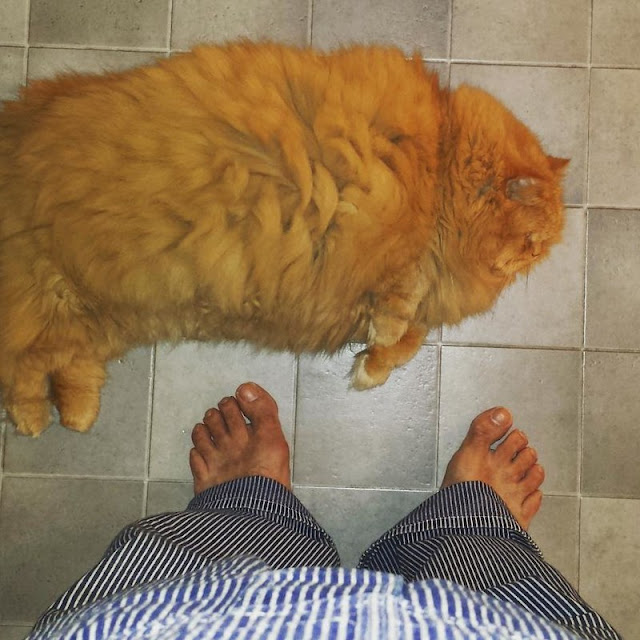
 My mother’s cat, a beautiful red Persian named “Maliboo”, died today at the fine age of 17. He had a fantastic life, truly winning the Cat Lottery. Oddly, Maliboo hated me until several years ago when he had no choice but to warm up to me while Mom took a 17-day trip to Wales. After that, he was fine with me.

Farewell, Maliboo. You were a good cat.

Share This Post

Tone Poem Tuesday

 William Grant Still is not new to this series, but the goal is to highlight music as well as composers, and to just hear one work by a composer and then move on forever seems…well, weird, doesn’t it? So let’s get back to Still, one of the most notable Black composers in the repertoire. Still (1895-1978) had a lush, Romantic style that nevertheless displays a lot of influences, among them the Negro spirituals of his ancestors.

This piece is a string quartet (although I have discovered that it can also be performed by a quartet of clarinets or saxiphones), called the Lyric Quartette. In this work, which in my ears summons up hints of Copland and Debussy, Still depicts three of his friends in descriptive terms: the first movement is “The Sentimental One”, the second is “The Quiet One”, and the concluding third movement is “The Jovial One”. All those descriptors do apply to the music, which is introspective and at times meditative. This is a beautiful work. Enjoy!

Here is the Lyric Quartette by William Grant Still.

Share This Post

Tablet Fun!

So one thing I’ve been saving money for is a new tablet. My old one is pushing five years old (and may be over that already, as I’m not entirely sure when I bought it in 2015), so it’s getting up there. Battery life isn’t awesome anymore and apps don’t always update, and in fact eventually a lot of apps become unwinnable. I’ve been squirreling away money so I could buy the new tablet outright, and now it’s mine! In fact, I am writing this very post on the new tablet.

It’s a Samsung Galaxy Tab A, in the 10-in size. This is the biggest tablet I’ve owned yet, which makes sense for reading comics and since I want to use this tablet as a secondary writing device. Of course, that particular bit of functionality will have to wait until the keyboard folio I also ordered comes; apparently it was backordered, which is a shame. (It was also included free, so I can’t whine too much yet.) My plan is to use the tablet for writing in Google Docs, for things like blog posts and reviews for The Geekiverse, and maybe even short-form fiction if the whim allows. Google Docs doesn’t handle very large files very well, and since brevity does not seem to be a thing I do as a novelist, that work will remain on the laptop and Scrivener. 
Aside from that, who knows? I just have a nifty new gadget!
And the camera is decent on this tablet, too. Here is a selfie I took last night with this very device. Not bad, I must say.
And oh yeah, those are also new overalls…but more on those in another post. Cheerio, mates!

Share This Post

Notes of an Overall Collector: Washington Dee Cee

There are a number of favorite subjects of mine that I haven’t used this blog to geek out about in a long time, so let’s go ahead and do some of that right now, OK? Time to talk about bib overalls!
Dee Cee overalls (for use in a blog post)

I think it’s long past time to admit that my acquisition of overalls has come to a point where there’s really only one way to describe it without making myself seem like a weirdo (or, maybe at least a little less of a weirdo), and that’s to assert that I am a collector of overalls. That doesn’t seem weird at all, right? When you’re an avowed collector of a thing, owning lots of it and being willing to go to odd lengths to procure it aren’t nearly as weird as if you’re just some goof who owns a whole lot of a particular thing.

Well, that’s what I’m telling myself, anyway.

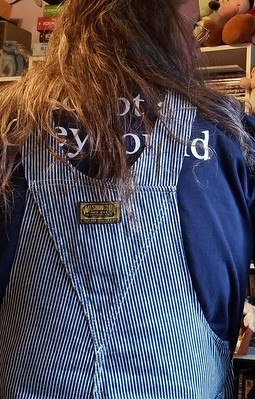
Which brings me to one recent acquisition for my overalls collection: a pair of Hickory-striped overalls by the Washington Dee Cee company. I haven’t been able to find much information out there about the Dee Cee company, but they were based in Nashville and they made a lot of denim Western-wear and workwear back in the day.

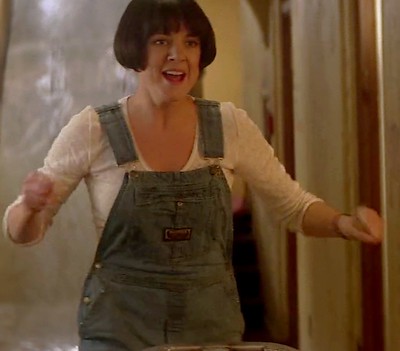
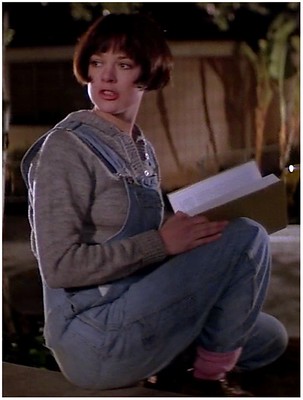
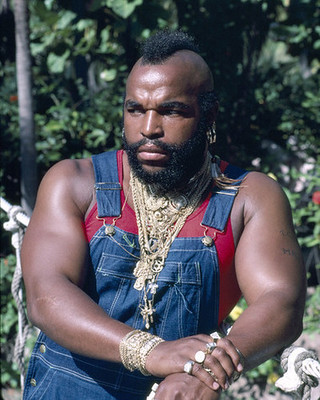
What makes their overalls distinctive is the styling of the large pocket on the bib. Instead of a dual-compartment pocket with two snap enclosures, which tends to be the norm (see Dickies or, my eternal favorite, Lee overalls for examples), the pocket is mainly one large enclosure with a snap in the middle over which a narrow flap fastens. It’s a neat look that’s a nice change from the usual style. Washington Dee Cee overalls were notably modeled by actress Michelle Meyrink in the wonderful 80s nerd-comedy Real Genius

Dee Cee overalls (for use in a blog post)

Dee Cee overalls (for use in a blog post)

Dee Cee overalls (for use in a blog post)

…and by Mr. T on The A-Team!

Dee Cee overalls (for use in a blog post)

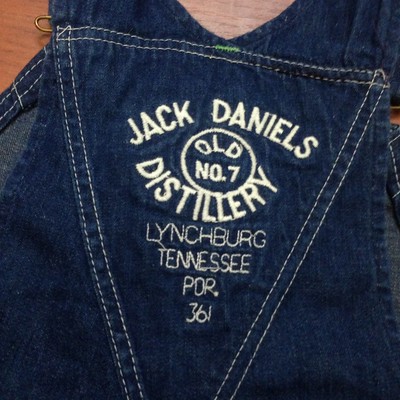
I’ve kept an eye out on eBay and other places for a pair of Dee Cee overalls, but usually they were either not in my size, or not in my price range. I did occasionally see this interesting variation, though–and never in my price range. It seems that the Washington Dee Cee people made versions of their overalls but to be branded for another great Tennessee institution:

Dee Cee overalls (for use in a blog post)

Dee Cee overalls (for use in a blog post)

Well, anyway, luck finally turned my way and I got my hands on a pair of Hickory-striped Washington Dee Cee overalls! I’ve really taken a keen liking to Hickory stripes over the years (commonly thought of as “engineer stripes”, because they’re commonly seen on railroad worker clothing). Here are my new ones!

Dee Cee overalls (for use in a blog post)

Dee Cee overalls (for use in a blog post)

Dee Cee overalls (for use in a blog post)

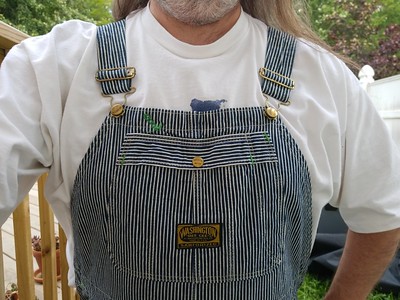
Some neat bib details here: While the Hickory-stripe pattern is always vertical on overalls, the Washington Dee Cee ones break with this in one place: the flap enclosure on the bib pocket. That makes for a neat visual contrast. At the far left of the bib pocket (the wearer’s left, on the right as you look at them), there is a pencil-slot, and though it can’t really be seen here, there is the traditional pocket-watch pocket that tucks into the seam just above the center tag. (For years I didn’t know that this is what the “button hole” present on most pairs of “traditional” overalls, somewhere across the top of the bib, is for: the fob of a watch chain. It’s one of those details that has held on for tradition’s sake, even though most people who wear overalls aren’t also carrying pocket watches.)
Dee Cee overalls (for use in a blog post)

Close-up of the center snap. Back in the day, manufacturers engraved their names on the snaps and buckles.

Dee Cee overalls (for use in a blog post)

Center tag. I love tags on overalls. Some people cut them off their overalls! I don’t understand that. But, whatever. [shrugs]

Dee Cee overalls (for use in a blog post)

I like them a lot, even if they are just ever so slightly too small, but they’re definitely wearable and I like the way they look. So, huzzah!

Dee Cee overalls (for use in a blog post)

More new arrivals to the collection to come!

Share This Post
Something for Thursday (Farewell, Leon Fleischer)

Pianist Leon Fleischer has died, at the age of 92.

Fleischer was one of the greatest American musicians of the twentieth century (and a chunk of the 21st!), and his story is one of consummate musicianship along with triumph to overcome and live with disability. Fleischer was already a pianist and teacher of great renown by 1964, when a neurological condition made playing with his right hand impossible. Fleischer didn’t lose a step, though: because one-armed pianists are hardly unheard of, there is a substantial amount of repertoire for them, including today’s feature piece.
Maurice Ravel, the great French Impressionist composer, was commissioned by an Austrian pianist named Paul Wittgenstein to write a concerto for him. Wittgenstein had lost his right arm in World War I, however, so Ravel wrote his Concerto in D for Left Hand. It’s an amazing, bravura work, with such impressive piano writing that it is never obvious that only one hand is playing.
Wittgenstein appears to have been a rather prickly individual; he clashed with Ravel about the Concerto, revising it himself before playing it, to Ravel’s displeasure. Later he commissioned another Concerto for Left Hand from composer Paul Hindemith, but Wittgenstein decided he didn’t like the piece, so he refused to play it–but he also owned the rights to it, so he never let anyone else play it, either…until long after his death, when Hindemith’s score was found in Wittgenstein’s papers. The work was finally premiered in 2004, more than 40 years after Hindemith’s death. The pianist who premiered it?
Leon Fleischer.
In the 2000s, even though he had a long career of left-hand piano playing, conducting, and teaching, Fleischer began undergoing experimental treatments in hopes of regaining control of his right hand. These treatments proved somewhat successful, enough for him to resume two-handed piano performance. In 2007 Fleischer was a Kennedy Center Honoree, inducted by President George W. Bush.
Here is Leon Fleischer performing Ravel’s Concerto for Left Hand in D Major.

Share This Post

Tone Poem Tuesday

There are two possibilities with regard to this amazing piece of music, which I’ve just heard for the first time ever the day before yesterday: Either this amazing work has been studiously ignored for decades since its composition, when it should be heard every year around Passover time, much as The Ten Commandments is screened each year; or, it is heard every year around that time, and White Musical America is just that good at ignoring the amazing work of Black composers.

Sadly, I can see it breaking either way.
Robert Nathaniel Dett was a Black composer, native to Canada but who eventually spent most of his life and career in America after his family moved there when he was eleven. Dett was born in 1882 in Niagara Falls, Ontario, and would die in 1943 at the age of sixty, from a heart attack while touring with the USO as a choral director. In between he wrote a good amount of music, apparently making heavy use of Black folk songs and spirituals in a typically Romantic style.
Dett’s oratorio The Ordering of Moses was premiered by the Cincinnati Symphony Orchestra in 1937. That performance was to be broadcast live by NBC, but the broadcast was cut short due to “technical difficulties” that apparently left many wondering if the issue had been technical at all, or due to large volume of complaints lodged with NBC for broadcasting a Black man’s music. That doesn’t matter now, because we can hear Dett’s amazing work now.
Here is The Ordering of Moses by Robert Nathaniel Dett.
(The entire work isn’t available in one video, so the above is an embedded playlist. As this doesn’t always work well for me, here’s the link to hear the work directly on YouTube.)

Share This Post

Happy Birthday, Martin Sheen!

Today is Martin Sheen’s birthday! He turns 80 years old, which I can hardly believe. In his honor, I’d like to note just one scene from his amazing life of work. This is from The West Wing‘s Season Two opener, called “In the Shadow of Two Gunmen”. The previous season had ended with an assassination attempt on President Bartlet (Sheen), and as the finale ended we didn’t know who had been shot or even killed.

When Season Two began with this two-part episode, we learned that President Bartlet and his Deputy Chief of Staff, Josh Lyman (Bradley Whitford), had both been shot. Bartlet’s injuries weren’t life-threatening, but Josh’s were critical, and the episode unfolds as doctors work to save Josh and the White House and the nation react to the attack. Meanwhile, in flashbacks, we learn how the cast came together in a quixotic campaign to elect a long-shot candidate President.
Throughout all of the flashbacks, much is made of Bartlet’s prickly nature, the fact that he’s not especially nice to those in his inner circle, and that he simply isn’t ready to be President. Aaron Sorkin’s script even has a description: “There’s something about Bartlet that seems smaller somehow.” I don’t know how Sheen managed to suggest “being somehow smaller”, but at the end of the episode comes this scene.
It’s one of the flashbacks. On the very night that Governor Josiah Bartlet wins the Illinois primary, thus becoming the almost-certain Democratic nominee, Josh receives the phone call that his father has suddenly died of cancer. As the campaign celebrates and gets ready for the trip to California, Josh instead has to go to the airport to fly home for his father’s funeral. He’s sitting at the gate when he notices Secret Service agents forming a perimeter around him…and then there’s Bartlet, the last person he expected to see.
In this scene Bartlet finally shows some warmth to the people who have given up other careers to try and elect this guy, and it really is quite a wonderful scene between Sheen and Whitford. But the real amazing thing comes at the end of the scene, when Josh is heading off to catch his flight. Leo McGarry (John Spencer), Bartlet’s oldest friend and campaign manager and eventual White House Chief of Staff, comes up from behind and asks Bartlet if Josh will be OK; Bartlet replies, “He’s gonna be fine,” and then…Bartlet turns around to face Leo.
And in that simple act of turning around and straightening up just a bit, we see that indeed Bartlet had been “somehow smaller”, but now…he’s not. He turns to face Leo, and he straightens just a bit, and he says: “Leo, I’m ready.” I love when actors can create a completely different tone in their characters just by altering their posture in the tiniest bit.
Here is the scene, and Happy Birthday, Martin Sheen!

Share This Post

ForgottenStars.net

The official site of Kelly Sedinger: Reader, writer, photographer, and dreamer

Skip to content ↓