I don’t remember if I’ve featured this before, but it’s just such a perfect piece of music that it’s worth revisiting now and again. Alexander Borodin’s In the Steppes of Central Asia depicts the meeting of two trade caravans, on some road in the Asian wilderness. There is no war or conflict here, just two groups coming together — depicted by two melodies of differing character — greeting one another and parting. This wonderful piece is so full of warmth and human optimism that it simply glows.
Sorry, folks, yesterday was a bit preoccupying, what with a nice visit from my old friends, the Car Repair Gods*.
Here’s something fun.
Pro tip: Looking for light, fun classical music to brighten your day? Listen to the overtures of Franz von Suppe. My favorites are this one, “Light Cavalry”, “Poet and Peasant”, “Morning, Noon, and Night in Vienna”, and “The Beautiful Galatea”.
* They’re not friends. They’re jerks, and when they come by, well — as Ned Flanders noted, I’m obliged to offer them a beer, but it’s mostly head.
There are a lot of ways to separate writers into opposing camps: Are you a plotter or a pantser? Do you write in past tense or present tense? Do you have a daily quota, or not?
One of my favorite such queries is: Do you listen to music when you write, or not?
Some writers don’t listen to music, claiming that they can’t focus on the story when music is playing. Others need music, as a way of setting mood and of shutting out the rest of the world. I fall into the latter category. I can write without music, and I often do, but my preference is to have music going.
Usually I listen to classical, Celtic, or film music while I write. I’m not too insistent on matching my writing music to the mood of what I’m working on, but I do like to use music as writing-mood music at least some of the time. Thus, for my current WIP – the Alexandre Dumas-inspired Hefty Adventure Fantasy novel Seaflame! – I have been listening to some swashbuckling adventure music. Sometimes you just need some good adventurous-sounding music when you’re writing about crossed swords and villains with big hats with feathers in the brim and pounding horse-rides across the landscape and highland clans and all that sort of thing.
The Three Musketeers, music by Michael Kamen. This is the score from the 1993 film of Dumas’s novel, and it’s a terrific score. In fact, it’s almost certainly the best thing about the film.
The Adventures of Robin Hood, music by Erich Wolfgang Korngold. So many wonderful swashbucklers of Hollywood’s Golden Age boast scores by Korngold. I can’t even look at a picture of Errol Flynn without hearing something by Korngold in my head.
The Sea Hawk, Korngold again. See what I mean? This is my favorite Korngold score.
Pirates of the Caribbean, music by Hans Zimmer and Klaus Badelt. I really do love these movies and have never understood the increasingly negative reaction to each one that comes out, and the music is a lot of fun too, for a more modern take on the swashbuckling thing.
Cutthroat Island, music by John Debney. This is not a good movie, although I also don’t think it’s quite as bad as everybody else does. It cost a ridiculous amount to make, the male lead was terribly miscast, and the movie simply wasn’t good enough to overcome being in a genre that simply wasn’t in demand at the time. Debney’s score, though, is amazing – in fact, many film music lovers consider it a classic. Lots of swashbuckling here!
The Mask of Zorro, music by James Horner. Energetic fun here, if you want a Latino flare to your swashbuckling music.
Ivanhoe, music by Miklos Rozsa. Rozsa is another of the great composers of Hollywood’s Golden Age. He’s likely best known for his work on big epics like Ben Hur, but Ivanhoe is a wonderful swashbuckling listen.
Hook, music by John Williams. Here we’re skirting the line between “swashbuckling adventure” and “outright fantasy”, but it’s hard not to get caught up in Williams’s work for this movie (which is, admittedly, not a favorite of mine).
Robin Hood, Prince of Thieves, music by Michael Kamen. Kamen was somewhat underrated during his lifetime, and, well, he might still be a bit underrated. His Robin Hood score is terrific. (I like the movie, despite its well-known faults in the “historical accuracy” department.)
Rob Roy, music by Carter Burwell. This film isn’t quite the standard type of swashbuckler you might expect – it’s more of a historical drama, and Burwell scores it as such. But there are still exciting moments in it, and the score is well-worth hearing.
The Princess Bride, music by Mark Knopfler. Also not your standard swashbuckler, and therefore not the standard type of adventure music you’d expect for one, but it can still fit the mood, especially if part of your swashbuckling story involves Twoo Wuv.
And not just film music! You can hear a lot of thrilling music of the swashbuckling variety in the classical realm. A few examples, which aren’t remotely exhaustive:
Le Corsaire Overture, by Hector Berlioz. Berlioz is one of my favorite composers ever, and there’s a lot of adventure in his music. Especially in this rousing overture!
The Polovtsian Dances, by Alexander Borodin. Exotic and wonderful. The Russian Romantics will sweep you away, if you’re not careful. But come to think of it…let them!
The Flying Dutchman Overture, by Richard Wagner. There’s a lot of overlap between good swashbuckling music and good outright fantasy music, and this is an example. Wagner makes amazing listening for fantasy purposes, actually – but fantasy music is another post.
I could go on, but this post is pretty long already. These are but a starting point, though, so sharpen your rapiers, put on your wide-brimmed hat with giant feather in it, and go buckle your swash!
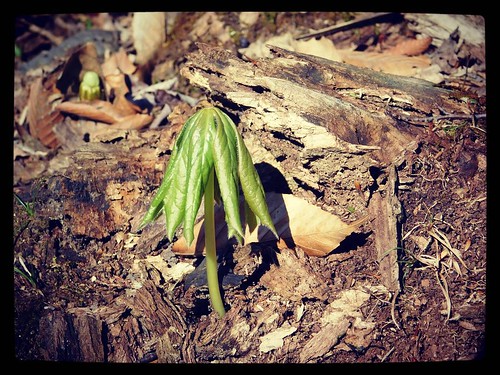
So a few weeks ago I was hiking with The Dee-oh-gee (at Sprague Brook Park in Colden, NY) and I happened across this strange-looking plant:
Odd little thing, innit? I’d never seen anything like it, to my recollection.
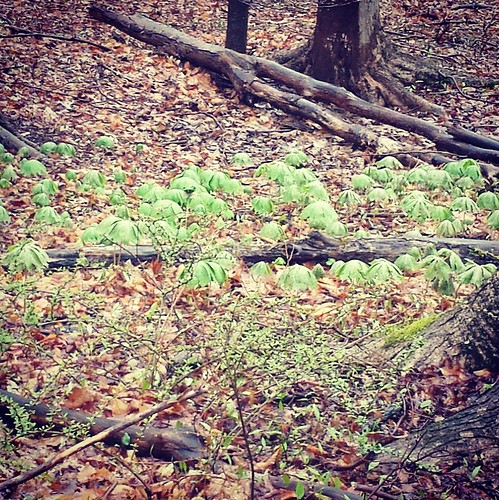
A week or so later, I’m hiking with the Dee-oh-gee (at Knox Farm State Park in East Aurora, NY), and I happened across an entire crop of those little plants:
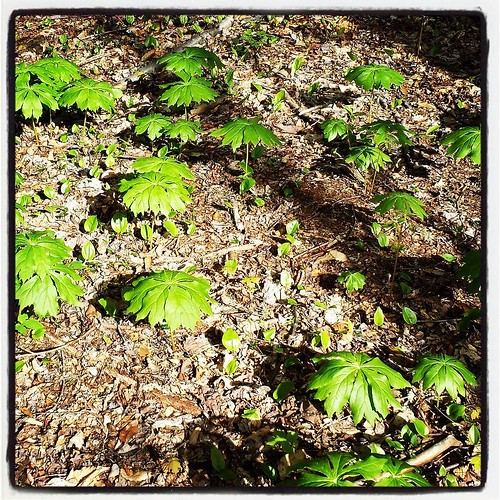
And then yesterday, I’m hiking with the Dee-oh-gee (at Chestnut Ridge Park here in sunny Orchard Park), and I happened across another crop of those things, even bigger now.
Well, a helpful Instagram user has come to my rescue! They are “May apples”, or podophyllum, so named because the flower that generally blossoms from these plants in May that become fruits later on. May apples grow in large colonies, with the ‘plants’ actually sprouting from a single root that has spread beneath the ground. That’s why I’m seeing large patches of these things, when I spot them in the WNY woods.
Wikipedia indicates that they are poisonous, but this article indicates that the fruit can be eaten, albeit with preparation and quantity in mind. I’m not sure if I’m quite that curious, but still, a bit of learning is useful — especially when it’s something that I’ve been observing on my own!
After three consecutive weeks of increasingly lengthy and heavy German symphonies, let’s step back and listen to something shorter and much less dense. What’s needed right now is a French composer, so this week we’ll encounter Vincent d’Indy.
I have heard almost nothing by d’Indy; in fact, it’s quite likely that the work featured in this post is the only work I’ve ever heard by d’Indy. My brief research confirms that his music is little heard today outside of the present piece, although in his Essential Canon of Classical Music, David Dubal does opine that d’Indy is a terribly underrated composer, so perhaps his work is deserving of greater exposure.
This work, the Symphony on a French Mountain Air, is unusual in a number of ways. First, it is in three movements instead of the traditional four; second, its melodic material is mostly derived from a single tune (the “mountain air” of the title, a song d’Indy heard while traveling in the mountains); and third, the work features a prominent (but not quite dominant) part for a solo piano, making it a sort of symphony-concerto hybrid, not unlike Harold in Italy, the symphony by d’Indy’s fellow Frenchman Hector Berlioz, which had featured a prominent part for solo viola.
The Symphony on a French Mountain Air is, to my ears, a delightful listen that always feels fresh and light, especially after a steady diet of heavy Germanic romanticism.
Next week: Well, I haven’t decided yet, but there is a big-name Russian composer knocking on the door….