

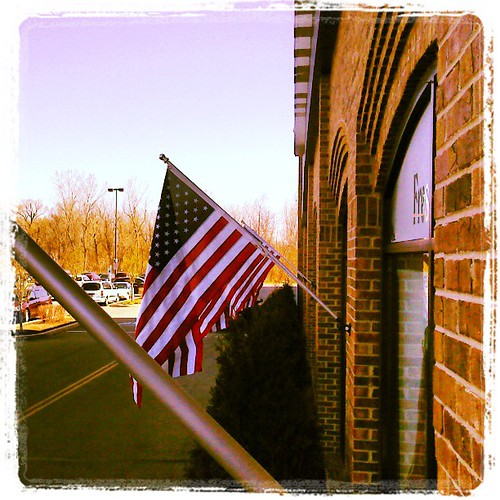
This has been a pretty trying month, all the way around. But at least I get to put the flags out on the front of The Store for the first time of the year. That helps!
Earth Day
A to Z: Sibelius
Jean Sibelius is one of those composers I struggle with from time to time. He seems like a composer whose music I should like more than I do, and yet, I don’t dislike his music. I’ve never really made a huge effort to listen to him, so I suppose the fault is mine. His life and career straddled the transition from Romanticism to Modernism, but Sibelius is generally best seen as one of the Romantics, albeit a highly nationalized one, coming from Finland and thus having a sound world all his own, quite distinct from the Wagner-Brahms thing going on farther south. Sibelius’s music is more of a cloth with Carl Nielsen’s, I suppose, but I tend to find it more distant, more difficult to really find the emotional center. But I also find that the more I listen to it, the more the internal logic of what he’s doing shows up. Sibelius’s music doesn’t so much sing or emote, as contemplate. It’s very inward-looking music.
In terms of performance, Sibelius was on my very first orchestral program, way back in the college days. It was the work below, his Concerto for Violin and Orchestra. It was nearly impossible in those early rehearsals to get any real feel for the work, as our orchestra only had half its complement for most rehearsals (our ranks would be padded out by paid pros from Waterloo/Cedar Falls, the large city twenty miles south), and we didn’t have the soloist (a violinist from the University of Iowa, named Leopold La Fosse) available for most of it, either. These were hardly ideal circumstances on which to engage with a piece of music, which is a shame because it was — and is — quite the concerto, when you really hear it.
(Those sparse rehearsals got a lot better over time. The orchestra’s director, Dr. Janice Wade, was in the early stages at that point of really striving to build a string program from almost nothing at Wartburg. By the time I graduated, four years later, we had a full orchestra present each week at rehearsal. Dr. Wade could be idiosyncratic, to say the least, but I came to deeply admire and respect the job that she did with that group. Indeed, some of my fondest musical memories come from my time under her baton. She retired a short time ago.)
Here’s the Sibelius Violin Concerto.
Tomorrow: A really modern composer!
Share This Post
Taking a break from writing about fictional spaceships….
…here are some photos, from a NASA FLickr stream, of an actual real spaceship launch. Specifically, the Antares rocket, developed by a private company. I think that the human future in space will depend in great part on private enterprise, and also that the future of the human economy will depend on our future in space.
Plus, there’s still something awfully thrilling about a rocket launching for space.


Space still beckons!
Share This Post
Sentential Links
Pilfering more participants from A-to-Z this week….
:: For the challenge this year, I have decided to challenge you. Because I love mathematics codes, and riddles, my 26 posts will test your brain. (Gotta look back on this one….)
I wanted it to be more than a diary. I have to be honest, I always felt a little corny when I would write a daily entry in the diary I received when I was younger. The process felt forced to me.
:: The electronic format is definitely a large part of the future of gamebooks, but I’m hopeful that printed versions will continue to be produced, aka Destiny Quest. I’d like to see gamebooks explore different concepts – while hack ‘n’ slash has its place, it would be great to see gamebooks where the choices made have real consequences, beyond “you don’t have this item so the dragon eats you”. Imagine a gamebook based on the ideas explored in Planescape: Torment or Tides of Numenera. (I have no idea what a ‘gamebook’ is. I need to look this up.)
I LOVE writing them and watching as chaos erupts around me.
However, I hate being on the reading end when a bomb drops and you know theres no way you’re sleeping tonight because you just have to finish the whole book after that.
More next week. Maybe. Or not. Who can tell, in these times of unpredictability? I could just end this post in the middle of a word, breaking off in highly strange fash
Share This Post
Some random thoughts on “Once Upon a Time”
I like this show a lot. We watch it every week. But it’s a really maddening show, because there are times it’s so wonderfully written (thank God they’ve got Jane Espenson on the staff), and other when it is so…not (too bad they can’t clone Jane Espenson).
:: Snow White / Mary Margaret is kind of irritating. She reminds me of the way Mary Ingalls was always depicted in the Little House books: insufferably good. The current storyline, of forcing her to do evil, could be interesting, but so far all they can figure out what to do is have her roll around in bed as she processes her existential crisis.
:: Regina / The Evil Queen is, by far, the most interesting character on the show. And Lana Parrilla plays her magnificently. She’s the most three-dimensional character on the show, and Parrilla captures that beautifully.
:: The next most interesting character on the show? Robert Carlyle’s Mr. Gold / Rumpelstiltskin. He seems to get the best lines, and so far, the writers have managed to keep him treading the line between good and evil in exactly the way a good Trickster character is supposed to do.
:: Come to think of it: Lana Parrilla will sadly be too old to play one of the Princesses when the totally inevitable movie of Princesses In SPACE!!! (not the actual title) gets made, which gives me a sad, because frankly, she’d be perfect for the older of the two. She has a very expressive face and a lot of range as an actress. (As opposed to Ginnifer Goodwin, who as Mary Margaret / Snow White seems to only have two expressions: happy smile and sad smile.) Robert Carlyle has a part waiting for him, too.
:: The worst character, by far, no competition, is Captain Hook. He is awful. The guy exudes zero menace, his sexual innuendos are embarrassing since he has no charisma or chemistry at all with anybody, he only serves to show up at inopportune moments to do something evil, and then he invariably gets his ass kicked. Hook isn’t a character, he’s a plot device, and a badly-acted one at that; every single time he shows up, any energy the show has gets sucked right out. The sooner the writers come to their senses and jettison this guy, the better.
:: I hope they never show August / Pinocchio as an adult wooden guy again. That was one of the creepiest damn things I’ve ever seen. Made that episode nearly impossible to watch.
:: I like the guy who plays David / Prince Charming, but his lips are distractingly red. Seriously, I’ve never seen a guy with lips that red before. Every time he’s onscreen, at some point during the scene I find myself staring at his lips. And I won’t lie — that makes me feel a little strange.
:: Some of the mining of old stories and folklore is pretty creative. Some of it, though…I don’t really know about. The last episode seemed to be going toward some kind of Asian lore, in a Big Trouble in Little China kind of way. I’m not sure where they’re going with that.
:: I’m honestly not sure how much longer this show can last — maybe one more season? My problem is that the worldbuilding feels increasingly tenuous. The town of Storybrooke can’t interact with the ‘outside’ world? Well, OK…but it’s a modern town, with all the modern trappings, so how do they get stuff? Where does the food at the store come from? How do they get gas for the vehicles they drive? It’s a town, not a separate world.
That’s about it. The second season starts winding down tonight…I think there are only three or four episodes left. I wonder how they’ll leave things hanging?
Share This Post
Sunday Burst of Weird and Awesome
Oddities and Awesome abound!
:: This is kind of creepy: the library of dust.
“In 1913, the Oregon State Insane Asylum began to cremate the remains of unclaimed patients and their ashes were stored in copper canisters.
After decades in storage the canisters have undergone chemical reactions resulting in explosions of vivid blue-green corrosion. Maisel was granted access to the room in which the canisters were stored to document them for his book.”
The full image of the room, with the cannisters all nicely arranged on the shelves like items in someone’s pantry, is particularly troubling to behold.
Well…that’s about it, I guess. This week really sucked, folks. We’ll get better, though!
Share This Post
A thought
A to Z: Rimsky-Korsakov
Toward the late 19th century, Russia came into its own in a big way as artistic Romanticism took hold in that country. One of the greatest composers to emerge from that period, slightly before Tchaikovsky, was Nikolai Rimsky-Korsakov.
I haven’t heard too much of Rimsky-Korsakov’s work, but I’ve yet to hear a piece of his that isn’t somehow deeply scintillating and evocative. The Russian gift for lyrical melody and brooding atmosphere is almost a stereotype, but Rimsky-Korsakov really was a magnificent melodist, but even more, he was one of the most brilliant orchestrators ever. He had a way of using the instruments of the standard orchestra in new and exciting ways to achieve tonal effects and colors that are as brilliant and fresh today as ever. This is particularly evident in this, my favorite work of his, and one of my favorite works of all time: the symphonic suite Scheherazade.
The idea of ‘program music’ has always been mildly problematic for composers. Can purely orchestral music really tell a story? Or can it only suggest mood and color? I tend to think the latter, but the visual associations in this music are very hard to forget once you read the titles of the movements. In any event, Scheherazade is an utterly spectacular musical entertainment, big and bold and vivid and melodic and thrilling and passionate and exotic. I used to pore over the score to Scheherazade, noting with amazement the things Rimsky-Korsakov did with just the standard symphony orchestra.
This particular performance, by the way, may sound slightly odd to modern ears, because the orchestra performs on period instruments, using period performance standards (such as a mellower trumpet sound and much less vibrato in the strings). I often find period-instrument performances fascinating and compelling if the performance carries a passion to match. This one nails the passion of Scheherazade fairly well.
Only eight letters left. What to do with ‘S’? We’ll see on Monday!
Share This Post
In the cornerless office
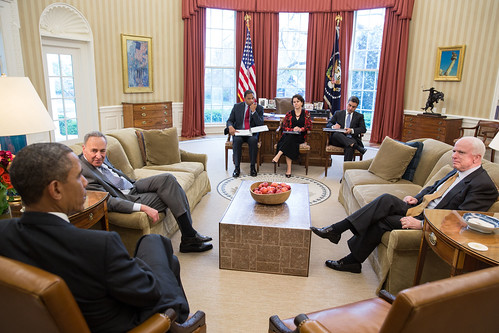
I continue to love the White House’s Flickr stream and its photographic documentation of the goings-on at the White House. White House photographers do great work, and I enjoy paging through it.
This particular photo is pretty cool because of its symmetry, the fact that the Obama Apple Bowl is in the center, and that you can really see how well the Oval Office’s wood furniture is polished. Senator McCain’s face is reflected with almost perfect clarity in that table.
And note that through the windows behind the President’s desk, it almost looks like there’s some sort of cabin or something out there, on the grounds. Anybody know what that is?