

Excluding Bugs Bunny and Daffy Duck, who is your favorite Looney Tunes character?
The Balance in the Blood, part one (a fiction repost)
This is a long story that I wrote a number of years ago, and which I serialized on this blog four years ago. Since it’s still my favorite of the horror stories that I’ve written, I figured I’d repost it over the eight days leading up to Halloween. I wrote this, by the way, well before someone decided that what vampires needed to be was ‘sparkly’.
Willem Schliemann extends a shaking hand toward one of his six remaining African violets. This plant hasn’t blossomed in months, and he wonders why. The truth is that he isn’t very good at this. He whispers an expletive as he hears the truck engine outside. He grabs his cane and heads for the door.
“Good morning, Senor,” Miguel says as Willem walks out onto the porch. Miguel goes around back of the pickup truck and begins unloading Willem’s weekly supplies. He puts two crates on the porch and stops to wipe his brow. “Senor, how can you wear long sleeves today?”
“The warmth appeals to me,” Willem Schliemann says with a shrug. “Though I admit that I will never truly be used to sun and heat in December.”
“You’ve been here fifty years.”
“Fifty-four,” Willem says. Fifty-four years since he last saw the Fatherland, though no one calls it that now.
“Perhaps that is why your flowers do not bloom.” Miguel grins and wipes his brow again. “I’ll see you next week, Senor Schliemann. Oh, your mail.” He hands Willem a pack of mail tied with a string, and then he gets back in the dusty old pickup and drives away down the narrow dirt road. Willem breathes in the warm breeze from the Atlantic. He thumbs through his correspondence. A few bills, letters he exchanges with people around the world – none bearing his real name, of course. Argentines don’t question such things. He finds a letter from a particularly engaging correspondent, and he smiles. Then he sees the postcard on the bottom of the stack.
The card shows a place Willem remembers with perfect clarity through fifty-four years, a lifetime, of memories. The front gates of the concentration camp at Hamerstadt. There on the left is the spot where he stood at attention that morning. The grass is green, the paint on the buildings is flaking – but it is the same place. He waits for the chill to run through him, but nothing comes. Has it been too long? He turns the card over and reads where a feminine hand has written in German, “I have finally found you.” There is no signature. One is not needed.
Old Willem Schliemann looks up at the bright morning sky. He knows that she will be here tonight. Willem sighs, puts the mail aside, and goes about putting his supplies away. As he does so he glances at his stubborn violets.
Some blossoms are more delicate than others….
Willem Schliemann stood at attention near the front gate. His new uniform, stiff and scratchy and at least a size too big, hung loosely on his slight frame. His head still itched from being shaved three days before. Thirty other new conscripts stood with him, waiting in the cold April air for….something. Flecks of ash fluttered down from the sky like snowflakes, ash from the great smokestack that towered above the giant foundry building that was not really a foundry. Somewhere behind them Willem could hear a train arriving.
“Attention!”
Commandant Gerhard Reger looked over his conscripts with a disgusted expression as a staff car pulled up in front of the phalanx. A man climbed out of the car’s back seat, and the Commandant turned to face him. “Herr Doktor,” Reger said. “A pleasure.”
“I’m sure,” the man said. Willem leaned slightly to one side to get a better look at this man. He was short, shorter than Willem. His black hair was slicked straight back and his thin lips were set in a tight frown. He wore a thick black overcoat with a sable collar, and a swastika-shaped lapel pin. He placed a pince-nez on his nose and looked over the conscripts. “Such a fine crop, Commandant. Our thousand-year Empire is now in the hands of sixteen-year-old boys.” He ignored the look of disgust on Reger’s face as he returned the pince-nez to his pocket and pulled out a slip of paper, which he handed to the Commandant. “This is the one I require,” he said. “I trust I have not picked a boy to whom you have formed….an attachment?”
Willem watched as Commandant Reger met the man’s gaze. He was close to the front and could hear what was being said, but even the soldiers in the very back row could not have missed the look of utter loathing in the Commandant’s eye. Reger faced the conscripts again and yelled out the name on the paper.
“WILLEM SCHLIEMANN! STEP FORWARD!”
Swallowing, Willem stepped forward and walked to the front of the line, where he returned to attention as the man, this Doktor, came down and looked him over. He smelled faintly of lavender.
“An honor,” the man said. “Please, come along.” He gestured for Willem to come with him. “You are assigned to me now.”
Willem glanced at the Commandant, who gave a single, curt nod. Willem joined the Doktor and climbed into the warmth of the staff car as a young soldier who was not much older than himself held the door open. When the driver was back behind the wheel the Doktor rapped twice on the forward window with his truncheon. The driver nodded, put the car in gear, and drove. Willem looked out the windows as they passed through the camp. There were many guards presiding over the comings and goings of hundreds of emaciated, prisoners. More than once he saw two soldiers dragging a dead body between them. The Doktor sipped from a flask and shook his head.
“Somehow I suspect our solution is not so final after all,” he said. “In the end, there are still more Jews than Nazis.”
“In the end?” Willem asked, surprising himself by speaking.
The Doktor nodded. “Italy is no longer with us. The Russians failed to oblige us by simply giving up. We have already lost France, and Hirohito hasn’t been able to command the total attention of the Americans. And, of course, the British….well, there it is.”
“There is still hope,” Willem said.
The Doktor eyed Willem suspiciously. “Fill an empty bag with hope, and you have an empty bag.” He capped the flask and returned it to his pocket. “My name is Wolf Muething. I am a physician by trade, although in recent years my work has gone in other directions.” He sighed. “I chose you because of your experience working with your uncle.”
Willem glanced sharply at the Doktor. “How do you know that?”
“He was my friend,” Doktor Muething said. “We were in school together, many years ago. I was very sad to hear of his passing.”
Willem nodded and looked away, mostly to hide the fresh tears welling up. He had been five years old when his father died and he’d gone to live and work with Uncle Gunther. Since then he had spent his days traveling with his uncle to the villages and farms all around the region. Willem had helped deliver babies, set broken bones, and tend to the dying. He had done everything that a country doktor would, and he had always supposed that he would become a physician himself.
Then, just six weeks before today, he had been at Uncle Gunther’s side, treating an elderly woman with rickets. Gunther complained of chest pains, and hours later he was dead. Uncle Gunther had been old, but he had never been sick for more than a day or two. The shock of his passing was compounded two weeks later by his conscription into the Army….and now he was apparently assigned to another physician. Looking at Doktor Muething, with his black hair and severe look that was the complete opposite of Uncle Gunther’s, Willem suspected somehow that he would not be delivering babies or setting broken bones.
Minutes later they arrived at their destination. Willem looked out the window at the small, low building. “Here we are,” Doktor Muething said. “Your new quarters will be over there.” He pointed to the dormitories across the street. These looked somewhat better than the mass quarters he had shared with the several hundred other new conscripts – if any housing in such a setting could ever be described as nice. “Come,” the Doktor said. “I would have a look at what they have built for us.” He waited for the driver to come open the door and then he climbed out, followed by Willem. He led the way up five stairs and inside.
It was a small medical laboratory. Clean, Willem noticed, definitely clean. The place still smelled like fresh paint, plywood and plaster; the stainless steel examination table in the center of the room gleamed in the sunlight that streamed in through the large windows. But as Willem looked closer he could see spots where the paint was too thick or too thin, where the wall panels didn’t fit together quite correctly, where electrical wiring was exposed. Another disposable building.
“Not bad for construction performed at gunpoint,” Doktor Muething said. “It won’t take me long to put things in order.”
Willem looked around at the rest of the laboratory, which wasn’t much bigger than the room where Uncle Gunther had based his practice. He now saw that the examination table was outfitted for surgical procedures as well. A cabinet on the right was stocked with chemicals and specimens preserved in formaldehyde. There was a packed bookcase, and between the bookcase and the cabinet there was a roll-top desk. Willem approached the surgical table. It was not as pristine as it had first appeared. Its surface was dull and scratched, and although it had been meticulously cleaned since its last use no amount of scrubbing could remove all the traces of blood from the collection grooves.
“You probably didn’t use a table like this, working for Gunther,” Doktor Muething observed.
“No,” Willem said.
“It should make you proud, having such an opportunity to help the Fatherland.” He took off his overcoat and hung it on the back of the chair in front of the roll-top desk. He was wearing a double-breasted charcoal-gray suit, and now he wore no swastika pin.
“I am honored to work for the glory of Germany,” Willem said.
The Doktor laughed, and Willem’s cheeks turned a bright crimson. What had he said that was funny?
“Forgive me,” the Doktor said. “I am an old man, and I have seen the Might of Germany plowed under twice in one lifetime.” He settled into the chair, the legs of which squeaked. “What we do here is not for Germany. What we do here, is for the betterment of Man. Out there”—he made a sweeping gesture—“the masses will not approve of what we do. They will hate it, condemn it, and some will try even to deny it. But they will benefit. We must learn what we can. Do you understand?”
Willem drew himself up straight. “You speak treason, Herr Doktor.”
“Hardly. Germany will survive; I merely question the form in which it shall be. Perhaps on that day we will be a wiser people.” He pushed himself up from the chair, walked over to the surgical table, and ran a finger down one of the blood-grooves. “Tell me, young Schliemann – are you a man of science?”
Willem shifted on his feet as he considered the question. Doktor Muething smiled.
“You are thinking,” he said. “Good. We haven’t driven you totally to automatic sentiments and easy platitudes.”
“I don’t understand the question, Herr Doktor.”
“And that, young Schliemann, is the beginning of wisdom.” Doktor Muething smiled. “There was a time, once, when the standard treatment for disease was prayer. It was thought that all maladies were caused by evil spirits, and that only God could restore health to an afflicted body. But centuries of science have taught us otherwise. What God would afflict, we can now put right.” He leaned against the table. “So much of what we have learned has come at the expense of the dead. What does this tell you, young Schliemann? What question should arise now, if you are truly of science?”
Willem thought for a moment. “Is there a limit to what the dead can teach us.”
Doktor Muething nodded. “And if the answer to that question is ‘yes’?”
The answer came as quickly as before, but Willem hesitated before saying it. “Then I would ask what we may learn from the living.”
“Precisely,” the Doktor said, and then he addressed someone behind Willem. “Are they here, Commandant?”
“Yes, Herr Doktor.”
Willem hadn’t heard Commandant Reger enter, but there he stood, waiting patiently in the doorway.
“Good,” Doktor Muething said. “Let us see them.”
Willem and the Doktor followed Commandant Reger outside, where six prisoners stood at attention under the watchful eye of eight rifle-wielding guards. Two guards would be enough, Willem thought, judging by the look of the prisoners. Doktor Muething stepped up and looked over each prisoner. There were four men and two women. Each had that sunken look of hunger, and each wore the yellow Star of David stitched to their ratty prison clothes.
“All Jews?” the Doktor asked. “No Gypsies or other undesirables?”
“All Jews,” the Commandant replied icily. “You were quite specific.”
Doktor Muething bid one of the male prisoners to open his mouth, and then he examined the man’s teeth. “Healthy enough, I suppose.”
He has a strange idea of health, Willem thought as the Doktor moved on to the two women. He very briefly looked over the older of the two, but he lingered on the younger. “Might I see your eyes, child?” the Doktor said as he lifted her chin with a single finger. As her head rose, her gaze flicked ever so briefly to Willem’s. There was no fear in her eyes, only quiet resignation. In health she would have been lovely, Willem thought. Even for a Jew.
The Doktor stepped away from the prisoners. “These will do.”
“You are truly a charitable man, Herr Doktor,” the Commandant said, making no effort to look at Doktor Muething as he addressed him.
Doktor Muething waved a hand. “Charity is hostility with an open hand,” he said. “Young Schliemann, we will begin tomorrow morning at precisely five o’clock. I assume that Gunther taught you punctuality?”
Willem nodded. Uncle Gunther had always carried three watches to ensure that he would never be late for anything. One of those watches was now Willem’s; he had inherited it along with Uncle Gunther’s stethoscope, the last proud artifacts from the life of a poor country doktor.
Share This Post
And…we’re back!
I said it would be a pretty short case of bloggus interruptus, did I not?
Anyway, I finished up my edits on the second draft of Princesses In SPACE!!! (not the actual title) last night, and I have already sent the draft out to most of the beta readers. Now begins the waiting for the feedback…which has me a bit on the nervous side, I must admit. I’ve never done the ‘beta reader’ thing; I’ve always just trusted my own instincts in editing the works and gone with them when I felt I was done. For this project, though, I’m going all-in with beta readers. Why?
Well, one reason is simple enough: I’m still an unpublished duffer, for all intents and purposes, so I’m hoping that there’s some bit of process I can change that will increase my likelihood of producing a book that someone wants to publish. Perhaps the input of beta-readers, who might identify issues with the narrative or the characters to which I’m blind because I’m too close to the project, will help do the trick.
Another reason is also simple enough: even if this book, too, ends up as nothing more than a space-taker on my hard drive, I’d still like it to be read by someone. Sometimes I think there’s a bit of romance in the idea of a writer who is long satisfied by just keeping a pile of completed works in the desk drawer, but there’s more romance in having books on the shelves. There’s also more money in it. Maybe not much, but more.
My main problem now is…what next! I’m leaning heavily toward actually participating in NaNoWriMo this year, because the timing has worked out perfectly: My decks are clear, project-wise, as November looms. And there’s an idea that I’ve been kicking around a while (and even made a couple of false starts upon) that strikes me as perfect for the length of work intended by NaNoWriMo. The problem there is…November’s still a week away, and I don’t want to write nothing between now and then. So…who knows. I haven’t done much short fiction in a long time, and right now I’m actually kind of devoid of short-fiction ideas. Who knows, indeed!
There’s always The Adventures of Lighthouse Boy, but I think I’m going to put that one on the back burner for a while longer. I reached a point where I wasn’t entirely sure of where the story was going, and I needed to focus on editing Princesses anyway. Lighthouse Boy would be an even longer book, most likely, than Princesses, so it would be spectacularly ill-suited to NaNoWriMo, and in any event, I’m thinking it might be wise to hold off any new long-form projects until some feedback on Princesses comes through. Just in case the unanimous opinion of the beta readers is along the lines of “Yeah, dude, we love you and all, but you gotta rewrite this thing from the ground up.” So Lighthouse Boy will remain kicking around the back of my head probably at least until some time in December.
And then, there’s the sequel to Princesses, tentatively not-actually-titled Princesses Still In SPACE!!!. When I finished the first draft, I had zero idea as to what would transpire in the second book. (Yes, I’ve envisioned this is a series, with as many as nine books, if The Gods are with me.) Wouldn’t you know it…the story for Princesses II started displaying its rough shape to me over the last week or so. At least I have that going for me, which is nice.
So that’s where things stand, writing-wise. As ever, onward and upward! Zap! Pow!!
Share This Post
Bad news, good news
Hey folks! First, the bad news: I’m going offline until I finish applying edits to Princesses In SPACE!!! (not the actual title), thus finishing the second draft.
The good news: all that’s left is the final two chapters and the epilogue, so there’s a good sporting chance I have it done tonight anyway. Huzzah!
Share This Post

Saturday Centus (Sunday edition)

Most of yesterday was taken up by the various festivities and comings-and-goings related to going to see a friend of mine get married (Huzzah!), so I’m a day late with this week’s prompt. This time it’s a photo prompt:

I’m sorry, Mr. Sauron, but there’s no eyedrop that will help you with that.
That’s all I got, folks!
Share This Post

Sunday Burst of Weird and Awesome!
Yup, time to return to this once-regular feature. Huzzah! Oddities and Awesome abound….
:: Prison slang. Hopefully I never have to learn this stuff firsthand, unless I’m writing a story set in a prison….
:: An artist superimposed some photos from World War II France onto up-to-date photos of the same locations. The results are pretty haunting.
:: I find this interesting, only because for almost as long as I can recall, this blog has received a few search engine hits every single week from people wondering if former Pittsburgh Pirates owner Kevin McClatchy is gay. Apparently he’s come out, so maybe that source of traffic here will dry up a bit?
More next week (maybe)!
Share This Post
Film Quote Friday
Been a while since I did one of these, huh? So much for ‘regular features’. Par for the course around here, though. I may one day relaunch this blog as a series of regular features, with one post each before completely disappearing.
Anyway, election season has me thinking about The West Wing. One thing that bugged me about the show during its run was that Aaron Sorkin wasn’t always very good at tying things together over the long haul of a teevee series, which led to things like the character Mandy (who was totally annoying) utterly disappearing between seasons one and two, despite the fact that season two begins literally at the exact same time that season one ended. But there were times when Sorkin did some really cool things, such as this.
One of the backdrops of the series — which was, to my mind, underutilized — was the fact that President Bartlet and Vice President Hoynes did not have a good working relationship. Their union was born of political necessity, after Bartlet surprised the political world by beating front-runner Hoynes for the nomination; after that, there was always friction between the two men. This scene happens in an early episode in Season One, called “Enemies”:
HOYNES
What did I ever do to you? Where, in our past, what did I do to make you treat me this way?BARTLET
John…HOYNES
What did I ever do to you except deliver the South?BARTLET
Really?HOYNES
Yes.BARTLET
You shouldn’t have made me beg, John. I was asking you to be Vice President.HOYNES
Due respect, Mr. President, you have just kicked my ass in a primary. I’m fifteen years younger than you. I have my career to think of.BARTLET
Then don’t stand there and ask the question, John. It weakened me right out of the gate. You shouldn’t have made me beg.A brief silence fills the room.
HOYNES
I’m glad C.J. straightened things out with Danny.BARTLET
Yeah.HOYNES
Good night, Mr. President.BARTLET
Good night, John.
That’s interesting stuff. The implication here is that Bartlet asked Hoynes to run on the ticket, and Hoynes made Bartlet wait and stew and ask again — made him beg — for Hoynes to be Vice President.
But later on, in Season Three, when Aaron Sorkin was in the midst of the big “Bartlet reveals he has MS” storyline, there’s a flashback in the episode “Bartlet for America” to the very night Bartlet asked Hoynes to join the ticket. We’d been lead to believe earlier that Hoynes’s reticence had actually been a little bit of a tantrum, but this casts quite a different light on things:
LEO
John?Hoynes looks over at Leo, then walks into the suite and shakes Leo’s hand.
HOYNES
Leo.Leo quietly closes the door and watches as Hoynes greets Abbey, who has banished the tension
from her face. They embrace formally. He kisses her on the cheek.HOYNES
Hello, Abbey.ABBEY
Hello, John.BARTLET
[smiles] Senator.Bartlet and Hoynes shake hands.
HOYNES
Good evening.BARTLET
I’d like you to be the Vice-President.Hoynes’ expression goes from amiable smile to shock. He and Bartlet stare at each other silently for a few moments.
BARTLET
Why don’t you sit with Abbey and me for a few minutes. [turns to aides] Can I have the room, please?As the staff quickly take their leave, Bartlet walks over to a table on the other side of the suite. He pours himself another cup of coffee.
BARTLET
[to Hoynes] You want anything? Coffee or anything?Hoynes, his hands in his pockets, walks slowly toward Bartlet.
HOYNES
Ah… no.On yet another TV, this one in a corner, crowds on the convention floor can be heard chanting “Bartlet! Bartlet!” Hoynes glances over at the TV. Abbey finally joins them but stands a bit off to one side. Again, she looks a bit nervous and distracted as she fidgets with her wedding ring and watches the two men talk.
BARTLET
You ran a good campaign. [pause] You’re a young man. You’ll be back.HOYNES
[nods] Thank you.Bartlet finishes getting his coffee and walks back over to the sofas. Hoynes and Abbey join him as the last of the aides leaves and the door to the hall finally closes. Bartlet and Hoynes sit down across from each other. Abbey remains standing off to one side.
BARTLET
There’s something you need to know. It’s why I asked everyone to leave the room.
[short pause] A few years ago, I was diagnosed with a relapsing remitting course of MS.HOYNES
[confused] I’m sorry?BARTLET
Multiple sclerosis.Hoynes, stunned, glances over at Abbey with a vaguely accusatory expression on his face. Bartlet looks over at her, too. She meets Hoynes’ gaze. She reveals very little, says nothing, but her expression is grave.
HOYNES
[to Bartlet] Did you just tell me that you have MS?BARTLET
Yeah.HOYNES
Which you never mentioned during the campaign.Bartlet shakes his head. Hoynes raises an eyebrow and sighs heavily.
BARTLET
I told you because it’s something you’re gonna need to know. But also because I wanted to show that I trust you.HOYNES
[slight edge to his voice] Oh, you do?BARTLET
[unfazed] Yeah.HOYNES
[leans forward] That’s supposed to be me accepting the nomination Thursday night. But I suppose your trusting me is consolation prize enough.BARTLET
[doesn’t flinch, pauses] Well, what do you say?Hoynes shrugs his shoulders, sighs, and stands up.
HOYNES
I’d like to think about it… for a few…BARTLET
[stands] I’d like your answer now, John.They stare at each other for several long moments, the tension rising.
HOYNES
You’ll have it when I give it, Jed.
That’s very interesting to me. It shows that Hoynes’s reasons for not being eager to join the ticket isn’t entirely, as Sorkin would put in another episode referring to something else, “the natural reaction to not getting the girl”. He no doubt feels that he lost unfairly, and that Bartlet in some sense cheated in winning the nomination without mentioning a fairly significant health concern. Hoynes no doubt has trouble trusting Bartlet after this, ironically in response to something Bartlet does in order to show trust in him.
That’s pretty cool.
Share This Post
Something for Thursday
Here’s Adele, singing the title song for Skyfall. What do you think? I like it a little more each time I hear it, and I liked it a lot at first. It stands in the fine tradition of sultry Bond songs, with its slow, torchsong melody sung by a big-voiced woman, and I like how it incorporates the James Bond Theme and manages to get the film’s title into the lyrics (in typically not-entirely-making-sense Bond song fashion).
Opine, folks!
Share This Post
A Random Wednesday Conversation Starter
Technology marches on
Roger wrote a post the other day about technology stuff, in which he name-checked me:
I don’t know what kind of typist Jaquandor is, but I’m sure that he is appreciating editing the text of his book or two, including Princesses In SPACE!!! (not the actual title), on a word processor, rather than retyping every draft.
In his post, he is addressing the question of what technology he finds the most indispensable, and which he wishes would go away for good. Those are interesting questions, but his citing of me as an example of what’s cool about the development of the word processor is interesting to me.
First of all, there’s an implied question there: Just how good a typist am I, anyway? I’ve once in a while done an online typing test, just out of curiosity, but I haven’t done one in a long time, so let’s find out. When I Google ‘typing test’, I find that there’s a site called TypingTest.com. Isn’t that helpful! So wait here while I go there and test myself. I’m choosing the following test options: English, 1 minute, and The Wonderful Wizard of Oz. OK? So hold on a minute….
[hum theme to Simon and Simon to yourself]
OK, we’re back. I was able to type 71 words in the one minute, and that’s with backspacing and correcting my errors as I went. I have never been a ‘fix the spelling later’ person, and I can almost always tell when I’ve mistyped something as I’m going — it’s like my fingers send a signal to my brain saying, “Whoa there, back up, we made a bit of a cock-up there.” So, I suppose that means I’m a passably-decent typist. Of course, I’ve known this for years; I have had many a person at various jobs marvel at how quickly I can dance my fingers across the keyboard. Yay, me!
Oddly, though, I am not an ‘official’ touch-typist, in that I never once took a keyboarding class in school of any kind. I have never been taught the business where you put your index fingers on the F and the J and use all four primary fingers to do the typing. In fact, now that I’m paying attention, I don’t think that either of my pinkies ever once touch the keys of any keyboard I use; instead, both just kind of ‘dangle’ up there in space, not doing much of anything. Frankly, I’ve never understood the utility of the ‘official’ method of typing or why it was taught in school, and I’m fairly certain that were I to try to force myself to learn it now, it would screw me up something awful. Kind of like how, in second grade, I ended up in a school that taught penmanship in a different manner than my first grade school had, and in my efforts to adapt, my handwriting turned to complete drivel for quite some time. (In first grade, we’d learned italics. In second, I was in a ‘balls-and-sticks’ school. That sucked for a while, until cursive came along and I was suddenly using a lot of what I’d already learned in first grade with the italics! Hmmmmm….)
Typing fast is a useful skill, but I struggled with it in my fiction writing for years, because I always had a terrific problem with my fingers being able to type faster than my brain could produce sentences to type. This tended to result in some spectacularly awkward prose when I would type my rough drafts, and I must admit that I’m still seeing evidence of that now, as I work my way through Princesses In SPACE!!! (not the actual title), which is the first book-length manuscript I have typed in its entirety.
So, how did I learn to type so fast? By, well, typing a lot. Lots and lots, over the years. A whole lot of typing. Not just in the course of writing something like Princesses In SPACE!!! (not the actual title), but in writing e-mails. Writing stuff for work in various jobs. Playing text-based computer adventure games. Writing lots of papers for the many writing-intensive courses I took in college. Writing research papers in high school. And, going back even farther, to typing on a typewriter.
We had two typewriters, if I remember correctly. One was an electric typewriter that I wasn’t really allowed to use; the other was a mechanical device in a shade of green that I would later see on our first Volkswagen Rabbit, and never again since. I got curious, so I Googled the words ‘green typewriter’, just to see if I could find out what that old typewriter was, and I believe I’ve found it:

I have zero recollection of the make and model of that green old warhorse of a typewriter, but this really looks like the one. I’d bang away on that thing for long whacks of time. I loved typing on that thing, even when I screwed up and had to deal with it by backing over my mistake and covering it with X’s. I loved the mechanical way it worked: you strike a key and one lever moves another lever which in turn causes an arm with a metal striker in the shape of whatever letter you wanted to swing up and smack the ribbon against the surface of the paper, causing an ink transfer in the shape of the letter you wanted. How cool was that! But, if you got typing too fast, you might hit two keys at once, and then both arms would swing up and try to strike the ribbon at the same time. This resulted in a jam.
I loved the bell that warned you that you were nearing the right-hand margin, and I loved that metal arm that you stuck up from the back of the machine to prop up your workpiece. There was just something awfully pleasing about the constant CLACK CLACK CLACKITY CLACK of that typewriter. I would use a number of electric typewriters after that, in various jobs and schools, but no electric typewriter — which used signals from the keys to make a motor strike a globe with the letters on it strike the ribbon — ever had that same physical appeal.
The typewriter had the same basic idea going on as the piano, and with that as your model, I suppose one could paraphrase the old joke about piano playing: Writing a good story with a typewriter is really very easy. You just have to hit the keys in the right order. I had a music professor in college tell me that playing the piano was terribly easy, as all you had to do was strike the keys in the right order, and the piano made the music for you. Heh.
What kind of things did I type? Well, I remember for a while I glommed onto the notion of Star Wars fan fiction, so I had some proto-adventures of Han Solo. At this time I was watching a lot of Star Trek, so I had Han commanding a starship with Chewbacca as his science officer. No, I do not have any copies of this stuff. Earlier than that, I recall a fascination with the Declaration of Independence, so I typed it out, drawing the text from an Information Please! almanac I owned. Why the Declaration? Who knows. And I didn’t really understand the thing. Original fiction? There was some of that, too. I recall chronicling the adventures of a superhero cat named Little Bootie, who flew around in a suit with a big letter K on the front of it. Why was he named Little Bootie? Hell if I know. Why the letter K on his super suit, which had nothing to do with him? Hell if I know. No, I don’t have any copies of those, either. In truth, I don’t think I’ve thought about Little Bootie since second grade, until Roger’s post set me to remembering.
So, yeah. Thanks for that, Rog!
I guess the question now would be, do I miss that old green typewriter? In all honesty, I do not. Being able to cut and paste, to move blocks of text around easily, and to be able to quickly search the text when looking up little details — these are all benefits that are too great for me to want to go back to the clackity-clacking. In editing Princesses, I decided to change one character’s name to something completely different; a decent word processor makes this change take all of five seconds. (Hell, even a crappy word processor makes this change quickly.) If I ever saw one of those old green typewriters someplace for sale, maybe at the Antique Mall, I might well buy it, especially if the price is right, just as a display piece. But I would never go back to it as a primary writing tool.
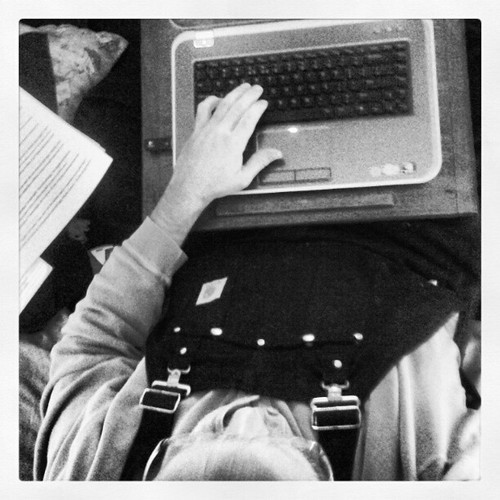
And what is my current primary writing tool? Here it is:

I just got this machine a month or so ago. It’s a Dell Inspiron, running Windows 7. My first laptop was still chugging along, but it was getting ever slower and slower, and showing every bit of its five years of age. For writing, it was a perfectly adequate machine, but web-browsing was getting harder and harder, and it just wasn’t multi-tasking the way it used to. I’d been planning to get a new laptop this year anyway (and from what I’ve heard, I just don’t want any part of Windows 8 until I literally have zero choice). So there it is. This machine isn’t going to win any techno prizes, but it works perfectly well for what I need a computer to do: I can write, surf the web, watch movies and such, and listen to music. Aside from Words With Friends (and now Draw Something, which I play on my tablet, anyway), I’m not a gamer, so I don’t need super-duper graphics or whatnot.
About the only drawback to this particular computer over my last one is the touchpad. I like touchpads, but this one is larger than the last one, and its shifted slightly to the right. In practice, this means that it falls directly beneath the ball of my thumb on my right hand as I type, which can result in me inadvertently moving my cursor to someplace else, as I’m typing. I’ve solved this by using the wireless mouse I’ve owned since I bought the last laptop, so that’s an easy fix. (Oh, and the touchpad doesn’t seem to scroll at all, which I found odd.)
By way of writing software, I’m a faithful user of OpenOffice (because it’s free, not because I have some desire to stick it to Microsoft), and an occasional user of Google Docs. I have Google Drive set up on my computer, and I make a number of regular backups to external drives. I’ve never even looked at this Scrivener thing I’ve heard tell about. Not sure I want to, either.
I do get a bit nervous when I read articles in tech publications touting the impending death of the PC and the rise of the tablet and smartphone as ‘gizmos that do it all’ for the future. Try as I might, I can’t get used to typing on my tablet’s touchscreen. Yes, I only have a seven-inch tablet, but I don’t want anything bigger, and the complete lack of tactile feedback is deeply off-putting, as is the fact that the touch-keyboard’s size makes using both of my hands the way I want to impractical, which in turn means that my tactile ability to trap typos as they happen is severely compromised. Sure, I could get a USB keyboard, I suppose, but then…why not just use a more powerful laptop? No, I think that I will be giving up on laptops only at the bitterest of bitter ends. That is the ground on which I shall make my stand.
Until, that is, they make a gizmo that can plug into my brain and transcribe the stories as I think them. As Keanu says: Whoa….