Your Daily Dose of Christmas

There’s little doubt that the work of classical music most closely and obviously associated with Christmas is Tchaikovsky’s ballet The Nutcracker. I’ve long loved the music of this glorious score, and one of my fondest memories of my musical performing life — now long over — is our yearly Christmas concerts with the college symphony, at which we always played the Suite that Tchaikovksy edited down from the complete ballet. This is one of a relatively few pieces of music that is so strongly associated in my mind with a certain time and place that when I hear it, I am transported back to there and then. I close my eyes and envision Dr. Janice Wade, conducting away, and yelling at us at the very end of the “Waltz of the Flowers” when we would invariably try to ritardando in the last couple of bars, a ritardando that was not in the score. Oh well. You’re not a real orchestral musician until you piss off your conductor.

(A ritardando is when the music slows down, either briefly or a gradual slowing to a new tempo. The last bars of the “Waltz of the Flowers” scream out instinctively for a ritard, and some conductors do indeed employ one on that basis — the music seems to inherently call for it. Problem is, Tchaikovsky did not indicate one in the score, and just as many conductors, if not more, nowadays take the view that if the composer wants a given musical effect they will darned well write it, and if they didn’t, then one is to ignore all the ‘instinctive’ stuff and just play the piece as written. Now, when I was a going concern as a musician, I tended to fall into the latter camp, with certain exceptions. A musical effect here and there that might not be written in the score is OK with me, but I had another conductor who would casually make wholesale cuts in pieces we were playing, a practice which infuriated me then and still bugs me now. Take liberties with the tempi, if you must, but damned well play all the notes the composer wrote!)

Here, then, are the composite parts of the Nutcracker suite. (These are not all taken from the same production of the ballet. It’s a mix-and-match.) Incidentally, another reason I loved playing this piece is that it has a lot of neat stuff for the trumpets to do. Many musicians judge a work on the basis of how it treats their particular instrument, so the Nutcracker suite was A-OK in my book. But from my trumpet playing perspective, an all-Mozart program? Fuhgeddaboudit!

OK, enough of that. The music:

“Miniature Overture”:

Marche:

Dance of the Sugar Plum Fairy:

Trepak (Russian Dance)

Arabian Dance:

Chinese Dance:

Dance of the Reed Flutes:

The Waltz of the Flowers:

Share This Post

A Very Public Service Message

This week being the week of Christmas and all, and thus being a week when Real Life ™ makes things insanely hectic, blogging will likely be lighter than usual, and usual features here might be late or not appear at all. Sorry, but bear with, folks! No hiatus, but updates will be a bit more sporadic than usual.

(As for Saturday Centus, I’m going to take a break on it until the new year. Must focus! Focus!!!)

Share This Post

I could SWEAR there was a Muppet named Elwood.

A couple weeks ago, in one single weekend, The Wife and I watched not one but two movies (along with The Daughter for one of them) with the following plot: guy finds out that an important piece of real estate from his past is about to be sold, so he decides to help preserve the important plot of land by getting his old group of cohorts back together for the first time in years and putting on a show. The first movie was The Blues Brothers. The second was The Muppets. Talk about nothing new under the sun – “Hey, let’s put on a show!” is an old chestnut of a plot. It’s all about the people putting on the show, and the show itself.

The Blues Brothers is something I’d completely forgotten about, to be honest. I hadn’t seen it in many years, and that was in a bowdlerized TBS-for-teevee edition. I honestly remembered very little about it other than the music and the “get the band back together” plot. But then, there’s really not a whole lot to it outside of those things. So, let’s compare and contrast the two films:

Primary Motivation

In The Blues Brothers, the Catholic orphanage that Jake and Elwood Blues grew up in is about to be sold unless the City can be paid by a certain date. Jake and Elwood learn this from the terrifying nun who raised them; this woman is so scary that when she retreats into her office after the meeting is over, she seems to move without walking. Scary. It’s oddly endearing, though, that the Blues Brothers want to save this unpleasant looking place, and decide to do so after they have a religious epiphany – their “mission from God”, pronounced gaaahhd — when they accidentally find themselves at a service in a black church where the music is led by a pastor who looks and sounds an awful lot like James Brown.

The Muppets, on the other hand, has the fabled Muppet Theater, which hasn’t hosted a show in years, about to be sold to an oil man. Boo hiss, evil oil men! Here I think The Muppets missed an opportunity. The evil oil man should have been played by either Larry Hagman or Patrick Duffy. In The Muppets, the scene where the good guys learn of the dastardly plan to sell their beloved theater is pretty prosaic – in fact, it was really the only time in the movie that I felt the plot’s gears a-grindin’ away – but at least it’s over quickly.

Transportation

In The Blues Brothers, we have the Bluesmobile, an old police car that Elwood has purchased and which seems virtually indestructible throughout the entire movie, no matter how many times Elwood drives it with the gas fully floored or how many object it hits – well, until the very end, after it reaches its final destination, when, in one of the film’s best sight-gags, the car falls apart as soon as Jake and Elwood get out. It’s hard not to love that old car, though, and it does bring back certain memories to see all the cars in this film, those old 1970s barge-like vehicles that dominated the roadways. At one point, Elwood gets gas and then says to Jake, “We’ve got a hundred miles to go and a full tank of gas. We’ll make it!” Wow, how things were when a hundred miles constituted quite a journey on a single tank of gas!

As for The Muppets, the car itself isn’t terribly special, but it does boast a couple of nifty abilities: traveling by map (in which case a long journey is shorted by superimposing it on a map that traces the course with a red line, not unlike the Indiana Jones flicks), and traveling by montage (in which case a montage of scenes whips us through the journey). These abilities are actually mentioned by the characters – “Let’s travel by map!” — which is a delightful thing to do because The Muppet Show was always breaking the fourth wall.

The Bad Guys


Here I definitely have to give the edge to The Blues Brothers. In The Muppets, we have your standard evil businessman, who plans to buy the building, raze it, and drill for oil. Nothing terribly original here, even if I’m totally sympathetic to the depiction of the businessman as an evil shill. (Suck it, FOX News.)

The Blues Brothers, on the other hand, has Jake and Elwood incurring the wrath of an entire motley crew of oddballs throughout the entire film, sometimes without even being aware of it. They get cops after them, naturally (driving your car into and through the entire length of a shopping mall will do that). They get a country band after them after they steal their gig. They get a crowd of neo-Nazis after them after they drive right through their demonstration, forcing them all to jump off the bridge they’ve been blocking. And for some reason, there’s an insane woman tracking them, making frequent unsuccessful attempts to kill them in spectacular fashion. Interestingly, the ‘villain’ behind the original threat to the building that they are trying to save isn’t much of a villain at all. It’s a faceless government agency that doesn’t care at all about the building, as long as it gets paid, either by the current tenant or the next one.

The Gang

Here, The Muppets has a built-in advantage, because we already know the gang. In The Blues Brothers, we have to meet each individual band member and learn something about them. But this also leads to a lot of great stuff, as this is how a lot of the film’s musical numbers end up taking place, including one very memorable one with Aretha Franklin (who is not in the band).

This leads to…

Guest stars

The Blues Brothers is loaded with bit parts filled by great blues musicians, right up to cameos by Ray Charles and Cab Calloway. The Muppets doesn’t include any big names within the group, but there are guest cameos along the way, which is a lot of fun. I wondered if some of these cameos are going to seem a lot less fresh in a few years, when some of these folks are less famous, and that will probably happen, but then, it happened with The Muppet Show too. When we watch the old shows on DVD, I have to explain to The Daughter who people like Joel Grey and Sandy Duncan are.

One particular cameo appearance by a Currently Famous Person in The Muppets filled me with glee, but I won’t reveal which one, for those who haven’t seen it. I had no idea he was in the movie, though, until he appeared.

The Music

Both films are wonderful in this regard. The Blues Brothers is loaded with magnificent, wonderful blues music. The Muppets has some new songs that are good enough, but it also throws in a gorgeous performance of “The Rainbow Connection” and ends with…yeah, I shouldn’t spoil that, either. The end credits number of The Muppets is so good, though, that I didn’t even pay attention to the credits at all. I wonder if that frustrates the people whose names appear onscreen at that point?

I’m not actually keeping score, here. But both movies are so clearly cut from some of the same cloth, even though one is full of raunchy, violent humor and the other is, well, the Muppets, that I couldn’t help but think of each one while watching the other.

On The Muppets specifically, I greatly appreciated the movie’s general tone more than anything else. I like irony and dark humor as much as anyone (I also watched Inglourious Basterds recently, with great relish), but the Muppets’ approach has been gentle humor all along. Which isn’t to say that they don’t occasionally make jokes that bite, but when they do, the jokes are usually clever enough that you don’t even notice the bite. One of my favorite sight-gags in the film comes when Kermit and Miss Piggy are talking for the first time in years. They are walking the streets of Paris, having a heart-to-heart…but Kermit is wearing a black turtleneck. That cracked me up.

I’ve seen other reviews of The Muppets that take the film to task for the paint-by-numbers romance between Jason Segel and Amy Adams; it’s the typical “girl wants guy to pay more attention to her than to the other thing that has consumed his passions for years” tale, really an old chestnut of a story. But I think that the film makes that storyline seem so stale that I have to think it’s on purpose, as if to provide a contrast that makes the world of the Muppets seem more real than it actually is. The first scene involves a song-and-dance number with Jason Segel leading his entire town in a “Isn’t it happy to be alive!” kind of peppy tune, but as soon as he departs the screen, the entire cast remains onscreen to slump down in a “Thank God that‘s over” kind of moment. The movie is winking at the audience. Ditto the fact that the movie gives us a Kermit the Frog who hasn’t performed in years, and yet when he turns up in the movie, he’s not bitter or angry at all. He’s just stopped performing. Why? I certainly didn’t care…but I’ve seen other reviews that point this out as a ‘flaw’ in the film. But come on, folks – do we really need to delve into the existential quandaries of a Muppet frog? I find it quite interesting that when we get to the now-reclusive Kermit, he’s just chosen to be reclusive, that’s all. He’s not your washed-up act trying to fight off the memories of past glory by drinking too much.

The Blues Brothers struck me in a similar vein. Despite the fact that it’s a lot more foul-mouthed and violent, it is, in its way, as zany and comical as The Muppets, and I found that it approached its characters and its humor with warmth in a lot of the same ways. These guys have been performing musicians for quite a long time, but they’re confused when they get a gig in a bar and find that the stage is secured top-to-bottom with chicken wire. “Why the chicken wire?” they wonder, only to find out the first time a rowdy patron tosses a beer in their direction. Both movies are, essentially, live-action cartoons with a lot of great music, and there really are worse things for a movie to be. Both are about getting the band back together. At the end of The Blues Brothers, we haven’t seen the last time the band will play together. Will the Muppets continue to play together, though? I suppose we’ll see.


Share This Post

Your Daily Dose of Christmas

Unfortunately, the embedding of the video has been disabled, so you’ll have to follow the link below to see it, but here’s a clip from Love Actually. What’s happening here is that Harry (Alan Rickman) is buying an expensive necklace for a woman in his office. He’s trying to do this quickly and quietly, because the woman is not his wife, who is shopping in the same store with him. But the jewelry counter man (Rowan Atkinson) will not be rushed with the increasingly insane gift-wrapping process.

Watch it here. It’s a great comedic moment, and it’s an interesting one because you’re not sure who you should be rooting for here!

Share This Post

Untitled Post

This isn’t a very good song, but I’m using it because it is heard as source music in On Her Majesty’s Secret Service. Here’s “Do You Know How Christmas Trees Are Grown?”, by Nina (song written by John Barry).

Share This Post

Page One: Cosmos

Page One: Cosmos

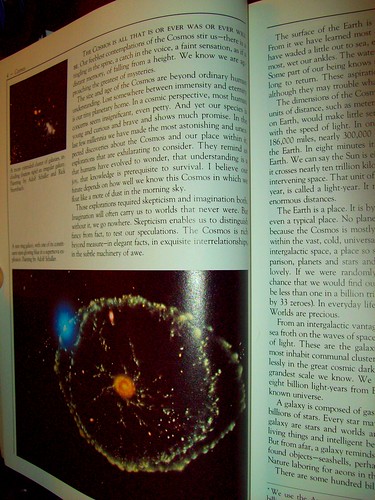
I was in fourth grade when Cosmos first aired. My teacher had a poster up about it in the classroom and encouraged us to watch it. I was quite the space geek at the time, and I expected the show to be about space and nothing else, so when it actually aired, I was baffled that it was about the entire history and breadth of science from a truly cosmic perspective. I didn’t understand much of the show, but I faithfully watched each episode. I remember to this day sitting in my living room, watching Carl Sagan standing on the cliffs above the sea, saying in that wonderful baritone of his, “The Cosmos is all that is, or ever was, or ever will be.”

After three or four episodes aired, we were shopping in one of the local malls (this was when we lived in Portland, OR, so I think it was actually the Washington Square mall), when we spotted the show’s companion book. It was something like $19 (hardcovers were expensive back then!), but my parents allowed me an advance of a whole bunch of weeks’ allowance to buy it. So for the rest of the series’s run, I’d watch and try to follow along in the book. This turned out a little more difficult than I’d expected, as the book is not a transcription of the show (and nor is the show a filming of the book). Both contain material not in the other, and in different sequences.

I was, as I said, only nine. I didn’t understand much of the material. A lot of it sailed right over my head. Most of it, actually. But I could sense something big there, and even now, I remember the sense of wonder certain passages of the show and book created in me: the animation detailing the history of human evolution. The ‘Cosmic Calendar’. The depiction of Johannes Kepler. Sagan’s concern over nuclear weapons. The anecdote of the mathematician who asked his nine-year-old son to name the number depicted by a 1 followed by one hundred zeroes, which the kid called a “googol”. (Sagan pointed out that making up names for numbers has a certain charm, especially if you happen to be nine. Which I was.) And all those poetic turns of phrase: “If you wish to make an apple pie from scratch, you must first invent the Universe.” “The Martians will be us.” “Our obligation to survive and flourish is owed not just to ourselves, but to that Cosmos, ancient and vast, from which we spring.”

No, I didn’t understand much of Cosmos. But I sensed it. (And I sure loved the pictures. Cosmos was the first truly beautiful book I ever owned. The mass-market paperback edition of the book, with only a small selection of the art in a section at the middle of the book, strikes me as a publishing error of high magnitude.)

Cosmos receded into the background of my life a bit over the rest of my school years. The show never repeated at a point where I could watch it again, and it wasn’t until college that I decided to re-read the book in its entirety. This time I understood a lot more of it. During ‘May Term’ of my junior year of college — ‘May Term’ was a four-week ‘semester’ that came in May, during which students took a single course — I discovered that this little dump of a video store up on the corner actually had the entire Cosmos series on VHS. I rented them all and, more than ten years after originally watching the show, saw it again. And it deeply thrilled me, again.

I’ve watched Cosmos again one time since college, although I am in the midst of a re-watch again right now. I’m waiting until I’m done to blog anything about it, if even then; Cosmos is now a classic of science documentary film making, and most folks interested in such things have already seen it. I can say that as a production, it stands up beautifully; some of the science is obviously dated, but the show’s overall theme of science as a candle in the dark (as Sagan would later call it in his book The Demon Haunted World) is as important and hopeful as it always was. And you know what? Over the last few years, as the Buffalo Bills have turned in one crappy season after another, I’ve turned to movies when I’ve reached a point where I no longer wanted to watch the Bills. And Cosmos is perfect viewing for turning around that “My football team just got crushed” funk. Who cares that the Bills just lost 39-2! The Cosmos awaits, man!

Carl Sagan’s death continues to strike me as an awful tragedy. I’m not sure anyone is out there right now who can bring such a sense of poetry to writing about science. There’s precious little science writing out there right now that shows that Sagan-esque quality of evocation of “sensawunda”, and some of what’s out there right now is smug in tone when it should soar.

I’ve read a large number of Sagan’s other works — not all of them, but a bunch. I must admit that when I tried his one novel, Contact, I did not much like it, although I greatly admired the film that was eventually made from it. I wish he’d had the opportunity to write more. As a close to this post, here’s another quote of his, not from Cosmos, but from his essay “A Sunday Sermon”, reprinted in the collection Broca’s Brain. I’ve had cause to think of this quote a great deal lately.

My deeply held belief is that if a god of anything like the tradition sort exists, our curiosity and intelligence are provided by such a god. We would be unappreciative of those gifts (as well as unable to take such a course of action) if we suppressed our passion to explore the universe and ourselves. On the other hand, if such a traditional god does not exist, our curiosity and our intelligence are the essential tools for managing our survival. In either case, the enterprise of knowledge is consistent with both science and religion, and is essential for the welfare of the human species.

Thank you, Dr. Sagan.

Share This Post

ForgottenStars.net

The official site of Kelly Sedinger: Reader, writer, photographer, and dreamer

Skip to content ↓