The Beatles Song of the Week: “While My Guitar Gently Weeps”

Well, maybe I should rename this series of posts, since there’s an element of weekliness that is implied and which I am not achieving at all. Oh well…I guess we’ll just have to stipulate that I never claimed that there would be a Beatles song for every week, but rather that I’ll be posting about the song when there happens to be a Beatles Song of the Week.

I’m not sure that made any sense at all, but let’s plow on, shall we? “While My Guitar Gently Weeps”:

This song’s genesis, as related by Wikipedia, is fascinating. The key phrase “gently weeps” were apparently the result of Harrison choosing to write a song using the first words he saw upon opening a book at random. The song also came at the time when the Beatles were deeply involved in their explorations of Eastern sprituality.

I look at you all see the love there that’s sleeping
While my guitar gently weeps
I look at the floor and I see it need sweeping
Still my guitar gently weeps

I don’t know why nobody told you
how to unfold your love
I don’t know how someone controlled you
they bought and sold you

I look at the world and I notice it’s turning
While my guitar gently weeps
With every mistake we must surely be learning
Still my guitar gently weeps

I don’t know how you were diverted
you were perverted too
I don’t know how you were inverted
no one alerted you

I look at you all see the love there that’s sleeping
While my guitar gently weeps
I look at you all
Still my guitar gently weeps

Harrison’s lyrics suggest that in a universe of constant change (he was reading the I Ching, the Chinese Book of Changes, at the time), there is still on unending constant: the gentle weeping of his guitar. The guitar is eternal; it is unchanging, and all the world’s strife and flux is almost illusory in the face of the guitar and its tones. Even “you” are changing: the “you” of the song has been “diverted”, “perverted”, and “inverted”. “You” were “bought” and “sold” and “controlled”, and your love remains folded. Ouch. That sounds pretty dark, indeed.

It’s not just the guitar that’s eternal, though; it’s the singer himself, who casts himself as the player of the eternal guitar and the observer of our transient world. The singer is placed outside the world: he can see its turning, he can see the sleeping love, and in a particularly fascinating lyric, he can see the floor needing. That last strikes me: usually we’d say “The floor needs sweeping”, which we take to actually mean “You need to sweep the floor.” But the way Harrison frames it in his lyric, it’s the floor that is doing the needing here. How can a floor “need”? And yet, it does.

In terms of the song’s sound, the guitar’s solos suggest the very eternal nature of the weeping by finding a single note to stay around for long periods of time. You hear the guitar keep coming back to same note, over and over and over again, before it finally moves on and finds a different note to constantly return to. The song’s rhythm drives forward constantly, even in the ‘B’ sections where we briefly turn to a more lyrical tone. The guitar in the song isn’t really gently weeping — but it’s certainly constant, unchanging in the face of a world of change.

This is about as far from “She loves you, yeah yeah yeah!” as you can get. What a band.

Share This Post

Hacking at the weeds

After a long time of inactivity, I’ve decided that it’s time to start selling books and such on eBay again, in an effort to weed the collection a bit and to raise a bit of money for Christmas or for buying power tools for myself. You never know…but there’s a new eBay button in the sidebar (down below the link to my Flickr stream). Maybe there’s something there that’s perfect for the reader in your family!

Share This Post

Chaos in action

Note the framing of this video as it starts, implying the direction the big smokestack is expected to fall after the demolition explosives are set off.

Whoops!

(It’s funny because nobody was killed or injured, but this could have been an awful tragedy.)

Share This Post

A word picture

The woman who entered the cafe was tall and thin, dressed in tight jeans, a form-fitting hot pink t-shirt, and a long black cardigan. In the style of the day, she had a wispy lavender scarf twirled around her neck. Her thick, black hair fell to the middle of her back, with one long lock, colored in that dark purplish-red that dark-haired women sometimes like, draped over her left shoulder. Her glasses made her look studious, as did the tote bag containing at least three books that she let fall to the chair in the same motion with which she set her plate down. The plate contained a single slice of pepperoni pizza, and when she sat down, she produced from her book bag a travel-worn water bottle that had the look of having been to the Serengeti once or twice.

Before she ate, she carefully — ever so carefully — opened the newspaper that the previous customer had left on the table, selected the section she wanted to read, and then — also so carefully, ever so carefully — opened the section to an inner page, and folded the paper open in a series of quick, practiced motions that called to mind those of the great masters of origami, that she might read the story that interested her without wrestling with the entire paper.

She laid the paper on the table in front of her, took another sip of water. In her left hand she lifted the slice of pizza, and then she looked around one last time, as if seeking a missed companion, before she lifted the pizza to her mouth.

Whereupon she seized the slice with her teeth, point first, and ripping the rest of the slice away with her hand as she chewed with abandon, ignoring the gob of cheese hanging down over her chin until she had swallowed and washed the bite down with another draw from the water bottle. It was then that she placed the slice back down on the plate, took a napkin from the holder, wiped her chin, and then resumed her savage attack on her pizza slice.

She consumed that slice in little more than 79 seconds, washed the last bite down with one last sip, and then in one motion that also must have been practiced, rose from her chair, slung her book tote over her shoulder, grabbed her empty plate and four used napkins, and headed for the exit, her long, oversized cardigan billowing out as she went.

Leaving me to wonder how a woman with that body ever got that body by eating with such savage glee.

Share This Post

More tools for the job

On the way home from work today I was listening to the local Sports Talk radio station, and they were doing a brief bit with former Buffalo Sabre Rob Ray, who talks on the station on days when the Buffalo Sabres play. At one point, the conversation turns to athletes and their use of Twitter, and one of the hosts asked Ray if he had any plans to start a Twitter account.

Ray’s response was along the line of this: “No way, man! My phone is ancient and you can barely text with it! How am I gonna do Twitter?”

And I’m thinking, Geez, the cell phone has become so dominant in our culture that we forget that there are things called computers?

Every so often I read articles either online or in magazines like WIRED which predict the demise of the PC, the laptop, and pretty much anything bigger than an iPad. I’m clearly no Luddite, but I like my laptop and I have no desire for something like an iPad, which I’m pretty sure would be a pain-in-the-ass to write with. I want a full keyboard, a screen that’s at least 15 inches, and I’m not impressed with something that’s super-super thin.

Come to that, I’m not sure I like anything in which thin-ness is touted as a highly desirable quality. Super-thin pizza? Meh. Thin models are ugly models. Thin computers? Do not want.

Yeah. Give the fat tools, please. Give me your big, your bulky, your heavy masses yearning to generate lots of lap heat!

Share This Post

A Random Wednesday Conversation Starter

I’ve set this post to publish at about the same time I’m getting up today: 3:00 am. This is because of a bunch of jobs at The Store that need doing, which have to be done very early before the associated departments start doing their thing (i.e., before they start handling food). The extra money associated with the overtime will be nice, but 3:00 am is just an awful time to get up.

So: what’s the earliest you can get up where you’re not thinking along the lines of, “Oh crap, I’m up now. Ugh ugh ugh.”?

Share This Post

X-Files Case Report: “Pilot”

So I’ve decided to embark on something of a long-term project here: rewatching The X-Files. I’d like to rewatch the entire series, start to finish, series pilot to final episode of Season Nine, with the first movie (Fight the Future) thrown in between Seasons Five and Six, and culminating in the movie from a couple of years ago (which I still haven’t seen). Obviously this will take a while, and while I’m not going to try to do this on a weekly basis, I’m hoping for at least two or three of these a month. Maybe more, when I watch them in clusters, as may well happen.

Why? Well, why not? Among the blogs I follow which focus on F/SF/H stuff, rewatches of movies and teevee series and re-reads of books and book series are always in vogue, and right now, nobody that I follow is doing an X-Files rewatch, which gives me a niche. This also gives me a longterm source of content (always nice), and it gives me an excuse to revisit a show that was once beloved to me.

Don’t get me wrong, there: as far as I know, I still love The X-Files. The show was an iron-clad, “can’t miss it” event at Casa Jaquandor for most of its run. But with relatively few exceptions, I only saw the episodes a single time each, upon their initial airings; and there are quite a few episodes from the first three seasons that I’ve never seen. I’m interested now, seventeen years after Season One, partly in how well the show has aged. We’ll see!

My fandom of The X-Files was slow to blossom. I was only dimly aware of the show’s existence for most of the first season. In fact, this was back when FOX was still a fairly fledgling network with only a couple of notable shows to its name (The Simpsons, Married With Children), and if I remember correctly, back then, FOX didn’t even have enough shows to put together and entire weekly lineup. (In some ways, FOX still doesn’t. There are no 10:00 shows on FOX.) I heard of this show that had FBI agents investigating paranormal stuff, but I didn’t watch until my mother, who did watch, recommended the show to me. So I saw a couple of episodes during the first season and came away somewhat favorably impressed, but my attention wasn’t grabbed enough to make me a regular viewer until somewhere in the middle of Season Three.

I’m lucky that I came along then, and not later; the show’s “mytharc” was still pretty manageable at that point, and a new viewer could pick up the basics pretty quickly. I do remember, though, a special episode that aired sometime toward the end of Season Three that was basically a summation of the show to that point. I found that very helpful, and a short while later, the show’s popularity led to video releases of early episodes. Of course, this was before DVD, so these video releases consisted of sets of VHS tapes with two episodes each, and only selected episodes at that – no complete seasons here, just the most important “mytharc” shows with a few of the better “monster of the week” shows thrown in. Anyway, I was hooked, and I didn’t fall by the wayside until Season Nine, which struck me as rudderless, pallid, and just too-much-of-a-good-thing. We’ll see what we find as we go, though.

Which brings me to the Pilot Episode. It opens with a teaser sequence, set in the Pacific Northwest, that shows a girl in her nightrobe running through a forest, until she stumbles in a clearing. Here she is met by a human-shaped figure (whose features we cannot see) who is accompanied by a brilliant light; the wind whips up, there is lots of noise, the leaves are blown in circles around them as the light brightens. Cut to twelve hours later, and the girl’s body is found in the clearing by the cops, sporting two circular wounds near her backside. The chief ID’s the body, noting that she went to school with his son; another cop says, “Class of 1989? It’s happening again, isn’t it?”

Cut to Washington, DC and the FBI Headquarters, where a beautiful young agent named Dana Scully reports to her superiors for assignment. She is to work alongside another agent, named Fox Mulder, who has been using his time to investigate cases that are outside the official FBI mainstream. These cases, called “the X-files”, are the kinds of thing nobody wants anything to do with – except for Agent Mulder, who later suggests that it’s only by way of his friends in Congress that he is able to do this work at all. Scully is being assigned for her scientific, skeptical approach; when she asks if she is being expected to debunk Mulder’s work, her superiors manage to say Yes and No in that wonderful bureaucratic way of not saying much at all. Off Scully goes to meet Agent Mulder, who has just caught wind of this strange case brewing out in the Pacific Northwest. After some introductions, Mulder briefs Scully on the odd case and the wounds on the bodies (of which there are four), and then they’re off to Oregon to do some investigating.

This really is one of the better pilot episodes to a show I’ve seen. In the space of about five to ten minutes, we get: an intriguing mystery for the first episode; an establishment of a supernatural/paranormal mood; the introduction of our two main characters, both to us and to each other; the establishment of certain tropes within their relationship; the tense conflict between the official FBI and Agent Mulder; and some initial conflict between Mulder and Scully. They would later come to trust each other in the implicit way of two people who are absolute soul-mates, but there is still constant tension between her skepticism and his willingness to take wild leaps in logic in order to press his case. (Oh, and in the first scene in the FBI Headquarters, there’s an ominous looking fellow lurking in the background who is always fingering a lit cigarette.)

This first case of theirs also sets up so many of the tropes that would dominate the show for the entirety of its run. Alien abduction. Lost time. Mystery elements that are never able to be conclusively explained because the evidence is somehow destroyed or compromised. Implants of unknown origin. Secret government storehouses where old evidence is squirreled away, never to be seriously investigated again. Autopsies of mysteriously deceased persons, and autopsies of mysteriously deceased things that may or may not be persons. Locals who are unwilling to talk to the two FBI agents, and the one local who is. The fact that Agent Mulder is haunted by the disappearance/abduction of his sister. And the solving of the mystery in an unfulfilling way that leaves Scully nothing to report on.

I also noticed that the show’s look that would dominate the first five seasons – dark, cloudy, foreboding, often raining – is in full effect here, as is the moody synth-driven music by Mark Snow (minus the famous main theme, which wouldn’t arrive until the second episode). I was surprised, watching the Pilot episode again, to see just how much of the show’s eventual theme and feel was present right there from the beginning. Everything except The Truth being Out There. But don’t worry – it is. Oh yes.

(Oh, and I promise not to make this series into one long love-letter to Gillian Anderson. But I had no recollection of the pilot featuring a scene with her in her underwear…her skin lit only by the light of a single burning candle….)

Share This Post

“These deadly rays will be YOUR death!”

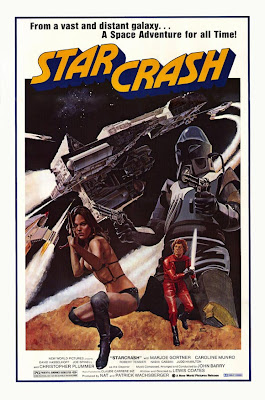
A while back I posted about an old SF B-movie I saw when I was a kid, Battle Beyond the Stars. I saw Battle in this old, somewhat beat-up theater in Hillsboro, OR that often showed double features – which I remember my parents sending me off to with their blessing, only now realizing that it was probably a great way to get an annoying kid out of the house for a few hours. Battle was the main feature that day; the lead-in was another SF flick called Starcrash. Yup, I saw Starcrash in its theatrical run.

If you’re a fan of SF movies, you’ve probably heard of Starcrash — and not in a particularly good way, either. It’s one of the legendarily bad movies of SF history, made on a shoestring budget to capitalize on the SF craze initiated by Star Wars in 1977. I remember kind of digging the movie, when I was 8 years old, but I never saw it again…until a month or so ago. I tracked the film down, wondering just how bad it really was. Is it really one of the worst movies in SF history? Or is it a bit better than I remember?

Well, it’s bad. Really bad. Its badness exists on some kind of epic level. Starcrash is almost a primal force of nature in its badness. Seriously, this is a bad bad BAD movie. But it does have that nice virtue of being bad on a level that’s entertaining in a “watch it just to laugh at it” kind of way.

The main characters is a female star pilot and criminal named Stella Star, who is gamely played by Caroline Munro, a buxom, gorgeous woman whose best-known role was a femme fatale who tries to kill James Bond in The Spy Who Loved Me, but upon whom Bond turns the tables and kills instead. (Interesting Bond trivia: Munro’s Spy Who Loved Me character, Naomi, is the first woman directly killed by James Bond in the movie series. Sure, he’s responsible for a lot of women dying, but she’s the first we ever see expire by his hand.) Stella is flying around with a curly-headed guy named Akton, when they incur the wrath of a couple of space cops, one of whom is a robot named Elle. They are basically blackmailed into searching for a lost ship that carried on it the son of the Emperor of space, or something like that. This is important because there are bad guys about, led by an evil Count, planning the conquering of the Empire. Or something like that.

Starcrash is one of those movies where when you try to summarize it, you find yourself saying vague things and using the phrase “or something like that” a lot.

Much of the middle section of the film settles into routine: Stella and friends go to a planet, find the Prince isn’t there, evade some dangers, and go to the next planet. Eventually there is betrayal, a bunch of mystical stuff involving Akton that makes no sense at all, the Prince turns up (played by David Hasselhoff!), we meet the Emperor (played with benevolent and soporific droning by Christopher Plummer), and we finally find out what the title “Starcrash” means. It involves crashing. Among the stars.

Below the fold are some screencaps of the glory that is Starcrash.

This is what space looks like. Kinda trippy – lots of stars of different colors.

Stella Star, on the right, and her trusty sidekick Akton. Ships in this movie are boxy and square on the outside, and filled with circles and ovals on the insides. Weird.

Stella’s line here – believe it or not – is “First you gotta catch me, you dirty cop!” Note the goofy smile on Akton’s face. That’s his main facial expression.

The evil count.

The evil count dispatches his robot assassins!

Stella is taken prisoner and put into a forced labor camp. Wearing this. Zowie!!!

Oh noes! Attack of the fifty-foot big-breasted sword-bearing robot!

Oh noes! Attack of the badly animated robot assassins!

Oh noes! ‘Tis the Hoff!

Hey, a sword that’s a laser! A saber made of light! What an idea!

The Emperor on his throne, which looks like…geez, how would you describe that thing?

If you decide to watch Starcrash, please prepare yourself for a bad movie. Drinking may help.

Here’s the trailer!

(Poster via)

Share This Post

ForgottenStars.net

The official site of Kelly Sedinger: Reader, writer, photographer, and dreamer

Skip to content ↓