From the Books: Dungeon, Fire and Sword

(A series in which I post longer excerpts from books I read)

This post is apropos of my post the other day on the movie Kingdom of Heaven. I’ve long been fascinated, along with many others, of the tale of the Knights Templar, the order of monastic knights founded during the Crusades who were later undone when the Pope and the King of France turned against them, ultimately leading to their final grand master, Jacques de Molay, being burned at the stake. Many legends have sprung up round the demise of the Templars, such as the disappearance of their fabulous treasure; the fleet of Templar ships that supposedly set sail from France when the uprising against them began, never to be seen again; the curse called down by Jacques de Molay on all those who betrayed the Templars. But the true story of the Templars is no less compelling than the legends, and it’s the true story that forms the backbone of John J. Robinson’s wonderful book Dungeon, Fire and Sword: The Knights Templar in the Crusades.

Robinson takes the approach of storyteller rather than dry historian as he recounts the tale of the Templars and their role in the larger Crusades that led to their founding in the first place. The Crusades are the ultimate period, I suppose, for those who love high adventure and drama in their history; they are replete with heroes and villains, with honor and treachery, with heroism and cowardice, with secular ambition and spiritual devotion. I haven’t read many books on the Crusades, so I can’t give Robinson’s book a comparative recommendation on that score, but it is one of the best history books I’ve ever read. He makes the history come alive, which is no mean feat.

Excerpted below is Robinson’s account of the events that took place at the Horns of Hattin. King Guy of Jerusalem has decided to march out to meet the forces of Saladin, at the behest of the Templar grand master, Gerard de Ridfort. The battle turned out to be a complete disaster, as the Christian forces made one mistake after another that played into the hands of Saladin, the Muslim leader. Thus it was that one of the most resounding defeats in the entire history of the Crusades was suffered by the Christian army:

That afternoon they reached the barren shelf above the village of Hattin. Ahead of them was a rock structure that rose into two summits, known locally as the Horns of Hattin. Beyond it, the road dropped to the Sea of Galilee, but Saladin’s army was across the road. Gerard sent word to King Guy [King of Jerusalem, 1186-1190 AD] that his harrassed Templars could go no further that day and that the Christians should make camp where they were. Most of the barons, including Raymond of Tripoli, wanted to press on immediately and fight their way through to the life-giving waters of the great lake. The army just could not go on for more hours without water. Once again the Templar grand master won out, and the king ordered the army to make camp. Some fo the men struggled to the slope of the Horns of Hattin, where they had been told they would find a well. They found it, but it was dry. No form of discipline could keep reins on men crazed with thirst, and several groups broke away to search for water. They were easily killed off by Muslim outposts.

Knowing that the Christians were already overcome with heat and thirst, Saladin decided to add to that discomfort by depriving them of sleep. The nobles had tents, but the whole armychose to sleep in the open to enjoy the cooling breeze. The Muslims set fire to the dry brush that covered the hills. Soon the breeze carried the hot acrid smoke into the Christian camp, making it difficult to breathe. Using the cover of the smoke and the darkness, Saladin positioned his troops throughout the night, so that when dawn broke, the army of Jerusalem found itself completely surrounded.

A whole night after a whole day without water was driving men mad with thirst, made worse by the dawn reflecting off the waters of the fabled lake below them. Some suddenly started to run for the water, and as the momentum built, thousands of foot soldiers rushed down the hill, not to fight, but to drink. Those who were not chopped down by the Muslim cavalry as they ran were herded together and taken prisoner. Raymond of Tripoli led a charge against the Muslims, but they simply opened their ranks and let his party gallop through them, then closed ranks behind him. Once outside, there was no way Raymond’s party could rejoin their comrades, so eventually they rode off the battlefield and back to Tripoli. Some of those left behind were convinced that they had witnessed an act of treachery.

The remaining knights fought to their limits, making charge after charge and repelling the cavalry sweeps of the Muslims, but they were steadily driven back up the hill.

Saladin’s son al-Afdal remembered: “When I saw them retreating with the Muslims in pursuit, I cried out in joy, ‘We have beaten them!’ The sultan pointed to the bright red royal tent of King Guy at the top of the hill and said, ‘Be silent. We shall not defeat them until that tent falls.’ As he spoke, the tent fell.”

The Christians were beaten as much by sheer exhaustion as by numbers. When the victorious Muslims broke through to the center of the Crusader defense they found knights and barons, including the king himself, prostrate on the ground with no strength left to lift their arms, much less their weapons. The leading nobles were all made prisoner and taken to a regal pavilion set up for Saladin on the battlefield. There the sultan greeted them with courtesy, inviting King Guy to sit by his side. Knowing that his royal guest was suffering from severe thirst, Saladin handed him a cup of cool water. Guy gratefully took a long drink, then handed the cup to Reynald of Chatillon. Saladin immediately asked Guy to remember that it was he, not the sultan, who had passed the cup to Reynald. That should have told them what the sultan had on his mind. Saladin was telling them that what would happen next did not violate the Muslim laws of hospitality that protected a man who was given food or drink by his host.

Saladin then turned to Reynald of Chatillon, whose crimes he began to recite angrily, cataloging Reynald’s lies, his betrayals of trust, his breaking of one truce after another. Made even angrier by Reynald’s arrogant reply, Saladin grabbed up a sword and struck off his head. He quickly assured the shocked Christian nobles that they were not condemned to share Reynald’s fate. They would be ransomed or exchanged.

Such mercy did not extend to the Knights of the Temple and the Hospitallers who ahd been taken in the battle. They were to be the star performers in a bizarre and brutal drama. Saladin was being visited by a group of Muslim Sufis from Egypt. Although fanatic Muslims, the ascetic Sufis were students of the Koran, not warriors. Saladin announced that they would have the honor or cutting off the heads of hundreds of captured knights of the military orders. Afraid the deny the great sultan, they took the proffered swords in hand as Grand Master de Ridfort was forced to watch. When a lucky stroke cleanly severed a neck, a cheer went up from the watching Muslim soldiers, while taunts and shouted suggestions went to those who hacked away at their victims six, seven, or eight times to get the head separated from the body. It was a grotesque carnival of blood, and one can only speculate on de Ridfort’s thoughts as he watched the horror for which he was principally responsible, knowing as well that he was the only captured warrior monk who was to be spared this death by amateur executioners.

Saladin took time for one other piece of business. The bishop of Acre had been killed in the fight, and the Muslims had taken the holy relic of the True Cross. Saladin expressed his intention to have it taken to Damascus to be placed under the doorstep of the principle mosque of the city, so that each time one of the faithful entered the mosque he would trample on the Christian relic. It was the ultimate humiliation. It was not, however, the ultimate victory. The Christians still held the holy city of Jerusalem.

Robinson wrote another book, Born in Blood, on the history of the Freemasons. I wish he’d written more; he had a deft touch for narrative in history.

Share This Post

My Geek Life

I seem to recall doing this quiz thing before, but they all run together, so here it is. I got it on Facebook and did it over there, but I figured I should put it up here as well, so here it is. You just ‘X’ in the items that pertain to you….

(X) You spent a day watching all of the Lord of the Rings/Star Wars/Star Trek movies.

(I’m claiming this, even though when we did this is was in college when there were only three Star Wars movies. Someday I want to watch the entire saga in one shot. I also want to watch all twelve hours of LOTR in one shot, and if I feel REALLY ambitious, I want to start watching an entire season of 24 at the time of day the first episode starts and then follow the entire season in real time.)

() You spent next two days after watching commentary, outtakes, and behind the scenes footage.
(X ) And you bought the soundtrack.
(x) You went to a midnight release of a movie.
( ) You camped in front of the theater for more than 12 hours to get tickets.

I only stood in line for Phantom Menace tix for an hour or two.

( ) Camping did not prevent you from being in costume.
(x) You can have an entire conversation with friends consisting of quotes from your favorite movies.
() You own at least three game systems.
() You have lost weight because you forgot to eat while trying to reach the next level in your game.
() You own more than four game controllers (of any kind).
( ) You have existed on 3 hours of sleep per night so that your “Sims” get 8 hours and are refreshed for work.
() You upgraded your computer because you wanted to buy a new video game/expansion pack.
( ) You have dressed as your game avatar, or as a npc in that game.
() You achieved level 60 on World of Warcraft.
(x) You have played “Dungeons and Dragons” or any other RPG.
(x) You know what “RPG” stands for.
( ) You dressed as your RPG character would dress.
(x) You own dice with more than six sides.
() You have been accused of having a “gamer” Scent.
() You can identify a Black Lotus.
( ) You can identify a Charizard.
( ) You have bought any of the “Harry Potter” books after standing in line until midnight.
( ) You waited to get your “Harry Potter” book in costume, quoting favorite lines.
( ) You have attended any function with “con” in the name.
( ) You stood in line at said “con” for more than 4 hours to have an item signed.
( ) You spent more than $50 on a costume to wear to “con” because you wanted it to be authentic.
(X) You own more than 50 comics.
(x ) You collect your comics in longboxes.

(Used to, anyway. Not in official longboxes, but reasonable facsimiles thereof.)

(X) You know what a “longbox” is.
( ) You’ve met and had your comics signed by the creator(s).
( ) You know how many “Robins” there are.
(x ) You know that the portrayal of Rogue in the movie “X-Men” is completely wrong.
(x) You have chatted online more than in person.
() You chatted online enough to learn the time zones.
() You think that when the Mythbusters say “Don’t try this at home,” they really don’t mean YOU.
(x ) Have participated in a movie/tv marathon that involved a drinking game.
() Can sing along with the Buffy Musical Episode.
(x) You know Seth Green from more than just the “Austin Powers” movies.
() You can name all 8 Kevin Smith-directed movies without referring to IMdb.

(AGGHHH! So close.)

(x) You have participated in a “Clerks”-esque discussion about Star Wars (or any other movie).
(x) You have participated in a Kirk vs Picard discussion.
(X) You have participated in a Star Wars vs Star Trek discussion.
( ) You have participated in a Babylon 5 vs. Star Trek:DS9 discussion
(X ) You know who jms is.
(X) You have ever corrected anyone who called you a Trekkie.
( ) You have worn a Star Fleet Uniform.
( ) You own a Star Fleet Uniform.
(x) You think “Twilight” is lame because everyone knows that vampires burst into flame in the sunlight.

(I think it’s lame because the writing sucks and the characters are brooding morons.)

(x) You have written fanfic.
(x) You have watched Bizzare Foods and thought “I’d try that.”
( ) You can pinpoint the moment at which “Lost” jumped the shark.
(X) You know who Stan Lee is.
( x) You know who Jack Kirby is.
( ) You know who Geoff Johns is.
(X) You have built a website.
(x) You have started a blog.
(x) You maintained a blog for over a year.
( ) You know what the Genie SFRT is
() You have a Twitter account.
( ) You have over 500 followers on Twitter.
( ) You purchased a smartphone just so you could check Twitter on the road.
() You forget your family members’ birthdays because they aren’t your friends on Facebook.
(X) You have given virtual gifts on Facebook.
() You have Superpoked your boss on Facebook.
() You have gotten a date through Facebook (and we’re not talking dinner and movie with your buddies).
( ) You have broken up with someone/been broken up with through Facebook
() You’ve reached level 30 or higher in Mafia Wars.
() You know what Mafia Wars is.
(X) You participated in more than three social networks.
(X) You’ve spent more than 200 hours playing the same video game.
(x ) You’ve seen any movie in the theater more than three times.
( ) You can name the episode of MST3K where Joel was replaced by Mike.
(x) You’ve argued why the comic is way superior to the show/movie when discussing “The Tick,” “Teenage Mutant Ninja Turtles,” “X-Men,” “Fantastic Four,” “Spider-Man,” etc.
(x) You have the soundtrack for “Dr. Horrible’s Sing-Along Blog” on your MP3 player.
(x) You are willing to defend the Star Wars prequels.

(TO THE DEATH!!!)

() You openly disparage the Star Wars prequels because they don’t live up to “Empire.”

(NEVER!!!!)

( x) You’re openly concerned about the time line ramifications that J.J. Abram’s “Star Trek” movie presents to the canon.
( x) You own anything written by Neil Gaiman, Alan Moore or H.P. Lovecraft.

(Check, check and check.)

( ) You have a flying spaghetti monster on your car
() You’ve seen a midnight showing of Rocky Horror Picture Show with live actors in front of the screen.
(x) You know the REAL reason Spider-Man had a black costume
( ) You know the NCC numbers of at least two starships other than the Enterprise
( ) You know what “NCC” stands for.

(Used to, on both counts…my handle on Trek lore is sadly well past its prime.)

( ) You own an original Star Trek Concordance, Technical Manual, and Blueprints

(Used to! Oooooh, my beloved Tech Manual!)

( ) You own at least two medieval weapons
( ) You have participated in battles with foam-covered swords
( ) You know who “Major Matt Mason” is
( ) You have seen bootleg copies of the original Fantastic Four and Justice League movies.
( x) After having had children you realize there’s now more people to costume and relish it.
( ) You’ve managed to turn four days at Euroquest* into nearly eight because, who needs sleep?
( ) You’ve spent more than $1000 on your “spot-on” costume. (and it’s still not quite right…)
( ) You’ve made a fan film.
( ) Your fan film has been seen by more than your immediate family.
(X) People know you by your online name instead of your mundane name.
() You know what Pennsic is.
( ) You’ve camped at Pennsic.
() You have/had personalized plates on your car proudly proclaiming your fandom.
( ) Your spouse and/or friends do as well.
(x) You yell at your kids when they try to open a toy/book/comic/figure etc. that you’re collecting.

(I don’t yell…but I’ve bought copies of stuff for The Daughter so she wouldn’t mess up mine.)

(x ) Your kids have broken your Hallmark collectible Star Trek/Star Wars, etc. ornament.

(Oh, you HAD to bring that up!!!)

( ) You’ve traveled more than 500 miles to attend a con.
( ) You have a tattoo related to your fandom of choice.
( ) You met your spouse at a fan-related event or con.
( ) You got engaged (to be married!) at a sci-fi convention.
(x) You are publicly willing to defend Dollhouse, because Joss Whedon must be trusted.

(That first episode did NOT suck, and I haven’t watched the rest yet, but when I do, look out!!!)

And there we have it! This identifies certain areas where my geekiness fears to tread, mainly in the area of gaming. I just don’t have time, and I’d love to. Maybe some day….

Share This Post

Sentential Links #162

OK, after a week off, we’re back in the saddle again.

:: There are two novels that can change a bookish fourteen-year old’s life: The Lord of the Rings and Atlas Shrugged. One is a childish fantasy that often engenders a lifelong obsession with its unbelievable heroes, leading to an emotionally stunted, socially crippled adulthood, unable to deal with the real world. The other, of course, involves orcs.

:: Ninjas are for those people who think bounty hunters are the best part of Star Wars because the only stuff in Star Wars they can stand is stuff that happens offscreen in their minds.

:: The Darwin debate never ceases,
For he wounded the pride of our species
When he made you and me
Share the family tree
With those monkeys that love to fling faeces.
(An older post, but funny. Kudos!)

:: To celebrate (or mourn) the last episode of Battlestar Galactica tonight, I made Cylon cookies. (Wow, I really need to watch BSG one of these days.)

:: It’s always interesting to see a place through the eyes of a person who came from somewhere very different.

:: Widower/crooner Danny Gokey did not wow the judges this week with his version of the Carrie Underwood smash, “Jesus, check the oil”. (I suppose I should go on record as saying that I actually kind of liked Adam Whatsisname’s LSD-enhanced, Ravi Shankar-ized arrangement of Johnny Cash’s “Ring of Fire”. I can see why a lot of people hated it, but I liked that he was the non-country singer who, instead of trying to find some kind of country song he could sound kinda-sorta countryish with and just survive to the next round, instead chose to do something completely off the wall in an admission that country just isn’t his thing. I also want to know if Paula, eternally drunk and/or stoned as she is during Idol, started to flash back during the performance.)

:: I do enjoy pointing and laughing, but I’ll refrain for the moment. Why? Well, I’ve heard tell that a noble spirit embiggens the smallest man, and I hope to imagine greater. (SyFy? WTF?!)

:: One of the problems when your life is a literary conceit …

… is that you maintain faith in the happy ending. (Boy Howdy, she’s right on that one.)

More next week….

Share This Post

Unidentified Earth #60

OK, after a week off last week, UI returns. As of yet, UIs 58 and 59 are without guesses of any kind! If you were to approach UI 58 on horseback, you might hear somewhere in the back of your head the playing of a Hardanger fiddle, while UI 59 looks like one of the most nail-biting drives in North America. Hmmmmm.

And now, the new one:

Where are we? Rot-13 your guesses if you’ve got ’em, folks!

Share This Post

Stupid Thoughts that Randomly Popped Into My Head

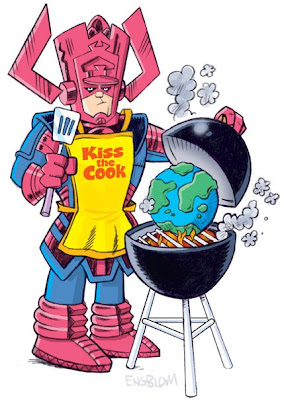
OK, so for some reason, I was thinking about Galactus. He’s the Marvel Comics supervillain who basically flies around the Universe eating planets, because that’s what he eats: planets. So I was thinking, does he get in the mood for certain kinds of planets? I mean, is Galactus ever kicking back and thinking, “Hmmm, I could go for a nice frozen rock of a planet right now, kind of like that one they call ‘Pluto’ in that one system I’m not supposed to eat?”

Are there any planets that are a guilty pleasure for Galactus, in the way that, say, a bucket of fried chicken might be a guilty pleasure for humans right now? As in, “Boy, I don’t eat gas giants all that often because they’re really not terribly good for me, but sometimes I gotta indulge!”

Are there any planets that Galactus avoids unless he’s utterly ravenous, because he either hates the taste or because they disagree with him? Does Galactus fly through our system, look at Mars, and think, “Tastes good, but I’d better not. Last time I ate a planet with that much red dust, I had heartburn for a thousand years.”

Does Galactus ever throw up? What does that look like? Could our Solar System’s asteroid field have resulted from Galactus doing his Galactic equivalent of praising the porcelain god?

Would Galactus’s Thanksgiving dinner consist of eating Jupiter, Saturn, Uranus and Neptune in one shot? Would he take a nap afterward?

Would a planet like Venus, by virtue of all that CO2 in the atmosphere and all the sulfuric acid and other nasty chemicals all over that world, leave Galactus with a really nasty aftertaste in his mouth? Would it give him a bad case of space flatulence?

When Galactus is just kicking back and wants to nosh on some snack food, does he snack on moons and comets and stuff like that? Is an Oort Cloud his version of a big bag of Cheetos?

And does Galactus ever get to wash it all down with anything at all? Or could his constant angry look just be the fact that he has eternal cottonmouth because he can’t ever get a nice drink to clean out his palate?

If Galactus eats a planet that hasn’t completely solidified yet because its accretion disc isn’t quite done accreting yet, is that his equivalent of eating something that’s only half-baked? Does he spit it out when he realizes it isn’t done yet? Does he shove it closer to its sun to help it cook a bit more, like throwing a steak back on the grill?

Yeah. I desperately need to get out more.

(Above image stolen from here.)

Share This Post

A Farewell to Sylvia

Well, voting has closed on my inaugural “Make Me Read!” poll, and it wasn’t even close. Sylvia Plath got stomped. I guess there are no fans of hers among my readers? Or maybe people just think that Hemingway is better. Who knows — but The Bell Jar got a single lone vote, while A Farewell to Arms got fourteen. So, Hemingway it is. Bring him on! And thanks for voting. The next poll will appear when I finish Arms, and thus begin GGK’s Tigana.

Share This Post

“If God does not love you, how could you have done the things you’ve done?”

(UPDATED twice below.)

So asks a Muslim nobleman of Balian of Ibelin near the end of Ridley Scott’s movie Kingdom of Heaven. Balian, who has been seeking God’s will through the entire film, makes no real answer as he takes his leave of Jerusalem, yielding to the Muslims who, under the leadership of Saladin, have conquered the city. And yet, Balian leaves with the respect, shared mutually, of the Muslim nobles.

Almost three years ago (as of this writing; more than that, as of this posting), I watched Kingdom of Heaven and was, as has been my typical experience with Ridley Scott’s movies, underwhelmed. I didn’t dislike the film, per se, but I found it curiously uninvolving and emotionally cool, despite the typical Scott production values. (The film is utterly gorgeous, one wonderful shot after another, but more on that later.)

I learned a while later that the film was a victim of the all-too-common movie malady, the dreaded Studio Cut, in which a director makes a movie the way the director wants, but when he screens it for the executives, they dislike it and mandate a whole bunch of cuts. In the case of Kingdom of Heaven, a three-hour epic that took its time telling its story was forced to become a two-hour pseudo-epic that felt overstuffed and, at the same time, underexplained. So, when it came time for the DVD release, Scott was allowed to restore the material he hadn’t wanted cut — almost an entire hour’s worth of material.

Now, not all movies are helped by indulging directors’ desires to stick stuff back into the films for DVD releases. But many are, with some movies – the Lord of the Rings films, for example – so benefit by their expansions that the “Extended editions” become the canonical versions. Really, who watches the theatrical cuts of LOTR anymore? Kingdom of Heaven benefits from Scott’s revisiting to a frankly amazing degree: the movie was a serviceable medieval war story, but now, in its Extended Director’s Cut, it’s a stunning epic. As I watched its story unfold, I kept thinking to myself, “Why didn’t I like this movie this much last time?” And I was often hard-pressed to come up with an answer. Even though it’s been three years since I saw the theatrical cut and thus can’t remember it well enough to definitively say what’s been added and what has not. (Upon further review, the entire subplot of King Baldwin IV’s nephew, who would become King when Baldwin IV dies, is new to this version.) This isn’t a movie with a few scenes added just to get you to buy the DVD. Nor is it an Extended version with lots of new scenes that enhance the movie you’ve already seen. So much has been restored for this version that it’s an entirely new movie.

The story is one of those “Poor stiff finds fame and glory in a far-away land” tales. Balian (Orlando Bloom) is the blacksmith in a French village; as the film opens, he is mourning his wife, who has committed suicide after losing her baby. Soon a band of Crusaders returns to the region, including a man (Liam Neeson) who is now a Baron in the Holy Land, and who turns out to be Balian’s father. After some nastiness, Balian has no choice but to leave his home and travel to the Holy Land himself, not so much as a Crusader but as a man seeking favor with God after committing sinful acts. On his way he makes friends and enemies, some of whom are Muslim and some of whom are fellow Christians; he becomes embroiled in all manner of political intrigue in the Holy Land at the time when the King of Jerusalem (Baldwin IV) is a leper who is nearing death and when the Muslims have found their greatest leader, Saladin, who is winning victory after victory. Balian finds himself involved with Sibylla, and toward the end of the film, he finds himself charged with the defense of Jerusalem itself.

Scott is, as ever, a visual genius, and there’s nary a shot in this entire film that doesn’t have something interesting going on. His Holy Land, hot and bright and dusty, contrasts with his Europe, which is cold and wind-swept and a place where snow is constantly fluttering down from gray skies. The sets are opulent and magnificent, and the long shots of medieval Jerusalem, created by computer, manage to look authentic. I’ve never questioned Ridley Scott’s skills as a visual director, but I’ve always found his movies somehow uninvolving on the human side – until this one, or at least, this version of this one. Watching Kingdom of Heaven now, in its longer version, I found my attention never wandering at all.

The film is full of fine performances. Orlando Bloom plays Balian, and it’s a good performance, if not especially wide-ranged. It seems to be accepted wisdom that Bloom is a bad actor and mainly a pretty face, but I don’t think that’s fair; he strikes me as a British version of Kevin Costner, a guy who may not have the wide range of quite a few better actors, but whose performances are better than typically seen and who, in the right role, can actually shine. Eva Green plays Sibylla, a woman caught between love and duty to her nation and her son, with lots of emotion that looks forward to her turn as James Bond’s first great lover in Casino Royale. The supporting cast is superb across the board, with not a single false note in the entire cast. Most notable is Edward Norton, who embodies King Baldwin IV; what’s amazing about him is that the King wears a silver mask in all of his scenes, owing to his disfigurement from leprosy. With no ability to call on facial expressions or even eye movements, Norton nevertheless conveys a wide range of feeling in his performance, so much so that this film is a good answer for anyone who has ever wondered how convincing Greek drama must have been, with all of those performers in their masks.

Many of the film’s events are drawn from true history; Baldwin IV really did die young of leprosy, and his successor, Baldwin V, did die at the age of nine. There was a Queen Sibylla who ruled alongside King Guy; there really was a Balian of Ibelin. Raymond of Chatillon really did suffer the fate depicted herein. It’s not strictly accurate history, obviously, but this movie treats its subject matter with respect. This isn’t a movie like the Pirates of the Caribbean films, which exist in a cheerfully-ahistorical timeline. And the film’s villains aren’t exclusively Muslims, nor are they exclusively Christians. There are honorable men and women on both sides, which is a pretty remarkable stance for this film to have taken given that it was made in the days following the 9-11-01 attacks.

The music for the film is by Harry Gregson Williams, a composer who has emerged over the last decade as a potentially exciting new voice (his most notable work is for the Narnia films). Here he writes a score that blends medieval European religious chant with soundscapes evocative of the Middle East, resulting in a score that is often captivating. The only down part of the score is the odd use, in a late scene in which Balian must give a rousing speech to the inadequate defenders of Jerusalem, of a cue from Jerry Goldsmith’s score to the movie The Thirteenth Warrior. I have no idea what possessed Ridley Scott to use this music here, when Gregson Williams has written an otherwise wonderful score for this fairly meditative epic, but Scott has a long history of making odd decisions with regard to the music for his films, so who knows. A regular viewer watching the movie probably wouldn’t even notice that there’s a melody heard in that scene that never occurs in any other part of the movie; they’d only notice that the music there is nicely rousing for a scene that’s rousing in nature. But a film music geek like me? That stands out like the proverbial sore thumb.

I’m glad Ridley Scott was afforded the opportunity to revisit this film. It really is a superior effort; it’s most certainly my favorite film by Ridley Scott. I can’t recommend it highly enough. (And now I’m actually looking forward to Scott’s announced project on the Robin Hood legend.)

UPDATE: My take on Orlando Bloom as an actor isn’t taken well at an Orlando Bloom message board, which strikes me as odd, since I openly state he’s not a bad actor. I actually think he’s pretty good. He’s not Olivier, or Ian McKellen, or Daniel Day-Lewis, but Bloom does perfectly well in the movies I’ve seen him in. He’s fine in Lord of the Rings, he’s fine in the Pirates of the Caribbean flicks, he’s good in Elizabethtown, and he’s good in Kingdom of Heaven. I’m not sure what their point of contention is, unless they’re of the view that I’m actually not being sufficiently effusive in my praise of Bloom as an actor. I’m not often taken to task for not being nice enough in my compliments, but there it is. I just know that most times I see Orlando Bloom mentioned, and people rip on him as being a bad actor, which I think is pretty wrong-headed.

I guess you can’t please everybody.

UPDATE II: Now that some more replies have popped up at the message board thread linked above, I see that the main point of contention seems to be my comparison of Orlando Bloom to Kevin Costner. I wasn’t making a one-to-one comparison of the men as actors, but I cited Costner as an example of another actor whose work I think tends to be unfairly maligned. No, Costner wasn’t a particularly great Robin Hood, but he’s really good a lot more often than a lot of stuffy cinema folks like to admit. (Bull Durham, Dances With Wolves, Tin Cup, Field of Dreams, A Perfect World, and JFK are all good examples, to my mind. And frankly, if I concede that Bloom would make a better Robin Hood than Costner did, surely one must also agree that Bloom could not play Crash Davis anywhere near as well as Costner did!) That’s all I meant with that comparison. So when I say that I see Orlando Bloom as a younger, British version of Costner, I do not mean that as an insult.

BTW, folks over there, you’re welcome to comment here too! I don’t bite. Not usually, anyway.

Share This Post

Answers!!!

Finally getting back to the questions of Ask Me Anything! 2009, here are a few answers.

First up, reader and frequent commenter (especially when I give voice to my Inner Liberal!) DaveS asks:

As a movie guy Did you Like Siskel & Ebert? Which one did you prefer?

I loved Siskel and Ebert. Loved ’em. During the 90s, they were usually on where we lived on Sundays at 10:00 or maybe it was 11:00; I watched faithfully. Their main corporate sponsor at the time was, appropriately enough, Orville Reddenbacher Popcorn. As entertaining as it was to listen to them disagree, I got more out of it when they agreed on movies, because that almost always meant that it meant something good. I honestly don’t recall ever seeing a movie that got “Two Thumbs Up!” that I personally didn’t like. I also loved how they didn’t just constrain themselves to the newest blockbusters and major releases; they’d frontload the show with those sorts of films, but toward the end they’d discuss the smaller films, the documentaries, the indie films, the foreign films, and that sort of thing. The show, for just its half hour a week, was never just about how good the newest Schwarzenegger flick was.

There was never anything cynical in the approach Siskel and Ebert took; each man showed a fierce love of film that always shone through, even when they disagreed. I recall one argument the two men had once that led to Ebert saying to Siskel, “I don’t think you wanted to like the movie”, to which a shocked Siskel replied, “How can you say that? I love to like movies!” Lots of critics write with a tone that implies that they are genuinely surprised every time they like a movie; Siskel and Ebert never seemed that way.

As to which man I liked more, I’d probably have to say Ebert, although that’s not so much based on the show as the fact that Ebert has had significantly greater visibility over the years, between his prolific writings on film and the fact that Ebert is still alive. I honestly don’t recall reading much of Siskel’s work, so I have no idea what kind of writer he was. But he and Ebert had a wonderful chemistry that has obviously not been duplicated since, even if Ebert had a decent partnership with Richard Roeper.

There seems to be a consensus that Ebert’s writing has improved substantially since his bouts with cancer rendered him unable to speak. I’m not sure if it has; Ebert’s always been a fine writer. More likely the attention has been focused more on his writing, now that that is his only real avenue for expression.

But yeah: I liked Siskel and Ebert a great deal.

More answers to come!

Share This Post

Something for Thursday

Natasha Richardson wasn’t in Love Actually, but her husband, Liam Neeson, was, and in that film he played a role he can now sadly play in real life: a bereaved husband.

From Love Actually, here is the Glasgow Love Theme, by composer Craig Armstrong. You can ignore the slideshow of images from the film; I selected this clip because the sound is better than some others.

Sigh….

Share This Post

ForgottenStars.net

The official site of Kelly Sedinger: Reader, writer, photographer, and dreamer

Skip to content ↓