
Streaming Killed the Cinema Star

This is a topic that just keeps coming up, and up, and up on social media: seeing movies in the theater versus waiting to stream at home. The latest go-round of this topic came up just in the last day or two, via this news report:

A new poll by HarrisX, exclusive to IndieWire, found that 34 percent of U.S. adults prefer to watch movies in theaters, which means a solid two-thirds would rather wait for them to be released on streaming.

“The competition continues between streaming services and the Hollywood engine. While we still see evidence of loyal movie-goers in recent box office numbers, our study shows that 2 in 3 movie watchers prefer to stream movies at home,” Alli Brady, VP at HarrisX, told IndieWire. “Despite this causing some upheaval for the industry, it also means that the demand for content is only increasing – nearly half of consumers say they stream movies weekly, more than 7x as frequently as those who do so in theaters.”

Brady’s pollsters also found that 30 percent of us stream a movie two or more times per week — the same percentage of respondents said they go to movie theaters “a few times a year.”

I have to admit that I have become one of the people who is more likely to wait for a movie to be able to stream at home than see it in a theater, though I’m not totally sure I’d call it a preference. If going to the movies was an experience similar to what I used to enjoy in the late 90s (before we entered the world of parenthood, after which movies became for a time a luxury in which we had to have the worlds of money and available time actually align), then I’d probably still prefer seeing movies at the theater.

Now, certain aspects have actually improved, or at least not got worse. The screens are still fine, and the sound may have actually improved, though the movies have certainly gotten louder, and not just action movies with explosions, either. When we attended a Fathom Events screening of Casablanca last year, I was rather put out by how blaringly loud the volume was, to the point that the movie’s mono audio mix really suffered and finer details of Max Steiner’s score were lost. I’ve noticed this for years; I’ve never forgotten when we went to see Notting Hill way back when and I was thinking throughout, “This is a rom-com! It does not need to be this loud!

And visually, the movies seem to suffer a lot less now…at least presentationally. I remember Roger Ebert’s frequent rants about how many theater owners years ago tried to skimp on costs by outfitting their projectors with bulbs of lower wattage, supposedly saving some electricity cost, which also made the movies themselves look dim and dingy. One theater I used to frequent in Olean did this, I am certain; that particular theater made the movie-going experience so bad, in fact, that eventually I refused to see movies there and if something arrived there that I wanted to see, we would road-trip to Buffalo for it.

But at the same time, screens and sound at home have improved in leaps and bounds. Does my home set-up rival the theater in terms of technical quality? Maybe not…but the difference is hardly so great that the movie itself suffers, either.

Another big factor cited by those who prefer streaming at home is cost, and for me, this is a huge factor indeed. Ticket prices are higher than ever, and so are concessions. I like to snack during a movie, and sure, I could just forego the popcorn–but I’ll get back to that. Time is also a factor, with movies frequently preceded by at least twenty minutes of previews and, deeply annoyingly, commercial advertisements. Apparently the high costs of attending the theaters are not even sufficient to keep them afloat, so they have to inflict ads upon the viewers prior to the movies. Ugh.

The responses when I point these factors out are typical: Just arrive twenty minutes late! Sneak in your snacks or just do without! Well, I honestly don’t much feel like picking my way through the darkened theater during the previews, and I also can’t smuggle in a large popcorn. And if you tell me to just “do without”, well then, you’re running into the last big argument the folks who still love the theaters have: it’s the experience, you see.

Seeing a movie in the theater, with an audience that is also into the story, is the real attraction of the theater. It’s the magic of the lights going down, and the giant screen enveloping you, and feeling the people around you rise and fall with the story in the same way you are. And look, that can be real; I wouldn’t deny that it is. I’ve had some wonderful experiences in theaters because of that communal aspect: a Nickel City con screening of Flash Gordon leaps to mind, or a recent film festival screening of a movie a friend of mine from work made. And I do have to admit that I wish I’d been able to attend a screening of Avengers Endgame in its first week out.

But, it’s generally my experience that those kinds of theatrical experiences, where everyone is into it and we’re all feeling it, are increasingly the exception than the rule. Instead nowadays it’s more common to catch glimpses of the light from someone’s phone, or having to shift to let someone get up to go refill their 64oz cup of Coke or go to the bathroom, or catch the whispers of conversations around. If you live in a place where the audiences still sit in the theater with reverent silence, awesome; I do not. And anyway, as an introvert, I tend to put less premium on the alchemy of the “communal experience” anymore. (And when the “But it’s the experience!” people tell me to go without popcorn or whatever, well…for me that’s part of the experience. That comment reveals an odd belief that I should cheapen my experience so I can be there to somehow enhance their experience, or some such thing.)

Many people do manage to stop arguing at this point, seeing that it’s really a matter of preference…but some really do look down on the very notion that seeing a movie in one’s own home is a perfectly acceptable thing to do. They’re only slightly pacified if you assure them that yes, obviously the theater is the best place to see a movie and it’s only because of these few factors that you just can’t get there as often as you’d like. The idea that the theater is simply not essential to the movie-seeing experience is never given the time of day, and this results in a not-uncommon accusation, one version of which was just leveled at me yesterday on Threads:

“You just don’t really love the movies, then.”

That is, quite simply, bullshit. One hundred percent grade-A bullshit. No aspect of that notion is not bullshit.

Take the simple fact that the majority of the movies I’ve seen on my life have either been seen on teevee, or on a computer screen, or projected onto a small screen in a small setting like a classroom, or even–gasp!–my tablet or–gasper!–my phone. Most of the classic films that I love, I have never had the opportunity to see theatrically, and if I did have a chance to see them theatrically, it was a one-time affair. I think it’s a conservative estimate to say that if I struck from my memory every film I have not seen theatrically, my roster of films seen would be reduced by at least seventy-five percent.

I’ve noticed similar arguments come up in regard to music: what is better, live music or recordings? And the arguments usually go the same way, ultimately referring to some undefined “electricity” or some other mystical element that takes place in a live setting. And sure, maybe. But then I think about books, and these arguments vanish, really. Once in a while someone will say that “audiobooks aren’t really reading”, and just about all of Bookish Social Media will rise up to laugh that person out of the room. Now, I don’t personally use audiobooks for my own reasons (basically: I can’t focus on them and I lose track of the story), but I certainly grant that audiobooks are reading. So are Kindles, e-book apps on your phone, and Braille. Nobody except a churlish weirdo ever maintains that it’s only reading if it’s, say, a first-edition hardcover. In this chair, underneath that light.

“You’re just not a movie person,” said the gatekeeping weirdo to me last night…and what am I supposed to do with that? Delete all the words I’ve poured into this space and elsewhere about Star WarsCasablanca, Princess Mononoke, My Fair Lady, and On Her Majesty’s Secret Service? Shall I forever recuse myself from conversations about Fred Astaire versus Gene Kelly? Am I unallowed forevermore to wax poetic about Harrison Ford in Witness and Jodie Foster in The Silence of the Lambs

I’m not a “movie person”, because I no longer see theaters as essential parts of the entire movie-viewing experience. Sure, OK. You can think that if you want to, and you can look down on my thoughts on film on that basis if you want to. That’s a you problem, not a me problem. I’ll just ignore you and keep seeing movies, once in a while at the theater but more often right here at home, with my own drinks and my own snacks and possibly a dog snoring next to me on this very couch.

Share This Post

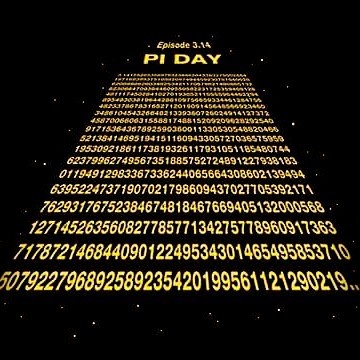
Pi Day 2024!!!

Another year, another Pi Day that I didn’t observe with anything new…sigh…but here’s a repost of an earlier celebration!

It’s Pi Day, everyone!

It is also Albert Einstein’s birthday and, sadly, this year’s edition marks the passing of Stephen Hawking, about which I’ll have more to say later. But for now, let’s celebrate Pi!


Calculate Pi yourself!

NASA’s Pi in the Sky Challenge

A few videos:

(That one’s titled “Pi Day” but the video has nothing to do with Pi so far as I can see, but it’s a cool video anyway, so there it is.)


This is from several years ago, made for a supermarket chain called D&W Fresh Market in Michigan:

And finally, here I am, in my last (well, most recent, I hope it’s not my last!) official video observing Pi Day! As I look at this, I see the video’s running time and I wonder why on Earth I didn’t trim it down another 32 seconds….

Happy Pi Day, everyone!

Share This Post

Whoa….

I’ll have more to say later at some point, but I’ve just read one of the earliest Star Trek novels, a 1974 book called Spock, Messiah!. And it is both super weird and not weird enough.

I need to think about this one.

That is all

Share This Post

Tone Poem Tuesday

Today, a rarity: or something that felt to me like a rarity many years ago, when I was still playing the trumpet (and, I might add, at a pretty high level!). The evolution of the trumpet as an instrument meant that there were certain things that the instrument could do and could not do at first, when the instrument had no valves and could only produce chromatic tones by manipulation of the “embouchure”–that is to say, the lip muscles that produce the buzzing against the mouthpiece that sets the air inside the instrument to vibration. This is why many of the trumpet concertos you hear from the Baroque era pitch the trumpet in a very high register, where it is much easier to produce chromatic notes due to the density of overtones.

Now, there were a few trumpet concertos written in the Classical era, most notably by Haydn and Hummel; these were written for a virtuoso named Anton Weidinger who invented a trumpet with keys (holes in the instrument’s piping that were covered by spring-loaded keys, manipulated by the fingers). This instrument could produce chromatic tones, but aside from Haydn’s and Hummel’s concertos (which are two of the most famous works for trumpet ever written), not much came of the keyed trumpet, due to issues with its sound quality; it took a virtuoso like Weidinger to make the thing sound good at all.

In the Romantic era, though, along came the invention of valves, which finally made the trumpet a truly chromatic instrument. So, you might expect that the trumpet entered a Golden Age of concerted works as the great Romantic composers embraced the trumpet as a solo instrument, capable of much more than just reinforcing tonics and dominants?

Why…no.

It always bothered me, as a young trumpet student, that there was no solo trumpet literature at all between the Baroque and Classical eras and the Modern era, when at last the trumpet’s popularity as a solo instrument exploded. I always wondered, what if a Schumann, a Brahms, a Saint-Saens, a Tchaikovsky, had embraced the trumpet as a solo instrument in a concerto? Alas!

But it turns out that there were works for solo trumpet and orchestra during that era; it’s just that they were written by more obscure composers who lived in obscurity and who are mostly forgotten today. Enter Oskar Boehme.

Boehme was a trumpet virtuoso who was born in Dresden in 1870. He made a good living as a musician, being both a great player and a decent composer; he landed in St. Petersburg, Russia as a young man, where he lived out his life, writing music and performing and teaching. He wrote there his Trumpet Concerto, which I present below. I had never even heard of this work until a recent Facebook ad notified me of an upcoming concert in Charlotte, NC (I think) conducted by the Buffalo Philharmonic’s own JoAnn Falletta, with Boehme’s concerto on the program. Having heard it several times this last week, how I wish I had known about it back in my college days!

Boehme himself came to a bad end. He lived in Russia, after all, during and after the Revolution, until 1938, when he found himself on the bad end of one of Joseph Stalin’s purges. According to his article on Wikipedia, his music is being rediscovered to this day. I hope that’s the case, given the quality of this concerto, with its Romantic sweep and dazzling virtuosic writing for the trumpet.


Share This Post

Sunday Thievery

I haven’t done one of these quiz-things in a while, so why not? Roger did this one, and now I’m going to appropriate it. (The quiz is from a blog called Sunday Stealing, so the fact that I’m doing this on Monday is right on brand for my “Rules? There are no rules here!” self.)

1) What is your favorite thing about winter?

Snow, I suppose…within reason! In truth, I love winter for being able to wear sweaters, and in general having more options for how to dress; dressing in summer isn’t as flexible because of the need to stay cool and the fact that minimizing layers is best.

I also love darker nights, the winter stars, and the hot drinks (coffee, tea, buttered rum, Tom&Jerry’s) hit better in winter than they do in summer.

2) What is your favorite winter sport?

To watch? Figure skating, I suppose. I also like hiking in winter, and though I haven’t done it in many years, I remember enjoying snowshoeing quite a lot.

3) What is the best winter treat?

I suppose hot chocolate, though I don’t have it very often.

4) What is the earliest time in the year it ever snowed where you live?

To the Google! Apparently in 1956 it snowed on September 20. The earliest I can remember is the October “Surprise” storm, which I believe was somewhere around the 13th or 14th in 2006.

5) What is the best way to stay warm in the winter?

Layers and warm beverages. Hats and gloves. Always hats and gloves!

6) What are your favorite things that are paper?

Books, obviously! But I also love writing on blank paper. And newspaper is great for starting charcoal aflame.

7) What are your favorite things that are cotton?

I assume all of my pairs of overalls are a cotton-based fabric.

8) What are your favorite things that are leather?

I have a pair of gloves that my mother got for me, made to measurement, from a glovemaker in Florence. They’re gorgeous.

9) What are your favorite things that are floral?

The Wife has a growing collection of orchids! She loves orchids to the point that we go to local orchid shows at the Botanical Gardens.

Also, I wish I could find a nice floral print shirt, but everything I ever find in that vein is a Hawaiian shirt, and I don’t want one of those, to be honest.

10) What are your favorite things that are wood?

I have a fountain pen made of wood! And my set of nesting dolls that I got when I was five or six. My bookshelves. And the trees that make up the forests of WNY!

11) What should you do if you think your house is haunted?

I have no earthly idea. BUT, I am acquainted with a local ghost-hunter, so I’d probably DM her and say, “Hey, wanna meet a ghost?”

12) When should you investigate a strange noise in your basement?

Immediately. Any malfunction down there that is significant enough to make a sound you can hear in the main body of the house can not be a good thing. And if it’s the sump pump, you need to get moving fast.

13) How do you know if an abandoned building is safe to visit?

You don’t! That’s the fun of it!

I’ve never actually been one to enter abandoned buildings, to be honest…but construction sites? Those, I’ve been known to explore, though not so much anymore because I’m more keenly aware of what can go badly wrong. But in college, they built a whole new music building, and I explored it in quite a few phases of the construction…including one ill-advised walk along the length of a single support beam with a drop on either side….

14) How do you decide whether to solve a problem as a team or split up and go it alone?

Well, at work I am used to working alone, but sometimes I sense the need to seek help. Now, sometimes it’s plainly obvious that I need help, because I can’t physically do the job by myself. I mean, I only have two hands, and if it’s obvious that the job needs three, then it’s time for help. Another factor, though, is the time factor: sometimes I ask for help because I can do the job myself, but if I do, it’ll take me a really long period of time. Help is necessary for efficiency sometimes. (Now, there are times when I badly underestimate the amount of time needed to get a job done, but that’s a different issue…I think….)

15) Where do you store your knives, and where would you look if one was missing?

We have a drawer where we keep most sharp objects, although we do have a set of knives in a block on the counter. If one’s missing, I look around the kitchen counters and in the sink, I suppose. (Don’t leave knives in the sink, folks. Not a great idea.)

Share This Post

Completion!!!

Yesterday I finally completed the first round of The Song of Forgotten Stars, Book Five: Embers of Future Flames. This book has taken a lot longer than I expected, but this phase is finally done.

Also, even though there is a lot more to be done, this entire story is now more than half told. That’s quite a feeling. I embarked on this particular journey roughly 14 years ago, after all.

Share This Post

From the Books, for International Women’s Day

This is a repost from a couple of years ago. I chose to repost this, about a book by astronomer Sara Seager, because it has lodged in my brain since I read it.

I generally try to avoid reading grief memoirs, for various reasons that mainly boil down to…well, I’ve had enough grief in my life already and I know that more is on the way someday*, and it’s a subject I don’t much enjoy plumbing any more than I have to. But sometimes I find a grief memoir that piques my interest and I read it anyway. Smallest Lights is such a book, and I am very glad that I read it. It’s so much more than a grief memoir, really. It’s about science and love and life and death and love again and parenthood and dealing with autism.

The Smallest Lights in the Universe, Sara Seager

It’s also beautifully written.

Not every planet has a star. Some aren’t part of a solar system. They are alone. We call them rogue planets.

Because rogue planets aren’t the subjects of stars, they aren’t anchored in space. They don’t orbit. Rogue planets wander, drifting in the current of an endless ocean. They have neither the light nor the heat that stars provide. We know of one rogue planet, PSO J318.5-22–right now, it’s up there, it’s out there–lurching across the galaxy like a rudderless ship, wrapped in perpetual darkness. Its surface is swept by constant storms. It likely rains on PSO J318.5-22, but it wouldn’t rain water there. Its black skies would more likely unleash bands of molten iron.

It can be hard to picture, a planet where it rains liquid metal in the dark, but rogue planets aren’t science fiction. We haven’t imagined them or dreamed them. Astrophysicists like me have found them. They are real places on our celestial maps. There might be thousands of billions of more conventional exoplanets–planets that orbit stars other than the sun–in the Milky Way alone, circling our galaxy’s hundreds of billions of stars. But amid that nearly infinite, perfect order, in the emptiness between countless pushes and pulls, there are also the lost ones: rogue planets. PSO J318.5-22 is as real as Earth.

There were days when I woke up and couldn’t see much difference between there and here.

Sara Seager is an astrophysicist at MIT whose main body of work involves exoplanets, their discovery around other stars, and analyzing them for signs of life. Among other things, if you wonder how on Earth (literally!) we can look for life on planets lightyears away that nobody in our lifetime (or, likely, in our great-grandchildrens’ lifetimes) will ever see directly, this book will give you some hints as to how that search is currently going. (It involves ingenious analysis of light coming from those planets. It really is amazing, when you think about it, the degree to which light energy is the main carrier of information in this universe of ours.)

In her book, Seager discusses her own work and the degree to which her work has shaped her personal life, and how her personal life has shaped her work in return. Her first husband was a man of considerable energy, whom she met on a canoeing trip; their courtship progressed on more canoeing trips all over the place. But he developed cancer, which eventually killed him at a terribly and unfairly young age. Thus this brilliant astrophysicist, whose work is an important part of the current growth of human knowledge of our universe, finds herself a single parent attending meetings of the local widow’s club, figuring out the nature of this new world she’s been thrust into. It’s the cruelest of ironies, I suppose, that this woman whose life’s work is understanding the universe and seeking other worlds suddenly finds herself in a new world, one that’s familiar to people who have known deep grief, where everything is the same and yet everything is deeply different.

Throughout Seager’s book, I found myself frequently hit in the heart by some of her observations:

:: Everybody dies instantly. It’s the dying that happens either quickly or over a long period of time. Mike spent a long time dying: eighteen months separated his diagnosis and his death.

:: There have been lessons I have chosen not to teach. Not all knowledge is power; not all things are worth knowing. Max and Alex [her sons] never saw Mike’s body. They did not see him leave the house.

:: [On the Widow’s club] All of our children had become friends. They didn’t gather because their fathers had died; they gathered because it was fun. There is a reason every children’s book is written from the perspective of the child. Children don’t care about adult concerns. We think of children as helpless when they are the embodiment of resilience, more impervious to outside forces than we could ever be again. Despite their suffering, our kids still knew pure joy.

:: Sometimes you need darkness to see. Sometimes you need light.

:: I don’t think it’s an accident that there’s a mirror at the heart of every telescope. If we want to find another Earth, that means we want to find another us. We think we’re worth knowing. We want to be a light in somebody else’s sky. And so long as we keep looking for each other, we will never be alone.

I love that last one (which actually closes the book, so apologies for the ‘spoiler’). Seager casts loneliness not in terms of presence but in terms of action: we’re only truly lonely when we accept that we are alone and stop seeking others to enrich our lives. True loneliness, really being alone, comes of a permanent turning inward, of looking down and not up. And really, how else would someone who loves the stars see things?

The Smallest Lights in the Universe is a wonderful book that stands in stark contrast, it seems to me, to the view of science as cold and mechanical and mathematical, an enterprise that somehow forgets about emotion and wonder. No less a genius than Walt Whitman expressed this view, in “When I Heard the Learn’d Astronomer”. But the numbers and the proofs surely don’t have to get in the way of the wonder; rather they inform it and give it focus. Science is not an impediment to love and life. Science is a part of those things. Sara Seager’s book shows us how.

Share This Post

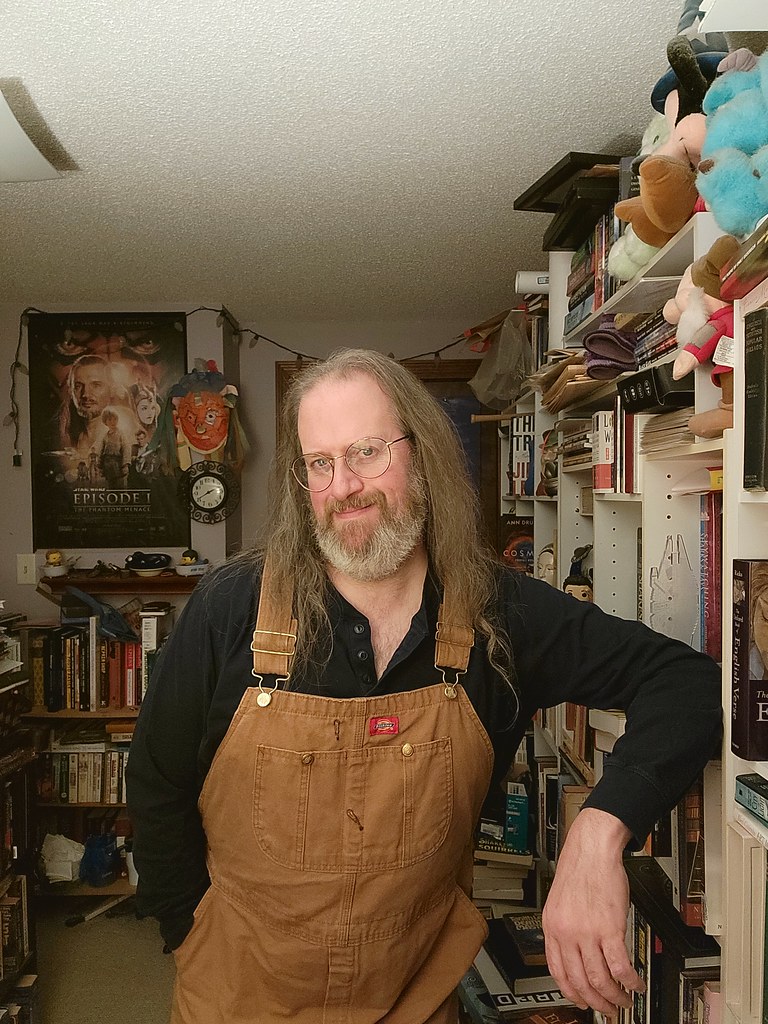
DUCK!!!

They call this fabric “duck”. I don’t know why, but they do. Duck is a canvas fabric made out of cotton, and the way it’s made it’s a lot tougher than, say, denim. And it can be a lot tougher. Apparently duck fabric has a grading system, with the lowest number indicating the heaviest and thickest duck cotton out there; that’s what you’d make sales for a yacht out of. At the upper end of the number scale is the lighter duck, for “light clothing”. Somewhere in the middle falls the duck used to make tough workwear like your Carhartt jackets and these Dickies overalls!

I just got these super-cheaply off eBay, and I like them a lot, even though they’re still really raw, which means they’re still really stiff and scratchy. They’re super comfortable, though (of course they are, they’re overalls!), and a new color in the palette is always nice.

Some more detail photos:


I only have three pairs in this shade of brown duck: these Dickies, a pair of Carhartts, and a pair by Berne. I also have a dark brown pair of duck Carhartts and a pair of black duck Carhartts.

Oh, and apparently it’s called “duck” from the original Dutch work doek, which refers to the fabric the Dutch sailors used for their clothes. The more you know!


Share This Post

ForgottenStars.net

The official site of Kelly Sedinger: Reader, writer, photographer, and dreamer

Skip to content ↓