Hookers for me, but not for thee

A rant:

I’m pretty cynical when it comes to politicians. I don’t look for moral leadership or role models. I don’t expect elected officials to set some kind of moral example over and above what I’d expect from the guy who changes my oil or the person who handles my transaction at Target. I won’t refuse to vote for a person because he or she cheats on their spouse; I will refuse to vote for them on one basis and one basis only: whether or not I agree with their policy objectives. That’s it. If my choice in an election is between a philandering Democrat and a steadfast Republican, I’ll almost always choose the Democrat.

There’s one proviso to this, though: I can’t stand hypocrisy. This is why I tend to be more nauseated when the Larry Craigs of the world are caught with their hands in the cookie jar: not because I’m offended at what they did, but because their actions make clear that the way they publicly profess we all should live our lives isn’t the way they think they should have to live their lives. William Bennett, the great moral crusader who has made his own little cottage industry pratting on about virtue and morality in American life? Whatever…until he turns out to be a gambler.

And Elliot Spitzer. Mr. Law-and-Order, crusader for the little guy. Everything was going to change on Day One. He was going to cut taxes, fix state government, reform Medicaid, finally start making New York work again. This he campaigned to do, on the basis of his tenure as Attorney General, during which he prosecuted corporations for Wall Street shenanigans, and during which he struck against prostitution rings. Caught with a prostitute.

The man’s a hypocrite. He was already a disappointment as Governor, failing to accomplish much of anything at all: government spending continues to rise, Spitzer’s own political instincts suddenly seemed made of tin, and more than a year into his term as Governor, absolutely nothing has changed in New York. And now he turns out to be a rank hypocrite. The former prosecutor who made hay against prostitution turns out to be a customer.

Like I said, I don’t look for moral leadership from my political figures. I’ve long since outgrown the pleasant notion of our leaders as George Washington types, the “Father, I cannot tell a lie” stuff. I don’t look for inspiration from political leaders, unless it’s the inspiration that comes from the accomplishment of positive results. So when Spitzer was elected, I wasn’t caught up in a massive groundswell of hope.

And the man still disappointed me.

Governor, you need to resign. It’s over. You’re done. You could have changed things for the better, but you didn’t. You had the political will behind you, and you had the mood of the state behind you. And yet you frittered that away on a stupid scheme to take down your political opponents, your budgets which kept the numbers ticking ever ever upward, your refusal to take on unpopular groups like the New York State Thruway Authority, your total failure to present any new ideas at all in the time you’ve had in office.

And you paid for sex in a state where that is illegal, after you’ve prosecuted others for the same. The game’s over. Time to let the next guy in. Maybe he can get things done where you and your predecessors could not.

Who knows, maybe New York will finally get lucky, and the day of Elliot Spitzer’s resignation will be the real Day One, when things actually start to change. Somehow I doubt it, but I can always hope, can’t I?

Share This Post

Sunday Burst of Weirdness

Time to get weird!

:: Down with “Danny Boy”! You know, I’ve yet to hear a vocal version of “Danny Boy” that I like. But Percy Grainger’s setting of the tune is wonderful. I’ve heard that setting for strings, wind ensemble, and, most hauntingly, wordless chorus. It’s one of the most beautiful melodies ever created in Western music, but the words? I can leave ’em, I suppose. (via)

:: Did you ever try to buy beer in Pennsylvania? If so, and if you might have cause to do so again, breathe a sigh of possible relief.

:: Well, it looks as if I’m not the only overalls-clad hippie around. Oh well, it was fun while it lasted. Time to cut the hair and start wearing Dockers.

(Kidding, of course.)

Share This Post

Bring on the Gelatinous Cubes!

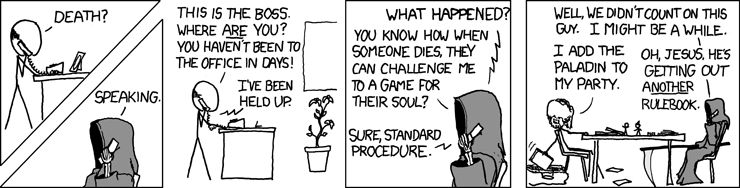
As just about everybody with a blog already knows, Gary Gygax, one of the inventors of Dungeons and Dragons, died last week. I’ve been too busy to post about it until now, and I also didn’t want to make the same obvious joke that everybody else did about Gygax failing his last saving throw. (A favorite geek humor joke of mine is: “Jesus saves! The rest of you take full damage.”) I, of course, choose to envision God as the ultimate Dungeon Master, and with regard to Gygax, he did the old DM trick of dropping a bunch of dice on the table behind his screen and then shaking his head and saying, “Ooooh, bummer, dude.”

But of course, leave it to xkcd to come up with the best Gygax tribute I’ve seen anywhere:

I was never a huge AD&D player, although there was a period in sixth grade when everybody in school was seemingly obsessed with it for some reason, to the point where cliques formed within our class based on whose character was a God and whose was a Demon. (What can I say? We were a bunch of dumb-assed eleven year olds.) Strange thing was, for all the D&D babble we all indulged, we did almost no actual playing of the game, which was a bummer. I didn’t actually get to play the game in anything close to the manner in which it’s meant to be played until college, when I was a part of two separate campaigns, the first in our freshman year and the next when we were juniors and seniors.

The DM of our first campaign was hard core on the role-playing aspect of the game. He and his high-school mates had used AD&D campaigns partly as means of honing their improv theater chops (this guy was really into drama), so we had to make a lot of effort in his campaign to be “in character”. This occasionally led to interesting results. Our second campaign, spread over the latter portion of junior year and a big chunk of senior year, was run by a guy who was a more action-oriented DM; with him, there was less emphasis on role-playing (although there was that) and more on pacing and excitement. He was really good at managing combat so that the “battle sequences” were exciting, and he was also good at managing the treasure and rewards, consistently finding the “sweet spot” between extreme stinginess (“The red dragon is dead, leaving his horde of one hundred copper pieces to be split amongst the party, after you pay these six NPCs their agreed price!”) and Monty Haul (“Your party of level eight characters has slain the duo of bugbears, taking their horde of one million platinum pieces, five swords +6, and eight scrolls with one Wish spell on each!”).

Both campaigns took place in the Greyhawk setting, so I never got to play in the Forgotten Realms. My own campaign, had we not petered out as a group in senior year, would have been a Forgotten Realms campaign. I also bought a lot of the “Al Qadim” materials for another campaign, in the style of the 1001 Nights, that never took place.

AD&D was, of course, lots of fun, and we usually had a blast whilst playing. I haven’t played a single game since college, fifteen years ago now, and while I don’t have a whole lot of desire to play again (mostly because I know that I just don’t have enough time), I’m glad I got to play the games that I did, and I do wish we’d had some time to get more playing in there. So, like every geek these days, I owe a certain debt to Gary Gygax.

Share This Post

Limey scum! Limey scum!

Signs that the Irish band you’re listening to might not be all that good:

One: Ten minutes into their first set, and they’ve already played “Tura-lura-lura”, “I’ll Take You Home Again Kathleen” and “Danny Boy”.

Two: Twenty minutes into their first set, they take on that well-known Irish classic, “Puff the Magic Dragon”.

I swear I am not making this up.

Share This Post

Lovers in Bolton

UPDATED below.

I’ve just watched about twenty minutes of FOX’s new reality show The Moment of Truth, and wow, what an appalling show. I can’t believe this is on teevee. I’m astonished…and all I can think of is how eerily prescient, once again, Monty Python turns out to have been:

(The relevant sketch comes at about the 1:10 mark.)

UPDATE: OK, just to put Roger at ease in comments, I didn’t sit down with the desire to watch this show. It happened to be on after American Idol, so when I sent The Daughter to the bathroom at 9:00 to do her “get ready for bed thing”, I had ten minutes to watch whatever was on next, and Moment of Truth was it. Rest assured, I won’t be watching this crap again!

Share This Post

To the books!

So, what have I been reading lately? Let’s look:

:: It’s actually been a long time since I bounced off a book, but damned if I didn’t bounce clean off a Stephen King novel. I haven’t read a whole lot of King, but what I have read, I’ve at least liked, and some of it I’ve found utterly brilliant (The Stand is just a magnificent work). So I didn’t expect to find Dreamcatcher a tough nut, but tough indeed I found it. Like many King books, the early going started flying by, and I actually got about a third of the way into the book before a major shift in tone and focus stopped me cold. The early stuff, detailing the lives of our hunter friend heroes, is all winning stuff, vintage King. But something really bothered me in the book’s tone once the military guys show up, and then the book veered into a long surreal section with Jonesy, if I was reading things right. Anyhow, my interest in the book dropped like a rock at that point, and I eventually set the thing aside. I’m quite surprised that’s how it worked out, and maybe I’ll give the book another go someday.

:: I did not bounce off In the Heart of the Sea: The Tragedy of the Whaleship Essex. This is one of those books I’d seen any number of times, either in bookstores or at the library, and each time there was something about it that said, “You know you’re going to read me sooner or later.” So the last time I saw it in the library, I picked it up and read the blurb on the dust jacket, describing the fate of the Essex as being a partial inspiration to Herman Melville in Moby Dick, and claiming that the Essex disaster was as famous in the nineteenth century as the Titanic wreck was in the twentieth. Clinching it is the fact that the book is cited on this list of sea books. I love a good book about the sea, and this certainly is that.

The Essex was a whaling vessel that set out from Nantucket on a whaling expedition and encountered many problems along the way, such as storms and short provisions as it sailed into the Atlantic, down the east coast of South America, around Cape Horn, and into the Pacific to attempt to harvest the whales in recently-discovered feeding grounds there. At that point, the voyage, already difficult, became calamitous when a sperm whale rammed the Essex repeatedly, eventually dealing the ship a mortal blow. The crew then set out in lifeboats to try to return to South America. A handful of crew eventually made it, after many days at sea in which they became starved and dehydrated and eventually resorted to cannibalism.

Tales of disaster like this, in which arrogant man is pitted against heartless nature, always seem to include numerous instances in which everything could turn out differently, and better, if only better decisions were made. Those bad decisions, constantly exacerbated by bad luck, make for a riveting and haunting read.

:: One doesn’t explore the world of comics beyond the well-known superhero stories very far before one encounters the name of Will Eisner, who by all accounts is one of the twentieth century’s leading lights of comics-as-literature, as opposed to comics-as-diversion-for-adolescents. Such creators as Scott McCloud, Art Spiegelman, and Craig Thompson all spring from the ground seeded by Will Eisner. And yet, until a few weeks ago, I’d never read any Eisner at all. Well, that is no longer the case.

Life, in Pictures is a collection of autobiographical stories, drawing from various aspects of Eisner’s life. The term “autobiographical” is meant to be taken somewhat loosely, as apparently the first tale in the book, “A Sunset in Sunshine City”, is not autobiographical at all but rather a fictional meditation on the kinds of feeling Eisner experienced when he, like the main character in the tale, moved from his lifelong home in New York City to a retirement home in Florida. Also partially autobiographical is “The Dreamer”, which follows the early career of a young cartoonist (a stand-in for Eisner) in the youthful days of the comic book industry (before World War II, and definitely before the disastrous creation of the Comics Code). Here Eisner depicts his young stand-in running across numerous real figures from comics history, albeit disguised with fictional names. (Luckily, this story includes a set of annotations, clearing up the identities of those depicted.)

The largest portion of the book is devoted to “To the Heart of the Storm”, in which Eisner, having been drafted into military service and on board the troop train riding to his bootcamp, reflects on his personal history and that of his parents, with particular emphasis on the fact that they are seemingly always on the run from anti-Semitism. “The Name of the Game” traces Eisner’s family history through his mother’s side, and the book concludes with a very short tale – a vignette, actually – called “The Day I Became a Professional”, which is exactly that.

I suppose this is no revelation whatsoever, but Eisner turns out to be that rare item in comics: the complete package, the brilliant writer as well as the terrific artist. His texts and his visuals blend so seamlessly that there were times in reading Life, in Pictures that I found myself literally losing my sense of time in the face of my awe at my first encounter with an obvious master of his form. So yeah, Will Eisner turns out to be pretty good. Film at eleven!

:: Sticking with comics, I thought that American Born Chinese by Gene Luen Yang would be an manga, but it’s not, really. It’s just a graphic novel by a comics artist of Asian descent on the subject of a young man who finds himself isolated as the only Chinese-American in his new school. It’s also the story of the Monkey King, a monkey who isn’t satisfied to be a King but who also wants to be a God. And it’s the story of a popular kid named Danny who sadly has a cousin named Chin-Kee, who happens to be the personal embodiment of every obnoxious stereotype of Chinese people that exists. American Born Chinese tells all these stories, and in reading the book, I figured that each tale existed in its own particular space in the book. That assumption turns out to also be wrong, when the three stories become one late in the book in one of the more delightful surprises I’ve encountered lately in a book.

I suppose there’s something about my initial assumption that the book was a manga (“Hmmm, Asian subject matter, Asian artist…clearly a manga!”) that illustrates part of the point the book makes about racial stereotypes toward Asians in the first place. We’re talking about a Chinese-American comics artist here, after all, and manga is a Japanese medium. But the book is brilliant, and along with the Eisner volume above truly indicative of how powerful a medium comics can be.

:: It’s generally taken as a given that political figures tend to exhibit qualities in their public speaking that are often labeled in the colorful way as “being full of shit”. However, it can always seem a bit daunting to identify exactly how our politicians are befuddling us with bullshit, since they’re obviously not baffling us with their brilliance. Hence a book like Aristotle and an Aardvark Go to Washington: Understanding Political Doublespeak Through Philosophy and Jokes, by Thomas Cathcart and Daniel Klein. It’s a brief, breezy, and mostly entertaining look at the various tricks-of-the-trade of political rhetoric. Granted, most of the examples the authors select involve lapses in logic by right-of-center politicians, but there are the occasional quotes by such Democratic masters of BS as Bill Clinton. The book also features lots of regular old jokes along the way, used to depict logical fallacies. It’s a fun and breezy read, especially as a kind of refresher course in logical argumentation.

:: I read Sheila’s appreciation of a production of Macbeth with Patrick Stewart as the lead with interest, as I had just weeks before finished reading Macbeth for the first time since high school. I remember this being the first of Shakespeare’s plays that I really liked, probably owing to its blood-soaked tale of regicide and eerie supernatural content; I remember being especially pleased in discovering the way Shakespeare had made the witches’ prophecies come true.

We read Macbeth in eleventh grade English; at the time, the norm was, if memory serves, one Shakespeare play a year. We started in ninth grade with Romeo and Juliet, which, well, I just wasn’t capable of appreciating in any way that early on. (I’ve always had this pet notion that literature should be taught in reverse chronology; dumping a bunch of ninth graders into iambic pentameter can’t be the best way to introduce kids to The Bard, I think.) In tenth grade it was Julius Caesar, which I found more interesting, although I still found Shakespeare mostly impenetrable. “Why do they keep talking for so long? A bunch of guys stab Caesar and yet he still manages to get out ‘Et tu Brute’?” It wasn’t until Macbeth that I started to actually see what Shakespeare was doing, that I started to understand that his language had rhythm and music inherent within it. (I may have been influenced by my discovery the year before of Berlioz, and my further discovery that Shakespeare had been one of Berlioz’s greatest artistic influences. I guess that was my first personal experience with being swayed by a celebrity endorsement.)

Anyhow, Macbeth. I don’t have anything particularly insightful to say about this work; I only note how wonderfully brooding a play it is, how gloomy. Macbeth himself always seems as though he believes himself to be in control of his own actions, but all along, we know that he is in no control at all. Watching his entire world collapse around him, and seeing him reduced to, in his words, “a poor player” strutting and fretting his hour upon the stage, forms the heart of the tragedy. I love this play, and I should really try to see some Shakespeare on stage someday.

:: Finally, I’m trying an experiment: reading Moby Dick at the rate of one chapter a day. If I can stick to that pace, I will get all the way through the book in 135 days. (Yeah, that’s a big ‘if’.) I’ve been planning to read Moby Dick for a while now, but my enjoyment of In the Heart of the Sea influenced my decision to get going now, and it will help that the chapters are all very brief. Occasionally I will post a brief thought about the book as I make my way through it, starting with this: the first sentence of Chapter Two.

I stuffed a shirt or two into my old carbet-bag, tucked it under my arm, and started for Cape Horn and the Pacific.

That is just a terrific sentence, isn’t it? Our boy Ishmael dreams big. He’s not setting out to find a berth on a ship, he’s not setting out for Nantucket, he’s setting out for Cape Horn and the Pacific. That would be like if Neil Armstrong had risen on that morning in July 1969, kissed his wife, and said, “Bye dear, I’m off for the Sea of Tranquility.” Ishmael’s a guy who knows where he’s going.

So that’s the literary activity lately at Casa Jaquandor.

Share This Post

But it’s spelled “FAHV-ruh”!

I don’t think that at any point in the last seventeen years I would have named Brett Favre as my favorite football player, but he would have certainly made the cut if I’d ever been asked to name my ten favorite players. That photo above is why: Favre always played with a greater feeling of joy. He always looked like what he was: a guy playing a game. Sure, many times he would try some kind of goofy thing that would only be attempted by a kid in a sandlot game of touch football, and many times those gonzo plays of his would turn into interceptions or turnovers, but…Favre was always fun to watch. I like that. There are lots of QBs who are interesting to watch, or admirable to watch based on their pure skill and mechanics, but Favre made the game fun to watch. You always knew that you were going to see something when he was on the field.

I’m surprised that he decided to retire now, especially seeing as how he seemed to find rejuvenation last year and since he’s as fierce a competitor as they come, and with him retiring now, that means that his final pass attempt in the NFL was an interception in overtime of the NFC Championship Game, with the resulting drive seeing the Giants score the points to win and go to the Super Bowl. But still…so long, Brett Favre.

Share This Post

Final Answers!

Bringing this year’s iteration of Ask Me Anything! to a close, we have a cluster of queries again from Roger. He put these all into a single bloc, but I’m breaking them up to make them more manageable.

OK, it occurred to me that I don’t know that much about your childhood. If you’ve blogged about it, it was before I found your corner of the Internet.

Well, while it would be nicely poetic if I could claim a childhood full of traumas and hardships, that just wasn’t the case. It wasn’t a remarkable childhood at all.

So: how many people were in your household growing up? What was the birth order of you and your sibs, and age differentials? What jobs did your father and mother have outside the home? What were your parents’ names, and what did you call them? Did you get along with your sibs?

The Main Family Unit included four people: Father, Mother, Older Sister, and Me. Not a huge family, so I can’t complain that I was lost in the shuffle of all those kids. No “middle child”, Jan Brady-esque histrionics for me. Likewise, no only-child psychological baggage to carry around. Alas.

My sister was six years and change older than me. (Actually, that’s not likely to change, is it? That should be present tense.) So, we were far enough apart in age so as not to be close in all particulars, especially since when I was starting to find my own personality and such, she was entering her teen years. One difficult thing in growing up was my failure, understandable though it might have been, to comprehend the degree to which her interests at twelve years of age would differ from mine at six. All things considered, she and I got along fairly well. There were fights and arguments, and moments when I was utterly convinced that everything always went her way; I’m sure there were moments when she thought, “Jeez, Mom, you sure coddle that twit brother of mine” as well.

My sister is now a professor and a Shakespearean scholar in Colorado. She’s freakishly smart, way smarter than me. Oh well.

My parents were both teachers, with my father teaching on the collegiate level (except for two years when he worked as a programmer, I think, with a computer company outside Portland, OR), and my mother at the elementary level (although she eventually left the classroom and became a school librarian). I called them Mom and Dad, although (embarrassing admission warning) I’m told that as a very small child, I fancied myself being Batman, which made my mother Robin. I have no memory of this, thankfully.

Both of my parents are still alive and in good health. I got my liberal politics from them, among many other gifts that I didn’t realize were gifts at the time.

Did you all have dinner together? Who sat where? Was the table square, rectangular or round? (This may seem like a peculiar question, but I’ve seen it, in person, be quite revealing.)

We had dinner together more often when I was younger than when we were older, if memory truly serves. We were never the Happy Days style of family, with us-as-the-Cunninghams all sitting down to the meal Mother had made at the same time every night, but we did eat together fairly frequently. My mother is a good cook, although a standing joke is her tendency to cook in larger quantities than our family size would have seemed to warrant; my father terms this as her need to feed the entire Russian army. We also ate out together a lot. I remember my father occasionally making a stew in the crockpot, and he’d also put together an impressively gigantic salad that would sit in the fridge in a wooden bowl for several days afterward while we grazed at it.

Funny food story: my mother attempted making homemade pita bread once. Apparently the procedure involved putting the individual flatbreads on a table, beneath a towel, while the gases inside forced the bread to form a cavity inside. Well, there’s a rule of nature that states that given a soft surface freshly laid down, a cat will lay down upon it. So the cat laid down on the towel with the flatbreads beneath, causing the pockets in the pocket bread to fuse shut. Oops. (That cat had a habit of sitting on things he wasn’t supposed to, to a degree unusual even for cats, who as a species love to sit on things. A few years later the SOB sat on the box containing my birthday cake.)

We also once lived in a house where the oven’s actual temperature was about 125 degree lower than the temperature displayed on the knob, so that year, our Thanksgiving dinner took place at something like 8:30 pm. I remember that night we ended up going to a park in nearby Beaverton (this was when we lived in Hillsboro, OR), where a trail wound around a lake. We’d often go there for my parents to jog on the trail while my sister and I would walk and do whatever; often we’d take bread to feed to the ducks who lived there. Well, there we were, at this park on Thanksgiving Day at 6:00 pm, because at home our turkey was just starting to cook.

(And thanks to the magic of Google, I found that very park!


View Larger Map

I wonder if SDB knows where it is? I think he lives in those parts these days.)

Dining room table shapes? We’d have a rectangular table for a few years, then get a round table, then back to rectangular, and so on. The table they have now is rectangular. “Grace” was almost never said, except on holidays, although we now say it before every meal ever since The Daughter got in the habit of doing so. (No “improvised” prayers, we just say what is apparently for Lutherans called the “Common table prayer”. For the longest time I was pretty uncomfortable with the concept of prayer before meals.)

(Our own table, by the way, is rectangular. The Wife usually sits at the “head” of the table, when we eat at the table at all. Lots of times we just dish up food and head to the living room to eat. A bad habit, maybe, but eating takeout at the table feels wrong somehow. A particularly pleasant ritual is to get takeout and eat in the living room in front of the teevee while we watch a movie together.)

On the playground, were you a bully, were you bullied, or did you manage to stay out of the fray? What were your best and worst subjects in school?

Was I bullied? Occasionally, but really, not that often. I never got my ass kicked, although I came close a few times, and I must now admit that my own mouth was often a factor in whatever incidents of possible bullying I may have found myself enmeshed within. I didn’t bully, either, although there were times when the temptation was somewhat strong, I must admit. For the most part, I avoided that whole fray, although there were rare instances of fisticuffs.

There was one incident of clear-cut bullying that resulted in me having a broken bone for a chunk of summer; that sucked. Oddly, though, I didn’t rat the kid out. In retrospect, I should have, but in my school, there was this odd stigma attached to being a tattletale (or a ‘narc’ as they called it).

I think I’m done now.

Thank goodness!

And with that, Ask Me Anything! 2008 comes to a close. Thanks to those who asked questions. For reference, here are the questions asked (albeit rephrased slightly) and answered previously, with the links to the posts involved:

Go ahead! Rant about the Patriots! You know you want to! All the cool kids are!

Chrysler Building or Cheops’s Pyramid: which was bigger? What fantasy world would you want to live in? Where’s the list of beautiful women I post from time to time?

How’s your faith journey going? Does rooting for the Giants over the Bills make me a bad person? What’s a pie in the face among friends?

Of these two fictional characters from books you haven’t read, which one kicks more ass? What time of day are you at your best? Where’s that posting series of satellite pictures of places on Earth?

Why didn’t you just name this blog Jaquandor’s Blog?

Share This Post

ForgottenStars.net

The official site of Kelly Sedinger: Reader, writer, photographer, and dreamer

Skip to content ↓