Sentential Links #40

I missed this weekly feature yesterday because of some unexpected stuff I had to do after work, so here we go. Invoking a theme of sorts for this week’s edition, I’m pulling all of my Sentential Links from the blogs of SF and Fantasy writers (although the posts themselves aren’t necessarily about Fantasy or SF). Click for context:

:: This is what happens when you let your kids read too much fantasy – they go and start writing it.

:: Periodically, when we were out sightseeing in that beautiful city, people would notice our fancy name badges, or overhear us chatting about the festival, and ask who we were. At first we mentioned our books, but, of course, the titles elicited blank stares. And so I started simply pointing to Norman and saying, “This man wrote an episode of Star Trek.”

:: She glared at me. Her furious eyes said if I opened my mouth one more time with one more negative word, I’d have to pay for lunch. (No permalinks here that I can see — it’s the topmost entry as of this writing, or the one dated 3.7, if it’s been moved down by the time you read this.)

:: Did you know that Darwinism is propagated by an international Jewish conspiracy? (You know, I heard that, but I was never sure about it. Now I know!)

:: I am looking forward to signing less and writing more during the rest of 2006. (We can only hope! Again, no permalinks — scroll down to January 21.)

:: A young child with a soda and a packet of pop rocks! What could possibly go wrong?

:: Bradley created the world, and the outline of the history, when she was fifteen, and one of the charms of Darkover is that it has all the cool stuff you put into your worlds when you’re fifteen and don’t know any better — breeding programs for psi powers that give you red-headed sorceresses, and aliens, and spaceports, and a low-tech metal-poor planet, and four moons, one of them peacock-tail coloured, and trackless wilderness, and Seven Domains, and amazons. And it also has all the things you put into the world to explain the things you put in when you were fifteen, like the consequences of the collision of all those things, and out of that arises complexity. It also has a depth of history, because Bradley’s Darkover novels cover thousands of years.

:: My native language isn’t English.

The problem is, I don’t know what language my native language actually is.

:: He put his tongue into her mouth and whispered, “This is like what will happen when we really, you know, do it.” (Ewwwwwww!)

:: How am I supposed to take over the internet if it keeps breaking?

Enough for this week. Tune in next week for the best posts containing the word “heebie-jeebies”!

Share This Post

Reaching across time

For all the dreamy talk about electronic books and how some day when the Technowhizkids figure out how to make a “screen” that has about as close a tactile and visual appeal to actual paper all the traditional bound books will go away and we’ll all be carrying our entire libraries with us wherever we go — and I have to admit that part of me finds that dreamy talk alluring — there are things about physical books, tactile books, real books, books-as-objects, that won’t ever be replicated by ePaper or the iTome or the CyberCodex or whatever it is we’re going to call it.

Here’s one.

Once every quarter, my local public library holds a book sale, with the most recent one being just this past Saturday. This book sale always yields an impressive bounty, on several fronts: I can load up on the kind of thick, breezy epics that The Wife likes to curl up with in bed at the end of a long day. I also snatch up a number of books for The Daughter, almost always finding copies of things she’s going to own someday anyway, like that Richard Scarry book about cars and roads (can’t recall the title right now) and her copy of Charlotte’s Web, which I just got the other day.

And for me? Past book sales have brought hardcover copies of things like Love in the Time of Cholera by Marquez, The Ascent of Man by Bronosky, Cosmos by Carl Sagan, The Discoverers by Boorstin, and more. It’s a great way to fill out the “classic lit” section of my personal library, too: I own a very old copy of Elizabeth Barrett Browning’s complete poems, an equally old copy of the Oxford Book of English Verse, and so on.

It’s always interesting to me to note a certain dichotomy at the library book sale between old copies of books everybody knows and old copies of books that nobody knows. For every copy of Charlotte’s Web and Johnny Tremain (which I’ve actually been wanting to re-read, and there it was last Saturday!), there will be a copy of a bestseller from yesteryear that is just gathering dust. The cover copy of these books will often say something like “The next great work from the author of _____!”, with _____ being yet another unfamiliar title. Here are authors who may have thought that their books would outlive them and carry their names into memory, and yet, here they are being purchased by people who want nothing more than to spend a quarter on a cheap, quick read. Don’t think for one second that I haven’t sadly envisioned, on some library table many years from now, a battered and yellowing copy of some novel bearing my name, being picked up by some person, perused for a moment or two, and then as likely as not being put back down again in favor of some other book with a more appealing cover.

I have to admit that book sales are the main vehicle by which I exhibit any real interest at all in antiques. I enjoy antique stores, mind you, but more as walk-through experiences than anything else, and I rarely feel any desire to buy anything from them. An old chair or dish just doesn’t have the same allure for me that an old book does. It’s easy to sit in a chair. There’s nothing terribly profound about the act of sitting in a chair, and even if the chair is a hundred years old, I don’t feel any kind of historical connection with the previous people who might have sat in it before, any more than I feel any connection with the people who have previously slept in hotel rooms I’ve booked or seats at a venerable old restaurant.

But books? Ah, there’s something else: when I read a very old book, I’m not just in that kind of “readerly communion” with the author, but also with the other people who have read it. The ideas being expressed in those pages, or the tales being told or the pictures being shown, are entering my mind in just about the same way that they did for someone many years before. I don’t think that kind of communion, a communion between readers, will be possible with the CyberCodex.

And then there are the physical reminders of all this that are only possible with very old books.

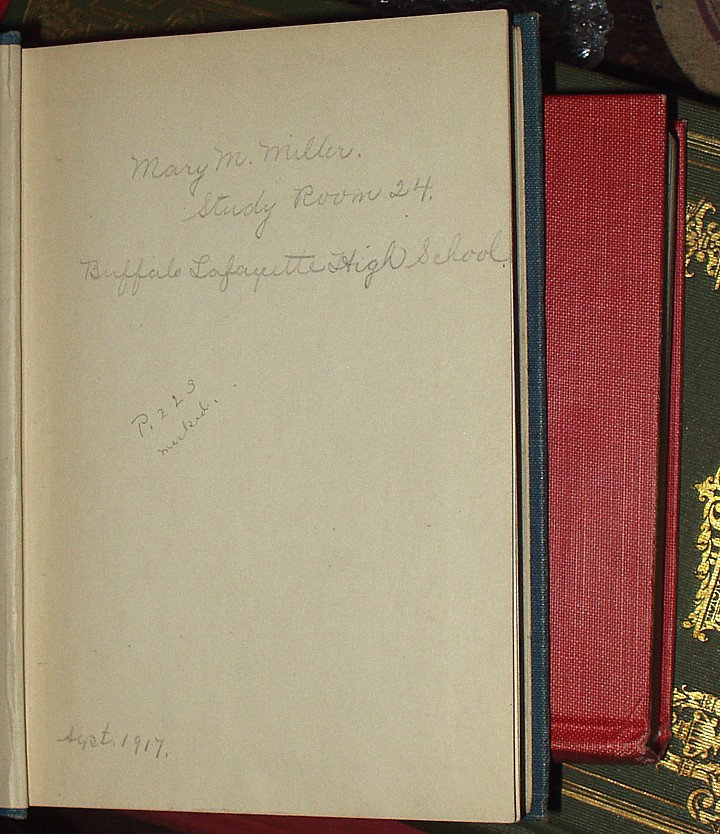
One of the volumes I bought the other day is a hardcover edition of Tennyson’s Idylls of the King. I already own the Idylls, of course, but I couldn’t pass up this lovely little hardcover, and I grabbed it and put it in my stack on sight. Only when I got home did I open it up, and find that the book was an edition specifically intended for school students. The student to whom this copy of Idylls of the King had been issued had dutifully signed the frontispiece:

And she dated it: September 1917. Almost eighty-nine years ago, this book that I grabbed off a stack of other dusty and forgotten volumes was given, presumably new, to a young woman named Mary M. Miller for use in her high school class. (By the way, her school, Buffalo Lafayette, is still there.)

Further flipping through the book, I found scattered marginalia throughout. The marginalia comes in spurts, with lots of it during certain passages and then none at all during others; this makes me wonder if Miss Miller’s class didn’t actually read the entire Idylls but only parts of it. Miss Miller, I also note, had lovely penmanship.

Finding marginalia in books like these is not uncommon, but the combination here of factors — the years between Miss Miller and myself, the Buffalo location, the fact that Tennyson is my favorite poet — made it feel more profound than usual. But the real whammy was still to come: for while finding marginalia is common, finding note cards in the book is decidedly less so.

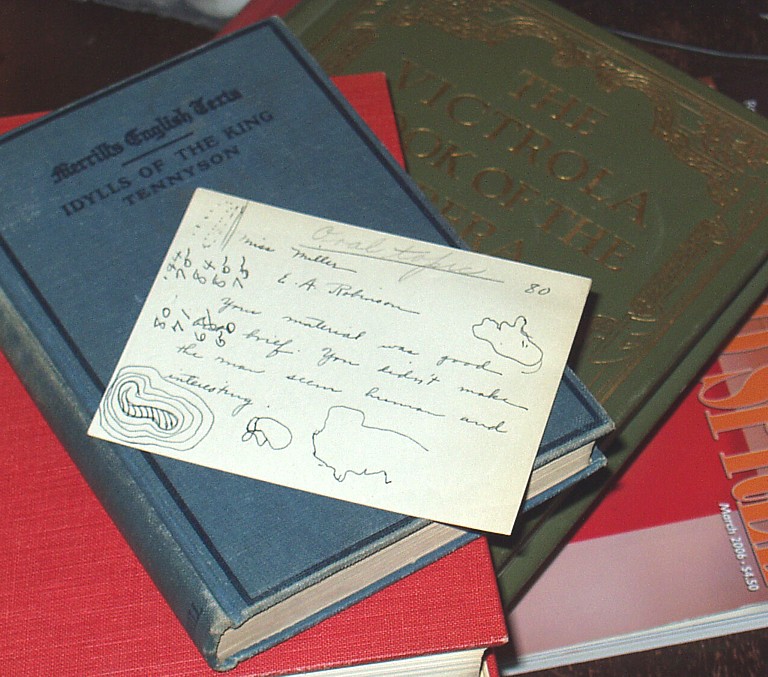
I found this card, tucked somewhere in the middle of the book:

In pencil at the top, it reads: “Oral Topic”. Then, in pen, there is a note in a hand that isn’t Miss Miller’s, and addressing her:

Miss Miller

E.A. Robinson

Your material was good
and brief. You didn’t make
the man seem human and
interesting.

I have no idea what the doodles are, nor do I have any idea what those numbers represent — page numbers, perhaps, or line numbers within the Idylls. I think the note probably comes from Miss Miller’s teacher, but the reference to ‘E.A. Robinson’ is slightly baffling.

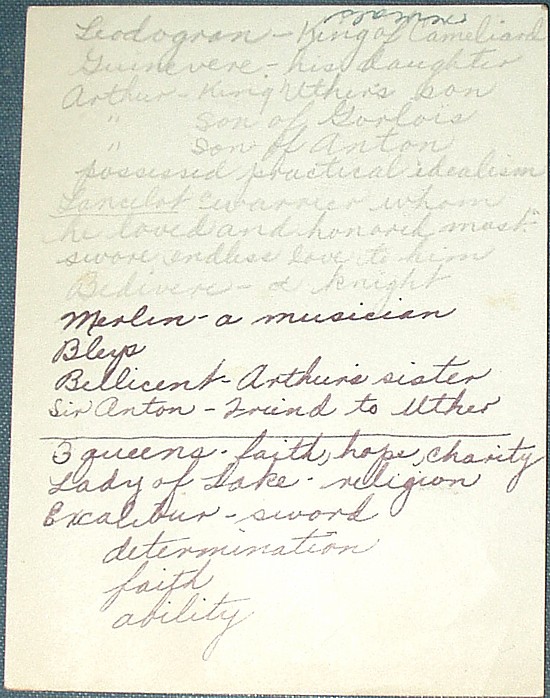
On the reverse of this card, Miss Miller wrote some notes pertaining to the Idylls — maybe study notes, or, thinking a bit more perversely, a cheat sheet! Here’s the reverse of the card:

So on one side of this card, there are notes about the book in which I found it; on the other, a probable note from a teacher about something else. I can only surmise that E.A. Robinson is actually American poet Edwin Arlington Robinson (1869-1935), and that this card was first a note of feedback for Mary M. Miller regarding an assignment on Robinson which she then used, on the reverse, as a place to write some notes she’d taken on Idylls of the King.

So this little book that I picked up at the library book sale has given me a small, fleeting glimpse into the life of a high school student from almost a hundred years ago.

As I noted above, finding margin notes is common, but finding cards like this is not. Cards tend to fall out of books the more they’re handled, and for a card like this to have remained in this book until I found it makes me wonder if anybody has handled this book at all since Miss Miller did. The likely chain of events is that Miss Miller toted this little volume around all her life, for whatever reason — maybe on her shelves, maybe at the bottom of a box of old school memorabilia — until some descendent of hers found it and decided to take it to the book sale.

Yes, someday I’ll be able to take my entire library with me when I travel. Someday I’ll be able to read just about any book ever written. Someday, “out of print” will be a virtually unthinkable concept. But also, someday I won’t be able to share the exact book that someone before me read, and I won’t be able to find some long-forgotten set of notes scrawled in haste on the back of a teacher’s note, lurking somewhere amongst the aging pages. An inevitable trade, of course, and certainly not a trade worth impeding upon the march of technological progress, but still: nothing is ever gained that something else isn’t lost.

(Of course, the real problem with the inevitable CyberCodex would be solved if they could figure a way to make it smell like an old book.)

Share This Post

Puck

Ah, dammit.

Like many a baseball fan, I keenly remember that 1991 World Series — each game won by the home team, four games decided in the final at-bat, a bunch of 1-0 final scores, a ten-inning Game Seven that ended with Gene Larkin’s deep single to left, and Kirby Puckett’s game-winning shot in extra innings (11th or 12th, I think) off Charlie Leibrandt.

When Puckett hit that ball, The Girlfriend (who eventually became The Wife) and I were driving back to college in Iowa from Chicago. Long drives, at night, listening to late-season or postseason baseball on AM radio are a supremely underrated pleasure, and Kirby Puckett gave me one of the best.

I got to see him play on my twenty-first birthday. It was a 9-2 Twins victory. I don’t recall any Puckett heroics at the plate, but he did run down a long fly to center. Dammit, he was good. His career — and now his life — were too short.

So long, Puck. Enjoy playing in my dream outfield, next to Roberto Clemente.

Share This Post

Oscar!

Having seen almost none of the films nominated this year for any Academy Award (and how Revenge of the Sith could go un-nominated in the effects categories is unforgivable!), my only real opinion on the Oscars last night is on the telecast itself.

I thought that John Stewart did an outstanding job, after a somewhat rocky beginning. However, I don’t think that was Stewart’s fault, and having now watched enough of these Oscar telecasts, I think I know why: the Hollywood people are severely humor-impaired. In fact, I think this explains why so many recent Oscar hosts have fallen flat, except for Billy Crystal: one, the Hollywood people don’t get a lot of the zanier or more sophisticated kinds of humor (I’m thinking of Letterman in the former and Stewart in the latter), and two, and this is big, they have almost no self-deprecation at all.

When I think about it, every time an Oscar host makes a joke about a specific actor or actress, when they show the obligatory closeup, that person invariably has this tight smile and curt nod — they’re trying to act the good sport, but it’s pretty clear that they don’t find the joke funny in the slightest. (Except for George Clooney, whom I admire precisely because he always seems to show, lurking somewhere in the back of his mind and visible as a gleam at the corner of his eye, that they whole thing is just a big bunch of BS.)

So when Stewart makes a joke like “Bjork couldn’t be here because when she put on her costume, Dick Cheney shot her”, I wonder if the laughing audience members get it, or if they’re laughing because Cheney just got made fun of. And I literally lost count of how many times, in an audience-response shot after a Stewart joke that would have had his Daily Show audience howling with laughter, some Hollywood personage is blinking and quite clearly saying, “What? Huh?” And that’s why, once the camera people realized that Jamie Foxx was getting the jokes and laughing at them and having a great time, they started showing his reaction every time Stewart opened his mouth.

Anyway, maybe that’s why the old Oscar telecasts were so much better: because back then, you had Hollywood populated by people who could laugh at themselves at least occasionally (like in those Dean Martin roasts), and you had people who got the jokes.

A few random thoughts:

:: I hated seeing John Williams lose yet again. Even though I haven’t heard the other score nominees, Williams had in 2005 his strongest year in a very long time, with at least three outstanding scores. (I haven’t heard War of the Worlds yet.) I think that Williams has come to be taken for granted these days, and that’s a shame.

:: I had no problem with the rap song winning its award. Rap isn’t my cup of tea, but I’ve never denied that it’s a fascinating blend of beat and linguistic rhythm. And I had to agree with John Stewart when he pointed out the rappers’ enthusiasm and commented, “That’s how you celebrate an Oscar.”

:: I found it sad watching Lauren Bacall, whose elegance has sadly eroded into age.

:: Robert Altman’s speech upon winning a special Oscar was a very fine moment. The attempted repartee between Lily Tomlin (who is one of the funniest people alive) and Meryl Streep (who is not) preceding Altman’s speech, however, was painful.

:: Oh, Christ, give me a break here:

Something caused nearly all the women to wear either black or beige dresses and to pull their hair back into a soft bun. Something caused the presenters to drain the life and playfulness out of their voices. They really do want us to love them, but when we see how they act when they are trying to win our love, we get a sense of what they really think we are like. We’re the people in the dark, featureless, mindless. They were trying to fit in with us. A dreary display!

Why you’d bother liveblogging an event celebrating the achievements of people you despise and whom you are convinced reciprocally despise you is beyond my imagination.

:: The point was repeatedly made by various speakers at last night’s ceremony that movies should be seen on the big screen. Lots of folks like to assume that the box office “problem” is a function of the movies (i.e., the ludicrous “Make better movies and people will see them!” canard), and Hollywood seems to want to assume that the box office “problem” is a function of the audiences (i.e., the equally ludicrous “Stop downloading all your movies!” canard). Odd that nobody seems to want to assume that maybe the box office “problem” is a function of the theaters. Renting a DVD and buying a box of microwave popcorn costs a fraction of what it does to go to the movies these days. Check out this recent Roger Ebert “Answer Man” column, which focuses entirely on how much of a pain it is to go to theaters these days. As wonderful as theaters are now, with astonishing sound and stadium seating, they’ve priced themselves well out of being regular entertainment venues. But people still love movies and still find ways to see them, don’t they?

Share This Post

I think I’ve composed this score before….

Last night I watched about half of the movie A Beautiful Mind, which was on ABC. It was OK, I thought, although it probably doesn’t say anything great about the film that once the kid was in bed and The Wife and I were by ourselves, I felt no need to stick with the movie. We ended up watching something else.

But I couldn’t help noticing James Horner’s score to A Beautiful Mind, and I came to a decision whilst hearing that score: I’m pretty much done with James Horner.

I’ve been one to cut the guy more slack than many film music fans, but I’ve reached my limit with this one and its Sneakers-like sound. I’ve realized that all Horner has to offer is new melodies each time out, but treated in the exact same way. Horner has not introduced a single new idea into his sound world in over a decade.

I hate it when a once-admired artist stops evolving. John Williams still tries new things. He gets derided for it a lot, but I liken his experiments with new sounds to athletes who note the moves they’ve never seen before by other athletes and incorporate them into their own sounds. Horner never does this, at all. All he has left is his standard bag of tricks, and the tricks just don’t interest me anymore.

Horner is still comparatively young and could have twenty years of filmscoring ahead of him. Maybe he’ll wake up and start doing exciting things again — but for now, his one remarkable quality is his ability to give producers safe, bland scores.

Share This Post

Most hated by the Dark, for their name was Light

Yesterday morning I finished re-reading The Fionavar Tapestry by Guy Gavriel Kay. Each time I re-read this trilogy, I wonder if the tale’s final 150 pages or so will still pack that same emotional punch, given how well I know the story by now.

Sure enough, I was blubbering like a baby through it all.

I’ve only read Fionavar in its entirety four times, with the last coming four years ago, a few months before I launched this blog. The timing seemed right — with Kay being my favorite living author, he’s on the short-list of authors whose books I actually do re-read completely. But I don’t like to do it too often: I prefer to wait long enough that while I know the large-scale course of the story, I am still surprised anew by other, smaller plot points. And I also find other things in the books, things that I may have missed in earlier reads. (Even though this was only my fourth complete re-read of the trilogy, I dip into favorite passages very frequently indeed.)

I first read Fionavar in 1994. It wasn’t my first brush with GGK. I’d earlier started, but not finished, A Song for Arbonne and read Tigana in full. So Fionavar came as something of a surprise: I was already familiary with GGK’s trend toward “historical fantasy” and away from the traditional, quest-based “high fantasy” that’s dominated the entire fantasy genre ever since The Lord of the Rings was published.

For those who haven’t read Fionavar: a wizard named Loren Silvercloak comes into “our world” and asks five young University students to return with him to “Fionavar”, the “first of all worlds”. This is ostensibly to provide some “bang” for a celebration for High King Ailell’s fiftieth anniversary of taking the throne in Paras Derval (think Minas Tirith), but we rapidly get the impression that there is more going on in Fionavar than Silvercloak discloses at first and that he hasn’t chosen these five strangers at random at all. Our five heroes go with him and are thus plunged into a world where the Dark God, Rakoth Maugrim, is about to be freed and where a war is about to begin which, if lost, would give Rakoth freedom to spread darkness throughout all the worlds.

I haven’t done the story justice at all in that brief summation of the background, believe me. What makes Fionavar interesting are some subtle ways GGK plays with the themes of “traditional” fantasy. Yes, we have elves and dwarves and the like, but their roles are very different from what we’ve been conditioned to expect from LOTR, and GGK provides deep glimpses into their respective cultures. We don’t just get a Dwarf who’s along for the ride, but an entire culture of them — and a culture that, as it turns out, may not entirely be on the side of Light. Character motivations in Fionavar tend to be quite a lot more complex than in run-of-the-mill fantasy.

I’ve always been amazed, in GGK’s novels, by his recurring theme of self-sacrifice. At some point in every one of his books you can count on some character making a major difference in the story by undergoing some act of self-sacrifice, usually heroic. In Fionavar, the self-sacrifice is cranked up to ’11’ on the provebial amp; just about every character in some way or another is eventually called upon to an act of self-sacrifice. And it starts, even, before the story in the books takes place: the backstory of Fionavar is replete with many acts of self-sacrifice. It’s no accident that so many of the book’s finest moments, in terms of sheer writing, are moments involving self-sacrifice, and it’s no accident that The Summer Tree (the first book in the trilogy) doesn’t really start to get involving until Paul Schaefer’s decision to go to the Tree, about halfway through.

What else to say? Yes, the final 150 pages or so moved me in pretty much the same way it always does. Darien’s final choice between Light and Dark, a moment when Diarmuid takes up an unexpected battle cry, a resolution to the sorrow in the tale of King Arthur, a realization by Paul of feelings he didn’t know he had…few books make me feel the way Fionavar does, even now, after four re-reads and uncounted references to favorite passages over twelve years since the first time I read it.

I have a couple of other points to make, but they’re kind of spoiler-ish, so I’ll change the font color to conceal the text a bit:


:: It’s amazing what you pick up on re-reads. I never recognized the passage where Lancelot comes to Daniloth for what it is: a reflection of, and resolution to, the tale of Elaine, the Fairy Made of Astolat, who falls in love with Lancelot and, being denied by him, dies in order that her body may be placed on a boat and set to be carried on the river past Camelot. Here, Leyse of the Lios Alfar loves Lancelot, but this is barely remarked — and after his departure from Daniloth, Leyse gets into a boat like Elaine did. Only, Leyse isn’t dead, and her boat thus becomes the first Lios Alfar boat to reach the world the Wevaer shaped for them alone. I didn’t catch this on any of my previous re-reads.

:: GGK’s final resolution to the tragic love triangle of the Arthurian legend is one of the moments that moves me to tears, each time I read it. I didn’t pick up before, though, on the sheer number of love triangles that resonate through this story. The big one is, of course, the Amairgen-Lisen-Galadan tale — but this one sort of mirrors one we only know of in passing, the Paul-Rachel-Mark triangle. Both Paul and Galadan are incapable of expressing their grief for their lost loves who first spurned them for another (Lisen turned to Amairgen, and Rachel to Mark) before dying tragically; the first major act of resolution in The Fionavar Tapestry involves Paul’s coming to grief for Rachel, and the story pretty much ends with Galadan finally coming to grief for Lisen.

There are other triangles, too: in a way, Ailell-Aileron-Diarmuid can be seen as another type of triangle, this one about fathers and sons. There is Raederth-Ysanne-Dana, which has more potency because Dana is a Goddess. The fates of Finn, Darien, and Leila are bound together as well, as are those of Matt, Kaen, and Blod. Triangles abound in Fionavar.

:: As much as I love this series, at the end I always envision Kim and Dave returning to the real world to be confronted, some time later, by some Toronto cops: “We’re looking for three missing people: Kevin Laine, Jennifer Lowell, and Paul Schaefer. They were last seen with you two….”

And now, I face the problem that I confront every time I finish a GGK novel: what to read next….

Share This Post

Vote! Vote! Vote!

The voting is apparently open over at the Koufax Awards, for which Byzantium’s Shores has received a nomination for “Most Deserving of Wider Recognition”. Of course, I have little chance of winning, since there are something like 300 blogs up for the same award (imagine the Oscars if they nominated dozens of actors or films for each award!), but if you’d like to vote for this blog anyway, here’s where to go.

Just a couple of kvetches about the Koufax’s, as long as I’m at it. First, it seems to me that an award like “Mose Deserving of Wider Recognition” should have more than one winner. Second, this may get me drummed out of Liberal Blogistan for good, but I’m flummoxed that Atrios won a nomination for Best Writing. The guy almost never produces a post that’s more than a few sentences long, and even when he does, there’s usually no way I’d put him up with Jeanne d’Arc, Lance Mannion, Wolcott, or any of the really good writers of Liberal Blogistan. Eschaton performs a very valuable service and might be the “MVP” of liberal blogs, but a showcase of writing prowess it’s not.

Share This Post

Come see our lovely parking! (But don’t park there.)

There’s been a bit of controversy in Buffalo lately over…parking. Basically, the Buffalo police are angry because of some kind of contractual thing — they were supposed to get money and didn’t, or they want more money but the City won’t give it to them, or something like that — so the police decided to do something about it. Their solution, or method of protest, is to institute a rigid, “Zero tolerance” policy in enforcing city parking regulations. Which means they’re handing out parking tickets numbering in the thousands.

This is all very strange, in my opinion — I neither live nor work in the City of Buffalo, and when I do have need to head into the City, I’ve never found that parking is much of an issue (because if there’s one thing we’ve got plenty of, it’s surface parking lots). So on the one hand, I’m thinking, Come on, folks — just find a way to park legally, even if it involves not having your car within sight of your destination and you find yourself walking a bit to get there from your car.

But on the other hand, I have to wonder: Just what is the logic behind the Buffalo police’s newfound militance on parking? I mean, in what way is this a reasonable kind of protest? How on Earth does this help the police in their beef with the City? If we’re going the “Park illegally, and you should expect a ticket” route, then why was the Buffalo News so easily able to find examples of “Well, OK, some tolerance after all” last week, and how do the police justify not having “zero tolerance” before?

This is all so…stupid.

Share This Post

It’s so…trippy!

Has anyone else out there encountered this kids’ show on PBS? In Buffalo, it airs Sunday mornings at 8:30. I personally find it wretched, but also damned hypnotic with all its colors and constantly moving camera. It’s like what you’d get if you had John Denver create a kids’ show after getting him stoned on marijuana and plunking him down in the middle of a Rainforest Cafe.

(That timeslot used to be home to Between the Lions, which is a very clever reading show. Curse you, WNED!)

Share This Post

ForgottenStars.net

The official site of Kelly Sedinger: Reader, writer, photographer, and dreamer

Skip to content ↓