Tag: 2021 reading

  • Recent Reading!

     It’s been a while since I posted an update on books I’ve been reading, so here’s a bit of catch-up!

    ::  Edge of Sundown is a noir-mystery set in Chicago, by indie writer Jennifer Worrell. A writer who was once a fixture on the bestseller lists for his genre potboilers has spent the better part of a decade in the creative doldrums, until he starts writing what is a marked departure for him: a dystopian thriller in which alien beings are ridding the city streets of “undesirable” elements. But when real-world events start to mirror those in his novel, our hero starts to wonder where the boundary between fiction and reality lies…and that boundary blurs even more when the murders start.

    I don’t often read this sort of thing, so I was surprised how compelling it was. There is a palpable sense of dread hanging over the story, even as the climax nears, and Worrell really creates a sense of dark place as she explores Chicago’s seedy underbelly. Highly enjoyable!

    ::  For my ongoing project of listening to (and writing about) the music of Jean Sibelius, I figured I should bone up on the composer’s life and times. I got a book out of the library, called Finlandia: The Story of Sibelius, by Elliott Arnold. This is an older book, published in 1941 while the composer was still very much alive (and, in fact, Sibelius himself appears to have had input into Arnold’s book). As such, the writing style is very much a throwback, and the tone of the book is one of somewhat relentless praise. If you are looking for a critical study of Sibelius and his music, you won’t find that here. But I just wanted a readable treatment of the composer’s life and times, and this is certainly that. In fact, I found the book valuable for its descriptions of the historical events in Sibelius’s homeland, Finland, a country which wasn’t even an independent nation when Sibelius was born. Sibelius was a highly nationalistic composer (even if he denied ever using actual Finnish folk material in his works), so this book gives a good sense of the events that shaped Sibelius’s attitudes and patriotic fervor.

    ::  Two rival sea-faring clans try to put their long feud behind them by marrying their two youngest nobles in Daughter of the Deep, a fantasy novel by Lina C. Amarego. The problem is that our heroine, Keira Branwen, is convinced that her new husband, Ronan Mathonwy, is the one who murdered her father. She is expected to push those feelings aside in the name of peace on the seas, but obviously that isn’t about to happen, and Ronan relentlessly insists on his own innocence. There’s no way that peace between the Branwens and the Mathonwys is going to be easily attained by any marriage, and so unfolds a novel full of character and conflict. I enjoyed this one immensely! Daughter of the Deep is the first volume of a duology called The Children of Lyr, and I absolutely intend to read the follow-up. Recommended!

    ::  For the Love of Music: Invitations to Listening by Michael Steinberg and Larry Rothe is a collection of essays that ran in the magazine of the San Francisco Symphony Orchestra, along with that magazine’s shorter program notes for specific concerts. As such, the book can be dipped into at will, which I recommend doing. There are chapters on Erich Wolfgang Korngold and on Sergei Rachmaninov and the great Chicago impresario Theodore Thomas, along with many more. The essays are often personal reflections on the part of Steinberg and Rothe, informed by many years of love of and listening to classical music. It’s an excellent collection of recent classical music writing.

    ::  A sadly necessary book, Under a White Sky: The Nature of the Future by Elizabeth Kolbert looks at the state of science today, in this time of climate change and the threats it poses to the natural world and to human civilization in general. This is not a general look at climate change, but rather an examination of a number of “case studies” in which scientists are working on very specific environmental issues, such as preserving a fish that only lives in tiny pools in caves in the Mojave Desert. In another example, Australian researchers are trying to engineer a coral that can thrive in the hotter oceans to come, hoping to somehow preserve the Great Barrier Reef. She ultimately arrives at the folks who are studying the possibilities of direct geoengineering to combat the ongoing warming of our planet, in such ways as dispersing huge quantities of reflective aeresols into the upper atmosphere, hopefully increasing the planet’s albedo in hopes of putting the brakes on continued absorption of solar heat. Who knows if that will work, but the fact that it’s being more seriously analyzed is itself an indictment of humanity’s utter failure to take any major steps to alleviate the problem. Under a White Sky isn’t an optimistic book, that’s for sure…but oddly, it’s not exactly pessimistic, either. My overwhelming feeling is that we’ll just keep not making things exactly better, but just continuing to make things different and figure out how to live with it down the road.

    More reading notes to come!

    Share This Post

  • Recent Book Notes!

     Here’s some recent reading I’ve done! I don’t have pictures of the covers, unfortunately. (Several of them I forgot to snapshot before I whisked them back to the library.)

    ::  Maybe you didn’t know that you needed a graphic novel about the Bronte sisters, their brother, and the imaginative life they lived in their youth, but you do need that graphic novel, and thankfully for you, it exists! It’s called Glass Town: The Imaginary World of the Brontes, by Isabel Greenberg. Apparently in their younger years, the Bronte sisters (Charlotte, Emily, and Anne) and their brother Branwell passed the time by creating a fantasy world called Glass Town, which they populated with all manner of interesting characters (no doubt providing the girls with valuable experience in character creation that would serve them well when they turned to their own literary works years later). As the siblings fight over the nature of their world, two break off and make their own world, and in Greenberg’s graphic novel–based on extensive research into the materials left behind by the Brontes themselves about this period of their lives–Charlotte Bronte becomes the focus. She seems to have the strongest relationship with the people of Glass Town, to the point where she actually speaks to them and finds herself drawn into their struggles.

    Greenberg’s art is unusual; I’m not sure how to describe it. It took me some work to get used to, and even until the end I didn’t always find it easy to tell which character was which. But the narrative as a whole has some interesting things to say about stories, how we relate to them, and the difference between how adults relate to stories and how kids do. If you’ve never seen a couple of kids get in a fight over a fictional character or world, well…that can be some serious stuff. Good book.

    :: I’ve read of the graphic novel series Monstress over the years, so I decided to give the book a try. It’s a highly regarded fantasy set in a steampunk Asia kind of world…and honestly, even though I read the whole first volume (collecting issues 1-6), it was long enough ago that I honestly remember very little of the story at all. I do remember the series’s incredible art–the book is worth looking at on that basis alone–but I also remember finding it very hard to care about the characters, and disliking the story’s tone. This is along the lines of SAGA and A Song of Ice and Fire: tons of violence and rape and murder and cruelty. Monstress isn’t remotely my cup of tea, but if you like your fantasy full of horrible people being awful, there it is.

    ::  More my speed was Elizabeth May’s The Falconer, the first book in a trilogy set in Edinburgh about a willful young lass named Aileana who has to contend with societal expectations, her father’s desire to see her wed, and the fact that she can see the magical beings who are obsessed with killing humans, so she has made it her mission to kill them first. Yup!

    May (who I’ve been following for years on Twitter, she’s awesome) writes a really fun book here, with enough humor and “comedy of errors” kind of stuff, along with crackling dialogue, to offset the story’s occasionally grim tone. There are steampunk elements and cool magical doings, fairy beings whose loyalties aren’t entirely clear, and on our side of the magic-realism divide, people who want what’s best for Aileana and people who think what they want is best for Aileana and people who just want her married off so they don’t have to think about her anymore.

    Aileana’s efforts to balance her “Magic hero” thing with her societal obligations put me in mind of the best Spider-Man stories, when Peter Parker was always this close to getting his high school or work or romance shit together, only to have to run off to fight Green Goblin when he was just on the cusp of getting a job or a date with Mary Jane or some such thing. May keeps that whole pot boiling nicely. I liked this book immensely and I look forward to the other two books in the trilogy. (They’re all out already; this series has been out for a few years.)

    All for now! Keep reading, folks!

    Share This Post

  • Recent reading: Space wizards, zombie apocalypses, reflections of Paris, universes ending, and a LOTR-but-not-LOTR fantasy

     A few more books I’ve read of late:

    ::  I can’t possibly keep up with the eternal flood of new books that is Star Wars publishing, but I do try to pick and choose the ones that sound good or come with good referrals. Last year, Lucasfilm announced a new project in their Star Wars publishing empire: a new series within the larger overall tale that focuses on life in our favorite galaxy far, far away two hundred years before the rise of the Sith, the fall of the Republic, and the arrival on the scene of a couple generations of Skywalkers. This series is called The High Republic, and it depicts the Republic at is height and the affairs of the Jedi as they act as the guardians of peace and justice and all that.

    Light of the Jedi, Charles Soule

    The High Republic is going to play out in books, comics, and who knows what else (no filmed entertainment set thusly has been announced yet, but who knows what the future may bring, as currently Star Wars is changing directions on an almost monthly basis). It all starts with Light of the Jedi by Charles Soule, and…well, it’s not bad, but it’s got a lot of room to get better.

    Light of the Jedi has to do a lot of heavy lifting: it has to establish the time period we’re in, which means that it has to show all the ways this time period contrasts with the one with which we’re most familiar. It also has to establish the new threat that the Jedi are going to be facing through all this, which can’t be the traditional Sith because canon has already established that the Sith have been gone for centuries and they stay gone until Darth Sidious steps into the open around the time of The Phantom Menace. Light also gives us a lot of viewpoint characters, probably too many, all having adventures that play out over relatively short chapters.

    The sad result is that Light of the Jedi ends up feeling overstuffed and underfocused, so that in its attempt to be really exciting it ends up under-engaging. I have to admit that I came close to DNFing this book halfway through, and ended up skimming a lot of the last act. It’s a shame, because there is interesting stuff here and it does set up some possibly exciting story possibilities to come. The book does the job of getting The High Republic out of the gate, but it’s not the galloping start it should have been.

    ::  I’m reading more indie books of late, which I should do because I’m an indie author myself, and which everybody should do because there’s a lot of great writing out there beyond the world of the standard publishers. I’ve been following author Anna Vera on social media for a while, and I finally got around to reading her book When Stars Burn Out, a dystopian science fiction novel about the zombie apocalypse and the human response to it.

    When Stars Burn Out, Anne Vera

    I freely admit that this genre is not generally my cup of tea, which is to say, it’s almost never my cup of tea. But I do enjoy it on a selective basis when it’s handled well, and Vera is one of the ones who handles it well. There is darkness and grim death here, because how could there not be, but for once it’s not wildly overdone with spectacular deaths just for the sake of deaths (like in, say, The Walking Dead). There are intriguing mysteries and an interesting society of people trying to live without becoming zombies themselves, and the character work is particularly good. Heroine Eos Europa is a fascinating person, and I hope to read more of her adventures soon.

    ::  I’ve had Paris to the Moon by Adam Gopnik on my shelf for years, and I finally got around to it. I have to admit to finding it slightly disappointing. I was expecting a travel book, but it’s really not that; it’s a collection of essays Gopnik wrote in the 1990s for The New Yorker about his and his family’s experiences in Paris when they packed up and moved there. It’s all well-written and all, but unlike the best travel writing, Paris to the Moon‘s essays feel distinctly rooted in a particular time and place, and from a particular vantage point. I felt an odd disconnect while reading it, like perusing the mundane dispatches from someone’s life decades ago.

    Paris to the Moon, Adam Gopnik

    It’s not bad, though! Not at all, and if life in Paris interests, there’s much here that’s interesting. I cite one passage, which I found particularly amusing:

    Late last year the French government assembled a committee to choose a name for the vast new stadium that’s being built in a Paris suburb. The committee included an actor, and “artiste”, some functionaries, and even a few athletes. It took a long time deliberating over its choice. Names were submitted: Some people liked the idea of naming the stadium after Verlaine or Saint-Exupery, and lots of others liked the idea of calling it Le Stade Platini, after Michel Platini, the great French soccer player. At last, late in December, the committee announced that it had come to a decision, and the government decided to broadcast the verdict on television. The scene was a little like the end of the Simpson trial: the worried-looking jurors filing to their seats, the pause as the envelope was handed to the minister of youth and sports, the minister clearing his throat to read the decision to the nation. The stadium that would represent France to the world, he announced, would be called (long, dramatic pause) Le Stade de France. The French Stadium. “Banal and beautiful at the same time,” one journalist wrote. “Obvious and seductive. Timeless and unalterable.”

    I suppose there is something oddly comforting, albeit in a kind of depressing way, in learning that the bureaucratic way of spending a lot of time and money coming to a perfectly boring decision isn’t something unique to the United States.

    ::  Katie Mack’s The End of Everything (Astrophysically Speaking) is a book about the end of our universe.

    The End of Everything, by Katie Mack

    Apparently the current state of science has a handful of scenarios by which our brightest minds think our universe will end, and Dr. Mack has written this helpful, clearly-written, and humorous (given the subject matter) book summing it all up. If you like a bit of science to help back up your low-level existential dread, The End of Everything is the book for you! Yes, there are passages that I didn’t entirely understand, but Mack does a very good job of explaining how we came to our current theories of how the universe began, and given our understanding thereof and of how the universe works now, how we might expect it to end. Her ultimate takes aren’t terribly optimistic (for ideas on what the end of the universe might look like from the standpoint of sentient starfaring civilizations, Michiu Kaku is the author to seek out), and there’s something particularly chilling about what’s called the “Heat Death” of the universe, as ultimately the unending expansion of space results in our skies growing ever, ever darker as the stars become too far from us for light to ever arrive. But, as Dr. Mack writes:

    In fact, the one thing that all the universe-ending scenarios we’ve already discussed have in common is that they definitely aren’t coming around anytime soon. As far as we can tell from our best understanding of physics, we have at least tens of billions of years before even the most extreme version of a sudden Big Crunch reversal could occur, and no Big Rip could be less than a hundred billion years off. A Heat Death, considered by most to be even more likely, would be so far into the cosmic depths of the future that we hardly have terms to describe it.

    So there’s that. Of course, she writes this just before sequeing into a chapter about a “Vacuum Decay”, in which a bubble of true vacuum forms someplace and expands at the speed of light, destroying everything it takes in as it expands. This, apparently, is a thing that can happen at any time, and since the horizon of the destructo-bubble’s edge moves at the speed of light, we’d never know it was coming. For all we know, there could be a universe-destroying bubble right now someplace, expanding toward us at the the speed of light…and depending on where it is, that’s how much time we’d have left. So…sleep tight, I guess!

    ::  Finally, a re-read of a book I liked a lot as a kid. Between 7th and, I think, 9th grades, I went on a huge epic fantasy reading kick. I read a lot of epic fantasy back then, between roughly 1982 and 1986. (After that I fell into spy and espionage fiction in a big way.) In those years, epic fantasy was far more dominated by the JRR Tolkien model than it is now, thankfully. I love JRRT, but wow, did the genre need some new thinking for a long time. Luckily that new thinking has long since arrived and the genre is healthier for it…but for years fantasy novels seemed really stuck in the same trope wonderland, and the biggest title in the post-JRRT swords-and-dwarves-and-elves type of fantasy was Terry Brooks’s The Sword of Shannara. I read Sword once, back in my junior-high days (along with its two immediate sequels, The Elfstones of Shannara and The Wishsong of Shannara), but I’ve never revisited them since…until now. A while back I was shopping at my local Savers store and I found the original three Shannara books in the Used Books section*, so I picked them all up. Last week I finally re-read Sword, and…well, it was like dipping my toes in Heraclitus’s river. It’s not the same river it was when I was thirteen.

    The Sword of Shannara, by Terry Brooks

    It’s close to forty years since I read Sword all the way through, so I don’t remember much of it at all from back then, except that I do remember finding it kind of padded back then. Nothing specific, but I definitely recall skimming through chapters I didn’t really care that much about. And lo and behold…that happened again.

    In Sword you have the Tolkien model almost in its entirety: a malevolent Dark Lord is threatening the existence of everything, while the races of Man (it was the 70s, so yes, it’s called “Man”), Dwarves, and Elves don’t really get along terribly well. There’s a single magical weapon, though, that can prove the Dark Lord’s undoing, and it can only be wielded by a specific individual who happens to be a member of a peaceful, pastoral people who live about as far away from the Dark Lord’s palace as you can get. A wizard-like figure who is known all over the world for his strange comings and goings arrives to send our young hero on his quest, which after many dangers leads him to a single quest to find the magic weapon. On this quest he is joined by a…what should we call it? A “fellowship”?…helpful team comprising men, Elves, Dwarves, and our hero and his pastoral buddy.

    Off they go to deal with the weapon and the Dark Lord, but eventually their “fellowship” is forced to break apart, and the others go off to deal with specific wars and stuff while Our Hero proceeds to his ultimate journey into the Dark Lord’s realm, which is a barren desolate wasteland of dust and sharp mountains.

    I don’t want to sound dismissive, but Sword really really does read like a Tolkien clone for people who wanted more Tolkien but who didn’t want to re-read Tolkien for the 80th time. All the tropes are here, with just about all the story beats; what Sword seems most to accomplish is reducing the Lord of the Rings from its 576,000 words down to about 226,000. This isn’t always a good thing, as I found it very hard to care about some of the “side adventures” that Brooks takes us on in the back half of the book. We meet a guy named Balinor early on, but we get little of his backstory until much later, which we get right before the book diverts us to his struggles against his crazy jealous brother. I found it nearly impossible to care about any of that.

    Ultimately I found Sword a slog to get through this time. Brooks overwrites and overdescribes to an amazing degree, and from a stylistic standpoint, his paragraphs are way too long, sometimes lasting entire pages. And look, I know he wrote this in the 1970s, but still: it’s a 726 page book, and our first (and only) female character doesn’t show up until we’re well past page 400.

    I do plan to read the other two books in the trilogy at some point. I remember liking Wishsong most of all from these, and I’ve also heard that Brooks’s various explorations in the Shannara universe after these initial volumes perk up quite a bit. I don’t know if I’ll go any farther past Wishsong, but…you never know.

    * I don’t know about anybody else’s Savers location, but the Used Books section at my local one almost always has something worth grabbing. I never leave that place without a book or two. Not huge hauls, but there’s always something!

    Share This Post
  • Lately reading: Ken Jennings on Maps

     Time to catch up on some of my recent reading!

    ::  Maphead by Ken Jennings is about maps and the people who like maps. More than that, it’s about people who love maps. Some people love maps so much they end up seeming a bit odd, but that’s fine! And who better to write about such strange people, committed to esoteric knowledge, than Ken Jennings, trivia champion extraordinaire?

    Maphead, Ken Jennings

    It’s safe to say that Jennings’s authorial career would not have taken flight had he not put together that wonderful winning streak on Jeopardy! back in the Aughts, but now that he’s writing, I hope he keeps doing it for a long, long time. He seems to be a cheerier version of Bill Bryson, able to write engagingly about topics that don’t often get written about (I love Bryson, but his work often has something of a dark tinge to it), and in this book especially Jennings is able to write both about maps and the entire subculture that has sprung up about maps.

    Along the way in Maphead, Jennings visits the London Map Fair, an event I never knew existed. I’ve read a lot about book collectors, though, and this little world intersects that of people who seek out First Folios very neatly. I also learned about things like road geeks, who learn about specific odd details you’ll find on America’s roadways if you look closely (like a traffic light in Syracuse where the green light is on top of the fixture!) and who nurse grudges against people like a Pennsylvania Congressman who used his power to insist that a new section of Interstate Highway in that state be numbered I-99, even though that number is in violation of federal highway numbering guidelines.

    Jennings visits the map collection at the Library of Congress, relating stories of how international incidents have actually been settled by other countries referring to maps in the LoC’s collection, and he writes about the National Geography Bee, which is exactly what it sounds like: an event like a spelling bee, where the goal is not to answer questions like “How do you spell chiaroscurist?” but rather questions like “What is the local name given to the katabatic winds in southern France that can cause damage to crops in the Rhone Valley?” (The answer is “mistral”. No, I don’t know what any of that means, and I am taking Jennings at his word here.)

    My favorite chapter, though, as a writer of fantastic tales myself, is the chapter on maps of places that don’t exist. Some people create elaborate maps of fictional locales as a hobby in themselves. but Jennings also discusses the role of maps in fantasy and science fiction novels, helpfully enlisting his former college roommate, bestselling fantasist Brandon Sanderson, to provide some comment. I personally get a bit antsy when I try to read an epic fantasy novel that has no map, and I’ve read a few advance copies of epic fantasies over the last few years that had blank pages where the eventual map would go. This always bugs me. Some readers are fine with no maps, but if you give me an imaginary world, I have to be able to see how its locales fit together. Jennings writes:

    It’s the importance of place to the genre, not just slavish imitation of Tolkien, that explaisn why todays’ fantasy authors still make sure maps are front and center. David Eddings, one of epic fantasy’s most popular writers, went so far as to put maps on the covers of his books. (Eddings’s nation of Aloria was born the same way Stevenson created Treasure Islans: he doodled the map first, and the map inspired the adventure.) The maps are certainly functional too; many fantasy novels are episodic quests, and a map is an easy way to plot that course for a reader–it’s no accident that the word “plot” can refer to the contents of both a chart and a narrative. But Brandon’s tried hard to get away from the quest narrative in his own books, most of which take place in contained urban settings, yet he still makes sure his books have maps. His latest novel–the first volume in a projected ten-books series–is called The Way of Kings, and it includes no fewer than nine maps.

    I haven’t read The Way of Kings yet (in a genre that tends to long books, Way is a doorstop of doorstops), but it does contain a lot of artistic ephemera, including maps. I never re-read Tolkien without constantly referring to his maps, and I’ve rejected owning several editions of The Lord of the Rings (primarily in mass paperback) because the maps are printed so badly as to be illegible. What I love most about Tolkien’s maps isn’t just how detailed they are (I admit to being frustrated by fantasy books that give me a giant world and yet the map is basically a blob with three or four place names on it), but also how much wider they are than the story! Just look at the map of Middle Earth as it appears in LOTR: most of the places depicted aren’t places the story ever goes! I love that. (And no, I don’t care that the geology makes no sense. It’s a world of dark lords, great wizards, elves, and magic rings. In the midst of all that, I think I can make room in my brain for the right angles formed by the mountains surrounding Mordor.)

    Jennings also takes some time to explore the degree to which love of maps, and knowledge of geography itself, has been pushed out of the realm of things we expect everyone to know and into that of self-applied geekdom. We’ve all seen the results of quizzes and polls showing how few Americans can identify a given percentage of the states. Jennings writes:

    There are obvious ways to explain an ongoing drop in geographic literacy. Geographers like to blame the curriculum revolution of the 1960s and 1970s, in which the clear-cut history and geography classes of grade schools were replaced by a wishy-washy amalgam called “social studies”. The adoption of social studies was the well-intentioned result of academics in a wide variety of social sciences hoping to expose kids to their pet fields: anthropology, economics, political science, and so on. But, as a side effect of the new curriculum, classes specifically devoted to geography virtually disappeared from the nation’s schools. The United States is now the only country in the developed world where a student can go from preschool to grad school without ever cracking a geography text.

    I can attest to this. I remember my social studies classrooms, decorated with lots of maps…to which my teachers (and these were good teachers! I enjoyed just about all of those classes) almost never referred or made the basis of a lesson. This didn’t stop me, of course, from learning about them. In fact, the maps on the walls often became my refuge in the midst of the occasional boring lecture.

    And it seems, from reading Maphead, that I am far from alone in this.

    Share This Post

  • 2021 in the Books: Grief, and the Learn’d Astronomer

     I generally try to avoid reading grief memoirs, for various reasons that mainly boil down to…well, I’ve had enough grief in my life already and I know that more is on the way someday*, and it’s a subject I don’t much enjoy plumbing any more than I have to. But sometimes I find a grief memoir that piques my interest and I read it anyway. Smallest Lights is such a book, and I am very glad that I read it. It’s so much more than a grief memoir, really. It’s about science and love and life and death and love again and parenthood and dealing with autism.

    The Smallest Lights in the Universe, Sara Seager

    It’s also beautifully written.

    Not every planet has a star. Some aren’t part of a solar system. They are alone. We call them rogue planets.

    Because rogue planets aren’t the subjects of stars, they aren’t anchored in space. They don’t orbit. Rogue planets waner, drifting in the current of an endless ocean. They have neither the light nor the heat that stars provide. We know of one rogue planet, PSO J318.5-22–right now, it’s up there, it’s out there–lurching across the galaxy like a rudderless ship, wrapped in perpetual darkness. Its surface is swept by constant storms. It likely rains on PSO J318.5-22, but it wouldn’t rain water there. Its black skies would more likely unleash bands of molten iron.

    It can be hard to picture, a planet where it rains liquid metal in the dark, but rogue planets aren’t science fiction. We haven’t imagined them or dreamed them. Astrophysicists like me have found them. They are real places on our celestial maps. There might be thousands of billions of more conventional exoplanets–planets that orbit stars other than the sun–in the Milky Way alone, circling our galaxy’s hundreds of billions of stars. But amid that nearly infinite, perfect order, in the emptiness between countless pushes and pulls, there are also the lost ones: rogue planets. PSO J318.5-22 is as real as Earth.

    There were days when I woke up and couldn’t see much difference between there and here.

    Sara Seager is an astrophysicist at MIT whose main body of work involves exoplanets, their discovery around other stars, and analyzing them for signs of life. Among other things, if you wonder how on Earth (literally!) we can look for life on planets lightyears away that nobody in our lifetime (or, likely, in our great-grandchildrens’ lifetimes) will ever see directly, this book will give you some hints as to how that search is currently going. (It involves ingenious analysis of light coming from those planets. It really is amazing, when you think about it, the degree to which light energy is the main carrier of information in this universe of ours.)

    In her book, Seager discusses her own work and the degree to which her work has shaped her personal life, and how her personal life has shaped her work in return. Her first husband was a man of considerable energy, whom she met on a canoeing trip; their courtship progressed on more canoeing trips all over the place. But he developed cancer, which eventually killed him at a terribly and unfairly young age. Thus this brilliant astrophysicist, whose work is an important part of the current growth of human knowledge of our universe, finds herself a single parent attending meetings of the local widow’s club, figuring out the nature of this new world she’s been thrust into. It’s the cruelest of ironies, I suppose, that this woman whose life’s work is understanding the universe and seeking other worlds suddenly finds herself in a new world, one that’s familiar to people who have known deep grief, where everything is the same and yet everything is deeply different.

    Throughout Seager’s book, I found myself frequently hit in the heart by some of her observations:

    :: Everybody dies instantly. It’s the dying that happens either quickly or over a long period of time. Mike spent a long time dying: eighteen months separated his diagnosis and his death.

    :: There have been lessons I have chosen not to teach. Not all knowledge is power; not all things are worth knowing. Max and Alex [her sons] never saw Mike’s body. They did not see him leave the house. 

    :: [On the Widow’s club] All of our children had become friends. They didn’t gather because their fathers had died; they gathered because it was fun. There is a reason every children’s book is written from the perspective of the child. Children don’t care about adult concerns. We think of children as helpless when they are the embodiment of resilience, more impervious to outside forces than we could ever be again. Despite their suffering, our kids still knew pure joy. 

    :: Sometimes you need darkness to see. Sometimes you need light.

    :: I don’t think it’s an accident that there’s a mirror at the heart of every telescope. If we want to find another Earth, that means we want to find another us. We think we’re worth knowing. We want to be a light in somebody else’s sky. And so long as we keep looking for each other, we will never be alone.

    I love that last one (which actually closes the book, so apologies for the ‘spoiler’). Seager casts loneliness not in terms of presence but in terms of action: we’re only truly lonely when we accept that we are alone and stop seeking others to enrich our lives. True loneliness, really being alone, comes of a permanent turning inward, of looking down and not up. And really, how else would someone who loves the stars see things?

    The Smallest Lights in the Universe is a wonderful book that stands in stark contrast, it seems to me, to the view of science as cold and mechanical and mathematical, an enterprise that somehow forgets about emotion and wonder. No less a genius than Walt Whitman expressed this view, in “When I Heard the Learn’d Astronomer”. But the numbers and the proofs surely don’t have to get in the way of the wonder; rather they inform it and give it focus. Science is not an impediment to love and life. Science is a part of those things. Sara Seager’s book shows us how.

    Share This Post

  • 2021 in the Books: Greeks by any other name, and how I learned to stop fearing the budget deficit!

     More reading!

    ::  Lloyd Alexander has been one of my favorite authors since I was a kid, but that assessment is basically on the strength of just two of his series: the Prydain Chronicles (which are a classic of 20th century fantasy), and the Westmark Trilogy (which I also consider a classic of “historical fantasy”, the genre that my favorite author of all time, Guy Gavriel Kay, calls home). I had never read much beyond his output in those works, so I read The Arkadians.

    The Arkadians, Lloyd Alexander

    Alexander was definitely drawn to the trope of the earnest young man thrown into the deep end of adventures involving the powerful (and usually nasty) people of his world, and this book is no exception. Lucian is basically an accountant, a bean-counter in the King’s court, when he manages to overhear the King’s soothsayers plotting against the King. Just like that he is forced to flee, and like other Alexander protagonists, he travels the world looking for a way to get his life back while he finds friends along the way. Here he meets a poet who has been turned by curse into a donkey, and a girl who has secrets of her own. Lucian embarks on adventures that recall the Greek epics, albeit with more gentle humor and a lot less violence.

    The Arkadians is steeped in Greek mythology, but Alexander doesn’t beat you over the head with it, which is something I remember from the Prydain books: the Welsh myth in those books was very muted, something you almost had to look for. It’s the same here, and Alexander’s prose style makes for a fun and breezy read. There’s none of the emotional heft in this book that you find in Prydain or Westmark, but that’s not a complaint at all.

    ::  Americans tend to worry a lot about the Federal budget deficit and the national debt, and rightfully so.

    Or…do they rightly worry about those things?

    What if we’re worry about the wrong thing? And what if, by worrying about those things, we handicap our own governmental response to the issues of the day?

    Hence Stephanie Kelton’s book The Deficit Myth.

    The Deficit Myth, Stephanie Kelton

    I am the first to admit that I don’t have the strongest foundational of knowledge when it comes to economics, but I have felt a vague sense for years that our discussions of these issues is based on a whole damn lot of faulty assumptions. We talk about dollars that only exist as ones and zeroes in certain columns on a computer drive somewhere as being genuinely real dollars, and we constantly kvetch about government debt and deficits. (Well, we sometimes kvetch about those things. It usually depends on which party is in control of the levers of power in Washington.

    I’ve also been hearing for years that “Government should be run like a business!” and “Government has to live within its means, like a household budget!” and so on. I’ve always had the vague feeling that these sentiments are completely wrong, but I could never really articulate just why I thought those sentiments were completely wrong. Along comes this book, The Deficit Myth, by Stephanie Kelton, an economist at Stony Brook University who has also worked for Senator Bernie Sanders. Her central argument is that deficits and the debt don’t really matter, not really, for many reasons, the most important being that the United States is monetarily sovereign and its government is an issuer of its own currency, so by definition, the US government cannot go broke. The things to focus on, for Kelton, are employment and inflation.

    I found Kelton’s arguments interesting and even convincing a great deal of the time, even if I didn’t always understand the more technical, nuts-and-bolts aspects of her positions. She focuses quite a lot on a “job guarantee” program administered at the Federal level, which would maintain full employment even in times of economic downturn, which is an interesting approach. I did find myself wondering how this will work as automation takes over more and more of the typical work of human beings. I count myself among those who believe that we are rapidly approaching a point where there simply won’t be enough work for humans to do, and that’s going to pose serious problems. Will we start transitioning to an economy that is not based on work? Or will we prop up the work economy by simply creating busy work? These issues don’t come up in Kelton’s book, and I found myself wondering about them.

    Still, this book is an engaging and even interesting read.

    Share This Post

  • 2021 in the Books: Beethoven, Merlin, and the Hardy Boys meet Veronica Mars

     Here’s some of my recent reading!

    ::  Beethoven: The Relentless Revolutionary by John Clubbe is simply superb. I wanted to get this one done in time to blog about it during 2020, but getting it done this year is fine.

    Beethoven: The Relentless Revolutionary, Clubbe

    While not really a “life and works” biography, Clubbe’s book has enough of that within its pages that it would suffice if one was looking for a single-volume account of Beethoven’s life. Clubbe is more interested in tracing through Beethoven’s life and music the influences of late-18th and early-19th century revolutionary history and politics. Beethoven emerges not just as a towering figure in art, then, but as an important historical figure in his own right. Many histories of music and biographies of artists don’t really do this kind of heavy lifting; any history is often treated as incidental. Mozart, for example, is often shown not as a part of history, but as a force of his own, only occasionally interacting with history, such as in his dealings with Emperor Joseph II of Austria.

    Beethoven, on the other hand, was profoundly impacted by history, and Clubbe shows this readily by tracing Beethoven’s artistic influences and artistic goals in the light of the revolutions in human rights and political philosophy that shaped that time. Napoleon Bonaparte turns out to be a deeply important figure in Beethoven’s world, going far beyond the famous anecdote of the great composer initially dedicating his Symphony No. 3 in E flat major to Napoleon, and then ripping the dedication away when the Frenchman declared himself Emperor.

    Clubbe writes:

    Beethoven’s music thus reflects both the turmoil of the age in which he lived and no less the turmoil within himself. As he matured, he affirmed ever more passionately the ideals in which he believed. By focusing on the revolutionary origins of his music, itself a response to the revolutionary age in which he lived, we enter the heart of his genius. For listeners, past and present, who have yearned for political and social change, Beethoven’s music has been and remains an inspiration.

    This book is outstanding and I highly recommend it.

    ::  The Crystal Cave, by Mary Stewart.

    The Crystal Cave, Mary Stewart

    This was a re-read of the first book in Stewart’s Merlin trilogy, which I first read almost thirty years ago when I went on a massive Arthurian binge during my collegiate years. I was obsessed with “the Matter of Britain” back then, and those stories have held a special place in my heart ever since. I remember finding Stewart’s trilogy, with a fourth book she added on later, in a boxed set in a shopping mall bookstore while on a tour with my college band, someplace in Wisconsin, and I read the four books the following summer. I remember loving them as I read them, but I never re-read them until now, although I’ve intended to re-read them for several years now. Time to get that job done!

    Stewart wrote The Crystal Cave in 1970. How does it hold up fifty years later? Quite well, in all honesty. Stewart writes a very historically-focused story here, keeping the fantastical elements to a minimum. The Arthurian saga has always presented problems to those who would write stories based on it, seeing as how there is no single “Arthurian saga”; what we call that, or “the Matter of Britain”, is a collection of tales and stories that accrued and gathered and evolved over hundreds of years. This can result in a lot of versions to take on a disjointed feel, which Stewart avoids by making Merlin, not Arthur, her main character; in fact, Arthur himself doesn’t arrive on the scene, and then only by virtue of being born, until the very end of The Crystal Cave. Everything up to then is Merlin’s story: his questionable birth, his entry into the world of post-Roman Britain mysticism, and his dealings with the pre-Arthurian Kings like Vortigern and Uther.

    Stewart’s prose is cooler than I remember, heavy on description and with long paragraphs. In this she might not appeal quite as much to modern readers, but I like this Tolkienesque approach. Her characters are sharply drawn, though, and Merlin’s adventures are interesting throughout. There’s a lot of military maneuvering in this book as armies tromp all over Wales, which is something I didn’t remember from my first reading, but then…it’s been a while!

    I will be reading the other two books in the trilogy later this year.

    ::  The Montague Twins: The Witch’s Hand, by Nathan Page and Drew Shannon.

    I checked this out of the library on a whim, because I like to use graphic novels as way to cleanse my reading palate from time to time. This one is an absolute delight. I loved it!

    The Montague Twins: The Witch's Hand, Page and Shannon

    Basically, what you have here is something that reads like The Hardy Boys mashed up with Veronica Mars, set in a small New England town in the 1960s, with magic and witchcraft thrown in. Actual magic and witchcraft, mind you, not the Scooby-Doo fake magic-and-monsters that always turns out to be Old Man Carruthers in a rubber suit and latex mask, who “woulda got away with it if it hadn’t been for you meddlin’ kids.”

    Our leads here are, yes, “the Montague twins”, but they have a larger supporting cast to the point where it seems like actually calling the book The Montague Twins feels like a bit of a misnomer. But they’re two late-teen twin brothers who wear their hair in stylish pompadours and who investigate local crimes. As the book opens, they’ve successfully located the missing dog of the local Very Rich Family Who Owns Everything, and yet oddly, the Very Rich Family doesn’t seem quite as happy with this as they should, which does play in later in the book. There’s a lot of bad-blood history in this book that comes out over the course of its story, not all of which is exactly surprising but a lot of which is satisfying in the “A-ha, I knew it!” way.

    What I loved most about this one is that it takes its time. We live in a storytelling epoch in which pacing is seemingly everything, in the sense that the faster-paced the better. One bit of writing advice I see all the time is “Every word must advance your story, and if it doesn’t, cut it!” This has resulted in stories that are constantly rush rush RUSHing their way through their plot beats, with no time for the reader to digest or think or linger in the world or enjoy a quiet moment here or there with characters. The Montague Twins: The Witch’s Hand does not rush, which pleased me greatly. Not every story has to whip by like a damn episode of a CBS procedural, folks!

    I read that a sequel is forthcoming to this book. I hope it’s a success and there are more to come!

    Share This Post

  • From the Books: WORLD OF WONDERS by Aimee Nezhukumatathil

    2021-01-31_02-50-22

    From summer 1976 to summer 1977, my family lived in LaCrosse, Wisconsin while my father taught at the university there. That school year I was in kindergarten, while my sister was in…sixth grade, I think? My memories of LaCrosse aren’t grounded by very many specifics these days, but there are things I remember of that year. I remember a couple of the pizza places we went to: one was Rocky Rococo’s, and the other…wasn’t. There was a bar and restaurant called Schmidty’s that I vaguely recall serving a pork chop on a steel serving plate, which I thought was really cool. I also vaguely recall my father jokingly calling that place “Shitty’s” because he always did like a funny rhyme, though he and my mother were less amused by me trying that same joke on for size. Bummer! Swear words are fun!


    I also recall one morning when we were gearing up for one of our usual Saturday (I assume it was a Saturday) road trips. A fixture of my childhood was all of us getting in the car and driving someplace an hour or two away, seeing what was there for a bit, and then coming home, usually with a stop at some tavern someplace for dinner. On this morning, I asked my mother where we were going, and she said, “Iowa!” I had no idea what “Iowa” was; remember, I was five years old and pretty hazy on the concept of states and stuff. I don’t remember what we saw that day on our drive to Iowa, but that was the first time Iowa was ever on my radar. Maybe we went to Dubuque? I don’t know.

    I think back on that day, though, and I realize that as a kindergartner was hanging out with his parents, about a hundred seventy miles or so west there was a first grade girl hanging out with her parents, and that thirteen years or so later, that girl would meet that kindergartner in college, and a year after that, he’d ask her to go see a movie with him (Edward Scissorhands), and fast-forwarding to today, as that onetime kindergartner writes this very post, she’s taking measurements for a new bed for one of our dogs. We grew up worlds apart, but then there was this one period when we weren’t that far from each other. Just a few hours’ drive apart, for that one day. Later in summer ’77, we’d move to Hillsboro, Oregon…and a couple years after that, to Allegany, NY. That young girl I’d marry was a couple thousand miles thataway…and then she was a thousand or so miles thataway. Until finally the thataways converged, and we were together, hoping for as few thataways as possible.

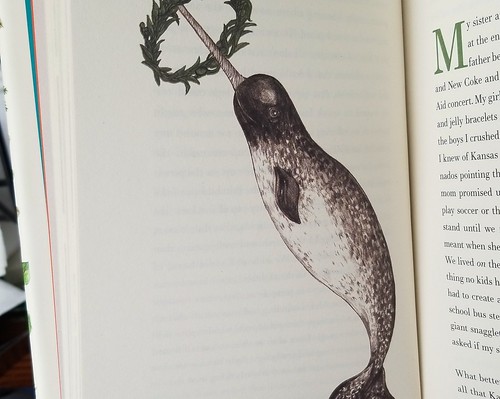
    I’ve been thinking about this a lot, after reading this passage from Aimee Nezhukumatathil’s remarkable book World of Wonders: In Praise of Fireflies, Whale Sharks, and Other Astonishments. At this point, Nezhukumatathil is in sixth grade, living in Kansas with her family through a year she doesn’t seem to have enjoyed very much:

    I could not have known that just one hour south of Larned State Hospital the person I would eventually marry, the father of my sons, was likely practicing layups in his driveway or hitting baseballs into a field not too far from a buffalo range. Just one hour from my life’s love! One hour! A white boy who would one day take my brown hand in his, putting it to his heart when he makes a promise so I can feel his heartbeat and the warmth residing there. If only the narwhal could have taught me how to listen for those clicks of connection, that echo reverberating back to me.


    Wait, you might be asking. What’s this about a narwhal?


    The book is called World of Wonders, and as I flipped through it in the bookstore where I found it (a brand new bookstore in Ithaca that is one of the most beautiful little bookstores I’ve ever seen and had the terrible luck of opening as the COVID pandemic was apparently shutting down the world), I figured it for a poetical look at a quirky selection of the world’s creatures, quirky and poetic. And it is certainly that, as Nezhukumatathil is a poet by vocation. But more than that, Nezhukumatathil uses all of these amazing creatures of the world as metaphorical gateways to discuss her personal biography and her experiences in the world.


    Nezhukumatathil, being a poet, writes with language that is beguiling and lyrical. The book has the feel of being one long prose poem. Here she is on fireflies:


    For a beetle, fireflies live long and full lives–around two years–though most of it is spent underground, gloriously eating and sleeping to their hearts’ content. When we see these beacons flashing their lights, they usually have only one or two weeks left to live. Learning this as a child–I could often be found walking slowly along untrimmed lawns, stalling and not quite ready to go inside for dinner–made me melancholy, even in the face of their brilliance. I couldn’t believe something so full of light would be gone so soon.


    One aspect of Nezhukumatathil’s life to which I can relate is moving a lot as a young person, but I cannot relate to her experiences as a person of color living in all these rural American locations. I can, though, readily envision the kind of experiences she had. There was an Indian family that moved to my town when I was a senior in high school, and one of their daughters (I think there were at least two kids in that family) was in my class, for all of one year. She was an incredibly smart and very nice (and, I might add, beautiful) person who was very well read; her favorite book was The Great Gatsby, which I myself read that year for the first time. She and I had some discussions on that book that I remember fondly. But some other things, I remember less fondly. As the year began to dwindle and as graduation neared, it was time for the yearly academic awards, and she won a bunch of them. Some of my classmates–all of them as white as anything–groused in the quieter moments of study halls that “Why should she get all the awards, she only came to town that year, she’d be gone soon, she was an outsider.” This at the time reminded me of my sister’s experience six years earlier in the exact same school district, when we’d moved in when she was a junior and she proceeded to win a lot of academic accolades. But of course her experience couldn’t possibly map to Shazia’s (that was her name), because Shazia had the added hurdle of moving to small-town rural Western New York as a person of color.


    Throughout World of Wonders, Nezhukumatathil occasionally makes glancing reference to time she lived in Western New York. I had no idea of this when I bought the book, but it caught my attention. But when the subject comes up, it’s a very quick mention, gone as quick as it comes, and I wondered if Nezhukumatathil had a bad experience here. I wondered where she lived in WNY, and how much of her experience here I would recognize, even as the person watching it unfold instead of living it. Late in the book, though, Nezhukumatathil names her town: Gowanda, NY. I know the town. It’s a small village in the hilly country between Erie and Cattaraugus Counties, a very beautiful area that I value highly for its hills and valleys and gorges and streams and waterfalls. But Nezhukumatathil writes of a single year there, and I think back on my classmate Shazia.


    Later, Nezhukumatathil writes of living in Western New York, during her chapter on the red-spotted newt:


    These newts are one of the only amphibians to contain a ferromagentic mineral in their bodies, and that, combined with their incredible capacity to memorize sun and starlight patterns to return to their original pond waters, make them an animal on par with salmon for their excellent homing capabilities. What’s particularly amazing is that in its lifetime–thanks to its innate magnetic compass–a newt doesn’t usually stray farther than just over a mile from its origins pond, staying within the range of about eighteen football fields.


    My own homing instinct was stronger than I ever could have thought. A decade after I left Western New York as a teenager, I was finishing up a fellowship year in Madison, Wisconsin. I scanned the academic job boards for entry-level professorships and had to blink twice when I saw there was an opening not too far from my old home. It was a long shot, I knew, but I applied anyway, even as I drove around to local bookstores and coffeehouses in Madison to apply for jobs there. Coffee barista, English professor–I felt guilty for even daring to hope I could land a tenure-track job–all I knew was that I wanted to stay in the classroom, but I also wanted to be able to spend time outdoors and write.


    After a few days’ worth of interviews, I received the magical call welcoming me back, and I spent fifteen more years in Western New York. I was married there. My babies were born there. But it wasn’t my forever home. Though we still keep in touch, my best friends had long since moved away. I was still one of too few brown people in town. I was tired of acquaintances at the post office asking about “my people,” meaning Filipinos or Indians; tired of people saying Namaste! to me in the grocery store, when I was least prepared for it; tired of the increasingly hostile climate at work if I dared to suggest more diversity on campus; and simply tired of being the one brown friend to so many people. On top of that, I spent fifteen winters navigating roads clogged with lake-effect snow. I was done with that pond. I would need to keep searching.


    Everyone has to find their own home, their own place to belong. Nevertheless, it makes me a little sad that the place that’s my home, my place to belong, wasn’t someone else’s. A bit selfishly, I mourn that my region had for a time someone living here who is capable of writing a book like World of Wonders…but for this reason or that, she felt that she couldn’t really live here. This happens for a lot of reasons, not all of them bad…but still. A place is a bit sadder when it says farewell to its poets, and a bit sadder than that when it doesn’t even realize its poets have left.


    Anyway, World of Wonders is a beautiful book.

    Share This Post

  • 2021 in the Books: SOULCATCHER and THE WEIRDSTONE OF BRISINGAMEN

     So, this year I’m going to try to do more with regard to writing in this space about the books I read. I’ve set a Goodreads challenge for myself of 52 books read, and as I write this, I’m ahead of schedule, with three books done. Huzzah! Here are capsule reviews of the first two.

    ::  Soulcatcher, by J.Q. Davis.

    Davis is a contact of mine on Instagram, and an indie author whose work I decided to support by buying one of her books. This one is quite an effective thriller, involving a company which employs sales reps whose job is to sell people on the idea of literally selling their souls to the Devil. Our heroine, Frankie, is an alcoholic who is quite good at her job, no matter how creepy her boss is and how deeply she knows that her job is morally repugnant. All she has is her sister, but when that relationship is threatened, Frankie meets a literal angel who is intent on destroying the business of soul-selling forever and freeing Frankie from her own contract which binds her to Hell.

    Soulcatcher, JQ Davis

    This book is very dark, with a lot of adult content. I also found it a bit slow in the first act, because of a lot of infodumping. But once Davis has her stage set, the book becomes a lot more involving, with a lot of surprises along the way. I was pleased at several junctures to find that what I was sure was going to happen actually was not, and yet, the things that do happen in the book make total sense. I ended up enjoying this one a great deal, even though this kind of story tends to not be my cup of tea more often than not.

    ::  The Weirdstone of Brisingamen, by Alan Garner.

    This YA fantasy novel dates from 1960, which makes it a pleasing throwback for me. Two young siblings, Colin and Susan, are living in England when they are attacked by strange creatures called the “svart alfar” while exploring their wilderness. They are rescued by a wizard who is tasked with overseeing and protecting the enchanted sleep of a small army of knights. Their is a particular item called the Weirdstone (also the Firefrost) that governs the magic behind the sleeping nights, and the Weirdstone has been lost. Now the forces of darkness are rallying to search for it, which leads to a desperate flight across the English countryside to hopeful safety.

    The Weirdstone of Brisingamen, Alan Garner

    Garner’s writing is dense in a way that a lot of contemporary YA is not, and it was actually a very refreshing read. I also liked his pacing: he takes his time. I do occasionally get frustrated with the idea that stories have to be all-motion, all-plot, all-the-time. This book opens slowly and gets more and more involving and faster paced as it goes, and by the time I got to the third act, I was turning the pages as quickly as I could. This is not a long novel, but Garner packs a lot into it. The book is pretty dense, and Garner’s mythology seems to be more a blend of various elements like Celtic and Norse myth, rather than reflecting specifics of each.

    I did find that the book’s characterization isn’t the greatest; if you’re a reader who needs your characters to feel like “real people” with sharply-drawn personalities. I suspect that this is partly the style of the time; it didn’t bother me all that much, really, and the characterization actually improves as more supporting characters arrive on the scene.

    Share This Post