Of Passions, forever and fleeting

WARNING: This is long, and quite likely boring.

Passions come and go in this life, don’t they? Things we are just so passionate about when we’re young may remain passions throughout our adulthood; others may fade into memory of something that was important to us once upon a time, while still others can find themselves subject to complete reversal as we realize that the new “Me” hates the very thing that the old “Me” found so amazing.

This is about two passions of my life, both of which I found at the same time, but only one of which has really endured. This narrative stretches back almost twenty years to my last months in high school, a time which is now starting to recede into a kind of haze where even some of the names of those involved require effort to dredge up. How distant some of those emotions now seem, however real and intense they were at the time.

This is the story of when I came to the writings of Richard Bach and the music of Sergei Rachmaninov.

I have always been drawn strongly to Romanticism, from the earliest time that I can recall being drawn to anything much at all. The Romantic in me is drawn to large gestures, bold statements, feelings so strong it seems that the force of my heart might well shift the world on its axis. Love is to be shouted from the rooftops; anger is to be no small irritation but a smoldering rage. Sadness is to be felt keenly and deeply, like the cut of a freshly sharpened knife, and beneath everything, every feeling, even happiness and joy, can be found a long streak of melancholy. That’s the Romantic in me, and he still lives within, sometimes under careful guard but at other times nearly allowed complete control.

In high school, my greatest passion above all was music. I was a good trumpet player, and had I continued down that path, I believe I would have become a very good trumpet player indeed. But for all my love of the trumpet, my greatest dream was to conduct an orchestra. This I dreamed in much the same way other boys dreamed of playing center field for the Yankees. I would watch concerts on PBS or attend the occasional concert of the Buffalo Philharmonic, and my eyes would remain forever riveted on the actions of the conductor. I would buy multiple recordings of the same piece of music and study those recordings to better hear the difference in interpretation each conductor brought to the work. I learned to hear which conductors did the best with which repertoire: Colin Davis conducting Berlioz, Solti conducting Wagner, Szell conducting Brahms, Bernstein conducting Mahler. I bought orchestral scores to study, and my bedroom stereo constantly throbbed with the strains of Mozart, Schumann, Beethoven, and Dvorak.

In music my supreme love was, and has always been, the music of Hector Berlioz, that great French Romantic who wrote one of the greatest of all symphonies, the Symphonie fantastique, after he fell passionately in love with an English actress during a performance of Hamlet. In Berlioz I sensed a kindred spirit: a person who felt everything so, so deeply. Strangely, though, given my predilection for Romanticism, it was not until my senior year when I began to explore the work of the Russian Romantics, composers who imbued their works with enough lyricism and fire to melt and mold the hearts of any listener. The first of these that I explored was Sergei Rachmaninov, via a tape cassette I bought in the budget bin at a record store of his Symphony No. 2 in E minor, played by the London Symphony Orchestra and conducted by Andre Previn. I have long since lost that tape, but I’ve always remembered something from the liner notes: Previn described the reaction to a performance of this work he had conducted with the LSO while on a tour of the then-Soviet Union, after which an old woman, so overcome with emotion at hearing the Symphony, pressed into Previn’s hand her most treasured possession at that moment: a single orange.

Nevertheless, when I first listened to the work, it didn’t move me greatly. It was long and pretty, to be sure, with lots of long melodies that dipped and soared, but it didn’t really move me. That was yet to come.

At the same time, non-musical life continued. There was a project in English class when we were supposed to pick a specific author and report on several of his works. I can’t remember now what author I chose – Arthur C. Clarke, perhaps – but the guy next to me (his name was Joe) did his project on Richard Bach. A few weeks later I was in a bookstore and I happened to see a shelf full of books by this Bach guy: his apparent perennial bestseller Jonathan Livingston Seagull, another mystical-looking volume titled Illusions: The Adventures of a Reluctant Messiah, yet another mystical-looking book called One. Having heard Joe talking a bit in class about Bach, I thumbed through the books a bit. I didn’t know what to make of Jonathan, which looked to be a short parable involving birds. (I’d later find out that that is exactly what that book is.) Illusions looked interesting in a way, but rather quasi-religious, and at that time, I was in a hostile-to-religion phase of my life that would last through much of the next five or six years (and frankly, there’s still a part of me that thinks that way). One looked oddly mystical as well, although I must admit that I was struck by what was written on the back cover. No synopsis, no blurb, just two sentences:

I gave my life to become the person I am right now. Was it worth it?

Now there was some food for thought, I had to admit. I do think that’s true to an extent: at any given moment, the person-we-are is the sum of the choices we’ve made through our years and the lessons we’ve learned from the results of those choices. To a great extent, what typically causes us to go off the rails in our lives is when we fail to learn lessons from our choices.

But back to that afternoon in the bookstore: the last Bach title on that shelf was The Bridge Across Forever: a lovestory. Like One, its back cover copy consisted of a single, brief item:

If you’ve ever felt alone in a world of strangers, missing someone you’ve never met, you’ll find a message from your love in The Bridge Across Forever.

As a Romantic at heart, that single blurb caught me. I bought the book and proceeded to read it pretty quickly. Without getting into too many details, my love life in high school was non-existent; I didn’t go on my first date until about a month before I graduated, and I didn’t have what I could by any reasonable definition a “girlfriend” until I was in college. (I always suspected my general high levels of geekiness and my general low levels of good looks as being prime causes of this, but I digress.) There was something about that bit on the back cover of that book that really captivated me: Missing someone you’ve never met.

As I recall, I read The Bridge Across Forever over the course of a week or so. Bridge tells the story of Richard Bach’s search for love, for a “soulmate”. Over the course of the first part of the book he casually meets women and rejects them for seemingly good reasons, but it soon becomes clear that despite his claims to be searching for true love, he’s purposely keeping love at arm’s length, in favor of some kind of “freedom” where he’s able to maintain open relations with a number of women. Much of this went right over my head when I read the book as a high schooler; I was mainly interested in how Richard found that person and in the book’s ultimate assurance that yes, there is someone out there and that one day, if you’re open to the possibility, you’ll meet the person you’ve been missing all your life. Richard meets that woman, actress Leslie Parrish, and at first he has a great deal of fun and open romance with her, before he realizes that he’s let her become too close. He pulls away, and she writes him a letter that’s worth the price of the book itself; they get back together and nearly break apart again; finally Richard allows himself to “use the words he despises” and says “I love you” to Leslie. The book meanders a bit after that, as he and Leslie build their life together through some hardships (and, frankly, some very strange “New Age” type mysticism, such as when Richard and Leslie share mutual out-of-body experiences and thus learn that their current cat is a reincarnation of Leslie’s former cat). The book closes with a luminous image: Richard and Leslie, after all their struggles, watching as their younger selves meet for the first time:

Dirt-streaked, glorious, she smiled at me, tear-bright radiance. “Richie, they’re going to try for it!” she said. “Wish them love!”

I don’t know if it happened during the time I was reading it, or shortly thereafter, but at some point in that general timeframe I listened again to Rachmaninov’s Second Symphony. This time I really heard it: the epic scope of that twenty-minute long first movement, with Rachmaninov introducing one motif after another that would recur throughout the entire work. The way the piece broods with a constant sense of melancholy but never descends into outright sadness. The opening, with the tone set by the low strings before the woodwinds break through with two high chords that usher in the violins with a soaring motif that offsets what’s going on in the low strings. The way that opening movement begins with a largo that is followed by an allegro that doesn’t feel all that much faster than the largo.

The second movement is a scherzo that I always have a hard time relating to; its mood stands at some contrast to the rest of the work, but it too includes the motifs brought forth in the first movement, and its second subject is as lyrical as anything. But it’s the third and fourth movements that worked their way into the innermost chambers of my heart, once I was attuned to them. I can barely describe those movements, and I don’t even want to try, except to note that this is, to me, what “eroticism” in music sounds like. True eroticism, though: the type of sensual experience that comes from shared emotion, from the ebb and flow of shared passion, with the type of climactic bursting at the end that comes as glorious release of pent-up tension.

I don’t know if having read Bridge made me more predisposed to the Rachmaninov Second, or if I simply came to two works at the same time, at the right time, at a time when I was equally predisposed to both. I suspect the latter; even when listening repeatedly to the Rachmaninov Second, I don’t recall ever making a specific connection between the music and the journey shared by Richard Bach and Leslie Parrish.

My college years saw my fascination with Sergei Rachmaninov and Richard Bach intensify. I listened to as much Rachmaninov orchestral music as I could find (I was always prejudiced toward orchestral music over chamber music, solo piano, and art song), and I soon read everything Richard Bach had written at the time, an activity that was helped along by the fact that his pre-Jonathan books were reissued in paperback right about that same period. Those earlier books – A Gift of Wings, Stranger to the Ground, Nothing by Chance, and Biplane – were all devoted to the main motif of all of Bach’s books: flight. Bach is obsessed with flight, having been a pilot his entire life, and flight is a constant metaphor in his books, where he is always flying to something, flying with someone, or, in the darkest moments, flying from something. Those early books were marked with none of the mysticism that would dominate Bach’s work beginning with Jonathan, but I could sense it brewing beneath the surface. A bit.

Likewise, I explored Rachmaninov. His Third Symphony also became near and dear to me, although never as intimate as the Second. I admired his Symphonic Dances, and I came to love the Piano Concertos and the Rhapsody on a Theme of Paganini deeply (if you think that 18th variation is gorgeous, it becomes even moreso when you hear it in the context of the remainder of the work). His magical choral work Vespers struck me as both gorgeous and haunting, and my favorite tone poem of all time is very likely Rachmaninov’s Isle of the Dead.

I’ve never re-read Bach’s early books, but I’ve always maintained a soft spot for both Jonathan and Bridge. Gradually, though, while Rachmaninov has always remained close to me, Richard Bach has slid away for some reason. I barely remember reading his Running from Safety, and I haven’t read anything he’s written since that. Why is this? Why have I moved on from the one passion I found in early 1989, but not the other one?

Richard Bach, for one thing, is still alive, and thus his tale is not done. And that means that things that happened to him later on could color my perceptions of his work, which happened: I learned a few years ago that the happy ending of The Bridge Across Forever was fleeting, and that Richard and Leslie divorced. In a message that appeared online (here it is), Richard painted a happy face on the ending of his marriage to the person he’d earlier declared in several books his “soulmate”, but it still casts something of a pall over the book now, knowing that it all ended anyway. I’m not sure that it’s fair for me to even feel this way, given my own ambivalence on the concept of “soulmates” to begin with. I’ve never believed that life is a quest for that one and only one person out there somewhere who can make us whole. How can it be that way, when we live in a world where a person can see his or her soulmate snuffed out in an errant turn of the steering wheel, or struck down by cancer?

Perhaps it’s not fair for me to read Bridge this way, but the tone of the book is pretty one-sided in its conviction that the journey, or “flight”, through life of Alone-Richard is over and all that remains is the journey of Richard-With-Leslie. But it’s hard to accept their eventual divorce in light of things like a chapter where Richard and Leslie are training themselves to leave their bodies so that they might cheat death together and exist as loving spirits. And maybe there’s something more basic than that underlying my movement away from Richard Bach: my sense that, as sympathetic as I may be to his brand of mysticism, I just don’t buy into a lot of it. (This may be a particular failing of mine; I tend to be almost envious of everyone else’s mysticism.) Maybe it’s that Richard, for much of Bridge, is really kind of a jerk: he’s a narcissistic prude who is shocked – shocked! when Leslie swears at a bad driver, as well as a guy who refuses to come to his friend’s aid when she really needs him because he has some predetermined principle about women and ownership of other’s lives of some such nonsense. (Although it’s to his credit that he’s willing to write himself as a jerk.) And maybe it’s that I see life, somewhat as Leslie does as she writes in the letter that Richard quotes in the book, as a sonata where Richard sees it as a sequence of flights in an airplane, where the only person who matters is the pilot and where the passengers are interchangeable. It’s telling that in all those books, Richard Bach never mentions his first marriage or the children it produced.

(Bach’s son would later write a book of his own, dealing with his father’s non-presence in his life. I read that book years ago, but I don’t remember a whole lot about it.)

But what’s the real reason that Richard Bach is no longer a constant presence in my life, while Sergei Rachmaninov is? It’s because Sergei Rachmaninov wasn’t a writer, he was a composer, and relationships with music are, I’ve found, much more fluid that relationships with books. Great music remains great music, even as we bring new associations and new experiences to bear. So too do great books, but there’s something about writing that remains fixed in time that doesn’t happen, at least for me, with music. I associate Richard Bach with a person I once was but am no longer, but I don’t do that with Rachmaninov. The Rachmaninov Second doesn’t represent musical rapture to me as it once did; it now represents something deeper and more primal. But it still represents something. Rachmaninov continues to show me new things through music; Richard Bach only shows me what he’s always shown me. That’s not a bad thing, but it shows a limit somehow. Listening to Rachmaninov today continues to feel like visiting an old friend who still looks the same but has something new to say; reading Bach today feels to me like thumbing through old photo albums and seeing faces I remember. But the memories are vague, and in some of the photos, I can no longer put names with the faces. And in a few cases, I recognize the girls I really really really liked back then…and in at least a few cases, I can no longer fathom why.

To me, Richard Bach is a memento. Sergei Rachmaninov, though, is a force.

(That said, I’ll be re-reading Jonathan this week.)

Share This Post

Assistant Pig-Keeper

I have a bit of a problem. At bedtime, The Daughter and I have been reading through The Dark is Rising Sequence by Susan Cooper, and The Prydain Chronicles by Lloyd Alexander. We’ve been alternating through the series, and tonight we finished The Black Cauldron, putting us at the two-books-down point in each series of five. OK.

However, it didn’t occur to me that I might have this particular problem until last night, when we read the last chapters of The Black Cauldron. If you’ve read the book and know the story, you know that a particular character executes a pretty amazing act of self-sacrifice at a critical juncture; it’s one of the most emotional moments of the series, and last night while reading that passage I found myself getting choked up.

I did pretty well at concealing it, and the real difficulty is still three books away, so it’ll be a while, but it’s real and it’s going to happen. The problem is that I can’t get through the last two chapters of The High King, the last book in the Prydain Chronicles, without crying like a little girl. Wow, that’s going to be a hard book to read aloud. Hmmmm. But as I say, that’ll be a while; tonight we’re back into The Dark is Rising, with Book Three, Greenwitch.

In other news, two short stories of mine went out into the world yesterday, where they will do battle against editors who will likely vanquish them with mighty Slips of Rejection +4. But you never know, so wish them luck.

Share This Post

Another Book Quiz

Here’s one snagged from Steph: it’s a list of books most often marked “Unread” on LibraryThing, indicating books people have copies of either so they can say they own them, or in the best intentions of reading ’em someday if only James Patterson would quit churning out must-read thrillers or whatnot. (Like I’m any different!) Anyway, the instructions are to bold the ones you’ve read, underline the ones you read for school, and italicize the ones you’ve started but not finished. I’ll add another two rules: strike the ones you know you’ll never, ever read and don’t even own a copy of, and mark with a *star the ones you own and really, genuinely intend to read one of these days. OK? OK!

Jonathan Strange & Mr Norrell (I’m reading this now, actually, and am halfway through it and loving it)

* Anna Karenina
* Crime and Punishment
Catch-22
One Hundred Years of Solitude
Wuthering Heights
* The Silmarillion
Life of Pi: a novel
The Name of the Rose
Don Quixote
Moby Dick (Another one in progress, very slowly.)

Ulysses
Madame Bovary
The Odyssey
* Pride and Prejudice
* Jane Eyre (loved this book, want to read it again)
* A Tale of Two Cities
The Brothers Karamazov (Grrrrr!)
Guns, Germs, and Steel: the fates of human societies
* War and Peace
Vanity Fair
The Time Traveler’s Wife
The Iliad
* Emma
The Blind Assassin
* The Kite Runner
Mrs. Dalloway
* Great Expectations
American Gods
A Heartbreaking Work of Staggering Genius
Atlas Shrugged (I so want back the time I spent reading this shit.)
Reading Lolita in Tehran: a memoir in books
Memoirs of a Geisha
Middlesex
* Quicksilver
* Wicked: the life and times of the wicked witch of the West (The Wife read this and loved it)

The Canterbury Tales
The Historian: a novel
A Portrait of the Artist as a Young Man
* Love in the Time of Cholera
Brave New World
The Fountainhead (What possessed me to read Atlas Shrugged after I read this and judged it insipid and idiotic, I will never know.)

Foucault’s Pendulum (Read it sophomore year of college. Loved it. Didn’t understand much of it at all.)

Middlemarch
* Frankenstein
* The Count of Monte Cristo
* Dracula
A Clockwork Orange
* Anansi Boys
The Once and Future King (Just a beautiful, wonderful book, with one of the greatest closing passages I’ve ever read.)

The Grapes of Wrath
The Poisonwood Bible : a novel
1984
Angels & Demons
The Inferno (and Purgatory and Paradise)
The Satanic Verses
* Sense and Sensibility
The Picture of Dorian Gray
Mansfield Park
* One Flew Over the Cuckoo’s Nest
To the Lighthouse
Tess of the D’Urbervilles
Oliver Twist
Gulliver’s Travels
* Les Misérables
* The Corrections
The Amazing Adventures of Kavalier and Clay (Amazing book)
The Curious Incident of the Dog in the Night-Time
Dune (I got sick of having to look things up in the glossary once per paragraph, but I definitely mean to read it.)

The Prince
The Sound and the Fury
Angela’s Ashes: a memoir (No interest at all.)
The God of Small Things
A People’s History of the United States: 1492-present
Cryptonomicon (What a wild fun blast this book was!)
Neverwhere
A Confederacy of Dunces
A Short History of Nearly Everything (I’ve read it twice!)
Dubliners
The Unbearable Lightness of Being
Beloved
Slaughterhouse-Five
The Scarlet Letter (Loved it.)
Eats, Shoots & Leaves
The Mists of Avalon (I really wanted to like this, but the anti-Christianity stuff just got to be too much. Nothing against that per se; it just overwhelmed the story.)

Oryx and Crake: a novel
Collapse: how societies choose to fail or succeed
Cloud Atlas
The Confusion
Lolita
Persuasion
Northanger Abbey
The Catcher in the Rye (You know what? Meh.)
On the Road
The Hunchback of Notre Dame
Freakonomics: a rogue economist explores the hidden side of everything
Zen and the Art of Motorcycle Maintenance: an inquiry into values (I’ve read it a bunch of times, along with its lesser-noted sequel, Lila. I like these books a great deal, but there are times when I think Pirsig takes easy ways out, simply using his novel structure as an excuse to drop lines of inquiry when they prove troublesome.)

* The Aeneid
Watership Down
* Gravity’s Rainbow
The Hobbit
In Cold Blood: a true account of a multiple murder and its consequences
White Teeth
Treasure Island
David Copperfield (Hated it in school, but I’m prepared to admit that I didn’t know my arse from the proverbial hole in the ground at the time.)

The Three Musketeers (Read last year and loved it. One of the most entertaining books I’ve ever read.)

Share This Post

The Big Red Cheese (and that other guy)

I have a couple of new reviews up at Green Man Review. First I look at Jeff Smith’s recent graphic novel treatment of Captain Marvel, SHAZAM! The Monster Society of Evil, which I liked a lot, and Kevin J. Anderson’s recent prose-novel treatment of the last days of Superman’s home planet of Krypton, titled appropriately enough, The Last Days of Krypton. This one I didn’t like as much, although I’m not sure it’s totally Anderson’s fault as he probably did the best he could with the task at hand. Anyway, check out the reviews. Or don’t. Hey, it’s your mouse. I can’t make you click the links!

Share This Post

Loving the Library

I happened upon this library quiz-thing, and given my love of libraries and quiz-things, I just had to do it. Sadly, I had no idea that February was “Library Lovers Month” until three days into March, when I found this. Alas.

How do you plan on celebrating Library Lovers month?

Well, by doing this quiz, I suppose, since I missed the actual Library Lovers Month. Whoops!

How often do you accidentally spell library as ‘libary’ when you’re in a hurry?

Never, I think. Let me try: Library library library library library library lobrary librayr librayr library library library. Nope, just a couple of typoes, and neither was the one specified. When I make a typo, it’s almost always because in my haste I hit the keys in the wrong order, so there end up being the correct number of letters, but either an incorrect letter or two or all the correct letters in the incorrect sequence.

What is the largest amount of books you’ve ever had checked out at one time?

Probably around twenty or so, on a day when I’m grabbing a lot of stuff and The Wife grabs a lot of stuff and so does The Daughter. Usually it’s around ten items or so.

What is the longest you’ve ever gone without visiting the library?

Six months or so, from roughly July 2005 to the end of that year. It just got to the point where going out with Little Quinn for a jaunt to the library was too much work, and also, I had a fairly large fine to pay at that time, and I never had the cash for it. Which leads to the next question:

What is the biggest fine you’ve ever had?

I don’t remember the amount, but it was close to $30, after I forgot to return a couple of DVDs before we went on a trip across the country, which ended up being the last trip for 2005 until after Little Quinn died. The Buffalo and Erie County Public Library charges $2.00 a day for late DVDs, so by having two of them overdue by over a week, the fines racked up very quickly.

When you go to the library, do you plan ahead and make a list? Or do you browse?

Occasionally I’ll make a mental note of a title or two, but usually I just browse. I love to go online and request titles when I know there’s something specific I want; the great thing about having a large library system at my disposal is that I can request a book and have it delivered from another branch to my own local branch, where I then check it out. I always look at the New Nonfiction shelf first, and then wander the older nonfiction shelves. (I don’t much go into the fiction section unless I’m looking for something specific that I think I might want to read, since my personal book-buying is almost exclusively fiction.)

Have you ever been shushed by a librarian?

I’m sure I was in school a few times, but never at the public library, where the rule seems to be for people to use normal conversational voices.

What is the worst (against-the-rules) thing you’ve ever done in the library?

I’m assuming this doesn’t mean things like “Hey, baby, let’s go up to the third floor and join the Government Documents club!” (No, I’ve never done that.) Truthly speaking, I can’t think of anything I’ve ever done as a library patron that was against the rules. Now, as a library employee at the university where my father teaches, I must admit that there were times when being in the presence of all those books led to “reading on the clock”, but that’s most definitely the worst thing. Oh, and there was the time they had me doing some work in the A/V room all by myself, with the door shut. I found a set of tapes of historical speeches, and then I sat down and listened to several of them, all the way through. Man, that JFK delivered a heck of an Inaugural, eh? And Jimmy Carter’s acceptance speech in 1980? “Hubert Horatio Hornblower! Er, Humphrey!” Wow.

What’s the worst thing you’ve ever done to a library book?

Not returned one. When we moved from West Seneca, NY to Syracuse back in 2002, I thought I returned all the books to the West Seneca library. Not so much: I missed one, and didn’t discover it until we got unpacked in Syracuse. One of the first things I did when we moved back to Buffalo (Orchard Park, current location of Casa Jaquandor) was to return that book and settle up my fines for it.

Have you ever had a “favorite” librarian?

My mother. Duh. (Wow, that was too easy.) And there’s one at the current library who always comments when I have a piece of writing in the paper, which is cool.

If you could change one thing about your library it would be…

More books, obviously. More periodicals. The building itself could use some sprucing up. But by and large, my library is a terrific place. It’s next to an old train station that has been restored, and it’s across the street from my church. (If we’re talking about the Buffalo and Erie County Public Library as a whole, though, I’d increase its budget substantially, so long as there was money to do so.)

Let me close by once again voicing my general befuddlement at people who claim to love reading and yet don’t use their libraries. Limiting one’s reading to the books one can afford to buy makes absolutely no sense to me, and I say that as someone who already owns more books than I’m likely to be able to read in my lifetime and who has little intention of stopping. On the flip side, a Buffalo News columnist (Charity Vogel, I think) recently wrote an article about our libraries, citing a friend of hers who had moved to Hamburg, NY from Orlando, and had to start buying books because the Hamburg library doesn’t get the “newest, hottest reads” as quickly as the Orlando library had. This just struck me as terribly silly: judging one’s public library by one’s ability to walk in and check out the very latest by Nora Steele or Danielle Patterson or James Roberts or whomever is to miss the entire point of a public library by a huge margin.

And whenever I hear some libertarian or conservative type opine that maybe in the days of Amazon.com it’s time to let libraries slip into the past, I want to scream. I can’t think of a more misplaced set of priorities than that.

Share This Post

To the books!

So, what have I been reading lately? Let’s look:

:: It’s actually been a long time since I bounced off a book, but damned if I didn’t bounce clean off a Stephen King novel. I haven’t read a whole lot of King, but what I have read, I’ve at least liked, and some of it I’ve found utterly brilliant (The Stand is just a magnificent work). So I didn’t expect to find Dreamcatcher a tough nut, but tough indeed I found it. Like many King books, the early going started flying by, and I actually got about a third of the way into the book before a major shift in tone and focus stopped me cold. The early stuff, detailing the lives of our hunter friend heroes, is all winning stuff, vintage King. But something really bothered me in the book’s tone once the military guys show up, and then the book veered into a long surreal section with Jonesy, if I was reading things right. Anyhow, my interest in the book dropped like a rock at that point, and I eventually set the thing aside. I’m quite surprised that’s how it worked out, and maybe I’ll give the book another go someday.

:: I did not bounce off In the Heart of the Sea: The Tragedy of the Whaleship Essex. This is one of those books I’d seen any number of times, either in bookstores or at the library, and each time there was something about it that said, “You know you’re going to read me sooner or later.” So the last time I saw it in the library, I picked it up and read the blurb on the dust jacket, describing the fate of the Essex as being a partial inspiration to Herman Melville in Moby Dick, and claiming that the Essex disaster was as famous in the nineteenth century as the Titanic wreck was in the twentieth. Clinching it is the fact that the book is cited on this list of sea books. I love a good book about the sea, and this certainly is that.

The Essex was a whaling vessel that set out from Nantucket on a whaling expedition and encountered many problems along the way, such as storms and short provisions as it sailed into the Atlantic, down the east coast of South America, around Cape Horn, and into the Pacific to attempt to harvest the whales in recently-discovered feeding grounds there. At that point, the voyage, already difficult, became calamitous when a sperm whale rammed the Essex repeatedly, eventually dealing the ship a mortal blow. The crew then set out in lifeboats to try to return to South America. A handful of crew eventually made it, after many days at sea in which they became starved and dehydrated and eventually resorted to cannibalism.

Tales of disaster like this, in which arrogant man is pitted against heartless nature, always seem to include numerous instances in which everything could turn out differently, and better, if only better decisions were made. Those bad decisions, constantly exacerbated by bad luck, make for a riveting and haunting read.

:: One doesn’t explore the world of comics beyond the well-known superhero stories very far before one encounters the name of Will Eisner, who by all accounts is one of the twentieth century’s leading lights of comics-as-literature, as opposed to comics-as-diversion-for-adolescents. Such creators as Scott McCloud, Art Spiegelman, and Craig Thompson all spring from the ground seeded by Will Eisner. And yet, until a few weeks ago, I’d never read any Eisner at all. Well, that is no longer the case.

Life, in Pictures is a collection of autobiographical stories, drawing from various aspects of Eisner’s life. The term “autobiographical” is meant to be taken somewhat loosely, as apparently the first tale in the book, “A Sunset in Sunshine City”, is not autobiographical at all but rather a fictional meditation on the kinds of feeling Eisner experienced when he, like the main character in the tale, moved from his lifelong home in New York City to a retirement home in Florida. Also partially autobiographical is “The Dreamer”, which follows the early career of a young cartoonist (a stand-in for Eisner) in the youthful days of the comic book industry (before World War II, and definitely before the disastrous creation of the Comics Code). Here Eisner depicts his young stand-in running across numerous real figures from comics history, albeit disguised with fictional names. (Luckily, this story includes a set of annotations, clearing up the identities of those depicted.)

The largest portion of the book is devoted to “To the Heart of the Storm”, in which Eisner, having been drafted into military service and on board the troop train riding to his bootcamp, reflects on his personal history and that of his parents, with particular emphasis on the fact that they are seemingly always on the run from anti-Semitism. “The Name of the Game” traces Eisner’s family history through his mother’s side, and the book concludes with a very short tale – a vignette, actually – called “The Day I Became a Professional”, which is exactly that.

I suppose this is no revelation whatsoever, but Eisner turns out to be that rare item in comics: the complete package, the brilliant writer as well as the terrific artist. His texts and his visuals blend so seamlessly that there were times in reading Life, in Pictures that I found myself literally losing my sense of time in the face of my awe at my first encounter with an obvious master of his form. So yeah, Will Eisner turns out to be pretty good. Film at eleven!

:: Sticking with comics, I thought that American Born Chinese by Gene Luen Yang would be an manga, but it’s not, really. It’s just a graphic novel by a comics artist of Asian descent on the subject of a young man who finds himself isolated as the only Chinese-American in his new school. It’s also the story of the Monkey King, a monkey who isn’t satisfied to be a King but who also wants to be a God. And it’s the story of a popular kid named Danny who sadly has a cousin named Chin-Kee, who happens to be the personal embodiment of every obnoxious stereotype of Chinese people that exists. American Born Chinese tells all these stories, and in reading the book, I figured that each tale existed in its own particular space in the book. That assumption turns out to also be wrong, when the three stories become one late in the book in one of the more delightful surprises I’ve encountered lately in a book.

I suppose there’s something about my initial assumption that the book was a manga (“Hmmm, Asian subject matter, Asian artist…clearly a manga!”) that illustrates part of the point the book makes about racial stereotypes toward Asians in the first place. We’re talking about a Chinese-American comics artist here, after all, and manga is a Japanese medium. But the book is brilliant, and along with the Eisner volume above truly indicative of how powerful a medium comics can be.

:: It’s generally taken as a given that political figures tend to exhibit qualities in their public speaking that are often labeled in the colorful way as “being full of shit”. However, it can always seem a bit daunting to identify exactly how our politicians are befuddling us with bullshit, since they’re obviously not baffling us with their brilliance. Hence a book like Aristotle and an Aardvark Go to Washington: Understanding Political Doublespeak Through Philosophy and Jokes, by Thomas Cathcart and Daniel Klein. It’s a brief, breezy, and mostly entertaining look at the various tricks-of-the-trade of political rhetoric. Granted, most of the examples the authors select involve lapses in logic by right-of-center politicians, but there are the occasional quotes by such Democratic masters of BS as Bill Clinton. The book also features lots of regular old jokes along the way, used to depict logical fallacies. It’s a fun and breezy read, especially as a kind of refresher course in logical argumentation.

:: I read Sheila’s appreciation of a production of Macbeth with Patrick Stewart as the lead with interest, as I had just weeks before finished reading Macbeth for the first time since high school. I remember this being the first of Shakespeare’s plays that I really liked, probably owing to its blood-soaked tale of regicide and eerie supernatural content; I remember being especially pleased in discovering the way Shakespeare had made the witches’ prophecies come true.

We read Macbeth in eleventh grade English; at the time, the norm was, if memory serves, one Shakespeare play a year. We started in ninth grade with Romeo and Juliet, which, well, I just wasn’t capable of appreciating in any way that early on. (I’ve always had this pet notion that literature should be taught in reverse chronology; dumping a bunch of ninth graders into iambic pentameter can’t be the best way to introduce kids to The Bard, I think.) In tenth grade it was Julius Caesar, which I found more interesting, although I still found Shakespeare mostly impenetrable. “Why do they keep talking for so long? A bunch of guys stab Caesar and yet he still manages to get out ‘Et tu Brute’?” It wasn’t until Macbeth that I started to actually see what Shakespeare was doing, that I started to understand that his language had rhythm and music inherent within it. (I may have been influenced by my discovery the year before of Berlioz, and my further discovery that Shakespeare had been one of Berlioz’s greatest artistic influences. I guess that was my first personal experience with being swayed by a celebrity endorsement.)

Anyhow, Macbeth. I don’t have anything particularly insightful to say about this work; I only note how wonderfully brooding a play it is, how gloomy. Macbeth himself always seems as though he believes himself to be in control of his own actions, but all along, we know that he is in no control at all. Watching his entire world collapse around him, and seeing him reduced to, in his words, “a poor player” strutting and fretting his hour upon the stage, forms the heart of the tragedy. I love this play, and I should really try to see some Shakespeare on stage someday.

:: Finally, I’m trying an experiment: reading Moby Dick at the rate of one chapter a day. If I can stick to that pace, I will get all the way through the book in 135 days. (Yeah, that’s a big ‘if’.) I’ve been planning to read Moby Dick for a while now, but my enjoyment of In the Heart of the Sea influenced my decision to get going now, and it will help that the chapters are all very brief. Occasionally I will post a brief thought about the book as I make my way through it, starting with this: the first sentence of Chapter Two.

I stuffed a shirt or two into my old carbet-bag, tucked it under my arm, and started for Cape Horn and the Pacific.

That is just a terrific sentence, isn’t it? Our boy Ishmael dreams big. He’s not setting out to find a berth on a ship, he’s not setting out for Nantucket, he’s setting out for Cape Horn and the Pacific. That would be like if Neil Armstrong had risen on that morning in July 1969, kissed his wife, and said, “Bye dear, I’m off for the Sea of Tranquility.” Ishmael’s a guy who knows where he’s going.

So that’s the literary activity lately at Casa Jaquandor.

Share This Post

Literature! Now good for kids, too!

UPDATED 3-6-08: A correction below where I mis-identify an author.

SamuraiFrog calls attention to this list of the top fifty childrens’ books, apparently arrived at via a poll of some sort. As usual, I’ll bold the ones I’ve read, and provide occasional comment. (SamuraiFrog has some good points on the list as a whole, particularly the wide definition of childrens’ books they used for this list.)

1 The Lion, The Witch and The Wardrobe, C S Lewis (Best? Huh?)

2 The Very Hungry Caterpillar, Eric Carle (I like Eric Carle, although sometimes his stuff starts to seem the same.)

3 Famous Five series, Enid Blyton
4 Winnie the Pooh, AA Milne (Wow, it’s really different to read Milne’s original after one has been immersed in the Disney-fied version of Pooh for so long.)

5 The BFG, Roald Dahl
6 Harry Potter and the Half Blood Prince, J K Rowling (OK, why this book? First, although it’s definitely good, it’s not the best of that series; my vote would go to Prisoner of Azkaban. Weird pick. I wonder when the poll was taken? If it was before Deathly Hallows came out last year, then clearly people are picking the most recent title they remember.)

7 The Faraway Tree, Enid Blyton
8 The Wind in the Willows, Kenneth Grahame
9 Alice in Wonderland, Lewis Carroll (I’m assuming we’re including Through the Looking Glass here? Brilliant books, obviously.)

10 The Gruffalo, Julia Donaldson
11 The Tales of Peter Rabbit, Beatrix Potter (I love Potter, although I have to wonder how many kids grew up prejudiced against chamomile tea because of it.)

12 Charlie and the Chocolate Factory, Roald Dahl (I’m not sure that I’ve read the book, come to think of it, but I’m claiming it on the basis of having seen the two movies lots of times each.)

13 Matilda, Roald Dahl
14 The Secret Garden, Frances Hodgson Burnett (I need to read this, but a very good movie was made of it back in 1993.)

15 The Cat in the Hat, Dr Seuss (Believe it or not, I actually prefer the sequel, and there are many times when I wish I could unleash the power of VOOM! upon the Federal Disaster Area that is my apartment.)

16 The Twits, Roald Dahl
17 Mr Men, Roger Hargreaves
18 A Christmas Carol, Charles Dickens (Is this a children’s book? Or is it a really good book that appeals to children as well?)

19 The Malory Towers Series, Enid Blyton
20 Peter Pan, J M Barrie
21 The Railway Children, E. Nesbit
22 Hans Christian Fairy Tales, H C Andersen (Not all of them, but quite a few.)

23 The Wizard of Oz, L. Frank Baum (I just grabbed a copy of this for The Daughter yesterday at the library book sale!)

24 The Witches, Roald Dahl
25 Stig of the Dump, Clive King
26 The Wishing Chair, Enid Blyton
27 Dear Zoo, Rod Campbell
28 The Tiger Who Came to Tea, Judith Kerr
29 Goldilocks and the Three Bears, Jan Brett (I haven’t read this, but I do love Jan Brett’s work.)

30 James and the Giant Peach, Roald Dahl (I recently blogged about this. We really need to read more Dahl in this household! I love Dahl.)

31 A Bear Called Paddington, Michael Bond (You know, I had completely forgotten about Paddington until just this very minute, while I’m writing this. We read these in class when I was either in third or fourth grade. I don’t remember disliking them, but other than that, I don’t remember much about them at all.)

32 Black Beauty, Anna Sewell (Another acquisition for The Daughter at yesterday’s book sale!)

33 Where the Wild Things Are, Maurice Sendak (Yeah, a classic. I saw a Bill Moyers interview of Sendak on PBS once, and I was struck at what a cynical man Sendak seems to be. There’s a reason his books have that hint of bitterness and despair in them.)

34 Aesop’s Fables, Jerry Pinkney (Not this specific translation, I suppose, but something similar.)

35 The Borrowers, Mary Norton
36 Just So Stories, Rudyard Kipling
37 Meg and Mog, Jan Pienkowski
38 Mrs Pepperpot, Alf Proyson (Never heard of this book, but I do love pepperpot soup. There’s no better soup for a morning after overindulging in ales and lagers the night before.)

39 We’re Going on a Bear Hunt, Michael Rosen 4 (I’m not sure if the one we own is this same version, but it was one of The Daughter’s favorite books when she was 2 or 3. I hated reading it, except for the very end, when I could really ham up the bear’s pursuit of the family right to their own door.)

40 The Gruffalo’s Child, Julia Donaldson
41 Room on a Broom, Julia Donaldson
42 The Worst Witch, Jill Murphy
43 Miffy, Dick Bruna
44 The Little Prince, Antoine De Saint-Exupery (Maybe I should read it again. I recall reading it and not seeing what all the fuss was about.)

45 Flat Stanley, Jeff Brown
46 The Snail and the Whale, Julia Donaldson
47 Ten Little Ladybirds, Melanie Gerth
48 Six Dinners Sid, Inga Moore
49 The St. Clares Series, Enid Blyton
50 Captain Underpants, Dav Pilke

OK, so I haven’t read too many of those, and there are more than a few that I haven’t even heard of. I suspect this is because the list was made by a bunch of Brits, and we all know that those Brits don’t know anything from literature; seriously, that country’s been resting on its literary laurels ever since Shakespeare died. What a good thing we Americans saved the English language from them! USA! USA! USA!

Oh all right, scratch that last paragraph. I was only kidding. But there are a lot of treasured reads from my own childhood that aren’t here at all. Nothing by Lloyd Alexander, for instance, appears on this list, and I would put The Prydain Chronicles right beside The Chronicles of Narnia for classic kidlit fantasy. Also, they’re hard to find these days (I’m not sure if they’re even in print), and they can be terribly un-PC, but John Fitzgerald’s Great Brain books are as entertaining a series as you’ll ever find; Tom Dennis Fitzgerald is one of the most memorable characters I can remember from any book I’ve ever read. (And you’d think these books would be popular with the Dangerous Book for Boys crowd.)

(By the way, Fitzgerald also mined his family history in a couple of books for grownups. I strongly recommend Papa Married a Mormon, but I found the follow-up, Mamma’s Boarding House, disappointing, although assuming that the events in that book actually happened as Fitzgerald relates them, the fault can’t really be his; it’s just that Papa Married a Mormon ends on a really perfect and bittersweet note. Reading Mamma’s Boarding House would be kind of like…oh, I don’t know, learning all about how Andy and Red make out with that boat after the end of The Shawshank Redemption. Some tales just don’t need to be told.)

And of course, my reading life would be immeasurably poorer had I not done something naughty in fifth grade and thus had my mother hand me The House with a Clock in its Walls by John Bellairs. Bellairs’s death in 1991 is the first time I ever mourned an author’s passing. It also seems strange that Laura Ingalls Wilder doesn’t appear on the list, but then, her tales of life in mid-nineteenth century heartland America probably don’t have much appeal for British readers, either.

Other authors? How about Robert Cormier, whose One Fat Summer was pretty meaningful to me (as a fat kid), and whose Fade is one of the most downright creepy books I’ve read? Or Beverly Cleary and Betsy Byars? Say, is Judy Blume still a popular childrens author? I’m tempted to read Tales of a Fourth Grade Nothing with The Daughter, but I wonder if it’s aged poorly.

UPDATE: OK, I completely bungled on Robert Cormier. While he did write Fade (and We All Fall Down, another book I admired greatly), he did not write One Fat Summer. That was Robert Lipsyte. Bugger! But I did love all those books.

(By the way, The Daughter and I are now making slow progress through the first book in Susan Cooper’s Dark is Rising sequence. I’m liking it quite a lot.)

I’m not “tagging” anyone to do the whole “bold the ones you read” thing, but I would be keenly interested to hear what Sheila, Jennifer, Erin, Jayme, Tosy or Cosh, Belladonna, and Mrs. M-Mv have to say on the topic.

Share This Post

And the Lord did grin….

SamuraiFrog did this quiz a day or two ago, and though it doesn’t feature tagging, I’m grabbing it anyway, because it’s actually interesting and it’s a quiz. It’s about the Bible.

1. What translation of the Bible do you like best?

I’m always a bit amazed at the sheer number of Bible translations that exist, and the many ways in which the translations selected greatly impact people’s personal versions of Christianity. I can’t honestly claim to have a “preferred” translation, since I am only familiar with two – the two I own copies of, as luck would have it. Everyone agrees that for sheer poetry and beauty of language, the King James Version can’t be beat. My study Bible is the “Today’s New International Version”. I don’t really have an opinion on how it stands up as a translation or as a doctrinal document, and it seems pretty readable to me, so I’m fine with it. I bought this particular version more because of the additional materials it came with (maps, illustrations, commentary, and a nice concordance) than out of any allegiance to the translation.

But come to that, when I was shopping for a study Bible, I was struck by the sheer number of Bibles that are out there, the price that some of them command, and the fact that Bible publishers seem to want Bible-shopping to be difficult because more often than not the bloody book is shrink wrapped. There were several study Bibles that I wanted to thumb through to compare with the one I bought, but as those were shrink-wrapped and this one wasn’t, I made my choice accordingly.

Also come to think of it, here’s an interesting rant I found the other day on the topic of that incredibly thin paper Bibles are often printed upon. While I can see the point, I’ve never personally been bothered by bleed-through like this; in fact, I wish someone would print a Complete Works of Shakespeare on paper like this, so I could carry one around with me. None of my current three Complete Shakespeares are the kinds of books one wants to keep in one’s bookbag at all times.

2. Old or New Testament?

As far as what? The OT is always fascinating, of course, and it contains a great deal of stunning poetic language, especially in the Psalms and Ecclesiastes. But it’s also got all the blood-soaked material, which is fascinating in itself but not terribly inspiring in terms of morality, and it’s got all that incredibly creepy Law stuff in Leviticus. Frankly, the God of the OT is a very hard to swallow deity. The NT has the four Gospels, which of course contain the story of Jesus, which is surely one of the most compelling of all stories, whether you believe or not. Revelation is, of course, a pretty wildly trippy book. I haven’t made up my mind on Paul’s letters. Paul seems to vacillate wildly between sage wisdom and assertions that sometimes actually irritate me.

3. Favorite Book of the Bible?

The Song of Songs, which doesn’t seem to come up all that often in church. I wonder why.

4. Favorite Chapter?

Luke, chapter 2. It’s the most poetic of the Bible’s versions of the Nativity tale. This chapter is where the KJV stands above every other translation, in my opinion.

5. Favorite Verse?

There are a lot of verses I’ve come to love a lot since I’ve become exposed to the Bible, but for reasons of writerly admiration I have to cite the final sentence of the Gospel According to John (John 21:25):

And there are also many other things which Jesus did, the which, if they should be written every one, I suppose that even the world itself could not contain all the books that should be written. Amen. (KJV)

Or:

Jesus did many other things as well. If every one of them were written down, I suppose that even the whole world would not have room for the books that would be written. (TNIV)

That’s a really good ending sentence, I think.

6. Bible character you think you’re most like?

Wow, I have no idea. I guess I’ll take the easy way and name Thomas, since I doubt stuff. A lot.

7. One thing from the Bible that confuses you?

Just one thing? I don’t believe a more confusing book than the Bible exists. When I read the Exodus story a few years ago, this passage from Ex. 4:21 hit me between the eyes:

And the Lord said to Moses, “When you return to Egypt, see that you perform before Pharaoh all the wonders I have given you the power to do. But I will harden his heart so that he will not let the people go. (TNIV)

Emphasis added. That little bit, right there, seems to imply that Pharaoh’s not the villain of the Exodus tale he’s always made out to be, doesn’t it? It almost implies that if the Lord doesn’t “harden his heart”, the conversation between Moses and Pharaoh would run something thusly:

And Moses said, “Let my people go.” And Pharaoh, thinking at length, replied “Go, please. Here’s a map, and make sure you pack enough sandwiches for everyone.”

OK, that’s a bit flip, but the ensuing chapters, in which Moses is able through the Lord’s power to visit upon Egypt all those plagues, repeat the stuff about the Lord hardening Pharaoh’s heart, so Pharaoh is reduced to being a mere pawn in some game of God’s, as opposed to being what he’s usually depicted as: a guy who clings to his old Gods to his detriment. Given that this hardening of hearts leads right to God slaying all the firstborn, what does that say about God’s nature? And come to that, if God is a loving God when Jesus comes along, why did God change?

While I’m at it, the tale of Sodom and Gomorrah bothers me. Two angels come to live with Lot, and when a bunch of men come to his house and demand that he send the angels outside so they can have carnal relations with them, Lot’s response is, in my eyes, pretty staggering. He basically says: “I’m not sending these men outside to have sex with you! Here, rape my two virgin daughters instead!” (This is in Genesis 19.)

8. Moses or Paul?

Moses, I guess. His story is a pretty amazing epic, all things considered.

(And here’s my excuse to use this pic, snagged from John Scalzi from a while back:

That totally cracked me up, first time I saw it.)

9. A teaching from the Bible that you struggle with or don’t get?

John 14:6.

Jesus answered, “I am the way and the truth and the life. No one comes to the Father except through me.”

I’d honestly hate to think that good people who aren’t Christians in life will be turned away by God for this reason. I have a very hard time with this notion.

10. Coolest name in the Bible?

Is there any doubt? Nebuchadnezzar, of course!

11. What are you wearing right now?

OK, that’s not really on the original version of the quiz. It just seems like that question has to come up on every quiz, no matter what the topic.

Share This Post

123

I got tagged with the “123 Meme”, which goes thusly:

1. Pick up the nearest book ( of at least 123 pages).
2. Open the book to page 123.
3. Find the fifth sentence.
4. Post the next three sentences.
5. Tag five people.

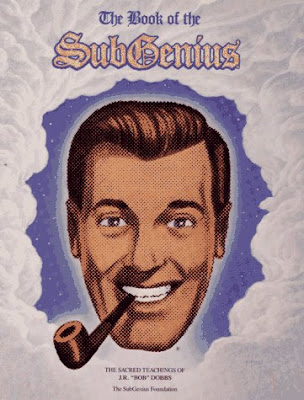
OK, here we go. As it happens, I have a small bookshelf immediately adjacent the computer table, so I consider every book on that shelf to be the “nearest book”. That being the case, I figure I should choose something fairly odd, so here it is: for this meme-thing I’m using The Book of the SubGenius: The Sacred Teachings of J.R. “Bob” Dobbs.

I bought this book years ago, in my “Collecting books on all manner of very weird subjects” phase, a phase which included my purchasing of many books on conspiracy theory and UFOs and the like. (Not that I’ve ever believed in any such, but it’s terribly fun to think about. Kind of like ghosts and stuff in Stephen King novels and X-Files episodes.) I’ve never read Book of the SubGenius all the way through, but I’ve thumbed through it on occasion. It’s a lot of gonzo fun, and I’m not totally convinced there’s not something to it all; surely we could all use more Slack!

But anyway, back to the Meme-thing in progress. Assuming that I start counting with the first full sentence — i.e., not counting the sentence carried over from the preceding page 122 — here are the fifth, sixth, seventh, and eighth sentences as they appear in the book:

BE READY.) [Sentence #5 comes in a parenthetical note. -Me]

What we envision for these dark days, when most others are starving, is a healthy feudal system in which all fit male and female SebGeniuses are warrior thug-serfs for “Bob”. How can any potential OverMan or ÜberLady entertain teh faitnest hopes of surviving the End Times without “Bob”? Yes, “Bob ” will be in Dallas then and you’ll want to be where “Bob” is if you want tickets to the Rescue Ships from Planet X… so why not serve under him and his chosen representatives on Earth while you STILL CAN???

Wow. Suddenly I’m wanting to read this thing all the way through. I think the secret answers I’ve been looking for may have been on my bookshelf the entire time!

And now, to tag people. Hmmmmm…normally I don’t tag people, but here are some that might be disposed. Or might not. They’re a temperamental bunch.

Erin, Jennifer, SamuraiFrog, (It’s not “No Meme Month” on my calendar!), Tosy and Cosh, and Lynn.

And there you have it.

Share This Post