“Most people are, when you finally see them.”

After the Twilight debacle, I needed something good to read. I’ve been hankering to do a complete re-read of Guy Gavriel Kay’s entire corpus, but I spied something on my stacks that I’ve been meaning to get to for a long time, so I figured, now’s the time. Enter To Kill a Mockingbird.

I read Mockingbird back in high school, in tenth grade. (That being the case, I should admit that I’ve been a bit mean, perhaps, in previous mentions of my English teacher that year. She wasn’t my favorite teacher by any means, and she did us the disservice of making my class read Ordinary People while the other classes were reading Mark Twain, but she did make us read Mockingbird, as well as Julius Caesar, which is when I first started to realize that maybe this Shakespeare fellow was highly regarded for a reason.

But anyway, back to Mockingbird. I assume the story is sufficiently well known that I don’t need to summarize it, right? I loved it in high school, and we also watched the movie, which is also amazing. I’ve seen the movie several times since then, but I’ve never gone back to the book until just now. What an amazing piece of work it is, too! I know, this comes as no revelation to anyone who’s read it, so I just have a couple of observations:

:: The book is a lot funnier than I remember it being. Aaron Sorkin once referred to his typical script structure as front-loading all the funny stuff and reserving the emotional hit for the last act; he called this “leaving the emotional hit in the tall grass”. Mockingbird does this amazingly well. It interests me that more than half the book is gone before we even start to learn the details of the big case Atticus is working on. Meantime, there is a lot of humor in the first part of the book.

:: One thing I’ve never had the guts to try in my own writing is writing my characters’ dialog in any kind of dialect, because I’m always afraid it’s going to sound like an affected mess. Harper Lee gets it so totally, totally right. Example: her lower-class characters are always answering questions posed by women in the negative with the word “Nome”. Of course this is what “No, ma’am” would sound like pronounced by someone with a Deep South drawl who doesn’t enunciate terribly well. It’s a brilliant effect, and everyone in the book has their own voice.

:: The story’s ending is just so…right. I mean, there are good endings, there are happy endings, there are sad endings that feel hopeful and there are sad endings that are just terribly sad, but rarest of all are those endings that feel like this is the only way this story could have turned out, and it’s satisfying in a way that most endings aren’t. The only other story ending that leaps to my mind by comparison is that of The Shawshank Redemption.

:: I finished the book while I was on my break at work. Luckily I was in the back room, by myself, so nobody could see me start to cry when Scout says, “It would be like shootin’ a mockingbird, wouldn’t it?” What a beautiful line, what a perfect place for it! The “killing a mockingbird” metaphor had already been explained, much earlier in the book, and Lee saved it for its second mention at the most perfect place to use it. I’m in awe of Lee’s sheer skill in terms of storytelling.

:: To Kill a Mockingbird seems to me to partly be about the falling of boundaries between worlds: the black and the white world, the poor and the not-so-poor world, the child and the adult world. Early on, Scout describes the world of hers and Jem’s childhoods being bounded at one end by the house of Mrs. Dubose, and at the other by the house of Boo Radley. And through the book, both boundaries fall, don’t they? First, Mrs. Dubose’s, and then, the great mystery of the book, Boo Radley at the end. All through the book, the world gets bigger for these two children, first Jem and then Scout. It’s not easy for them, and sometimes it’s downright painful, but it can’t be stopped.

:: Atticus Finch on courage: “It’s when you know you’re licked before you begin but you begin anyway and you see it through no matter what.”

:: Jem Finch on people: “If there’s just one kind of folks, why can’t they get along with each other? If they’re all alike, why do they go out of their way to despise each other? Scout, I think I’m beginning to understand something. I think I’m beginning to understand why Boo Radley’s stayed shut up in the house all this time…it’s because he wants to stay inside.”

:: Scout Finch, greeting the most mysterious person in the world: “Hey, Boo.”

I rather hope that Harper Lee has a closet full of manuscripts for after her passing, if she is so dead-set against appearing in print again while she’s alive.

Share This Post

Stick a fork in it?

I linked it in yesterday’s Sentential Links, but I wanted to flesh out my response to George RR Martin’s irritation at people who are irritated with him that A Dance with Dragons, the fifth book in his Song of Ice and Fire series, isn’t done yet. John Scalzi posts about this:

Some fans do have a tendency to forget that the creative folks they love are not simply black boxes, who produce desired product at regular intervals. They’re actually real people who do other things than just what the fans want them to do, because humans from time to time want to do the things they want to do, not the things other people want them to do. Yes, some fans don’t like that, but you know what, screw the type of fan who thinks a writer (or musician, or actor, or whatever) exists only to provide them with the entertainment of their choosing.

I’ll go personal here and talk about my own experience. As most of you know, the books in my Old Man’s War series are my most popular ones; each of the four novels have done very well and even the shorter works are pretty popular. There are people who would be delighted if all I did was write OMW universe books from now until the hopefully long-future date at which I drop. But thing is, at the moment, I have no plans to write any more OMW books. It’s not to say I never will, if I figure out what I want to do with that universe from here. I expect I may. But at the moment: Nope. I’ve got other things I’m working on which at the moment interest me more.

Now, I know this annoys some people — my matrix of ego-surfing search engines alerts me to many incidents of fan entitlement, particularly as regards the OMW universe — but I don’t think they understand what they’re asking for. Yes, I could write OMW #5 at the moment, but I guarantee it would suck, because at the moment I don’t know what I would write about, and thus OMW #5 would simply be a bit of commercial hackery, and it would show. And these same fans would say “Yeah, the series used to be good, but then he started phoning it in around book five.” You know, if I’m going to annoy a fan, I’d prefer to annoy a fan by not writing a book that sucks, than by writing one that does.

These are all points well taken. I’d only have a couple of rejoinders: first, I’m not sure the OMW books of Scalzi’s are a great counterexample, since they’re self-contained books; if he never writes another, he’s not leaving anyone clamoring for the end of the story. Second, I do think that Martin has himself set up a lot of the bad feelings by periodically making overly optimistic appraisals of his progress on Dance, and by setting up the structure of Feast so as to imply that Dance would come along in pretty short order. Fans no doubt fear that the next book after Dance will take an equivalently long time, and there’s no telling how long this series will become when all is said and done. I have a feeling that this series may end up going unfinished, and that would be a shame, even if I was disappointed a bit with Feast.

But this sort of thing is hardly new in the art world. Here is Richard Wagner, writing a letter in 1851 about his new project, an opera based on the legends of the Nibelungs:

With this new concept, I sever all connection with our present-day theatre and its audience: I make a definite and permanent break with present-day forms. Would you like to know what my intention are regarding my plan? In the first place, to carry it out, so far as lies within my power as poet and composer. This will take me at least three full years.

So, in 1851, Wagner was figuring on three years to write his Ring Cycle. When did he actually finish Gotterdammerung, the final opera in the cycle? Not until 1874, twenty-three years later. Of course, Wagner didn’t have legions of fans on the Internet clamoring as to his progress, which is the only thing that’s different, I suppose.

Share This Post

Twilit

I tried, folks. I’m not usually one to jump on whatever the literary bandwagon of the moment happens to be — despite my love of a good conspiracy tale, preferably involving the Knights Templar and the secret history of Jesus and the Catholic Church, I still haven’t read The Da Vinci Code — but I figured, hey, I like vampires, and I like well-done teen angst. So I gave Stephenie Meyer’s Twilight a try.

The qualifier there is well-done teen angst.

Twilight, for those who haven’t succumbed, is the tale of a teenage girl named Bella who moves from Phoenix to a little town in northwest Washington state — the rainy part of the state, the part that looks like the small towns in most of the early seasons of The X-Files when the show was still filmed in Vancouver — where she has some troubles adjusting to her new school. She’s the new kid. She’s living with her father, who is divorced from her mother. She’s already studied everything that comes up in class. Some boys take a liking to her, angering the local girls who are already interested in them. She hates gym class because she’s a klutz. And there’s this one boy who both refuses to give her the time of day and seems obsessed with her. This is Edward. Edward is a vampire.

(This is not a spoiler. The back cover of the book tells us this.)

Bella makes new friends, and a few enemies. She tries getting to know Edward, and is rebuffed. She hangs out with her new friends. She cooks dinner for her father. She tries to get to know Edward again, and makes some headway, before she is again rebuffed. She talks to a local boy who descends from the Native Americans in the area, who have legends that tell of people like Edward and his family. (Oooooh, Native American legends!) She wonders if Edward might actually be a vampire. Edward saves her life in a stunningly contrived incident that suddenly displays his Mad Vampire Skillz, in the school parking lot, before school starts. (And nobody but Bella see what Edward does.) Bella goes to a bigger town to hang out, gets separated from her friends, and happens upon the town rowdies who chase her, until Edward shows up to save her. More tense conversations with Edward, who alternates between being very sweet and a complete prick. Lather, rinse, repeat.

The first hundred pages are OK; they set the scene fairly well. But the whole book just feels like scene setting, not a story unfolding. Not much happens, and it’s mostly a series of conversations between Bella and her friends or Bella and her father or Bella and Edward and so on. The dialogue’s OK, but the story never seems to build to much of anything. I felt absolutely no tension here, which is weird, because, you know, vampires.

I felt my attention flagging shortly after the first hundred pages, mainly because the book is full of passages that never go anywhere or save any purpose whatsoever. Now, I’m fine with slow-moving stories — my favorite book is The Lord of the Rings, which can be not-inaccurately described as a thousand pages of people walking from one place to another — but if that’s the case, then you’d at least better have some wonderfully poetic stuff going on in there, or some keen insight into things, or some very compelling characters, or something to make the pages where nothing’s happening not so hard to get through. Unfortunately, Twilight doesn’t have much going on in that regard.

By way of illustration, here is one such passage that really bugged me. After her conversation with the Native American lad who tells her of the legends about vampire-like creatures which the old-timers still believe (“But we young people know that’s all hooey!”), Bella decides to go home and go on the Internet to do some research on vampires. Fair enough. This should have required, maybe, two sentence or so to do: “I put dinner in the oven and then went upstairs to use the Internet. I brought up Google and typed in: vampires.” That would have done the trick — but here’s what Meyer does instead:

I dressed slowly in my most comfy sweats and then made my bed — something I never did. I couldn’t put it off any longer. I went to my desk and switched on my old computer.

I hated using the Internet here. My modem was sadly outdated, my free service substandard; just dialing up took so long that I decided to go get myself a bowl of cereal while I waited.

I ate slowly, chewing each bite with care. When I was done, I washed the bowl and spoon, dried them, and put them away. My feet dragged as I climbed the stairs. I went to my CD player first, picking it up off the floor and placing it precisely in the center of the table. I pulled out the headphones, and put them away in the desk drawer. Then I turned the same CD on, turning it down to the point where it was background noise.

With another sigh, I turned to my computer. Naturally, the screen was covered in pop-up ads. I sat in my hard folding chair and began closing all the little windows. Eventually I made it to my favorite search engine. I shot down a few more pop-ups and then typed in one word.

Vampire.

It took an infuriatingly long time, of course. When the results came up, there was a lot to sift through — everything from movies and TV shows to role-playing games, underground metal, and gothic costume companies.

Then I found a promising site – Vampires A-Z. I waited impatiently for it to load, quickly clicking closed each ad that flashed across the screen. Finally the screen was finished – simple white background with black text, academic-looking.

How much detail is here that nobody in their right mind is going to care about? We don’t need to know how slow her Internet service is, how dumb she is for not using an ad-blocker, how comfy her sweats are, what she’s listening to, her bowl of cereal, et cetera. None of this is interesting in the slightest. And the book abounds with passages like this. Lather, rinse, repeat.

When I started the book, my initial impression was to think of it as My So-Called Life (with Vampires); I quipped on Facebook that I kept waiting for Bella to launch into another monologue about Jordan Catalano. However, I quickly disabused myself of this notion, because Twilight boasts none of the humor of My So-Called Life, nor does it have any of its compelling drama, its insight, and its memorable characters. I still remember Angela Chase, Rayann Graff, and Ricky Vazquez to this day, even though I haven’t watched MSCL in years. Five days after putting Twilight aside, I can’t even remember Bella’s last name.

I finally threw in the towel shortly after Bella went with Edward out into the woods, where they could touch each other on the arms and shoulders and caress each other’s cheeks and listen to each other’s heartbeats and then ask each other “Was that hard for you.” (I swear I am not making this up.) I just couldn’t take the book seriously at all after that. The scene is unintentionally hilarious.

I skimmed the rest to see what happened (some guy does something to Bella’s mother, or something like that — Edward saves the day or something), and then I went on Wikipedia to read the plot summaries of the next three books in this series. (Bella and Edward get married, run afoul of some secret vampire society or something, have a baby with a stupid name, Bella becomes a vampire, and maybe they open a bed-and-breakfast in the Carpathians.) With that, I’m done with the Twilight series.

Needing a good book to cleanse my literary palate, I am now reading To Kill a Mockingbird for the first time since high school. Now there is a book: it’s funnier than Twilight, scarier than Twilight (without resorting to a vampire Leif Garrett), more moving than Twilight.

Twilight is awful. Avoid it.

Share This Post

Kushiel

Kushiel’s Dart is the first “fat fantasy” I’ve read in a long time; and I enjoyed it so much, I may find myself shying away from the genre for a while for fear of disappointment in whatever Fat Fantasy book I pick up next. Jacqueline Carey has crafted here a novel that put me in mind of Guy Gavriel Kay; in fact, I thought more than once while reading it that this is what GGK would have written if he’d been a woman. This was a wonderful, wonderful book that only let me down at the very end, when it came time for Carey to set things up for the sequel.

The setting was the first thing about the book to remind me of GGK. We’re in a land that is basically Europe with the names changed, and the history is strongly based on Europe as well. In their “Middle Ages”, the main action takes place in the City of Elua, named for Blessed Elua, an angel born in the aftermath of the crucifixion of Yeshua more than a thousand years before. Blessed Elua and his followers established a land where the guiding priciple is Love as thou wilt. Into the service of Naamah, one of Elua’s followers, comes our heroine, Phedre, whom we meet as a child but who grows up before our eyes over the course of this 900-page novel. She is sold into the service of Naamah, which makes her a courtesan; later, she comes into the direct employ of a charismatic teacher named Anafiel Delaunay, who turns out (as does everybody in this complex book) to be much more than he seems. Phedre learns much about the world while in Delaunay’s service, much that eventually puts her in danger as she finds herself engaged in the court politics of this dangerous land; but Phedre is a good student and sharply intelligent, so she becomes as much a player as an observer over time.

More than that, Phedre is a rarity among courtesans: she has a red mote in her eye, which indicates that she has been marked with Kushiel’s Dart (Kushiel was one of Blessed Elua’s followers), and as such, she is something called an anguissette, a person who experiences physical pain as erotic pleasure, which leads to some fairly difficult passages in the book wherein Phedre describes for us her erotic actions (the book is told in first person, from Phedre’s perspective). Fair warning here, folks: if reading about what is literally sadomasochism isn’t your cup of tea, this book won’t be for you; but likewise, if you don’t mind that material (which is very well written, and not really gratuitous, in my estimation), the rest of the book is worthy of attention.

I don’t want to say a whole lot about the plot of this book, not just because I wouldn’t want to spoil it, but also because it’s a hard book to summarize. It’s very long, being the type of book one loses oneself within. One of the book’s most important characters, Joscelin Verreuil, who serves as bodyguard (and eventually much more than that) to Phedre, isn’t introduced until after page 250. This is an actual epic of a book, with the action ranging over virtually the entire continent of “Europe”. Along the way we meet roving bands of gypsies and their king; we travel north and east into the rugged lands dominated by Viking-like warriors called Skaldi, who are gathering underneath the banner of a new warlord; we travel west, over the straits, to the barbarian island realm where the blue-painted warriors fight for dominion. We meet the Master of the Straits, the being who controls the weather in the straits between Alba and Terre d’Ange (think the English Channel), choosing who gets to make passage and who doesn’t. We meet nobles motivated by love and by hate, soldiers motivated by money and by loyalty, lords motivated by revenge and lust, and noblewomen whose motivations can’t even be summarized in any real way.

Kushiel’s Dart is the start of a series, and I have every intention of continuing on. It takes a really good “Fat Fantasy” to capture my attention these days, but this one did. Carey creates a vivid world here, familiar and fantastic, and she populates it with memorable people who stand out and command sympathies – even the villains. I loved this book.

Share This Post

Mr. Data, set a course — for love!

Sometimes you feel like reading a romance novel, right?

OK, I’ll assume by the chirping crickets I just heard that I’m wrong here. But anyway, sometimes I want to read a romance novel. But not just any romance novel, mind you; I’m not looking for those books with the titles printed on the covers in flowery script over a picture of some long-haired guy whose chest is just a-heavin’ in the wind. No, I want at least some modicum of muscle in my romances! So I was happy to discover Linnea Sinclair, writer of space opera romances. Yes, you read that right: space opera romances. Games of Command is the first of her books that I read, and damned if I didn’t enjoy the hell out of it. Looking for a science fiction beach read? This is it.

In the wake of a war, at the end of which a tenuous truce exists and a shaky government is holding power, former combatant Tasha Sebastian is assigned to the ship commanded by her former adversary Admiral Branden Kel-Paten, a cybernetically enhanced man who is a hard, cold, by-the-books kind of commander. His big, dark secret is that he’s desperately in love with Tasha Sebastian, a love which he dares not show because cybernetics are not supposed to show emotion and can be deactivated if they do. They take into their custody a wanted man, Jace Serafino, who happens to be telepathic, and is able to learn of Kel-Paten’s feelings; and in the course of trying to figure out what to do about the potentially explosive situation, Tasha breaks into Admiral Kel-Paten’s personal records, hoping to learn something definitive about his intentions and loyalties, but instead finds his personal journals where he has written extensively of his unrequited love for his second-in-command.

Yeah. Hilarity ensues, along with lots of action: adversaries trapped in shuttlecraft stranded in deep space; potential lovers who are also former enemies finding themselves relying on each other on a mysterious planet that’s not what it seems; races against time; all the usual complications in a book that makes you want to read it over a big bowl of buttered popcorn. The story here is pretty much paper thin, but Sinclair is able to keep things moving pretty briskly, her dialog tends to crackle, and her characters are sharply drawn and sympathetic. In terms of SF, there’s nothing here that you wouldn’t find in a better episode of Star Trek (in fact, I kept visualizing the book’s main ship, the Vaxxar, in terms of the good old NCC-1701-D. Recommended, even if it’s not terribly good for you.

Share This Post

Frak! Frak frak frakkity frakking frak.

One of my most beloved literary traditions, the annual Year’s Best Fantasy and Horror volume, will not be published this year. Those books are worth their price just for the introductory essays alone; they are chock full of reading recommendations and reviews of the year gone by in Fantasy and Horror, with long essays on graphic novels and music and movies as well as literary F&H. I get hours of pleasure from those essays each year, and their information always goes a long way to shaping what I read over the coming year. And that’s before I even mention that these books are, each one of them, wonderful anthologies of fine fiction as well.

Crap.

I’m not sure as yet if any publishers have picked up YBFH in the current publisher’s stead. We’ll see. But the prospect of no YBFH in 2009 makes the coming year feel all the bleaker, and if there’s one thing 2009 doesn’t need more of, it’s the prospect of more bleak.

Frak.

Share This Post

Mush! I got yer mush here!

[I make no effort to avoid spoilers for a couple of the books discussed below.]

I’ve long established on this blog my predilection for mushy romance stories of all types, usually in film. But it occurred to me a few months ago that I wasn’t exploring the world of mushy romance stories in book form enough, so I figured I’d start with one of the Big Heads of the mushy romance tale working in books today. I figured I’d go with someone whose books have been made into at least several movies and who can be found at nearly any bookstore. Such authors aren’t terribly hard to find, so I was able to identify my pigeon fairly quickly.

Hence my recent reading of several books by Nicholas Sparks.

Sparks is…well, I’m not sure what he is. After four of his books, I’m not sure I want to admit to liking him. There’s something in each book thus far that’s pissed me off for some inexplicable reason, and yet, I’ve read four of the damn things so far, and I have every intention of reading a few more, at least. He’s maddening: Sparks is probably the most manipulative writer I’ve ever encountered, pulling stunts of chain-pulling and tear-jerking that appall me in their simplicity and yet still end up working to perfection. It’s like he just says on page one, “I’m gonna make you cry like a little girl and I’m gonna make you like it.” Does it work? Yup. Dammit.

So, which Sparks books have I read thus far? I started with True Believer, in which Our Hero is a writer of scientific articles debunking paranormal claims. He travels to one of the Carolinas (I don’t recall which one) to investigate some mysterious lights that appear in the local cemetery. There he meets, and becomes transfixed with, the local librarian, a fetching woman named Lexie. Sparks is pretty good at characterizing beautiful and smart women, it turns out; he makes his ladies seem like people you’d well, find yourself attracted to if you were the type of person to be the lead in a Sparks novel. Or something like that.

The second Sparks book I read was At First Sight, which I borrowed from a friend and discovered a few pages in is actually a direct sequel to True Believer. This one I didn’t like so much, mainly because the complications Sparks devises for the couple he introduced us to in the earlier book seem awfully contrived in some cases and downright gratuitous in others. I don’t want to give too much away, but there are parts of At First Sight that make me feel as if we could somehow learn what became of all the characters in Casablanca after the final scene, and if it turns out that Victor and Ilsa die in a plain crash on their way to America. Yeah, the book’s a bit of a downer. And yet, I did tear up at the end.

Then came Sparks’s nonfiction memoir, Three Weeks With My Brother, in which he goes on an around-the-world trip with his brother Micah. He alternates between telling us the tale of the trip and the tale of his upbringing as a kid with Micah and sister Dana. This, too, ends up being pretty depressing stuff as the book goes on. The family was dirt poor for all of Sparks’s youth, but hey, they had each other! Finally, though, the kids go off to college and everyone’s starting to prosper and finally the parents can afford nice things, including the horses that Mom has always dreamed of owning. And then Mom is thrown from a horse and dies of her injuries. This, as you might expect, plunges Dad Sparks into a terrible depression that lasts years and strains every single one of his relationships to the breaking point. But he’s finally moving out of the cloud and re-engaging life when…he’s killed in a car accident. And this happens about fifty pages before we learn that Dana’s brain tumor is back, and this time it’s not going away.

Yeah, if cheerful’s your thing, don’t read Sparks. He doesn’t do cheerful.

Which brings me to the last one I read, The Choice. This is Sparks at his most manipulative. A prologue has Our Hero going to the hospital where his wife works because he hasn’t talked to her in several months; he’s bringing flowers, in hopes that it will help things. So the scene is set: somehow these two met, fell in love and got married, but now they’re separated. Check. On we go. After a long (more than half the book) and, it must be admitted, deftly written courtship that lasts only a few days, Our Hero and Our Heroine fall in love and get married. And then we flash back forward, to find out why they’re separated.

Only, they’re not separated. Gabby’s in a coma from the injuries in a very bad car accident. Hence the book’s title, The Choice: will Our Hero pull Gabby’s plug, or not?

See what I mean? Shameless manipulation. Crass, even. Sparks should be ashamed.

And yet I lapped it up like a kitten laps up warm milk, and I’ll probably read more of this guy’s stuff. I see he’s got a new book out. Sigh…what on Earth is wrong with me?!

[NOTE: I wrote this post more than a month ago and saved it. Last night I finished reading Sparks’s Nights in Rodanthe, which is typical Sparks, all the way. I started asking myself about a third of the way through why certain aspects of the book were being told in past tense, a question which could only have one answer. And when I confirmed that answer, I started blubbering like a baby. I gotta stop reading this guy.

Just as soon as I borrow his latest from a friend.]

Share This Post

Books! (A quiz)

Here’s another quiz, that I found a few weeks ago at Sheila O’Malley‘s place. It’s about books. I’m writing this a few weeks before my return from posting, so a couple of answers may technically be inaccurate by the time this sees the light of Blogistan, but here we go!

What was the last book you bought?

On my birthday I treated myself to two items at Borders: this year’s edition of The Year’s Best Fantasy and Horror, edited by Ellen Datlow and Kelly Link and Gavin J. Grant, and an Everyman’s Library edition of the writings of Kahlil Gibran, a man whose writings have intermittently fascinated me over the last year or two, to the superficial degree that I’ve explored him at all. (Which is why I bought the book.)

The Year’s Best Fantasy and Horror series is an invaluable resource for anyone at all with any interest whatsoever in those genres. Not only are the books packed with amazing fiction, but the introductory essays, summing up the preceding year in those genres, are extremely good sources of reading suggestions. Even better are the essays on music, film and TV, and comics; if you want to know some great comics to read, just follow the suggestions in these essays. I’m glad to report that one graphic novel I read in 2008, Bryan Talbot’s stunning Alice in Sunderland, made the list.

Name a book you have read MORE than once

I don’t do a whole lot of re-reading of books in their entirety, but I do enjoy dipping into books again on a frequent basis. But there are some that I’ve re-read, and some of those I re-read fairly regularly. I read the following every three or four years:

The Lord of the Rings, JRRT (I’m due, actually; maybe this winter)
The Fionavar Tapestry, Guy Gavriel Kay (Another year, maybe.)
The Lions of Al-Rassan, GGK (my favorite GGK novel, by a good margin)
The Prydain Chronicles, Lloyd Alexander (Currently reading with The Daughter at bedtime; as of this writing, we have only two of the five books to go)
Quite a few of John Bellairs’s books. Why none of these have been made into movies is beyond me; I should think that The House with a Clock in its Walls, The Curse of the Blue Figurine, and The Treasure of Alpheus T. Winterborn would make terrific movies.
Cosmos, Carl Sagan.
On Writing, Stephen King
The Griffin and Sabine sequence (both trilogies), Nick Bantock. I gave this whole set to my best friend a year ago. I love the execution of this series.

There are a number of books I intend to read again sometime, hopefully soon: Christopher Moore’s Bloodsucking Fiends; Mary Stuart’s King Arthur quartet; all of GGK’s novels that I haven’t recently re-read (A Song for Arbonne, The Sarantine Mosaic) and the ones I haven’t re-read at all (The Last Light of the Sun, Ysabel).

Has a book ever fundamentally changed the way you see life? If yes, what was it?

Hmmmm…interesting question. Books don’t usually change my thinking as I read them; they take some time to work on me and to shift my soul about. In my college days, Zen and the Art of Motorcycle Maintenance and its sequel Lila: An Inquiry into Morals, by Robert Pirsig, made quite the impression, although I think about them less and less as time goes on. I re-read Zen a few years ago, and I remember noticing this time how whenever Pirsig reaches a really interesting, but potentially troublesome, spot in his philosophical meditations, he uses the fact that he’s writing in novel form to simply stop the philosophy and return to narrative.

I do recall that my own personal liberalism was faltering a bit back in 2002, only to have it strongly resuscitated when I read John Steinbeck’s The Grapes of Wrath.

How do you choose a book? eg. by cover design and summary, recommendations or reviews?

I do all of these. They always say you can’t judge a book by its cover, but you can sure judge if you want to buy it by its cover; that’s what browsing the bookstore is all about. Choosing a book is like trying it on for size, you know? I love good cover art, and it’s more likely to make me pick up a book to look at it.

Recommendations and reviews also go a long way. There are lots of authors I wouldn’t have ever experienced had I not received recommendations for them. That, to me, is the best part of reading blogs: constant reading recommendations!

Do you prefer Fiction or Non-Fiction?

Either. I’ll usually have one of each going at the same time, in fact. However, I tend to be a lot less rigorous about finishing non-fiction books that I am with novels; I tend to feel guiltier about not finishing a novel than I do about a non-fiction book. (Unless the novel is just dreck, in which case I generally give up pretty early on.) With non-fiction I’m a lot more willing to read until my attention for the book wanders, and then I skip through the rest of it, getting a general gist of things. I don’t really read non-fiction out of a need for research; I read non-fiction as a way of stoking my creative fires and giving my curious self something to do. I read fiction to satisfy my need for story.

What’s more important in a novel – beautiful writing or a gripping plot?

Writing, I think. Beautiful writing will keep me going through a book that may not even have a “plot” in the usual sense. I couldn’t describe the “plot” of The Lions of Al-Rassan in any useful way, for example. But the writing propels me forward. “Beautiful writing” isn’t just about description, though, or artfully-turned paragraphs; I consider things like the overall motion of a story to fall under that category as well.

Most loved/memorable character (character/book)

As usual with questions like this in quiz-things, I’m answering with a list:

Taran of Caer Dallben, Princess Eilonwy, and Fflewdur Fflam (The Prydain Chronicles)
Lewis Barnavelt, Uncle Jonathan, Mrs. Zimmerman (The House with a Clock in its Walls, and sequels)
Johnny van Dixon, Professor Childermass (The Curse of the Blue Figurine and sequels)
Diarmuid dan Ailell, The Fionavar Tapestry
Jehane bet Ishak, Ammar ibn Khairan, Rodrigo Belmonte, The Lions of Al-Rassan
Samwise Gamgee, The Lord of the Rings
David Bowman, 2001: A Space Odyssey
Tom Joad, The Grapes of Wrath
Tyrion, A Song of Ice and Fire

Which book or books can be found on your nightstand at the moment?

As of this writing, Pride and Prejudice by Jane Austen; Hollywood by Garson Kanin; The Arrival by Shaun Tan; the Flight series of comics anthologies; The Complete Correspondence of Robert and Clara Schumann; and The Daughter and I are reading Silver on the Tree, the final volume in the Dark is Rising sequence.

What was the last book you’ve read, and when was it?

Before this writing, Kushiel’s Dart by Jacqueline Carey. I loved it. Also The Bookhunter, a graphic novel I’ll post about soon.

Have you ever given up on a book half way in?

All the time. Life’s too short. I rarely decide that I hated a book, though, when I give up on it; my typical way of referring to the act of book-abandonment is to say that I “bounced off” the book. Whenever I decide that I’m just not invested enough in a book to keep going, I almost never decide it’s because I hated the book but rather than it’s either simply not my cup of tea, or maybe it is my cup of tea but I just wasn’t much in the mood for that particular tea. I’ve bounced off lots of books over the years; some of which I’ve come back to finish later, others I’ve not come back to yet. Some I’ve even stopped reading not for any reason relating to the quality of the book, but because life circumstances intruded. My best example of this is Guy Gavriel Kay’s A Song for Arbonne, which is the first GGK book I ever started. I found it at the Olean Public library when I lived there, and was struck by its cover; I checked it out and read a chapter or two. But a trip and some work stuff reared their heads and interrupted my reading; then the book was due so I let it go back to the library but mentally bookmarked GGK as an author to return to. (I eventually did, of course, when I read Tigana. Arbonne would be the third GGK I would finish.)

I’ve also started but failed to finish The Brothers Karamazov a whole bunch of times. I’m probably due for another attempt. For me, that book is like Everest and every time I set out from Base Camp, a big storm comes along and buries me in snow and by the time I dig my way out climbing season’s over. Someday, though, I’m gonna reach the summit of that book. And then I’m gonna come back down. Oh yeah.

Books I abandoned because I simply hated them? Hmmmm. There’s The Celestine Prophecy, which I hoped would be an Indiana Jones type of adventure (with its cover copy referring to ancient Peruvian manuscripts and the like), but instead it was mystical hogwash, complete crap. And I was really underwhelmed with Stephen King’s Dreamcatcher; I like King a lot, but I doubt very much I’ll ever bother returning to that one.

Share This Post

Recent Reading

It’s been a while since I recapped what I’ve been reading lately, so here’s a, well, a recap of what I’ve been reading lately. (Reading a lot makes me a gooder writer, apparently.)

:: Do other readers have writers who never quite reach the level of “Favorite Writers” but rather stay at the level of “Oh, yeah, that writer, I should really read more of him/her soon”? And it’s not even the writer’s fault that they stay at that level just under our radar screen of “Holy S***, a new book by XXX!”; it’s that I’m often-times so all-over-the-map in my reading choices that few writers ever get a real chance to ascend to the “OMG a new one in hardcover SQUEEEEE!!!” position on my own personal Mt. Olympus of writers. Anyway, one of those writers for me is Michael Flynn. A few months ago I read The Wreck of the River of Stars.

Flynn does near-future hard-SF very, very well; he’s right up there with Kim Stanley Robinson (yeah, there’s another one of those almost-to-the-top writers), and I think he’s actually quite better at managing the infodumps and creating characters to boot. Flynn’s Falling Stars quartet (which I’ve only read three books of, yeesh!) is pretty damned riveting stuff, epic in scope in detailing one possible vision of how humanity starts to establish a permanent presence in space. The Wreck of the River of Stars is something quite different. Flynn assumes that humans have populated the Solar System, and that we have large ships ferrying people and cargo from planet to planet; and he also notes something that would obviously be the case, once one thinks of it: there would be the space equivalent of maritime disasters. Shipwrecks, with the ships being giant spaceships. As humans colonize the stars, sooner or later there will be the space-age analogue of the Titanic disaster, or the Andrea Doria, or the Lusitania, or any other great disaster. This is the tale of how one such disaster unfolds: the fate awaiting the River of Stars.

It’s not really a spoiler, I guess; the title of the book establishes that the River ends up as a wreck. The River is an old vessel, nearing the end of her useful life; once an opulent passenger liner that used its gigantic solar sail to ferry the rich and wealthy around the System, the ship is now a retro-fitted cargo ship that is soon to be mothballed. On what the crew suspects is to be the ship’s last voyage, though, a series of events occur to lead the crew to plot to bring the ship into Jupiter not under normal propulsion but by using the ship’s long-dormant sails; it’s a desire to taste the ship’s glory days one last time in an age when solar sails have fallen out of fashion. Unfortunately, as the title establishes, the scheme fails, and the book tracks the efforts of the crew first to deploy the sail and then to stave off utter disaster. Flynn expertly ratchets up the tension as the desperation becomes more and more palpable. Some of the book’s blurb quotes draw an analogy to Greek tragedy, and there is some of that here, as the crew is undone by its own hubris.

:: My Boring-Ass Life: The Uncomfortably Candid Diary of Kevin Smith is also exactly what the title says it is. Movie writer/director Kevin Smith (Clerks, Mallrats, etc.) was once asked what a “day in the life of Kevin Smith” is like, and he genuinely had no idea how to respond, so he kept a written diary for a year of what he did. I like Smith, so I enjoyed the diary, although I ended up skimming over large parts of it, as certain things get pretty repetitive. (Smith starts every day by getting up, defecating, letting the dogs out, seeing what the kid is up to, etc.; every day pretty much ends the same as well, with Smith and his wife Jen falling asleep to teevee shows on teevoe.) The more interesting stuff, as expected, focuses on Smith’s tales from his filmmaking days during 2005 and 2006, when he was preparing for Clerks II (which I haven’t seen) and gearing up for his first major acting job (for a flick called Catch and Release, which I also haven’t seen). Along the way Smith sees an advance screening for Revenge of the Sith which he loved, discusses the sudden death of his father two years earlier, relates his failed effort to do a Fletch sequel with Chevy Chase (a guy who is legendary for being difficult to work with), discusses the drug addiction of his best friend, bitches about AICN talkbackers, and relates some pretty uncomfortable detail about his bout with anal fissures. (I really could have done without that whole last sequence.)

This book is witty if you, like me, have a high tolerance for the profane; other readers will likely find it tiresome quickly and end up throwing the book against a wall.

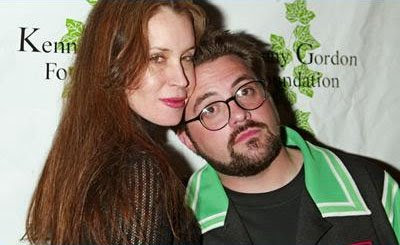
(BTW, here’s Kevin Smith and his wife:

Looking at her, and thinking about all the other guys I know in life, myself included, who were “the unpopular with girls fat kid” in grade school who later ended up with really pretty women, I almost believe it should be my mission in life to go to every fat kid in every grade school in this country, every one of them who is despairing over their lack of any kind of dating life at all, and just say to them: “Guys, hang in there. It sucks now, but you get through another ten years and you’ll reach this magical point where beautiful women suddenly realize that they actually dig the fat kid.”)

:: One graphic novel that I’ve heard a lot about through the years, but never read, was The Dark Knight Returns, by Frank Miller. Apparently this book was something of a relaunch for the Batman character, returning the character to his noir roots, or something like that. Batman has never been my favorite comics character – not that I’ve disliked him, but I’ve never really been all that entranced with him, either. There’s always this uncomfortable mix of noir and camp in Batman that rarely, for me, comes off entirely successfully (although the movie Batman Begins, I think, got it right, and I’m really looking forward to The Dark Knight).

So, what of The Dark Knight Returns? Well, I don’t know, really. Yeah, it’s a good book, but it’s not as good as I was hoping. In his introduction, Miller notes that Batman has never really aged, so that’s his starting point: Batman when Bruce Wayne is in his last years of being middle-aged, or in his first years of being elderly. That’s an intriguing conceit, but for me it ended up straining credulity toward the end, when we’re still supposed to buy into Batman, whom we must remember is just an ordinary guy with some really cool tools at his disposal, going toe-to-toe with Superman, who is anything but an ordinary guy. I just couldn’t believe that. Comics do this kind of thing all the time, having superheroes win fights that by any rights they shouldn’t even be able to compete in (one example I’ve always remembered was when one of the Spiderman books had the Black Cat beating the crap out of Sabretooth).

I was disappointed anyway when Superman showed up, and I also felt the book overselling the whole “Will Batman cross the line he’s constantly treading between good and evil?” thing. Mostly, though, I found the book too episodic for my tastes. Is it good? Sure. But “classic”? I’m not seeing it.

:: And then there’s Life Sucks, a graphic novel that sort of blends Kevin Smith (Clerks) with Christopher Moore (Bloodsucking Fiends). A businessman whose main concern is his twenty-four hour convenience store finds that the best way of hiring reliable overnight clerks is to turn them into vampires. Our focus is on Dave Miller, overnight clerk who doesn’t want to feed on fresh blood so he only drinks stolen plasma, who falls in love with the goth chick who comes into the store one night for orange juice. However, he also ends up in a wager for the girl’s affections with Wes, another vampire who is a blond surfer-type. Hilarity ensues.

It’s all pretty typical stuff for a vampire tale; lots of black humor involving death and blood. The story is well-drawn and nicely paced, and the dialogue is sharp and witty. Recommended.

:: Finally, one writer who is very near to cracking my “Screw the new iPhone, I’m camping out for the new book by XXX!” list is Anthony Bourdain. I read three of his books in rapid succession a while back, and now I’ve found his latest, a glossy photo book called No Reservations: Around the World on an Empty Stomach, in which Bourdain shares a lot of photos and stories from the making of his teevee show of the same name. The tone Bourdain strikes here isn’t the typical “companion book to the PBS series” sort of thing; it’s more like if Bourdain personally showed you his photos from each location, with the occasional backstory thrown in. Bourdain is also a wonderful writer, so much so that I’m now starting to give serious thought to tracking down his novels, since I’ve exhausted his current non-fiction output. Here are some quotes:

Bourdain on drinking with Russians: In Russia people are not outgoing, or cheerful, or even particularly friendly. The women greet you with a look that says, “I could snap your collarbone without blinking. Why are you here?” And the men are equally gloomy – until you get halfway down the vodka bottle, that is. And you will. There’s no way out. Each paint-peeling shot, inevitably from a whole bottle, plunked down on your table as automatically as the ketchup at a burger stand, is accompanied by a specific toast. To refuse the ninth toast of “To our mothers!” is to say, in effect, “F*** your mothers.” Whatever relationship you might have had with the locals, it ended right there. Stick with it, however, and you are rewarded with a slow reveal of the beautiful Russian soul, a flowering of heartfelt declarations, poetry, song, and expressions of comradely affection. Centuries of Russian history and culture open up to you, make you a part. Soon you begin to understand the magic of the birch forests, the fierce Russian winters, the sad majesty of black crows on snow-covered fields. You vow to reread Tolstoy, to read Gogol – in Russian. The you throw up in your shoes.

On bathrooms in Japan: If you’re comparing plumbing around the world, there’s no contest. Japan wins. The Japanese like to be clean. Very clean. This is a nation of people who advocate showering – and scrubbing with a bristle brush – before getting into the bath.

On bathrooms in Uzbekistan: Fighting off carnivorous insects while squatting with one’s pants around one’s ankles, trying not to slip in the muck while at the same time nervously monitoring the unlocked “door” and tearing a piece out of the local newspaper – this is a skill set one must quickly master in the steppes of central Asia.

He doesn’t say it as such, but here’s Bourdain on why cooking is Art, as much as painting or music or poetry: When someone feeds you, they’re saying something, they are telling you something about themselves. If you can’t hear a voice, or if the voice is confused, chances are, you’re eating at a “big box” faux-fusion restaurant – or a chain, or a hotel – where the menu and recipes were arrived at long ago, by consensus of committee. But when you hear a whisper in your ear with every plate that arrives at your table, or totilla wrapped personally by your host and placed directly in your hands, a bowl of pho, handed to you with a silent grin, then you feel…part of something…privy to a secret language, an ongoing, worldwide dialogue that’s been going on since the very beginning.

From time to time, standing in an airport, some queasy fan will approach me and ask, “How do you eat all that stuff?” I think; So many people are trying to tell me things; why would I want to shut my ears to what they are saying? Particularly these days – when so much of what you hear coming out of people’s mouths is bullshit? There is no lying with food. You either can or can’t make an omelet. No amount of skill with words can conceal the truth of the matter. If you can cook, your soup is seasoned one of two ways: the way you like it, or the way your guests will like it. Both scenarios contain simple, inescapable truths.

Yeah, Anthony Bourdain rocks.

Share This Post

Ewwwwww!

So Entertainment Weekly has made two lists: one is a list of its Top 100 movies of the last twenty-five years, and the other does the same thing with books. You know the drill: the ones I’ve seen or read are in bold, with occasional comment. (However, a couple of provisos: yes, I’d include the Star Wars prequels, so sod off, haters. And as T & C point out, the list excludes The Shawshank Redemption, which is well-nigh inexplicable.)

1.Pulp Fiction (1994) (Wouldn’t be my best, but I’m not going to quibble.)

2. The Lord of the Rings trilogy (2001-03)
3. Titanic (1997)
4. Blue Velvet (1986)
5. Toy Story (1995) (Come now. It isn’t even the best Pixar movie; this is absurdly high to put this movie.)

6. Saving Private Ryan (1998) (Again: come on, now. It’s just not that good a movie once the Normandy stuff is past. And with all due respect to T & C, the film’s construction seems to strongly imply that we’re dipping into Ryan’s memories. The whole bit at the beginning with him walking through the graveyard isn’t even necessary; nor is the coda.)

7. Hannah and Her Sisters (1986)
8. The Silence of the Lambs (1991) (I consider it a great film; a lot of its atmospherics set the stage for horror filmmaking in the 90s and beyond.)

9. Die Hard (1988) (One of the iconic action movies, obviously. I haven’t seen it in a long time.)

10. Moulin Rouge (2001)
11. This Is Spinal Tap (1984) (I can’t believe this is almost twenty-five years old.)

12. The Matrix (1999) (Meh. It was really cool the first time I saw it, but I liked it less each time I watched it after that. I tried once to watch The Matrix Reloaded and I fell asleep.)

13. GoodFellas (1990) (I really do think this is overrated, and that it wasn’t robbed at the Oscars.)

14. Crumb (1995) (This looks fascinating; I’d love to see it.)

15. Edward Scissorhands (1990) (A sentimental choice for me, since this movie was what The Girl I Thought Was Cute saw on our first date. She would later become The Girlfriend, then The Fiancee, and then The Wife.)

16. Boogie Nights (1997)
17. Jerry Maguire (1996) (I heart Cameron Crowe, as I’ve long established. I may have mentioned this before, but I saw this movie in a theater in Buffalo, and since it came out just a handful of years after the Cowboys beat the Bills in two straight Super Bowls, the shot during the big game at the end of the Cowboys coach glowering actually got a cheer from the audience.)

18. Do the Right Thing (1989)
19. Casino Royale (2006) (This seems a bit quick to anoint as a classic, but it’s such a good movie that I’m not going to complain.)

20. The Lion King (1994) (I know, I just said this the other day, but I’m starting to suspect this movie of being wildly overrated.)

21. Schindler’s List (1993) (Superior to Saving Private Ryan in every way.)

22. Rushmore (1998)
23. Memento (2001)
24. A Room With a View (1986) (I think this is the only Merchant-and-Ivory movie I’ve seen. I watched it during the last week of summer vacation before my junior year of high school, after a guy I’d met at music camp two weeks before had told me that this movie “made him want to fall in love”. And yeah, it did. Haven’t seen it in years, though.)

25. Shrek (2001)
26. Hoop Dreams (1994)
27. Aliens (1986) (Meh. Again, The Abyss is a much better movie.)

28. Wings of Desire (1988)
29. The Bourne Supremacy (2004)
30. When Harry Met Sally… (1989) (A favorite of mine.)

31. Brokeback Mountain (2005)
32. Fight Club (1999) (I don’t like this movie, but I can’t find anything wrong with it. It’s simply not my cup of tea.)

33. The Breakfast Club (1985) (This was a staple in college.)

34. Fargo (1996)
35. The Incredibles (2004) (I don’t grok this as much as some others, but it’s a fine, fine film.)

36. Spider-Man 2 (2004)
37. Pretty Woman (1990) (Really? Last time I watched it, I came away a bit disappointed.)

38. Eternal Sunshine of the Spotless Mind (2004) (Ah, yes. I need to watch it again.)

39. The Sixth Sense (1999) (I figured out the “twist” halfway through, but mainly I suspect because of an unplanned intermission when the film broke and I had five minutes to think it through.)

40. Speed (1994) (Or The Bus That Couldn’t Slow Down….)

41. Dazed and Confused (1993) (I need to see this.)

42. Clueless (1995)
43. Gladiator (2000) (I want to see this, kinda-sorta. I loved Kingdom of Heaven.)

44. The Player (1992)
45. Rain Man (1988)
46. Children of Men (2006)
47. Men in Black (1997) (Really? It was a clever enough comedy, but was it that good?)

48. Scarface (1983) (I see this on a lot of “great movie” lists, and everyone I’ve met who has watched it tells me it stinks. Odd.)

49. Crouching Tiger, Hidden Dragon (2000) (Wow, I need to watch this all the way through one of these days.)

50. The Piano (1993)
51. There Will Be Blood (2007)
52. The Naked Gun: From the Files of Police Squad (1988)
53. The Truman Show (1998)
54. Fatal Attraction (1987)
55. Risky Business (1983)
56. The Lives of Others (2006)
57. There’s Something About Mary (1998)
58. Ghostbusters (1984)
59. L.A. Confidential (1997)
60. Scream (1996) (One of the more disappointing movies I’ve seen. It can’t be taken seriously as horror, and it’s not funny enough to rise to the level of clever spoof.)

61. Beverly Hills Cop (1984)
62. sex, lies and videotape (1989) (Wow, did this movie ever flummox the small-town Lutherans I watched it with in college!)

63. Big (1988) (OK, when did this become a classic? I bet nobody remembers this movie if not for the “Chopsticks” scene.)

64. No Country For Old Men (2007)
65. Dirty Dancing (1987) (I’ve seen parts. Meh.)
66. Natural Born Killers (1994) (I saw this and admired it, but I’m not sure it’s a classic or anything. It’s not even the best Oliver Stone movie from this period, and none of those appear on this list.)

67. Donnie Brasco (1997)
68. Witness (1985) (Should be higher. I hope Harrison Ford finds this level of inspiration again one day.)

69. All About My Mother (1999)
70. Broadcast News (1987) (I haven’t seen this in far too long! I really loved it.)

71. Unforgiven (1992)
72. Thelma & Louise (1991)
73. Office Space (1999) (They said I could play my radio at a reasonable volume.)

74. Drugstore Cowboy (1989)
75. Out of Africa (1985)
76. The Departed (2006)
77. Sid and Nancy (1986)
78. Terminator 2: Judgment Day (1991)
79. Waiting for Guffman (1996)
80. Michael Clayton (2007)
81. Moonstruck (1987)
82. Lost in Translation (2003)
83. Evil Dead 2: Dead by Dawn (1987)
84. Sideways (2004)
85. The 40 Year-Old Virgin (2005) (The Bollywood ending had me on the floor.)

86. Y Tu Mamá También (2002)
87. Swingers (1996)
88. Austin Powers: International Man of Mystery (1997) (A friend at work and I like to express our mutual frustration by quoting this movie. “Come on, people! Throw me a frickin’ bone here!”)

89. Breaking the Waves (1996)
90. Napoleon Dynamite (2004)
91. Back to the Future (1985)
92. Menace II Society (1993)
93. Ed Wood (1994)
94. Full Metal Jacket (1987)
95. In the Mood for Love (2001)
96. Far From Heaven (2002) (I just checked this out of the library, and will report back.)

97. Glory (1989)
98. The Talented Mr. Ripley (1999)
99. The Blair Witch Project (1999)
100. South Park: Bigger Longer & Uncut (1999)

So, there are the movies. Omissions? I’m not sure what I’d knock off, but I’d include Apollo 13, Braveheart, The Shawshank Redemption, The Karate Kid, The Abyss, The Iron Giant, Stand By Me, Misery, Platoon, JFK, Nixon, and the in-my-opinion-criminally-underrated Dolores Claiborne.

As for the books:

1. The Road , Cormac McCarthy (2006)
2. Harry Potter and the Goblet of Fire, J.K. Rowling (2000) (Sorry, but Prisoner of Azkaban is the better book.)

3. Beloved, Toni Morrison (1987)
4. The Liars’ Club, Mary Karr (1995)
5. American Pastoral, Philip Roth (1997)
6. Mystic River, Dennis Lehane (2001)
7. Maus, Art Spiegelman (1986/1991) (Sheer genius.)

8. Selected Stories, Alice Munro (1996)
9. Cold Mountain, Charles Frazier (1997)
10. The Wind-Up Bird Chronicle, Haruki Murakami (1997)
11. Into Thin Air, Jon Krakauer (1997)
12. Blindness, José Saramago (1998)
13. Watchmen, Alan Moore and Dave Gibbons (1986-87) (What else is there to say?)

14. Black Water, Joyce Carol Oates (1992)
15. A Heartbreaking Work of Staggering Genius, Dave Eggers (2000) (Liked it but didn’t quite get the fuss.)

16. The Handmaid’s Tale, Margaret Atwood (1986)
17. Love in the Time of Cholera, Gabriel García Márquez (1988)
18. Rabbit at Rest, John Updike (1990)
19. On Beauty, Zadie Smith (2005)
20. Bridget Jones’s Diary, Helen Fielding (1998)
21. On Writing, Stephen King (2000) (God, yes. What a book. I’ve worn mine out and need to get a new one.)

22. The Brief Wondrous Life of Oscar Wao, Junot Díaz (2007)
23. The Ghost Road, Pat Barker (1996)
24. Lonesome Dove, Larry McMurtry (1985)
25. The Joy Luck Club, Amy Tan (1989)
26. Neuromancer, William Gibson (1984)
27. Possession, A.S. Byatt (1990)
28. Naked, David Sedaris (1997)
29. Bel Canto, Anne Patchett (2001)
30. Case Histories, Kate Atkinson (2004)
31. The Things They Carried, Tim O’Brien (1990)
32. Parting the Waters, Taylor Branch (1988)
33. The Year of Magical Thinking, Joan Didion (2005)
34. The Lovely Bones, Alice Sebold (2002)
35. The Line of Beauty, Alan Hollinghurst (2004)
36. Angela’s Ashes, Frank McCourt (1996)
37. Persepolis, Marjane Satrapi (2003) (Another wonderful work; I like that EW is open to graphic novels.)

38. Birds of America, Lorrie Moore (1998)
39. Interpreter of Maladies, Jhumpa Lahiri (2000)
40. His Dark Materials, Philip Pullman (1995-2000) (Only the first book; I’m not sure I’ll ever make it a sufficient priority to read the second and third. Nothing against Pullman’s message, but that first book just didn’t excite me to the point that I want to read the rest of the trilogy.)

41. The House on Mango Street, Sandra Cisneros (1984)
42. LaBrava, Elmore Leonard (1983)
43. Borrowed Time, Paul Monette (1988)
44. Praying for Sheetrock, Melissa Fay Greene (1991)
45. Eva Luna, Isabel Allende (1988)
46. Sandman, Neil Gaiman (1988-1996) (I haven’t read the entire thing yet.)

47. World’s Fair, E.L. Doctorow (1985)
48. The Poisonwood Bible, Barbara Kingsolver (1998)
49. Clockers, Richard Price (1992)
50. The Corrections, Jonathan Franzen (2001)
51. The Journalist and the Murderer, Janet Malcom (1990)
52. Waiting to Exhale, Terry McMillan (1992)
53. The Amazing Adventures of Kavalier & Clay, Michael Chabon (2000) (I thought this was wondrous from start to finish.)

54. Jimmy Corrigan, Chris Ware (2000) (Gotta read this – I’ve owned it for six years now.)

55. The Glass Castle, Jeannette Walls (2006)
56. The Night Manager, John le Carré (1993)
57. The Bonfire of the Vanities, Tom Wolfe (1987)
58. Drop City, TC Boyle (2003)
59. Krik? Krak! Edwidge Danticat (1995)
60. Nickel & Dimed, Barbara Ehrenreich (2001) (It told me what I already knew, but too many people don’t know and worse, don’t care.)

61. Money, Martin Amis (1985)
62. Last Train To Memphis, Peter Guralnick (1994)
63. Pastoralia, George Saunders (2000)
64. Underworld, Don DeLillo (1997)
65. The Giver, Lois Lowry (1993)
66. A Supposedly Fun Thing I’ll Never Do Again, David Foster Wallace (1997)
67. The Kite Runner, Khaled Hosseini (2003)
68. Fun Home, Alison Bechdel (2006)
69. Secret History, Donna Tartt (1992)
70. Cloud Atlas, David Mitchell (2004)
71. The Spirit Catches You and You Fall Down, Ann Fadiman (1997)
72. The Curious Incident of the Dog in the Night-Time, Mark Haddon (2003)
73. A Prayer for Owen Meany, John Irving (1989)
74. Friday Night Lights, H.G. Bissinger (1990)
75. Cathedral, Raymond Carver (1983)
76. A Sight for Sore Eyes, Ruth Rendell (1998)
77. The Remains of the Day, Kazuo Ishiguro (1989)
78. Eat, Pray, Love, Elizabeth Gilbert (2006)
79. The Tipping Point, Malcolm Gladwell (2000)
80. Bright Lights, Big City, Jay McInerney (1984)
81. Backlash, Susan Faludi (1991)
82. Atonement, Ian McEwan (2002)
83. The Stone Diaries, Carol Shields (1994)
84. Holes, Louis Sachar (1998)
85. Gilead, Marilynne Robinson (2004)
86. And the Band Played On, Randy Shilts (1987)
87. The Ruins, Scott Smith (2006)
88. High Fidelity, Nick Hornby (1995) (I just read this last week!)

89. Close Range, Annie Proulx (1999) (I’ve read one of the stories within this collection, and I’ll write about that story sometime soon.)

90. Comfort Me With Apples, Ruth Reichl (2001)
91. Random Family, Adrian Nicole LeBlanc (2003)
92. Presumed Innocent, Scott Turow (1987)
93. A Thousand Acres, Jane Smiley (1991)
94. Fast Food Nation, Eric Schlosser (2001) (I have a feeling this would also tell me what I already know.)

95. Kaaterskill Falls, Allegra Goodman (1998)
96. The Da Vinci Code, Dan Brown (2003)
97. Jesus’ Son, Denis Johnson (1992)
98. The Predators’ Ball, Connie Bruck (1988)
99. Practical Magic, Alice Hoffman (1995)
100. America (the Book), Jon Stewart/Daily Show (2004)

Not much to say there, I suppose. I need to read more, obviously. But from what I’ve heard, The Da Vinci Code isn’t actually a good book, so why is it here? Just because it was the mega-bestseller of the year back when? I obviously haven’t read enough of these to offer serious criticisms of this list, but one book I’d have in my list is Neal Stephenson’s Cryptonomicon. Come to that, no great SF or fantasy has been written in the last twenty-five years? I think not.

And with that, I think I’m caught up on lists for now. Bring on the quiz-things!

Share This Post