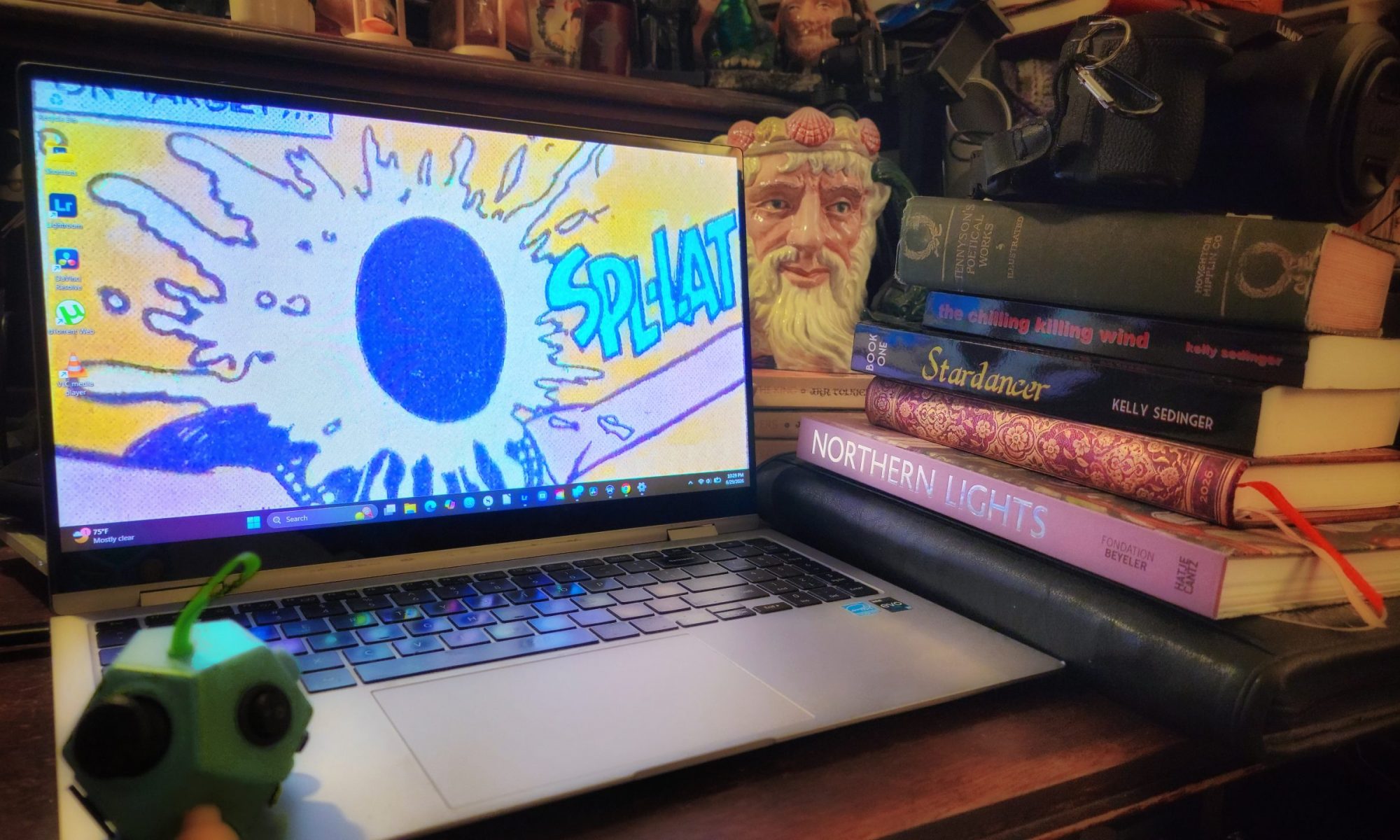

On books, and joy, and hoarding, and having too many books, and what to do with the too many books you have, and….

I recently decided to re-read a book that I first read back in 1995 when it first came out, a wonderful volume by journalist Nicholas Basbanes called A Gentle Madness. Subtitled Bibliophiles, Bibliomanes, and the Eternal Passion for Books, Basbanes traces the long and often delightfully anecdotal history of book collecting and book collectors themselves, from early collectors to those of today (well, those of twenty-some years ago). Such collectors are often odd people driven by specific desires, some are shady characters indeed (witness the case of one Haven O’More), and some are outright criminals (witness the case of Stephen Blumberg, one of history’s greatest book thieves, and whose 1990 arrest in Ottumwa, Iowa, had a bit of local interest to me given that I was in college in that same state at the time).

My Goodreads review of Basbanes’s book is here, but a bit of coincidental happenstance led to my finishing my re-read of A Gentle Madness during a weekend during which there was quite a bit of online controversy regarding the advice of a “decluttering” guru named Marie Kondo, who apparently counseled people to get rid of books that didn’t “bring them joy”. (I’m not sure if this came out via a Netflix series Kondo is hosting, or an article, or what. I didn’t pay that much attention to the particulars.) Here’s an article that argues the counterpoint to Kondo’s advice:

The metric of objects only “sparking joy” is deeply problematic when applied to books. The definition of joy (for the many people yelling at me on Twitter, who appear to have Konmari’d their dictionaries) is: “A feeling of great pleasure and happiness, a thing that causes joy, success or satisfaction.” This is a ludicrous suggestion for books. Literature does not exist only to provoke feelings of happiness or to placate us with its pleasure; art should also challenge and perturb us.

We live in a frantic, goal-obsessed, myopic time. Everything undertaken has to have a purpose, outcome or a destination, or it’s invalid. But art doesn’t care a noodle about your Apple watch, your fitness goals, active lifestyle, right swipes, career and surrender on black pudding. Art will be around far longer than Kondo’s books remain in print. Art exists on its own terms and untidy timeline.

Now, I don’t particularly have a dog in this fight one way or the other. If you love books and want to own a bunch of them? Go for it! If you want to be a collector, focusing on some particular subset of literary production? Go for it! And the whole thing about books “bringing you joy” is…well, it’s pretty amorphous advice, so far as I can tell. There are a lot of things that bring me joy, and there are a lot of ways that books bring it to me. Some by their content alone; some by the style of the content.

I have copies of Coleridge’s The Rime of the Ancient Mariner in at least three compilations that I know of, so why did I buy the copy that comes in a single slim hardcover? Because it’s pretty. It’s a nicely-produced volume with copies of engravings by Gustav Dore accompanying the poem’s text. I have four copies of The Lord of the Rings for similar reasons, and five or six complete Shakespeare’s. (I could swap all those for a First Folio, of course–any takers?)

My own approach to the gathering of books (I wouldn’t say “collecting”) is that I want my books to comprise a working library. There’s not a book in my Scriptorium (yes, I’m trying that word on for size, deal with it) that I don’t want to read someday, even if I may or may not have a reasonable shot at actually getting there. Some I have because they’re prettier than other books, but I can see myself sitting down to read each and every one of them. Do I weed it out? Yes, occasionally. Maybe not as often as I ought to. But the books all bring me joy in one way or another. There are different kinds of joy, after all, and different ways things can make us happy.

One rule I have–and this I share with one of my favorite bibliophiles, Sheila O’Malley–is that aside from what I’m currently reading and have set aside on the bedstand when my eyes can no longer remain open, there are no books in my bedroom. None. (Well, none of mine–The Wife has a bookcase in there, and that’s on her.) As Sheila wrote, “I don’t want any books in my bedroom. My bedroom is for sleep and moisturizing and loving. I’m sick of sleeping surrounded by 5,000 books.” Hear, hear.

I’m reminded of Roger Ebert’s words about his own personal library:

Chaz [Ebert’s wife] and I have lived for twenty years in a commodious Chicago town house. This house is not empty. Chaz and I have added, I dunno, maybe three or four thousand books, untold numbers of movies and albums, lots of art, rows of photographs, rooms full of comfortable furniture, a Buddha from Thailand, exercise equipment, carved elephants from India, African chairs and statues, and who knows what else. Of course I cannot do without a single one of these possessions, including more or less every book I have owned since I was seven, starting with Huckleberry Finn. I still have all the Penrod books, and every time I look at them, I’m reminded of Tarkington’s inventory of Penrod’s pants pockets. After reading it a third time, as a boy, I jammed my pockets with a pocketknife, a Yo-Yo, marbles, a compass, a stapler, an oddly-shaped rock, a hardball, a ball of rubber bands, and three jawbreakers. These, in an ostensible search for a nickel, I emptied out on the counter of Henry Rusk’s grocery, so that Harry Rusk could see that I was a Real Boy.

My books are a subject of much discussion. They pour from shelves onto tables, chairs, and the floor, and Chaz observes that I haven’t read many of them and I never will. You just never know. One day I may need to read Finnegans Wake, the Icelandic sagas, Churchill’s history of the Second World War, the complete Tintin in French, forty-seven novels by Simenon, and By Love Possessed. That 1957 bestseller by James Gould Cozzens was eviscerated in a famous essay by Dwight Macdonald, who read through that year’s list of fiction bestsellers and surface with a scowl. I remember reading the novel late into the night when I was fourteen, stirring restlessly with the desire to be possessed by love.

I cannot throw out these books. Some are enchanted because I have personally turned all their pages and read every word. They’re shrines to my past hours. Perhaps half were new when they came to my life, but most were used, and I remember where I found every one. The set of Kipling at the Book Nook on Green Street in Champaign. The scandalous The English Governess in a shady bookstore on the Left Bank in 1965 (two dollars, today ninety-one). The Shaw plays from Cranford’s on Long Street in Cape Twon, where Irving Freeman claimed he had half a million books. Like an alcoholic trying to walk past a bar, you should see me trying to walk past a used bookstore. Other books I can’t throw away because, well, they’re books, and you can’t throw away a book. Not even a cookbook from which we have prepared only a single recipe, for it is a meal preserved, in printed form. The very sight of Quick and Easy Chinese Cooking by Kenneth H.C. Lo quickens my pulse. Its pages are stained by broth, sherry, soy sauce, and chicken fat, and so thoroughly did I master it that I once sought out Ken Lo’s Memories of China on Ebury Street in London and laid eyes on the great man himself, dining alone in a little room near the entrance. A book like that, you’re not gonna throw away.

Returning to Basbanes’s book, I was struck reading it this time by the fact that many of the people he interviewed twenty-five years ago are now dead, and their collections are either long-dispersed or long-bequeathed. The question comes up over and over again: What happens to your books when you die? And the answers change all the time. Some collectors make arrangements for donating specific parts, or the wholes, of their collections. Some are trying, with varying degrees of success. One mentioned was Forrest J. Ackerman, he of the greatest science fiction, fantasy, and horror collection ever assembled; Ackerman wanted his entire collection to be kept whole, but as no major institutions could accommodate the books and the memorabilia, his collection was eventually auctioned off.

That might seem a bit of a tragedy, but many of Basbanes’s interviewees specifically intend to auction their collections, either because families have no interest or, as a few note, only by auctioning their collections can they guarantee in some small way that the next generation of collectors will have their chances at anything worthy at all. Collectors paying it forward to collectors: the wheel turns on.

Perhaps the greatest single instance of a collection being bequeathed in its entirety is that of Samuel Pepys, who made detailed arrangements and instructions for the handling of his personal library after his death. Pepys gave the entire collection to Magdalene College in London, with instructions that no books could be sold from or added to the library–and he even included the bookcases that he had had made for his own home. To this day, more than three hundred years after Pepys’s death, that library remains intact on the very shelves that once graced Pepys’s own home.

So, what should you do with your books? Do as you will. It’s really the only way to go.
Share This Post

2018: My Year In Books

While I’ve been on Goodreads for a number of years, it’s only in the last two that I’ve started using it more aggressively as a device to track my reading. Here’s the complete list of what I read in 2018, broken down into fiction and nonfiction. Also, if you want to see the individual books with the links to my reviews on Goodreads, you’ll find that here.

(A word about how I use Goodreads: for me it’s basically a low-key reading diary, so I can keep track of what I’ve read and when. I don’t use it much as a bookish social media thing, although if you engage me there I won’t shun you, either! Also, I only record and rate what I finish reading over there, and if I’m finding that I’m not liking a given book, I simply set it aside and move on to something else. This is why very few of my reviews or ratings over there are negative.)

This list is in alphabetical order by author (first-billed, if applicable). A few notes on specific books (not all) are interspersed throughout.

NONFICTION

Baxter, Sarah: A History of the World in 500 Walks

Bleyer, Kevin: Me the People: One Man’s Selfless Quest to Rewrite the Constitution of the United States of America


A terrific book that somewhat humorously (but still seriously) examines the genesis of the Constitution and looks at whether or not specific ideas enshrined in its pages deserve to be kept alive today. This is an important thought process, it seems to me. Constitutional idolatry seems quite dangerous to me, especially considering the ever-increasing gulf between the time of the Founding Fathers and our own. And besides, many of the Fathers didn’t even like the Constitution.

Brown, Nancy Marie: The Abacus and the Cross: The Story of the Pope Who Brought the Light of Science to the Dark Ages

Bryson, Bill: Shakespeare: The World as Stage


Excellent brief look at the life and times of the Bard, as well as discussions on how maddeningly unknowable he really is and what a miracle it is we have as much of his work as we do.

Cazentre, Donald: Spirits and Cocktails of Upstate New York: A History

Cook, Kevin: Electric October: Seven World Series Games, Six Lives, Five Minutes of Fame That Lasted Forever

I loved this book! Great sports writing is an absolute joy. I thought it was going to be about seven individual games from different World Series, but it’s about a single Series: the 1947 Series (Yankess over Dodgers in seven). A terrific look at how often the big sports moments are actually not shaped by the immortal Hall-of-Fame types, but the daily-grind guys who are barely remembered today. If you love baseball, this is a great book.

Dennis, Jerry: The Living Great Lakes: Searching for the Heart of the Inland Seas


Brilliant. Utterly brilliant. If I had to choose one 2018 book to randomly thrust into strangers’ hands, this would be the one. It’s both a captivating history of the Great Lakes, a travelogue recounting the author’s journey across most of the Lakes as a crewman on a yacht, and a warning about the environmental state of affairs in our Inland Seas. I can NOT recommend this book highly enough.

Ehrman, Bart: The Triumph of Christianity: How a Small Band of Outcasts Conquered an Empire


Bart Ehrman is always brilliant. Here he concentrates on the history of early Christianity, looking deeply at how it overcame its surrounding pagan climate.

Ettinger, Amy: Sweet Spot: An Ice Cream Binge Across America

Ferriss, Timothy: Tribe of Mentors: Short Life Advice from the Best of the World

Fitzharris, Lindsey: The Butchering Art: Joseph Lister’s Quest to Transform the Grisly World of Victorian Medicine


If you like your history with a little blood, stay away from this book. If you like your history with a whole shit-ton of blood, go get this one NOW.

Garfield, Simon: On the Map: A Mind-Expanding Exploration of the Way the World Looks


Were you the kid in school who would drive your History teacher crazy because when they called on you, you were too busy gazing at the maps on the wall? Do your re-reads of Lord of the Rings take longer than most other books because you study the maps and note all the places Tolkien never takes you? Then check THIS book out!

Hughley, D.L.: How Not to Get Shot: And Other Advice From White People


Very funny, and deeply depressing that this book could or should be written.

Igort: Japanese Notebooks


Excellent graphical cultural history here.

Kaku, Michio: Parallel Worlds: A Journey Through Creation, Higher Dimensions, and the Future of Humanity
The Future of Humanity: Terraforming Mars, Interstellar Travel, Immortality, and Our Destiny Beyond Earth


I don’t pretend to understand long stretches of these, but if you want some Cosmic Sensawunda with your science reading, Kaku’s your huckleberry.

Kells, Stuart: The Library: A Catalogue of Wonders

King, David: Death in the City of Light: The Serial Killer of Nazi-Occupied Paris


I don’t read a lot about creepy serial killers. This one was good.

Kohan, Rafi: The Arena: Inside the Tailgating, Ticket-scalping, Mascot-racing, Dubiously Funded, and Possibly Haunted Monuments of American Sport


Outstanding. Sports venues themselves are inherently interesting, and it takes a LOT of work to keep those places going. 

Lerner, Alan Jay: The Street Where I Live: A Memoir


Indispensable. I check this out of the library once every couple of years to keep it from getting weeded. This time I even re-read it! If you’ve any love of 20th Century Broadway at all, you need to read this.

Manguel, Alberto: Packing My Library: An Elegy and Ten Digressions

Morrison, Toni: The Origin of Others


Required.

Noroc, Mihaela: The Atlas of Beauty: Women of the World in 500 Portraits


Photography book, but what photography it is.

Nye, Bill: Undeniable: Evolution and the Science of Creation
Everything All at Once: How to Unleash Your Inner Nerd, Tap Into Radical Curiosity and Solve Any Problem


Quite good, especially if you’re looking for signs that rationality and science aren’t dead yet.

Puchner, Martin: The Written World: The Power of Stories to Shape People, History, Civilization


A fantastic exploration of the evolution of writing and storytelling from around the world, and how they influenced one another. Excellent for storytellers!

Roach, Mary: Packing for Mars: The Curious Science of Life in the Void


Mary Roach is a treasure. And so is this book, her look at the various problems that face space travelers past and future.

Szostak, Phil and Johnson, Rian: The Art of STAR WARS: THE LAST JEDI


I shy away from fandom litmus tests, but I do have trouble counting anyone as a STAR WARS fan who doesn’t own at least a few ART OF books. They’ve made one for every movie in the franchise, after all. (Note to self: Get off your butt and get the one for PHANTOM MENACE.)

Tapalansky, Nick and Espinosa, Anissa: Cast No Shadow

Walton, Jo: What Makes This Book So Great


Collection of posts by Jo Walton to TOR.com. Great stuff on books often counted as Fantasy or SF classics, and a model for my own recent work on the Geekiverse website.

Weigel, Dave: The Show That Never Ends: The Rise and Fall of Prog Rock

Weinersmith, Kelly: Soonish: Ten Technologies That’ll Improve And/Or Ruin Everything

Wendig, Chuck: Damn Fine Story: Mastering the Tools of a Powerful Narrative


I don’t read many books about writing these days, but this one’s good. (It’s more about storytelling than actual writing, but still.)

FICTION

Abrams, JJ and Dorst, Doug: S.


This astonishing book shouldn’t be as good as it is. It’s as much a gimmick as a book: its story is told not just through the straight narrative, but also through the margin notes left by two readers and the ephemera they stuff into its pages, many of which come together in puzzling ways. Aspects of Abrams’s storytelling that I usually hold up as weaknesses are actually strengths in this style of tale. This one is a bit of a rabbit hole to disappear down, and its payoff isn’t apparent in any usual kind of way, but it is very rewarding. I loved the experience of reading this and I look forward to revisiting it in a couple years.

Ahdied, Renee: The Wrath and the Dawn

Ahmed, Samira: Love, Hate, and Other Filters


Superb examination of a Muslim-American family in the heartland when terrorism strikes.

Alsberg, Sasha and Cummings, Lindsay: Zenith


YA space opera that I enjoyed enormously.

Allen, Rachael: A Taxonomy of Love


Another good YA story, this one about a kid with Tourette’s Syndrome and his various struggles through adolescence.

Bantock, Nick: Griffin and Sabine
Sabine’s Notebook
The Golden Mean
The Gryphon
Alexandria
The Morning Star


I tore through these again this year, for the first time in several years, and I still adore them. It’s a set of epistolary novels that goes even farther: the letters that tell the story are physical objects in the book, meaning you actually have to remove them from their envelopes to read them. Magic and mysticism and literary arts and love and time and space, all wrapped together. Amazing stuff. (Apparently there’s a seventh volume that I haven’t tracked down yet.)

Belleza, Rhoda: Empress of a Thousand Skies


Another good YA space opera. YA is the scene of a LOT of amazing work these days.

Canales, Juan Diaz and Guarnido, Juanjo: Blacksad: Amarillo
Blacksad: A Silent Hell

Carey, Jacqueline: Kushiel’s Dart


One of the finest fantasy novels of the last thirty years. Why it’s not as well-known as GAME OF THRONES is quite beyond me.

Chambers, Becky: The Long Way to a Small, Angry Planet


Miss FIREFLY? This is right up your alley. An episodic novel (called “a cozy space opera” by the hosts of SWORD AND LASER, a podcast I like) about the various life concerns of the crew of a space freighter. Wonderful.

Clarke, Arthur C.: 2001: A Space Odyssey


Classic. I re-read this for an article on the 50th anniversary of 2001, book and film, for The Geekiverse.

Clarke, Susanna: Jonathan Strange and Mr. Norrell

Oh my. I took forever to read this. For almost two-thirds of its 1000-page length I dolled it out at the rate of no more than a chapter a day, sometimes less. It reads wonderfully that way, this odd Dickensian historical fantasy set in an England-that-wasn’t. For the last third I abandoned the serialized reading and plowed straight through. A book to lose oneself in. Take special care to enjoy the language as you go; this is not a blast-through-it page-turner. This is a page-lingerer.

Doctorow, Cory and Wang, Jen: In Real Life

Fan, Mary: Starswept


Fellow indie writer does good! I loved this classical music inspired space opera, and I look forward to its sequel.

Ford, John M.: How Much for Just the Planet?

I almost never read media tie-in novels these days, but this is almost a classic of the form from the 1980s. The gonzo tale in which the crew of the Enterprise are pitted against Klingons by a civilization inspired by classic movies is reminiscent of Original Series episodes like “The Trouble with Tribbles” and “A Piece of the Action”. I had no idea until I read it that it includes a pie fight between Kirk and crew and all the rest.

Gailey, Sarah: The Fisher of Bones


Gailey is relatively new to the scene and quite a talent. I believe she has a novel coming out in 2019. This novella is haunting.

Lovelace, Amanda: The Princess Saves Herself In This One

Poetry in the new style. Free verse about various personal life traumas. I found it quite moving.

Okorafor, Nnedi: Binti


Okorafor is really good, and I look forward to the rest of this series.

Pond, Mimi: The Customer Is Always Wrong

Powell, Gareth R.: Embers of War


Fascinating first volume of a space opera series that asks the question, “What about AFTER the big interstellar war?”

Rundell, Katherine: The Wolf Rider


Historical YA set in pre-revolutionary Russia. Excellent book that I received as part of a holiday book exchange on a Facebook group last year.

Scalzi, John: The Collapsing Empire

Scalzi’s stock-in-trade is the fast-moving tale of adventure, and this is certainly that. Book Two, THE CONSUMING FIRE, is already out. I can’t wait to read it!

Starlin, Jim: Dreadstar, Vol. 1: The Metamorphosis Odyssey


Old-school cosmic space opera from the early 80s in comics. Remember vans with giant murals of fantasy art painted on the sides? This is the stuff those van owners were reading. Maybe not your cup of tea, but if it is, there’s a lot of appeal here.

Stokoe, James: Wonton Soup (Big Bowl Edition)

Valente, Catherynne M.: Space Opera

This is one of two books I strongly expect to win the next Best Novel Hugo award. (Mary Robinette Kowal’s THE CALCULATING STARS, which I’ve yet to read, is the other.) Imagine a galactic version of Eurovision, with the added incentive that if you lose, your species is annihilated and life on your planet turned back to pre-intelligence.

Vaughn, Brian K. and Staples, Fiona: Saga, vol. 8
Saga, vol. 9

Sigh. I hate to end on a down note, but alphabetically that’s where we are. SAGA was one of my favorite things in its early going, but its last several volumes have descended into directionless stories that rely more and more heavily on shocking deaths for their emotional heft (one especially irritating case is when Vaughn introduces a couple of characters for literally NO other reason than to kill a major character, and once that’s done, he kills off his newly-introduced murderers). I find that when stories go in the direction of pure grimdark, what is clearly intended to be emotional manipulation ends up being emotional eviction as I simply stop caring about what happens to the characters at all.

So that’s my reading in 2018. Plans for 2019 include more about Shakespeare and by Shakespeare. I also have a whole bunch of fantasy novels that I plan to read–2018 was heavy on science fiction, so I want to spend some time in the lands of epic fantasy for a while. As ever, reading continues to be the center of my creative and artistic life, so onward and upward!

Share This Post

From the Books: THE COMING OF THE KING

So yesterday I saw a New York Times article linked on Twitter in which apparently some members of former European aristocracy are starting to raise the notion that maybe, just maybe, world problems might be helped somewhat by a return to monarchy. I confess I didn’t bother reading the article because…well, the whole notion just sounds goofy. But I did note the name of the first person quoted in the article: one Count Nikolai Tolstoy, who is a member of onetime Russian nobility, a distant cousin of Leo Tolstoy of War and Peace fame, and the writer of a fantasy novel about the wizard Merlin called The Coming of the King.

As it happens, I bought this book way back when I was in college and going through the big Arthurian phase of my reading life. There was a couple of years where if I was reading a book not related to any of my classes, it was an Arthurian book of one sort or another: either fantasy novels retelling the tale, or a nonfiction book about the legends or the larger category of British folklore from which the Arthurian matter springs. Tolstoy’s novel is…well, I started it and got about seventy pages in before I gave up. His writing style was very formal and almost stilted (not unlike The Silmarillion), but what got me was a passage that ranks as one of the strangest passages I have ever read in a fantasy novel. I thought that I had shared this before, but I did a cursory search of the archives and couldn’t find it, so here is is anew.

I don’t even recall the contextual events in which this takes place, save that it is a big feast-type party or something at the King’s great hall. Tolstoy is describing some of the evening’s entertainment here, and…well, this happens. I swear that this is from a novel that actually got published.

Low before the king bowed the seven newcomers; and bowed low they remained, with buttocks bare gleaming from the ruddy glare of the king’s hearth. For they were the far-famed farters of the Island of the Mighty, whose skill in farting surpassed any that might be found in Prydyn, or Ywerdon, or distant Lydau across the Sea of Udd.

Wonderfully loud was the farting of the royal farters at the feasting of King Gwydno Garanhir upon the Kalan Gaeaf; wonderfully lour, skillfully sonorous, and evil-smelling beyond the achieving of all others of their calling. At first they emitted with rare delicacy the seven notes of the scale, moving up and down the line in harmony, high and low. Then they blew forth tunes such as cowherds and milkmaids sing. They whistled high and they whistled low in semblance of the whistling of the keepers of the king’s kennels. or of unseen birds that pipe in the brake.

But these wonderful feats were as nothing to what followed, and an ecstasy came upon the Men of the North as each of the performers excelled his fellow with some new and marvelous display of art and skill. Marvelously true to reality was the snorting of war horses, the braying of trumpets, the roaring of stags, the rumble of thunder, the bellowing of bulls, the snarling of wildcats, and long, low drone of a homing cockchafer on a summer’s eve.

Well-fed were the performers upon dulse and lentils and beans, but not beyond the space of half an hour were they able to sustain their skillful performance. There came a moment when their conductor gave vent to a long, low whistling sound like a serpent retiring to its heathery laid; so sibilantly soft, stealthy-sounding, and stalely stinking as to instill an awed silence upon the assembled company. It was a signal for the departure of the troop, and with a final effort of such loudness and force and vigor that men swore afterward it set the goblets rattling upon the royal board, and all but extinguished the pine torches flaring in their sockets and even the great hearth burning beneath the royal cauldron.

Like the gale before which no man is able to stand upright, which blows without ceasing from the mouth of that Cave in the land of Gwent which men call Chwith Gwent, was that mightiest of farts which was in the North at that time. There were those in the king’s hall, however, who feared lest the performance might arouse storms and tempests in the winter sky, avowing they could hear afar off in the mountains the rolling of Taran’s wheel.

It was amid smoke and confusion and stench that the king’s farters flew from the banquet hall to the hostel set apart for them. It was long before the pleasure passed and laughter died away and tongues were stilled, so delightful was their performance to the Men of the North.

As noted, I have little idea what to make of this, and I recall that I read very little farther in the book after this.

As for the novel itself, it was apparently at one point to be the first book in a trilogy of novels about Merlin, but the next books never appeared. Count Tolstoy was apparently involved in some sort of legal action involving libel, which put a bit of a kibosh on his writing at the time. To my knowledge these books have never appeared.

And there, folks, is the strangest thing I’ve ever read in a fantasy novel.

Share This Post

From the Books: THE RETURN OF THE KING

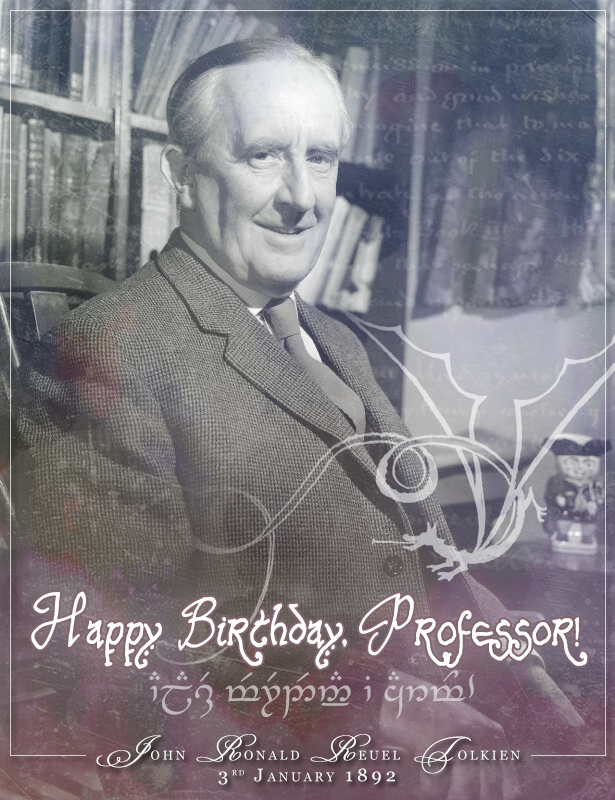
It’s JRR Tolkien’s birthday!

Tolkien is, naturally, one of my favorite of all authors. He wasn’t my first foray into epic fantasy–that would be Lloyd Alexander–but Tolkien cemented my love of that genre for keeps. He is, for me, as profound an influence on my own storytelling as George Lucas.

Here is one my very favorite passages in a book chock-full of favorite passages. This is from The Return of the King, the chapter titled “The Siege of Gondor”.

In rode the Lord of the Nazgul. A great black shape against the fires beyond he loomed up, grown to a vast menace of despair. In rode the Lord of the Nazgul, under the archway that no enemy ever yet had passed, and all fled before his face. 

All save one. There waiting, silent and still in the space before the Gate, sat Gandalf upon Shadowfax: Shadowfax who alone among the free horses of the earth endured the terror, unmoving, streadfast as a graven image in Rath Dinen. 

‘You cannot enter here,’ said Gandalf, and the huge shadow halted. ‘Go back to the abyss prepared for you! Go back! Fall into the nothingness that awaits you and your Master. Go!’ 

The Black Rider flung back his hood, and behold! he had a kingly crown; and yet upon no head visible was it set. The red fires shone between it and the mantled shoulders vast and dark. From a mouth unseen there came a deadly laughter. 

‘Old fool!’ he said. ‘Old fool! This is my hour. Do you not know Death when you see it? Die now and curse in vain!’ And with that he lifted high his sword and flames ran down the blade.

Gandalf did not move. And in that very moment, away in some courtyard of the City, a cock crowed. Shrill and clear he crowed, recking nothing of wizardry or war, welcoming only the morning that in the sky far above the shadows of death was coming with the dawn. 

And as if in answer there came from far away another note. Horns, horns, horns. In dark Mindolluin’s sides they dimly echoed. Great horns of the North wildly blowing. Rohan had come at last. 

That is one of those passages that, every time I read it, I pray to whatever powers there are that one day I might write something half so wonderful.

Happy birthday, Professor Tolkien! Long may your stories shine, into the next Age and beyond!

Share This Post

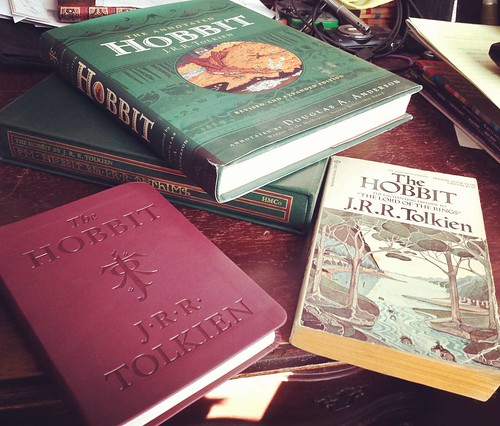
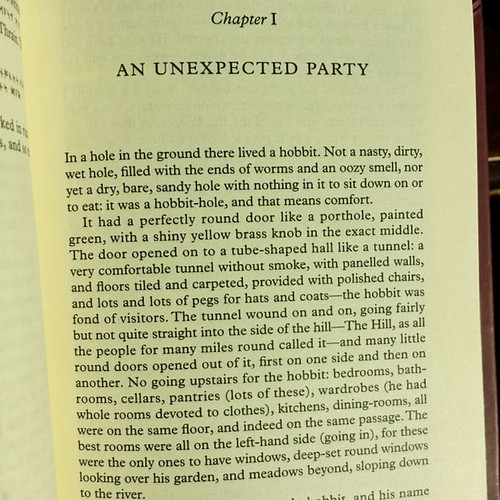
“In a hole in the ground there lived a hobbit.”

THE HOBBIT at 80! My current collection of copies. Bilbo lives! #thehobbit #lordoftherings #lotr #tolkien #books #bookstagram #reading #fantasy

I didn’t know this until I saw it online today, but The Hobbit was first published 80 years ago today.

At no point have I not loved this story (except for the handful of years I was unaware of it), and I don’t expect that I will ever not love it. The Hobbit and its more noted follow-up, The Lord of the Rings, are on my shortlist of the stories that have shaped me the most: we’re talking Star Wars territory here, to be honest.

I knew the story of The Hobbit — well, most of it, anyway — several years before I actually read the book. That’s because my first encounter with this story was via the Rankin-Bass animated version that first aired in 1977. I don’t recall if I saw it then or on a subsequent re-run, but it didn’t matter: I loved this story quite intensely, and when I read the book a few years later, I was done for.

IMG_20170921_180611_553

The Hobbit is often seen as a children’s tale, inessential to the greater work that followed it, but I’ve never viewed it that way. Reading The Hobbit is as essential to the experience as anything, and I never ever re-read The Lord of the Rings without reading The Hobbit first. There is so much in The Lord of the Rings that simply doesn’t make sense, or at least has the impact blunted, if one hasn’t read The Hobbit. The eagles arriving at the Black Gate; the tonal shift about halfway through Fellowship into a more heroic mode; the history behind Sting and the mithril coat.

More than that, though, the adventure story that comprises The Hobbit contrasts greatly with the world-wide import of the events to come. The focus in The Hobbit is intimate, and the focus never wavers from this little hobbit named Bilbo who is ensnared in events larger than he can comprehend, and his efforts to make his way in a world he doesn’t understand and barely wants to. The Hobbit is an adventure story, but it’s an adventure story that ends somewhat ambiguously with the treasure won but one of its seekers dead. This anticipates the moral direction of what is to come, when the fundamental quest is not to find something but rather to lose something that is already found.

And it is, really, one hell of an adventure story.


Long live The Hobbit! It’s been a few years since my last re-read, so…I think that I may be quite ready for another adventure!

Share This Post

Something for Thursday (Twenty Years of HARRY POTTER edition)

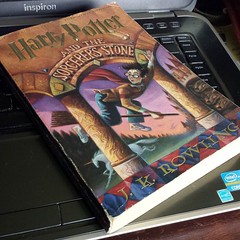
Twenty years. Well done, Mr. Potter! Thank you, @jk_rowling! #books #harrypotter

The other day marked the twentieth anniversary of the initial publication of Harry Potter and the Sorcerer’s Stone (or Philosopher’s Stone, if you live in Britain–and I guess I should link that first since that’s where the book came first). I could wax poetic for quite a long post about Harry Potter and the enormous effects on culture those books had, but others have weighed in more intelligently than I could on those points. I, like many others, have had my own “personal journey” with Harry Potter, starting with sometime in what must have been 1999 when I started noticing these books with the unusual cover art and title font on the front displays at Borders, and very prominently placed in the childrens’ section. By the time I was aware of the growing Harry Potter phenomenon, there were already three books out, and I bought the first one out of curiosity.

And I loved it, right from the get go–right from the opening paragraph. I mean, that first book’s opening paragraph is some seriously wonderful stuff! Don’t take my word for it, either: look what this fan did with it:

I never looked back, eagerly snatching up each book as it came out and squeezing it into my reading time. By the release of Deathly Hallows, the last book, I was in as much a fever-pitch as anyone, and I remember a kind of Devil’s bargain I made with The Daughter at the time, who was about eight years old: on a Sunday afternoon I told her that she could play videogames for as long as she wanted. Then I went out on the balcony of our apartment and plowed through the last four hundred or so pages of that book.

I’ve been meaning to reread the Potter books for some time now, and perhaps this winter it will finally be time to do so. (In honesty, I associate the books–as I do most fantasy–with the cooler months. I’ve never been sure why that is, because fantasy is not an inherently autumnal genre.) I also need to rewatch the movies, which are, for the most part, excellent adaptations and retellings of the story.

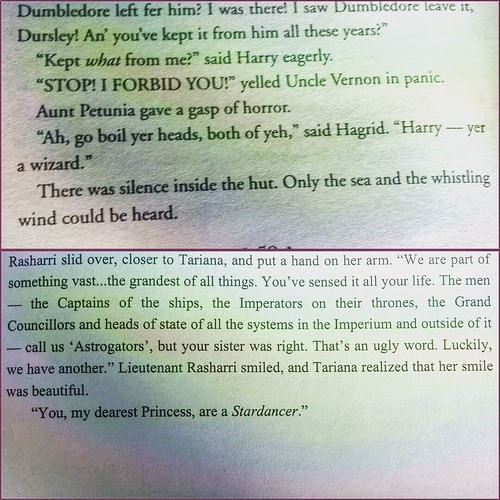
One final note: I included a call-back to Harry in Stardancer. How could I not? While the situation involving Lt. Rasharri’s revelation to Tariana Osono of her powers isn’t so confrontational as when Hagrid tells Harry that he’s a wizard, it was hard not to see this moment in my story as a reflection of the earlier one.

I always meant this scene in STARDANCER to partially be a callback to HP & THE SORCERER'S STONE. #amwriting #harrypotter

And now, since this is Something for Thursday and all, some music!

Share This Post

The Force will be with you always: STAR WARS at 40


D19 of #IGWritersMay: Novel aesthetics. I make no secret that at its heart, THE SONG OF FORGOTTEN STARS is really my love letter to STAR WARS. (This is a page from the book THE ART OF STAR WARS.) #amwriting #starwars #sciencefiction #spaceopera #Forgotten


I didn’t see Star Wars on opening day. In truth I don’t even remember exactly when I saw it, but it was later in the summer of 1977. We had just moved from Wisconsin to Oregon, and in that time I was not even aware of this enormous movie phenomenon whose popularity was sweeping the nation.

I finally saw it, though, with my sister, who is six years older than me.

I didn’t like it.

It was very loud. It opened with big words flying through space and then there was loud spaceships and talking robots (one of whom only talked in beeps and whistles). There was a girl in white and a bad guy in black whose breath sounded weird. There was a desert planet with weird dwarf-creatures and a kid named Luke who lived with his aunt and uncle. (The uncle could be pretty gruff if Luke was goofing off, to which I could relate.) There were more loud spaceships and one really really big spaceship shaped like a giant ball. There was a guy dressed in black and white who helped the farm kid, and this guy had a giant ape-man friend. There were swords made of light and even more spaceships and a big battle in space.

All of that, and I didn’t understand a lick of it.

In my defense, I was all of five years old at the time.

Until Star Wars, my movie experience was pretty much limited to stuff like Bugs Bunny Superstar and Disney live-actions like The Shaggy DA (which contained a hoot of a pie fight). Then there was this movie with loud spaceships and robots and a farm kid and a bad guy in black and…well, I had no idea what to make of this movie.

Luckily for me I had my sister, who is six years older than me.

She went all-in for Star Wars. She ate it, drank it, breathed it. She talked about it a lot, and gradually her enthusiasm began to win me over. She explained the story to me because I hadn’t understood it all that well, and I decided that I wanted a part of her enthusiasm for my own. So I went with her to see the movie a second time.

I have never ever ever recovered.

I’ve been thinking a lot about Star Wars as it nears and achieves 40 years, and I find myself relating to it most as a storyteller myself. As a writer I tend most to look at Star Wars through the prism of story. Many stories have had a deep effect on me, on the stories I want to tell, and the way I go about telling them, but none moreso than Star Wars, even as the Star Wars story itself has changed over the course of its four decades. Most of the core ideas are still there, though, as Star Wars is now no longer in the hands of its creator, George Lucas. Star Wars is still a tale of heroic adventure unfolding in the sky. It is still a tale not just of the wars but more well-focused on the people fighting that war. It is a tale of improbably redeemable villains, of the way our paths mirror those of our parents, and of finding love in the face of desperation. It is a tale of family.

I can’t help thinking in most, if not all, of these terms every time I write a story, no matter which genre it’s in. Star Wars made me want to be a storyteller (what is playing with action figures, if not storytelling?). It also taught me that stories can focus at times on more mystical matters, and it taught me that story is an excellent way of addressing the challenges people face in their hearts. Most importantly, though, Star Wars taught me about heroes and quests and the wise elders who try to guide the heroes on their way.

Other stories have come since Star Wars arrived, and many have come to places almost as near to my heart. It’s not only stories, either; it’s all of creative art, really:

Lloyd Alexander’s Prydain Chronicles
The Lord of the Rings
Casablanca
On Her Majesty’s Secret Service
My Fair Lady
Cosmos
Much Ado About Nothing
The House with a Clock in its Walls
The Lions of Al-Rassan
Mary Stewart’s Arthurian trilogy (plus The Wicked Day)
Berlioz’s Symphonie fantastique
Rachmaninov’s Symphony No. 2 in E minor
Invisible Touch by Genesis
Once and Again
Princess Mononoke

These are all things — and there are more — that are at the center of my creative life, but none has ever quite dislodged Star Wars as my Prime Mover. Star Wars is, and continues to be, my Platonic Ideal of what story is.

Even so, I haven’t always kept as close an eye on Star Wars as a massive universe as many. I’ve read only a small handful of all the many novels and comics written over the years, and I haven’t played any of the video games. For me, my appreciation focuses pretty exclusively on the movies themselves, and not just the wonderful Original Trilogy but also the admittedly uneven — but still, in my eyes, uniquely compelling — Prequel Trilogy and even to a smaller extent the recent “Rebirth” movies, The Force Awakens and Rogue One. Those form the core.

Star Wars is as strong now as it ever was, and it is very likely even stronger. It has more fans than ever, and it is now in the hands of a corporate power whose pockets are deep enough to maintain it at a very high level for decades to come. More fans are created every day, it seems, and yet…I do have to admit to feeling a certain level of possibly grumpy oldsterism. Sure, you kids can love Star Wars and in fact I hope that you will, and that your love for Star Wars will lead you to other things. But I came in on the ground level. My memories may be hazy, but I do remember a time before Star Wars.

I believe that every story one writes — or rather, every story that I write — should be, in one way or another, a love letter, either to someone or something. The Song of Forgotten Stars has many influences, but it is ultimately my love letter to Star Wars. If not for Star Wars, there’s no way I would be writing this story. It’s not just about the internals of Star Wars, though: it’s about the way Star Wars impacted me and shaped my life and helped reflected certain relationships in my life. Put it this way: There’s a reason why the two main characters in my Forgotten Stars books are two Princesses, one of whom is six years older than the other. It’s a dynamic that makes sense to me on a lot of different levels.

I also know, from reading a lot about the making of Star Wars over the years and about the life of George Lucas in particular, that the way by which a creative work comes into existence is often a messy one. Lucas’s manner of creation is eerily similar to my own, or maybe vice versa. Lucas is someone who starts out by following ideas in any direction they might go, and only gradually whittles things down and discards this notion or that idea until a streamlined story starts to emerge. I work the same way, at least in part. My rough drafts are often very messy and they always contain entire ideas that I remove entirely, for one reason or another. Lucas has done so much mixing and matching of ideas over the decades (remember that for him, Star Wars is 47 or 48 years old, depending on where he dates The Beginning) that he at times seems to be misremembering his own history. I know how he feels. There are times when an idea seems so organic that it’s hard to claim it for my own. Even if it is.

So thank you for forty years, Star Wars! And may the Force be with you, forevermore.

Share This Post