

“You can type this shit, George, but you can’t say it.”
I recently read a fascinating book about the Star Wars phenomenon, titled How STAR WARS Conquered the Universe: The Past, Present, and Future of a Multibillion Dollar Franchise. Written by journalist Chris Taylor, the book traces the history of Star Wars, not as purely a “making of” story, but as a cultural phenomenon. It’s a terrific book that I reviewed on Goodreads, but I wanted to revise and extend those remarks a bit.
This book is one of the most even-handed accounts of Star Wars and the work of George Lucas that I have read. There isn’t much axe-grinding here, which I greatly appreciate. Taylor is interested in just how this thing called Star Wars came to be one of the dominant pop-culture forces today, tracing the influences that led a young George Lucas to think more and more obsessively about his “little space movie”, and then tracing its own influences on those who came after and showing some of the many and surprising ways that Star Wars has enhanced and influenced the lives of several generations of fans, geeks, and whatever else has come afterwards.
Star Wars started as one movie that wasn’t even supposed to be 20th Century Fox’s big picture for 1977, but it became an enormous force, as everyone knows. It is certainly, along with Star Trek, likely the single biggest influence on my creative life, and it’s inspired an astonishing amount of activity over the years, from comics to music to books to fan films to cosplayers, some of whom have organized into the largest amateur costuming group in the world after the Society for Creative Anachronism. All that, from the imagination of a filmmaker from Modesto, California who only became driven to succeed after he nearly died in a car crash in his youth.
From my perspective, the best parts of the book are those that home in on George Lucas’s creative process. A lot of ink and a lot of pixels have been deployed over the years in discussing Lucas, many times in derision. What emerges in this book – and in others I’ve read, such as Rinzler’s wonderful Making of… books for each of the original Star Wars films – is a man with a deeply non-linear creative process. Lucas’s approach seems to be to generate ideas by the dozen, and then mix-and-match them in various ways until something coherent begins to emerge. Sometimes his earliest ideas are set aside only to return many years later, and sometimes his early ideas stick around through most iterations of story.
The genesis of Star Wars, as it went from being an enormous and ungainly thing bogged down in dozens of names and jargon terms, was a very messy process, and it’s always amazing to me to see the long litany of notions that came and went. There are ideas that Lucas entertained in 1975 that would not show up on film until thirty years later (such as the planet Utapau, present in the earliest drafts of Star Wars, when it was called The Star Wars, and which would not actually show up on film until Revenge of the Sith). In this way, Lucas reminds me of some favorite artists of mine, like composer Hector Berlioz, who would think nothing of using a melody in an early work and then using it again many years later, if he felt that he still had use for it.
The messiness of Lucas’s storytelling process stands at odds with things he says later about his own process, which is something that a lot of people have used as a source of criticism. Lucas is often thought to have promised a nine-episode Star Wars saga back in the days of the Original Trilogy, but his actual statements were that he had written an enormous story and then cut it in half, resulting in the Original Trilogy being the second half; the seventh, eighth, and ninth episodes were only conceptual in nature. This seems to be partly true, but Lucas didn’t so much cut an original story in half as he kept reducing his focus. The “Star with Episode IV” approach seems to be more emergent than intentional, which is not a bad thing.
Here, from the book, is just such an example of one of Lucas’s old ideas resurfacing much later on:
The moment Lucas decided to add a kind of rational, scientific component to Jedi knowledge of the Force, in Episode I – the infamous “midi-chlorians,” microscopic organisms that are supposed to help the Force bind to living beings – long-time fans revolted. It didn’t matter that, as Lucasfilm protested, the midi-chlorians are not supposed to be what the Force is actually made of – just a biological indication of its presence. If you dig deep enough into the Lucasfilm archives, you’ll find Lucas talking about midi-chlorians as early as August 1977. “It is said that certain creatures are born with a higher awareness of the Force than others,” he said during a role-playing exercise designed to help him flesh out Star Wars concepts after the original movie. “Their brains are different; they have more midi-chlorians in their cells.” This didn’t matter either. What fans actually want, it seems, is as little detail as possible. They want twenty-eight words, and nothing more.”
The twenty-eight words Taylor refers to is the simple description of the Force given by Ben Kenobi in A New Hope, and nothing more. Without rehashing the whole midi-chlorian thing, it’s certainly interesting that Star Wars fans seem to want to leave things open and mystical and unexplained in a lot of cases. They certainly stand in contrast to, say, fans of JRR Tolkien, who want as much detail as humanly possible, to the point of learning to speak fictional languages and developing their grammars beyond what Tolkien created. (I still maintain that the midi-chlorians are not a category error but a storytelling one. Their existence adds exactly nothing, story-wise, to the Star Wars saga.)
This book also provides some evidence in favor of an oft-cited notion, that Lucas functions best when he has a strong voice to tell him “No.” By the time of the production of the Prequels, Taylor describes Lucas as so revered that literally no one goes against him in any way at all. I’ve never been totally convinced of this, and I’m still not. Producer Rick McCallum doesn’t come off terribly well, being shown as mainly a yes-man, but still: Lucas brought in script help for all three Prequels, in acknowledgment of his own weaknesses in the writing department. (Which are, in my view, a bit overblown.) Taylor’s own negative opinion of the Prequels stands, but to his credit, he does give voice to some pro-Prequel voices, and he acknowledges that they are not the irredeemable films that many have deemed them. (I’d rather he hadn’t even mentioned that awful Red Letter Media guy at all, though.)
Taylor seems fairly bemused, in the closing chapters, by the fact that Star Wars fandom has only strengthened over time, even in the face of three Prequel films that are, shall we say, less than beloved. As the book closes, Lucas has sold it all to Disney, but even then he was starting to knock around ideas for Episodes VII through IX, the ones he had previously said he’d never do. One ends up wishing that George Lucas would simply come out and admit that Star Wars has been his life. That wouldn’t be so bad a thing, would it?
Ultimately, Taylor’s book does a wonderful job of tracing the growth of Star Wars in our cultural life, and he also shows how it came to utterly dominate the life of its creator, a complex man whose own skills, great as they are, were not always a match for what was in his head. I’m grateful for the book’s portrayal of a George Lucas who is flawed genius, instead of a hack who just happened to get lucky a couple of times. I hope Taylor gets to revise the book in five or six years, once the Saga again stands complete. Unless, of course, Disney decides to fire up production on Episode X in due course….
Share This Post
THE WISDOMFOLD PATH is now LIVE!!!
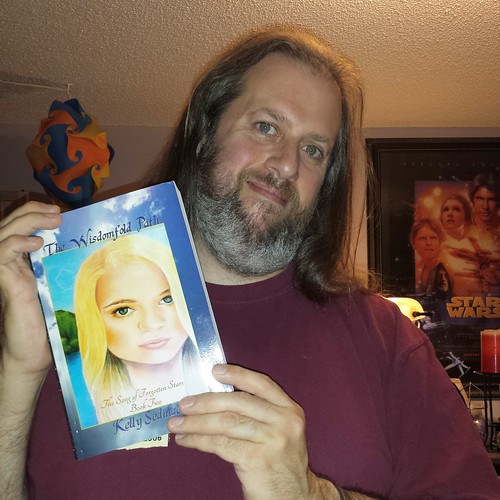
Yes, folks, the day has come: Book II of The Song of Forgotten Stars is now a reality! Details are over on the official site, but the important thing is: THE WISDOMFOLD PATH is a GO!!!
More commentary to come, but for now…WOW!
Share This Post
Five Lakes (and one book)

I’ve pretty much been of the opinion for years, even though I don’t think I realized it until more recently, that I honestly don’t ever want to live more than a few hours from one of the Great Lakes. This region has been my home since 1981, and you might make a case for before that, since Pittsburgh certainly falls within the “few hours from the Lakes” category. These five inland seas encompass so much beauty and history and character, all of which are sometimes overlooked in our seemingly forever-ongoing “North versus South” thing in this country.
There’s a children’s book I read not long after we moved to Allegany, NY, in 1981. I don’t recall exactly when I read it, or the circumstances under which a copy found its way into my hands; I don’t recall if I owned it or if it was a library book. The book’s title is Paddle To The Sea, by Holling Clancy Holling. If I owned this book, it vanished from my personal library years ago. However, I found myself remembering it recently, so I availed myself of the Erie County Public Library and checked it out.

The book came out in 1941, and it tells a simple story: a young boy living in Canada carves a wooden Indian in a canoe, names him “Paddle To The Sea”, and sets him afloat on a river that empties into the northern reaches of Lake Superior.

From there, Paddle follows the long and improbable journey through every one of the Great Lakes, until he finally reaches the St. Lawrence River and the Atlantic Ocean. Paddle’s journey is mainly a narrative frame, though, which supports Holling’s real goal: exploring the nature of these five enormous lakes.

Holling’s art in this book alternates between pencil drawings accompanying the text on the left-hand pages, and full-color plates on the right. In this way Holling traces paddle’s voyage, which doesn’t even begin to follow any kind of straight line.

Along the way Paddle encounters various obstacles and dangers, such as the huge cargo ships on Lake Superior, the enormous waterfalls at Niagara, and a sawmill, whose operation Holling depicts:

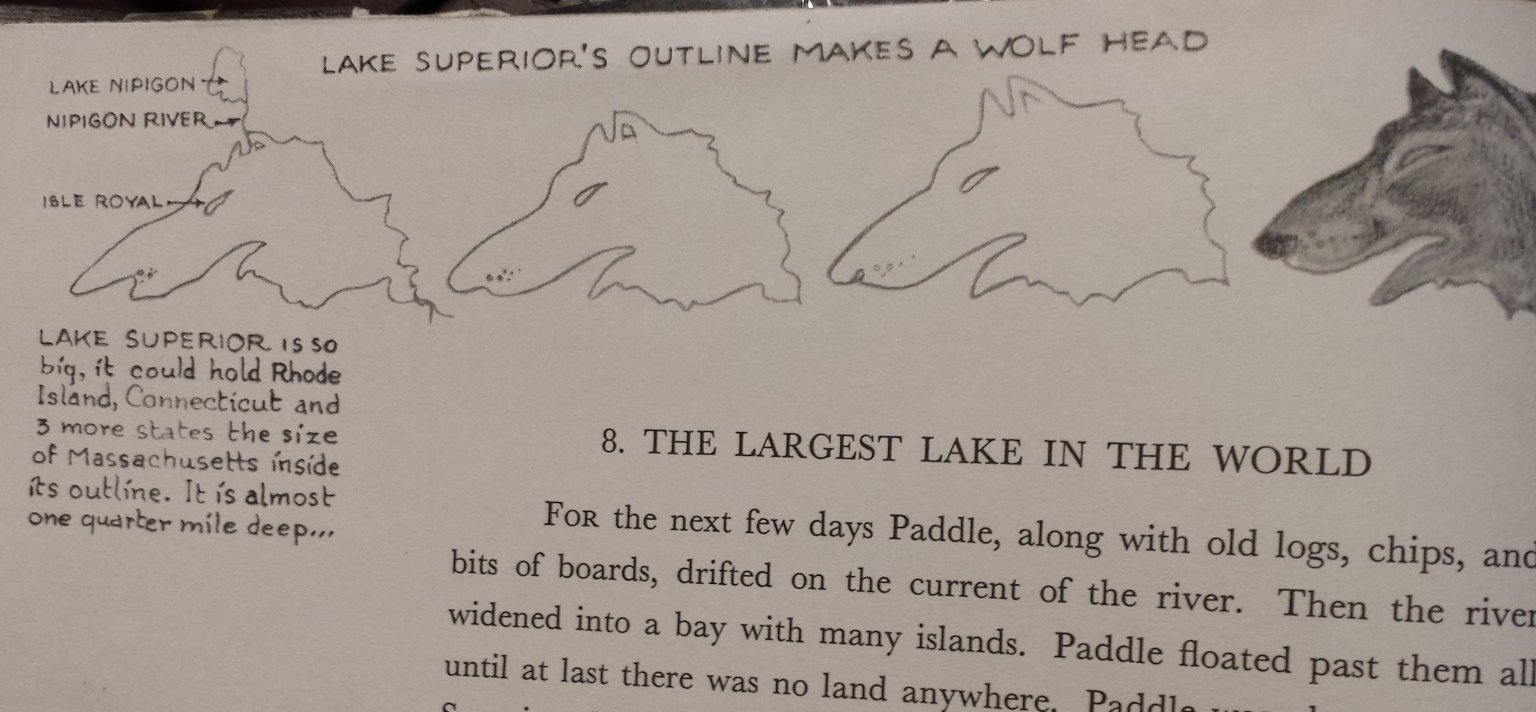
I also love the fanciful ways Holling interprets the shapes of the lakes themselves. Lake Superior as a wolf’s head is pretty obvious, I suppose, but the others are impressively creative, and I have thought of all the Great Lakes as these shapes ever since I read the book when I was ten or eleven. I remember a conversation with some college mates, trying to explain to them this particular interpretation of the shape of Lake Huron, and I remember wishing I had a copy of the book then to show them.


Holling’s prose is somewhat dated at this point, but that’s to be expected, and I wonder how Holling would depict the Great Lakes now, since the region endured a period of extended decline that began not terribly long after this book came out and which some might still think is going on. But it’s still a region of nature and industry often side-by-side, all of it dominated by these enormous bodies of water.
Paddle To The Sea is a wonderful piece of Great Lakes lore, and I’m glad I took the time to revisit it.

Share This Post
An appalling misuse of statistics

That’s right, folks! STARDANCER currently polls higher than Trident gum! Buy yours today!
Share This Post
All right, 2015, it’s just YOU and ME!!!

I don’t much do “resolutions”, because it always seems slightly unrealistic to suddenly expect to adopt an entirely new approach to life or something based merely on the flipping of a calendar page. I do, though, set goals. Here are mine for this year:
1. Watch 26 movies that I’ve never seen before. I have a few titles in mind, but others will be things I find along the way. (And I won’t count Avengers II or Star Wars VII among them.) I feel I need to broaden my cinematic horizons a bit. Twenty-six movies is one movie every two weeks, which given my schedule should be doable! I’ll track these on the blog, somehow.
2. Read 52 books. That might be a bit on the ambitious side, given that I’m not the fastest reader and some of the books I really want to read are dootstoppers, but we’ll see. Some books I’ll fly through, whilst others will take longer, so we’ll see.
2a. Half of my fiction reading will consist of independently published books. This is important to me, both as an indie author and as a reader in general. There does seem to be a still-existent, if slowly-weakening, stigma against independently published writing, which seems more and more strange to me. We love independent musicians and independent film makers and independent comics creators, so why not love independent authors? More and more I’m of the view that a publishing contract should no more be an indicator of an author’s quality than a recording contract should be of a musician’s.
3. Read 24 short stories. I never read enough short fiction, so I want to get back to doing that. I own a lot of short fiction collections and I can find a lot more online.
3a. I may do this, actually (I just saw this on Facebook):
4. Rewatch Cosmos (the Carl Sagan original) and then the Neil DeGrasse Tyson follow-up. I meant to do this in 2014 and didn’t get around to it.
5. Do more cooking, learn to cook more things. There’s no reason not to. This is a continual goal of mine, and every year I do make some strides in the kitchen. This year I want to figure out gluten-free fried chicken, if nothing else!
6. Listen to more music. I’m not quantifying this, I’m just doing it.
7. Erect shelving in my library closet and create my “Archive” in there. I need to get my CDs organized, likely into binders. I also need to rip more of my CDs to the computer and uploaded to Google Music.
8. Hang the new light fixture above our kitchen sink. The fact that this item is number 8 on this list is not indicative of how important this one is; I’ll be getting this done before the 18th of this month!
9. Finish moving in! If nothing else, the Living Room Box Pile must go.
And these aren’t even my writing goals (you can read about those on the official site)! Wow!

Share This Post
Where STARDANCER came from!
This post is cross-posted from ForgottenStars.net, and slightly spoilery for the book.
So, where exactly did I get the idea for Stardancer? Easy answer. I got it from a lot of places.
(This is long, but I hope it’s at least a little interesting!)
Like many a writer, my first efforts at fiction writing were fanfiction — Star Wars fanfiction, specifically. I suppose that’s not terribly surprising, huh? Fanfic has been the starting point for many a writer, and Star Wars was one of the biggies.
Now, when I was writing Star Wars fanfic, I wasn’t writing original stories in that universe. Instead I took the basic thrust of the Original Trilogy’s story and rewrote it, with “new” characters and some plot twists along the way. I changed Luke Skywalker from a farmboy to a competitive pilot. My Han Solo character acted the part of a cynical space-rogue, but that was just a front for his own revolutionary activities. Princess Leia? Well, she was the voluptuous space pirate who ended up being a part of the good guys. And instead of rebels versus a Galactic Empire, I had the galaxy basically divided into two “countries”, a democratic republic and a harsh Empire. These two entities had been at war for decades, and now it was coming to a violent head.
I kept some other stuff, of course. I had an Emperor and his Vader figure, although I played up the angle in the Original Trilogy of Darth Vader wanting to kill the Emperor and take over. The thrust of my Episode One (which coincided with Star Wars Episode IV: A New Hope) was the necessity of destroying my Empire’s new superweapon; in my Episode II, the freshly defeated Empire — well, it struck back. And so on.
I finished my own version of the Star Wars trilogy, in the first year or two after I graduated college. Then, I started working on the first draft ever of my Arthurian novel, The Promised King (and let me tell you, that draft was an embarrassing mess). I thought I was done with Star Wars fanfic, but I found myself sucked back in, around the time The Phantom Menace came out. Now I was wanting to continue on — but not, as George Lucas was doing, by going backwards; I wanted to write what would have been a putative Star Wars Episode VII.
I did start that project, but I never finished it, choosing instead to eventually leave fanfic behind for good, as I started working on that Arthurian novel a lot and writing short fiction for attempted publication. Problem was, my space opera story for my own Episode IV was sticking in my head. The central idea was the discovery of a planet that has been literally sequestered from the rest of the Galaxy for centuries, a planet that was once a part of a vast Empire that has been gone for so long it’s almost completely forgotten — but its descendants are still lurking out there somewhere. I liked that idea, and filed it away in the back of my head. I knew I’d get back to that strange planet, whose inhabitants were forbidden to travel to the stars, but I knew it wasn’t going to be my re-worked Luke, Han, and Leia who went there.
So who would?
I had no idea.
I wasn’t worried about it. I wasn’t even consciously thinking about this, much. When I get ideas, I almost never jump on them as soon as they pop into my head. I let them marinate a bit. Or percolate. Or simmer for years and years and years — and I’m not kidding about that. This whole thought process, beginning with this little lost planet? That’s from 1999 or 2000. A long way back.
Meanwhile, at some point in 2001, I got a movie on a VHS tape that I had heard was very good, an animated film from Japan that would be suitable for The Daughter, was was only 2 at the time. The film? Hayao Miyazaki’s My Neighbor Totoro.
If you’ve seen that film, you know that it’s about two young sisters, one of whom is roughly 13 or 14 and the other of whom is around 6 or 7. They move with their father to a small village, out near a hospital where their mother has had an extended stay, and here they have adventures, some of which are supernatural and involve the giant furry beast who lives in the nearby enormous tree. (Yes, it sounds heavier and more depressing here than it really is — the film is utterly delightful and magical and you should see it if you haven’t.)
I didn’t watch My Neighbor Totoro and immediately conclude that I should have two sisters go to my little lost planet. But that notion came along not very long after I saw the movie, and it’s clear to me that this is where that part of the puzzle came from. Now, I did make my two Princesses older than the ones in the film, but I liked the idea of the dynamic between two sisters. Brother-and-sister has been done a lot, but sister-and-sister, not quite so much.
From there, it sat in my mind. For years. I wrote a couple of pages, over ten years ago, just to see what it might feel like. I considered serializing the story online, in blog form, writing one chapter at a time. I kicked around a lot of options, through the last half of the 2000s, always kicking this idea of these two Princesses (because obviously they were Princesses!) and the odd planet they found, but never quite getting ’round to writing it.
I’m not sure what I was waiting for, but finally, sometime in 2011, I decided that it was time to stop waiting for the story to be “ready”. There is never a “ready”, when it comes to stories. I believed in this idea, more than any other I had (and I have quite a few), and I wanted to write it, more than any other. The question was, What was I waiting for?
And thus, it was off to the races.
Three years later, here we are!
Share This Post
I am SO behind the times….


Those three little words….

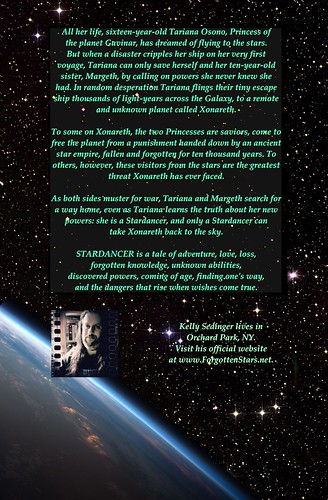
Yes, today is the day. I’ll have more to say later on, but for now: Stardancer is now available for purchase on Amazon.com.
Currently the book is available in print only, but the Kindle e-version will follow in two or three weeks (more likely two), with other platforms to follow once any exclusivity periods run out.
As I say, more later.
For now, STARDANCER is available for purchase!!!
Share This Post
Peanuts and Cracker Jack
So the World Series kicks off tonight. I know, that’s the wrong metaphor. Sorry. I used to be a huge baseball fan, and I still find the game itself utterly beautiful to watch unfold, a game of moments where things happen one thing at a time. Baseball may be the last major sport that isn’t a constant flow of motion. As for rooting interests, as the League Championship Series started in each league, I noticed that of those four teams, none were a team I dislike in any major way. Generally, my approach in such cases is this: when there are no teams left for whom I have a rooting interest (be it rooting for a team to win or for a hated team to lose), I root for the remaining teams in order of how long it’s been since they won. In the AL you had the Orioles versus the Royals, whose last World Series wins were in 1983 and 1985, respectively. The Royals haven’t even made the postseason since then. (The Orioles have, but have not won any pennants.) As for the NL, it was the Cardinals and Giants, two teams who have each won it at least twice in the last few years. So no matter who won the AL pennant, I would root for the AL champion in the World Series. Hence, go Royals!
The remainder of this post is a book review. My sports fandom is nowhere near what it once was, and I see little reason to expect it to rebound in any significant way in the future. That said, I do still enjoy good sports writing, and John Feinstein is one of the betters sportswriters out there. He has a new book about baseball, called Where Nobody Knows Your Name: Life in the Minor Leagues of Baseball, and it’s definitely worth a look.
Minor-league baseball is sometimes seen as the more “pure” version of the baseball experience these days, where you can still go to the ballpark and take in a game for a few bucks, where goofball promotions are often used as enticements, where ads for local businesses still cover the outfield walls, where players still endure long bus rides from town to town, and where brushes with true baseball celebrity come mainly from young phenom players or Major Leaguers sent down to the minors to work their way back into the game after an injury.
Feinstein’s portrait of the minors has all that, but he also captures something that a lot of fans may not come to realize: that the minors are, in addition to being a training ground for guys not yet ready for the Majors, a place of frustration. The fact is, especially at the AAA level, nobody wants to be there. This is a fact that everyone must acknowledge, and some managers come right out and say it. Nobody wants to be in AAA baseball, because AAA is the cusp of the Majors. When you’re in AAA, your dream is almost there, constantly tantalizing you and torturing you with every single injury with the big club, with every time the manager’s phone rings, with every invitation to spring training. Triple-A baseball is a land of players who are this close. For some, it’s just a brief spot, while for others, it’s a place to spend years without ever getting to “the show”.
Feinstein focuses his book mostly on just nine men: six players, two managers, and one umpire. Some have made it and will make it back; others haven’t made it yet; some have made it and will never make it back. The central fact of this book is that while dreams do come true, they don’t always stay true. It’s a hard lesson for some of these players, and it’s very easy to understand why they keep signing up for one more year, why they keep trying to catch on someplace, even as they pass their 30th birthdays and start approaching their 40th.
It’s interesting to me, as well, that Feinstein includes an umpire in his journey through AAA baseball. Fans don’t think too much about umpires, really, and the only time their names really come up is when they screw up. If a baseball fan knows Don Denkinger’s name, it’s almost certainly because he blew a call in a World Series game; and even then, it’s not like umpire’s names stay in the memory for long. I couldn’t tell you the name of the umpire who screwed up a call a couple years back that cost a pitcher a perfect game on what should have been the final out. (For the record, I still think that MLB should have reversed the call and credited that guy with the perfect game. The idea that umpire’s calls are sacred and must never be changed, ever ever ever, is deeply bizarre to me.) Umpires work their way through the minors just like players do, hoping for that call to become an umpire at the Major League level. What I didn’t know is that umpires’ time is limited even more than players. A player can stay in the minors as long as some organization is willing to have him, but not so an umpire: you only get so many years, and if by that time the people who choose the Major League umpires don’t think you have it, that’s it: you’re done. There are no career minor league umpires.
I was likewise surprised at the degree to which winning isn’t much of a concern in the minors. They like to win, but winning is mainly seen as a function of playing well, and playing well is seen as the means to the end of reaching the Majors. Feinstein depicts the feel of a championship-winning minor league clubhouse as a pretty surreal place. It’s an accomplishment that nobody much gives a shit about. This reminds me of the great movie Bull Durham, which spans an entire season and yet except for one brief segment in the middle of the movie, you get almost no sense for how the team’s doing in the standings. No one cares. All that matters is who gets the call to go up, and who gets the call to go home.
Minor leaguers, it turns out, put up with a lot of crap. They’ll fly with their team in the morning to a new city for a day game, only to be told as soon as they plane lands that the big club needs an arm for that night’s game, so they’re to turn around and get on another plane entirely. Mets pitcher Chris Schwinden, for example, got a call up to join the Mets in Toronto. After sitting in the bullpen, he flies with the team to Pittsburgh, where he’s told that he’s been sent back down already, so he has to turn around and get to Buffalo. At this point in the night, a direct flight from Pittsburgh to Buffalo isn’t available, so they fly him to JFK, where he’s supposed to catch a flight to Buffalo. That plane is delayed for two hours, so the team sends a car to drive him from NYC to Buffalo. After a series of mechanical mishaps with the car, Schwinden finally gets back to Buffalo eighteen hours after leaving Pittsburgh. This whole passage had me laughing, because you can drive from Pittsburgh to Buffalo in less than four hours.
Feinstein is an honest sportwriter, which means that he can’t just depict baseball’s poetic and pastoral beauty. Baseball keeps going, and as big as some players get, there is no player so big that the game can’t keep being played once they hang up their cleats. Throughout the book, Feinstein makes clear that each and every person is aware that they are just minor cogs in the game’s history and that the game will go on without them when they’re done, almost as if they were never a part of it at all. At times this aspect of baseball can be bluntly heartless: near the end, when the umpire is finally told that he simply isn’t good enough and that his career is over, one reason given is the time he has missed from umpiring. How much time did he miss? Two weeks once, for the birth of his own child, and two days one other time, so he could attend an uncle’s funeral. That’s pretty brutal.
The emotions go the other way, though, and Feinstein shows this as well in many passages. Why do these players work so hard to chase a dream that few will ever get, for whom the odds get smaller with each year? This passage, from the introduction, explains it perfectly.
Every player knows how much the first call-up means. Which is why there is almost always a celebration of some kind in a Triple-A clubhouse when someone gets the call for the first time. Everyone understands what an extraordinary moment it is in a player’s life. Those who have been called up remember what it meant to them; those who have not know how much they want it to happen.
J.C. Boscan’s story isn’t quite the same as Jimmy Morris’s, because he never stopped playing. He signed with the Atlanta Braves in the summer of 1996 at the age of sixteen and spent the next fourteen seasons bouncing around the minor leagues. He first reached Triple-A in 2002 but couldn’t take the next step, because, even though he was a solid catcher, he just couldn’t hit well enough to be regarded as a serious big-league prospect.
He left the Braves for a couple of years to play Double-A and Triple-A for the Milwaukee Brewers and the Cincinnati Reds. He signed back with the Braves in 2008, because the people running the organization had so much respect for him as a clubhouse leader and someone who would set a good example for younger players that they were willing to bring him back – knowing he was unlikely to ever play in Atlanta.
Two years later, playing in Gwinnett, he had his best offensive season. Nothing spectacular, but a career-high five home runs and a batting average of .250 – higher than his lifetime average of .222. Late in August, Boscan began to hear that he might be on the September call-up list.
Every year on September 1, major-league teams can expand their rosters to as many as forty players (the regular roster size is twenty-five). Rarely do they bring up more than five or six players. Those who are brought up usually provide depth in the bullpen or on the bench of are young players being given a taste of the major leagues. Every once in a while, a team will give a player a “good guy promotion” – bring him up so he can make major-league pay for a month as a reward for being a good guy and not complaining about being stuck in the minor leagues.
Boscan had been in the minors for fourteen years and had never seen the inside of a big-league clubhouse except during spring training. At thirty, he was a long way from being the bright-eyed teenage prospect the Braves had brought to the United States from Venezuela in 1997.
On August 31, the word in the Gwinnett clubhouse was that the Braves were going to make their call-ups after the game. Boscan remembers being more nervous that night than at any other time in his career.
“I walked on the field that night, and all I could think was, ‘If I don’t get the call tonight, it’s never going to come,'” he remembered. “I honestly thought this was my last shot and my best shot to ever get to the majors. I could barely keep my mind on the game. All I could think about was what was going to happen after it was over. I was praying to God to let this be my time.”
When the game ended, Boscan sat in front of his locker and picked at the postgame meal. Hitting coach Jamie Dismuke had been designated by manager Dave Brundage to bring players into his office so they could be told they were going to make the thirty-seven-mile trip down I-85 to Turner Field. As Dismuke worked his way around the clubhouse, that thirty-seven miles felt more like a million to Boscan.
The first player called in was Freddie Freeman, the twenty-year-old phenom, who was hitting .319 and was considered a lock call-up. He came out of Brundage’s office with a huge smile on his face and was engulfed in congratulations.
Dismuke continued his rounds. One player after another walked around the corner to Brundage’s office and came out wearing the giveaway grin. The congratulations continued. No one had made a move to leave because this was a happy night – for those going up.
Six players had gone in to see Brundage – entering as Gwinnett Braves and coming out as Atlanta Braves – and there was no sign of Dismuke for a couple of minutes. Boscan’s heart sank. That was it – six guys. His dream had died.
Dismuke appeared again, this time walking directly toward Boscan.
“Skip wants to see you, J.C.,” he said. He wasn’t smiling. Boscan panicked. Maybe Brundage had gotten the good news out of the way first, and now he was going to let Boscan know that the team needed him in Double-A to work with a young catcher. Or, maybe he was being released.
Brundage was, in fact, preparing that kind of speech for Boscan. “I was going to look very sad and tell him that sometimes things don’t turn out the way you want them to in baseball,” he said. “But when he walked in here, he was shaking. I couldn’t go through with it.”
The entire Gwinnett staff was in the room when Boscan walked in.
“Have a seat, JC,” Brundage said, trying to look grim.
Boscan sat on the couch across from Brundage’s desk.
“You ever been to the big leagues?” he asked – knowing the answer.
“No,” Boscan said, shaking his head.
Brundage couldn’t keep up the charade.
“I was going to mess with you, JC, but I can’t do it,” he said, feeling himself start to choke up. “This is your day. You’re going up.”
Boscan burst into tears. Everyone else in the room was fighting to hold tears back.
“I’ve been a minor-league manager a long time,” Brundage said. “I can honestly say that was the best moment I’ve ever had.”
After Boscan had thanked everyone and shaken everyone’s hand and been hugged all around, he walked out of the office. Brundage’s office is in a hallway that leads to the clubhouse area where the players’ lockers are located. When Boscan turned the corner to reenter the locker area, the entire team was waiting for him.
Feinstein doesn’t reveal what became of JC Boscan after he finally reached the Major Leagues after fourteen years of minor-league toil, because that’s really not the point of his book at all. But I couldn’t help wondering, so I looked it up. That’s the thing about baseball: you can always look it up. He only had one plate appearance with the Braves that fall, in which he drew a walk to load the bases; he would then score a run when a subsequent hitter doubled. Over the next two seasons with the Braves and then one season with the Cubs, he appeared in a total of 17 Major-League games, collecting 7 hits in 28 at-bats, for a .250 average. He has 2 career RBIs, and zero home runs. After the 2013 season he signed with the Dodgers organization, and he’s still there, playing Double-A ball with the Chattanooga Lookouts.
Baseball abides, man.