In Memoriam 9-11-01: “The City of Dead Works” and “Elegy”

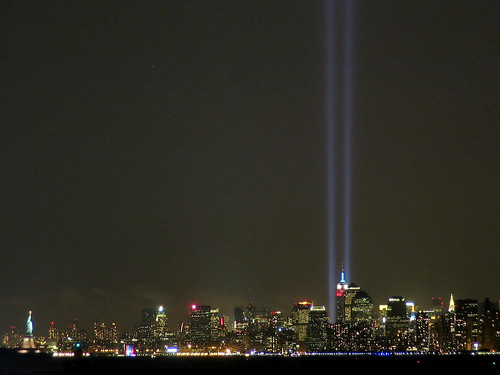
Tribute in Light, 9/11/03

I re-post this every year on this date. It is the first piece of fiction I wrote after the awful events of 9-11-01.

“The City of Dead Works”

There is never any rest for me, the Ferryman of the Dead.

I pole my barge across the black waters and up to the pier. So many wait this time, many more than usual. I wonder what has happened, what event has sent me this many. “Come aboard,” I say. “I will take your coin for passage.” One by one they file past me, each handing to me the coin that they never knew they had. It is the coin which determines where they shall be taken to rest, its metal shaped and determined by life. The coins of these dead are gold, every one of them purest gold. Six thousand come aboard my barge, and each has passage for the farthest and greatest of destinations. In that moment I know that something truly dark has happened; the gold coins are always forged in moments of darkness. I am the Ferryman. I can give them no answers to what lies behind their haunted, questioning eyes. I can only take them on this, the last of all journeys.

When they are all aboard I take up the pole and push away from the pier. The barge always feels the same, no matter how many stand upon its decks. Whether six or six thousand, it is all the same to me. I guide us out onto the River Styx. Some of the people look worried, but there is no need for fear. This river can do them no harm. They are already dead.

This is to be a long journey, I know – it always is, to this destination. As I guide the barge through the black waters, I look on the faces of those who have come to me. As different as these people all look, they all have the same expressions of shock, disbelief, and withering sadness. Here is a man of business, talking into a cell phone. He is trying to call someone, anyone, who will tell him that it’s all a dream, that it didn’t happen, that he didn’t die in a blast of fire, smoke, glass and steel. There is a mother who is explaining to her daughter that they won’t be going to Disneyland after all. And there, a group of firemen stand together, realizing that soon they will meet all their brothers-in-arms who have gone into the infernos before them. So many now – colleagues once in business and now colleagues in death, people who have never before met but now have the gravest thing in common. As the current takes hold, I look back at the pier. There are more gathering there. There are always more. They will wait. Time does not exist for the dead.

“Please,” a young man says as he turns to me, “I have to go home to my daughters.”

“You are going home now,” I reply. “To the home where all eventually return.” Two black rocks slide past on either side, the rocks that mark the passage of the circling Styx.

“This can’t be,” a woman cries out. “My mother needs me.”

“She will be with you soon enough.”

“When?” Her voice pleads, and yet there is no solace that is mine to give.

“I cannot say,” I reply. “The Ferryman has no hand in Fate.”

The tears come then, tears from the six thousand that run over the gunwales and into the river which has been fed by tears for centuries. All tears are born in the River Styx.

“Where will you take us?” someone asks.

“To the place you are promised,” I answer. I recall the words of a poet: Will there be beds for all who seek? Yea, beds for all who come.

One our left we approach the Hills of the Damned, an endless stretch of shattered lands which reach away into the blackness. The waters echo with the cries of all those who have been taken to the Hills for the agony they have brought on the living. I consider the bag of six thousand gold coins, and I realize that I will have to journey to the Hills this day. There will be a person, perhaps more, who will pay me with a coin of black tin; but not on this journey. As the hills recede behind us, the unending cries of the damned become fainter and fainter until they are drowned out by the lapping of the waters upon the sides of the boat and the marker stones that we pass. The six thousand fall silent, each realizing that it is not a dream. I would offer solace, but as ever I cannot. I am the Ferryman.

We come around a particularly dark bend, and before us lies a very wide expanse of water, as if the Styx has become an ocean – which in some sense it probably has. And beyond that expanse are the thousands of twinkling lights that I have come to know so well. One man, a fireman, sees them too. “What is that?” he asks.

“It is the City of Dead Works,” I reply. The lights of the city glow on the horizon, and every one of the six thousand turns toward them as the Styx impels us onward. As we come ever closer to the city, the glittering lights reflect off the black water.

“I don’t understand,” someone else says. “The City of Dead Works?”

“Aye,” I reply. “Behold!”

From behind us, golden light: the Sun of the Dead is rising as it always does when the dead come near the City. Above us the firmament is turning purple, then blue; soon the light of the Sun will illuminate the City of Dead Works. As the sky lightens, the true scope of that city becomes plain: it stretches away into the land, farther than any eye could see. Not even the highest-soaring raven, cavorting in the breezes and zephyrs of the dead, could take it all in. It is bigger by far than any one city ever built by the hand of men, because it encompasses some part of all of them. Perhaps it is bigger than all of the cities ever built. Now the sun’s first rays come up behind us, and the first buildings can be seen down by the water.

“That one looks Egyptian,” a woman says.

“The Great Library of Alexandria,” I tell her. “Once the greatest repository of learning the world had ever seen, now only a memory to the living and a reality only to the dead.”

A man points to a building high upon a rock. I nod.

“The Temple of Solomon,” I say.

“There are ships in the harbor,” says another. Thus for him I name the ships: Arizona, Indianapolis, Lusitania, Bismarck, Wilhelm Gustloff, Cap Arcona. And many, many others. I scan over the impossibly vast city and spot Dresden, as it was; and beside it the cities of Hiroshima and Nagasaki. And how many smaller villages, tucked into the hills beyond the City? None can say. The Sun of the Dead shines upon those hills now, and the great stone statues in the likeness of Siddhartha Gautama.

“I don’t understand,” a young man says. “Why this City? Why here?”

I only shake my head as we continue to float by the City. I do not point out the fairly small, nondescript office building that sits near the water. It is not a particularly remarkable building; nor was it, really, until the fuse was lit. The six thousand almost don’t recognize it.

Almost.

Not one word is uttered as we slide past the Alfred Murrah Federal Building. Then we turn away from the City of Dead Works, and head again down the waters of the Styx toward distant hills and the place where these people will join their brethren.

“Who lives in that city?” It is a priest in a fireman’s coat.

“No one lives there,” I tell him. “The City of Dead Works is not for people. It is for the buildings and the ships. It is for the books and the music, the sculptures and the paintings which are gone forever. It is for everything destroyed by craven people in the name of foolish wars, for everything judged forfeit in the face of transitory desires.”

The Styx takes us into the Golden Hills. Soon we will be there, and the six thousand will go where they belong. And then the Styx will complete its circle, taking me back to the pier where more dead await.

“We will be there soon,” I say. “Soon we will be at the Elysian Fields, where all heroes go – for that is what you all are. It is what you have bought with your lives, with the shaping of your coins into gold.” No one replies. We near the last bend now, and before us lie the Elysian Fields, where peace reigns and where heroes dwell; where all is light and voices are always raised in song. The Sun of the Dead shines warmly on Elysium.

But they do not see it. They, the six thousand, all gaze back behind us upon the City of Dead Works. It will soon be behind us forever as we round the last bend of the River Styx into Elysium. I know they all need one last look upon that City, and I do not grudge them that. For myself, I do not look back; the eyes of the Ferryman are ever forward. But I know. I know that the City of Dead Works is different now. I know that it has changed. I know that the people who come with me now to Elysium, the dead around me, look back on the two soaring towers of steel that now rise above the City where there had been no towers before.

I know these things.

I am the Ferryman of the Dead.

Finis

And this, a piece called “Elegy” by Mark Camphouse, is the first piece of music I was able to listen to after that day. It took me three days, if I recall correctly, to feel like music again. This piece has stayed with me ever since I played it in the Wartburg College Concert Band back in 1989-1990, as a freshman. It remains, to this day, for me one of the most profoundly effective musical meditations on grief and death and, ultimately, hope for a better tomorrow that I have ever heard. This performance is by the United States Marine Band. I made the video using images of the World Trade Center and the events of 9-11-01 that I found online.

Share This Post

“The Martians will be us.”

Images of Mars-fall:

Mars Science Laboratory (MSL)

Curiosity Parachute Landing Spotted by NASA Orbiter [detail]

Mars Curiosity Rover Landing Broadcast at Times Square, Earth

Mars Curiosity Rover Landing Broadcast at Times Square, Earth

Mars Science Laboratory (MSL) (201208050020HQ)

Mars Science Laboratory (MSL) (201208050018HQ)

FLA_397506083EDR_F0010008AUT_04096M_x2sqt-HD

Mars Curiosity


If we were to cut our defense budget by, say, a third, and instead of using that money for tax cuts we were to put every penny of it into our budget for space exploration, I think it would be better for us, maybe later rather than sooner…but not so much later as we might believe.

Share This Post

Is the ‘A’ for ‘Asshole’?

I haven’t been following the whole Chick-Fil-A thing much, because as far as I know, there’s no Chick-Fil-A location anywhere near Casa Jaquandor.

(Actually, I’m not even sure about that. Hold on while I look…nope, nearest one is in Erie, PA, 90 miles away.)

So, apparently the founder of Chick-Fil-A is really really ruh-HEEL-ly against gay marriage. Fine. Lots of people are. But not everyone is the head of a fast food chain, so saying something strongly on one side or the other of a major issue of the day is to invite a boycott.

Of course, supporters who think that gay marriage is icky are all “Chick-Fil-A, boo-yeah!” and encouraging people to eat there. Again, fine and dandy. But then I see this on Facebook:

Ummm…what the hell does a boycott of Chick-Fil-A have to do with the 1st Amendment? The Amendment means that the government won’t censor you. It does not give you a blanket right to say whatever you want with zero consequences. If I say things that anger people, they stop liking me. If I say things that anger The Wife, I sleep on the living room floor (we don’t even own a couch). Imagine the following conversation:

HUSBAND: Why yes, that dress makes you look fat. And the color makes you look jaundiced. And your hair looks like a colony of fire ants did battle on your head with a hive of bees.

WIFE: That’s it, you’re on the couch tonight.

HUSBAND: But…you HAVE to let me say those things! It’s my 1st Amendment right!

Any husband who would say that is being an ass on many, many grounds. So get over it, Chick-Fil-A supporters. No one is trampling on whats-his-name’s 1st Amendment rights. You open your mouth, you take your chances.

(I would, however, consider eating at Chick-Fil-A’s location in Nashua, NH.)

(Besides, if I want waffle fries, I can get a bag from the freezer section at The Store. I don’t need some homophobic fast-food joint to get a waffle-fry fix.)

Share This Post

My only thought on the Colorado Shootings

Actually, this isn’t my only thought on the subject, but it’s the only one that I feel like posting, as my remaining thoughts are conflicted, given my longstanding general support of Second Amendment rights (although I don’t rise nearly to the belief, widespread though it seems to be, that the Second enshrines the most important of all rights by a towering margin — in fact, I’m not even convinced that the Second Amendment even says what most people think it says) and my equally longstanding squeamishness when it comes to guns (in short, I’ve never fired one, never held one, and want no part of either).

But anyway, whenever something like this happens, one meme that pops up a lot is the “If someone in that theater, just one person, was packing a gun, this awful thing might not have happened.” Whenever I read that, I don’t hear it as an argument for more people toting guns. What I hear is this: “If I had been in that theater with my gun, you can bet that I would have taken that guy down!”

Which is, of course, complete nonsense. From everything I’ve ever read and learned about these things, this stuff is hard. It’s hard even for military sharpshooters to do their job, even with tons of training that Joe Blow Sittin’-in-a-dark-theater-with-a-9mm-in-his-pants almost certainly does not have. I would wager that, of all the people in this country with legal carry-and-conceal permits, the percent of those who would be able to do something with their gun in that situation other than just contribute to the chaos with more bullets flying around is vanishingly small.

One lunatic blasting away is bad enough. Throw in a few pseudo-Rambo’s? Ugh.

Share This Post

When in the course of human events (repost)

This is a repost from July 4, one year ago today. Happy birthday, America!

Here’s a really weird story. It’s so weird, I’m not sure the historians didn’t make it up out of whole cloth. It seems that around 235 years ago or so, some folks living in a place under the rule of a King decided that they didn’t much like the way that King was ruling them. At all. They pretty much decided, en masse, that their King was behaving, to use a current term, like a douche.

Now, over the many centuries before these folks came along, lots of other folks in other lands have decided that their Kings and Queens were being douchey, so they came up with ways to replace them. They’d organize revolts, usually behind the banner of some obscure relative of the monarch’s so they could say that their person has a better claim to the throne, and off they’d go. So you’d expect that the folks we’re talking about here would have just said, “You know what? Our King is a douche. Let’s replace him with a new King.”

But these folks didn’t say that. What they said was, “Not only does our King suck, but he sucks so much that we’re now thinking maybe we won’t even have any more Kings. We’ll do it all ourselves.”

Over a year or so, there were some battles and skirmishes between these folks and the troops sent by the King to put down the pesky rebels, but it didn’t work, and that notion — “No more Kings and Queens!” — took hold. It became a really popular idea, so finally, these folks appointed some representatives to gather in one of their cities and talk these issues over. The conversation went like this:

GUY #1: So, we’re all agreed then? Kings suck?

GUY #2: Yes, Verily, they suck.

GUY #1: OK, so what do we do?

GUY #3: Well, we’re already fighting, so we just keep fighting. But we should probably tell the King that we’re being serious and we’re not just a bunch of rabble-rousers here.

GUY #1: Right! How do we do that?

GUY #4: How ’bout a letter? I’ve got some nice parchment, quills, and a new bottle of ink.

GUY #2: Good idea! But you’re about as eloquent as my cow. You’ll just write “Hey King, sod off” and be done with it. We should be a bit more poetic about it.

GUY #4: How about Tom? He’s pretty poetic.

GUY #1: Good idea! Let Tom do it. Now where’s that Adams guy with the beer?

So a guy named Tom wrote the King a sternly-worded letter. It was pretty wordy, given the standards of the time, so here’s a paraphrase:

Dear King,

We the undersigned, being representatives of the people of your colonies, have collectively decided that you are a douche and we don’t want to live under your rule anymore. Furthermore, we’re going to come up with a government of our own that won’t even have a King. Now, we’ve just called you a douche, so you’re probably thinking that we should be kind enough to at least tell you all the reasons we have for thinking you’re a douche, so there’s a list of those reasons later on. For now, suffice it to say that we believe in Life, Liberty and the Pursuit of Happiness. And you don’t. And since we like the whole Life and Liberty thing a lot more than we like you, we’re gonna take those and let you do whatever it is you do with your time in that Palace of yours.

So, here’s the list of ways you’ve pissed us off. Note how long it is. You don’t have to be a douche, you know.

…

See? Really, dude. There’s no reason for some of that stuff, right? So anyway, have a good life and all. You’ve still got your island, and Canada seems pretty happy with you for some reason (but really, they’re weird folks to begin with, what with that odd game they like to play on ice). But we’re out of here.

Signed,
All the guys present

PS: Could you make sure your soldiers always wear those bright red coats? It makes it really easy to see ’em in the forests. KTHXBAI.

And so it came to pass that after some years of war, and some further years of cruddy government, they all got together again and figured out how they wanted to set up their new, “No Kings!” government. Their notion was to spread power out amongst a bunch of folks who were accountable to the people, and to further make sure that their government was required to respect certain rights that couldn’t be taken away. It was a really weird idea…and yet, these folks worked hard to make it work, and their children kept working hard to make it work, and their children kept at it, and so on and so on and son on, until today.

Does it still work? Sometimes yes, sometimes not so much. But we’re still here, and we’re still working at it.

So Happy Birthday, United States of America! You’re a wonderful, weird, beautiful, maddening, and awesome country.

(Hey! Uncle George is in there!)


Share This Post

Every building’s sacred….

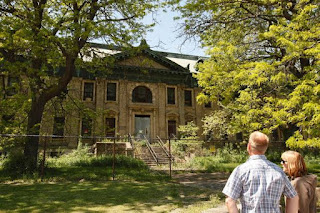
So they want to tear down this building:

That’s the old Bethlehem Steel headquarters building in Buffalo. It’s quite an attractive structure. The problem is that it’s been unoccupied for more than thirty years. And what’s more, it’s not exactly in a great location.

That’s the building,  way up in the upper right hand corner. Note that it’s not surrounded by a larger business district or neighborhood; no, this building basically sits on an enormous brownfield that takes up a huge portion of the Buffalo and Lackawanna waterfronts. Bethlehem Steel closed up shop here more than three decades ago, and this building has been empty, unused, and unmaintained in all that time. Now, the city of Lackwanna wants to demolish it.

Enter…as always…the Preservationists.

Here in Buffalo-Niagara, we have a large and vocal contingent of people who are awfully well-meaning, but their main goal seems to be to mobilize anew each time some old building is ‘threatened’. The refrain always comes: Save the building, it’s a part of our heritage, re-use it, et cetera. The odd thing is that this ‘mobilize for the newly threatened building’ approach seems to be the main way of operating; you don’t hear much about pursuing public policies that might make preservation preferable to demolition.

The main problem is that all this preserving ends up contributing to the already uphill battle this region tends to face every time it courts a new business or entertains the growth of an old one, and for me, it’s come to the point where the mobilization of the preservationists just makes me wince every single time. The last few years, my family and I have taken brief trips to other cities in the spring, and it’s always eye-popping to me to see the degree to which other cities are rebuilding and reenergizing and reinventing, even in this economy. But not us. Not Buffalo. Here, we treat every building as though it’s the very place in which George Washington took the oath of office while baptizing Abraham Lincoln and punching Adolf Hitler in the jaw. So much of the ‘historical significance’ seems to often boil down to ‘A successful business stood here for a long time before it either died or went away and nobody since then has had enough money to do something with this building so here it sits, beloved for simply existing.’

Here’s a good example of the foolishness that the preservation instinct around here can lead to. This is the Blue Cross/Blue Shield building in downtown Buffalo. It was erected just a few years ago.

See that odd-looking stone facade at the front of the building? For many years, this entire lot was completely vacant, except for that facade. That was it. Just the facade, no building behind it: a stone facade and a big empty lot, right at downtown’s front door. So when local health insurance company Blue Cross-Blue Shield bought the lot and built their building there, they for some unfathomable reason incorporated that facade into their building in a way that doesn’t ‘incorporate’ at all — it just basically duct-tapes the facade to the building. Every time I drive by there, I think, “That is one of the dumbest looking buildings anywhere.”

Are there great old buildings worth keeping in Buffalo? Sure…but I’m sick of the way we go about it. Just as I’m generally sick of the way Buffalo goes about everything. While other cities rebuild and grow and keep a little bit of heritage while they move into the century we’re living in, Buffalo remains the cruddy hovel in a Monty Python sketch.

Which brings me to this. It’s to be sung to the tune of…well, any Monty Python fan ought to be able to figure it out.

We’ve got tons of old buildings in Buffalo,
Brick buildings, stone buildings and more;
And almost all of those buildings were
built back in days of yore!

Yup, we got lots of old places,
they’ve been empty since before you were born,
but we still think that they’re pretty awesome,
like empty towers once full of corn!

It might bug you that they are crumbling,
and you might want to build something new,
but don’t even think about demo,
‘cause if you try it we’ll sue!

Be-cause….

Every brick is sacred,
Every building’s grand;
We’ll fight to keep them standing,
‘Til they turn to sand!

We love old Greek ruins,
crumbling on fields brown;
And we want that look for
our aging, rusting town!

Let Milwaukee build things;
Pittsburgh, itself renew;
We’ll stick with closed fact’ries,
And warehouses too.

Shuttered buildings thrill us,
new ones make us mad!
Though they’re forever empty,
the old ones make us glad!

So stop the demolitions;
our plan, we must endorse!
Though soon, no one will live here,
And things will take their course.

Every building’s sacred,
and hist’ry makes them great;
And if you try to wreck one,
we’ll all be quite irate!

(Apologies to Cleese, Chapman, Gillian, Jones, Palin, and Idle.)

Share This Post

Copyright Math

I really need to watch TED talks more often. Here, science fiction author Robert Reid delves a little into the mathematical claims of the movie and music industries when they rail against piracy.


I always love when big numbers are thrown about, and no one questions them at all. I remember the Direct Marketing Association’s fierce opposition to the Federal Do Not Call List, on the basis that it would cost the economy something like two million jobs. A job hit of that magnitude, at once, would be an economic calamity of historic proportions, but that number just sat out there. Weird, huh?

Share This Post

I hate casinos

Yeah, that’s pretty blunt, but there it is: I can’t stand casinos. I don’t understand the appeal at all. I mean, I understand once I find myself inside one. It’s hard to resist all those flashing lights and cheering people and the way the casinos make you go up and down and in and out in an effort to make you forget the existence of an outside world; all the better to put you in the mood to lose your money. But in general, I have no desire to spend time in a casino, I never consider going to one when I’m looking for something to do, and I’m totally baffled by people I know who love to spend entire weekends at “the casino”. It’s just something I don’t get.

But casinos can be awesome settings for amazingly cool stories, can’t they, and not just fictional stories. Check out this amazing tale of a guy who took three different Atlantic City casinos for $16,000,000. And he did it straight-up. No card-counting here (although to be honest, I’m not sure why card-counting is considered ‘cheating’, unless ‘cheating’ is defined as ‘doing anything whatsoever to increase one’s odds over the house’s’): he beat them fair and square, and fascinatingly, the casinos practically invited him to do it.

As Johnson remembers it, the $800,000 hand started with him betting $100,000 and being dealt two eights. If a player is dealt two of a kind, he can choose to “split” the hand, which means he can play each of the cards as a separate hand and ask for two more cards, in effect doubling his bet. That’s what Johnson did. His next two cards, surprisingly, were also both eights, so he split each again. Getting four cards of the same number in a row doesn’t happen often, but it does happen. Johnson says he was once dealt six consecutive aces at the Mohegan Sun casino in Connecticut. He was now playing four hands, each consisting of a single eight-card, with $400,000 in the balance.

He was neither nervous nor excited. Johnson plays a long game, so the ups and downs of individual hands, even big swings like this one, don’t matter that much to him. He is a veteran player. Little interferes with his concentration. He doesn’t get rattled. With him, it’s all about the math, and he knows it cold. Whenever the racily clad cocktail waitress wandered in with a fresh whiskey and Diet Coke, he took it from the tray.

The house’s hand showed an upturned five. Arrayed on the table before him were the four eights. He was allowed to double down—to double his bet—on any hand, so when he was dealt a three on the first of his hands, he doubled his bet on that one, to $200,000. When his second hand was dealt a two, he doubled down on that, too. When he was dealt a three and a two on the next two hands, he says, he doubled down on those, for a total wager of $800,000.

It was the dealer’s turn. He drew a 10, so the two cards he was showing totaled 15. Johnson called the game—in essence, betting that the dealer’s down card was a seven or higher, which would push his hand over 21. This was a good bet: since all face cards are worth 10, the deck holds more high cards than low. When the dealer turned over the house’s down card, it was a 10, busting him. Johnson won all four hands.

Johnson didn’t celebrate. He didn’t even pause. As another skyscraper of chips was pushed into his skyline, he signaled for the next hand. He was just getting started.

Absolutely fascinating.

Share This Post

Can we have ACORN back now?

Politics below the fold….

SamuraiFrog on Andrew Breitbart:

I wonder if even half of the conservative bloggers who are aghast and dismayed at the number of tweets celebrating Breitbart’s death called for the same kind of respect for the dead they’re calling for now when Ted Kennedy died. I know Breitbart wasn’t. He was on Twitter showing the same lack of decorum and being the same kind of asshat conservatives are whining about right now.

I’m not celebrating the death of Andrew Breitbart, but I’m not going to miss this guy, either. I didn’t know him personally, and I’m sorry that people who did and who liked and loved him lost someone they were close to. He leaves a wife and kids behind, and that’s tragic.

But he also leaves behind a legacy of public hatred. He leaves behind a Twitter page that is 8% conservative talking points, 2% chortling with glee over the pain of Occupy protesters, and 90% answering every hate tweet he gets with more hate. Andrew Breitbart created a lot of hate in this world: his legacy is insults, divisiveness, anger, lies, and hypocrisy.

So I’m not going to mourn the guy. I’m not even going to feel bad that he’s dead. I’m not going to say that the world is smaller because we lost an important conservative voice and all that nonsense, because I never considered him an important conservative voice, just a loud one. One who made it his life’s work to destroy progressives, misrepresent them, ridicule them into silence, and call them terrorists. If you’re a progressive or a liberal, how losing that is something to mourn, I don’t know.

I couldn’t agree more. I see no reason to eulogize Andrew Breitbart. If I’m loath to claim that the world is better without him, I certainly don’t see that the world was a better place with him.

Share This Post

Stop SOPA

Would I be able to write this blog in a world where the Internet is governed by SOPA? I honestly don’t know. I strongly suspect that I would, but it would be a lot less interesting. I also strongly suspect that a good many posts here wouldn’t be possible, and that a good many things I’ve done in this space would result in this blog being ‘blacked out’ because of dreaded ‘piracy’.

Stop this bill. The Web is too important to be hobbled in this way. We’ve already burned the Library of Alexandria once. Let’s not do anything like that again!

Share This Post