Nine Score and One Year ago….

March 4 was the original date mandated by the US Constitution for the commencement of Presidential terms, which means that March 4 was Inauguration Day. This was later changed with the 20th Amendment, which moved the Presidential term of office’s beginning to noon on January 20, and there it has remained ever since.

This means that today is the 181st anniversary of perhaps the most infamous of Inaugural ceremonies (well, prior to the one that unfolded on January 20, 2017, that is). I’m talking about the swearing in of President William Henry Harrison.

President William Henry Harrison. His legacy, unfortunately, lives on mostly as the answer to questions in Trivial Pursuit and JEOPARDY!.

President Harrison was the paternal grandfather of a later President, Benjamin Harrison, and he was also the last President born initially as a subject to the British Empire. Until Ronald Reagan, Harrison was the oldest man ever elected President. But what happened at that inauguration on March 4, 1841 that was so infamous?

He gave the longest Inaugural Address in history. It was over 8000 words long, it took him two hours to deliver, and he refused to dress warmly for the weather, which was cold and damp.

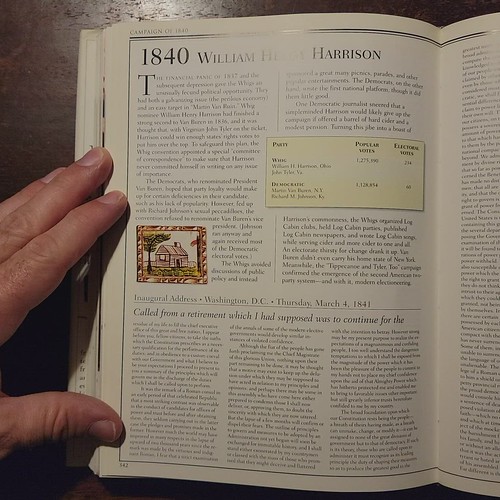
I own a book of Presidential history that includes the texts of all the Inaugural addresses (up to, I think, Barack Obama’s first), and here’s the text of President Harrison’s speech:

20220304_064109

Imagine standing there for two hours in wet cold drizzle listening to this! Imagine standing there for two hours in wet cold drizzle, with no overcoat, delivering this speech! A stemwinder, it ain’t.

And from this, Harrison went on to a very long (three hour) parade, and then he attended Inaugural Balls late into the night. So of course…he caught cold.

The cold became pneumonia.

President Harrison became, one month later, the first President to die in office. This resulted in a Constitutional crisis because the Founding Fathers hadn’t specified exactly how presidential succession, outside of an election, was supposed to work. (Quite honestly, there’s really way too much ambiguity in our nation’s founding documents for me to worship the guys who wrote them all that fervently, but that’s just me.)

Harrison’s successor, John Tyler, is also mainly known for being a trivia answer: the first Vice President to become President, a President who was elected to the Confederate Congress later on, and–as of this writing, anyway–a President who was born in 1790 but who, thanks to an apparent habit of men in his line to father children late in life, has a living grandson to this day.

More recently, I noticed several years ago, when I was obsessively listening to Lin-Manuel Miranda’s great musical Hamilton obsessively, that for scansion purposes, “William Henry Harrison” has the same number of syllables as “Alexander Hamilton”! This has led me to try to get Mr. Miranda’s attention on Twitter now and again:

So far, Mr. Miranda has resisted my suggestion…but I know it has to be eating away at him! It just has to!


Share This Post

My current reaction to a certain news item

There’s a thing that might be happening today, or it might not, and absent confirmation by the person who can confirm whether the hoped-for thing is in fact happening today, I will keep my reaction noncommittal. Moreover, everyone acting as if the thing that might be happening today actually is happening today would do well to listen to the wisdom of Mr. Toby Ziegler in this West Wing clip.

Or, failing that, Professor Jones’s wisdom from this scene in Indiana Jones and the Last Crusade:

INDY: Well? We made it!

PROFESSOR JONES: When we’re airborne, with Germany behind us, then I’ll share that sentiment.

Indeed.

Confirmation. I need it!


Share This Post

Something for Thursday

I watched the Blue Origin flight yesterday, in which William Shatner joined three others in the very short up-and-back-again space shot yesterday in Jeff Bezos’s interestingly-shaped spacecraft. I have to admit to a certain amount of cynicism as I’ve watched the breathless reactions in recent years to the achievements of a tiny handful of ultra-wealthy white men who have apparently decided that the best thing to do with their vast sums of money, sums that it seems to me a sane society would make it impossible to accumulate in the first place, is to replicate things that the United States government did sixty years ago.

I don’t even mind, really, that this is the way it’s shaping up. The really ground-breaking stuff, the envelope-pushing stuff, needs to be done at the government level, because that’s still the level that can operate in the amounts of capital needed to do the experimental work. If the rich then want to test the waters that have already been explored, that’s great. And that’s what’s been happening…only with a sense of worship about what the Bezoses and the Elon Musks of the world have been accomplishing. I’ve even heard it suggested that maybe now we can just do without NASA entirely, get government out of the space game, and let “Private enterprise” or “the Free Market” or “capitalism” get about the work of really making space exploration happen.

As always, to this I say, “Bollocks.”

But…but!

On the other hand…a spaceship launched yesterday, and it blasted a capsule into space. Then the launching craft didn’t just tumble back to earth to be swallowed by the sea; it fired its thrusters again, extended four landing legs, and landed right where it started. Meanwhile the capsule completed its trajectory, entered space, arced back down, and parachuted back to earth.

The passengers (I trouble to call them “astronauts”, in all honesty) climbed out then. Three of them hugged and high-fived and cheered and hooted and hollered and sprayed each other with champagne. But the fourth? He, Mr. Shatner of Star Trek (and others) fame, stood off to one side, as if gathering his emotions. This flight had moved him deeply; you could see it in the way he stood. Then he started talking, and said, among other things:

“I mean, the little things, the weightlessness, and to see the blue color whip by and now you’re staring into blackness. That’s the thing. This covering of blue is this sheet, this blanket, this comforter of blue around that we have around us. We think ‘oh, that’s blue sky’ and suddenly you shoot through it all of a sudden, like you whip a sheet off you when you’re asleep, and you’re looking into blackness – into black ugliness. And you look down, there’s the blue down there, and the black up there, and there is Mother Earth and comfort and – is there death? Is that the way death is?”

Look, I can be as cynical as anyone about rich people and them treating space like it’s their playground and ignoring the problems of the world and the fact that they profit greatly on some pretty nasty labor practices. But…there’s still space! My heart will never not thrill to a rocket ship blasting away from Earth, or to space passengers disembarking their spacecraft after returning to Earth. And I will never not be moved to hear those returning to Earth talking about the planet’s blue blanket.

Great human achievements are never just so…but they are still great.

Oh yeah, this is supposed to have some music, isn’t it? It’s a Something for Thursday post. Here’s a suite from Bill Conti’s score to The Right Stuff.

https://www.youtube.com/watch?v=tCblQ_fnPpc

Share This Post

Twenty Years

 I thought about writing a long remembrance of that horrible day, a walk-through of the weird mix of terror and business-as-usual that played out in the office where I was working at the time. I just…don’t want to do that.

I remember that for several days after I tried listening to music, and I just…couldn’t. It took, I think, until Friday when I was finally ready to listen to something. I chose one of the most emotional pieces of music I know, a work I played in my freshman year of college. It seemed, in terms of mood and title, appropriate: Elegy, by composer Mark Camphouse.

It was the saddest day I can remember as an American, and it’s even sadder now in retrospect as we went forth from that day and proceeded to learn all the wrong lessons and undertake all the wrong responses.

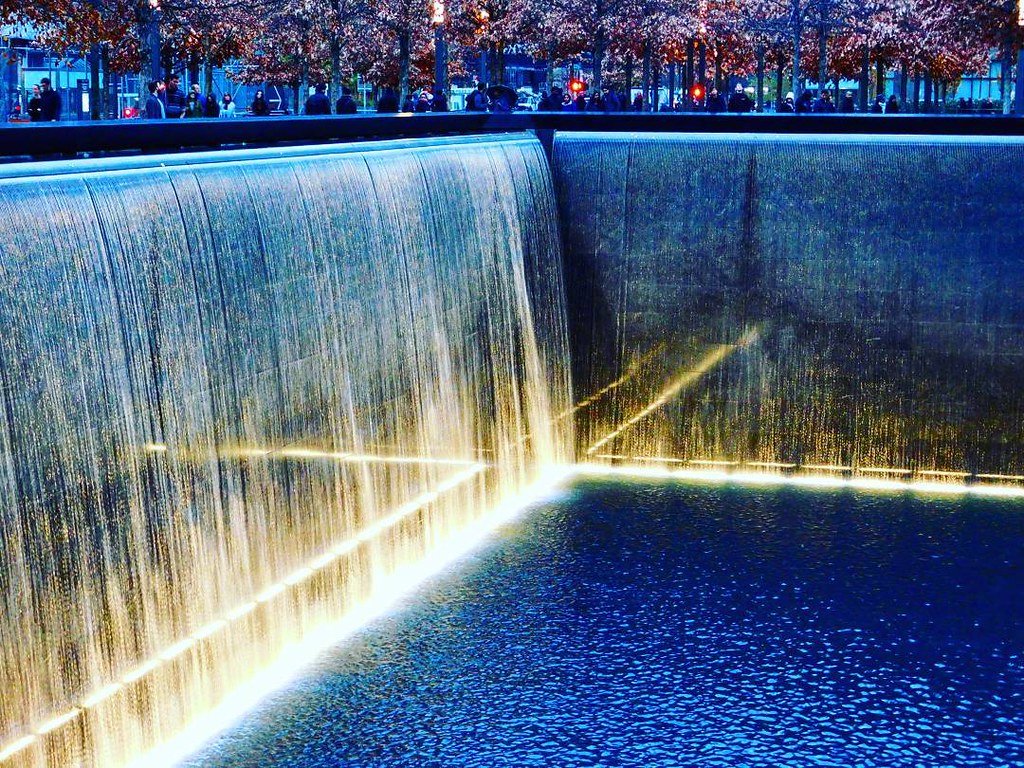
We went to New York City in 2015 for Thanksgiving, and we did go to “Ground Zero”. We weren’t there long, but we did want to see the place where this thing happened. It was a damp, cloudy, cold day…and for the location, somehow very beautiful.

There is always beauty to be found, eventually. I wish America would remember that more. Americans, myself included, are too quick to respond with anger and rage to the ugliness of the world.

I eventually wrote a short story in response to the emotions I was feeling at the time, called “The City of Dead Works”, and I used to post it annually here. I don’t do that anymore, but you can read it here. And please do read Sheila O’Malley’s post about one life that was lost that day.

Share This Post

For the Record

 I support the right to abortion. Moreover, I do not think that anyone who gets an abortion has done anything the least bit morally wrong. I believe that conservatives in America, for all their blather about “freedom”, will keep chipping away at real freedoms until there aren’t any left.

If this is a problem for you, the “Back” button is to your upper left.

And no, I am not interested in debating this.

Share This Post

Happy Birthday…

 …to the person whose influence on my life includes, among many other things, a love of these various musical numbers.

And so many more!

(The person in question is my mother, who turns 80 today!)

Share This Post

Sure, we got a billion bucks lyin’ around someplace

 Looks like the shoe is finally dropping in Buffalo and WNY, regarding the future of the region’s NFL franchise: the team’s owners, Terry and Kim Pegula, are floating the idea of a new stadium to replace the team’s existing venue, which would be publicly funded to the tune of over $1,000,000,000.

Hold on, let me count the zeroes to make sure I have that right…thousand, million, billion. Yup, that’s right.

Newer reports have the team citing possible other locations for the franchise if the stadium doesn’t happen. Locations like Austin, Texas.

My position on this is simple: I am against any public funding for stadiums at all. None. Not one penny.

A sports team is an investment on the part of billionaires that in almost every case ends up making many more billions for those owners. If someone who is worth a billion dollars wants something that costs a billion dollars, well, let them put up their own money for it. The notion that the public should put up the money so the owner can reap further billions is ludicrous.

And don’t come at me with “Stadiums spur development!” and “Stadiums create jobs!” We all know this is complete nonsense. Study after study after study has confirmed it. I live less than a mile from the local stadium, and believe me when I tell you, the area around the stadium is not a hotbed of massive economic development. There’s about half a dozen bars, a convenience store that was a 7-11 once, a Tim Hortons, and one of those really seedy motels where people who, ahem, are required to register their whereabouts and living arrangements with the local constabulary (and whose presence might be communicated to local parents) go to live.

I consider spending a billion dollars on a single project that will literally benefit a small number of people and enhance the profits for literally one family, and I think of things like…local schools. Parks. Water and electrical infrastructure. Libraries. Museums and arts projects. Streetlights. (This last one sounds prosaic, but I think of it every time I drive through another city that has streetlights on its main expressways. Buffalo does not.)

On a larger point, I am sick of living in an economy which is largely organized around the precept that the natural and preferred course of money is ever, ever relentlessly upward. The idea of giving money to people at the bottom of the economic spectrum is seen as socialist nonsense, but the idea of public money being spent in gigantic amounts so that a single married couple can pocket more millions in profits before eventually selling their investment for a gargantuan return is never even questioned.

When sports stadium talk comes up, I think of Atlanta, Georgia. In the early 1990s, an aging facility–Atlanta Fulton County Stadium–served both the NFL’s Atlanta Falcons and MLB’s Atlanta Braves. The state of Georgia funded the building of the Georgia Dome for the Falcons, which opened in 1992, and the Braves got their new park, Turner Field, four years later when the stadium build for the 1996 Summer Olympics was converted to ballpark status.

In the last few years, both of those venues, built not just in my lifetime but in my adulthood, have been replaced, and for all the usual reasons cited, each and every one of which could be reduced to one very simple reason: the teams’ owners could make more money if they had new venues.

And now here come the Pegulas, the owners of the Bills. When they bought the team they tabled new stadium talk for several years, even though everyone around here knew the subject would come up, if not by them then by the NFL itself (which is an organization that is made to further the football-related investment goals of the owners). As the team is finally good again after many years of not being good, it’s clear that the Pegulas basically wanted to wait until the local mood was favorable toward the Bills again. It’s no accident that the year after the team went 13-3 and nearly made the Super Bowl that the owners are shaking the money tree for a new stadium.

Where will it be built? Current discussion is a new stadium pretty much across the street from the current one, so at least we seem to have abandoned the notion of building it in downtown Buffalo. But still: local money? Over a billion dollars of it?

This local citizen says no. And if the Bills move to Austin (or Toronto, or San Antonio, or Portland, or anywhere else), this local citizen says, “Thanks for the memories, good luck.” I saw the point being made all over social media the last couple days that the Bills “bring Upstate NY together” and that the Bills shape the local mood, and that losing the Bills would be an irrevocable blow to the local psyche. This seems deeply unhealthy to me. Plenty of successful and fine cities exist in this country with no major sports teams. It is my firm belief that we can have a very nice and vibrant city, with all of the things that nice and vibrant cities have, without major-league sports teams. I like sports and I get excited by the prospect of Josh Allen leading the Bills to a championship too, and I’d like to see the hockey team stop being awful and win a Stanley Cup…but I’d hate to lose the Philharmonic, the Albright-Knox, Shea’s, or our waterfront much, more more. I’d hate to see local schools get worse and for jobs and people to keep migrating away.

Regional identity, self-image, self-worth, and major economic policy should not be based on the existence and/or the performance of local sports teams.

If the Pegulas want it, let them build it. And if they can’t afford it, well–Terry Pegula once boasted that if he needed more money he’d just drill another well.

Start drilling, Terry. Better start now.

Share This Post

Seven Four Twenty One

 As another Independence Day arrives, I find myself increasingly unable to really understand what’s happening in America. I find myself these days oddly optimistic about the future of humanity, but a good deal less so about my country.

Here’s a piece I just saw for the first time this morning. It was written last September, before the election, but you don’t have to change many words to make it relevant for this day, today, this morning.

From “A New American Manifesto”:

From the People of the United States of America: From time to time in human societies, things get so bad with the governments that we set up that we have to take a step back, stop being citizens of that government and just be basic humans again, loyal only to the primary needs of humanity. This is one of those times and it’s only fair if we are going to take such a drastic step, that we first explain why. We owe everybody that.

First of all, we start by taking for granted that nobody’s life should matter more than anyone else’s. Everyone should have the right to live their life without people oppressing them. At minimum everyone should have the right to live. Nobody should be prevented from moving around freely or doing whatever they want as long as they are not causing harm to someone else. More than that, every human has the right to seek out things that bring them joy.

These are basic things that humans need.

The whole reason we create governments is so that communities can come together and agree among themselves to set up structures that make sure that ALL the humans among them have access to these fundamental needs. If the structure that they set up stops functioning properly, if it becomes corrupted, if it stops serving the needs of the people, then it is critical that those humans be allowed to dismantle that structure in order to build one that does a better job. They need to be allowed to create new structures that are better at keeping them safe and happy.

Sounds familiar, doesn’t it? Not unlike a similar missive, written in ink on parchment, and signed two hundred and forty-five years ago by a gathering of wealthy white men in Philadelphia. Later, some of those same men would gather to bang out some ideas for how to go about forming a more perfect union. Imperfect men, imperfectly representative of their new nation, doing incomplete work in forming a nation that somehow always feels…incomplete.

Well, that’s America, and we do still have it in ourselves to make a more perfect union. 

This is a harder and harder country to love, but hope still flickers. A little, anyway.

Flicker on, America. Flicker on….

(Comments are closed on this post)

Share This Post

“I’d rather die living”

 I suspect these little controversies have been erupting all over the United States over the last few months, as the COVID-19 vaccines have rolled out. My local version had a prominent member of the Buffalo Bills, a wide receiver named Cole Beasley (who is quite a good player indeed) opining quite loudly that he will not be getting vaccinated, because of, well, reasons. As his reasons are almost entirely transparently goofy anti-science BS, his entire position ended up boiling down to amorphous concepts like “Freedom!” and “Personal choice!” and “Respect my opinion!” and, in one very strange utterance, “I’d rather die living.”

I’m not going to prosecute the scientific case against the vaccinations, because in my estimation there simply is no such case and I’m not going to pretend there is just for the sake of balance. (And if you intend to use my comments section to make your own anti-vaccine arguments, don’t bother. Moderation is on and no such comments will be published, nor even read past the point it takes me to recognize the game.) I am, however, interested in this notion of “I’d rather die living”, because it represents a deeply strange way of looking at life.

I’ve heard various versions of this sentiment all throughout the pandemic, and in some contexts, even farther back than that. A particularly weird individual, an Ayn Rand-loving Objectivist, with whom I occasionally crossed swords on a particular geeky forum before I realized how far out the dude was and stopped engaging entirely. But at one point he was holding forth on the “metaphysical consequences” for not thinking logically (i.e., conceding the superiority of every one of his opinions), though he could never exactly say what those “metaphysical consequences” might be. I do recall him quoting a line from the movie Braveheart, in which our hero, on the eve of his public execution, says “Every man dies, but not every man really lives.” Seems to me the same kind of notion as Beasley’s “I’d rather die living”.

Here’s my question: I got vaccinated, just as soon as I was eligible to do so. Does this mean that I’m not “living”, in Beasley’s head?

Seriously, what does that mean?!

The idea seems to be an expression of a particularly annoying brand of American individualism. I’ve seen a lot of the past 18 months in America as yet another in a lifelong (and longer, actually) sequence of events illustrating just how spectacularly bad Americans are at thinking collectively, in terms of being a part of a community and the idea that a society has moving parts, and those moving parts are people. The very notion of doing any one thing that you might not want to do, on the basis that by doing so you will assist others, is anathema to a great number of people in this country. I mean, sure, they’ll do voluntary stuff, because that makes them feel good. They’ll donate to charities and attend the Basket Raffles to benefit some cancer victim, but suggest that we all contribute via our taxes to a nationally-administered health program that meets the healthcare needs of the people at significantly less cost per capita and ends the possibility of bankruptcy for people who get sick? Well, that is unacceptable.

We’ve seen this all over the place in the last year: You can’t tell me not to go to a packed theater! I’m an American! I have freedom!

You can’t tell me not to eat at a packed restaurant or get takeout only! I’m an American! I have freedom!

You can’t tell me not to go to a baseball game with forty thousand other people! I’m an American! I have freedom!

You can’t tell me not to wear a mask! I’m an American! I have freedom!

And now?

You can’t tell me to get a vaccine! I’m an American! I have freedom!

Just imagine that: thinking that your freedom to refuse a vaccine to beat a pandemic that has killed more than 600,000 of your fellow citizens as of this writing is somehow more important than protecting the lives of those people in the first place.

To me, this represents a pretty sick version of freedom, and it’s pretty clear to me that there are limits beyond which protecting life is a finer goal than preserving certain “freedoms” that aren’t exactly existential in nature. In fact, I believe the ways that life might be made better through collective action greatly outweigh the benefit of any abstract “freedoms”.

I don’t mind giving up my freedom to drive my car 90mph whenever I want.

I don’t mind giving up my freedom to drink a bottle of scotch and then go out driving.

And those are just the obvious examples. I don’t mind giving up my “freedom” to quit my job tomorrow, because the benefit of showing up to work and doing a good job far outweighs the exercise of my “freedom”.

And you know what? I’m still living, in every sense that matters.

By choosing to accept wearing a mask and by getting vaccinated against COVID-19, I wasn’t choosing to not live. I think I was choosing to live more than Beasley is: I’m choosing to do my part in squashing this pandemic, and hopefully bring about the ability to do the things I love all the sooner. And while doing those things, it’s not like I was sitting in some sort of ascetic withdrawal from society. We went out, we went for walks in the woods, we went on long drives, we got takeout food from favorite restaurants. We watched movies, had fires in the backyard, read books, walked dogs. We adopted two cats. We listened to music. We lived.

For Cole Beasley’s “I’d rather die living” notion to be true, then the converse would also have to be true: By choosing the mask and social distancing and vaccination, I chose not to live. Beasley thinks his existence is somehow richer than mine, simply because he’s taken the ignorant path against vaccination. And I find that notion…stupid and insulting.

You know what I’ve been doing, Cole Beasley? I’ve been living. And part of that has been helping to ensure that other people live, and that the people who need me and rely on me will still have me.

I’ve been living. And I’d rather continue living.

Because show me a person who died living, and I’ll show you a dead person.

I’ll get there soon enough, I guess. But for now, I’m not going to elevate it in some weird way.

(Comments are closed.)

Share This Post

On Memorial Day

Here is my annual reposting of some things that pertain to Memorial Day. This particular year’s iteration of this day gives me pause to consider my sense that many of the things for which the men and women we honor today fought and died may be slowly, or quickly, passing into memory. I hope not….

First, a remembrance of a soldier I never knew.

Fifteen years ago I wrote the following on Memorial Day, and I wanted to revisit it. It’s about the Vietnam Veteran whose name I remember, despite the fact that I had no relation to him and clearly never knew him, because he was killed four years before I was born.

Memorial Day, for all its solemnity, has for me always been something of a distant holiday, because no one close to me has ever fallen in war, and in fact I have to look pretty far for relatives who have even served in wartime. Both of my grandfathers fought in World War I, but both had been dead for years when I was born. I know that an uncle of mine served during World War II, but I also know that he saw no action (not to belittle his service, but Memorial Day is generally set aside to remember those who paid the “last full price of devotion”). My father-in-law served in Viet Nam, but my own father did not (he had college deferments for the first half of the war, and was above draft age during the second). So there is little in my family history to personalize Memorial Day; for me, it really is a day to remember “all the men and women who have died in service to the United States”.

One personal remembrance, though, does creep up for me each Memorial Day. It has nothing at all to do with my family; in fact, I have no connection with the young man in question.

When I was in grade school, during the fall and spring, when the weather was nice, we would have gym class outdoors, at the athletic field. On good days we’d play softball or flag football or soccer; on not-so-good days we’d run around the quarter-mile track. But the walk to the athletic field involved crossing the street in front of the school and walking a tenth of a mile or so down the street, past the town cemetery. I remember that at the corner of the cemetery we passed, behind the wrought-iron fence, the grave of a man named Larry Havers was visible. His stone was decorated with a photograph of him, in military uniform. I don’t recall what branch in which he served, nor do I recall his date-of-birth as given on the stone, but I do recall the year of his death: 1967. I even think the stone specified the specific battle in which he was killed in action, but I’m not sure about that, either.

That’s what I remember each Memorial Day: the grave of a man I never knew, who died four years before I was born in a place across the world to which I doubt I’ll ever go. And in the absence of anyone from my own family, Mr. Havers’s name will probably be the one I look for if I ever visit that memorial in Washington. I hope his family wouldn’t mind.

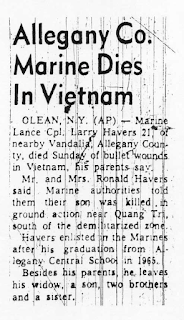
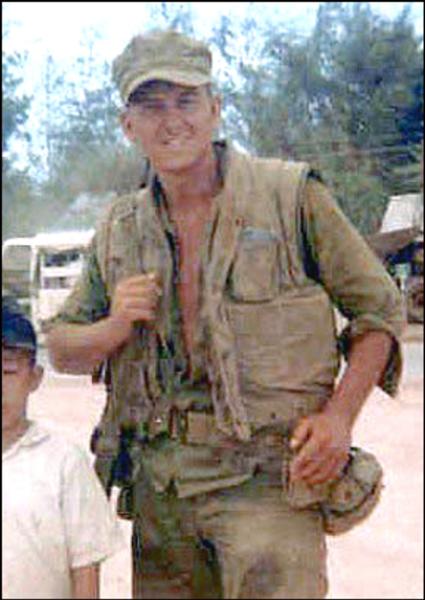
I looked online and found these images, first of Mr. Havers’s obituary and then of Mr. Havers himself. The things you remember. I wonder what kind of man he was. He has been gone for more than half a century. His name is not forgotten.

Mr. Havers’s service information can be found on the Virtual Vietnam Wall here. He was born 14 October 1946 and died 29 October 1967, in Thua Thien.

Next, my annual repost for Memorial Day.

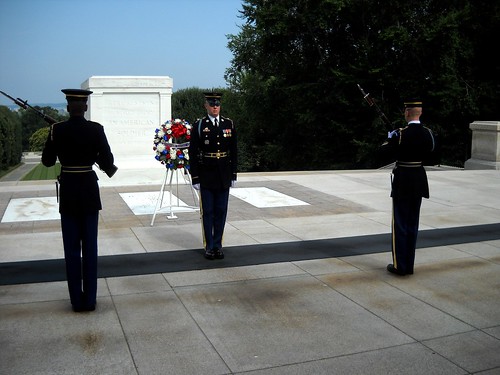
Tomb of Unknown Soldier


Know, all who see these lines,
That this man, by his appetite for honor,
By his steadfastness,
By his love for his country,
By his courage,
Was one of the miracles of the God.

— Guy Gavriel Kay

“The Green Field of France”, by Eric Bogle

Well, how do you do, young Willie McBride,
Do you mind if I sit down here by your graveside?
And rest for awhile ‘neath the warm summer sun,
I’ve been walking all day, and I’m nearly done.
I see by your gravestone you were only 19
When you joined the great fallen in 1916,
I hope you died quick and I hope you died clean
Or, Willie McBride, was it slow and obscene?

Did they Beat the drum slowly, did they play the fife lowly?
Did they sound the death-march as they lowered you down?
Did the band play The Last Post in chorus?
Did the pipes play the Flowers of the Forest?

Did you leave a wife or a sweetheart behind
In some faithful heart is your memory enshrined?
And, though you died back in 1916,
To that faithful heart are you forever 19?
Or are you a stranger without even a name,
Enshrined then, forever, behind a glass pane,
In an old photograph, torn and tattered and stained,
And faded to yellow in a brown leather frame?

Did they Beat the drum slowly, did they play the fife lowly?
Did they sound the death-march as they lowered you down?
Did the band play The Last Post in chorus?
Did the pipes play the Flowers of the Forest?

The sun’s shining down on these green fields of France;
The warm wind blows gently, and the red poppies dance.
The trenches have vanished long under the plow;
No gas and no barbed wire, no guns firing now.
But here in this graveyard that’s still No Man’s Land
The countless white crosses in stand mute in the sand
To man’s blind indifference to his fellow man,
And a whole generation who were butchered and damned.

Did they Beat the drum slowly, did they play the fife lowly?
Did they sound the death-march as they lowered you down?
Did the band play The Last Post in chorus?
Did the pipes play the Flowers of the Forest?

And I can’t help but wonder, no Willie McBride,
Do all those who lie here know why they died?
Did they really believe when they answered the call,
Did they really believe that this war would end wars?
Well the sorrow, the suffering, the glory, the pain
The killing and dying, was all done in vain,
For young Willie McBride, it all happened again,
And again, and again, and again, and again.

Did they Beat the drum slowly, did they play the fife lowly?
Did they sound the death-march as they lowered you down?
Did the band play The Last Post in chorus?
Did the pipes play the Flowers of the Forest?

Share This Post