

By the light of the guttering candle

It’s been a while since I updated the books that The Daughter and I have been reading at bedtimes, so here are some capsules. Some of the most satisfying and entertaining reading I’ve done lately has come at night, as I read these books aloud to The Daughter, one chapter per night. What’s nice about reading aloud is that you can’t skim. At all. When reading silently, I do tend to slip into skimming once in a while, if I sense that I’m reading a passage that may not entirely be crucial to the action. Reading aloud re-directs my reading attention to each individual word, and I find myself noticing some more details occasionally that I might otherwise not notice. I also notice word rhythm a lot more, and which words actually work together sonically. This fascinates me.

A problem that occasionally crops up deals with dialogue, particular in instances where two characters are conversing. It’s not uncommon to find authors simply drop dialogue attribution altogether for a bit, since it should be easy for a reader to keep track of who’s talking. But I wonder sometimes if that’s true when reading this kind of thing aloud, so sometimes I’ll hedge a bit and throw in my own attribution, a “he said” or “she said” where the author didn’t. I suppose I could adopt other voices for different characters, but…well, no, I don’t want to do that.

Now for specific books:

:: Over the last couple of years, when I’ve been in the kid-lit sections at the local bookstores, I’ve noticed a glut of pirate tales on the shelves. I suppose the popularity of the Pirates of the Caribbean films has been the major factor here. We’ve picked up a couple of these titles, but the only one we’ve read thus far is Pirate Curse, by Kai Meyer. Meyer is a German author whose books are translated for English audiences, and Pirate Curse is the first installment in a trilogy.

Of the pirate books I’ve seen all over, all of them seem to employ supernatural goings-on. I’m not sure why this is the case, since surely a compelling pirate story could be written for kids (or adults) without ghosts or magic or whatever. I seem to recall that a fellow named Robert Louis Something wrote a highly-regarded story about a pirate whose name went on to grace a chain of fast food joints that offer deep-fried seafood, but I digress. Pirate Curse involves just that: pirates who are cursed.

As is always the case with children’s books, our heroes are children. A pirate girl named Jolly is what pirates call a “Polliwog”: she has the ability to walk on water. When her ship is ambushed and sunk in a trap, she is the only survivor, escaping to an island where she meets a farmboy named Munk, who also turns out to be a Polliwog. Munk’s parents are killed in another supernatural attack a short while later, and Jolly and Munk are fleeing for their lives, falling in with a mysterious man called the Ghost Trader as they try to evade the growing evil force called “The Maelstrom”.

This is a very exciting book, and we’re looking forward to returning to this series in the future. Its protagonists are engaging and sympathetic, there’s the requisite mystery of the Ghost Trader, the usual mysterious figure of authority whom I’m sure will turn out to be far more than he seems, there are fun battles and daring escapes. At times I did wonder if the book might have been a bit on the dark side, but The Daughter seemed to take it in stride. Recommended, if you like creepy pirates-and-ghosts tales with a lot of adventure in them.

:: Some time ago we read a book called Larklight, by Philip Reeve. This book looked so intriguing on the shelf at Borders that I picked it up, in hardcover, knowing nothing about it. It is a steampunk space opera that assumes that the universe actually operated the way science thought it operated back in the Victorian era: the luminiferous ether exists, people can breathe in space, and so on. The spaceships are basically sea galleons in space, powered faster than light by traveling the “Golden Roads” when someone performs an alchemical operation called the “Chemical Wedding”. The book featured the adventures of a brother and sister, Art and Myrtle Mumby, who live in a space mansion called Larklight. They fall in with a space pirate named Jack Havock (I think we need a moratorium on pirates named “Jack”) and his crew as they investigate a threat to Earth by a race of evil spider-like creatures. They also meet a spy for the British Empire (which now, naturally, extends into space) named Sir Richard Burton (whom, I suppose, is not translating the 1001 Nights) and a number of other fine people, few of whom are actually human. Larklight was a fabulously fun read, and we dutifully kept an eye out for the promised sequel.

Since then there have been two sequels: Starcross and Mothstorm. I don’t want to say too much about the plots of these books, except to note that Reeve’s wild and wooly Victorian steampunk worldbuilding continues to be a delight. We have asteroids connected by a railroad, time traveling, crusty space sailors from spaceports on the moons of Jupiter, strange things on the planet Mercury and stranger things beyond Neptune, diseases that turn people into trees, and more. These books are the most pure fun reading I’ve found since the early volumes in the Harry Potter series. The books are written in the first person, mostly from Art’s point of view, with occasional chapters from Myrtle’s point of view; Reeve very nicely maintains a completely different voice for each character. There are lots of footnotes which Reeve uses ingeniously to do his infodumping, and the books are illustrated nicely.

There was one spot at which I wanted to reach into the book and slap Reeve. During a space battle sequence, he wrote a paragraph in which he describes a ship “shaking, rattling, and rolling” as it evades “great balls of fire” and the characters suffer through a “whole lot of shaking going on”. I groaned and then had to stop reading to explain why I was groaning to the kid. I wish Reeve hadn’t done that.

So, if you’re wondering how a Victorian steampunk space opera can possibly work, check this series out.

:: Some time ago we read Lloyd Alexander’s classic Chronicles of Prydain. The Daughter loved it, although she never really said that she loved it. I know because it comes up in conversation now and then, such as when a character named “The Bard” in the book we’re reading right now came up and she said, “You mean, like Fflewddur Fflam?” So I was happy to use my reading time with her to revisit Alexander’s less-noted Westmark Trilogy, which I think is the equal of Prydain. Thus far we’ve read the first two books, Westmark and The Kestrel.

In the Prydain books, Alexander explored themes of coming-of-age, of the nature of heroism, and the nature of duty. While some of those themes are revisited in Westmark, Alexander is more interested here in more mature notions: freedom and its limits, the best type of government, whether violence is ever justifiable.

Set in a kingdom called Westmark, the era is roughly analogous to the French Revolution; pistols, muskets and bayonets are the weapons of choice here. In the first chapter we meet a young man named Theo who works as an apprentice to a printer in a time when freedom of the press is greatly curtailed. He quickly finds himself on the run from the law, taking refuge with a con-man named Las Bombas and his dwarf companion Musket; along the way they meet a street urchin girl named Mickle and a revolutionary beloved by the sophisticated city youth named Florian. He also comes to the attention of the kingdom’s chief minister, Cabbarus, and gradually Theo finds himself in the midst of turmoil engulfing the whole of Westmark.

This trilogy is as much about politics and concerns of adults as it is about coming of age and heroism. Alexander doesn’t shrink from the fact that many who are called “heroes” are people who have committed acts of questionable heroism for reasons that weren’t entirely noble; he also doesn’t shrink from the fact that great conflicts can arise between people who are genuinely trying to make a good world as best they can, and he presents few, if any, easy answers. At times the story gets pretty dark, actually, but it’s still exciting, briskly paced, and full of memorable characters.

I’ll report back when we finish the trilogy.
Share This Post

A Tango with Tiamat

George R.R. Martin reports on the writing of A Dance with Dragons: he now has 1100 manuscript pages, and hopes to bring the book’s final manuscript in under 1500 pages. He says that the book is now longer than A Game of Thrones and A Feast for Crows, getting close to A Clash of Kings, and has a way to go before A Storm of Swords. Well, that’s nice and all, but I’m not going to get happy yet.

I’ll probably start a re-read of the series in a year, though.

Share This Post

Bone

UPDATE: Welcome, readers of Boneville, and thanks to Jeff Smith for the link.

I’ve read a few graphic novels lately that I’ve procrastinated posting about, so here goes.

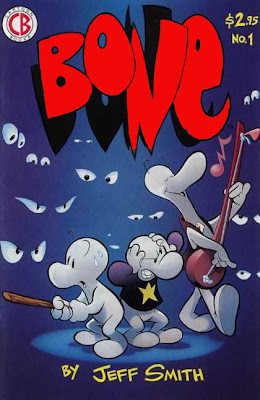
I’ve seen Jeff Smith‘s name mentioned a lot in comics circles as being a highly-admired artist and writer, but I hadn’t read him much at all except for his recent Shazam! miniseries (which I reviewed for GMR back when). Smith’s most famous work to date is his gigantic opus Bone, which I’d held off reading for a while. The first time I heard of Bone was in the comics essay in one of the Year’s Best Fantasy and Horror volumes about ten years ago now; the writer made the first of many comparisons I’ve seen over the years of Smith’s work to Tolkien’s. Well, that is certainly high praise.

But when I looked into a volume of Bone back in 2003 in the library, I remember being confused. I open to the first page and see, instead of epic fantasy goings-on, a trio of characters wandering through a wasteland. The characters are…well, they’re hard to describe. Pasty-white, doughy folk. Short. It looked like, well, the Pilsbury Dough Boy and two of his friends wandered off for an adventure. Tolkien? Bone? Not so much. Maybe it was a great book, but…I wasn’t going to find out right then.

Well, years go by, and I see more and more reference to Bone in reverent tones, with more comparisons of the book to Tolkien. Now I was finally intrigued, although I still didn’t read the book; but when I read Smith’s afore-mentioned Shazam!, I was highly impressed with Smith and decided that it was finally time to look into Bone. A little while after that I’m in a local bookstore and spot individual volumes of Bone priced cheaply ($9.99, I think), and picked one up. Then I forgot I owned it, as I do with many books I buy. I only read that first volume of Bone, Out From Boneville, a few months back, and I enjoyed it so much – it won me over in the first ten pages – that I soon tracked down the rest of the series in the enormous, single-volume edition.

When I say “enormous”, I mean just that. Bone runs for more than 1300 pages. (That single volume edition retails at around forty bucks, but that’s when I tend to use those 40%-off-any-item coupons that Borders sends me once in a while. It’s the best way I know to make comics affordable. As I’ve noted before, I tend to think that price point of individual volumes is one of the major factors that keeps comics readership lower than we all know it should be.) And yes, it turns out that this is a comic of truly epic scope, even if it doesn’t feel epic in its first few chapters. Bone‘s epic quality sneaks up on you, and there’s the big way in which Smith’s opus mirrors Tolkien’s: the story starts out quite small indeed, and gradually becomes bigger and bigger and bigger over time until we realize that our heroes have stumbled into the middle of an ancient struggle that is about to climax.

The story opens with three “Bones” wandering in the desert: Phoncible P. Bone (otherwise known as “Phoney Bone”), Smiley Bone, and the one who will turn out to be our main hero, Fone Bone. They’re known as “Bones” because they hail from “Boneville”, a locale we never see. They have been kicked out of Boneville because one of Phoney Bone’s get-rich-quick schemes has gone awry. Never fear, though: Phoney Bone is always ready with a new get-rich-quick scheme, much to the chagrin of the sweet-natured Fone Bone and much to the amusement of Smiley Bone, who finds mirth in nearly everything. Soon the Bones are separated, however, and Fone Bone finds himself stranded and alone in a dark and mysterious forest populated by talking insects, giant furry beasts called “Rat Creatures” who are menacing but not-terribly-bright, a dragon whom apparently only Fone Bone can see, and a girl named Thorn and her protective grandmother. Fone Bone follows Thorn to the little farmstead where she lives, and little by little finds himself drawn into various intrigues in this forest, where all is watched by a menacing figure who seems to be directing the Rat Creatures for some nefarious purpose.

Along the way, Fone Bone develops a crush on Thorn and bores everyone around him by obsessively discussing his favorite book (Moby Dick); he runs afoul of too many of Phoney Bone’s schemes to remember; he runs afoul of a giant cat whose allegiances are unknown; he runs afoul of hidden perils called “Ghost Circles”; he travels into ancient shrines and ancient cities and finds himself in the middle of ancient wars.

Bone is really something special. It is long and epic, but also poignant and intimate and familiar. The characters’ motivations are never unexplained or inexplicable, and much of the conflict is character-driven. There are sad moments and laugh-out-loud funny moments, and Jeff Smith ties it all together with wonderful art. Originally the series was done in black-and-white only (and that’s how my single-volume edition is), but the smaller re-issues have been colored beautifully under Smith’s direction. I prefer the B&W because it is (a) original and (b) cheaper. Bone is seriously wonderful stuff.

Smith’s most recent comics work is an ongoing series called RASL. This is an ongoing series which Smith is apparently self-publishing. It’s a science-fiction story that is aimed at mature audiences (which is a strong consideration after Smith’s earlier appropriate-for-all-ages Bone and Shazam! work). I’ve only read the first volume of the graphic novels that are collecting it, so I don’t have a strong impression of RASL yet. But it’s a surprisingly dark and violent tale featuring an art thief who travels between dimensions using this gigantic gizmo he wears on his back. The book is hard to describe, and while I found it intriguing, I also found it hard to evaluate based on the little that is printed in the graphic novel edition. I’ll probably wait however long it takes Smith to do RASL in its entirety before I really dig into it.

Share This Post

“One land, one king!”

Here’s a good example of something that makes clear that I’ll never understand the mindset that governs the way Hollywood does business. Apparently Bryan Singer, who was reported last week as being attached to a new Battlestar Galactica reboot movie, is also near to being attached to a project to remake John Boorman’s classic King Arthur film Excalibur:

Warner Bros. has closed a rights deal to remake the 1981 “Excalibur,” with Bryan Singer producing and developing the picture as a potential directing vehicle.

Deal comes as Singer gets serious about making the New Line-Legendary co-production “Jack the Giant Killer” his next directing effort, according to sources.

WB and Legendary Pictures have labored for months to pull together the rights to the film, which Singer will produce with Julie Yorn. Polly Johnsen, who was Polly Cohen when she was the WB exec who presided over the Singer-directed WB/Legendary collaboration “Superman Returns,” will also be a producer.

What catches me here isn’t the notion of remaking Excalibur so much as this: according to this, Warner Bros. has spent months and, by obvious extension, lots of money to acquire the remake rights to Excalibur. But Excalibur was based on material that has been in the public domain literally for centuries! This is what I don’t get. If Warner Bros. wanted to do a King Arthur movie, they could have simply hired a writer and said, “Write us a draft of a script based on the Arthurian legends.” But Hollywood suits don’t think like that, do they? They don’t think in terms of getting a project done, they think in terms of properties to be acquired. Which means that where they could make any movie they want based on Le Morte d’Arthur, they’d much rather spend orders of magnitude more money to acquire rights to a thirty-year old movie.

The mind reels.

(And really, why remake Excalibur anyway? The original is really about as good an Arthurian movie as I think can probably be made, given the non-cinematic nature of the source material. If the suits are that keen on hopping on the filmed-fantasy bandwagon, there are lots of unmade properties out there. This makes no sense.)

Share This Post

Lying Locke

The Lies of Locke Lamora by Scott Lynch was pretty strongly hyped when it came out a few years ago; I remember seeing it mentioned on nearly every SF and Fantasy site I tend to frequent. I made mental notes to read it, and then kept forgetting about it…and forgetting about it…and forgetting about it…until I finally picked up a copy when I remembered it one day whilst standing in Borders. I read it soon after, and it turns out there was a reason for all the hype: it’s a really good book, an adventure story that actually rollicks. I read a lot of adventure tales, and not all of them actually manage to rollick. This one? Yup, it’s set at full rollick.

Locke Lamora is a thief who lives in the city of Camorr, which is most reminiscent of Renaissance Venice, with its canals and its tightly-clustered buildings piled atop muddy islands. There are differences, though: the entire city is dominated by structures made of “Elderglass”, left behind by some non-human race thousands of years before; the skyline is dominated by five towers of Elderglass that rise over six hundred feet above the rest of Camorr. Alchemy is also practiced in Camorr, alchemy to produce light and to hinder one’s enemies and to turn regular animals into docile beasts of burden in a creepy process called “Gentling”. Locke Lamora is apprenticed to a guild of thieves, but that guild eventually kicks him out when he unleashes a scheme that ends up costing a couple of his fellow thieves their lives. He falls in with another group of thieves, though, and after he’s grown up with the rest of these thieves, he and his friends form their own little thieves’ guild, calling themselves “the Gentleman Bastards”. Their goal is to get rich by fleecing those already rich, and as the book opens, Locke Lamora is already laying the groundwork for just such a scheme, pretending to be a dealer in highly valuable brandy from a distant kingdom.

However, dark things are afoot in the arrival in Camorr of a mysterious figure called the Gray King. who has his sights set on taking over rule over the entire city’s criminal underworld from a man named Barsavi. The Gray King’s plans also involve Locke Lamora, for some reason, and Locke ends up in a great deal of trouble before the book is even half done.

It was an interesting choice, using the tropes of high fantasy to tell a caper story like this, and Lynch does it all very well. Sometimes the dialog is a bit hard to accept; I’m sure we’ve all read bad fantasies where the characters all talk as if they’ve just been transported from the pages of Sir Thomas Malory to whatever fantasy they’re in now. The Lies of Locke Lamora isn’t like that. The dialog is earthy, full of expletives, and occasionally – very occasionally – the stuff being said sounds as though it needs to be said with a thick Jersey accent. At times it was a bit jarring, but if you tire of Fat Fantasy novels where everybody talks like Gandalf the White (“Run, Shadowfax, and show us the meaning of haste!”), then you might find pleasure here. The book is a caper story; imagine Ocean’s Eleven or The Thomas Crown Affair set in a fantasy world. There are double crosses, secret identities, plots and plans within plans and plots, and at the center of it all are Locke Lamora and his best friend Jean Tannen, frequently charing into situations with no plan whatsoever.

One of an apparent six planned sequels has already come out: Red Seas Under Red Skies. In this book, Locke and Jean arrive at a different city, a wealthy sea town called Tal Verrar, where the world’s most exclusive gambling house, the Sinspire, resides. Their plan is to break into the Sinspire’s vault and steal its contents. Do they succeed? I’ll never tell – but their plans do go awry when they find themselves embroiled in all manner of other intrigues at the very political heart of Tal Verrar, a frustrating state of affairs for two men who just want to steal lots of money from the rich. The plot of Lies is twisty enough, but Red Seas is, if anything, even twistier: the plot seems to lurch about every ten or twenty pages, so that what starts off as a caper story becomes a political thriller and then, about halfway through, a nautical tale and a pirate story. The plots and double-crosses come fast and furious in Red Seas, right up the very last page, which leaves our heroes in a bit of trouble whose resolution in the third book (still forthcoming) will, I hope, be as fascinating and enjoyable as what has gone before. I can’t wait.

(Red Seas does not necessarily assume that the reader has already read Lies, but it does help. The book’s opening is probably much more effective if one knows something of the history of Locke Lamora and Jean Tannen.)

Share This Post

Gee, thanks for coming down from Elysium to talk to us….

Someone from the New Yorker decided to read some fantasy:

I’ve read a few best-selling fantasy series—Harry Potter, The Lord of the Rings, His Dark Materials, Twilight, Narnia, A Wrinkle in Time, The Dark Is Rising—but I would never describe myself as an aficionado. First because all these books are on about a fourth-grade reading level–

At this point, were this a sitcom like Scrubs, this is where you would hear the sound of the record needle being dragged across the grooves. “Fourth-grade reading level”? Lord of the Rings? Really?

I don’t have much to say about the recommendations offered. It’s a decent-enough list of recent fantasy writing, but it all tends to the “epic fantasy” arena. The fantasy genre is incredibly rich, offering so much beyond the whole swords-in-epic-lands kind of thing — Tim Powers, Christopher Moore, Lian Hearn, many others — so I’m surprised the writer of this article stuck with mainstream, epic fantasy. I haven’t read Goodkind or Hobb, but I have read Tad Williams, and Memory, Sorrow and Thorn is a good series, although I found it overlong and overstuffed. Erikson is good, although I wasn’t as wowed by Gardens of the Moon as most others (which leads me to believe that I may have missed something there). And it’s all a matter of taste, but it’s been years since Terry Brooks impressed me.

Anyhoo….

Share This Post

From the Ashes

So I was wandering the magazine aisle at work the other day, and I saw a new issue of Realms of Fantasy Magazine. This struck me as odd, because RoF ceased publication a few months ago. So what gives?

Well, a new publisher has picked up Realms. By “new publisher”, it actually turns out to be an old publisher working under a new name: Warren Lapine’s old DNA Publications company is apparently now Tir Na Nog Press. Lapine’s former company ran into trouble some years back, and I remember reading that there was some bad blood left behind in the wake of DNA’s failure, but here’s hoping that that’s all behind them. Anyway, I’m glad to see Realms is sticking around.

Share This Post

Thirty Fantasy Movies

SamuraiFrog did this last week, and I just have to follow suit. That being the case, here are my thirty favorite fantasy movies.

One caveat: I’m taking a more inclusive stance on what constitutes “fantasy” here, to basically include any kind of non-SF story in which supernatural stuff happens. For those who think that “fantasy” means armored Princes going to war on horseback using magical swords against evil wizards, well, you need to broaden your views!

The list is in no particular order, except for the final two, which really do constitute my top two.

Ghostbusters

So, why start here? Why not? It’s funny and it’s got ghosts. It’s full of wildly funny visual jokery, and some of it can slip by without notice; for instance, the StayPuft Marshmallow Man gets a huge laugh when he shows up, but what’s great is that he actually changes facial expressions: his grin turns mean when he’s stepping on people, and when he’s clinging to the edge of the building, watching helplessly as our heroes cross the streams (even though “it would be bad”), he has this comical expression of anger and fear. On a Marshmallow Man. I love that. This movie also features one of my favorite throwaway lines of all time: “Listen! Do you smell something?”

Willy Wonka and the Chocolate Factory

Now, I do like the recent Tim Burton version of this story, but it’s the old one that’s the enduring classic, and with good reason. I remember watching it when I was just a kid, and then I didn’t see it again until I was in college. Usually that is a formula for serious disappointment; nostalgia, as someone once wrote (I can’t remember who), is usually happiest when not fully investigated. But Willy Wonka sucked me right back in when I was twenty. To this day it’s the best thing Gene Wilder ever did. I love the way he takes over the film as soon as he shows up, and the casual malevolence and benevolence he is able to portray, often from one line of dialogue to the next.

The Exorcist

A lot of people I know don’t find this movie particularly scary, but I thought it enormously effective, and it accomplished its scares without resorting to things going bump in the night or evil slashers hiding behind curtains or any of the usual horror movie tropes. Instead, the movie takes place in brightly lit rooms where everyone can be seen, and it still got under my skin when I saw it. (I do consider horror to be part of fantasy.)

Back to the Future

Am I wrong to think of this as fantasy? Maybe. Maybe it’s science fiction. I’m not really sure. It depends on the definition, and as everyone knows, there’s just no good definition separating SF from fantasy. So I include BttF here because the BS behind its story is such cheerfully made-up BS. Sure, they dress it up a bit with some technobabble, but I’m calling it fantasy. So there it is.

Who Framed Roger Rabbit?

Now this is most definitely fantasy, and one of the most engaging movies of the 1980s. The sheer amount of craft in melding the animation and the live acting is amazing, but the movie’s script is just so perfect, always taking its material seriously but managing to evoke its madcap world of cartoons and people living together with extremely subtle winks to the audience. It’s a wildly funny and inventive fantasy.

TRON

Is it actually SF? No, I don’t think so. I think it’s pure fantasy, and another grand example of a movie creating its own world. Fantasy all the way.

The Princess Bride

Is it fantasy? Or parody of fantasy? I think it straddles the line like no other movie ever has. This movie kids because it loves.

Stardust

This movie died a quick death at the box office, and I don’t know why; I found it charming and fun.

The Green Mile

I may be cheating a bit here, since I haven’t seen the whole movie in one go, but I’ve seen all of its bits and pieces enough times in various telecasts that it all adds up to the whole thing. That said, this is, well, The Shawshank Redemption with some added supernatural elements.

(Warning — that’s the last scene of the film.)

The Adventures of Buckaroo Banzai Across the Eighth Dimension

This is another one that straddles the SF-Fantasy line. Maybe it’s actually SF, but I’m not sure; all of its Sfnal content is completely made up out of whole cloth. It’s a wickedly funny movie, too, full of sly and twisted humor that’s my cup of tea in such things. Lots of great lines, including another of my all-time favorites, “Whoa, don’t tug on that! You never know what it might be attached to.”

Pirates of the Caribbean

I’m listing all three of them here, because I genuinely love them all, even if the last one could have used one more pass through the rewrite stage.

Ben Hur

By far my favorite Biblical epic. Am I on blasphemous ground in calling it a fantasy? I guess one day I’ll find out. But I really love this movie (and I’m due to watch it again, come to that).

Raiders of the Lost Ark

‘Nuff said.

Merlin

The only movie on this list that was made for teevee. I don’t get the sense that it’s very well liked or remembered, but I find it a lively romp, telling the story of Merlin’s life as it intersects with the Arthurian story. It tends to be a bit episodic and disjointed, but I still think it’s a fun movie.

Interview with the Vampire

I thought Tom Cruise was just fine as Lestat. This is one of those movies that gets better on repeat viewings, I’ve found.

The Wizard of Oz

This movie is almost clicheed at this point, but it’s really a finely crafted fantasy. (Although frankly, I’ve often wondered what happens after the movie’s end – isn’t Toto still doomed?)

Krull

It’s not that great a movie, but it’s an ambitious piece of 1980s adventure movie making, it has a terrific score by James Horner, and as fantasy set-pieces go, surely the fire-mares sequence is one of the best.

Excalibur

It may seem odd, at first glance, that no indisputably great film has been made out of the King Arthur legends, but when one considers the Matter of Britain as a whole, the obstacles it poses to filmmakers become obvious. The Arthur “legend” is actually a giant collection of legends, and any telling of the story in a movie form is going to leave large amounts of stuff out. And if you really do it proper, Arthur himself will disappear for large periods of time while we follow other knights around. So, for now, Excalibur is as good as it gets, as far as Arthurian films are concerned. It’s a beautifully made movie, even if the tone is generally cool.

Peter Pan

I’ve long maintained that this is my favorite Disney animated film, and I’ve not changed my mind yet.

Pinocchio

You know what? This is not only fantasy, but in a lot of ways it’s straight-up horror. The whole Pleasure Island part of the movie is downright scary, especially when Lampwick starts his own transformation. Most people think of Jiminy Cricket warbling “When You Wish Upon a Star”, but that’s only the tiniest portion of this movie.

The Emperor’s New Groove

I never tire of giving this flick some love. It’s by far the zaniest thing ever to come out of Disney; it’s so zany and madcap and hilarious, in fact, that I almost think they were channeling the spirit of Chuck Jones when they made it. General opinion seems to be that Disney’s animated offerings after, say, Pocahontas were poor, but I’ve never believed that, and this movie stands with anything they ever did.

Aladdin

Rounding out the Disney portion of this list. This movie just barely edges out Beauty and the Beast, which is probably actually a better movie, maybe. But this one’s a sentimental favorite of mine, because in college The Girlfriend (now The Wife) and I saw it in theaters together four times.

My Neighbor Totoro

Now the Hayao Miyazaki portion of the program. Miyazaki is so good at making magic a part of his worlds, as normal as wind or trains or trees or whatever. He doesn’t give long explanations of anything; he just shows us his magical stuff and we accept it. The masterstroke here is how not only are we seeing the magical world of the Totoros, but they are seeing what is to them the magical world of us. How many other movies show big magical creatures taking enormous delight in the sound a raindrop makes when it hits an umbrella?

Kiki’s Delivery Service

Such a simple, low-key movie, telling the story of a young witch who has to use her powers to…deliver packages and find her own self-confidence. That’s it. No evil wizards to defeat, no threats to the world to thwart, just a girl at an awkward age trying to figure things out. And one of the most beautiful fictional cities ever in a movie. I’d love to live in that town!

Spiderman II

Spidey’s my favorite superhero, and I like all of the movies, but the first and third ones have problems that bug me a bit about them, where the second one is just about as good as it can be.

Superman

To this day, my favorite superhero movie ever. It does, admittedly, come a bit close to derailing courtesy of some of the slapstick stuff with Otis and Miss Tessmacher, but even with the “Turning back the world” thing, it just works on all levels for me.

Spirited Away

Many think that this is Hayao Miyazaki’s best film. I think it’s his second best.

Princess Mononoke

This is Hayao Miyazaki’s best film.

The Lord of the Rings

The whole thing.

Star Wars

Either A New Hope, or all six. Take your pick.

And there they are!

Share This Post

Rising Darkness

The Daughter and I recently finished working our way through Susan Cooper’s Dark Is Rising Sequence, a five-book series where each novel tells a distinct story that is part of a larger whole, depicting the final battle between the Old Ones, who serve the Light, and the servants of the Dark, who would seize the magic of the world and dominate the lives of men forever, or something like that. The books are interrelated, so that reading them out of order is not advisable, as each one assumes knowledge of what has gone before. However, the books don’t exactly tell the entire story in strict sequence, which took some getting used to. There are two different sets of viewpoint characters, and the novels switch back and forth between the two, to sometimes odd effect.

I’m probably already giving the impression that I didn’t like the series, and I don’t want to give that impression, because I did. It’s full of great stuff. But for some reason I never found myself really drawn in. It never really involved me, and I’m not sure why. So what to do? Why, a rambling blog post! (Which is filled with spoilers, by the way.)

The series opens with Over Sea, Under Stone, in which three siblings – Simon, Jane, and Barney – go to spend a summer at their Uncle Merriman’s house in a town in Cornwall, where they find themselves involved in a modern-day quest for the Grail. The term “Holy Grail” is never used, nor is the history of the Grail ever much discussed in full. (That sets a tone for the entire series, which surprisingly assumes a knowledge of the Welsh and British folklore that forms the underpinning of all five books.) Their Uncle Merriman, whose last name is Lyon, soon turns out to be more than he seems, and in the second book, The Dark is Rising, he reveals himself to Will Stanton as an “Old One”, the magical race who stand forever opposed to the actions of The Dark. The point in this book is for Will’s powers to be awakened, as he is to be the last of the Old Ones, after whose birth and awakening everything is to begin building toward the final battle between the Light and the Dark. Will’s goal in this book is to find the “Six Signs”, magical talismans with powers to be revealed later on.

Book Three, Greenwitch, brings Will and the three children from the first book together, where they must assist the denizens of the Cornwall village from the first book in a very clearly pagan tradition: the construction of the Greenwitch, a wooden idol that is always offered to the sea, and then must recover an object lost at the end of the first book. Book Four, The Grey King, has Will traveling to Wales where he meets an albino boy named Bran who also turns out to be much more than he seems, and who is to be another ally in the battle against the Dark. Finally, the fifth book, Silver on the Tree, brings everything together: Will, Bran, the Drew children, Merriman, and everyone else for the last battle against the minions of the Dark.

The entire series is full of startling imagery, good characterizations, and some very lyrical prose. Reading these aloud, I found myself amazed by some of the most gorgeous passages I’ve read in a long time. Here’s a sample, from The Dark is Rising:

Will was never able afterwards to tell how long he spent with the Book of Gramarye. So much went into him from its pages and changed him that the reading might have taken a year; yet so totally did it absorb his mind that when he came to an end he felt that he had only that moment begun. It was indeed not a book like other books. There were simple enough titles to each page: Of Flying; Of Challenge; Of the Words of Power; Of Resistance; Of Time through the Doors. But instead of presenting him with a story or instruction, the book would give simply a cnatch of verse or a bright image, which somehow had him instantly in the midst of whatever experience was involved.

He might read no more than one line — I have journeyed as an eagle — and he was soaring suddenly aloft as he winged, learning through feeling, feeling the way of resting on the wind and tilting round the rising columns of air, of sweeping and soaring, of looking down at patchwork-green hills capped with dark trees, and a winding, glinting river between. And he knew as he flew that the eagle was one of the only five birds who could see the Dark, and instantly he knew the other four, and in turn he was each of them….

He read: …you come to the place where is the oldest creature that is in this world, and he that has fared furthest afield, the Eagle of Gwernabwy…and Will was up on a bare crag of rock above the world, resting without fear on a grey-black glittering shelf of granite, and his right side leaned against a soft, gold-feathered leg and a folded wing, and his hand rested beside a cruel steel-hard hooked claw, while in his ear a harsh voice whispered the words that would control wind and storm, sky and air, cloud and rain, and snow and hail – and everything in the sky save the sun and the moon, the planets and the stars.

Then he was flying again, at large in the blue-black sky, with the stars blazing timeless around his head, and the patterns of the stars made themselves known to him, both like and unlike the shapes and powers attributed to them by men long ago. The Herdsman passed, nodding, the bright star Arcturus at his knee; the Bull roared by, bearing the great sun Aldebaran and the small group of the Pleiades singing in small melodic voices, like no voices he had ever heard. Up he flew, and outward, through black space, and saw the dead stars, the blazing stars, the thin scattering of life that peopled the emptiness beyond. And when he was done, he knew every star in the heavens, both by name and as charted astronomical points, and again as something much more than either; and he knew every spell of the sun and moon; he knew the mystery of Uranus and the despair of Mercury, and he had ridden on a comet’s tail.

But as I note above, I still found it hard at times to really get emotionally involved in the stories. I think that it’s because of the way Cooper frames her story: everything that is transpiring is doing so according to ancient prophecies, and all of the wise old people in the stories are constantly making it sound as though various outcomes along the way are preordained. This event will happen, because it must happen before the next event can happen, which we already know will happen. Also, the children are constantly told that the Dark can do them no real harm, so there’s a sense in which the books undermine any sense of danger that you really need in a story involving the final, cataclysmic battle between Good and Evil. The books never really have that sense of risk, the feeling that even if victory is to be achieved, a heavy price must, and will, be paid. Come to that, there really isn’t a great sense of what happens to the world if the Dark wins out.

For this reason, the most effective parts of the series, for me, were those which did not deal with the actual lead protagonists, but rather those that dwelt with the normal people, the non-magical folk, who found themselves drawn through no fault of their own into a conflict that has been raging through the centuries. It’s here that the Dark is Rising Sequence finds it most effective voice. Some of these characters – most notably, Caradog Lewis and John Rowlands – endure outright tragedies, their individual responses to which shape greatly what is to come later on. I suppose that’s my major problem with the series: the moments in the books that are the most emotional are the ones that deal with supporting characters whom I didn’t know well enough to really be invested in. But come to that, those parts of the books tend to have that Greek Tragedy feel to them, in which people suffer because they have no choice but to suffer. That’s well and good, but I tend to prefer the Shakespearean approach to tragedy, where people suffer because of the choices they make. (That’s not a rigid distinction, mind you.)

There was one other aspect of this series that bothered me greatly: the ending. I’ll yellow this next bit out, if you’re reading the series and want to avoid the spoilers:

There’s a particular problem that faces any writer who crafts a story in which the real world, the world in which we live, is threatened by magical forces: namely, that at the end, when the battle is won, what does one do with the characters who have just saved the world and now have to live the rest of their lives knowing what they’ve done and not being able to really discuss it? Guy Gavriel Kay faced this problem in his Fionavar Tapestry, and he showed his solution – which wasn’t entirely satisfying, in my opinion – in last year’s Ysabel. But in the Dark Is Rising Sequence, Susan Cooper does something else: at the end of the series, when the battle has been won and the Dark defeated, all of the children’s memories, save Will’s, are ‘erased’, so they will live the rest of their lives with no knowledge at all of the things they’ve done and their actions in that final war.

I hated this development. Hated it. It just seems so wrong somehow, like having a contest where the prize is that you get to carry around a briefcase filled with one million dollars for a single day, but you can’t spend any of it and when the sun goes down the briefcase is taken away and all you are is the person you were at the beginning. Inducing magical amnesia may have been the right thing to do for John Rowlands, who is the one character who really does pay a heavy price in the tale in order to allow the victory of the Light; to wipe the memories of all the children struck me as cruel. I found this a serious mis-step, and it bothered me tremendously. It left a seriously bad aftertaste in my mind after I set the book aside the last night we read it.

I was reminded of the movie Heaven Can Wait: if Warren Beatty is brought back from the dead by taking over some other guy’s body, but the other guy’s memories and personalities are what remain and Warren Beatty’s are allowed to vanish utterly, in what possible way can the guy who’s alive at the end of the movie be thought of as the original Warren Beatty character at all? He’s not, he’s some other guy we don’t give a crap about. Well, ditto with the magical amnesia in The Dark is Rising.

But the books are still very much worth reading, because they are deeply steeped in the ancient folklore of Britain, and Cooper is able to draw on that folklore without giving us long infodumpish passages of exegesis; the spectre of King Arthur looms over the entire series, but there’s never anything so ham-handed as the story grinding to a halt while someone talks about who Arthur was and the glory of Camelot and all the rest of it.

I do recommend this series; after all, we’re talking about a series that boasts not one but two Newberry awards. There’s a lot of wonderful stuff here, and it’s a journey well-worth taking, even if it felt for me like a journey observed rather than a journey shared.

Share This Post

Brightly Weaving

After clearing the decks of some earlier reading I wanted to get out of the way, I’m finally embarking on something I’ve intended to do for a couple of years now: I am re-reading every word Guy Gavriel Kay has written, in the order that he wrote them. Why? Because he’s my favorite living author, and it’s been a while since I’ve gone through his work. Here’s how it breaks down:

:: My last re-read of The Fionavar Tapestry was almost exactly three years ago. This will be, by my count, my fifth complete re-reading of the trilogy, although I have dipped into it to read favorite passages too many times to count.

:: Then comes Tigana, viewed by many as GGK’s finest work. It’s not my favorite of his, but it is wonderful. It is also the first of GGK’s books that I ever read in its entirety. The last time I read it was, I believe, in 2000. That’s far too long.

:: After that is A Song for Arbonne, which seems to be held in less regard than GGK’s other works. It was the first time I ever encountered his writing, when I saw the book at the Olean Library and was intrigued enough by its cover to check it out, but for some reason I didn’t finish it at that time. I think school got in the way or something…I’m not sure. This was in 1992 or 1993. My last re-read of Arbonne was in 2001; that I remember because I recall the apartment we lived in at the time. This will be the third time I’ve read it.

:: In 2005 I re-read The Lions of Al-Rassan for the third time, so this will be my fourth trip through what is my favorite of all of GGK’s books. This book, with its tragic love stories and its wonderful characters and gorgeous setting just hits on every level for me.

:: Of the two volumes that make up The Sarantine Mosaic, I have only re-read the first, Sailing to Sarantium, a single time, and that was in preparation for the release in 2000 of the second book, Lord of Emperors. I have never re-read Lord. This may be the one I’m looking forward to the most, at this point.

:: GGK’s book of poetry, Beyond This Dark House, came out in 2003. I read it, and since have dipped back into it a bit, but now I’ll re-read it in its entirety.

:: I reviewed 2004’s The Last Light of the Sun for GMR, and since then I have not re-read it. I remember this book very favorably and look forward to seeing if it measures up to my memories of it.

:: And finally, 2007’s Ysabel, which I blogged about when I read it. This will end up being the shortest period of time I’ve ever gone between full re-reads on a GGK book.

All this means that if GGK has a new book out next year, which seems a reasonable expectation (he seems to go about three years between books), I’ll be totally up to speed on his oeuvre. And that’s a good thing.

Even though I already own every one of his books, for the sake of this project I spent some time on eBay last December searching out new copies of each, in different editions. I’ve sometimes found that when you re-read a book that’s very familiar to you, but you read it in a different edition than the one you’re used to, with a different typeface and different cover art and so on, some details in the story stick out more than they otherwise would. I’m already noticing this in Fionavar. I already owned two editions, one a mass-market paperback edition that was my first copy and a trade paperback edition with new cover art; but both editions were done by ROC Books, and both used identical type-settings. This edition I’m reading now uses a totally different font, even, so I’m finding the experience of re-reading just slightly different. This may sound goofy, but we’re talking about books I’m sufficiently familiar with that with some passages, I know where they physically appear on the page. Now those passages will have, well, shifted.

(Besides, my original copy of Last Light of the Sun is actually an advance reading copy; the thing doesn’t even have cover art. I’ve rectified that with a hardcover version, albeit a book club edition. Nothing’s perfect.)

I’ll blog my way through these, obviously. I’m not sure if I’ll be reading them all back-to-back-to-back, or if I’ll read something else in between once or twice, just to cleanse the palate a little, but I’m hoping to be done with this at least by the end of summer, if not sooner. We’ll see…but for now, I’m off to Fionavar!

Share This Post