In the service of Naamah

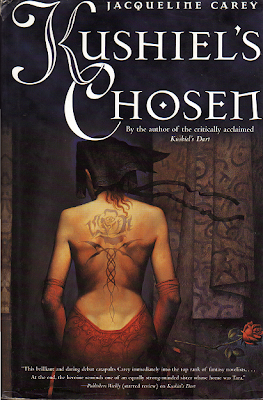
Quite a while ago, I read a wonderful fantasy novel called Kushiel’s Dart, by Jacqueline Carey, a long book set in a pseudo-Europe roughly around the Renaissance era, featuring as the lead character a woman named Phedre who serves a goddess called Naamah, an an anguissette — a courtesan, or concubine, whose major point of attraction is the fact that she is, well, masochistic by nature. Phedre became deeply involved with the court politics of her city, making enemies before she even knew that she had, and eventually found herself journeying across the continent in an effort to save her kingdom from the disastrous war that was about to befall it. Along the way, she fell in love with her companion and bodyguard, a conflicted young man named Joscelin Verreuil. At the end of the book, most threads were resolved satisfactorily, save one: the escape of the main traitor of the first book, Melisande Shahrizai.

The sequel, Kushiel’s Chosen, opens with Phedre having been made a noblewoman by the new Queen, and with Melisande still at large and very likely scheming anew against the realm. Phedre takes it on herself to try to find Melisande and the insiders who helped her escape. This leads her anew into ever more dangerous areas of court politics, evil plotting, selling herself to people she would rather not, and journeys to areas we didn’t visit in the first book. All the while she is searching for clues to the magic that will release her dearest friend, who voluntarily took on permanent magical imprisonment in the first book.

Kushiel’s Chosen is, as it happens, the middle book of a trilogy, and so it has some of the problems inherent in middle books, leaving certain plotlines unresolved in an ending that sets up the final book. But enough of the plotlines that are inherent to this book are tidied up, so while there is a sense of “To be continued” at the end of Kushiel’s Chosen, it is still an overall satisfying read.

The strength of the book, as in its preceding volume, lies in Carey’s writing and in her ability to populate a familiar world with interesting and sympathetic characters. In Phedre and Joscelin, Carey has created a couple we can’t help but root for – but she does not make things easy for them, in any way at all. They are, in many ways, completely different people, and their relationship is a clear illustration of the old precept that the people we hurt the most tend to be the people we love the most. Carey creates a number of other fascinating new characters here as well: cruel jailers of an inescapable prison, a Prince and Princess who rule a distant island kingdom, a pirate captain, an entire people of supposed heretics who are looking for someone to lead them to the homeland that their god promised them, and many others.

I did find that Kushiel’s Chosen was not quite as engrossing as the first novel; the first half of the present book is mainly character-driven drama that doesn’t move along very briskly at all. The second half is where things start to happen, and the pace livens significantly after that. The first book had some of the same problem, but in that case, Kushiel’s Dart had the sense of exploring a new world that we didn’t know helping to alleviate any problems arising from slow pacing. In Kushiel’s Chosen, we already know the world we’re reading about, so it is a bit more of a problem here. (But it is in no way a large enough problem to detract from reading the book in the first place.)

I am already looking forward to reading the final volume in this trilogy, Kushiel’s Avatar. Carey has also written several other books set in this world; I hope to eventually read those, as well.

Share This Post

Lumos

So, I took The Daughter to see Harry Potter and the Deathly Hallows the other day. We loved the movie, just loved it; but then, we’ve loved the entire series to this point — even the occasionally sickeningly-sweet first two, directed by Chris Columbus — and this is the one where it all comes together. Some of this will involve spoilers, so my thoughts are below the fold.

What I liked most about Deathly Hallows was that it didn’t make the mistake lots of movies make these days: it didn’t confuse “dark” with “relentlessly grim”. The film is dark, make no mistake about it. The way JK Rowling wrote the story, this is the one where Harry and friends basically get their arses kicked around for just about all of the story before finally figuring out how to turn the tide. Prices are paid — heavy, sad prices. Hermione must bid farewell to her family, magically erasing their memories of her so as to protect them; Harry has to watch the Dursleys, who never liked him much at all, give up their home so as to protect them. More and more unhappy events are piled on, along the way, and the film ends with the saddest loss of all.

But for all that, there is quite a lot of humor in the film: some genuinely funny stuff, and some stuff that is the humor that comes of people who are in the midst of grief but who find themselves laughing because they must. Deathly Hallows piles on, but it doesn’t do so relentlessly, which is a very welcome development. That’s what I liked most about the film.

Random observations:

:: There isn’t a single weak link in the entire cast. Not one. I love how perfectly the three leads — Daniel Radcliffe, Rupert Grint, and Emma Watson — have been together long enough now that they can play off each other almost effortlessly. Their friendship is real, and it shows onscreen.

:: Some critics have noted dismay at the perfunctory nature with which Mad Eye Moody’s death was handled, but it felt real to me, in a way. Not everyone dies in a heroic final act, filmed in slow motion, with everyone else watching him go. Sometimes you have no idea until someone just bluntly tells you: “Mad Eye is dead.” The moment lingered, just enough, and then it was on to the next thing, because sometimes in war you don’t even have time to grieve.

:: I also think that by handling Moody’s death in this way, it made Dobby’s death at the end that much more emotional. There have been deaths along the way, and losses, and constant fear of losses — before we finally get one that hits home in all the usual cinematic ways. I found Dobby’s passing to be the best ending point for half the story; it leaves Harry at his lowest point. How can he keep going now? It’s been so hard just to find one Horcrux and destroy it. There are three more out there, and Voldemort has just found the Elder Wand. What a witheringly bad place to be, heading into the story’s climax.

:: The film didn’t really solve the structural problem JK Rowling created with the “camping all over England until they happen upon relevant information” nature of the central part of the story, but the film did take advantage of that opportunity to highlight some fine character moments, including the wonderful scene where Harry and Hermione dance to some rock tune.

:: In the book, Neville Longbottom doesn’t show up until the end; but here, we get one quick glimpse of him, standing up to Death Eaters who are searching the Hogwarts Express. The overall arc of Neville’s life, from loserish nerd to Kicker of Magical Arse, is one of the most satisfying things about the books, and I look forward to seeing Neville’s huge moment at the end of Part II.

:: There’s a “jump out of your seat” moment in the film that doesn’t conceal itself at all. You know it’s coming. You even know when it’s coming. And you still jump. That is effective filmmaking, folks.

:: The animation that accompanies Hermione’s telling of the story of the Deathly Hallows is absolutely brilliant. It’s one of the finest moments in a fine film.

:: Bring on Part II! (July? WTF, Warner’s?!)

Share This Post

Holy SHIT.

Sorry I couldn’t come up with a more eloquent title for this post, but…well, sometimes you gotta go with the words that hit you. Therefore: Let there be dancing in the streets!

Yup, I won a copy of Doug Adams’s The Music of The Lord of the Rings, which makes me so utterly happy that…well, later there may be opening of beer and dancing once I am alone and no one can see.

The entry rules were simple: in addition to providing contact info, entrants had to identify their favorite bit of music from the films and describe why. Here’s what I wrote:

My favorite bit of music from the LOTR scores? That’s a nearly impossible requirement for me to fill, as I adore just about every single note in the trilogy, from start to end. But for the purposes of this contest, I’ll name the music that plays as Gandalf leads the Fellowship into the ruin of the subterranean Dwarvish city of Dwarrowdelf, in Moria. There’s just something so majestic and regal about the music in this scene: most of the Moria music is dark and forbidding, but in this one passage, Howard Shore conveys some of the optimism that the Dwarves must have felt as they started digging into Moria. The music builds and builds, and it feels like it’s about to open up into a huge melody — but that melody never comes, which is fitting since Moria never reached the heights that the Dwarves had hoped. Instead, the music turns dark again as Gimli finds Balin’s tomb. This moment in the score always makes
my spine chill a bit. (The film actually blunts the impact a bit by having Sam say “Now that’s an eye-opener and no mistake”. It’s a scene that needed no dialogue.)

Here’s the music I’m referring to. It’s the first 1:15 of this clip, and I shiver in awe every time I hear this passage. It’s so regal and sad and evocative of Tolkien’s world that is full to overflow with old things that are lost and nearly forgotten:

That music is Middle Earth.

Share This Post

Krull

Ah, the fine lure of 1980s cheese movies! I loved Krull when it came out, and saw the thing twice. It hit all of my sweet spots at the time. But then, I was 12, and I’ve grown a bit more sophisticated since then. My sweet spots at the time? A young Prince thrust into Kingship by the sudden onset of war; sword fights; aliens with ray guns; aged wizards come to nudge the young Prince toward destiny; a funky and mythical weapon; a really pretty Princess; the Prince’s motley collection of allies, most of whom are outlaws; perils like enormous spiders and quicksand-filled swamps and a monstrous villain who lives in an impregnable fortress of rock.

Yeah, those were all of my sweet spots when I was 12. And as it turns out, these are still a lot of sweet spots now that I’m 38! Which is probably why I still have a lot of fondness for Krull even though it’s more cheerfully goofy to me now than the serious bit of heroic fantasy I thought it was back then.

The plot of Krull is…well, from my list of “sweet spots” above, you can pretty much figure it out for yourself. There’s a planet called Krull, which is invaded by a force of soldiers called “Slayers” who wield ray guns and fly around the galaxy in a giant mountain-shaped fortress made of rock that lands on one world after another for conquering. This enormous spaceship lands on a planet, whereupon its hordes of ray-gun wielding soldiers in space armor ride out on horseback to take over. Yowza!

But the planet Krull isn’t to be taken so lightly. Two Kings decide to put their kingdoms together, by marrying their son and daughter. But on the eve of Prince Colwyn’s wedding, the Slayers attack and kill the two old Kings and kidnap Princess Lyssa! Oh noes! Colwyn wakes up the next morning, amidst the wreckage of battle, to find his father dead, his bride a prisoner, and a cranky old wizard (who is not named Obi Wan or Gandalf) binding his wounds and telling him to get up off his arse because he’s a King now and he needs to go fight the Slayers and their horrible leader who is known by the horrifyingly scary name “The Beast”.

And off they go. First they’re off to pick up a nifty weapon called a “Glaive”, which is basically a really ornate throwing star that seems to work by remote control or mental command or something like that. Then they need to find a powerful Seer, because they need to know where The Beast’s fortress is going to be (it changes location every morning). Along the way they meet some brigand-outlaw types and recruit them to their cause. And so on.

It’s all very typical, although I didn’t realize it when the movie came out. It’s full of British actors, which always helps lend an air of weight and believability to the most ludicrous plots. The film is full of beautiful shots of wonderful vistas (its director of photography, Peter Suschitsky, also shot The Empire Strikes Back), but a lot of it doesn’t make a whole lot of sense. The Glaive is touted as an amazing weapon, but by the time we get to see it in action, it’s actually a bit disappointing; poor Lysette Anthony as our beautiful Princess literally has nothing to do as she is a prisoner for ninety percent of the movie; some of the film’s events feel contrived, as if the screenwriter felt the need to pad out the running time and tick off some well-worn fantasy conventions along the way.

The most notable aspect of Krull now, nearly thirty years after it came out (holy crap!), is its score by James Horner. It’s typical young Horner: big and muscular, with lots of nods to various classical masters and to Jerry Goldsmith. Horner’s tendency toward self-referencing isn’t in much evidence at this point in his career, although there are places where the score sounds a lot like his most noted score to that point, Star Trek II: The Wrath of Khan. The score also has two of the best melodies of Horner’s entire career (the heroic “Main Theme” and the love theme).

Krull really needs to be seen through the prism of time, for what it is: an artifact of the 1980s. If this movie were to be released anew today, it would be laughed off the screen, with its occasionally murky visual effects and its earnest and irony-free script. Oh well. I still have a soft spot for it. The scene where Colwyn and friends ride the Firemares across a thousand leagues is still a thrilling bit, even with some wretched 1980s-style rear-projection, and Ken Marshall is, all things considered, a pretty good Prince Colwyn. I imagine that as Hollywood gets more and more focused on remaking old properties, a new version of Krull is probably inevitable at some point. I’m not sure how I’d feel about that.

For a taste of Krull, here’s a video of one of the best tracks from the score, “Riding the Firemares”. The main theme kicks in at about the :37 mark. Try to not have that tune in your head for days. I had that theme in my head for years, which is amazing considering that for many years, the score album to Krull was nearly impossible to find. I didn’t locate a copy myself until I was in, of all places, a Barnes&Noble in Cedar Rapids, IA in 1995, and that was a single-disc album with lousy sound that left off most of the score. The entire score has been re-released on a couple of film music labels since then (including La La Land Records, just in the last month or two).

ADDENDUM: Oh, what the heck. Here’s the actual scene of “Riding the Firemares”. The idea here is that Colwyn and company has learned where the Beast’s Fortress will be the next morning…but the location is a thousand leagues away, so the only way they can clear that distance in time is to try to capture, harness, and ride the Firemares. What are Firemares? They’re horses. Really, really fast horses. Horses so fast that when they really get going, well…here’s what happens.

For the main action, skip to the 4:30 mark. Excuse the cruddy video quality; this is the only clip I’ve found that has the entire scene. (The cyclops dude remains behind because his people are cursed to know the day they will die, and he knows this is his day, or something like that.)

Even with the bad rear-projection — oh, what George Lucas’s ILM could have done with this scene — it’s a terribly fun part of the movie.

Share This Post

Bring him Ice

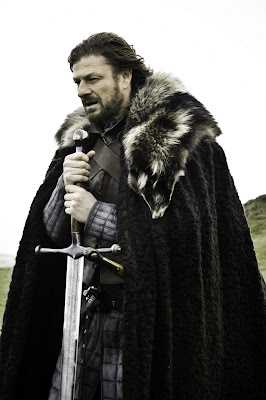
SamuraiFrog comments favorably on Sean Bean’s casting as Lord Eddard Stark in the forthcoming HBO series A Game of Thrones, adapting the first book in George RR Martin’s pretty good, but I suspect doomed to eternal incompletion, Song of Ice and Fire series. Bean looks really good in this photo:

Looking at this pic, I have a new thought: [SPOILER, highlight to read]Maybe after this, Bean can play Uther Pendragon in a filmed adaptation of Mary Stewart’s Arthurian books, so he can keep up his newfound habit of playing guys who die in the first books of the series whose filmed adaptation he’s starring in.

In other Game of Thrones casting news, the part of Hodor has been cast. Talk about having it easy! (Hodor is a mentally-challenged character who only ever says his own name. That’s it. His dialogue will consist of him doing nothing but saying “Hodor”. In fact, I have a hope that in the unlikely event GRRM ever actually does finish the series, the book ends with “Hodor,” said Hodor.)

Share This Post

May he rule a thousand years

My review of Under Heaven is now available at GMR. For non-spoiler thoughts, feel free to read the review.

I do have some thoughts on the book that I left out because they were spoilerish, so I’ll put those here, but in order to read them you’ll have to highlight them with your mouse:

:: GGK so often writes about medievalish places wherein women have little real power given to them overtly, and thus must scramble to assume whatever power they can through other means. This theme is particularly evident in this novel.

:: Is Kitai in the same “world” as Esperana and Sarantium? I don’t think so. The book’s reference to the moon is singular, where GGK’s previous pseudo-Europes all have two moons.

:: I spent much of the book thinking that Tai would eventually give his horses to the Kanlin Warriors. I was wrong, obviously.

:: I love GGK’s elegiac endings, even when he’s written a happy ending (for the most part). The fact that Spring Rain’s letter never reaches Tai and the way the voices of the ghosts of Kuala Nor eventually face away set a perfect note of melancholy alongside Tai’s union with Wei Song.

:: Speaking of Tai’s union with Wei Song, this was as satisfying a finale in a GGK novel as I’ve ever read. I loved it.

:: GGK really managed to work up some tension by having Tai continually worrying over his sister’s fate, when we know that she’s already been rescued from that fate. Meshag’s dual nature (trapped between wolf and man) makes him one of the book’s most fascinating characters.

:: I really want to see more of this world, and I hope I am wrong about Kitai not being in the same world as GGK’s proto-Europe. I’d love to see GGK’s Marco Polo come to this world.

That’s all for now. What a great book this was.

Share This Post

Break time!

Wednesday is Donut Day!

My Facebook friends know that on Wednesdays, I like to celebrate “Hump Day”, past the midpoint of which the week is all downhill, with the indulgence of a donut or two at my mid-morning break. Above you see two of my unwitting victims: a coconut frycake donut, and a glazed cruller. These I wash down with coffee (from that orange mug there), whilst either reading or talking with a coworker who is at my location of The Store two weeks per month.

And what do I read? Lots of stuff. But right now, of course, it’s this:

What break looks like....

Boo-yeah!

I usually go on break about 10:30 in the morning, after I’ve been there about three hours. Other people take their breaks earlier than that, but I find that the day bogs down too quickly if I break too early. At one job I had, years ago, the work day started at 8:00 am, and lots of people in the office would take break at 9:00! I’ve never understood that — how can you need a break after one hour of working? For me, late breaks and late lunches have always been the rule.

So how do you spend your breaks?

(I used Blogger’s scheduled-posts ability to have this post go “live” at the time I usually go on break on Wednesdays. So, if you’re reading this just as the post went live, I’m on break right now!)

Share This Post

“No sun, no moon, no stars over Al-Rassan”

UPDATE: Welcome, readers and followers of BrightWeavings! I’m in the process of re-reading all of GGK’s books leading up to the Under Heaven release. You can find earlier posts of mine on the subject of GGK here. Feel free to stick around!

When the Lion at his pleasure comes
To the watering place to drink, ah see!
See the lesser beasts of Al-Rassan
scatter, like blown leaves in autumn,
Like air-borne seedlings in the spring,
Like grey clouds that part to let the first star
Of the god shine down upon the earth.

I suppose many readers have the problem of the Favorite Author: after reading one of the Favorite Author’s books, it’s often hard to work up any enthusiasm for some book by some other author, putting those subsequent authors at a disadvantage. It’s even worse if one follows up a book by one’s Favorite Author with something by an author one has never read before; after all, what are the chances that some new fry is going to measure up to the Favorite Author?

That’s the problem I tend to have with Guy Gavriel Kay: reading him leaves me in the mood to read little else but more Guy Gavriel Kay. It’s been this way for years; I suppose I’ve bounced off more books I’ve read immediately post-Kay than anyone else. What’s the solution? Reading another favorite author, I suppose, but that can only put off the problem. Best to just keep trying books until something sticks.

And there’s the thorny sub-problem of the Favorite Author conundrum: the Favorite Book by the Favorite Author. Ah, now we’re treading on dangerous ground, because when you re-read your favorite book, that afterglow tends to stick around for quite a while, outshining the light of nearly everything else. So it is with me and The Lions of Al-Rassan. My own experience is that most fans of GGK will cite Tigana as their favorite, but not me. It’ll always be Lions.

The Lions of Al-Rassan is set in a land that has two names: Al-Rassan, as it is called by the Asharite lords who have ruled it for centuries, and Esperana, as it is called by the minor Kings in the north who dream of driving out the Asharites and uniting all of the peninsula under a single banner. The situation is basically a fantasy analog of the Iberian peninsula as Moorish rule was coming to an end, and indeed, GGK gives us our own Ferdinand and Isabella, in the persons of King Ramiro and Queen Ines of the realm of Valledo. But that’s getting ahead a bit.

I’ve noticed over my years of reading fantasy that a common theme in the best of the genre is the passing of ages and of kingdoms and of the onward march of history; even as one person’s great ambitions are being fulfilled, another is seeing a beloved kingdom pass into memory. That is the main theme of Lions, with the Asharites slowly but inevitably losing their grip on Al-Rassan, and the Jaddites slowly but inevitably bringing it under theirs. The Asharites are the “Muslims” of this world, the worshippers of the Stars of Ashar; the Jaddites are the “Christians”, worshiping the sun-god Jad. Caught in between them are the moon-worshipping Kindath, who are viewed with suspicion and derision everywhere they go. Thus the three great monotheistic faiths of our world are reflected in GGK’s fantasy world.

The book has a huge cast of characters, all of them memorable. Our attentions focus most on three: Jehane bet Ishak, a Kindath physician; Rodrigo Belmonte, a Captain of Jaddite cavalry from one of the three kingdoms of Esperana; and Ammar ibn Khairan, an Asharite poet, assassin, and mercenary warrior. I suppose that, in a sort of way, these three people form a love triangle of sorts, but calling it that reduces the very real and very complex emotional connections between three of the most memorable characters in any book I’ve ever read to the level of soap opera. GGK manages to create a very real, and ultimately heartbreaking, emotional fabric amongst these characters whose struggles alongside, and against, each other mirror the tensions of the struggles amongst three faiths dominant in a violent world.

Plot isn’t really a force in GGK’s best works; what he instead excels at is in depicting characters who are, like all of us, struggling between what we want to do and what we are allowed to do, whether by the conventions of our societies or the forces of history. Jehane, the Kindath physician, becomes beloved of Rodrigo Belmonte and his company of men, so much so that Rodrigo invites her to take up service with them. Jehane is forced to point out the troubling hatred of the Kindath evident in Esperanan society and history. All this leads to a number of deeply heartbreaking moments toward the end of the book, when Rodrigo and Ammar must finally confront the fact that they can only truly ever be adversaries. GGK’s master stroke with this book, as pertains to these two characters, is that he makes us wish for a world in which these two men can be friends, before confronting us with a world where not only can they not be, it becomes clear that they cannot even exist together.

The way Ammar ibn Khairan is allowed to show real anger on occasion, and to admit his own faults, keeps him from seeming almost too perfect of a character at times. I remember when I first read the book, I didn’t really have a good handle at all on Ammar until well over halfway through, because he is shown to be so many different things in the course of the novel. He’s one of the most celebrated poets in Al-Rassan; he’s a warrior of stunning skill; he’s an assassin, wanted dead and celebrated for heroism in the same culture at the same time; he’s a lover and a killer. Ammar’s nature is one reason the book seems to improve so markedly upon a re-read, when his nature becomes more and more clear. On this re-read, I was far more attuned to the interplay and contrast between Ammar and Rodrigo Belmonte, who is as strong and memorable a character as Ammar himself.

GGK’s gift for writing strong and three-dimensional female characters continues to shine here, as well. He gives women who strive in their own ways to better the world in which they live, even while operating within its constraints against them. Jehane is the main female character here, but there are others: wives, queens, concubines, mothers and daughters. Some are all of those.

Finally, the book’s verse ranks among the most captivating in all of GGK’s books. Poetry often plays a role in his novels, but in Lions, poetry is especially important, almost moreso than it had been in A Song for Arbonne, the book in which troubadors themselves are main characters. Here the poetry reflects the Andalusian verse of Moorish Iberia, and while there’s not a great deal of verse in the book, what there is is fascinatingly evocative. The verse is a big way that GGK is able to explore the central theme of the book, as noted above: the passing into memory of beloved things, and the difficulty in finding one’s way in a world that one no longer recognizes.

The Lions of Al-Rassan is a deeply brilliant book. And now, onto The Sarantine Mosaic. (Actually, as of this writing, I’m more than halfway through Sarantine Mosaic, which means I’m well on schedule to complete my GGK re-read before Under Heaven comes out.)

Share This Post

I must return to Ryhope Wood

I’ve seen today, in a number of places, that fantasy author Robert Holdstock has died. He was only 61. Apparently he was hospitalized several days ago with an E. coli infection, and he succumbed today. He was only 61 years old.

Holdstock wrote a number of highly-regarded books, but as of now, the only one I’ve read is Mythago Wood, which a friend of mine who was also a correspondent of Holdstock’s sent me with orders to read it as soon as possible. I did, and I was highly impressed with it (this was seven or eight years ago, and might well have been before I even launched this blog). He also sent me the sequel Lavondyss, which I still have not read — nor anything else by Holdstock, for that matter — but I will. And soon.

Share This Post

Bill Denbrough Beats the Devil (III)

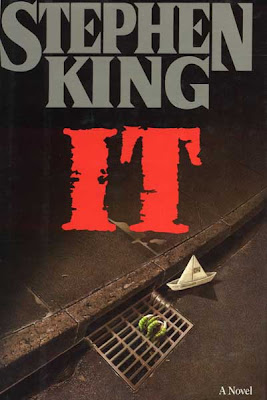
I’m not the biggest Stephen King fan in the world. I find that he can be hit or miss, which is probably to be expected of a writer so prolific as he. I haven’t read everything of his; not even close. I’ve read some stuff of his that I liked a good amount (Salem’s Lot), some stuff that I enjoyed a bit less but still liked just fine (Carrie), some stuff that I outright bounced off (Dreamcatcher), and a range of reactions thereof. But I have also read a good deal of his work that just blows me away (The Stand, numerous short works of his). I’ve often seen King’s It cited as one of his best and scariest novels, but I’d never read it until just a short while ago. And wouldn’t you know: it’s one of his best and scariest novels. It’s also, in my opinion, a great novel.

The book opens with a scene of fairly shocking violence as a small child is killed in the town of Derry, Maine by something that lives in the sewer. It calls to little George Denbrough as he is floating his newspaper boat down the street gutters which are swollen with rain; it appears to him as a clown dwelling within the sewer grate, and when it beckons to him with the promise of cotton candy, the clown – named Pennywise – grabs George’s arm and pulls on it, pulls harder and harder, until it rips free and little George dies. Thus begins Pennywise’s reign of terror in Derry in 1957, which eventually turns out to be a cyclical event; Pennywise shows up every 28 years or so for a fresh round of violent killings. Meanwhile Derry goes on, as it always has – a sad town where life just kind of grinds on and on, until the grinding of the decades is punctuated by the murderous awakening of the malevolent clown that lives in its sewers.

The main characters in the book are a group of teenage children, and the same children as adults, in 1985 – twenty-seven years after the 1957 arise of Pennywise, and therefore on the cusp of the new one. One of the kids is little George’s older brother, Bill, and as the summer of 1957 begins, none of them knows each other well at all, but circumstances bring them together – circumstances like Pennywise and the fact that they have each been targeted by the local bully, a boy named Henry who is in his own way as malevolent as Pennywise himself, who is actually the embodiment of something almost eternal. And in 1985, the kids – now adults – are brought together again, back to Derry, to do battle with Pennywise again. The novel shifts back and forth between these two timeframes, and King does this with such amazing facility that it is actually two stories unfolding at the same time. The 1957 parts never once feel like mere flashback, even though we know that by definition the characters alive in the 1985 chapters of the book must therefore survive the 1957 parts. It’s a testament to King’s skill that instead of grinding through large segments of the book given over to flashback, we instead sense that we’re following two stories that happen to befall the same group of people, many years apart.

King’s sense of pacing is pretty remarkable, given how long this book is. Even more impressive, though, is King’s ability to create a number of characters, this circle of friends bound by grim destiny, who are all vivid and real. Ultimately this is why the horror in the book works, and why It is such a scary read. It’s not all about ratcheting up the gore quotient; it’s about depicting horrible things befalling people we care about. But more than that, King’s gift for not only creating people we care about but also for people who genuinely feel like real people, and who respond to things in a very real way. This is King’s great strength as a writer, and it’s on tremendous display here. Not only are we sympathetic to Bill and Eddie and Beverly and Ben and the others, but we see them react to events in ways that we might well react ourselves if we found ourselves confronted by the kinds of horror that confront them in It.

That’s another of King’s great strengths: his knowledge that there are, in fact, many different kinds of horror. The scary stuff in It comes in a wide range of types, and not all of them are supernatural. In fact, some of the scariest events in King’s book don’t involve anything supernatural at all: they are the terrors we all remember (or maybe only some of us remember) from being the kid singled out by the school bully for continual “special treatment”. There is more than one way to scare a reader, and King at his best always does. In It, King creates for us a group of outcast children who feel like outcast children and who suffer all the normal horrors that many outcast children face, even before they are confronted by the horrible clown who lives in the sewers of Derry.

A word about the setting: Derry is a fictional city in Maine, which is a setting used by King in a number of other works. It’s not, as far as I know, a “redressed” version of a real place, but a creation from King’s viewpoint of the kind of city you’d find in Maine — if that city happened to be the scene of numerous supernatural horrors throughout its history. Several times in It, it is suggested that the kids aren’t just battling a demonic clown, but some kind of darkness in the very spirit of Derry itself. King portrays Derry as an organic being all its own, with a long — and very dark — history that we learn along the way. The book, therefore, spins three stories together: our child heroes in 1958, their adult exploits in 1985, and the long dark travails of Derry itself.

And yes, this book is scary. There is some extremely disturbing imagery throughout the book, and particularly so in the last 150 pages or so, when the tales in both timelines start plowing toward their respective conclusions. The ending is moving, satisfying, and poignant. It is amazing. If you have any love for the horror genre at all, read it.

Share This Post