Stick a fork in it?

I linked it in yesterday’s Sentential Links, but I wanted to flesh out my response to George RR Martin’s irritation at people who are irritated with him that A Dance with Dragons, the fifth book in his Song of Ice and Fire series, isn’t done yet. John Scalzi posts about this:

Some fans do have a tendency to forget that the creative folks they love are not simply black boxes, who produce desired product at regular intervals. They’re actually real people who do other things than just what the fans want them to do, because humans from time to time want to do the things they want to do, not the things other people want them to do. Yes, some fans don’t like that, but you know what, screw the type of fan who thinks a writer (or musician, or actor, or whatever) exists only to provide them with the entertainment of their choosing.

I’ll go personal here and talk about my own experience. As most of you know, the books in my Old Man’s War series are my most popular ones; each of the four novels have done very well and even the shorter works are pretty popular. There are people who would be delighted if all I did was write OMW universe books from now until the hopefully long-future date at which I drop. But thing is, at the moment, I have no plans to write any more OMW books. It’s not to say I never will, if I figure out what I want to do with that universe from here. I expect I may. But at the moment: Nope. I’ve got other things I’m working on which at the moment interest me more.

Now, I know this annoys some people — my matrix of ego-surfing search engines alerts me to many incidents of fan entitlement, particularly as regards the OMW universe — but I don’t think they understand what they’re asking for. Yes, I could write OMW #5 at the moment, but I guarantee it would suck, because at the moment I don’t know what I would write about, and thus OMW #5 would simply be a bit of commercial hackery, and it would show. And these same fans would say “Yeah, the series used to be good, but then he started phoning it in around book five.” You know, if I’m going to annoy a fan, I’d prefer to annoy a fan by not writing a book that sucks, than by writing one that does.

These are all points well taken. I’d only have a couple of rejoinders: first, I’m not sure the OMW books of Scalzi’s are a great counterexample, since they’re self-contained books; if he never writes another, he’s not leaving anyone clamoring for the end of the story. Second, I do think that Martin has himself set up a lot of the bad feelings by periodically making overly optimistic appraisals of his progress on Dance, and by setting up the structure of Feast so as to imply that Dance would come along in pretty short order. Fans no doubt fear that the next book after Dance will take an equivalently long time, and there’s no telling how long this series will become when all is said and done. I have a feeling that this series may end up going unfinished, and that would be a shame, even if I was disappointed a bit with Feast.

But this sort of thing is hardly new in the art world. Here is Richard Wagner, writing a letter in 1851 about his new project, an opera based on the legends of the Nibelungs:

With this new concept, I sever all connection with our present-day theatre and its audience: I make a definite and permanent break with present-day forms. Would you like to know what my intention are regarding my plan? In the first place, to carry it out, so far as lies within my power as poet and composer. This will take me at least three full years.

So, in 1851, Wagner was figuring on three years to write his Ring Cycle. When did he actually finish Gotterdammerung, the final opera in the cycle? Not until 1874, twenty-three years later. Of course, Wagner didn’t have legions of fans on the Internet clamoring as to his progress, which is the only thing that’s different, I suppose.

Share This Post

Fantasy movies: A list!!!

Over at World in the Satin Bag, S.M. Duke gives a list of his top ten fantasy movies. As always, I shall reproduce said list, with comment. Huzzah! (Cue the chirping of crickets…anyway….)

Lord of the Rings (Peter Jackson)

Absolutely. This is probably the greatest fantasy film of all time. (Referring, of course, to all three films collectively, which is the only sensible way to think of them.) They’re not without flaws, God knows, but the sheer edifice of the creative effort here is so massive as to render the flaws minimal by comparison. It’s hard to imagine a production of this scale ever taking place again.

Legend

I think I watched this in college, but I’m not even sure if that’s the case. I don’t remember the movie being memorable. This movie tends to be particularly reviled by film music lovers, because its original score by Jerry Goldsmith – one of the finest he ever wrote – was replaced for the US release with a lesser score by Tangerine Dream.

Pirates of the Caribbean: The Curse of the Black Pearl

I’m fine with this being here; I loved the first movie and consider it one of the better cinematic adventures of the last ten years or so. Captain Jack Sparrow is virtually iconic. Now, I would note here that I don’t hold the two sequels in nearly as low regard as most others seem to do; I think there’s a lot of good stuff in those movies, and had they made one more pass at those scripts in the rewrite phase and recast Lord Cutler Beckett with an actor who had any screen presence whatsoever, Dead Man’s Chest and At World’s End would be viewed in a much better light.

The Wizard of Oz

Sure. I loved this movie when I was a kid, then I went through a long phase of thinking it was a piece of mawkish, sentimental rubbish. Then I watched it again in college and realized how full of crap I’d become. I’ll never forget going with The Wife (she may have been The Girlfriend at the time) to see Wizard of Oz on the big screen.

Princess Mononoke (Mononoke-hime)

Picking a Miyazaki film is hard! You have to have one; he’s probably on a consistent basis the best fantasist working in film today. Oh hell, forever that “probably” – Hayao Miyazaki is the best cinematic fantasist alive today, and I could make a case for any of his films appearing on a “Top Ten Fantasy Movies” list. I’ll go ahead and agree with this one, simply because Mononoke Hime is the first Miyazaki film I ever saw. It is a beautiful, challenging, magnificent movie.

Toy Story

Well…I suppose it gets mentioned because it’s the first of Pixar’s films, and yes, it’s a wonderful, wonderful movie. But if I’m required to have a Pixar movie here – and the Pixar body of work is almost as good as Hayao Miyazaki’s – I’d go with my personal favorite, Finding Nemo. That movie just hits my sweet spot in every possible way. I’m sure there’s something wrong with it. I just don’t know what that is.

The Princess Bride

How I remember first seeing this movie. The commercials on teevee made it look like a fun fantasy romp, so I was confused when the theater darkened and when the movie started we were in some sick kid’s bedroom. What the hell kind of fantasy movie was this? Well, I sure found out. People who don’t love this movie are sick, sick individuals who shouldn’t be allowed to leave their homes for fear of infecting the populace.

The Neverending Story

I didn’t like this movie, I’m sorry to say. It just didn’t do it for me. Yeah, it’s about the magic of reading and of imagination – but it’s also boring.

Willow

Meh. I really loved it when it came out, but when I watched it again a few years ago, I didn’t think it had aged well at all. It’s very well made, and the acting is generally good, but the story is relentlessly derivative. It’s watchable, and I don’t hate it, but it’s certainly not all that great.

Alice in Wonderland

Not really sure. I haven’t seen it in a few years, and even then it was never one of my favorites. (We’re talking about the animated Disney one, right? Was there another version out there somewhere?) For Disney, I’d cite Pinocchio, or better yet, my favorite Disney film, Peter Pan.

So, I’d probably replace five of the movies on this list. I already named two replacements, so I need three more, replacing Legend, Willow, and The Neverending Story. Well, then: let’s go with The Thief of Baghdad for an old movie, Krull for an 80s fantasy flick (no, it’s not that good, but I certainly like it better than Legend), and for a dark fantasy, The Sixth Sense (a movie I still like).

Share This Post

Kushiel

Kushiel’s Dart is the first “fat fantasy” I’ve read in a long time; and I enjoyed it so much, I may find myself shying away from the genre for a while for fear of disappointment in whatever Fat Fantasy book I pick up next. Jacqueline Carey has crafted here a novel that put me in mind of Guy Gavriel Kay; in fact, I thought more than once while reading it that this is what GGK would have written if he’d been a woman. This was a wonderful, wonderful book that only let me down at the very end, when it came time for Carey to set things up for the sequel.

The setting was the first thing about the book to remind me of GGK. We’re in a land that is basically Europe with the names changed, and the history is strongly based on Europe as well. In their “Middle Ages”, the main action takes place in the City of Elua, named for Blessed Elua, an angel born in the aftermath of the crucifixion of Yeshua more than a thousand years before. Blessed Elua and his followers established a land where the guiding priciple is Love as thou wilt. Into the service of Naamah, one of Elua’s followers, comes our heroine, Phedre, whom we meet as a child but who grows up before our eyes over the course of this 900-page novel. She is sold into the service of Naamah, which makes her a courtesan; later, she comes into the direct employ of a charismatic teacher named Anafiel Delaunay, who turns out (as does everybody in this complex book) to be much more than he seems. Phedre learns much about the world while in Delaunay’s service, much that eventually puts her in danger as she finds herself engaged in the court politics of this dangerous land; but Phedre is a good student and sharply intelligent, so she becomes as much a player as an observer over time.

More than that, Phedre is a rarity among courtesans: she has a red mote in her eye, which indicates that she has been marked with Kushiel’s Dart (Kushiel was one of Blessed Elua’s followers), and as such, she is something called an anguissette, a person who experiences physical pain as erotic pleasure, which leads to some fairly difficult passages in the book wherein Phedre describes for us her erotic actions (the book is told in first person, from Phedre’s perspective). Fair warning here, folks: if reading about what is literally sadomasochism isn’t your cup of tea, this book won’t be for you; but likewise, if you don’t mind that material (which is very well written, and not really gratuitous, in my estimation), the rest of the book is worthy of attention.

I don’t want to say a whole lot about the plot of this book, not just because I wouldn’t want to spoil it, but also because it’s a hard book to summarize. It’s very long, being the type of book one loses oneself within. One of the book’s most important characters, Joscelin Verreuil, who serves as bodyguard (and eventually much more than that) to Phedre, isn’t introduced until after page 250. This is an actual epic of a book, with the action ranging over virtually the entire continent of “Europe”. Along the way we meet roving bands of gypsies and their king; we travel north and east into the rugged lands dominated by Viking-like warriors called Skaldi, who are gathering underneath the banner of a new warlord; we travel west, over the straits, to the barbarian island realm where the blue-painted warriors fight for dominion. We meet the Master of the Straits, the being who controls the weather in the straits between Alba and Terre d’Ange (think the English Channel), choosing who gets to make passage and who doesn’t. We meet nobles motivated by love and by hate, soldiers motivated by money and by loyalty, lords motivated by revenge and lust, and noblewomen whose motivations can’t even be summarized in any real way.

Kushiel’s Dart is the start of a series, and I have every intention of continuing on. It takes a really good “Fat Fantasy” to capture my attention these days, but this one did. Carey creates a vivid world here, familiar and fantastic, and she populates it with memorable people who stand out and command sympathies – even the villains. I loved this book.

Share This Post

Is short fiction dead yet?

Realms of Fantasy, one of my favorite magazines and one to which I’d eternally hoped to one day sell my work, is shutting down. There are fewer and fewer markets out there for short fiction. I’m frankly starting to think, the hell with it, and just put all of my own stuff up right here and let whoever finds it, find it.

Oh well. I always enjoyed reading Realms, and I’ll always have my stash of back issues.

UPDATE: Check out Warren Ellis’s headline for this news.

Share This Post

Frak! Frak frak frakkity frakking frak.

One of my most beloved literary traditions, the annual Year’s Best Fantasy and Horror volume, will not be published this year. Those books are worth their price just for the introductory essays alone; they are chock full of reading recommendations and reviews of the year gone by in Fantasy and Horror, with long essays on graphic novels and music and movies as well as literary F&H. I get hours of pleasure from those essays each year, and their information always goes a long way to shaping what I read over the coming year. And that’s before I even mention that these books are, each one of them, wonderful anthologies of fine fiction as well.

Crap.

I’m not sure as yet if any publishers have picked up YBFH in the current publisher’s stead. We’ll see. But the prospect of no YBFH in 2009 makes the coming year feel all the bleaker, and if there’s one thing 2009 doesn’t need more of, it’s the prospect of more bleak.

Frak.

Share This Post

A bit o’ geek stuff

A few links of geek and pop culture import, starting with some items that caught my eye at AICN:

:: A movie version of Philip Reeve’s novel Larklight is in the works. Hopefully this project goes well, because the book is one of the most entertaining reads I’ve had in recent memory. I just hope they don’t get Hans Zimmer to write the music. Nothing against Zimmer, but this will really need a pompous, Elgarian sound.

:: Looking at NBC’s announced schedule for next season, I see that ER‘s next season will be its last. Longtime readers will know that I think this should have happened four or five years ago, when the show wasn’t a complete shell of its former self. The show started losing me with the awful killing of Dr. Romano, and then it came close to permanently losing me with the even more awful resolution of the Reece Benton custody battle, and then it finally lost me for good when it had its own Moldavian Wedding Massacre (see this post of mine for the reference there) and had a bunch of criminals shoot up the ER. Back in the day, though, wow, was that show good.

:: The film version of The Hobbit officially has a composer: Howard Shore, who is the only choice, really. The idea of a Middle Earth film without music by Shore is just plain wrong.

And to think, I thought for a fleeting moment back in 2005 that, with the conclusion of the Star Wars saga, geek culture would enter a Dark Age….

Share This Post

Bring on the Gelatinous Cubes!

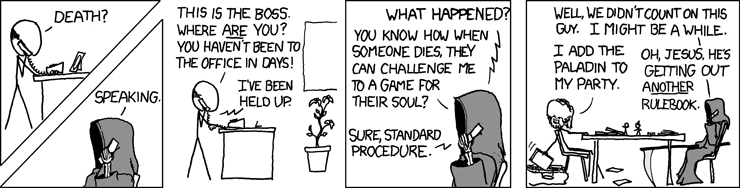
As just about everybody with a blog already knows, Gary Gygax, one of the inventors of Dungeons and Dragons, died last week. I’ve been too busy to post about it until now, and I also didn’t want to make the same obvious joke that everybody else did about Gygax failing his last saving throw. (A favorite geek humor joke of mine is: “Jesus saves! The rest of you take full damage.”) I, of course, choose to envision God as the ultimate Dungeon Master, and with regard to Gygax, he did the old DM trick of dropping a bunch of dice on the table behind his screen and then shaking his head and saying, “Ooooh, bummer, dude.”

But of course, leave it to xkcd to come up with the best Gygax tribute I’ve seen anywhere:

I was never a huge AD&D player, although there was a period in sixth grade when everybody in school was seemingly obsessed with it for some reason, to the point where cliques formed within our class based on whose character was a God and whose was a Demon. (What can I say? We were a bunch of dumb-assed eleven year olds.) Strange thing was, for all the D&D babble we all indulged, we did almost no actual playing of the game, which was a bummer. I didn’t actually get to play the game in anything close to the manner in which it’s meant to be played until college, when I was a part of two separate campaigns, the first in our freshman year and the next when we were juniors and seniors.

The DM of our first campaign was hard core on the role-playing aspect of the game. He and his high-school mates had used AD&D campaigns partly as means of honing their improv theater chops (this guy was really into drama), so we had to make a lot of effort in his campaign to be “in character”. This occasionally led to interesting results. Our second campaign, spread over the latter portion of junior year and a big chunk of senior year, was run by a guy who was a more action-oriented DM; with him, there was less emphasis on role-playing (although there was that) and more on pacing and excitement. He was really good at managing combat so that the “battle sequences” were exciting, and he was also good at managing the treasure and rewards, consistently finding the “sweet spot” between extreme stinginess (“The red dragon is dead, leaving his horde of one hundred copper pieces to be split amongst the party, after you pay these six NPCs their agreed price!”) and Monty Haul (“Your party of level eight characters has slain the duo of bugbears, taking their horde of one million platinum pieces, five swords +6, and eight scrolls with one Wish spell on each!”).

Both campaigns took place in the Greyhawk setting, so I never got to play in the Forgotten Realms. My own campaign, had we not petered out as a group in senior year, would have been a Forgotten Realms campaign. I also bought a lot of the “Al Qadim” materials for another campaign, in the style of the 1001 Nights, that never took place.

AD&D was, of course, lots of fun, and we usually had a blast whilst playing. I haven’t played a single game since college, fifteen years ago now, and while I don’t have a whole lot of desire to play again (mostly because I know that I just don’t have enough time), I’m glad I got to play the games that I did, and I do wish we’d had some time to get more playing in there. So, like every geek these days, I owe a certain debt to Gary Gygax.

Share This Post

Drink up me hearties!

So in the last month we’ve finally caught up on our Johnny Depp swashbuckler viewing by watching the second and third Pirates of the Caribbean movies, Dead Man’s Chest and At World’s End. Prevailing opinion of these movies, so far as I can tell, is that each could have been an hour shorter, each is a mess with too much incomprehensible plot, each consists of a couple of large-scale action set pieces surrounded by boring scenes in which characters continually doublecross each other. In fact, the one word that seems common to nearly every review of these two movies I’ve read is “mess”. Ouch. They must really be bad, right?

Well, wouldn’t you know it: I love the two sequels, I found the plots of each fairly easy to follow, and I wasn’t in the least bit confused by all the apparent switching of loyalties. Go figure. These aren’t great movies, but they’re really very good, in my view. I can’t see why so many people hated them.

I don’t understand the critiques of the films from a story point of view, at least as far as the claims that there isn’t enough story to sustain the films and that the second movie is nothing more than set-up for the third. Well, DMC is designed to lead directly into AWE, so of course it’s a large set-up: it’s literally one-half of a story, with the other half contained in AWE. The PotC movies are less like, say, the Indiana Jones or James Bond films, each of which contains a single story that has no bearing on the next. They’re more like the Star Wars or Lord of the Rings movies, in which they are intended clearly to serve as parts of a larger whole. Since DMC is the first half of a story, to say that it’s set-up for the third movie is actually praise rather than complaint: the movie does its job well.

So what of that larger whole, anyway? I genuinely didn’t have much problem with it. Some stuff isn’t handled as well as it should be, but for the most part, I was never totally confused by the machinations of the story, even when characters start betraying one another and apparently switching sides. I say “apparently” because, for all the double-crossing that goes on, the actual motivations of the characters never changes, which is nice: they’re always acting toward the same goal. Will Turner’s actions are driven first by his desire to be free to marry Elizabeth, and then by his desire to free his father from Davy Jones’s servitude. Captain Jack Sparrow’s actions are always driven by his desire to be free, and by the fact that he defines his freedom in terms of having a ship such that he can always sail wherever he wishes. Now, it may be the case that the various motivations aren’t always cleared up right away, and sometimes when they really should be, but they’re there. Basically, I found that the characters stay true to themselves throughout, which is something I appreciate.

Taking the two films separately, I can certainly see how the plots can be seen as convoluted, but really, they aren’t that complicated after all. Jack’s actions at the beginning of DMC are explained soon enough: he became Captain through making a bargain with Davy Jones, who raised the Black Pearl from the ocean floor for Jack to command, with the proviso that after thirteen years of being Captain, Jack would owe Davy Jones one hundred years of servitude aboard the Flying Dutchman, a bargain Jack is clearly eager to circumvent; this he plans to do by capturing the Dead Man’s Chest, which contains the very heart of Davy Jones. Leverage. Captain Jack Sparrow is always all about leverage.

Meanwhile, Will Turner and Elizabeth Swann are to be married, but they are arrested for piracy instead by Lord Cutler Beckett, the new Big Cheese in the Caribbean. Will is offered freedom in exchange for retrieving Jack’s compass, which we later learn points in the direction of whatever one wants most; meanwhile, Elizabeth escapes and goes after Will, not understanding why he’s left without telling her where he was going.

What’s so confusing about this? Nothing that I can see, really, but the film does derail itself a bit with a lengthy set-piece that involves an escape from a tribe of cannibals. Maybe that bothers some viewers, but I didn’t have much difficulty with this either, as the whole sequence is nicely in keeping with the gonzo action sequences of the first film. (I particularly love the double-take both sets of pirate prisoners do when they realize that there’s really no reason for both groups to survive and escape to the Pearl.)

I don’t need to go into the plot details beyond that, but I note that it’s not all that hard to follow, and with one admittedly large exception, just about everything that happens actually gets explained at some point. Why do Jack Sparrow, Will Turner, and James Norrington all want the Dead Man’s Chest? Who is Tia Dalma, and why does she have the presumed-dead Captain Barbossa ready at hand? Why is she already apparently planning a voyage to World’s End, to save Jack Sparrow? Why is Lord Beckett trying to get Jack’s compass? Why is Davy Jones always playing emotionally-laden music on the organ in his quarters? What is the significance of his locket? All of this is explained, and within the dense and happily gonzo mythology the PotC writers have created, it all fits together pretty nicely. With the exception of a couple of action sequences, just about everything that happens in these movies actually leads on to the next thing. Fine by me. Sometimes the movies take their sweet time in explaining why one thing leads to the next thing, but that’s not the same thing as not explaining it at all.

I also loved how the afore-mentioned gonzo mythology of the film draws from all manner of sea lore, with great sea monsters, buried treasures, curses, a ghost ship called the Flying Dutchman, Davy Jones’s locker being a real place belonging to a very real Davy Jones, and so on. I loved the design of the creatures, from the skeletal cursed crew of the Black Pearl in the first movie to the men of the Dutchman, who are gradually becoming one with the sea and are thus taking on the appearance of all the creatures of the ocean. I loved how many of the minor moments of the first movie came into play in the later films: that one guy’s wooden eye, the way that Will gets Jack out of a prison cell, and so on. The visuals of these films are magnificent, with every ship seeming to move through real water with very real weight, and Gore Verbinski’s direction of the action sequences is extremely well-handled. In the final “Maelstrom” sequence of AWE, all hell is breaking loose, and yet Verbinski keeps everything clear to the point where the sequence is very easily followed. I never found any of the action sequences hard to follow, and it’s these kinds of sequences that are the hardest to get right.

So, what else? Most commentators I’ve read have mentioned that Orlando Bloom and Keira Knightley are barely adequate in the films, but I generally had little problem with them, so there’s that. As for the other actors, I loved all but one. We’ll get to that in a minute, but first the good: if they make more of these movies, focusing on Captain Jack Sparrow, I could watch Johnny Depp playing him forever. I nearly cheered at the end of DMC when Captain Barbossa was revealed to be very much alive; one great thing about AWE is the way Barbossa becomes one of our heroes, as opposed to one of our villains, and yet he remains the same character. He hasn’t had a change of heart; it’s the allegiances of everyone around him that have changed. That was great, and Geoffrey Rush could play Barbossa for life, as far as I’m concerned, as well.

The films also have a lot of fine dialogue, with lots of exchanges that gave me pleasure. This, between Jack Sparrow and Barbossa, when they are standing beside the body of the dead kraken, really stood out in my ear:

BARBOSSA: Still thinkin’ of running, Jack? Think you can outrun the world? You know the problem with being the last of anything, by and by there be none left at all.

JACK SPARROW: Sometimes things come back mate. We’re livin’ proof, you and me.

BARBOSSA: Aye, but that’s a gamble of long odds, ain’t it? There’s never a guarantee of comin’ back. But passin’ on, that’s dead certain.

JACK SPARROW: Summoning the brethren court then, is it?

BARBOSSA: It’s our only hope, lad.

JACK SPARROW: That’s a sad commentary in and of itself.

BARBOSSA: The world used to be a bigger place.

JACK SPARROW: World’s still the same. There’s just less in it.

“There’s just less in it.” What a great sentiment, and what a perfect line for Captain Jack Sparrow, a man who would rather live free in a world where he can die in the grasp of a vicious “beastie” like Davy Jones’s kraken than any other. Jack is mourning the monster who killed him. I loved that.

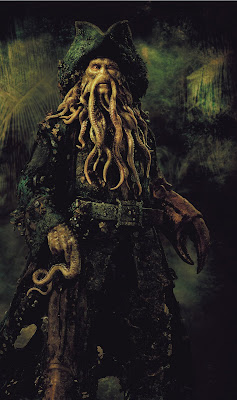
Another great bit of casting is Bill Nighy as Davy Jones. His face is obscured by the visual effects of the tentacles they give him, but he is still able to emote strongly with his eyes, and it’s clear that the facial expressions of his tentacled mug are models on the real expressions he made at the time, so much so that I found him totally believable as a character. His performance here is along the lines of Andy Serkis as Gollum in the Lord of the Rings films: even though we see almost nothing of the actual man, he gives a full-on performance through and through, as the man fearsome enough to make Captain Jack Sparrow afraid. And as long as I’m on the subject of Davy Jones, he’s really a great character, a man who has become somewhat twisted and refused to carry on his duties as Captain of the Dutchman in his bitterness over his doomed love for Calypso. The scene between him and her in the hold of the Pearl is a really good scene: he demands to know why she wasn’t there for him when she’d said she would be, and she replies, “It is my nature.” Isn’t that the truth? The beautiful sea has been betraying sailors ever since men first put boats into water. There’s quite a lot of insight in these films that slides right by, almost unnoticed.

So who, then, is the weak link in the cast whom I mention above? Sadly, it’s a big one, and it’s probably the biggest reason I think that the PotC sequels miss the mark of being potentially great adventure movies. It’s the guy who plays the main villain of the two films, Lord Cutler Beckett. I can’t remember the name of the actor, and that’s the problem: he’s as white-bread a villain as you’ll find, basically using two facial expressions and a British accent to establish his villainy. This is a person who aspires to ruling over all the seas of the world, and he is brazen enough to take command over Davy Jones himself, and he’s played by one of the blandest actors I’ve ever seen. He’s supposed to be the virtual equal of Captain Jack Sparrow, having been the man who branded the Captain a pirate, and yet, the actor is blown off the screen by Johnny Depp in their one big scene together. Heck, he’s even dominated on the screen by Orlando Bloom. For this part, an actor was needed who was at least equal to Johnny Depp, and this simply didn’t happen. A great adventure movie needs a great villain. This one could have had a great villain, but it didn’t. (Aside from Davy Jones.)

The failure of Lord Beckett isn’t just the actor’s fault, though; the script leaves him too blank. We learn that Beckett and Jack Sparrow have a history, but we learn nothing at all of what that history is. Jack points out that his compass won’t help Beckett because what Beckett most wants is Sparrow dead. This is an interesting little twist, but the obvious question — why does Beckett want Sparrow dead – is never answered. Beckett is more cypher than character, and it hurts the film.

Other problems with AWE are smaller, but real. The freeing of Calypso from her human bonds is a good scene – Captain Barbossa’s interpretation of what it means to “speak to a lover” is hysterical – but then there’s a very odd bit where Calypso suddenly becomes a fifty-foot giant before exploding into a million crabs. This was just silly.

Also faulty is the nature of the final battle. While it’s certainly true that we only really need to see a clash between the Black Pearl and the Flying Dutchman, since those are the two ships we’re actually invested in, this needed a bit more set-up, since the film has to this point been setting up a massive battle between the pirate fleet and the English. Even worse is that there was an obvious way to do this: by resorting to the Pirate Code of the Brethren. (“I call on the right of Single Combat by ship: one vessel from each fleet. The Pearl versus your flagship.” Which Beckett could then use to seize the upper hand by sending not his flagship, but the invincible Dutchman.) Truth is, as much as I loved watching these two films, they definitely could have used another run-through in the script-writing phase. A lot of necessary exposition in these movies comes at very odd times: it’s from the dead Governor Swann (whose demise really should have been shown onscreen, come to that) that we first hear the fateful words “The Dutchman must have a Captain”, and the explanation for Tia Dalma’s resurrection of Captain Barbossa goes by in a flash, even though it makes perfect and utter sense (he’s one of the Pirate Lords, and without him, she can never be freed from her human bonds as Calypso).

So the second and third PotC films are big, loud, exuberant films that feature many conflicting loyalties and actions on the part of their characters that are sometimes a bit hard to follow. But that’s not the same as saying that these films are a “mess”.

(I’ll say something in a later post about Hans Zimmer’s music for these films. Zimmer’s a troublesome figure in film music.)

Share This Post