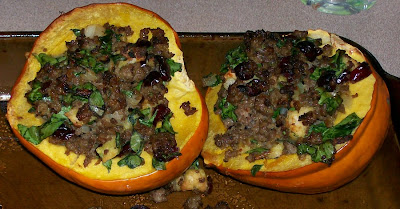
I think I can say with a high degree of confidence that I ate better than you did last night, thanks to The Wife’s cooking of a new recipe.

I am now well on my way to becoming a big fan of squash. I never cared much for them until about a year ago.


The official site of Kelly Sedinger: Reader, writer, photographer, and dreamer
One of the towns adjacent to the one in which I live is called Hamburg, NY. A bit of the local lore of that particular burg is a claim that their town is the site where the quintessential American sandwich, the hamburger, was invented.
This guy says this is false, and that the hamburger as we know it today was invented by the guy who started the White Castle chain.
While I don’t have much emotional investment in our local claim to have invented burgers, it does disappoint me that the thing was birthed by White Castle. That would be like learning that pizza was invented by Little Caesar’s.
(If you can’t tell from my tone, the mythic appeal of White Castle has always escaped me. Those little burgers of theirs are nasty.)
I mentioned a while back that The Wife and I decided to use some Christmas money to strike one item from our long-term wish list: the KitchenAid mixer. So far we’ve used it a number of times, and it’s just a wonderful, wonderful thing. It’s totally worth the loss of a significant chunk of our counter space. (In this apartment, we don’t have a lot of counter space.) Not only does the mixer allow us to avoid the sore-arm syndrome that comes with using a hand-held mixer for more than two or three minutes at a time, but it allows us to do more involved recipes that would be totally impractical with a hand-held. Case in point: pizza dough.
For a long time I’ve been wanting to make my own Chicago-style deep dish pizza. Two nights ago, with the help of the mixer, I got my wish. Here’s how it all went down. I used this recipe, which I’ll annotate with pictures.
First, there’s the mixing of the ingredients to make a batter; then you add the remaining flour to turn the batter into a dough. If you’ve ever had the fortune (or misfortune, as the case may be) to work at Pizza Hut, this dough turns out to be slightly less sticky than Stuffed Crust dough, but it’s pretty close to that.
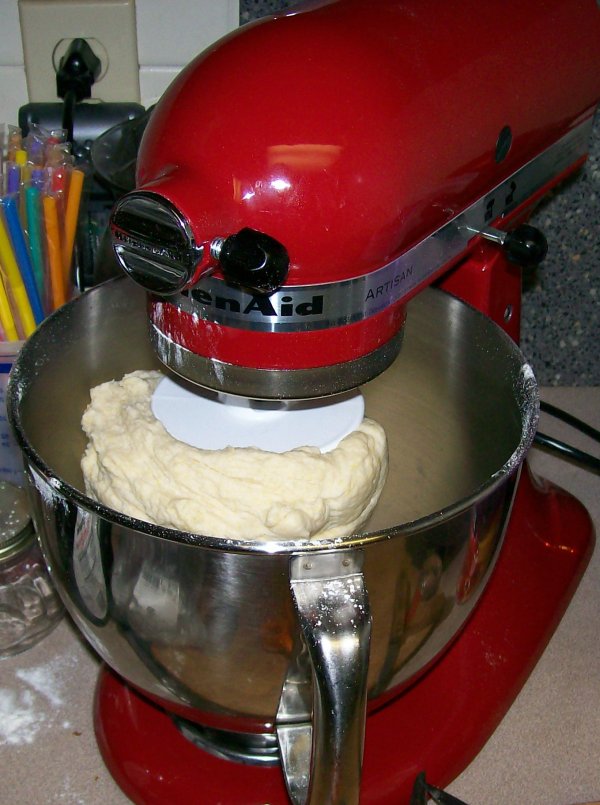
The recipe says to put it on the counter to rise and cover with a large bowl, but since I don’t have that much counter space, I put it in the bowl and covered it with a damp towel. Here’s the dough before rising:
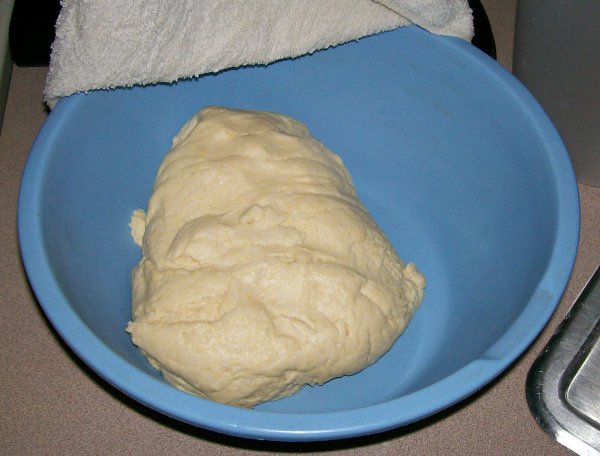
And here it is after doubling in bulk.

The fist there belongs to The Daughter, who was tickled at the concept of punching down the dough. Now you let it rise a second time, again to double in bulk. While the dough is rising, you have plenty of time to get the tomato mixture ready and do some other topping preparation. Here’s Your Fearless Narrator, frying up some bulk Italian sausage for the pies:

(Hey, why don’t chefs wear overalls? You get lots of pockets for holding thermometers and utensils and whatnot, they pretty much eliminate the need for an apron, and you can hang a towel off the hammer-loop. The stuff I think of….)
Finally, the dough is done with its second rising, which turns out to take less time than the first:

That red mixing bowl on the right contains my tomato mixture. The recipe calls for a large can of plum tomatoes, but I prefer smaller chunks, so I went with two 14-oz. cans of diced tomatoes, to which I added some garlic, basil, oregano, salt, and pepper.
We punch it down again, and then start putting it into the pans. These are regular nine-inch cake pans. You rub them with oil, dust them with cornmeal (the recipe doesn’t call for this, but I did it anyway), and then plunk half the dough into each. Then you just use your fingers to “smoosh” it out, right up the edges of the pans, like so:

Here’s one area I would do differently next time: I didn’t smooth it out quite thin enough, especially in the corner where the bottom of the pan ends and the side begins. This resulted in quite a thickness of crust at that point of the final product. But hey, live and learn!
By this point, most of your work is done, as long as you’ve observed the cooking principle of mise en place. (This means having everything chopped, diced, sliced, and prepped before you get to the final assembly of whatever dish you’re doing. Nothing sucks like having everything almost ready to go, and then realizing that you’ve forgotten to dice the onion or whatever.)
With Chicago-style deep dish pizza, your cheese goes in the bottom of the pie. You tile the slices, like so:

Here, too, an opportunity for improvement next time: I probably should have made my slices thinner, so I could use more of them for a better tiling effect. Not a huge thing, but one of those little touches that probably would have made the final product slightly more refined. That gets added to the memory bank for next time.
Anyhow, now is when we add the “toppings”, even though with this pizza they’re more properly thought of as “fillings”:

On the left we have pepperoni and Italian sausage; on the right we have Italian sausage, mushrooms, and onions. Now’s the time to pour the tomato mixture on top:

When this is done, you may think with alarm that you don’t have enough tomato mixture. Don’t worry about it. It’ll smooth out in the baking process. Now we simply sprinkle fresh Parmesan cheese over the top, drizzle a bit of olive oil over each pie, and we’re ready for baking!

Deep dish pizza takes quite a while to cook. I baked them for about forty minutes, side by side, in a 450-degree oven. And after you bake them, it’s essential that you let them rest outside of the oven for at least ten minutes before slicing. Once a deep-dish pizza attains the proper temperature in the middle (180 degrees), it will hold that temperature for quite some time. You want it to cool a bit so that the liquids resolidify a bit.
I also had a problem with grease running off the top of the pies, and onto the rack below. This filled the apartment with smoke, so on a very cold night, we had to open the patio door and some windows. You can probably alleviate this by putting some water in a cookie sheet and putting it on the rack below, but I didn’t try this, and I’m a little concerned about how any resulting steam would affect the pizza.
But anyhow, once the smoke cleared, we had a wonderful final product. Behold:
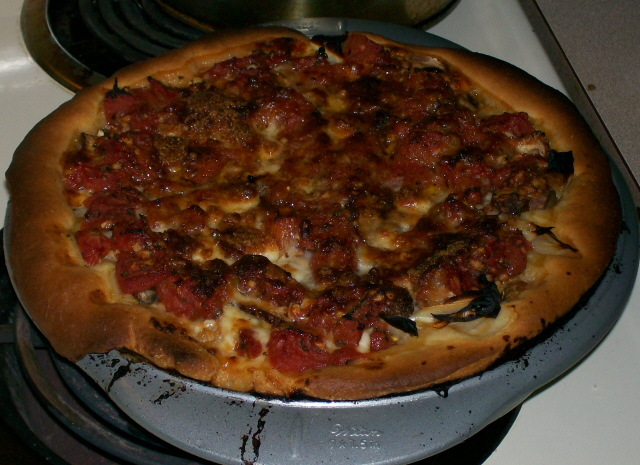
As I said above, the crust was a bit too thick at the corner edges. Also, I’m considering next time substituting melted butter for the olive oil in the dough recipe, in hopes of a flakier texture. This is my usual practice with new recipes: I do it exactly the way the book says to do it, but when I make it a second time, that’s when I start tinkering with it.
The proof, though, was in the eating, and all pronounced it delicious. So there you have it: I can make my own Chicago-style deep dish pizza. How awesome is that!
(And no, it is not a casserole. Anyone who says it is can bite me. It’s a pie, not a casserole. No disagreement with me is possible on this point.)
Ahhhh, the Pizza Wars are starting again!
Initiated by this site (which I saw on MeFi, but hadn’t got round to blogging yet, and which is as of this writing down because it got FARK’d and BoingBoing’d and MeFi’d all in the same weekend — but mirror links are provided there) wherein some fellow relates his obsessive effort to produce a New York City-style pizza, Alan and BuffaloGeek take their shots.
Says Geek:
However, there is nothing we disagree more vehemently on than the definition of good pizza. As you know, Pundito is a a fan of thin crust Neapolitan style and foldable NY Style Pizza…both are crimes against pizza.
I’m a fan of local Buffalo pizza for one reason only, it’s what I grew up eating. Nino’s, Bob & Johns, Bocce Club, Abbott, Avenue, Mister Pizza…all pizzas of my youth. While tasty and laden with crispy pepperoni memories, these pizzas fail the test of “Best Pizza in America”
When asked who makes the best pizza in the country, my answer is very simple. Lou Malnati’s, a Chicago institution and purveyor of fine deep dish pizza.
If God came back to Earth and asked to see evidence of gastrological perfection, I would take him to Lou’s for a slice of buttercrust deep dish pepperoni with mushrooms and hot giardiniera. If God is a vegetarian, I’d get him “The Lou”, which comes with basil and garlic spinach, mushrooms and sliced tomatoes covered with a blend of mozzarella, romano and cheddar cheese. Pizza perfection.
Retorts Alan:
He calls New York style / Neapolitan pizza a “crime against pizza”. Oh, no you di’int. Since the Neapolitans invented it, it is the default; the standard by which all other pizzas are measured.
“Stop the Madness!” says I.
We actually had a mini-discussion of this before in the Buffalo Prefecture of Blogistan, back in the days when Alan was still on Blogger. My thoughts, encapsulated here and here, have not changed:
Personally, I like NYC-style pizza just fine. But then, I like all styles of pizza just fine, really. Thin, foldable crust? Sure. Deep-dish Chicago-style, with the cheese tiled at the bottom and the tomatoes on top? Great. All styles in between? Bring ’em on.
“There are more pizzas in Heaven and Earth than are dream’t of in our philosophy,” wrote Shakespeare. And he was right. (Although, now that I think of it, I’m not sure the Bard was talking about pizza at all. Hmmmm.)
And a bit later on:
But what interests me is this (as I comment on his blog): everybody I’ve ever met who grew up on NYC-style pizza, with that type of pizza being their virginal pizza experience, loves it to the point of loathing every other kind of pizza that exists, anywhere. On the other hand, every person I’ve ever met who loves pizza but did not encounter NYC-style pizza first tends to love NYC-style pizza when they discover it, but they don’t drop every other style of pizza in its favor. I don’t know why this is, but it’s true. Talk to a native eater of NYC-style pizza, and they’ll react with horror at the idea of consuming any other kind of pizza. But talk to a non-native eater of pizza, and if they’ll likely say, “NYC-style? Yeah, that’s pretty good. So’s Chicago….”
I think that’s still the case. I’m always baffled by the notion that NYC-style pizza is some kind of Platonic ideal when it comes to pizza; pizza is a food that has evolved over many centuries, starting long before the folks in Naples with spices and meats served atop flatbread. There is no more a “standard” for pizza than there is a “standard” for chili, to name another food that varies wildly by region. (Don’t believe me? Order chili in Dallas sometime, and compare what they serve you to what comes in the bowl when you order chili in Cincinnati.) Or wine. Or beer.
Note my verb there: pizza evolved. Nobody “invented” pizza. The folks in Naples may have developed the historical dish that’s closest to what we now call “pizza”, but they didn’t “invent” pizza. At least, they didn’t in the same sense that Thomas Edison “invented” the incandescent light bulb and the phonograph.
As an aside, though, would it matter anyway if the Neopolitans actually did “invent” pizza? Who ever said that inventions should never change? I used to listen to music on my record player, but no one ever told me that I wasn’t really utilizing Thomas Edison’s invention just because the record was a flat disc as opposed to a wax cylinder. And as another aside, Neapolitan pizza wouldn’t exist at all as such if not for the importation into Italy of the tomato, which is originally indigenous to the Americas. (In fact, tomatoes were thought poisonous in Italy when they first arrived there, brought back from the Americas by the Spaniards; they were grown strictly as ornamental plants before they found their way into peasant food. Pizza, like so many other dishes, is originally a peasant dish that is now being fought over by the gourmet types!
So I’d say that the Neapolitan pizza is not the “standard by which all others are judged”, since the Neapolitans did not “invent” pizza and even if they did, merely being the inventor of something doesn’t imply that the thing will remain the exact same for the Rest of Recorded Time. So there.
I’d also take exception to Alan’s contention that a Chicago deep-dish pizza is not a pizza at all, but rather a casserole. I don’t frankly see on what basis deep-dish pizza can be denied to be a pizza, or on what basis it is a casserole. It’s a leavened flatbread-style crust onto which is loaded cheese and whatever other toppings are used. It is casserole-like in that it is baked in a dish and then typically served in that same dish, but merely sharing some qualities with a thing doesn’t make it that thing, right? An apple pie is baked in a baking dish, but that doesn’t make it a casserole. Neither is a quiche. Chicago deep-dish pizza is pizza, and like all pizza, it stands squarely in the pie family of dishes, and not in the casseroles. QED. (Heck, I have some recipes for “casseroles” that aren’t baked at all, but cooked in a slow cooker! Take that, Rigid Food Definition Police!)
Not, however, that I’d endorse Geek’s view that NYC-style pizza is a “crime against pizza”. I love a good NYC pizza. I also love Chicago deep-dish. Although, frankly, my personal preference tends toward the Chicago, because I adore that flaky crust. Oh man, that crust is just beautiful. But I’m not going to turn my nose up at a NYC pizza, either. And I love Buffalo’s pizzas too. (Well, most of ’em, anyway.) So I get the best of all worlds: I don’t have to turn up my nose at entire categories of pizza goodness! So, once again, I am supreme in the Buffalo Prefecture of Blogistan. ‘Twas ever thus!
And now, judging by the chirping crickets, I shall change the subject.
UPDATE 1-23-07: This post has been receiving several search engine hits per day for a while now, so for readers just coming, I more recently wrote — with photos — a post wherein I made my own Chicago-style deep dish pizza. Enjoy!
Lynn Sislo appears to have food on the brain today. First, she seems surprised that someone suggests putting sauerkraut in chili, but that’s nothing, really: when I went to college in Iowa, the local Pizza Hut offered kraut as a pizza topping. Ewwwww. (Strangely, while I don’t like sauerkraut itself and won’t eat it, I think that a nice piece of meat, like a beef roast or a nice thick section of Polish sausage, simmered until tender in a big pot of sauerkraut is just heavenly.)
More interestingly, Lynn solicits suggestions for musical food metaphors, taking this as a starting point:
If Johann Strauss II is the musical equivalent of whipped cream, Richard Strauss’s waltzes from the Rosenkavalier are whipped cream with a pound of sugar and half a dozen egg yolks.
Hmmmm…Strauss and whipped cream…never tried that before…hmmmmm….
OK, sorry about that. How about some other musical metaphors?
Mahler is a giant stack of buckwheat pancakes: wonderfully nourishing and filling, but he sits in your stomach forever.
Berlioz? He’s Chicago-style deep dish pizza: beloved by some, not understood by many.
I’d better give this up right now. Not only am I making myself hungry, but the whipped cream thing is…um, excuse me….
Three items of interest to home-bodies:
1. Tonight I made a favorite recipe of mine, Black bean and Beef Stew. This time, instead of using two pounds of ground beef, I used a little more than a pound of cut-up steak which I floured and browned, and made up the difference in meat bulk with thinly-sliced andouille sausage. And, to go with it, I made a loaf of beer bread, from the recipe in Emeril Lagasse’s newest cookbook. (Yeah, I love Emeril. Deal with it. BAM!)
2. John Scalzi links the perfect recipe for roasted chicken. I’d try it, but I’m lazy: when I get a hankering for roasted chicken, I buy one for $4.99 at The Store. (But they’re not organic. Oh well. Shoot my food up with chemicals, says I.) But there is a whole chicken in my freezer, so maybe I’ll give this a shot.
3. I don’t usually think of Snopes.com as a resource for home-ec type stuff, but this tip is right on: removing the layer of lint from the dryer’s lint-trap isn’t enough. You actually need to wash the thing.
OK, enough for now. I need to go hammer up some drywall or something.
Reading this post by Alan at BuffaloPundit, I note something odd about pizza.
Alan is a partisan of New York City-style thin-crust pizza. For those who don’t know what this is, the crust is thin, but not so thin as to be cracker-like. Instead, it’s just thick and doughy enough — and not one bit thicker or doughy-er, thank you very much — to be foldable in the hand whilst being consumed. It’s a unique texture for pizza, and even though Buffalo is in the same state as NYC, that style of pizza is very hard to find in these parts. So Alan reports on a few places here that make the authentic NYC-style product.
But what interests me is this (as I comment on his blog): everybody I’ve ever met who grew up on NYC-style pizza, with that type of pizza being their virginal pizza experience, loves it to the point of loathing every other kind of pizza that exists, anywhere. On the other hand, every person I’ve ever met who loves pizza but did not encounter NYC-style pizza first tends to love NYC-style pizza when they discover it, but they don’t drop every other style of pizza in its favor. I don’t know why this is, but it’s true. Talk to a native eater of NYC-style pizza, and they’ll react with horror at the idea of consuming any other kind of pizza. But talk to a non-native eater of pizza, and if they’ll likely say, “NYC-style? Yeah, that’s pretty good. So’s Chicago….”
(For the record, I think we make pretty decent pizza here in Buffalo. But it’s not NYC-style. We’re a Great Lakes city.)
UPDATE: Alan adds more here, giving the background that supposedly establishes NYC-style pizza as the best: according to his account. NYC-style pizza is the closest thing you’ll get to what is served as pizza in Italy. So, I suppose if one defines “best” along the lines of “most authentic”, I suppose that there’s an argument to be made. Pizza may have become the great culinary specialty of Naples, but it’s not like the Neapolitans invented it — the idea of putting toppings on flatbread goes back way farther than the Neapolitans. So, even though I love a good Neapolitan pizza, I still see little reason to anoint it “the best” pizza possible. (Outside of personal preference, that is.)
However, I don’t always think that “most authentic” is the best indicator of “best”, and pizza is one of those times. Pizza is a dish that has sprung into so much regional variation that I think that quibbling about authenticity almost misses the point entirely. It’s like chili, albeit not quite to that degree — chili’s regional variation is so extreme that it varies not from region to region, but from pot to pot.
Finally, here’s an interesting history of pizza, that offers among other things this tidbit about offical Neapolitan pizza:
Today, the Associazione Verace Pizza Napoletana (the Association of True Neapolitan Pizza) maintains strict member guidelines for ingredients, dough, and cooking. This elite organization maintains that pizza dough must be made only with flour, natural yeast or brewers yeast, salt and water. Dough must be kneaded by hand or mixers which do not cause the dough to overheat, and the dough must be punched down and shaped by hand. Also, only wood-burning, bell-shaped brick ovens are permitted in pizzerias that belong to this organization. The pizza must be cooked on the surface of the oven (often made of volcanic stone), and not in any pan or container, with oven temperatures reaching at least 400-430° C (750-800° F). These ovens often have to heat up for hours before the first pizza is cooked.
I know that Alan will disagree, but for me, I love the fact that in Buffalo I can get pizza in just about any variety that exists. If I want a NYC-style pie, I can get one. If I want a good old Great Lakes region pizza, on fairly soft dough with lots of toppings, I can get that, too. I can even get those Californian seafood-topped pizzas, Chicago-style deep-dish pizzas, and more.
(Just don’t ask me about “breakfast pizza”. I can’t get into that, at all. I don’t know what it is, but that stuff just looks wrong to me, even though it’s basically a quiche on a pizza crust. I dunno.)
Over at Buffalo Pundit, Alan provides a handy description of New York City-style pizza. So, if you’re ever about the country and you encounter someone from NYC who pronounces the pizza of your particular locality abyssmal, and you’ve then wondered, “Geez, what’s wrong with our pizza? It tastes pretty good to me!”, this is the Platonic ideal they’re coming from.
Personally, I like NYC-style pizza just fine. But then, I like all styles of pizza just fine, really. Thin, foldable crust? Sure. Deep-dish Chicago-style, with the cheese tiled at the bottom and the tomatoes on top? Great. All styles in between? Bring ’em on.
“There are more pizzas in Heaven and Earth than are dream’t of in our philosophy,” wrote Shakespeare. And he was right. (Although, now that I think of it, I’m not sure the Bard was talking about pizza at all. Hmmmm.)
UPDATE: As of 2-23-13, I’ve relocated and updated all of the content from this post to a new page on this blog, ‘A pie in the face is a wonderful thing’. Thanks!
pie in the face pie in the face pie in the face pie in the face pie in the face pie in the face pie in the face pie in the face pie in the face pie in the face pie in the face pie in the face pie in the face pie in the face pie in the face pie in the face pie in the face pie in the face pie in the face pie in the face pie in the face pie in the face pie in the face pie in the face
