

A to Z: James, Jerry, and John

The other day SamuraiFrog paid tribute to John Williams, which gave me the inspiration for this post. I grew up listening to film music, and at that time, my three favorite composers were John Williams, Jerry Goldsmith, and James Horner.

Williams was, of course, my favorite from the earliest, and he remains so to this day. His gift for melody, his orchestrations, his touch with a scene…he has an ability to get right to the heart of the emotions of a scene that has always been, for me, the key to film music.

Horner came along a few years later. I’m happy to say that I was on board with Horner very early on; his first major scoring assignment was the Corman B-movie space opera Battle Beyond the Stars, and Horner provided a nifty bit of space adventure scoring, even if I would realize in later years that it was pretty derivative of the work Jerry Goldsmith was doing at the time. Horner’s first major assignment was for Star Trek II: The Wrath of Khan, and what a score he turned in – exciting and adventurous, while at the same time elegiac and with a definite seafaring mood, as befitting the movie’s Moby Dick parallels. I’ve cooled on Horner in recent years, as I think that his compositional palette tends to be a bit limited. But I can’t deny his power in his best scores.

Goldsmith was the toughest nut for me to crack. I first experienced him via Star Trek: The Motion Picture, a score which I liked well enough but found harder to draw myself into, given long passages that were pretty free of bombast (remember, I was nine at the time, so bombast was my order of the day). I would come to love a great deal of Goldsmith’s music over the years, but my enthusiasm for him waned a bit during the last ten years or so of his career, when he seemed to eschew the wonderful complexity of his earlier work in favor of giving each film a single memorable melody or two and then leaning on those melodies, over and over and over again. But there’s no mistaking that Goldsmith composed a great deal of truly great film music.

Of course, I’d learn a great deal more over the years about other composers, some of whom could easily fit into this ‘J’ post (John Barry, Joe Hisaishi, Jan AP Kaczmarek….). But from my early days, those were the biggies for me.

Here are some musical selections. (I’ll provide links to YouTube rather than embed the videos, so as to keep this post uncluttered.)

John Williams:

1. Williams is often associated with bombast, but he can do churning suspense as well as anybody. Witness his main title to Dracula, with its haunting suggestions of lurking terror.

2. The Flying Sequence from Superman blends lyricism with magical wonder better than any music I can think of.

3. One of Williams’s most underrated scores is his music for Nixon, the Oliver Stone film about the 37th President. The 1960s: The Turbulent Years is a fascinating tone poem that suggests American idealism and paranoia in the same track, as well as Nixon’s often single-minded pursuit of his political goals. It’s Williams’s insight that allows him to musically portray these things in the same individual.

4. I don’t think I can write even a brief “What John Williams means to me” post and not include something from a Star Wars movie, so here is, for me, the musical emotional heart of the entire saga. This moment – when Luke attempts to raise his X-wing from the swamp and cannot – really drives home the mysticism of the story, and makes Luke’s failures more elemental in nature. The music is “Yoda and the Force”. (This cue, to me, also gives the lie to the notion that until a certain point, Williams was all about brassy bombast. His string writing in this cue is amazing.)

5. Well, one more from Star Wars, this time Return of the Jedi. Brother and Sister underscores the scene where Luke reveals to Leia who he is, who Vader is, and why he must confront his destiny. It’s gorgeous writing, and in three minutes, Williams employs three different themes to suggest what is going on.

Jerry Goldsmith:

1. I can’t talk in any emotionally true way about Goldsmith without talking about Star Trek, so here’s his amazing music for the Enterprise (in a live performance), from Star Trek: The Motion Picture. Lots of folks decry this long sequence of James T. Kirk undressing a starship with his eyes, but…I’m fine with it.

2. There’s another long sequence later in the same film, in which, just as we had earlier seen Kirk relating to the Enterprise, now we see the Enterprise relating to the massive ship called V’Ger. The first music was romantic and stirring; this is haunting and mysterious. It’s Vejur Flyover.

3. One of my very favorite Goldsmith scores is his stunning work for the Schwarzenegger skiffy action flick, Total Recall. Here’s the main theme. It’s just fantastic, the way Goldsmith keeps the musical momentum percussively driving forward, forward, forward, suggesting the story to come of a man on the run who can’t stop running, even though he has no real notion why he’s running.

4. Goldsmith did a lot of synthesizer work in the 1980s. Some of this stuff sounds awfully dated, but the scores still work, for the most part. He also scored one of the best sports movies ever, Hoosiers. Here’s the theme.

5. One of the greatest noir scores of all time is Goldsmith’s score to Chinatown, which he had to churn out in a very short time, which is part of what led him to compose a very minimalistic score for a very small ensemble. The main theme sets the stage for a weary, bleak story to come.

James Horner:

1. It’s been nearly thirty years since I saw the movie – and it wasn’t really all that memorable – but Horner’s score to Brainstorm is wonderful. I should probably watch it again, just to remind myself what’s going on during “Michael’s Gift to Karen.

2. Horner’s score to Titanic isn’t my favorite, but the gently simple solo piano arrangement of the love theme, heard when Jack is drawing the portrait of Rose, is a beautiful moment.

3. The finale to Legends of the Fall is a fitting conclusion to a big-skyed Western family epic melodrama. This is my favorite Horner score.

4. Re-entry and Splashdown from Apollo 13 is just a great bit of film scoring. Horner keeps the tension going, even during the parts of the scene where it seems that hope has been lost.

5. From Battle Beyond the Stars, here’s “Cowboy and the Jackers”. This bit of action music comes when our hero, a kid named Shad, encounters a guy named Cowboy whose ship is under attack. This is what Horner sounded like when he first came on the scene. He would mature a lot, and pretty quickly. (He’d also learn to orchestrate…at the end of the track, just listen to the long, slow execution of the trumpet section that Horner mounts. Ye Gods.)

Share This Post

A to Z: Horses

If there’s an animal more suited to heroism and derring-do than the horse, I don’t know what it is. Horses abound in fantasy and in science fiction. If you want a big heroic moment, you can do it without having a horse there…but a horse or two really helps.

Horses aren’t just well-suited to heroism. Horses lend themselves to tearjerking, too; if you want the audience to sympathize for the main character, well, just kill his poor horse, and that’ll do it. Dances With Wolves starts to become gut-wrenching when Cisco, John Dunbar/DWW’s horse, is killed out from under him.

Horses are, of course, a major factor in The Lord of the Rings. You have Gandalf, claiming for himself Shadowfax, the greatest of all horses, and one of the most heroic moments in the story – book and film – comes when the Riders of Rohan, a culture devoted to the horse, finally arrive on the scene at the Battle of the Pellenor Fields. Even the hobbits get into the horse act, with their use of ponies; Sam’s beloved pony Bill, who gets turned away at the Mines of Moria, is long-missed, and Sam’s relief many months later to discover that Bill has turned up back at Bree is a wonderful moment. And in truth, the fact that the Fellowship is mostly horseless seems to put them at a psychological disadvantage already, before they ever set out from Rivendell.

LOTR also gives us evil horses, in the black steeds that the Nazgul ride in the first half of The Fellowship of the Ring. In the film, Peter Jackson depicts this by use of close-ups of the horse, from strange angles, shots of the spittle dripping from the horse’s mouth, and so on. And when the power of the river is unleashed against the Black Riders, the foaming waters take the form of white horses.

On the flip side of that particular coin we have the sacred horses of Stephen R. Donaldson’s Chronicles of Thomas Covenant, the ‘Ranyhyn”. These horses are larger than their Earthly equivalent, and they are somehow in touch with “Earthpower” – the magic inherent to the world – and will not allow anyone to ride them that they themselves do not choose. One of the most potent moments depicting the power of Thomas Covenant comes when Covenant, as an act of atonement, commands the Ranyhyn to visit Lena, the girl he raped earlier.

Great horses are the key plot point of Guy Gavriel Kay’s brilliant novel Under Heaven, when a distant princess decides to gift a relatively minor man with two hundred fifty of her great horses, an act which sends shockwaves across the dynastic rule of Kitai (GGK’s medieval China). And let’s not forget the Firemares of Krull!

Horses in SF? Well, there are horses aplenty in Firefly, which is fitting as the show is essentially a space western. There are no horses, per se, in Star Wars, but the Tauntauns of The Empire Strikes Back are rather horselike. In Star Trek V, there are beasts on Nimbus III (the “Planet of Galactic Peace”) that aren’t horses, but might as well be. (I think they’re there because William Shatner, who directed that one, is a noted horse enthusiast.) Shatner’s equestrian enthusiasm would be indulged again in Star Trek Generations.

Not SF or fantasy, but here’s a scene from a good movie called Hidalgo, which has Viggo Mortensen playing a guy who, along with his horse Hidalgo, enters a race across the Sahara. I like this scene because it shows the beginning of the race…and what happens once the racers are out of sight of the people watching them start.

All hail the horse!

Share This Post

A to Z: Florin

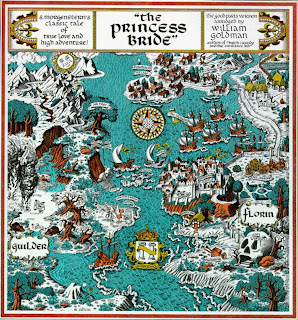
Stories have to take place somewhere, don’t they? In the best of tales, the someplace is almost as important as what goes on there. Heck, there are times like The Lord of the Rings when the setting is, or seems, more important than the tale. The rule of thumb holds: if the setting isn’t memorable, then the tale of the fantastic isn’t going to be, either. Conversely, if you have a really good tale, your setting’s going to be good. So, it stands to reason that one of the greatest of all tales – a tale featuring fencing, fighting, torture, revenge, giants, monsters, chases, escapes, true love, and miracles will take place in a very special realm indeed. Hence Florin, the land of The Princess Bride.

We don’t learn a whole lot about Florin as a country, really. What we know is that it is a monarchy, ruled currently by a very old King and Queen, with a nasty Prince waiting in the wings. Florin is the sworn enemy of Guilder, a nation that lies across the sea. Florin is largely agrarian, and yet it has a number of notable geographic features, such as the enormous Cliffs of Insanity and a horrible place called the Fireswamp. Florin is also the location of vicious sea creatures like the Screaming Eels, and the rumored ROUS’s that dwell in the Fireswamp.

The people of Florin don’t appear to be terribly wealthy, and the castle itself looks fairly spartan in its appointments, so it’s to be assumed that Florin doesn’t have much of a standing army. This likely explains why the elite of Florin seem to prefer schemes against Guilder to open wars of conquest. The latest such scheme, hatched by Prince Humperdinck, involved his murder of his own wife and framing Guilder for it. This plan turned out to be overly complicated, to the point where Humperdinck had to claim that it was a major reason for his being ‘swamped’, and in any case, Humperdinck failed to take into account the power of Twoo Wuv…er, True Love.

Florin’s greatest achievements as a nation may well end up being the fact that the Greatest Kiss of Them All took place there, and its placement of the phrase “As you wish” among the most powerfully romantic things one can say to one’s lover.

Huzzah for Florin!

(image credit)

Share This Post

A to Z: Clint Howard

OK, we’re going with an actor here rather than a character or thing, but let’s be real here: Ron Howard’s younger brother Clint is, in addition to being one of the hardest working character actors anywhere, an absolute fixture in F&SF movies and, more generally, in geek culture. I mean, the guy has been in, as near as I can tell, just about everything. I mean, just go look at his filmography. It’s astonishing how much stuff he’s been in, and he’s always so professional about it.

You want to know how cool Clint Howard is? In 1998 he was given MTV’s Lifetime Achievement Award at the MTV Movie Awards. Now, this award was considered something of a spoof award, but when they gave it to Howard, it was an actual honor – so much so that they retired the award after he got it. Isn’t that a hell of a thing!

So here’s to you, Clint Howard. Geek culture and F&SF fandom would be poorer for your absence!

(That’s Clint Howard, as a kid, voicing the child elephant.)

Finally, I can’t embed this one, but it’s a pretty funny send-up of movies like Armageddon, where early on the experts have to brief the President and use some handy metaphors to convey the direness of the situation.

Bravo, Clint Howard!

Share This Post

Page One: A Princess of Mars

Page One: A Princess of Mars

Here’s Page One of one of my copies of A Princess of Mars. This copy is part of something called the “Library of Wonder”. I bought it off the Bargain Books table at Barnes&Noble. Even though I already owned a copy (an omnibus I bought, in turn, back when I was a member of the SF Book of the Month Club), I couldn’t resist this one. I read A Princess of Mars a while back, and I was surprised at how well the writing holds up after 100 years; I expected a pulpy work that would be difficult to read for its prolix writing, but Burroughs crafts a nice, spiffy, readable tale that doesn’t have nearly as many anachronisms as one might expect. I haven’t yet read any farther into the series, but I intend to. This volume contains the first three of Edgar Rice Burroughs’s “Barsoom” novels, of which the first, A Princess of Mars, has just been adapted for the big-screen. Somewhat infamously, it turns out.

So, why did John Carter fail? I suspect for lots of reasons, not just one.

I’ve heard that there was a change in Disney management during the film’s production, and William Goldman has pointed out in his books that often an incoming exec’s first act of business is to make sure everything that the previous guy greenlit either gets ungreenlit or at least is just tossed out there without hype. I’m not sure about this; it’s one thing to just put the brakes on developing projects, but quite another to purposely scuttle a movie that’s already been made because the $200 million has already been spent. I’ve also heard that director Andrew Stanton was in charge of the marketing, and he made the decision to assume that audiences are more familiar with the John Carter character than they actually are. I’m not sure who was behind the decision to change the movie’s title to simply John Carter, when John Carter of Mars would have been more evocative, and hell, A Princess of Mars would have been in keeping with the book on which the movie was based in the first place.

For my part? I wonder if this isn’t the kind of movie that wouldn’t have failed had it come out, say, twenty years ago, when movies could be allowed to be in theaters for a couple of months, when they weren’t thrust into 18-screen multiplexes on as many screens as possible so as to guarantee massive opening weekends and then a couple more respectable weekends before the movie disappears from release entirely barely a month after its initial appearance. John Carter opened on a Friday, and I was reading about the movie’s box office failure on the subsequent Tuesday. Four days later. That is insane.

Now, I’m not convinced that word-of-mouth can always change a movie from failure to success – remember, The Shawshank Redemption was a box office failure and word-of-mouth didn’t elevate that movie to classic status that everyone’s seen until it came out on video. But still, in this day and age when there are a bunch of movies coming out all the time, and when most folks in my experience only tend to go to movies once or twice a month at most (and many less than that, as the cost of moviegoing is getting to the point where it might well rival the cost of a nosebleed-section admission to an NHL game soon), they tend to only go see whatever the BIG new release is. And that, sadly, tends to be the sequel to the tentpole franchise, or the adaptation of the current favorite book, or whatever. Not a movie like John Carter, which is in turn marketed with ads that really aren’t clear at all as to what the damn movie is about in the first place.

So anyway: I saw John Carter this past Saturday. For a reputed flop, there were a lot of people in the theater to see it. The place wasn’t packed, but the auditorium was probably almost half-full. That’s not bad, especially considering how packed the cinemas were for The Hunger Games. It’s just not the case that no one wants to see this movie. It’s just the case that, for whatever reason, this movie was set up to fail with unreasonable box office expectations that make the movies a sprinting horserace and an ad campaign that simply didn’t get the job done.

My particular screening didn’t start out so well. I attended a 2D showing, because I refuse to see 3D movies. I just can’t do it. I had a headache years ago after sitting through a couple of fifteen-minute 3D flicks at DisneyWorld. And I’m certainly not paying extra for the privilege of having a headache. So 2D it was. But after the previews ended, a title card appears on the screen, accompanied by voiceover: “Please put on your 3D glasses, now!”

Uh-oh….

And yup, they started the 3D version, with the telltale doubling-up of the image that had me in mind of the Monty Python sketch with the double-vision guy planning an expedition to climb “both peaks” of Mt. Kilimanjaro. I wondered if I’d screwed up or ended up in a 3D showing by mistake, but suddenly there were a bunch of folks behind me saying “Wait, what?” and getting up and heading out to the hallway. A Cinema employee stepped in, saw the 3D movie on the screen, and said, “Uh, I gotta go upstairs.” A minute or two later, the 3D version stopped, another minute or two passed, and the 2D version started. Huzzah! And they gave everyone there a free ticket to another movie, which was nice. So I get a free movie, for not that bad of an inconvenience.

(Oddly, when they restarted the movie, we had to sit through the previews again. Are they physically attached to the print of the movie you see?)

So anyway: about John Carter, the movie. Yeah, I loved it, and it depresses me that lost in all the discussion of the movie’s terrible marketing and undeserved fate (which, unless the movie develops surprising legs and then goes on to a remarkable life on DVD, will rule out sequels) is the fact that John Carter is a kind of movie you don’t see much anymore: a rollicking and entertaining adventure movie with high production values. The acting is good all the way around, especially the leads (Taylor Kitsch as John Carter, and Lynn Collins as Dejah Thoris). The visuals are all well-done, with none of the odd muddiness that I’ve noticed in movies shot for 3D. The film is full of wonderful spectacles and set-pieces, and for the most part, the plot isn’t hard to follow, once it gets going. There is a prologue that really doesn’t have much need to be there, and I did find the final battle scene slightly hard to follow as it ended. Also, there are a few pacing problems in the first act, as we cut away from John Carter for a bit too long to learn about Dejah Thoris and her dilemma; in my view, in these kinds of “Fish out of water” stories, it’s best to stay with the fish as long as possible. Those are fairly minor quibbles, though; once the movie settles into itself, about half an hour in, it’s as absorbing an escapist movie as I’ve seen in a long time. Michael Giacchino turns in a typically professional score, sounding a lot like his score to Star Trek 2009, and just as ear-wormy as the earlier score – I’ve had the main theme stuck in my head ever since.

John Carter, and the books that inspired it, aren’t really space opera, but its sister genre, planetary romance. There’s no space here whatsoever. Carter is teleported to Mars – Barsoom, they call it – and there’s an air of steampunk over the entire movie. It feels ‘retro’, and that retro feel is a large part of the movie’s charm.

No, John Carter is not a great movie. But it’s a very good one, well made, a fine addition to its genre. It deserves to be seen and enjoyed, not dissected in some kind of half-assed postmortem on what Hollywood does wrong these days.

Share This Post

Space Battleship Yamato

It seems that, aside from the occasional Star Trek movie, we just don’t do big-screen space opera much in this country anymore. That’s a shame…but at least there’s Japan, who was nice enough to come up with Space Battleship Yamato in 2010. And what a movie this is. This thing scratched nearly every space opera itch I have: war against nigh-unstoppable aliens, a hero who is a discipline case and who has a history, a love story, a crusty captain, a warship that is humanity’s last hope, and so on. And the warship looks like a 20th-century seagoing destroyer…made into a spaceship. You can’t beat this stuff!

Space Battleship Yamato is based on a popular anime series from the 1980s, that was dubbed into English for American audiences and called Star Blazers. I never saw this, so I have no idea how faithful the movie is to the anime, but taking the movie for what it is…it’s a grandly entertaining space opera epic. There’s a massive alien threat to Earth, and the last-ditch effort to gain an edge featuring an enormous warship that is sent across the Galaxy; there are plucky heroes and skilled fighter pilots and talented officers with discipline problems. There’s the old and grizzled captain with a history, and there’s the hero who knows that things may eventually come down to him and him alone. We have desperate assaults on alien fortresses, and acts of noble self-sacrifice all the way around. And there’s the warship of the title, the space battleship Yamato, which is built to look like…a seagoing battleship. Hey, why not?

In the year 2199, Earth is being ravaged under the attacks of the alien Gamilas. The last remaining battleship, the Yamato, is outfitted with a special new super-weapon and sent across the galaxy to the planet Iskandar, where they hope to learn how to counteract the lethal radiation with which the Gamilas have been rendering the surface of Earth uninhabitable. Along the way, secrets about the alien race are discovered, other secrets about the pasts of our characters are revealed, lots of space battles take place, and…well, if you think it should happen in a big-scale space opera movie, it happens here. This movie is almost the Platonic ideal of “Explodey Spaceshippy Goodness”. It’s well-acted, the characters are all pretty memorable, and there are only a few slow moments (and one moment that felt odd for me, as an American, when one of our Japanese heroes delivers a rousing address to the crew, citing the ship’s namesake as inspirational figure). The effects are mostly quite good, and you rapidly get over any of the oddness of a starship that’s built to look like a standard 20th-century battleship. I even loved the opening shot, which is an extreme closeup of someone’s eyeball; the camera zooms back as the lights of blasterfire reflect from the eye, to reveal that the eye belongs to a fighter pilot who is in the midst of a major dogfight. Cool stuff.

I don’t have much more to say about the film than that. But if you want to see a grand space opera movie, track this one down. It’s very much worth the effort!

Share This Post

Happy Birthday Mr. Shatner!

William Shatner’s birthday is today. How old is he? Who cares? Here’s one of my favorite scenes from all Star Trek, from the much-maligned Star Trek V: The Final Frontier.

Trek V is what I consider to be a ‘noble failure’, in that it doesn’t succeed, but even as it falls short it has some really nice moments, and it really tries to do something interesting, something that really involves sending the Enterprise crew into an unexplored place to confront an unknown. The above scene comes early in the film, while the crew is on shore leave, and Kirk, McCoy, and Spock have gone camping in Yosemite. If nothing else, this film understands that at the heart of the original Trek crew is the three-way friendship of Kirk-Spock-McCoy, a fact which the folks in charge of the current Trek original crew reboot seem to be missing completely.

Anyway, happy birthday to Mr. Shatner! May you row your boat gently down that stream for many years to come!

Share This Post

Prometheus

I know, I know…I’ve said a bunch of times that I have little to no use for the Alien movies, which I suppose would rule me out of bothering to see the forthcoming Prometheus, which as I understand it isn’t actually a direct prequel or anything of that nature, but is set in the same universe, so I suspect there’d be some overlap. This trailer for the film, though, is making me question that resolve.

This looks less like Attack of the Killer Space Vaginas, and more like a dark space opera, with ships exploring the unknown, massive alien artifacts, and so on and so forth. Who knows…and with trailers these days, you never know, because trailers can make the worst movies look like giant storehouses of Awesome, so we won’t know until the movie comes out. But I am really intrigued by this trailer.

Share This Post

Fifty most hated movies???

SamuraiFrog posted this list of “Fifty Most Hated Movies”, with comment, and damned if I’m not going to do the same. I’ll only bold the ones that I’ve actually seen, though.

50. Daredevil

49. Superman Returns

I didn’t hate this movie, but it deserves quite a bit of its bad press. I actually liked the cast, but the movie was a bit too open about its reverence for the first Superman movie, and yet, it somehow seemed to take place in an alternate universe, at the same time, by seeming to refer to the original without actually doing so, by giving us a Metropolis that was a generic cityscape instead of being clearly New York with the names filed off, and so on. I remember someone on Aint It Cool News or someplace like that writing, “This movie doesn’t just pay homage to the original Superman — it calls the older movie up and breathes heavily into the phone when it answers.”

48. The Texas Chainsaw Massacre (2003)

47. Terminator: Salvation

For me, the Terminator story begins with the first movie and ends with the second. Never saw this one.

46. Exorcist II: The Heretic

45. Halloween (2007)

44. Fantastic Four (2005)

Didn’t bother, because the trailers looked awful. But then, I was never a FF fan even when I read comics regularly.

43. Resident Evil

42. Jersey Girl (2004)

One of these years I’ll get myself caught up on Kevin Smith’s movies.

41. Constantine

40. Swept Away (2002)

39. Epic Movie

38. Clash of the Titans (2010)

37. A Nightmare on Elm Street (2010)

36. The Matrix Reloaded/The Matrix Revolutions

I know, I’m bolding it, but I’ve only seen the first half hour or forty minutes of Reloaded. I’ve mentioned it in the past, but the movie literally bored me to the point that I dosed off. So when I awoke I turned it off and never went back to the Matrix franchise. I loved the first one when I saw it, but each viewing after that made me like it a little bit less.

35. Godzilla (1998)

I thought this might be epically fun…and instead it was bad, bad, bad, with a Godzilla whose size seems to change from scene to scene, with making Jean Reno play second fiddle to Matthew F***ing Broderick (sorry, but I can’t stand the guy), and the supreme idiocy of Devlin and Emmerich using this film to strike back at Gene Siskel and Roger Ebert. This movie is terrible.

34. Van Helsing

33. The Spirit

32. Crash (2005)

I can’t even imagine myself wanting to see this movie.

31. Sucker Punch

30. Alien Resurrection

Never bothered, having hated the first Alien movie (and still do — sorry, fans, but the Freudian horror for me basically boils down to Attack of the Killer Space Vaginas), not much liking the second movie (slickly made, but predictable as hell), and loathing the third, from the opening moments of “Hey, remember all the crap those people went through to survive the last one? They all died anyway. Sorry.” And now they’re making Alien prequels or some such? Count me out. I hate this franchise.

29. Spider-Man 3

I do not hate this movie; in fact, I find it highly watchable and even entertaining, despite the fact that it makes one wrong turn after another and starts to commit the crime of betraying its source material. I hate that a much better movie was going to be made before some asshole exec stuck his nose in and forced changes that harmed the film, and I really hate that the result was so much a mishmash that it doomed the existing efforts and triggered a pointless reboot movie that, when I finally do see it (almost certainly on DVD), I’ll watch it with an enormous chip on my shoulder because it’s so unnecessary. Ugh. I don’t hate Spidey 3, but I feel like I should.

28. Sex and the City 2

27. Pirates of the Caribbean: At World’s End

I love this movie and despite some of its meandering and plot holes, I think it’s terribly underrated. I’m a big fan of the whole franchise.

26. Planet of the Apes (2001)

25. The Avengers

24. Pearl Harbor

I’ve seen parts of it. I don’t hate it, but man, is it bad.

23. The League of Extraordinary Gentlemen

22. Battlefield Earth

21. The Wicker Man (2006)

20. X-Men: The Last Stand

I refuse to watch this.

19. Aliens vs Predator

Never bothered. See above: F*** Alien.

18. Highlander 2: The Quickening

Oddly, I did not hate this one, because I expected it to utterly, completely suck, so I cheerfully munched my popcorn and laughed at it. I’d already hated the first one — one of the dumbest things I’ve ever seen, a movie whose popularity eternally mystifies me — so I expected nothing from this one. And hey, Michael Ironside. I paid to see H2 in a theater and had a good time, which is a lot more than I can say for the original, which I watched for free and hated.

17. Love Actually

People who hate this movie are like people who hate kittens: I know they’re out there, but they are almost certainly a mutation of some sort.

16. Hulk

15. Catwoman

14. Avatar

I love this one! No, I don’t think it’s got one original thing in it, but so what? I liked the cast, I loved the effects, I love the pace at which Cameron allows the story to unfold. It’s beautiful and I found it fun.

13. Lady in the Water

12. The Happening

11. The Last Airbender

I haven’t seen a Shyamalan movie since Signs, which I liked. From what I hear, I have missed nothing.

10. Die Another Day

This movie actually has an awful lot of good stuff in it, but that all ends with the arrival at the villain’s Giant Ice Cave or whatever. Don’t hate it…but on balance, it’s pretty weak.

9. House of the Dead

8. Titanic (1997)

I still love this movie, and I find the backlash against it really reflective of a cultural mean-spiritedness that always saddens me when I see it in action.

7. Transformers: Revenge of the Fallen (2009)

I refuse to watch any of these.

6. Batman and Robin

It stinks, but I still found it fun to watch. Oh well.

5. Psycho (1998)

I can’t imagine why this movie got made in the first place.

4. Twilight

I refuse to see this movie. I want nothing to do with this whole awful, stinking, fetid excuse for a story franchise. The book was so achingly bad that any notion that I should go see the movie makes me wretch. (And as to that, again let me raise my objection to anyone who tries telling me that well, I can’t really understand the book since I was never a teenage girl with raging hormones. It’s the writer’s job to make me understand things I’ve never done. I’m not going to do the writer’s homework for her. I have no idea what it was like to experience love and loss in the backdrop of the French Revolution, but Charles Dickens did the heavy lifting for me.)

3. Forrest Gump

I don’t hate it. I’ve never hated it. In fact, I still like it. But I do find its messages confounding, even if I don’t totally buy the usual criticism that it’s “Right wing values good, counterculture bad”.

2. Star Wars Episode I: The Phantom Menace

Yeah, right. Defending this movie, and its two follow-ups, may well be my main reason for living. I still love it, to this day. (All together now, class: F*** Red Letter Media!)

1. Indiana Jones and the Kingdom of the Crystal Skull

Nope, don’t hate this one, either…although it really could have used one more pass through the rewrite phase. I’m not bothered in the least by the “Aliens” thing. The first three were based on the serial adventure flicks of the 1930s; seems perfectly reasonable to me that if we’re going to move Indy into the 1950s, then paranoid science fiction needs to be the order of the day. If anything, I don’t think the movie played this angle up nearly as well as it should have.

Here are some movies that I genuinely cannot stand, that didn’t make the list:

Live and Let Die
The Usual Suspects
City of Angels
Wedding Crashers
Scream

Share This Post