“This mortal form grows weak. I require sustenance!”

Thor was never my favorite Marvel superhero, not by a longshot. I never really got the whole thing…he was a Norse god, that much I knew, but the whole “Norse god banished to twentieth century America” never made a whole lot of sense to me. I just didn’t get it. And it didn’t help that, from my perspective, the Thor comics weren’t in the midst of a great run or anything when I was really into comics, from 1983 or so to 1989. Thor was just kind of there.
Thus, I wasn’t all that keen on a Thor movie, either…I had no major objection to one, but I wasn’t terribly interested in it, either. And frankly, the only reason I bothered to see it at all was because it’s part of the background for the upcoming Avengers movie. So I decided to check Thor out.
And you know what? I’m glad I did. Thor is a comic book movie that really succeeds in nailing what a lot of comic book movies fail to do: combine elements of Big Mjaestic Heroes With Great Powers Who Are Fighting Cosmic Horrors, along with elements of goofy fun.
I won’t bother giving a plot summary, since Thor‘s plot is fairly convoluted in that comic-book way of making sense while you’re watching it, but not being easy to remember once you’re done. There is an ancient struggle between Thor’s people, the people of Asgard, and the evil Frost Giants of Jotunheim. These places look more like other planets than mythical realms – especially Asgard, which is a fantastic cityscape and yet looks oddly unpopulated at certain points along the way. Thor is an impulsive youth who is destined to be King, as long he doesn’t keep screwing up…but screw up he does, and his father Odin (played with proper pomposity by Anthony Hopkins) banishes him. To where? Why, Earth, of course!
Of course, Thor is found on Earth by a trio of scientists, because you can’t have a Marvel comic book story without some scientists roaming around. This time, our lead scientist is played by Natalie Portman; she’s accompanied by Stellan Skarsgard (an actor who never bugs me, but also never really impresses me much, either), and a third scientist played by Kat Dennings. (Now, I had zero idea that Dennings was even in this movie, so that was a happy surprise. And I loved her character – she doesn’t have much to do, but there’s a weird ‘happy medium’ thing going on with her: she’s a scientist, but from a different discipline, so she’s usually one or two steps behind, without seeming stupid about it. Playing smart is one thing; playing smart-but-not-entirely-invested is something else.)
The production design of Thor is pretty nifty. This movie really looks like it’s inspired by a comic book. Everything is big and bold and bright and colorful (except for the Frost Giant kingdom, but what can you do there, they live on a giant ice cube), and the film’s main Earth location is not a big city but some small town in the middle of the New Mexico desert, the kind of small towns that comic books are always sticking out in the middle of nowhere so that Big Important Cosmic Things can happen there. Our scientists have a lab set up in what looks like an abandoned 1950s breakfast restaurant. And when Thor’s Hammer shows up in the middle of an impact crater, something not unlike a redneck version of the knights coming to take a whack at pulling Excalibur out of the stone transpires. (Keep an eye out for the cameo appearance by a guy playing a doofus with a pickup truck.)
Thor is a movie where the heroes can all stand around talking about kings and wars for the ages and their destinies and their duties, while also having the hero meet the heroine when she hits him with her truck…and then, the next day, hits him with her truck again. There were times, watching Thor, when I thought, “This movie shouldn’t work”…and yet, oddly, it does. Director Kenneth Branagh keeps things whisking right along; he doesn’t spend much time lingering over anything, and the script is full of tiny touches that really ring true – such as Dennings’s inability to pronounce ‘Mjolnir’ correctly, or Thor’s attempt to secure a second cup of coffee in a diner. The film’s only weak spots, for me, were in making Asgard look a bit too antiseptic, and in the guy who played Loki – he just seemed slightly bloodless. (Although, if they ever reboot Star Trek: The Next Generation, I know where they can find their Lt. Cdr. Data.)
At this point in the whole superhero thing, I don’t think a movie is ever going to come along that will supplant Superman in my heart as the definitive superhero movie. But Thor comes quite a bit closer than most have. What a fun movie!

Share This Post

“This just might be my masterpiece.”

Pulp Fiction has been a favorite film of mine ever since it came out…which is why it strikes me as odd that until quite recently, it was the only Quentin Tarantino film I’ve seen since I first heard of him. All I’ve seen of Tarantino’s work was Pulp Fiction and episodes of ER and CSI that he directed (both of which, very well, in my view). I did start to watch Kill Bill Volume One a few years ago but never finished it, for no real reason. And there I stopped, until I finally got around to watching Inglourious Basterds a month or so ago.

I loved this movie. Absolutely loved it. I loved it for what it is: a big, violent, gory, profane cartoon parody of jingoistic war movies.

Tarantino is not everyone’s cup of tea. He tends to construct long scenes consisting of conversational duels that are punctuated by violence, and that’s certainly on display here, several times, in sequences whose tension increases as Tarantino delays the violent payoff, and delays it again, and delays it still again. The very first scene does this, when a Gestapo commander drops in to visit a French farmer. His visit seems dull and routine; our Gestapo fellow at first doesn’t seem terribly invested in what he’s doing: searching for hiding Jews. He initially gives off an air of a man just going through the bureaucratic motions, and the farmer seems to be just answering his questions until he buggers off. But at some point it becomes clear that he’s not going to bugger off, and that this dull Gestapo bureaucrat is anything but. As I thought back over this scene, I kept trying to pinpoint exactly when it is that this man, Colonel Landa, takes on an air of quiet malice, but he does. It’s the most unsettling kind of malice, the smiling malice of a man who knows that his job is to mete out death and that he will do his job and then go home and go to bed at night.

This ‘delaying of the payoff’ recurs over and over again throughout the film, such as an extremely tense scene set in an basement tavern in France that never seems to end, or in a moment in a restaurant when a girl who is hiding the fact that she is a Jew finds herself at a table with Hermann Goering. In fact, this payoff-delaying tactic of Tarantino’s shows up in the very first shot, as our French farmer watches the Nazis driving up his road. Watch this scene and realize, several times, that the Nazis should be there by now.

The seriousness of this scene contrasts with the sheer absurdity of the storyline that has a drawling American, Aldo Raine, recruiting a special team of assassins – out of Jewish-Americans – whose job will be nothing more than to operate in Europe and kill as many Nazis as possible, in as violent a way as possible, so that their reputation – the ‘Basterds’ – will reach back to Berlin and strike fear into the heart of the highest command, including Hitler himself. Raine’s team and their casual acceptance of torture and execution is a bit unsettling, but there’s also something weirdly exhilarating about it all. Maybe it’s because it’s the Nazis and we know that we can hate on them just fine, but Tarantino allows the ‘rank and file’ Nazis to have just enough personality that it’s a bit unsettling when Raine uses his bowie knife to carve a swastika into the forehead of one of them (“I’m gonna give you something you can’t take off”). But only a little.

And as usual, in a Tarantino film, so much of the weight is carried by the dialogue, such as when Raine realizes that a captive Nazi has decided to be defiant, so he shouts to one of his men: “We got a German here who wants to die for his country! Oblige him!”

This parody material exists alongside a revenge story, as an escapee from the film’s first scene later encounters Colonel Landa again (in a scene that made me realize that never has whipped cream looked creepier). She hatches a plan to do nothing more than kill Hitler himself. How? Well, he’s coming to see a movie. In the theater she owns. She’s going to get everyone in there, bar the doors, and set the theater on fire. I can only assume that this is an allusion to the infamous events at Oradour-sur-Glane.

Why is Hitler coming to France to see a movie? The film explains that, too, but I’d just as soon not get into it. The whole film is awash in odd coincidences, broad strokes, and scenes stitched together with narration by Samuel L. Jackson.

Since it’s Tarantino, it’s not unexpected that his knowledge of film history is going to come into play at some point. The key location of the second half of the film is a movie theater, a key plot point hinges on the flammability of film stock used in the 1940s, the timing of the plot hinges on a reel change, and so on. Tarantino’s visual sense is as keen as ever; Inglourious Basterds includes one of the most striking visuals I’ve ever seen, as the movie keeps projecting onto clouds of smoke, creating swirling images of film in a film.

Ultimately the movie seems by turns serious and silly, which I think is rather the point; it’s not unlike that old Captain America cover that has Cap punching Hitler’s lights out. And it all helps that the film is acted almost perfectly. There isn’t a single weak spot in the cast, so far as I can recall, and it’s all grounded by Brad Pitt as Aldo Raine and Christoph Waltz (who won an Academy Award) as Colonel Landa. Even so, I think the best performance belongs to Melanie Laurent as Shoshanna, the escaped Jew who later gets her chance for revenge. She perfectly captures the tension of someone walking a tightrope as trying to maintain a secret identity, carry off a revenge plot, and fend off the advances of a smitten Nazi.

This film has a certain unsettling effect, because I found myself laughing at a lot of very violent death being meted out in large quantities against Nazis. But it’s so over-the-top, so cartoonish, that ultimately I think that the film works best as gonzo comedy that is a blending of genres than anything else.

(Poster above via)

Share This Post

“You still stammered on the ‘W’.”

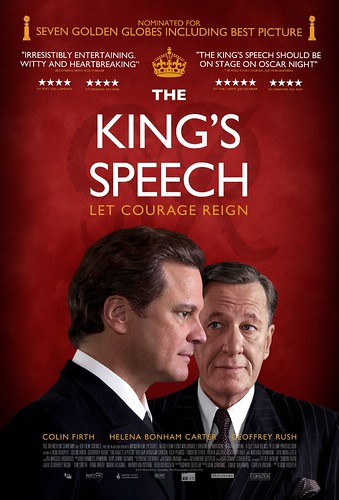
The King's Speech

I’ve seen British period dramas referred to as “Bigscreen episodes of Masterpiece Theater“, which I suppose is kind of an apt description. But it’s something of a dismissive description, isn’t it? It seems designed to put off the kind of people who think that watching stuffy Brits on Masterpiece Theater is the stuff of torture. And it can be, if what’s on Masterpiece Theater isn’t all that good. But when it is good, what’s wrong with that?

This is what I kept thinking of while recently watching The King’s Speech: “This reminds me of Masterpiece Theater.” And not in a bad way, mind you, because I’ve always liked the good things on Masterpiece Theater. But it’s the air of the story: very little by way of visual invention; instead, it’s very solidly produced drama, with a good script, acted out by a great cast. Aside from a few stylistic things along the way, there’s no real feel of a particular “director’s hand” in The King’s Speech.

The story follows a particular Prince of Wales who is destined – although, being second in line, he doesn’t know it – to be King George V of England. This particular Prince has a deep problem that seemingly makes any public life nearly impossible: he has a terrible stutter. The King’s Speech would probably be the best movie I’ve ever seen about a stutterer, if not for A Fish Called Wanda. As it is, this movie runs a nice second.

Colin Firth plays the future king, Prince Albert, the Duke of York, who in the first part of the film is frustrated by his stutter when he needs to speak in public but is also thankful that as second in line, he isn’t called that often to perform acts of oratory. He seeks out some treatments, but none of them work; it is his wife (Elizabeth, the Duchess of York, played by Helena Bonham Carter) who visits yet another ‘expert’ on the treatment of stuttering, one Lionel Logue (Geoffrey Rush). Over the course of the film Logue provides Albert with treatments, most of which Logue has developed on an ad hoc basis over his life. And over the course of the film the two men develop a deep friendship, despite Albert’s insistence that they cannot (because of his station) and Lionel’s insistence that when the door closes in his office, and it’s just the Prince and Lionel, then it’s Lionel’s rules that must be obeyed.

Of course, we know – without even needing to consult the history books – that Prince Albert will, in fact, become King; we also know that he will be called to address his entire nation via the relatively new medium of radio, and that this speech will be either his big triumph or the hill on which he dies. How it goes really isn’t a surprise at all, and it shouldn’t be; for all the historical drama, Masterpiece Theater production full of Brits thing that this movie has going on, it’s pretty clear early on that The King’s Speech is simply a new version of one of storytelling’s most classic tropes, the student who must learn from an enigmatic and idiosyncratic teacher if he/she is to triumph over his/her foes. The only difference is that here, the foe that must be triumphed over is a part of Prince Albert’s own character. It’s an inner struggle, and it’s only in that that The King’s Speech differs much in structure at all from, say, The Karate Kid.

A problem is established for which a person needs help. The person has a tentative, untrusting meeting with a teacher who promises to help. The lessons begin, and they’re a bit confusing at first, both to the student and to us, watching it. But over time, as the connections begin to form, the lessons make more sense, and the story builds to the inevitable conflict, whether it be against a particular boxer, the rich blond black-belt karate dude, or against the expectations that the King will fail to deliver a stirring speech to his nation in a time of war.

Ultimately, what makes The King’s Speech compelling is pretty much what makes all movies compelling that tell familiar stories: the characters and the relationships amongst them. Albert and Lionel form a friendship based in deep respect for one another and, even, need, without ever really coming out and saying it. Albert, obviously, needs help with his stutter, but Lionel needs some kind of acceptance. Lionel, it seems, is an amateur actor who wishes to play the lead in something, anything, but who seems eternally relegated to secondary roles. In helping the future King, he finally – in some way – achieves his wish. I also like how the film makes a gentle feint in the direction of having the King turn away from his teacher, but this well-worn and frankly unsurprising turn is avoided by the two men having a frank conversation.

Tom Hooper’s direction is fairly understated; he seems content for the most part to let his actors do most of the heavy lifting after he decides where to put the camera or how to light the room. In fairness, there are a lot of interesting choices to be made there, and Hooper makes them. He rarely puts his actors in the center of the frame, for instance; they are always slightly off to the left, or close to the bottom. The lighting is generally bright and washed out; this is not your standard English drama with long walks in gorgeous gardens while everyone talks about God Save the King. After watching a bit of the film, I started to wonder why Hooper just didn’t go all-in and shoot The King’s Speech in black-and-white.

The King’s Speech won the Best Picture Oscar for its year. I’ve seen some evidence out there, amongst the various pop-culture and film-oriented sites that I frequent, that the general opinion is starting to settle that The King’s Speech was unworthy of that award, and that it should have gone to The Social Network instead. Speaking for myself, I personally found The King’s Speech far more engaging and interesting, particularly in its human interactions, than The Social Network, which largely left me cold. Obviously your mileage may vary…but The King’s Speech lingers in my memory much longer than The Social Network did.

(Apparently Tom Hooper is now helming the filmed adaptation, long-awaited, of the Les Miserables musical. Well, he’s got his work cut out for him. I’ve made that movie in my head to the point where I can read the credits over the final montage.)

Share This Post

Things I thought while watching “St Elmo’s Fire”

I decided to watch St. Elmo’s Fire, the coming-of-age flick from 1985 starring quite a bit of that group of actors known as “the Brat Pack”. I vaguely remember watching the movie way, way, way back in the late 80s or maybe early 90s. And by ‘watching’, I mean, ‘being in the room reading comic books while the movie was on the teevee’. So my recollection is, shall we say, rather hazy.

Turns out I shouldn’t have investigated those memories, because…well, that movie is Crap On Toast. Seriously. What garbage. I decided to try to make it bearable by mocking it on Facebook. Here are the things I posted:

So I’m watching “St Elmo’s Fire”, which I may well have never seen in its entirety. I’m about half an hour in. My plan is to watch until I encounter a character who isn’t an asshole. I’m gonna have to watch the whole movie, aren’t I?

(This was answered almost immediately by two friends saying, ‘Yes’. Ouch.)

Oh god…a scene with a welfare queen. This isn’t a movie about actual young people in the 80s, it’s about what William F. Buckley thought young people in the 80s were like.

(Few things have the ability to INSTANTLY piss me off like the whole ‘Welfare Queen’ stereotype, and this was it, in spades. A white woman with her five kids with her, all of different races, who keeps responding to her case worker’s attempts to interest her in job training with “Just gimme my check.”)

Obviously my memories of the 80s may not be entirely reliable, but I don’t recall women dressing either like streetwalkers or underneath at least four layers and buttoned up to the lower lip.

(Seriously, just look at the Mare Winningham character. She dresses like an cast extra on Little House: The Ever More Chaste Edition.)

If ever there was a person who just can’t wear an earring, it’s Rob Lowe.

(It’s an awful earring.)

Rob Lowe tries to get his hand under her (the Mare Winningham character) skirt…but he has to pull up about eight yards of fabric to get there!

(This just cracked me up. He literally has to move his hand back down like three times to get the skirt far enough up that he can get a hand under there. It’s like she has to walk around on stilts, just so her skirt isn’t dragging on the ground. And this is seconds after she reacts to Rob touching her breast as though he’s just zapped her with a cattle prod.)

Sweaty Rob Lowe is faking the hell out of that sax solo, I tell you! I keep waiting for CJ to walk up to him and say, “Sam, get your ass back to the office. Toby’s pissed at you.”

(A Georgetown bar is full of people rocking out to Rob Lowe on the sax as though he’s Kenny G Van Halen or something.)

This movie is dragging my lifelong crush on Ally Sheedy outside, where it plans to beat my poor crush to death with a tire iron.

(Every time Sheedy was onscreen, I was reminded of Harrison Ford’s great line from Working Girl, which he says to Melanie Griffith when she shows up at a function in a gorgeous dress: “You’re the first woman I’ve seen at one of these things who dressed like a woman, not how a woman thinks a man would dress if he were a woman.”)

Ahhh, the 80s…when eyeglasses were large enough to cover the vision span of four people!

(Holy shit, this movie has the Biggest Eyeglasses EVER.)

I have to think that anybody who has ever seen, oh, any movies at all takes one look at the city block that St Elmo’s Bar is on and immediately yelps out, “Hey! The Universal backlot!”

(Ayup. This really broke the illusion for me. All that location shooting, and they couldn’t do a couple of establishing shots someplace real?!)

Rob gets fired from his lucrative bar gig. Probably shouldn’t have attacked the guy who showed up with his wife.

But it’s all good, because he lets out a massive rant outside, gets kicked to the ground, and is well on his way to make-up sex within thirty seconds! Yay, him!

(This scene made no sense.)

Clearly the place to have a heart-to-heart with your friend is at the homeless shelter where she’s doing volunteer work. WHILE she’s doing volunteer work.

(Another really odd scene, with Demi Moore and Ally Sheedy showing up at Mare Winningham’s homeless shelter to give her life advice, which is basically, ‘Give in and make love to your boyfriend.’ OK then. Winningham is wearing a long skirt with a bib and shoulder straps, not unlike overalls, over a button-down shirt which is over a turtleneck. Were the entire 80s a study in layers?)

In this scene, Ally Sheedy is wearing a frilly bow tie under the incredibly frilly collar of a blouse that is in turn under a jacket that has a really frilly collar. Were the 80s the frill decade?

Rob’s having sex in a hot tub. Or at least he was. House owner got home early. Whoops. Hate when that happens.

(I thought that the producers had cast a Latino actor, named Mario Machado, as an Asian character. Turns out he’s of Chinese and Portuguese ancestry. So I was wrong.)

Emilio Estevez apparently believes, as do all movie men, that turning up the collar of their suit jacket has the same effect as opening an umbrella.

(I never understand this.)

Stalking Andie MacDowell is creepy on two levels. Because it’s stalking, and because it’s Andie MacDowell.

(Cheap shot, I know, but there’s just always been something about Andie MacDowell that’s just a bit ‘off’ for me. I have a terrible time with Four Weddings and a Funeral on that basis.

Wow…as Emilio goes in to confront Andie, we get the “Person who shot JR” POV shot, complete with people stopping and staring at him! Every movie should include a shot like that.

(Here’s what I’m talking about. This seemed a very odd stylistic choice for this movie.)

And for this she lets him go home with her?!

(I guess obsessive stalking wasn’t deemed creepy until that guy killed Rebecca Schaefer.)

Rob is starting to realize what a loser he is. Took him half the movie. Took me thirty seconds of the movie. Yay, me!

THIS is Emilio’s plan to win the heart of Andie MacDowell? Pretending to be rich?! Did we wander into a “Three’s Company” episode?

(Apparently she’s also stupid and will think that he’s become rich overnight. Great plan, this.)

I’d forgotten how in the 80s, all men wore neckties, but the men who weren’t to be taken seriously wore their ties so loose that the knot is eight inches below their collar.

(I hate neckties. They’re stupid.)

Ooh, I gotta stop. This movie is terrible. Ye Gods. I’m just gonna read the WikiPedia plot summary and call it a night on this one.

For the record, I gave up just after the party scene where Ally Sheedy accuses Judd Nelson of cheating on her. I just couldn’t even muster up enough emotional investment to make fun of the thing any more after that.

I really don’t have anything insightful to add about St. Elmo’s Fire. It just isn’t good. It’s annoying 80s fluff, the kind of thing that makes me wonder why so many people seem to fetishize that decade. I do like that title song and the synthesizer love theme, though. That’s good. But the movie? The Breakfast Club it ain’t.

Share This Post

All Things Pie

Pie on the brain lately!

::  Beth Howard, who has become one of my favorite bloggers, has been working on a book called Making Piece, which is about how she dealt with awful grief (her husband passed away suddenly at a terribly young age) by, among other things, throwing herself into pie-baking and from there to pie evangelism. Her book is now available for pre-order. I’ll definitely be getting a copy. I’ve found that learning new things, and becoming a bit obsessive about them, is a good way to (at least partially) deal with grief.

::  On the making of pie…I do love a good pot pie, although I hadn’t made one in quite a long time until last week, when I did what pot pies are for and made one as a way to use up some leftover meats. In this case I used leftover ham from New Year’s and leftover smoked beef sausage. The result was like this:

Ham and Sausage Pie

I thickened some beef broth with a roux and added some onion and sauteed mushrooms, in addition to the meats. The crust? Well…I really need to start making my own. This was a store-bought crust, one of those ones you unroll. The resulting pie was tasty, but a bit on the salty side. I’ll be revisiting the pot pie concept again soon, though — next week I intend to make some pulled pork, which I think would make an interesting pot pie!

Part of my problem with making pie crust is that we only really have one spot in the kitchen area suitable to the rolling out of a dough, and that’s our dining room table, which isn’t always free of obstruction. (Translation: we tend to pile an awful lot of clutter on our table.) Not that clearing the table takes very long, but it’s just a whole extra step, you know?

:: Speaking of baking pie, I wonder if this gizmo, which Roger Green e-mailed to me, actually works? It seems…well, it seems odd. Why not just bake two pies? How strange!

::  My favorite pie for eating has always been apple, which cries out for a scoop of vanilla bean ice cream and some caramel sauce drizzled on top:

Pie: Not just for my face!

I just can’t get behind that whole “cheddar cheese on apple pie” thing, though. Cheddar cheese and sliced raw apples are great together, but…I can’t make the leap from there to cheese-on-apple-pie. Sorry!

:: Roger also e-mailed me a while back a couple of posts by Mark Evanier, on the subject of pies as comedic props (i.e., pies for forceful application to people’s faces). It makes for interesting reading, as Evanier spells out some techniques (here and here) for what he considers ‘proper’ pie-throwing. Basically he says that pies for throwing should consist of a crust outside of the tin or pan, filled with shaving cream. I suppose he may have a point, if your pie-throwing is part of some kind of performed skit of stage show or something like that. Quick clean-up and the lack of any souring-milk aromas are certainly desirable factors. But as for myself, well…I’m not a stage actor, and I sure don’t want to get hit with something that tastes like soap because it basically is soap! Nope, if it’s going in my face, I want the real thing.

::  Finally, some funny behind-the-scenes photos. Here’s Natalie Wood on the set of The Great Race, whilst shooting that film’s pie fight:

(EDIT: I couldn’t remember where I got that photo from…but now I do. And contrary to Mr. Evanier, it turns out that all those pies in that pie fight were real! No shaving cream at all!

And here is actress Mia Sara, on the set of Ferris Bueller’s Day Off. For some reason she’s getting pied. No idea why.

That about covers it. Pie is awesome!

Splat! The meeting of Pie and Face

A pie in the face is a wonderful thing!

Share This Post

A lifetime of sitting in the dark

I was nine years old, and I wandered into the living room to find my mother watching some show on PBS. It was a show about movies – there would be a clip of a new movie that was out, and these two guys would then talk a bit about whether the movie was any good or not. One of these guys was a thin, lanky guy. The other was a squat, fat guy. The thin guy was named Gene. The fat guy was named Roger.

“What’s this?” I asked.

“It’s called Sneak Previews,” my mother answered. “Those two men are film critics. They tell us if movies are good or not.”

“Oh.”

And I watched the thing. I didn’t know anything about movies, but these two guys were interesting to watch. Another year or two later, their show was off PBS, which struck me as a bummer…but they turned up again, in a syndicated show that was on, like many syndicated shows, at whatever time some station or other felt like putting it on. No matter, it was fun seeing these two guys, Gene and Roger – who worked for newspapers in Chicago – talk about movies.

So I watched Gene Siskel and Roger Ebert for years, off and on, right up until Siskel’s deeply saddening death in 1998. Then I watched Ebert and Richard Roeper (a good enough fellow, but no substitute for Siskel) for a few more years, until we no longer had cable and thus the show was beyond my grasp. And then, a few years after that, Ebert himself started to have health issues, which eventually resulted in unsuccessful surgeries that have famously left him unable to speak or eat (he takes meals through a G-tube, which is something I understand all too well, thanks to Little Quinn).

Siskel and Ebert were, in my view, one of the great duos in the history of anything. Those two had such astonishing chemistry together, that it was a joy to watch them agree positively on a movie, an even bigger joy to see them agree negatively on a movie (seriously, watching the two of them tag-team on a bad movie was always great), and the biggest joy of all when they disagreed. Then you could see some fireworks. I remember Ebert being astonished at Siskel’s thumbs-down review of Scorsese’s Casino; “Thumbs down?!” Ebert yelped. And there was another time – I can’t remember the movie – where Ebert liked it and Siskel did not, and Ebert said something like “I don’t think you wanted to like this movie”, a suggestion that seemed to physically hurt the usually more acerbic Siskel. “I love to like pictures!” he protested.

One time on Late Night with David Letterman, there was a segment that had Mujibur and Sirajul, the two Indian owners of a local store, reporting to Dave from somewhere in the country. And Dave says, “If you two are out there, who’s watching the store? Can we send a cameraman to see who’s in charge at the store?” So a cameraman goes into the store, to reveal a very stern-looking Siskel and Ebert. OK, I guess you had to be there.

Anyway, Ebert has been writing about the movies for decades now, and he is, by nearly any measure, the critic whose work I find the most illuminating and the most evocative. I’ve been reading him nearly almost as long as I’ve been watching him on teevee, and for a number of years, his annual review collections were required book purchasing of mine. Now he has produced a memoir, which he has titled Life Itself.

Ebert’s health struggles in recent years are well-known, and it’s been truly fascinating to watch him take to blogging in the wake of the loss of his physical voice, a medium he had initially viewed with suspicion but which allowed his authorial voice to finally blossom to its greatest strength. Ebert has always been a fine writer, but oddly, his disability-due-to-cancer has, for many, made him even better. Maybe it’s similar to that old saw about how when you lose one sense, the others somehow make substantial gains in acuity.

Reading his blog, I’ve mostly been struck by Ebert’s ongoing zest for life, even when there were occasional posts that took an especially elegiac tone that made me wonder if he was preparing for his own departure from this world. Ebert is still with us, though, and now we have Life Itself.

The book is more a series of vignettes than a straight telling of Ebert’s life. The vignettes are more or less in chronological order, but Ebert seems to be more exploring various themes in his life than the chronology of events. The book is something of a memory album that gives an impression of a life, which seems to me a good way to structure a biography. Sometimes when I read biographies, I get a sense of “plot” that couldn’t possibly be there. Ebert is well aware that life is plotless, and that many of the things that shape the paths of our lives for good or ill are often accidental, a function of our coming into the circle of this person instead of that person, or even something so prosaic as taking this flight instead of that one.

It’s telling that the book gives more of a sense of his development as a writer than as a critic; I suspect that Ebert believes that he would have been a writer no matter what, and it was just an accident of various circumstances that led to him writing about movies for the last forty years. There’s no “Through all my life the cinema has grounded my being” or anything like that; Ebert grew up as a talented kid who liked going to movies with his buddies on Saturdays. I love when he recounts his first reviews of avant garde films; finding himself in confusion as to what the films were about, he took the approach of simply recounting his experience in watching the film. This is an approach that has gone on to inform his entire approach to movie reviewing and film criticism.

Sometimes, in the course of his blogging over the last few years, a tone has crept into Ebert’s writing – that he seems to deny whenever it is pointed out, but it is there – that he is, in long form, saying goodbye to his life. I deeply hope that this is not the case. Ebert is, for me, to film as Carl Sagan is to science, and he’ll be missed by me in equal measure when he is gone.

Here are some excerpts from Life Itself.

On Mike Royko:

At about six p.m. On New Year’s Day of 1967, only two lights on the fourth floor were burning – mine and Mike Royko’s. It was too early for the graveyard shift to come in. Royko walked over to the Sun-Times to see who else was working. A historic snowstorm was beginning. He asked me how I was getting home. I said I’d take the train. He said he had his old man’s Checker car and would drop me at the L station. He had to make a stop at a twenty-four hour drug store right where the L crossed North Avenue.

Royko at thirty-five was already the city’s most famous newspaperman, known for compelx emoitons evoked with unadorned prose in short paragraphs. Growing up as the son of a saloon keeper, he knew how the city worked from the precinct level up, and had first attracted attention while covering city hall. He was ten years older than me and had started at the old City News Bureau, the copperative supported by all the dailies that provided front-line coverage of the police and fire departments. Underpaid and overworked kids worked under the hand of its editor, Arnold Dornfeld, who sat beneath a sign reading: If your mother says she loves you, check it out. When I met him he’d been writing his Daily News column for two years. It was his writing about Mayor Richard J. Daley that took the city hall word clout and made it national. He chainsmoked Pall Malls and spoke in a gravelly poker player’s voice. He drank too much, which to me was an accomplishment.

That snowy night the all-night drugstore was crowded. “Come on, kid,” he said. “Let’s have a drink at the eye-opener place.” He told me what an eye-opener was. “This place opens early. The working guys around here, they stop in for a quick shot on their way to the L.” It was a bar under the tracks so tiny that the bartender could serve everyone without leaving his stool. “Two blackberry brandies and short beers,” he said. He told me, “Blackberry brandy is good for hangovers. You never get charged for a beer chaser.” I sipped the brandy, and a warm glow filled my stomach. It may have been the first straight shot of anything I’d ever tasted. I’d been in Chicago four months and I was sitting under the L tracks with Mike Royko in the eye-opener place. I was a newspaperman. A blackhawks game was playing on WGN radio. The team scored, and again, and again. This at last was life.

“Jeez, they’re scoring like crazy!” I said, after the third goal in less than a minute.

“Where you from, kid?”

“Urbana,” I said.

“Ever seen a hockey game?”

“No.”

“That’s what I thought, you asshole. Those are the game highlights.”

On books:

Chaz [Ebert’s wife] and I have lived for twenty years in a commodious Chicago town house. This house is not empty. Chaz and I have added, I dunno, maybe three or four thousand books, untold numbers of movies and albums, lots of art, rows of photographs, rooms full of comfortable furniture, a Buddha from Thailand, exercise equipment, carved elephants from India, African chairs and statues, and who knows what else. Of course I cannot do without a single one of these possessions, including more or less every book I have owned since I was seven, starting with Huckleberry Finn. I still have all the Penrod books, and every time I look at them, I’m reminded of Tarkington’s inventory of Penrod’s pants pockets. After reading it a third time, as a boy, I jammed my pockets with a pocketknife, a Yo-Yo, marbles, a compass, a stapler, an oddly-shaped rock, a hardball, a ball of rubber bands, and three jawbreakers. These, in an ostensible search for a nickel, I emptied out on the counter of Henry Rusk’s grocery, so that Harry Rusk could see that I was a Real Boy.

My books are a subject of much discussion. They pour from shelves onto tables, chairs, and the floor, and Chaz observes that I haven’t read many of them and I never will. You just never know. One day I may nee to read Finnegans Wake, the Icelandic sagas, Churchill’s history of the Second World War, the complete Tintin in French, forty-seven novels by Simenon, and By Love Possessed. That 1957 bestseller by James Gould Cozzens was eviscerated in a famous essay by Dwight Macdonald, who read through that year’s list of fiction bestsellers and surface with a scowl. I remember reading the novel late into the night when I was fourteen, stirring restlessly with the desire to be possessed by love.

I cannot throw out these books. Some are enchanted because I have personally turned all their pages and read every word. They’re shrines to my past hours. Perhaps half were new when they came to my life, but most were used, and I remember where I found every one. The set of Kipling at the Book Nook on Green Street in Champaign. The scandalous The English Governess in a shady bookstore on the Left Bank in 1965 (two dollars, today ninety-one). The Shaw plays from Cranford’s on Long Street in Cape Twon, where Irving Freeman claimed he had half a million books. Like an alcoholic trying to walk past a bar, you should see me trying to walk past a used bookstore. Other books I can’t throw away because, well, they’re books, and you can’t throw away a book. Not even a cookbook from which we have prepared only a single recipe, for it is a meal preserved, in printed form. The very sight of Quick and Easy Chinese Cooking by Kenneth H.C. Lo quickens my pulse. Its pages are stained by broth, sherry, soy sauce, and chicken fat, and so thoroughly did I master it that I once sought out Ken Lo’s Memories of China on Ebury Street in London and laid eyes on the great man himself, dining alone in a little room near the entrance. A book like that, you’re not gonna throw away.

On his wife:

I sense from the first that Chaz was the woman I would marry, and I know after twenty years that my feelings were true. She had been with me in sickness and in health, certainly far more sickness than we could have anticipated. I will be with her, strengthened by her example. She continues to make my life possible, and her presence fills me with love and a deep security. That’s what a marriage is for. Now I know.

On Siskel:

One of the things I miss about Gene Siskel is that he’s not around to make jokes about my current condition. He would instinctively know that at this point I wouldn’t be sensitive, having accepted and grown comfortable with my maimed appearance. He wouldn’t have started joking too soon. His jokes would have the saving grace of being funny. Here’s one I’m pretty sure he would have come up with: “Well, there’s one good thing about Roger’s surgery. At least he no longer needs a bookmark to find his chin.”

On movies:

I have seen untold numbers of movies and forgotten most of them, I hope, but I remember those worth remembering, and they are all on the same shelf in my mind. There is no such thing as an old film. There is a sense in which old movies are cut free from time. I look at silent movies sometimes and do not feel I am looking at old films; I feel I am looking at a Now that has been captured. Time in a bottle. When I first looked at silent films, the performers seemed quaint and dated. Now they seem more contemporary. The main thing wrong with a movie that is ten years old is that it isn’t thirty years old. After the hairstyles and the costumes stop being dated and start being history, we can tell if the movie itself is timeless.

What kinds of movies do I like the best? If I had to make a generalization, I would say that many of my favorite movies are about Good People. It doesn’t matter if the ending is happy or sad. It doesn’t matter if the characters win or lose. The only true ending is death. Any other movie ending is arbitrary. If a movie ends with a kiss, we’re supposed to be happy. But then if a piano falls on the kissing couple, or a taxi mows them down, we’re supposed to be sad. What difference does it make? The best movies aren’t about what happens to the characters. They’re about the example that they set.

Casablanca is about people who do the right thing. The Third Man is about two people who do the right thing and can never speak to each other as a result. The secret of The Silence of the Lambs is buried so deeply that you may have to give this some thought, but its secret is that Hannibal Lecter is a Good Person. He is the helpless victim of his unspeakable depravities, yes, but to the limited degree that he can act independently of them, he tries to do the right thing.

…

What I miss, though, is the wonder. People my age can remember walking into a movie palace where the ceiling was far overhead, and balconies and mezzanines reached away into the shadows. We remember the sound of a thousand people laughing all at once. And screens the size of billboards, so every seat in the house was a good seat. “I lost it at the movies,” Pauline Kael said, and we all knew just what she meant.

When you go to the movies every day, it sometimes seems as if the movies are more mediocre than ever, more craven and cowardly, more skilfully manufactured to pander to the lowest tastes instead of educating them. Then you see something absolutely miraculous, and on your way out you look distracted, as if you had just experienced some kind of a vision.

May Ebert’s spot in the balcony remain reserved for years to come.

Share This Post

“Greetings, Programs!”

“The Grid – a digital frontier. I tried to picture clusters of information as they moved through the computer. What did they look like? Ships? motorcycles? Were the circuits like freeways? I kept dreaming of a world I thought I’d never see. And then, one day….”

“You got in!”

“That’s right, man! I got in.”

The first time I realized, as a kid, that there were limits to how far my interests intersected with most of the other kids was when a movie came out in 1982 called TRON.

I was, probably, the ‘nerd’ in school, although I wasn’t walking around with my button-downed shirt tucked into my too-high pants and my writing instruments tucked into a pocket protector. I didn’t wear a tie to school. (I actually loathe neckties, I didn’t learn to tie one until I was 24, and I only own exactly one necktie right now whose location in the bedroom I don’t even know and have not worn since a job interview in 2003. But that’s another topic.) I didn’t know a blessed thing about sports, so when it came time to play football or softball in gym class, I’d have to have the games explained to me.

But even so, to be in fifth and sixth grade in the early 1980s meant that we were all, nerds and jocks, part of “Star Wars nation”. By this I mean that, for the most part, we all saw the same movies, so even if I had no input on conversations of the weekend’s football games, I could still join in with speculations on whether or not Han Solo would return from his carbonite prison, or talk about how bad-ass Indiana Jones was, and so on. I had a friend who was as big a fan of the James Bond movies as I was, so we had those. And so on.

But along came TRON, which I wanted to see because it looked freakishly cool. And I did see it that summer, planning to discuss it with all my friends that fall when I saw them again (TRON was a summer movie). To me, TRON was the obvious next thing in the line from Jaws to Star Wars to Close Encounters to The Empire Strikes Back to Raiders of the Lost Ark to ET. However, to my dismay, not one of my friends saw TRON. I remember a couple of abortive “Hey, did you see TRON?” conversations, all of which ended with something like, “Is that the weird movie inside the computer” or something? Yes. Yes, it was. At the time I was known for various reasons as the resident ‘computer nerd’, so it stood to reason that I’d like the computer movie. But computers weren’t ubiquitous just yet.

(Now, in truth, I wasn’t that big of a computer geek. I loved them, and I dabbled, but I never really had the determination to dig as deeply into computers as I could have, and anyway, a few years later my nascent fascination for computers took a big developmental hit when I got bitten by a beast called music. There’s an alternate me, though, in some other universe, in which I became one hell of a hacker who eventually wrote programs for NASA. And there’s still another alternate me, I would wager, that also became a hacker but for shadowy governments and groups based in Eastern Europe. That guy sports a goatee and likes to sit in quite contemplation, steepling his fingers together as be mulls over what manner of mayhem he wishes to unleash upon cyberspace this week.)

Now, this wasn’t exactly a traumatic experience. OK, the other kids didn’t see TRON. No biggie. I didn’t watch football, they didn’t see TRON or appreciate Star Trek. It was OK. But not until college would I find other fellow travelers who’d seen and liked TRON. The movie was my first intimation of a thing that might later be called “geek culture”, but at the time, it was an underground thing. The geeks hadn’t taken over the world just yet, and in truth, back then it didn’t much feel like they would. So into my memory banks went TRON, filed under “Things I Like That Not A Lot Of Other People Did”. I certainly never figured that TRON would get a sequel, even though the innards of the ENCOM system seemed like such fertile ground for exploration.

Thus, imagine my surprise when a sequel, to be called TRON Legacy, was announced.

I suppose it was inevitable, given Hollywood’s current fetish for remakes and reboots and other ways of working with old properties instead of developing new ones. Lots of times, these kinds of projects make me roll my eyes, but others make me think, “Hmmmm, why not?” (And I’d be outright lying if I didn’t admit that a part of me is just waiting for Firefly to get old enough for someone in a suit in Hollywood to say, “Hey, howzabout we reboot that?” Of course, with my luck, Joss Whedon will have no involvement and Roland Emmerich will direct a script by Roberto Orci and Alex Kurtzman.)

I liked what I saw of the trailers to TRON Legacy, which seemed to be implying a grittier “World Inside the Computer” than the original, with a look that was unmistakably TRON but also slightly Matrix-influenced. And, even though the movie itself got generally mixed reviews, I found myself really enjoying it. Really enjoying it. TRON Legacy was, for me, like scratching a spot that I didn’t realize was itchy until I touched it.

In terms of story, TRON Legacy really doesn’t break a whole lot of new ground. It gives us the kid (Sam Flynn) with the absentee father (Kevin Flynn) who has a lot of issues with responsibility and a willingness to flaunt danger, but who is called upon to embark on a Quest of sorts when he receives an odd piece of information that may bear on his father’s fate. In Sam’s case, Kevin Flynn’s old friend Alan Bradley tells him that he’s just received a message from Kevin Flynn’s old video game arcade, a place that has been shut down for years. Sam goes there, finds a hidden door that leads to a secret computer lab set-up, and when he starts tinkering around, a laser-imager-thing fires up, pulling Sam into “the Grid”, as the System is known.

The Grid, in the movie, is clearly the World Inside the Computer from the first film, fast-forwarded twenty-eight years or so. The script used terms like “Grid” instead of other terms that we might expect, such as “The Net”, which seems to cover over a conceptual point that the film never really addresses: how the World Inside the Computer of TRON would be given the surging of Moore’s Law and of the development of the Internet. Maybe a future sequel (one is said to already be in development) would look into this sort of thing: what would viruses be like in the World Inside the Computer? And how would Programs – depicted as people in the System – be affected by things like DRM? But maybe this sort of thing would be too esoteric.

TRON, though, didn’t really deal with computer issues either, even for the computers of the 1980s. There was never really a sense of how bad things would be for humans – ‘Users’ – if the Master Control Program succeeded in taking over the entire system. Ultimately, the World Inside the Computer was a setting for a not-terribly-original story of plucky heroes defying the odds against a tyrannical villain; what was unique was the film’s look and the paraphernalia of the story. A lack of originality in the original story can be overlooked, if at the same time we’re watching things like Recognizers, Sailships, and, of course, light-cycles. All this is, of course, mainly because TRON purported to be inspired by the just-starting-to-snowball computer revolution, but what really inspired TRON was the then-in-full-swing video arcade game craze.

TRON Legacy shows us a World Inside the Computer where things have gone wrong since the original events that, at the time, were thought to be setting the stage for a Golden Age in that world. What happened? Why? And how does it involve Kevin Flynn, and by extension, his son Sam? This is the story of the film, which involves some of the programs from the original film, mainly Flynn’s alter-ego program CLU. (Now, CLU had been executed – ‘derezzed’, short for ‘deresolution’, in TRON lingo – in the original film, so either Flynn had a backup CLU or this is CLU 2.0. The film doesn’t say, but there’s an interesting question to be explored in the TRONiverse regarding the ontological status of backups, which would literally be identical copies of programs! In a way, they’d be more perfect than clones, wouldn’t they? Bring on TRON Episode III: Attack of the Backup Copies!)

TRON Legacy makes no real effort, as I note above, to ‘update’ the TRONiverse in a way that reflects what we now know about computers. Instead, it goes on its way, creating its own terminologies for the System. Thus we have a subplot involving Flynn’s inadvertent creation of a sentient ‘race’ of programs, which are then summarily destroyed by CLU; what kinds of programs would those be, anyway? TRON Legacy studiously avoids drawing parallels between what happens in the Grid and what happens in our own computers, so again, we have a story that’s unfolding in an amazing-looking world that’s more organic and less stylized than the blocky, 8-bit-looking world of TRON. TRON Legacy is visually stunning, there’s no doubt about that. One stylistic tic of the film that I noticed in a big way is the symmetrical construction of a good many of the big, establishing shots. If you like symmetry in your movie visuals, TRON Legacy is your movie. Another is that the film is firmly entrenched in the much-derided “teal and orange” tradition which is currently at sway in movies. I’m of mixed mind on this. On the one hand, I’m tired of the limited color scheme in movies today. But on the other, it works very well in TRON Legacy, seeming like an extension of the original film’s blue-and-red.

So what about that story, then? In terms of the dressings of the Grid, there’s not a lot new – it all simply looks a lot better now. The light-cycle sequence in the new film is amazing, and there are more battle scenes involving the discs that Programs wear on their backs. There is a love story and there is a redemption story and there is the whole father-and-son story, which has double parallels because Kevin Flynn is not just Sam’s father, but in a very real way, he is CLU’s father as well. Jeff Bridges plays Flynn this time out as equal parts Obi Wan Kenobi and The Dude, to good effect, saying things like “It’s amazing how productive doing nothing can be.” We’re not entirely sure how he’s managed to survive twenty-plus years in the Grid, but it doesn’t really matter. Bridges does double-duty, actually, also playing CLU with scenery-chewing malevolence. (He’s also been digitally ‘enyouthened’, to make up a word on the spot, thus solving the problem of having CLU look like the Jeff Bridges of 1982 – or at least more like that than the Bridges of 2010.)

Sam Flynn is a pretty interesting character, too. On the one hand, he’s your standard ‘young man with daddy issues and trouble with responsibility’, but he’s not sullen or bitter, which is nice. It would have been too easy to have Sam brooding his way through the film, but he doesn’t; he engages with the world, partly accepting it and partly disbelieving it.

The performance of the film, though, belongs to Olivia Wilde as Quorra, Kevin Flynn’s main ally in the Grid. She is a blend of strength and intelligence and raw naivete, a program who serves a User incarnated before her, and who learns more about the world of the Users than anyone in the film should probably know. She shows up almost out of the blue, to help Sam, and we soon learn that she is Kevin Flynn’s closest ally in the Grid – his only ally in the Grid, actually. She is also deeply interested in the world of the Users, having read the books that Kevin Flynn has surrounded himself with in his Grid apartment, but not quite understanding certain details:

QUORRA: Between you and me, Jules Verne is my favorite. Do you know Jules Verne?

SAM: Sure.

QUORRA: What’s he like?

At the end of the film, Sam Flynn is able to bring Quorra with him into the ‘real world’, the world of the Users, and as the film closes, he is driving along on his motorcycle with Quorra clinging to his back as she looks with wonder on the sunset for the first time. Wilde does something here that amazes me: she doesn’t so the slack-jawed stare that you might expect. Instead, she takes in the sunset, and then she turns back forward to lower her face and bury it in Sam’s back, in a gesture of intimacy that’s probably best saved for the back of a motorcycle. But even as she lowers her face, her eyes again flick upward and around, to see what she might see. She can’t decide what to look at, but she doesn’t want to stop looking, even as she acts on feelings for the son of her hero. Wilde’s performance in TRON Legacy is pitch-perfect, and it is her character that is key to the whole film. Quorra’s journey is the longest one in the film, and Wilde’s portrayal of her quiet joy upon reaching her journey’s goal is absolutely wonderful.

The music for the original TRON was provided by pioneering synthesizer composer Wendy Carlos. Given that film’s video game subtext, the music was crafted to sound like video game music (and then was used in the actual TRON video game, which was, incidentally, a pretty awesome damned arcade game in itself!). TRON Legacy‘s deepening of the textures of its world calls for more intricate music, and it is provided by techno group Daft Punk, in what is frankly one of the finer electronic scores I’ve heard for a movie. It is otherworldly, sometimes rhythmically pounding and at other times dreamy, but almost always melodic and haunting. This is the kind of film music that makes me laugh when I hear other film music fans talk about how that particular art’s better days are farther and farther in our past.

I would not contend that TRON Legacy is a great film. But it is a slick and extremely well-constructed entertainment.

Share This Post

I could SWEAR there was a Muppet named Elwood.

A couple weeks ago, in one single weekend, The Wife and I watched not one but two movies (along with The Daughter for one of them) with the following plot: guy finds out that an important piece of real estate from his past is about to be sold, so he decides to help preserve the important plot of land by getting his old group of cohorts back together for the first time in years and putting on a show. The first movie was The Blues Brothers. The second was The Muppets. Talk about nothing new under the sun – “Hey, let’s put on a show!” is an old chestnut of a plot. It’s all about the people putting on the show, and the show itself.

The Blues Brothers is something I’d completely forgotten about, to be honest. I hadn’t seen it in many years, and that was in a bowdlerized TBS-for-teevee edition. I honestly remembered very little about it other than the music and the “get the band back together” plot. But then, there’s really not a whole lot to it outside of those things. So, let’s compare and contrast the two films:

Primary Motivation

In The Blues Brothers, the Catholic orphanage that Jake and Elwood Blues grew up in is about to be sold unless the City can be paid by a certain date. Jake and Elwood learn this from the terrifying nun who raised them; this woman is so scary that when she retreats into her office after the meeting is over, she seems to move without walking. Scary. It’s oddly endearing, though, that the Blues Brothers want to save this unpleasant looking place, and decide to do so after they have a religious epiphany – their “mission from God”, pronounced gaaahhd — when they accidentally find themselves at a service in a black church where the music is led by a pastor who looks and sounds an awful lot like James Brown.

The Muppets, on the other hand, has the fabled Muppet Theater, which hasn’t hosted a show in years, about to be sold to an oil man. Boo hiss, evil oil men! Here I think The Muppets missed an opportunity. The evil oil man should have been played by either Larry Hagman or Patrick Duffy. In The Muppets, the scene where the good guys learn of the dastardly plan to sell their beloved theater is pretty prosaic – in fact, it was really the only time in the movie that I felt the plot’s gears a-grindin’ away – but at least it’s over quickly.

Transportation

In The Blues Brothers, we have the Bluesmobile, an old police car that Elwood has purchased and which seems virtually indestructible throughout the entire movie, no matter how many times Elwood drives it with the gas fully floored or how many object it hits – well, until the very end, after it reaches its final destination, when, in one of the film’s best sight-gags, the car falls apart as soon as Jake and Elwood get out. It’s hard not to love that old car, though, and it does bring back certain memories to see all the cars in this film, those old 1970s barge-like vehicles that dominated the roadways. At one point, Elwood gets gas and then says to Jake, “We’ve got a hundred miles to go and a full tank of gas. We’ll make it!” Wow, how things were when a hundred miles constituted quite a journey on a single tank of gas!

As for The Muppets, the car itself isn’t terribly special, but it does boast a couple of nifty abilities: traveling by map (in which case a long journey is shorted by superimposing it on a map that traces the course with a red line, not unlike the Indiana Jones flicks), and traveling by montage (in which case a montage of scenes whips us through the journey). These abilities are actually mentioned by the characters – “Let’s travel by map!” — which is a delightful thing to do because The Muppet Show was always breaking the fourth wall.

The Bad Guys


Here I definitely have to give the edge to The Blues Brothers. In The Muppets, we have your standard evil businessman, who plans to buy the building, raze it, and drill for oil. Nothing terribly original here, even if I’m totally sympathetic to the depiction of the businessman as an evil shill. (Suck it, FOX News.)

The Blues Brothers, on the other hand, has Jake and Elwood incurring the wrath of an entire motley crew of oddballs throughout the entire film, sometimes without even being aware of it. They get cops after them, naturally (driving your car into and through the entire length of a shopping mall will do that). They get a country band after them after they steal their gig. They get a crowd of neo-Nazis after them after they drive right through their demonstration, forcing them all to jump off the bridge they’ve been blocking. And for some reason, there’s an insane woman tracking them, making frequent unsuccessful attempts to kill them in spectacular fashion. Interestingly, the ‘villain’ behind the original threat to the building that they are trying to save isn’t much of a villain at all. It’s a faceless government agency that doesn’t care at all about the building, as long as it gets paid, either by the current tenant or the next one.

The Gang

Here, The Muppets has a built-in advantage, because we already know the gang. In The Blues Brothers, we have to meet each individual band member and learn something about them. But this also leads to a lot of great stuff, as this is how a lot of the film’s musical numbers end up taking place, including one very memorable one with Aretha Franklin (who is not in the band).

This leads to…

Guest stars

The Blues Brothers is loaded with bit parts filled by great blues musicians, right up to cameos by Ray Charles and Cab Calloway. The Muppets doesn’t include any big names within the group, but there are guest cameos along the way, which is a lot of fun. I wondered if some of these cameos are going to seem a lot less fresh in a few years, when some of these folks are less famous, and that will probably happen, but then, it happened with The Muppet Show too. When we watch the old shows on DVD, I have to explain to The Daughter who people like Joel Grey and Sandy Duncan are.

One particular cameo appearance by a Currently Famous Person in The Muppets filled me with glee, but I won’t reveal which one, for those who haven’t seen it. I had no idea he was in the movie, though, until he appeared.

The Music

Both films are wonderful in this regard. The Blues Brothers is loaded with magnificent, wonderful blues music. The Muppets has some new songs that are good enough, but it also throws in a gorgeous performance of “The Rainbow Connection” and ends with…yeah, I shouldn’t spoil that, either. The end credits number of The Muppets is so good, though, that I didn’t even pay attention to the credits at all. I wonder if that frustrates the people whose names appear onscreen at that point?

I’m not actually keeping score, here. But both movies are so clearly cut from some of the same cloth, even though one is full of raunchy, violent humor and the other is, well, the Muppets, that I couldn’t help but think of each one while watching the other.

On The Muppets specifically, I greatly appreciated the movie’s general tone more than anything else. I like irony and dark humor as much as anyone (I also watched Inglourious Basterds recently, with great relish), but the Muppets’ approach has been gentle humor all along. Which isn’t to say that they don’t occasionally make jokes that bite, but when they do, the jokes are usually clever enough that you don’t even notice the bite. One of my favorite sight-gags in the film comes when Kermit and Miss Piggy are talking for the first time in years. They are walking the streets of Paris, having a heart-to-heart…but Kermit is wearing a black turtleneck. That cracked me up.

I’ve seen other reviews of The Muppets that take the film to task for the paint-by-numbers romance between Jason Segel and Amy Adams; it’s the typical “girl wants guy to pay more attention to her than to the other thing that has consumed his passions for years” tale, really an old chestnut of a story. But I think that the film makes that storyline seem so stale that I have to think it’s on purpose, as if to provide a contrast that makes the world of the Muppets seem more real than it actually is. The first scene involves a song-and-dance number with Jason Segel leading his entire town in a “Isn’t it happy to be alive!” kind of peppy tune, but as soon as he departs the screen, the entire cast remains onscreen to slump down in a “Thank God that‘s over” kind of moment. The movie is winking at the audience. Ditto the fact that the movie gives us a Kermit the Frog who hasn’t performed in years, and yet when he turns up in the movie, he’s not bitter or angry at all. He’s just stopped performing. Why? I certainly didn’t care…but I’ve seen other reviews that point this out as a ‘flaw’ in the film. But come on, folks – do we really need to delve into the existential quandaries of a Muppet frog? I find it quite interesting that when we get to the now-reclusive Kermit, he’s just chosen to be reclusive, that’s all. He’s not your washed-up act trying to fight off the memories of past glory by drinking too much.

The Blues Brothers struck me in a similar vein. Despite the fact that it’s a lot more foul-mouthed and violent, it is, in its way, as zany and comical as The Muppets, and I found that it approached its characters and its humor with warmth in a lot of the same ways. These guys have been performing musicians for quite a long time, but they’re confused when they get a gig in a bar and find that the stage is secured top-to-bottom with chicken wire. “Why the chicken wire?” they wonder, only to find out the first time a rowdy patron tosses a beer in their direction. Both movies are, essentially, live-action cartoons with a lot of great music, and there really are worse things for a movie to be. Both are about getting the band back together. At the end of The Blues Brothers, we haven’t seen the last time the band will play together. Will the Muppets continue to play together, though? I suppose we’ll see.

Share This Post

“This isn’t ‘Nam, this is bowling. There are rules.”

I’ve heard for years about The Big Lebowski, enough to know that it’s about a slacker dude who mainly hangs out in a bowling alley. I knew that he was called “The Dude”, and that his most famous line is, “The Dude abides.” And yet, I’d never actually seen the movie until recently. I always tend to take my sweet time getting around to things that everybody says I should already know about; most of the filmography of the Coen Brothers is one thing I most definitely need to get through.

The Big Lebowski most definitely involves a guy who goes by the name “The Dude”; he’s played by Jeff Bridges as a kind of mystical blend of Obi Wan Kenobi and Tommy Chong. He needs half-and-half for home, and he pays for it with a check written for $.69. In most scenes he has his favorite drink, a White Russian, in his hand. He wears sunglasses constantly, has a weird habit of incorporating things he hears into his everyday conversations, and – in the masterstroke that leads to most of the movie’s zaniest and funniest bits of comedy – actually turns out to have the strongest grasp of reality of any of the guys in his small circle of friends.

Description of the plot of The Big Lebowski is something of a fool’s errand, as some of the particulars of the plot evade description entirely, while others seem utterly, utterly silly when described outside of their context. This is one of those movies that you have to see to really get, and even then, you might not really get it. Our story opens with an introduction to The Dude, who is out of cream for his White Russians so he goes to the grocery store in his bathrobe and slippers to get some, paying with a check he writes for $.69. (In a spooky bit of coincidence that couldn’t possibly have been planned, we hear in the background as The Dude writes his check the voice of President George HW Bush, talking about Saddam Hussein’s invasion of Kuwait – and the date on the check is Sept. 11, 1991.)

The Dude goes home with his half-and-half, where he is attacked by hoodlums in his own apartment who are demanding that The Dude “pay up”. But, he’s with it enough to realize that they have accosted the wrong Lebowski. Not that this matters to the hoodlums, one of whom makes his big exit statement by urinating on The Dude’s throw rug. This will become a major driving point in the plot: The Dude’s desire to get restitution for his crappy rug, a rug which all of The Dude’s friends agree “really tied the room together”. So The Dude tracks down the right Lebowski, which draws him into some kind of rich-family intrigue involving kidnapping, money drops, and…well, a whole lot of gonzo stuff.

The Dude endures all this with the support of his two best friends: a clueless bowler named Donny who is constantly trying to catch back up to the conversation, and Walter, a Jewish security contractor who served in Vietnam and who has all manner of anger issues and who is unbelievably foul-mouthed. These three oddly-matched friends discuss things at their sanctum sanctorum, a local bowling alley where they are members of a league. Donny is forever not quite hearing the discussion, but his every attempt to catch back up is met by a harsh “Shut the f*** up, Donny,” from Walter.

The Big Lebowski is one of the most foul-mouthed movies I’ve ever seen. This doesn’t bother me at all, but for folks who are turned off by salty language, this movie will turn you off within five minutes of the first title card on the screen. The language forms its own poetry, though, giving nearly every conversation in the film a kind of rhythm all its own. It’s really very fascinating to listen to the permutations of the various curses, expletives, and naughty phrases our language has to offer. John Goodman’s Walter engages in a lot of this, and he has what is my favorite line in the movie: “Life does not stop and start at your convenience, you miserable piece of shit.”

A movie like this desperately needs a cast capable of pulling it off, and Jeff Bridges as The Dude is…well, I figured Bridges had been born to play Kevin Flynn in TRON, but now I see that he was really born to play The Dude. I just love his weird blend of wisdom and stoner slackitude; all through the movie, Bridges makes it seem like The Dude understands what’s happening to him on some instinctive, subconscious level, but he can’t really put it into words. And it’s that inability which leads him into new situations, each one more bizarre than the last, because he wasn’t able to just articulate things. I also love how he’s able to come up with some witty responses to some of the things that happen to him, such as when the thugs first break into his apartment and threaten him. One of them shoves The Dude’s head into the toilet several times, each time shouting “Where’s the money, Lebowski? Where is it?” The Dude clearly has no idea what he’s talking about, but instead of protesting, he says, “Uh, I think I see it down there. Let me take another look.” And down goes his head, into the toilet again.

Given that this is a Coen Brothers movie, there’s a liberal use of music and song to create mood, right from the 1970s bowling-alley graphics that form the main titles. O Brother Where Art Thou? may have had a more famous soundtrack, but the musical choices in The Big Lebowski are as skillfully made, with each song seeming to exist, as do the people in the movie, in some backwater world that we on the outside aren’t always aware of.

Near the end of the film, The Dude utters his most famous line, “The Dude abides.” He sure does. He’s probably out there right now, somewhere, abiding away. I wonder if he ever got another rug, or if whatever rug he eventually got tied the room together as well as the first one.

Share This Post