“An awful waste of space”: CONTACT at 25

The movie Contact, based on Carl Sagan’s one and only one novel, came out this month in 1997. Almost ten years ago I posted the following piece about the movie, a film that I’ve always liked and admired but not quite crossed over into loving. I’m not sure I totally agree anymore with what I write below, but thinking does shift and evolve, and I appreciate Contact more now than I used to; it remains one of the few major pop culture artifacts that endorses the Saganesque view that science should be our guiding philosophy as humans, and not spirituality. But I still think the movie hedges its bets too much, it drives its points home with too little subtlety (a fault often found in Robert Zemeckis films), and I think it undermines the feminist subplots by surrounding its main character with men without whose help and influence she would not succeed.

And yet…Contact is still a movie that says the right things about science and about the universe. It’s a movie that confirms that the proper response to this universe is curiosity and wonder, and my favorite moment is when Ellie Arroway (Jodie Foster) is discussing the voyage into the Cosmos that is at the heart of the movie’s narrative and she describes the required quality as “a sense of adventure”.

(Oh, Contact‘s score, by Alan Silvestri, is really good–for all the film’s lack of subtlety, Silvestri brings the goods here. Here’s one cue, called “The Primer”, scoring a scene in which the secret of an alien transmission is revealed. This is really good stuff, excellent suspense music, and it shows why Silvestri ended up being the composer for the recent sequels to the original Cosmos series.)

Here is my old post:


As much as I love Carl Sagan, I have to admit that I never warmed to his one and only novel, a science-fiction first contact story he called Contact. I tried reading it a couple of times, and each time I only got about a hundred pages in before I stopped. I just don’t think that Sagan was really cut out for novel writing, no matter how great his gifts may have been for science writing. But in 1997, a movie adaptation of the book arrived in theaters, starring Jodie Foster and Matthew McConnaughey and directed by Robert Zemeckis. The movie was six months too late for Sagan to have seen it, alas.

I’ve had a somewhat uneasy relationship with Contact ever since it came out. On balance I like it a lot…but I don’t love it, and in truth, I never really have. I’ve never been entirely successful in putting my finger on what it is about Contact that vexes me, but after recently watching the film again on NetFlix, I think I have it: the movie is too unfocused. When the film is concentrated on telling its story and attending to that central story, it is a fine, fine piece of work. But too often I get the impression that Robert Zemeckis got distracted, often by something shiny, and there are way too many times in the movie that the story gets lost so we can follow something shiny.

Contact tells the story of Ellie Arroway, an astronomer whom we meet as a young child, operating her HAM radio under the guidance of her father. They have a wall map of the United States, on which she marks her radio contacts with push pins; after talking to someone in Pensacola, Dad comments that it’s her farthest contact yet. Ellie asks if a radio could talk to the Moon, or to Mars…or to her mother, who is apparently dead. Dad responds, “I don’t think they’ll ever make a radio that can reach that far.”

Grown-up Ellie (Jodie Foster) turns out to be an astronomer, as noted, who is using her research time at the Arecibo Radio Telescope to look for, as she says, “little green men”: she is dedicating her career and scientific energies to SETI (Search for Extra-Terrestrial Intelligence). This leads to her meeting a former priest (Palmer Joss, played by Matthew McConnaughey), who despite being religious and spiritual where she is not, attracts her on a number of levels, and it also leads to run-ins with an older male scientist named David Drumlin (Tom Skeritt) who is snide and condescending to Ellie as he regards her chosen field of specialty as an utter waste of time. After a number of obstacles to her career – mostly owing to funding difficulties, as convincing people to part with money for something like SETI tends to be difficult – Ellie finally has a breakthrough when, while working at the Very Large Array in New Mexico, her radio telescopes detect an unmistakable alien signal. The rest of the film follows the implications of such a discovery.

Or, rather, the rest of the film should do that, and when it does, it’s incredibly effective and thought-provoking and loaded with the grand “sensawunda” of all the best science fiction. The problem with the movie is that it too often wanders into less interesting stuff, or its steps away from subtlety to drive its points home with a jackhammer, or it does things that forcibly eject me from the world of the film.

Taking the less interesting stuff first: Ellie Arroway is too often portrayed in the film as the feminine voice of reason in a crowd of over-bearing, pompous, or downright dim men. Science and engineering are male-dominated fields, and it’s a well-established fact that women in those fields tend to have a tougher going just to overcome gender biases. The problem with Contact‘s approach isn’t so much that it points this out, but that it’s about other things, and thus it can’t really delve too intelligently into those topics which really do deserve higher scrutiny. Thus we have Ellie being treated like an outsider on her own project, or Drumlin stepping up to claim ownership over a project he’s derided consistently up until the moment it proved fruitful. Ellie is constantly on the defensive in the movie, and I think it hurts the narrative because the film can’t just gear up and take us where it wants to go. Instead we have to keep talking about God.

And God is where subtlety just isn’t something that interests Robert Zemeckis. Contact is full of discussions of religion versus science, but the feeling is never that anything is really being debated; what happens is that opposite sides’ viewpoints are stated, and restated, and stated again. Ellie goes to a reception in Washington, where her first order of business upon approaching Palmer Joss is to immediately launch into a discussion on religion, without any preamble or preliminary; more than that, though, the script treats all such conversations – and many that aren’t on the topic of religion at all – as though Ellie has a sizable axe to grind, while everyone else (just about all of whom are male) is calm and collected in their disagreement. Coupling that with the several instances in the film where Ellie is betrayed by men – Drumlin’s taking of the credit, Joss’s posing of a question at the hearings when he knows that the answer is going to doom Ellie’s chances of being the one selected to go in ‘the machine’ – and the film seems to depict Ellie as someone who doesn’t so much achieve a lot but whom is given things, table-scrap like, by the men in her life. It’s an odd kind of feeling.

It also bothers me that the film ends right when it gets most interesting, and it feels to me like it takes the easy way out. To me, the most interesting thing is, What would human society be like once we know that we are not alone in this Universe? We may know next to nothing about who is out there, but surely knowing once and for all, without speculation, that there is someone or something living out there would be a staggering revelation for the human species. Unfortunately, the film doesn’t do much with this notion – in fact, it backs away from it. We get lots of intrigue involving the contents of the message that is received from space, and then the construction of the transport “machine”, and so on. And this is all very compelling and entertaining…but at the end, the film gives us the old “Did it really happen?” gambit, reducing a momentous scientific discovery to something that will appeal to some people and not to others. Not unlike, say, the belief in God.

(Again, I don’t know to what degree the film’s story tracks that of the novel.)

I always find that the film deflates in its last fifteen minutes or so, after Ellie returns from her journey only to learn that, so far as anyone here knows, she never went anywhere. This leads to a Congressional hearing (which really drives home the film’s theme of “one woman versus a whole bunch of mean men”), at the end of which one Representative says, “Are we supposed to take your story…on faith?” And yes, he really pauses and puts big emphasis on those last two words, just in case we missed the irony of a scientist committed to objective observation being forced to admit the necessity of faith. Again, subtle, this is not. The movie does try to have it both ways by showing two government folks discussion the fact that the machine’s video recorder recorded eighteen hours of static (had nothing happened at all, there would have been about two seconds’ worth). But this is to be kept secret, apparently. They might as well seal all this information in a crate and store it in the warehouse next to the Ark of the Covenant.

And the movie ends, on this state of affairs. What happens now, though? Does some kind of new religion start to accrete around Ellie and her scientific beliefs? Does Ellie somehow become an evangelist for a new blossoming of a scientific worldview? Does her experience have any effect on the human tension between science and religion? We never get any suggestions or speculations. All we get is the rolling of the credits. Contact tells a good story, but it stops just as its important story is just beginning.

Finally, I just have to note that all the cameos in the movie annoy the crap out of me. This was when Robert Zemeckis had just discovered that he could put people into lots of interesting situations, digitally; remember, he’d had Forrest Gump consorting with Presidents Kennedy, Johnson, and Nixon. So here we get loads of real-life CNN personalities, and even President Bill Clinton, with the film taking quotes from actual Clinton newscasts and editing them so that it sounds like he’s discussing the events of the movie. It’s incredibly distracting. Instead of being drawn further into the story, I find myself trying to think of what event Clinton was actually discussing in the speeches that were repurposed for this movie. Things like having Rob Lowe play a Christian conservative leader named “Richard Rank” are incredibly distracting, because of course it makes me think of Ralph Reed. Shoehorning in mention of the mass suicide of the Heaven’s Gate cult, which had happened just months before the movie came out, is another example. Zemeckis seems to want his movie to seem ‘real’ and relevant, but all this stuff has the exact opposite effect on me: it forces me to keep the story at arm’s length.

Ultimately, I want to love Contact, because of my love and admiration for Carl Sagan, for the subject matter of the story, and for the view of the Universe as a place of wonder and of science as humanity’s greatest achievement. And there really is a lot to love about Contact. But the movie spends so much time getting in its own way that I inevitably end up just admiring it a lot.


Share This Post

“Ninety years ago I was a freak. Today, I’m an amateur.” (David Warner, TIME AFTER TIME)

David Warner, 1941-2022

Actor David Warner has died.

Warner was a very prolific actor; bring up his filmography and you’ll be scrolling for quite a while. While he was usually not a lead, he was more than a “character actor”. Warner brought gravity, precision, and seriousness to every role he undertook. He brought an air of dignity to the table whether he played a villain or an ally or something in between. Warner appeared in genre films a lot; the first thing I ever saw him in was 1982’s TRON in which he had the dual role of the oily businessman Ed Dillinger in the ‘real’ world and the sadistic henchman program Sark in the ‘computer’ world. From then on I would run into Warner pretty frequently, as he was the kind of actor who was always working.

Warner showed up on Star Trek several times, first as a human in Star Trek V: The Final Frontier, and then as the doomed Klingon Chancellor Gorkon in Star Trek VI: The Undiscovered Country. He would then be a Cardassian in the Star Trek: The Next Generation episode “Chain of Command”, a particularly memorable turn in which his character, Gul Madred, tortures a captive Captain Picard, taunting him to break and admit that there are five spotlights shining down on him when in reality there are only four.

Oddly, despite being such a prevalent English actor, Warner never appeared in any Star Wars property, except for some voice work in a game that came out in 2000. I consider that a missed opportunity for Star Wars.

David Warner was like Christopher Lee in his ability to elevate whatever material he was in. His characters, whether villainous or virtuous, always had an air of dignity and consideration about them, and there was always a careful precision in his acting. He was Billy Zane’s security-henchman guy in Titanic, a really nasty character named Lovejoy; at the end of the scene where Jack saves Rose from her suicide attempt and then helps her cover up that she attempted suicide at all, Warner fixes Leonardo DiCaprio with a pleasant expression as he says “It’s curious how she slipped and fell so suddenly, and yet you had time to remove your jacket and your shoes.” And the pleasantness leaves his eyes entirely, even as he gives DiCaprio a tight, controlled smile. You can see Lovejoy’s lethal nature in that tiny moment that Warner pulls off. There’s no question this guy is going to be bad news before the end.

The first time I saw David Warner in anything was a thriller called Time After Time, in which Warner played an 1890s London physician who turns out to be none other than Jack the Ripper. He commits one more murder but now the police are onto him…when he learns that his good friend, author and naive utopian H.G. Wells, has created a time machine. I wrote about this movie several years ago when I was still writing for The Geekiverse, and I discovered earlier that that site has been taken down (The Geekiverse‘s owner has been retooling, refocusing, and ultimately rebranding the site, which is absolutely fine!). Luckily, via the Wayback Machine, I was able to grab the text of what I wrote back then. I offer it below as tribute to David Warner, a wonderful actor who will be missed but whose body of work will endure.

What if H.G. Wells wrote The Time Machine out of direct experience with time travel? What if Wells actually built a time machine and used it to visit San Francisco in 1979? What if Wells came to 1979 chasing Jack the Ripper, who had also used Wells’s machine to flee certain capture in 1893? That’s the hook of the 1979 movie Time After Time, one of my favorite time travel stories of all…well, you know.

Time travel is one of speculative fiction’s warhorse tropes, and I very much doubt you can find a genre fan whose personal list of favorite stories doesn’t include at least one time travel tale, be it Back to the Future or Star Trek entries like “The City on the Edge of Forever” or ST IV: The Voyage Home or that weepiest of weepers, Somewhere in Time.

Time After Time opens in 1893, on a steamy gaslit street in London where we witness as Jack the Ripper (“My name is John, but my friends call me Jack….”) murders a prostitute.

Then we meet our hero, H.G. Wells (played by Malcolm McDowell), who is hosting a dinner party at which he unveils to his friends (including a physician named John Leslie Stevenson, played by David Warner) the time machine that he has built. Wells is planning to travel forward in time so he can witness what he assumes will be humanity’s Utopia, believing as he does that the dawn of the Socialist utopia is at hand.

The dinner party is cut short by a visit from Scotland Yard. It seems that “the Ripper has struck again,” after several years of inactivity, and he has done so quite nearby. Searching Wells’s home, the detectives find Dr. Stevenson’s medical bag containing the knife and the bloody gloves, revealing Wells’ own friend to be England’s most notorious murderer. Stevenson is not in the house, though, and Wells realizes that there is only one way Stevenson can have escaped: he has fled in the time machine to 1979. “I’ve turned that bloody maniac loose upon Utopia!” Wells says as he follows Stevenson into the future, where he discovers many things, including lunch at McDonald’s, that women have achieved a degree of professional mobility, and that the future is far from the Utopia he has envisioned.

When Wells confronts Stevenson in his hotel room, Stevenson shows Wells a television set and all the violent content available on it. Stevenson points out, to Wells’s horror, that their future is closer to his Utopia than Wells’s. “Ninety years ago I was a freak,” Stevenson says. “Today I’m an amateur…We don’t belong here? On the contrary, Herbert. I belong here, completely and utterly. I’m home.”

Luckily for the film, Time After Time doesn’t dwell much on this bit of social commentary, preferring to keeps its story moving, but it does make clear the viewpoint that violence is an eternal part of the human condition. Late in the film Wells says: “Every age is the same. It’s only love that makes any of them bearable.”

Love: that’s the other main part of Time After Time, because H.G. Wells also finds love while he is searching for the Ripper. He needs money and goes to convert some of his 1893 currency, where he meets banker Amy Robbins (Mary Steenburgen). They begin a romance in which Robbins is entranced by Wells’s quaint clothes and oddly out-of-touch prudishness. Wells keeps his secret as long as he can, but eventually he realizes that he has to come clean with her, and when he does he proves that he is telling the truth about having come from the past by using the time machine to take her four days into the future. This works…except that the newspaper they find, proving that they have indeed gone into the future again, has a headline story about the new Ripper’s latest murder: Amy herself. Wells must now stop Jack the Ripper entirely, and stop him from murdering the woman he loves.

Time After Time is a grand, old-fashioned entertainment, right from the very start when the film opens with the great old Warner Brothers fanfare that once opened films such as Casablanca. Director Nicholas Meyer, in his first feature film, keeps the story moving briskly along and lets his actors do the work. The “fish out of water” stuff, like Wells ordering at McDonalds and identifying himself to police as “Sherlock Holmes” (clearly never expecting a popular fictional character from his own day to endure for all time), works very well, and Meyer does not lean on that stuff too heavily at all, thus keeping the film from spinning off into pure comedy.

Best of all are the performances. McDowell depicts Wells’s wisdom and naivete, and it’s hardly a revelation that David Warner plays a very fine villain in his Jack the Ripper. Steenburgen’s Amy Robbins is smart and competent, clearly seeing through Wells but also being willing to go along with his weirdness for a while…until things get too weird, of course. By limiting the time travel to the future, Time After Time involves all the paradoxical time travel stuff like changing history and keeping parents from meeting and the like. Instead the film focuses on how the future invariably amazes and disappoints at the same time. The movie also holds up quite well, not being terribly dated at all (the period McDonald’s uniforms are a hoot, though).

Time After Time looks great, even after all these years. The machine itself is a great bit of Victorian steampunk, looking vaguely fishlike and studded with gems. Miklos Rozsa, one of the greatest composers of film music ever, turns in one of his last scores. Nicholas Meyer would make an even bigger mark in genre film three years later, with Star Trek II: The Wrath of Khan, and both McDowell and Warner would show up in Trek movies themselves (though not together). Looking for a great time travel story? Try Time After Time!

Share This Post

A Repost: “Whacking. I’m hell at whacking.”

I first wrote this post in 2008, back in the days of Byzantium’s Shores. I repost it now on the occasion of Harrison Ford’s 80th birthday.


Sheila waxes poetic on one of my favorite movies, Witness. (Yeah, I didn’t rank it highly enough.) Here’s Sheila:

Let’s look at how delicately things are set up in this film – so much so that you don’t notice them. John Book has recovered (somewhat) from his wound and Samuel Lapp takes him on a tour of the farm. He shows him the well. (“It goes … it makes … it goes …” so cute) He shows him the silo and tells him how it works. He shows him the trap door. All of this will become crucial in the final scenes, as John Book sneaks around, trying to evade the murderers. But what becomes clear, beautifully, in subsequent viewings – is that it is SAMUEL who showed Book the way. It is SAMUEL who, innocently, gave John Book the tools for survival in those crucial end moments. And so the title of the film takes on even more meaning, more depth. WITNESS. “What’s up there?” asks John Book. “Corn,” answers Samuel. Notice the grace and simplicity of how that information is imparted. You might not even notice it. A lesser film would have just had John Book figuring out how the silo worked while he was under the gun (which is how so many thrillers operate – they ARE their plots. That’s it.) … but in Witness we are introduced, via Samuel, to “the way things work”. And he’s excited to show John Book around and to show him the well and also to show him how much he knows. It isn’t until later that we realize what Samuel Lapp has done, in that innocent tour.

She’s absolutely right. The exposition there is handled so well. Problems can often arise with this kind of thing, in movies like this; they’ve got to get that gun onto the mantle in Act One so it can go off in Act Three, but so many times, the filmmakers go overboard, making it blindingly obvious that they’re setting up something for later. This quiet scene between Samuel and Book, where Sam’s just showing Book around the farm, helps us get our bearings, and we never realize that we’re being set up for the climax.

Done wrong, this sort of scene-setting stands out like a sore thumb. A perfect example is in James Cameron’s Aliens, where we have that early scene where the one female Marine is demonstrating the robotic forklift-you-can-wear thing: there’s never one iota of doubt that Ripley will be putting that thing on and using it as a weapon by film’s end. That’s just badly done. Of course, Cameron would later get it right in Titanic, where he knew that he would have to make clear to the audience what exactly was going on at each stage of the ship’s sinking, but he also know that he couldn’t stop the tension of Rose and Jack’s harrowing exploits in the ship’s water-filled lower decks to explain it all, so he gives us the computer simulation of the sinking early in the movie. We never have to stop the action so Jack can tell Rose something like “See, the ship is going down by the head, so the stern’s going to rise up. I just hope the ship’s hull can withstand that pressure, because if it can’t, the ship will break in two!” Likewise, in Witness, we’re spared John Book talking to himself (us), saying things like “This is a silo! I’ll bet there’s corn up there!”

Sheila’s post also gives an appreciation for Harrison Ford’s work in Witness, a performance that Ford has never since come close to equaling. His work in this film is as good an example of character creation as I’ve ever seen. There’s not one moment in the film where Ford in the slightest way echoes something he did as Han Solo or Indiana Jones. His performance is full of tiny little touches, moments it’s so easy to miss, that add up to John Book being a real person, and not just a guy on a screen. I commented over there as follows (fixing my own typos):

Every time I watch this film I get a little more sad that this appears to be the last time Harrison Ford really used his talent to great effect. His performance is full of so many little details. I love how, after Eli interrupts his dancing with Rachel, he heartbreakingly wipes the sweat of his forehead on his shoulder. I love how the first time he’s handed a glass of lemonade (by Rachel) he downs the whole thing in one gulp, but the next time (by Hochleitner) he takes a single small sip and hands it back. I love how at the end, after he’s beaten the bad guys and all the cops are there on the farm, he’s standing there, leaning exhaustedly against a police car, having a much needed cigarette, when we haven’t seen him smoke at all in the whole film to that point.

I think that a good test for people I meet is to see if they give me a knowing smile when I tell them to “Be careful out among them English.”

Of course, I could go on. I love the bashful smile that Rachel gives John Book when they’re in the workshop and Book’s working on fixing the birdhouse he’d earlier driven into. She’s smiled at him politely before, usually with her lips, but this is different; she shows her teeth here in a full smile that’s at once more revealing and yet more shy than she’s been to that point. I think that’s when she first starts realizing her attraction to Book, because of the line that accompanies that smile, a very simple observation on her part: “You know carpentry.” In that moment I think that Book stops being something alien to her, some being almost literally from another world she can never know. I think that’s where it starts. Witness really is full of tiny moments of magic that you don’t even realize are there until you think about them.

On another tangent, a recent thread over at FSM included speculation on the relative lack of eroticism in the scores of John Williams. While only a couple of readers make the obvious point that John Williams really hasn’t scored any movies much at all that would call for an erotic kind of tone, others bring up as an example of a “sexy” score Jerry Goldsmith’s Basic Instinct. Now, that is a terrific thriller score, but I’m not sure how sexy it is. Basic Instinct, for all its kinky subject matter, just isn’t sexy to me. In the whole of that film, with all its nudity and violent sex and infamous shots of Sharon Stone’s privates, there is nothing at all that is nearly as erotic and beautiful and sexy as in Witness when John Book and Rachel Lapp dance in the barn to a golden oldie, with no clothing being removed at all.

(One of my favorite bits of trivia about Witness is that the barn dance was filmed during daylight in the middle of summer. Since it had to be night, the crew basically draped tarps over every entrance to the barn, thus creating the necessary darkness, but also making it really really hot in there; hence the sweating that only highlights the emotion of the moment.)

For me, just about the only flaw in Witness is the film’s score, by Maurice Jarre. It was the mid-80s, and at the time Jarre was into heavy synthesizer use, and this score is just about entirely on synth, if not entirely outright. Some of the atmospheric music early on works nicely, but it’s all mostly long chords that set a tone, and of course, the barn-raising scene is a wonderfully scored sequence. (When watching it, there’s a bit early on where John Book introduces himself to a new group of Amish men he hasn’t met before. The first one whose hand he shakes, the one in the light green shirt? That’s a young Viggo Mortensen, there, fifteen years before he’d take up his role as Aragorn son of Arathorn, King of Gondor.) The score’s “suspense” material is all fairly routine and a bit repetitive; none of the music hurts the film, but I’ve always thought that the film would have been better served with a more strong touch of melody, excepting that great barn raising set piece.

ADDENDUM: At the risk of sounding like I’m damning Jarre’s work with faint praise, the afore-mentioned barn-raising scene really is something. Here it is in a full orchestral version, and it’s really quite something:

More than that, while I’m still not in love with much of Jarre’s work on this film–much of it is pretty much what you’d expect to hear in any 80s synth-driven police prcedural score–it’s better than what I describe above. Jarre avoids some of the obvious choices he could have made; he doesn’t try at all to echo a Coplandesque “Appalachian Spring” approach; instead he writes music that echoes the “plain” values of the Amish without resorting to obvious attempts to quote “Simple Gifts”, for example.

Anyway, you all be careful, out among them English.

Share This Post

“Think classy, and you’ll BE classy!”

Speaking of Bull Durham, here’s something I saw last week on The Athletic:

Bull Durham has been my favorite baseball movie for pretty much forever (receipts!), so this particular promotion just makes me incredibly happy. It refers to one of the movie’s many “real-life of a minor-leaguer” jokes, in which our hero, eternal minor-league catcher Crash Davis (Kevin Costner), having been demoted in the minors so he can tutor Nuke LaLoosh, a young hotshot pitcher with tremendous talent who is also a slovenly doofus (Tim Robbins), looks with disdain on Nuke’s shower shoes (flip-flops one wears in the locker room showers):

Your shower shoes have fungus growing on them. You’ll never make it to The Show if you’ve got fungus growing on your shower shoes. Think classy, you’ll be classy. When you win twenty in The Show, you can let the fungus grow back all over your shower shoes and the press will think you’re colorful. Until you win twenty in The Show, however, it means you’re a slob.

This scene comes in the first act:

In the film’s last act, Nuke gets his inevitable call-up to the Majors after a whole season of learning and getting his ass kicked by Crash. There’s one last scene between the two of them, where Crash is giving Nuke a few last lessons before Nuke goes off to the big leagues and probably out of Crash’s life for good. Unfortunately, I can’t find this scene on YouTube, but it really is one of the best scenes in the movie as it shows that Nuke has grown over the course of this one minor-league season. You can watch a part of it here.

What makes this so great is that this scene has a purely visual call-back to the shower-shoes speech that flashes by; you might not even notice it. I didn’t until something like my eighth or ninth time watching the movie. You’re listening to Crash and Nuke talk while Nuke finishes packing, and you might not even notice that at one point Nuke takes his shower shoes out of his locker and puts them in his bag. You might not even notice that they’re clean. I just love that writer-director Red Shelton had enough confidence in his story and his script and his actors that he didn’t feel the need to underline this in any way. He left it purely as an Easter egg to be found by people who are willing to pay close attention to his movie.

And now it’s a promotion for the real-life Durham Bulls!

I’m not gonna lie: I’m not a ballcap guy, I never have been. I only ever wear one at work when I’m in a department that requires it, and it’s the one with The Store’s logo on it. But I can’t say I haven’t thought about buying one of the gross-shower-shoe caps when they hit the market. That’s a degree of next-level geekiness that I can respect!


Share This Post

Tone Poem Tuesday

A suite of film music today! We watched Avatar the other night, our first time watching it since we first saw it when the DVD came out after the movie’s initial release, way back in 2009 or 2010 or so. The movie was such a huge hit back then, but it oddly became that huge hit that somehow disappeared down the memory hole, never much being talked about except for when news about James Cameron’s more-than-a-decade of work on a bunch of sequels drips out. In fact, a kind of backlash has arisen around Avatar, for reasons that I might go into in another post. For now, though, here’s a suite culled from the film’s score, by James Horner.

I’ve always had a tough relationship with James Horner; some of his music is indispensable, but his strange habit of self-borrowing and self-repeating is often maddening (in this way Horner was the Aaron Sorkin of film music). For me, Horner’s work peaked in the mid-90s, and little of his work after that period really hit my sweet spot, with one exception: his score to Avatar. This music is evocative and exciting and it conveys the sense of wonder that I find when I look at the stunning visuals of the moon of Pandora.

It’s too bad that Horner died several years ago, and thus won’t be able to write the music for the sequels that are going to finally start coming out this December. I’m sure his work will be quoted, but still, his voice will be missed.

Share This Post

May 4: Audrey, and Star Wars

Unrelated except by calendrical coincidence, it’s Audrey Hepburn’s birthday…

…and, thanks to the pun May the Fourth be with you, it is also STAR WARS Day.


Share This Post

Roger

Sheila O’Malley re-shared her post on the anniversary of Roger Ebert’s passing today, and I thought, why not do the same? Here’s what I posted the day he died. I still miss his writing. There’s something about those Chicago newspaper men….

I was trying to figure out something to write on the passing today of Roger Ebert, but nothing was leaping to mind, so I figured I’d just repost my original thoughts, from January 2012, on his book, Life Itself. I have loved and admired Ebert since I was nine, and his output of thoughtful writing even in the face of debilitating disease the last few years has been truly astonishing. It’s something of the ultimate motivator: When I think “I don’t really wanna write today”, I then thing, “Roger Ebert’s writing today, and that guy’s got some hardcore difficulties. So get in the chair and write.”

When I saw the news today — my first report came via Sheila O’Malley on Facebook, and she is frankly the exact person I would have wanted to hear this from — I commented thusly:

Amazing how something you totally expect and don’t find a surprise can still hit you between the eyes and make the world a little less shiny

Farewell, Mr. Ebert. If there is some realm beyond this one…well, whatever. At least on this side we’ll have your years and years and years of writings. I’ve come to see you as being to film what Carl Sagan was to science, and I mourn and salute you in the same manner. Congratulations on a life well-lived!

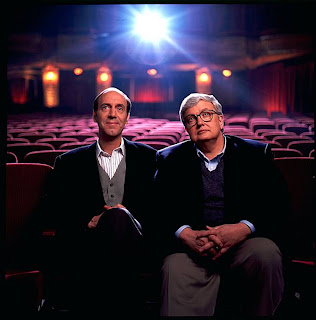
I was nine years old, and I wandered into the living room to find my mother watching some show on PBS. It was a show about movies – there would be a clip of a new movie that was out, and these two guys would then talk a bit about whether the movie was any good or not. One of these guys was a thin, lanky guy. The other was a squat, fat guy. The thin guy was named Gene. The fat guy was named Roger.

“What’s this?” I asked.

“It’s called Sneak Previews,” my mother answered. “Those two men are film critics. They tell us if movies are good or not.”

“Oh.”

And I watched the thing. I didn’t know anything about movies, but these two guys were interesting to watch. Another year or two later, their show was off PBS, which struck me as a bummer…but they turned up again, in a syndicated show that was on, like many syndicated shows, at whatever time some station or other felt like putting it on. No matter, it was fun seeing these two guys, Gene and Roger – who worked for newspapers in Chicago – talk about movies.

So I watched Gene Siskel and Roger Ebert for years, off and on, right up until Siskel’s deeply saddening death in 1998. Then I watched Ebert and Richard Roeper (a good enough fellow, but no substitute for Siskel) for a few more years, until we no longer had cable and thus the show was beyond my grasp. And then, a few years after that, Ebert himself started to have health issues, which eventually resulted in unsuccessful surgeries that have famously left him unable to speak or eat (he takes meals through a G-tube, which is something I understand all too well, thanks to Little Quinn).

Siskel and Ebert were, in my view, one of the great duos in the history of anything. Those two had such astonishing chemistry together, that it was a joy to watch them agree positively on a movie, an even bigger joy to see them agree negatively on a movie (seriously, watching the two of them tag-team on a bad movie was always great), and the biggest joy of all when they disagreed. Then you could see some fireworks. I remember Ebert being astonished at Siskel’s thumbs-down review of Scorsese’s Casino; “Thumbs down?!” Ebert yelped. And there was another time – I can’t remember the movie – where Ebert liked it and Siskel did not, and Ebert said something like “I don’t think you wanted to like this movie”, a suggestion that seemed to physically hurt the usually more acerbic Siskel. “I love to like pictures!” he protested.

One time on Late Night with David Letterman, there was a segment that had Mujibur and Sirajul, the two Indian owners of a local store, reporting to Dave from somewhere in the country. And Dave says, “If you two are out there, who’s watching the store? Can we send a cameraman to see who’s in charge at the store?” So a cameraman goes into the store, to reveal a very stern-looking Siskel and Ebert. OK, I guess you had to be there.

Anyway, Ebert has been writing about the movies for decades now, and he is, by nearly any measure, the critic whose work I find the most illuminating and the most evocative. I’ve been reading him nearly almost as long as I’ve been watching him on teevee, and for a number of years, his annual review collections were required book purchasing of mine. Now he has produced a memoir, which he has titled Life Itself.

Ebert’s health struggles in recent years are well-known, and it’s been truly fascinating to watch him take to blogging in the wake of the loss of his physical voice, a medium he had initially viewed with suspicion but which allowed his authorial voice to finally blossom to its greatest strength. Ebert has always been a fine writer, but oddly, his disability-due-to-cancer has, for many, made him even better. Maybe it’s similar to that old saw about how when you lose one sense, the others somehow make substantial gains in acuity.

Reading his blog, I’ve mostly been struck by Ebert’s ongoing zest for life, even when there were occasional posts that took an especially elegiac tone that made me wonder if he was preparing for his own departure from this world. Ebert is still with us, though, and now we have Life Itself.

The book is more a series of vignettes than a straight telling of Ebert’s life. The vignettes are more or less in chronological order, but Ebert seems to be more exploring various themes in his life than the chronology of events. The book is something of a memory album that gives an impression of a life, which seems to me a good way to structure a biography. Sometimes when I read biographies, I get a sense of “plot” that couldn’t possibly be there. Ebert is well aware that life is plotless, and that many of the things that shape the paths of our lives for good or ill are often accidental, a function of our coming into the circle of this person instead of that person, or even something so prosaic as taking this flight instead of that one.

It’s telling that the book gives more of a sense of his development as a writer than as a critic; I suspect that Ebert believes that he would have been a writer no matter what, and it was just an accident of various circumstances that led to him writing about movies for the last forty years. There’s no “Through all my life the cinema has grounded my being” or anything like that; Ebert grew up as a talented kid who liked going to movies with his buddies on Saturdays. I love when he recounts his first reviews of avant garde films; finding himself in confusion as to what the films were about, he took the approach of simply recounting his experience in watching the film. This is an approach that has gone on to inform his entire approach to movie reviewing and film criticism.

Sometimes, in the course of his blogging over the last few years, a tone has crept into Ebert’s writing – that he seems to deny whenever it is pointed out, but it is there – that he is, in long form, saying goodbye to his life. I deeply hope that this is not the case. Ebert is, for me, to film as Carl Sagan is to science, and he’ll be missed by me in equal measure when he is gone.

Here are some excerpts from Life Itself.

On Mike Royko:

At about six p.m. On New Year’s Day of 1967, only two lights on the fourth floor were burning – mine and Mike Royko’s. It was too early for the graveyard shift to come in. Royko walked over to the Sun-Times to see who else was working. A historic snowstorm was beginning. He asked me how I was getting home. I said I’d take the train. He said he had his old man’s Checker car and would drop me at the L station. He had to make a stop at a twenty-four hour drug store right where the L crossed North Avenue.

Royko at thirty-five was already the city’s most famous newspaperman, known for compelx emoitons evoked with unadorned prose in short paragraphs. Growing up as the son of a saloon keeper, he knew how the city worked from the precinct level up, and had first attracted attention while covering city hall. He was ten years older than me and had started at the old City News Bureau, the copperative supported by all the dailies that provided front-line coverage of the police and fire departments. Underpaid and overworked kids worked under the hand of its editor, Arnold Dornfeld, who sat beneath a sign reading: If your mother says she loves you, check it out. When I met him he’d been writing his Daily News column for two years. It was his writing about Mayor Richard J. Daley that took the city hall word clout and made it national. He chainsmoked Pall Malls and spoke in a gravelly poker player’s voice. He drank too much, which to me was an accomplishment.

That snowy night the all-night drugstore was crowded. “Come on, kid,” he said. “Let’s have a drink at the eye-opener place.” He told me what an eye-opener was. “This place opens early. The working guys around here, they stop in for a quick shot on their way to the L.” It was a bar under the tracks so tiny that the bartender could serve everyone without leaving his stool. “Two blackberry brandies and short beers,” he said. He told me, “Blackberry brandy is good for hangovers. You never get charged for a beer chaser.” I sipped the brandy, and a warm glow filled my stomach. It may have been the first straight shot of anything I’d ever tasted. I’d been in Chicago four months and I was sitting under the L tracks with Mike Royko in the eye-opener place. I was a newspaperman. A blackhawks game was playing on WGN radio. The team scored, and again, and again. This at last was life.

“Jeez, they’re scoring like crazy!” I said, after the third goal in less than a minute.

“Where you from, kid?”

“Urbana,” I said.

“Ever seen a hockey game?”

“No.”

“That’s what I thought, you asshole. Those are the game highlights.”

On books:

Chaz [Ebert’s wife] and I have lived for twenty years in a commodious Chicago town house. This house is not empty. Chaz and I have added, I dunno, maybe three or four thousand books, untold numbers of movies and albums, lots of art, rows of photographs, rooms full of comfortable furniture, a Buddha from Thailand, exercise equipment, carved elephants from India, African chairs and statues, and who knows what else. Of course I cannot do without a single one of these possessions, including more or less every book I have owned since I was seven, starting with Huckleberry Finn. I still have all the Penrod books, and every time I look at them, I’m reminded of Tarkington’s inventory of Penrod’s pants pockets. After reading it a third time, as a boy, I jammed my pockets with a pocketknife, a Yo-Yo, marbles, a compass, a stapler, an oddly-shaped rock, a hardball, a ball of rubber bands, and three jawbreakers. These, in an ostensible search for a nickel, I emptied out on the counter of Henry Rusk’s grocery, so that Harry Rusk could see that I was a Real Boy.

My books are a subject of much discussion. They pour from shelves onto tables, chairs, and the floor, and Chaz observes that I haven’t read many of them and I never will. You just never know. One day I may nee to read Finnegans Wake, the Icelandic sagas, Churchill’s history of the Second World War, the complete Tintin in French, forty-seven novels by Simenon, and By Love Possessed. That 1957 bestseller by James Gould Cozzens was eviscerated in a famous essay by Dwight Macdonald, who read through that year’s list of fiction bestsellers and surface with a scowl. I remember reading the novel late into the night when I was fourteen, stirring restlessly with the desire to be possessed by love.

I cannot throw out these books. Some are enchanted because I have personally turned all their pages and read every word. They’re shrines to my past hours. Perhaps half were new when they came to my life, but most were used, and I remember where I found every one. The set of Kipling at the Book Nook on Green Street in Champaign. The scandalous The English Governess in a shady bookstore on the Left Bank in 1965 (two dollars, today ninety-one). The Shaw plays from Cranford’s on Long Street in Cape Twon, where Irving Freeman claimed he had half a million books. Like an alcoholic trying to walk past a bar, you should see me trying to walk past a used bookstore. Other books I can’t throw away because, well, they’re books, and you can’t throw away a book. Not even a cookbook from which we have prepared only a single recipe, for it is a meal preserved, in printed form. The very sight of Quick and Easy Chinese Cooking by Kenneth H.C. Lo quickens my pulse. Its pages are stained by broth, sherry, soy sauce, and chicken fat, and so thoroughly did I master it that I once sought out Ken Lo’s Memories of China on Ebury Street in London and laid eyes on the great man himself, dining alone in a little room near the entrance. A book like that, you’re not gonna throw away.

On his wife:

I sense from the first that Chaz was the woman I would marry, and I know after twenty years that my feelings were true. She had been with me in sickness and in health, certainly far more sickness than we could have anticipated. I will be with her, strengthened by her example. She continues to make my life possible, and her presence fills me with love and a deep security. That’s what a marriage is for. Now I know.

On Siskel:

One of the things I miss about Gene Siskel is that he’s not around to make jokes about my current condition. He would instinctively know that at this point I wouldn’t be sensitive, having accepted and grown comfortable with my maimed appearance. He wouldn’t have started joking too soon. His jokes would have the saving grace of being funny. Here’s one I’m pretty sure he would have come up with: “Well, there’s one good thing about Roger’s surgery. At least he no longer needs a bookmark to find his chin.”

On movies:

I have seen untold numbers of movies and forgotten most of them, I hope, but I remember those worth remembering, and they are all on the same shelf in my mind. There is no such thing as an old film. There is a sense in which old movies are cut free from time. I look at silent movies sometimes and do not feel I am looking at old films; I feel I am looking at a Now that has been captured. Time in a bottle. When I first looked at silent films, the performers seemed quaint and dated. Now they seem more contemporary. The main thing wrong with a movie that is ten years old is that it isn’t thirty years old. After the hairstyles and the costumes stop being dated and start being history, we can tell if the movie itself is timeless.

What kinds of movies do I like the best? If I had to make a generalization, I would say that many of my favorite movies are about Good People. It doesn’t matter if the ending is happy or sad. It doesn’t matter if the characters win or lose. The only true ending is death. Any other movie ending is arbitrary. If a movie ends with a kiss, we’re supposed to be happy. But then if a piano falls on the kissing couple, or a taxi mows them down, we’re supposed to be sad. What difference does it make? The best movies aren’t about what happens to the characters. They’re about the example that they set.

Casablanca is about people who do the right thing. The Third Man is about two people who do the right thing and can never speak to each other as a result. The secret of The Silence of the Lambs is buried so deeply that you may have to give this some thought, but its secret is that Hannibal Lecter is a Good Person. He is the helpless victim of his unspeakable depravities, yes, but to the limited degree that he can act independently of them, he tries to do the right thing.

…

What I miss, though, is the wonder. People my age can remember walking into a movie palace where the ceiling was far overhead, and balconies and mezzanines reached away into the shadows. We remember the sound of a thousand people laughing all at once. And screens the size of billboards, so every seat in the house was a good seat. “I lost it at the movies,” Pauline Kael said, and we all knew just what she meant.

When you go to the movies every day, it sometimes seems as if the movies are more mediocre than ever, more craven and cowardly, more skilfully manufactured to pander to the lowest tastes instead of educating them. Then you see something absolutely miraculous, and on your way out you look distracted, as if you had just experienced some kind of a vision.

May Ebert’s spot in the balcony remain reserved for years to come.


Share This Post

Elmer Bernstein at 100

Elmer Bernstein, one of the most consistently delightful of all film composers, was born one hundred years ago today. Bernstein died in 2004, after a long and prolific life of making our cinematic world better. Here’s a sampling of his work. Thank you, Elmer Bernstein!

From Westerns to science-fiction films to comedy scores to character dramas to sword-and-sandal Biblical epics…and more. Elmer Bernstein was one of the greats.


Share This Post

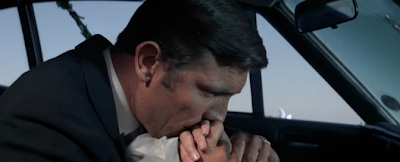
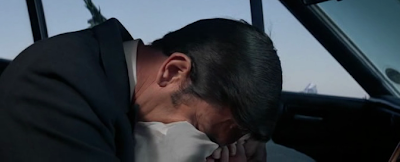
“I get why you shot him.” “Well, everyone tries at least once.” — Thoughts on NO TIME TO DIE

(NOTE: As this review heavily references ON HER MAJESTY’S SECRET SERVICE, I have revised and reposted my long essay about that film as well.)

After a series of production false-starts, headaches, and then a global pandemic, No Time To Die, the twenty-fifth James Bond film and the last one featuring Daniel Craig as Agent 007, finally arrived in late 2021. For a while it seemed like the movie would never get here: Craig’s reluctance to return after the grueling SPECTRE shoot, and then a troubled development phase with scripts being reworked and writers and the original director coming and going, and then delays in filming when Craig himself got hurt on set.

And all of that happened before the COVID-19 pandemic pushed the film’s release…and then pushed it again…and again, to the point where for a time there was serious talk of the movie being issued directly to one of the streaming platforms instead of getting a theatrical release at all. This didn’t happen, obviously–but for a while, No Time To Die felt like some kind of mythical beast, often referenced but never actually seen. Six years elapsed between 2015’s SPECTRE and 2021’s at-long-last release of No Time To Die, a span only equaled by the gap between 1989’s Licence to Kill and 1995’s GoldenEye, when the Bond series as a whole was derailed by some legal issues.

Was the wait worth it?

It depends on who you ask. Some James Bond fans hate this movie, with some intensity. I know this because I am married to one of them.

On the flip side of that coin, some James Bond fans react to No Time To Die as if it were specifically crafted to hit the sweet spot on each and every one of their emotional buttons as James Bond fans. I know this because I am one of them.

The most common objection to No Time To Die that I’ve heard cited by the film’s detractors is that this movie just goes too far. While all of Daniel Craig’s Bond films deviate from the classic “Bond formula”, this one goes so far from the established tropes of Bond that it ceases to be a Bond movie at all. Here we get a Bond who is grappling with emotional issues, who has left MI6 entirely, he is in love, he has been hurt, he has history, he has demons, and he has a kid.

And, of course, there is the movie’s biggest deviation from Bond formula, and you don’t get bigger than this: No Time To Die tells us that James Bond is mortal.

For many fans, this is simply too much.

And I respect that. I don’t agree with it, but I do respect it.

All through the Craig run, I wondered–along with many others–when we’d get back to the “classic” kind of James Bond adventures. We had the reboot, but surely we’d eventually get Craig to the old formula: an adventure in the pre-credit sequence, followed by a villainous figure starting some nefarious stuff. Bond would get a briefing from M on what little info they had, and then he’d go out into the field–getting some gadgets from Q at some point in the first act–and he’d do actual spy stuff. He’d meet “the girl”, or maybe two, and he’d bed one or both, and he’d slowly put together the bad guy’s plot before finally thwarting it in a big action finale with explosions and cool fisticuffs and whatnot.

You know the drill. Point is, I think we all expected Daniel Craig’s James Bond to get to that kind of movie–and yet, all through Craig’s run, he always seemed to flirt with that formula but never quite get there.

Maybe we expected it after Casino Royale, but then Quantum of Solace picked up right where that film left off, with Bond still chasing that film’s threads and reeling from Vesper’s death. Then Skyfall started off that way, with a banger of a pre-credit sequence, but that film deviated too with Bond being shot and disappearing for a while and reappearing and so on, before the adventure unfolded that took him into his roots. When Skyfall ended with Bond standing in the new M’s office, with that leather-padded door and saying that he was ready to get to work, I thought, “OK, next time out, James get a briefing and sent out on a proper mission!”

And then…Spectre thwarted the expectations again, in a movie that is a lot more derided than I generally like, though I can understand some of the frustrations around it. And then Spectre had Bond turn away from MI6 and go away with “the girl”, leaving us with a starting point for No Time To Die. We were never going to get a “standard” Bond film with this one, either, and what was more, Spectre did some retconning of the three movies before it to tie it all together into a single story, which NTTD would then have to wrap up. So in five movies made over fifteen years or so, we never once got Daniel Craig in a “standard” James Bond movie.

In my recent series of posts ranking all the Bond movies, I noted that I tend to prefer the “outlier” Bond flicks over the “standard formula” ones: “I especially love the ones that acknowledge that James Bond really, truly does have an emotional life of his own and that he gets personally invested sometimes.”

Maybe five films in a row of this is a bit much, but it seems to me that to follow up four movies that really were all about James Bond as a human character, establishing his history and using a consistent theme across all of these films of the present being shaped by our previous choices (and those of our forebears), to ignore all of that and just give Bond an old-school formula adventure, would have been a crime of storytelling. This is for thematic reasons, as well as reasons of continuity.

A common thematic thread has wound its way through all of Daniel Craig’s Bond films: the actions of our families informs our own actions, and their actions influence our lives in ways we can barely appreciate, long after they are gone. It makes total sense to me that the last Craig film would tie all of that together. This is, of course, another break with Bond tradition, where one adventure has little, if anything, to do with the next. But here we don’t just have a final adventure, but a wrap-up, a summation, a capstone adventure that draws on what has gone before–all of what has gone before.

Consider the film’s opening: we see the traditional gunbarrel sequence, but instead of the stylized cartoon blood and the gunbarrel fading to the dot that eventually irises us into the scene, the gunbarrel itself irises us there, which uses established Bondian film language to tell us, before anything happens in the story, that this is different, that we’re seeing something new. And new it is: a flashback to a strange man in a ceramic mask, on his way to murder Madeleine Swann’s family. This sequence is scary and intense, and it establishes Madeleine’s connection to Saffin, this strange assassin who decides to rescue Madeleine after he has killed her mother. The visuals in this sequence are stark, cold, almost black-and-white, which makes our eventual cut to the present day all the more surprising. Adult Madeleine is on holiday with James Bond, who has left MI6.

We don’t know how much time has passed since the end of Spectre, but it can’t be too long. Bond and Madeleine are in the relationship, but they’re still feeling each other out, still trying to figure out where each one stands against the backdrop of tragedy in both their backstories. Madeleine has brought Bond to a town in Italy where the locals have a custom of writing their sins on slips of paper, setting them aflame, and tossing them into the air. (These visuals are gorgeous–if nothing else, No Time To Die is one of the most visually beautiful films I’ve ever seen.)


Madeleine has another motive for bringing James here: she knows that his first love, the one he lost, the one whose death haunts him and whose betrayal damaged him, is buried in the cemetery in this town. She wants James to visit her grave and put that part of his past behind him. The film is already deep into acknowledging the pain and history in this particular incarnation of James Bond. Imagine a James Bond film not just showing “the girl” from the last film, but also mentioning the importance of “the girl” from four movies ago! Imagine, say, Octopussy opening with Bond and Melina from For Your Eyes Only talking about Mary Goodnight from The Man With The Golden Gun. Absurd? Maybe, in that approach to James Bond.

The Craig films are different.

It turns out that SPECTRE has already anticipated Bond’s visit to Vesper Lynd’s grave, and they’ve planted a bomb there. It goes off, but doesn’t kill Bond; instead a group of SPECTRE goons attack, and Bond grabs Madeleine and makes a typically Bondian escape, although Bond is blaming Madeleine for the attack: remember, she is not ignorant of SPECTRE. Her own father was a major figure for them, and to Bond, she must be involved, because how else would they have known that Bond was there? As Bond says: “We all have our little secrets. We just haven’t gotten to yours yet.” They make their escape, but Bond, furious, puts Madeleine on a train and leaves her, disappearing into the crowd.

Now, consider that: at some point between each James Bond movie and the next one, there must be a scene where Bond breaks up with “the girl”. One time we actually got an acknoweldgement of this fact, in Tomorrow Never Dies, when Bond had to go seduce a former lover in hopes of gaining intel on an enemy. (Damn, how I wish that movie hadn’t killed Paris Carver off! She was a potentially interesting character and the idea of watching Bond try to win back over a former “Bond girl” was a great one. Alas! How extravagant Purvis and Wade are, tossing great ideas aside like that!)

Fade to the opening credits, the amazing Billie Eilish song, and a precredits sequence that visually calls back to Casino Royale, Dr. No, and…On Her Majesty’s Secret Service.

And that brings me to the heart of the matter.

Just after No Time To Die cuts from Madeleine Swann’s childhood to the present, but before SPECTRE’s attack at Vesper’s grave, there’s a brief scene where Bond and Madeleine are driving through the Italian mountains overlooking the Mediterranean, in the Aston Martin DB-V, and this exchange takes place:

MADELEINE: Can you go faster?

BOND: We don’t need to go faster. We have all the time in the world.

When Daniel Craig said those words as I watched No Time To Die the first time, I said audibly, “Oh no, don’t say that!”

But Bond did say that, and as if to accentuate the point, at this moment in the film we cut back to sweeping shots of the Aston-Martin on those soaring Italian roads–as Hans Zimmer’s score rises with nothing more than a full-on quote of John Barry’s original orchestral arrangement of the song “We Have All The Time In The World”, the love theme from On Her Majesty’s Secret Service.

As I watched No Time To Die, I realized that the film was almost a love letter to OHMSS, in a way that no Bond film has ever been. With its various call-backs to that film, with its structural similarities and tones, with its approach to Bond as a character…well, NTTD seems almost calibrated to hit the same emotional buttons that OHMSS pushes. I suspect that how well one responds to this film can be partly determined by how one responds to the earlier one. As I’m one record as considering OHMSS not just the best Bond movie by a significant margin but also one of the great movies of all time, it follows that NTTD felt like it was almost made for me.

And that’s a strange sensation, I have to admit.

NTTD doesn’t remake OHMSS or retell its story (though we’ve already seen elements of it in previous films–remember the health clinic high in the Alps, in Spectre? That alone had me wondering about how big an influence OHMSS has been on writers Purvis and Wade), but NTTD does allow OHMSS to echo throughout its own story. Like OHMSS, NTTD gives us a weary James Bond who is pretty tired of the whole business. This was one of the more interesting aspects of OHMSS, and it’s an aspect that doesn’t get commented on much, so I think a lot of people simply miss it, which is a shame. It certainly helps understand some of the acting choices George Lazenby makes when you consider that his Bond is tiring of the spy gig. But I digress….

The point is, James Bond has a very real emotional life in NTTD, a very real emotional journey. It begins with Bond trying to make peace with some personal demons, but that effort is thwarted by a SPECTRE attack, and Bond’s response it to pile more baggage on top of the old. So, when we rejoin the story after the opening credits and the passage of five years of story time, Bond has retired and is living in the Caribbean, not really doing much of anything at all. This echoes OHMSS‘s first act, in which Bond has been trying to track down Ernst Stavro Blofeld for two years, with little success, to the point that when we join Bond in that film, he’s not really trying all that hard to be a good spy (to the point of lazily losing track of his own gun twice).

Meanwhile, as NTTD gets rolling, a somewhat labyrinthine plot involving a nanotech-driven bioweapon unfolds, into which Bond will eventually get drawn, not at first by an MI6 in need of its best agent–because M has apparently made peace with Bond’s departure to the point of appointing a new Agent 007 (the quite wonderful Nomi, played by Lashana Lynch), but because his old friend Felix Leiter asks for his help. I actually like the twisting plot; my formative years in the spy genre were in the heyday of Robert Ludlum, Tom Clancy, Nelson DeMille, and other writers who cranked out 600-page doorstops with plot twists on every page, so I’m always on board with a spy story that’s just a bit too hard to follow at times. I will admit that NTTD could have benefitted from a more clear explanation of the bioweapon, but the info is there in the movie, and it made more sense on the rewatch. For these reasons, though–the complex plot and the dense emotional story unfolding around it–I have zero problem with NTTD‘s generous running time.

OHMSS echoes throughout NTTD in other ways, many of them not immediately obvious. Both films depict a complex relationship between Bond and M, with M’s frustration with Bond bubbling over a few times, but never at the cost of M’s respect for Bond’s abilities. In the earlier film Bond’s frustration drives him to the point of resignation (fortunately thwarted by a clever bit of failed dictation by Miss Moneypenny, an action that is praised by both Bond and M), whereas in NTTD Bond, having already resigned, is now being pulled back into the mess which is in no small part M’s fault for having pursued the development of the bioweapon in the first place. Late in OHMSS, Bond is forbidden to go after Blofeld; in NTTD, M is similarly reluctant to bring Bond back into the fold, for personal reasons. In both films Bond is committed to a moral view that he feels is being compromised by his superiors, leading to confrontational scenes in both films.

(By the way, OHMSS detractors really need to watch the scene between Bond and M after the adventures in the Alps and Tracy’s capture. Lazenby portrays Bond like a tightly-coiled spring ready to explode, and he’s perfect there. Again, I digress….)

There’s a scene toward the end of the third act in NTTD when Bond and M finally get themselves onto the same page again, and here Hans Zimmer makes another interesting musical choice that thrilled me when I realized it in the theater: he quotes, as underscore to this scene, the main theme from OHMSS. At that moment James Bond is officially back on Her Majesty’s Secret Service.

Of course, the most important parallel that NTTD shares with OHMSS is that it gives James Bond a love story. While OHMSS propels Bond into its love story by a chance encounter with a woman broken to the point of suicide, NTTD‘s continues a love story that began in the previous film by bringing Bond to the point of commitment and then yanking that away (partially his own fault, because he makes no effort to listen to Madeleine’s protestations of innocence after the attack at Vesper’s grave, protestations that would later be confirmed by Blofeld himself). Even though five years have passed, Bond is still carrying the torch for Madeleine, and even though he has sworn to never see her again, events push them together, and that’s when Bond meets Mathilde.

Madeleine’s daughter.

Whose eyes look very much like James Bond’s.

NTTD makes two story choices that Bond fans can either accept, and therefore like this movie, or reject, and therefore hate it. This is the first of the two: it makes James Bond a father.

Now, in itself, how surprising is this? With all of his sexual exploits through the years, you have to figure that James Bond, well, “slipped one past the goalie” at least once. Right? This is never admitted or granted or mentioned at all, until now. It’s kind of like finding out in Star Trek II that James T. Kirk has an adult son, which probably makes sense given how frequently Kirk “got the girl” in the Original Series. But here is James Bond, meeting his five-year-old daughter (though Madeleine won’t confirm this until the very end).

Is it right for James Bond to be a father? That turns out to be a bridge too far for a lot of fans. It doesn’t bother me, exactly, though it does take a bit of getting used to. Again I have to return to considering the nature of Daniel Craig’s entire run of Bond films, and not just think about this one in a vacuum. All of Craig’s run is informed by Bond being haunted by choices and actions of his ancestors, and by the secret lives of those around him. His becoming a father is probably the best distillation of this constant emotional undercurrent of these movies, and it gives Bond the very best motivation for wanting to succeed and then be done with it all.

This is another of the parallels with OHMSS: Bond’s coming to terms with the fact that he does want a normal life with love in it, and that his profession isn’t compatible with this. In OHMSS, Bond admits to Tracy that he’ll need to find a different living if he wants to be with her, and in NTTD, James Bond is deeply aware of this already.

In fact, Daniel Craig’s James Bond has always chafed against the constraints of the job, and he has always taken a fatalistic view of how it can all end. By the time NTTD rolls around, Bond has seen the possibility of something else…but then there was this exchange, way back in the first act of Casino Royale, that seemed at the time just a bit of pith, but now seems prescient:

M: I knew it was too early to promote you.

Bond: Well, I understand that Double-O’s have a very short life expectancy, so your mistake will be short-lived.

And that brings me to NTTD‘s other deal-breaking (for some) story choice: the acknowledgment that James Bond is, in fact, mortal.

There’s a thing about characters like James Bond: episodic characters who have lots of episodic, unrelated adventures. Eventually the constant drumbeat of one adventure after another, each unrelated to the last and to the next, gets a bit unsatisfying, so in nearly every case of such characters–think Sherlock Holmes, Tarzan, John Carter, Dr. House, et cetera–some kind of continuity creeps in. Old enemies and old flames resurface, and gradually a life, a larger story, emerges. The same thing happened with James Bond, particularly in Ian Fleming’s original novels. And if you acknowledge a character’s larger story, you eventually have to acknowledge, somehow, their mortality. You can get around this a little, by having killing their previous life in some way (see the ending of House MD for a good example; House doesn’t die, but his career is as dead as Old Marley), or you can actually kill the character.

NTTD takes the latter course.

And for some, again, this is an unforgivable move for a James Bond story. I’m not really sure why, because this type of story–the weary hero’s final adventure, after which they die–is not new at all. See Robin and Marian, or Logan, for good examples. Especially the latter film, which I remember being almost universally hailed, with no one sobbing that “You can’t kill Wolverine!”

NTTD takes the emotional course of OHMSS and reverses it, because it knows that James Bond simply cannot have a permanent happy ending. All he can have is moments of happiness that pass quickly: he can wrap up the mission and bed “the girl”, and then he’s off to the next mission, the next adventure. This is not a new thing with Bond; the “hero who can never find true happiness” is a trope as old as time. Sherlock Holmes is one, and this was used to good effect in the movie Young Sherlock Holmes; the afore-mentioned Captain Kirk from Star Trek may be another example. And James Bond is that kind of hero as well.

The few times that he does seem on the cusp of some kind of permanent happiness–with Vesper, with Tracy–it ends horribly. So it must here: he loves Madeleine and he has a daughter with her, and maybe he could even make it off Saffin’s island in the end before the missiles hit, but he’s infected with Saffin’s bioweapon, which Saffin has programmed to kill Madeleine and Mathilde, so Bond knows that even if he survives, he can never touch Madeleine or Mathilde again. It’s a perfect dilemma, leaving Bond with choosing either a life where he can never be with those he loves, or simply choosing death. So…he chooses.

It’s quite simple, really: if you have a hero who can’t have permanent happiness, and then you bring that hero to the brink of permanent happiness, there really are only two ways to go. OHMSS went one way. NTTD goes the other.

Bond’s actual death scene is exactly what I would have envisioned for a James Bond death scene: Agent 007 sacrificing himself to save the world. His demise is very quick, but he gets to say his goodbyes to Madeleine, almost heartbreakingly via radio–they tell each other they love each other, and Madeleine finally admits that yes, Mathilde “has your eyes,” meaning, Mathilde truly is Bond’s daughter–and then it goes full-circle in giving Bond one more time to say those most heartbreaking of words in Bond history, but this time with a more optimistic twist: he says to Madeleine, “You have all the time in the world.” He is looking up as he says it, slightly smiling, as if thinking of the weird beauty in the sky above him as the missiles deploy their warheads and then rain down upon him. He closes his eyes as the fireball hits…and that’s it.

NTTD doesn’t linger on this moment: Bond is consumed by the flames, then we see a few long shots of Saffin’s island installation being destroyed, and then a fade to London, to MI6, after the mission is over. M has gathered together Q, Miss Moneypenny, Nomi, and his assistant Bill Tanner for a quick remembrance of Bond via a Jack London quote and a shared whiskey (neither shaken nor stirred), and then we cut to Madeleine and Mathilde, driving along another mountainous coast–maybe the same one from the film’s beginning. Hans Zimmer quotes “We Have All The Time In The World” again, as Madeleine looks at Mathilde and says, “I’m going to tell you a story about a man. His name was Bond…James Bond.” Mathilde smiles, and then their car–the Aston Martin!–disappears into a tunnel, and as the camera pulls out in front, the car and the tunnel recede, in a cunning reversal of the traditional gun-barrel opening of these films.

And the credits roll, with Louis Armstrong’s original recording of “We Have All The Time In The World” bringing it all to a close. But where OHMSS ended with an instrumental of that song being cut off by an almost unpleasant-sounding rendition of The James Bond Theme, reinforcing the fact that Bond and Tracy did not have all the time in the world, no such cut-off happens now. Bond is gone, but he has made good his promise. Madeleine and Mathilde really do have all the time in the world.

So ultiamtely No Time To Die echoes On Her Majesty’s Secret Service all the way to the end, and it does so with love and respect. I can’t not love this movie, because I value its craft, its storytelling choices, its pacing, all of it. It doesn’t stop at calling back to OHMSS, either: Felix Leiter’s betrayal and fate call back to Fleming’s original book of Live and Let Die as well as the film Licence to Kill, and Bond’s dispatching of Leiter’s assassin is reminscent of Roger Moore’s most ruthless moment, when he confronts an assassin in a similarly precarious position in For Your Eyes Only.

In terms of the villains, NTTD has an impressive Rogue’s Gallery going on, led by Rami Malek’s Lyutsifer Saffin, who is as coldly cunning as Bond villains get. (I don’t think he necessarily needed to be depicted as being disfigured, though.) With Saffin, Craig’s Bond gets his first real shot at a bad guy with a “Destroy the World” plot and a secret base built in a remote location. The evil scientist who invented Heracles, the nanotech bioweapon, is a wonderfully slimy toad of a character, and Christoph Waltz’s one scene as Blofeld is an excellent scene. I wondered during the film’s making if it would be weird, having Blofeld around but with a new “main” villain; NTTD makes this work pretty well.

As for allies, Jeffrey Wright’s Felix Leiter has pretty much become the iconic version of that character (apologies to the great Jack Lord). Lashana Lynch’s Agent 007 is slick and professionally capable, Ben Whishaw and Naomie Harris are excellent again as Q and Miss Moneypenny. Ralph Fiennes can be M for as long as he wants the role, as far as I’m concerned; Lea Seydoux sells me on the idea of another woman who James Bond loves. And there’s the joyous turn by Ana de Armas as Paloma, the CIA agent sent to help Bond in a sequence that is far too short.

Ultimately, though, No Time To Die rests on Daniel Craig’s shoulders, and he picks the film up and carries it. At no point does he feel like he’s mailing it in; I buy his weariness, his desire for closure, his humor, and his acceptance of the end at the end. He even gets to joke around a bit in this movie, getting a Roger Moore-esque quip after dispatching one bad guy in a delightfully gruesome Bondian way, and mugging for the camera when Paloma grabs him by the hand and pulls him out of frame when they first meet. All of Daniel Craig’s films have to convince us that James Bond is a man who feels things, and Daniel Craig brings those goods, each and every time.

On the technical side, No Time To Die is a triumph. It is loaded with beautiful compostions, even during action sequences, and the action sequences are always easy to follow, no matter how much mayhem is happening onscreen. (Craig’s second outing, Quantum of Solace, is much criticized for the downright incomprehensibility of its action scenes.) The score is by Hans Zimmer, a composer whose work I tend to love or dislike in equal measure, and he is mostly up to the task here, especially in the film’s moments of drama. I’m not as big a fan of his action music, but that’s always been the case with Zimmer’s work for me. I was glad to hear a more prominent use of melody in Zimmer’s score, since Zimmer has largely been eschewing melody in favor of stacked chords and soundscapes in his film music over the last decade or so.

I loved No Time To Die, even if I understand why a lot of people do not. After all, this movie literally kills James Bond…and then, at its very end, the last thing onscreen after the credits is the traditional promise:

Well…how is that going to work?

There are a few choices that I can see. Either the next Bond incarnation will acknowledge the Craig run, or it won’t. If the latter, there will likely be a reboot of some nature: maybe a full reboot where everything is done brand-new again from the ground up, like Casino Royale did, or maybe a “light” reboot where, say, Fiennes and Harris return with a new Bond without mentioning these adventures. I’ve also seen suggestions of making Bond into a series of period films, setting James Bond back in the milieu of the 1960s. In all honesty, I’m not sure I want that…or any reboot, partial or full. The Craig run represents a complete body of work, in a way that no other previous Bonds do with their respective runs (Lazenby excepted, since his run was one film, admittedly great). To simply plug in a new Bond and return to episodic adventures of the traditional sort would feel, at least to me, a bit cheap.

Maybe the best way is to acknowledge the Craig run…but then, how do you have a new James Bond at all, if you admit to having killed the last one? Well, there’s an old fan theory that all the movies up to Casino Royale weren’t telling the adventures of a single character, but rather the adventures of five different characters, each of whom assumes the name of James Bond and the number 007 at some point. In other words, James Bond is a code name assigned to an agent upon promotion to that level.

So…maybe they recruit a new agent, promote him, and give him a code name inspired by a real agent, now deceased, who served with distinction. Now you have a new “James Bond” with a new backstory, a new history, and none of the old baggage. Maybe the new “Bond” can develop a crush on Moneypenny, and maybe she hates him and only tolerates him, in a reversal of their old flirtatious relationship. (And there’s nothing here that even insists that the new “James Bond” be white, or a man!)

Maybe, maybe, maybe. How would fans embrace this? I don’t know. A lot might bail, to be honest, in the same way that a lot of Sherlock Holmes purists reject utterly the recent Benedict Cumberbatch or Jonny Lee Miller modern-day versions of the character. But speaking for myself, I just don’t see a return to the Bond formula of old, a formula that we haven’t even really seen executed on screen in more than twenty years, as if nothing in the interim has happened. In addition to the Craig run, there are the Mission: Impossible films to look to, with their format of new adventures for Ethan Hunt and his team, but also admissions with each mission of the cumulative effects of the previous missions.

I don’t have any idea what’s coming, obviously. But I do know that when Daniel Craig took over as James Bond, Barbara Broccoli and Eon Productions seized an opportunity to rethink James Bond fromt he ground up. They now have the chance to do it again. Let’s see what they do.

But in the meantime…thank you, Daniel Craig. Your James Bond was something special.

To James.


Share This Post

“Thy dawn, O master of the world, thy dawn….”

A repost, with some revisions and additions throughout, to accompany my review of NO TIME TO DIE, which is coming tomorrow. I wrote this more than ten years ago, and if anything, my esteem for ON HER MAJESTY’S SECRET SERVICE has only increased since then. I rewatched the film on one leg of our recent journey from Buffalo to Honolulu, and the film still holds up.

Here we go. Additions to the post’s original text will be in blockquoted offsets. Far up! Far out! Far more!!!
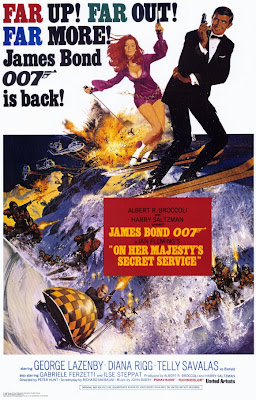
Sometimes I change my mind about movies. Sometimes I don’t. Some movies meant a lot to me, years ago, but have dropped away to the point that I’ve forgotten about them. Other movies, though, have stayed with me forever. One of those is On Her Majesty’s Secret Service, the sixth James Bond film, which I have regarded since I was a teenager as the best Bond film ever made. In fact, I consider it one of my favorite films of all time, in any genre.

OK, a story here: I cut my teeth as a Bond fan in the era when the films’ teevee rights were owned by the ABC network, in the early 80s. This was before home video was much of a thing–we didn’t even own a VCR until 1985, I think–so the only way to catch up on the Bond films was to catch them on ABC, which would run one every few months. Now, at the time I was aware that Sean Connery had played Bond in the first five or six films, while Roger Moore had taken over the role (and was still active at the time). However, when perusing Bond soundtracks at a record store in a mall one day, I found the soundtrack album for a flick called ON HER MAJESTY’S SECRET SERVICE, with “George Lazenby” as Ian Fleming’s James Bond 007. What was this? A parody? A one-off by some other studio? No, it said “Albert R. Broccoli presents” and “EON Productions” and the like, so it had to be official. I asked my mother, who knew about Bond and was guiding me through the movies as they came up, and she wrinkled her nose and said something like, “Oh, that one. There was a guy who did one Bond movie but apparently he was really bad and the movie bombed so they fired him.” Now, that’s not entirely accurate, but it sums it up, for the most part.

But within a year or two, ABC televised OHMSS, and we watched it. I wasn’t terribly excited, because I expected it to suck, but I remember getting into it more than I expected…and then, during a commercial break around the halfway mark, my mother observed, “You know, he’s really not bad as James Bond!”

When we got our VCR a few years later, I’d start recording the Bond movies when they aired, which is how I watched them obsessively for years. That’s how my appreciation for OHMSS started, and how it deepened. By the time I went to college in 1989, I already considered OHMSS the best Bond film.

Released in 1969, OHMSS came out when the Bond-mania of the 1960s was starting to wane. Films like Goldfinger and Thunderball had been enormous hits, but now, Sean Connery had left the role of Bond and a complete unknown named George Lazenby was cast as his replacement. All this is well known, and over the years, Lazenby’s performance in OHMSS has been reliably controversial. To this day, there are Bond fans who loathe his performance, and to this day, there are fans who not only think he did a fine job, but that he really doesn’t stand in Sean Connery’s shadow at all. (I am in the latter camp.)

Narratively speaking, OHMSS is one of the strongest films in the series. Its script, by Richard Maibaum, is outstanding, with lots of wit and fine dialogue that rarely seems as far-fetched as Bond dialogue can sometimes get. The story, though, does present problems for people who are interested in continuity.

The problem comes from the fact that Eon Productions (the producers of the Bond series) did not adapt the Ian Fleming novels to the screen in the order that they were written. The first Bond film is Dr. No; the first novel is Casino Royale. The Bond films of the 1960s, excepting Goldfinger, all feature Bond squaring off against the minions of SPECTRE, culminating in You Only Live Twice when he finally meets Ernst Stavro Blofeld face to face. However, in the novels, it’s in OHMSS that Bond meets Blofeld. The problem then is why Bond and Blofeld don’t recognize each other in the OHMSS film when they come face to face. There are lots of possible fictional explanations for this, and the original idea was to have Bond undergoing plastic surgery to explain his new resemblance to George Lazenby. The producers chose not to do this…and yet, in the next film, Diamonds are Forever, they would use the plastic surgery idea to explain why Blofeld in that film now looks like Charles Gray. (Without, of course, explaining why it is that Bond now no longer looks like George Lazenby but like Sean Connery again.)

(Having read recently a book about the history of the Bond movies, it turns out that Eon was going to make these movies in their correct order, with OHMSS coming before YOU ONLY LIVE TWICE, but it turned out that there was insufficient snow in the Alps when they would have been shooting OHMSS, so they did YOLT first.)

In watching OHMSS recently, I came to realize that the Bond films that are the best tend to be the ones that most deviate from the standard Bond “formula”. That certainly holds true with OHMSS. The film starts with Bond, already on assignment in Portugal. But, as M notes in the film’s very first scene, no one with MI6 has any idea where Bond is, and his current assignment is becoming politically problematic: “Number 10 is making ugly noises about Operation Bedlam.” Operation Bedlam, we later learn, is the search for Blofeld, who is presumably on the run following his failed scheme in You Only Live Twice. So already Bond is on thin ice with his superiors; he is failing at an assignment; he’s been on a single assignment for two years.

That last is important, because time is a recurring motif all through the film. Bond’s relationship with time is a constant underlying theme, made explicit in Maurice Binder’s typically-brilliant opening titles sequence. Clocks and hourglasses figure prominently in the title sequence. Now, timers and clocks are a constant trope of spy fiction and thriller films, what with heroes defusing bombs or whatnot as the digital timer ticks off the last few seconds before disaster is to strike. But there is something different about time in OHMSS: even as Bond is up against the same kinds of time constraints that he’s always faced before, we get a real sense that he’s weary of the whole thing and desires a different kind of relationship with time.

So Bond is in Portugal, driving along, when a woman in a red car passes him on a lonely seaside road. Bond, of course, gives chase, and comes to a beach where the woman parks her car and goes down to the water, where she starts to wade out. Bond spies her through the telescopic sight of his rifle, and it’s thus that we get our first close-up of Contessa Teresa di Vicenzo, better known as Tracy.

Tracy – played by Diana Rigg – already looks sad and lost in this shot, as Bond watches her wander into the water. He quickly realizes that she intends to let the tide carry her out; he is watching a suicide attempt, so he intercedes, bringing her back in from the water and introducing himself – “Good morning! My name’s Bond. James Bond.” Here we see Lazenby’s face for the first time; up until now, the film has teased us with shots of his head from behind, closeups of his lips as he lights a cigarette, and the like.
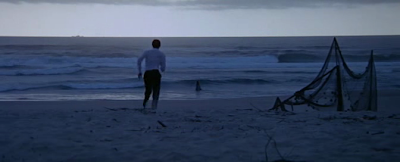
Two goons show up here, to take Tracy away. Of course, Bond has no idea who this girl is, or who her two “protectors” are, but the goons apparently intend to kill Bond, so there’s a fight. It’s a pretty kinetic fight, and all of the fights in OHMSS are pretty kinetic – and with good reason, as director Peter Hunt has literally sped them up in the editing room. I’m not sure why he chose to do this – some fans speculate that Lazenby was an awful screen fighter, and the sped-up fights are a ploy to conceal this – but it doesn’t matter. This is another facet of OHMSS that can divide fans. Some are distracted by the quickened fight scenes; others – myself included – simply accept it as a stylistic choice in a film that has a lot of style going for it.

Anyhow, Bond dispatches the goons, but the girl has already fled, jumping back in her car and driving away. Bond is left alone on the beach, holding her shoe, whereupon he breaks the fourth wall to tell us, “This never happened to the other fellow.” Cut to opening title sequence.

There appear to be two schools of thought as regards the breaking of the fourth wall here with the “This never happened to the other fellow” line. It doesn’t bother me. I like strategic breakings of the fourth wall, on occasion. This one seems to me a signal: “Yeah, it’s a new guy. Get over it.”

When we return, Bond is still in Portugal, and checks into a hotel, where he notices a red Cougar parked outside that he is informed belongs to a lady. He takes his room, and looks down on the pool, whereupon there’s a wonderful transition shot from day to night as this shot…
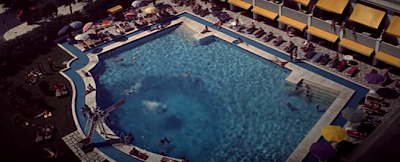
…fades into this one, while a slow tune for jazz flute plays in the background.

I love that second shot; the pool seems deserted but the reversed “Casino” logo is disrupted by ripples a couple of times. This isn’t the kind of shot one typically sees in a Bond film.

By the way, that jazz flute piece I mention there? On the score album this track is called “Try”, and it’s a very subtle and cool bit of subdued jazz. I really like its general feel, with brushes on the drums and the melody carried by vibraphone before the solo flute plays. There’s a world-weariness to the track that works well to set Bond’s mood.

Over the next twenty minutes or so, the film’s story continues to unfold slowly, and in a way that seemingly has absolutely nothing to do with spy intrigue. Bond goes to the casino to play baccarat (the traditional card game of the Bond films, until Casino Royale replaced it with poker). An elegantly-dressed woman enters the game, places a huge bet, and promptly loses – but she has no money. Bond recognizes her: she is the woman whom he saved on the beach the night before. Detecting her streak of self-destructive behavior, Bond bails her out for twenty thousand francs and then has a brief conversation with her over champagne, where she is quite blunt about how she is to repay her debt to him: she gives him her room number and says, “I hope it’ll be worth it.” She is cool and businesslike; when Bond calls her “Contessa Teresa”, she replies, “Teresa was a saint. I’m known as Tracy.”
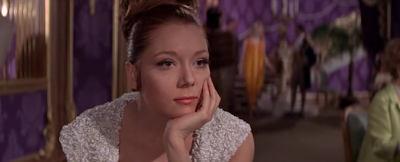
Bond is already intrigued by this woman who is proving somewhat resistant to his charms, by her mysterious background, and by the fact that she has goons following her around. One attacks him when he enters her room; after dispatching the goon, Bond figures that the tryst isn’t happening and goes back to his room, which is where she’s waiting. She pulls his own gun on him, but now he is having none of this: he demands to know who the men following her are, and when she claims ignorance, he slaps her and says, “I can be much more persuasive, Contessa.” Ahhh, the freewheeling sexism of the early Bond films – not a quality of the Bond series that I’ve missed, but it’s worth noting that Tracy proves equal to the moment, lifting her gaze to fiercely meet Bond’s as she says, “Whatever else I may be, I’m not a liar.”
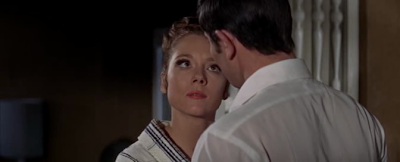
Here, at this moment, is when the film score gives us the first hint that this girl is different, because this is where we first hear the film’s love theme. After some more discussion during which Tracy still resists Bond’s efforts to figure out who she is and why she is acting the way she is (“The only thing you need know about me, Mr. Bond, is that I pay my debts”), Bond and Tracy do, in fact, sleep together, but when he awakes the next morning, he finds that she is gone not just from his room but from the hotel entirely…but not before leaving two chips for ten thousand francs in his bedstand. “Paid in full,” Bond notes – and we never learn just how she came up with that money.

OK, two notes here. First, about Lazenby himself: Since the precredit sequence is primarily mood and action, this is where we first get a sense of Lazenby ACTING as Bond, and aside from a few weird line readings–more on that in a minute–I honestly don’t see the problem people have with him. His entry into the casino is pretty Bondian, the way he casually glances at passing women and walks through the place with a laconic ease, like he’s totally in his element. He has more than enough physical presence, and for the most part his tone is excellent when he speaks.

But there are a couple of weird notes, one of which comes after Bond bails Tracy out at the chemin de fer table. He tells her to play it safe and stay with the cards she has (chemin is sort of like Blackjack, in that you are trying to not go over a certain number with your cards), and Tracy says, “People who want to stay alive play it safe.” Bond gives her a half-smile and says, “Please stay alive…at least for tonight.” But here’s the thing: the film cuts that line together out of two very obviously different takes, so Lazenby’s tone changes. He says “Please stay alive” just fine, but then there’s an odd cut to an admittedly very awkward take of “at least for tonight”. I have to assume this would have been very easily fixed in post, so I’ve always wondered why the weird reading was left in there.

A similar thing happens later when Bond is interrogating Tracy about who the man was who attacked him in her hotel room. He’s got her by the wrist, and she says, “You’re hurting me,” to which he responds, “I thought that was the idea tonight.” And then, in the same breath–very awkwardly–“Now, WHO WAS HE?” And again it sounds…weird, and again, I wonder why they just didn’t have Lazenby re-record the line and dub in a better version.

My other note? I point out above that in this scene we first hear the film’s love theme, a melody that will later be given a title and lyrics. Our first hearing is by the same solo flute we just heard minutes before in the bit of late-night soft-jazz, and then John Barry brings in the strings. But it’s not just a love theme, as Barry recasts it. We actually hear it twice: first as Bond is talking to Tracy, actually talking to her, before their extracurricular activities take place; and then we hear it again, in an almost jaunty arrangement, as Bond is very politely abducted by Draco’s men. (Seriously, what a polite abduction!) Barry’s use of this theme in different circumstances, with different arrangements, accentuates the film’s theme of time and Bond struggling against it. This is quite simply the best score John Barry ever wrote for a Bond film, and he brings the goods from the get go.

Here, Bond is again greeted by the goons following Tracy, who have him at gunpoint (with his own gun – Bond was a bit careless in not noticing that it was missing).

Another aside: Bond lost track of his gun twice! Tracy got a hold of it first, playfully pointing it at Bond, before Draco’s men got it. There’s something to be said for the fact that this movie gives us a James Bond who is not always firing on all cylinders.

The goons take him on a long drive to a shipping company headquarters, where Bond meets the man behind these guys. Is he a villain? Maybe, at first glance – he is Marc-Ange Draco, the head of a crime syndicate called the Union Corse – but more relevant, he is Tracy’s father. It is he who fills in some of the blanks, telling the story of Tracy’s birth and her sad life which has led her to behave self-destructively. Draco’s big idea, though, is that Tracy’s need can be filled by…a man. A man like Bond. This, too, is eerily sexist, and Bond seems to see through this whole notion, refusing Draco’s offer of a dowry of one million pounds in gold.

But here, about a half hour into the movie, is when the film finally steers its course back into the espionage arena, because Bond senses an opportunity here. He knows that Draco, as head of a huge crime syndicate, may well have information on the whereabouts of Ernst Stavro Blofeld; he implies to Draco that while he won’t take Draco’s money, he might consider marrying Tracy if Draco tells him where Blofeld is. Draco, for his part, says “If I did know [where Blofeld is], I would not tell Her Majesty’s secret service. But I might tell my future son-in-law.” Bond gets his first break in the case in years, returns to London to report to M on what he’s learned…and the formula reversals continue.

M takes Bond off the case without even hearing his new lead. “You’ve had two years to run him down,” M points out. “The license to kill is useless unless one can set up a target.”

Bond has been chasing Blofeld for two years, and the little bit we’ve seen of that chase has taken its time unfolding – but M has just decided that Bond is out of time, and Bond angrily decides that he’s had enough of the whole thing and decides to resign. He dictates his resignation letter to Moneypenny and goes to clean out his desk (allowing a few brief glimpses of gadgets from Bond-films past), before M calls him back to accept his request. Bond thinks he’s out of a job, but Moneypenny has changed the letter to a request for two weeks’ leave, so Bond heads out again…this time to return to Draco to get his information. Bond has been freed of his time constraint for finding Blofeld, since there really can’t be any doubt that he intends to continue the chase.

(In a charming bit, M expresses his gratitude to Moneypenny for changing Bond’s resignation letter as well, saying “What would I do without you, Miss Moneypenny? Thank you!”)

In previous films to this point, M has always been shown as Bond’s stern boss. In OHMSS we get a different sense of their relationship. M is frustrated with Bond’s lack of results, and Bond chafes at M’s direct criticism of that lack of results. Lazenby and Bernard Lee have several wonderful scenes together in this movie. Also of note is Lois Maxwell, who is allowed to give us a Miss Moneypenny who is more than just an occasional office flirt. This is a great sequence.

The film’s relaxed pace continues, as Bond returns to Portugal to meet with Draco at his country estate. Tracy is there as well, and is disgusted to find Bond there; she clearly regards him as just another in a long line of men who have come along who were interested in one thing alone from her. Funny thing is, we know Bond’s history, and this might well not be off the mark – only Tracy is, for the first time, different for Bond. Tracy susses out the crappy deal between Draco and Bond (“No woman would waste this excellent champagne discussing a business deal unless she herself happened to be part of the arrangement”), and basically forces her father to give Bond the information he wants without going through with the whole marriage idea. Draco relents, telling Bond that there may be a connection between Blofeld and a lawyer in Bern, Switzerland; then Tracy gets up from the table and storms away after saying, “And now Mr. Bond need have no further interest in me.”

Bond, however, disagrees, and goes after her. Meeting her by her car, he finds that Tracy is in tears. Why? I suppose it’s because she’s sick of this kind of thing. She doesn’t want to be someone’s prize or payment, and she doesn’t want to pay her own debts anymore, either. When Bond catches up to her, though, he does something interesting: he doesn’t crack wise, or make it obvious that his next goal is to make love to her. In the first real gesture of intimacy we have ever really seen from James Bond, he brushes the tears from her cheeks, and then takes Tracy into his arms.
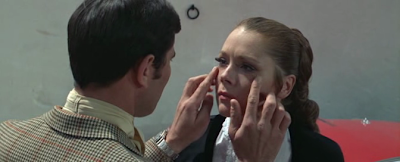
Our slow pacing continues, as what comes next is an honest-to-goodness love montage, complete with love song (“We Have All the Time In the World”, sung by Louis Armstrong), which at first might seem terribly out of place in a James Bond film, but which works here, because the film has taken its time in setting it up. We’re only vaguely aware that Bond is on the job at all; the whole first third of the film is given to him meeting this strange, wounded woman and finding himself under her spell. The title of the song used makes it all clear that Bond has finally found a woman with whom he wishes to relate outside of his job, because as a spy “on Her Majesty’s secret service”, Bond never has all the time in the world. His world is a world of ticking time bombs, of stopping villains before it’s too late, of passing moments of physical pleasure that must be set aside quickly so that he can move on to the next threat. Now, he’s getting his first hint of a world where one doesn’t have to worry about time.

On Her Majesty’s Secret Service is entirely about time. It’s evident right from the credits sequence, with its clocks and hourglass imagery. George Lazenby’s performance fits in with the film’s theme perfectly: his portrayal of Bond really does seem to convey a certain feeling of weariness about the whole business. Lazenby’s Bond is competent, skilled, brave, and witty – but he also seems just a bit tired of it all. It’s in little touches, really – would a Bond who is really invested in things fail to notice that his gun wasn’t where he’d left it? If he’s on assignment, would he really be heading out for a round of golf? It’s not that Bond is “phoning it in”, not at all, but it’s as if the thought is starting to form in the back of his mind that maybe, just maybe, he doesn’t want to be 007 for his entire life.

Also, is this the first Bond film that actually has a theme underlying all of its action? OHMSS is saying something about time and how Bond has to relate to it. In general, James Bond movies aren’t your prime destination if subtle subtext is your thing, but this one’s got it.

As the montage ends, though, Bond is back in the world of spying and being up against time. He has to infiltrate the office of a lawyer named Gumbold and search for any connection he can find to Blofeld, while Gumbold is off at lunch. For a simple office break-in, this scene is surprisingly tense, because of the time limit. (Again with time!) Gumbold emerges from his office and walks down the hall, curtly informing the desk attendant that “I’ll be back in an hour.” Gumbold’s shoes click on the marble floor of the office building with such precision (we’re in Switzerland, after all) that it sounds like the ticking of a clock. Bond arrives, and goes to work, using the only real gadget in the movie: a safe-cracker that also comes with a built-in photocopier. This is hoisted up to the balcony of Gumbold’s office from the construction site next door – Bond has a man there – and then Bond has to simply wait for the machine to do its job. Meanwhile, John Barry’s suspenseful music churns in the background, first slowly and then picking up steam as the hour ticks past. Here’s the scene; it’s like a thriller-within-a-thriller. I love the bit where Bond settles in, looking bored while he waits for the safe cracker to do its thing; it’s also hilarious the way Bond finds Gumbold’s issue of Playboy, tucked into a newspaper.

Only on my most recent rewatch did I notice that the crane from the construction site next door, which hoists the safecracker-photocopier machine up to Bond in Gumbold’s office, is owned by Draco Construction!

Of course, Bond finds something: letters from a “Count de Bleuchamp”, who is apparently seeking to establish himself as reigning Count of the Bleuchamp family. Bond takes this information to M – visiting him at his home – and indicates that “Bleuchamp” is the French form of “Blofeld”. The reversal here is interesting: Bond is briefing M, not the other way around.

Another lovely scene with Lazenby and Bernard Lee, starting with Bond’s smirk as he shows off his knowledge of butterflies, of all things. I love Lee’s shift in tone when Bond reveals what he’s discovered: a real clue as to where Blofeld is. Lee sighs and reminds Bond that he was relieved of that assignment, and Bond casually says, “I assumed you’d reassign me, sir,” and keeps right on talking.

The next scene, when Bond discusses the heraldry matter with Sir Hilary Bray, sets the stage for Lazenby’s voice being dubbed by George Baker for a lengthy sequence to come minutes later. This dubbing gets a lot of heat from fans, which is an objection that I’ve never understood, and I like the smirk Lazenby gives when Bond shows off his ability to mimic Sir Hilary. Also, there’s a really nice line delivery by Lazenby about Blofeld’s problematic location: “Yes, if he IS our man, I’d like to get him away from Switzerland.”

What unfolds next is more in traditional keeping with Bond films, as the intrigue takes over as Bond, posing as an expert in heraldry and genealogy, heads to Switzerland to find out if this “Bleuchamp” is Blofeld or not.

The Switzerland sequence is gorgeous, with sweeping panoramic shots of the Alpine landscape as Bond (masquerading as heraldry expert Sir Hilary Bray) is escorted by a woman named Irma Bunt up into the mountains. John Barry’s score soars here, and we even get some visual foreshadowing as Bunt points out avalanche damage to a forest and as the helicopter flies over a bobsled run. I’m glad OHMSS returned to Switzerland and really put some effort into showing off that land’s beauty, because GOLDFINGER really didn’t do much for Switzerland at all when it went there.

Of course, he is, with the whole works: a new scheme involving his posing as a doctor who cures allergies, the young women who are his patients (but who are really unwitting pawns of his, via mind control), and a fortress perched atop a Swiss Alp.

Of course, what commands Bond’s attention almost immediately is Blofeld’s allergy patients:
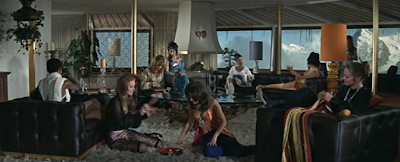
There’s a funny scene where Bond is trying to seduce one of the girls at the moment the mind-control stuff in her room starts up: swirling red lights, odd music, and Blofeld’s voice coming over the loudspeaker to address this girl who is mortally afraid of…chickens. Bond’s expression of “WTF?!” is perfect as we hear Blofeld’s voice intoning things like “You love chickens. You love their feathers.”
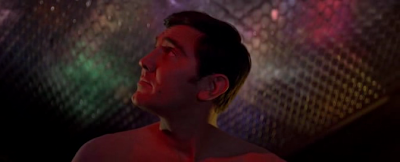
Even so, all of this continues to unfold quite slowly, and the film actually is free of action entirely from the fight in Tracy’s hotel room fifteen minutes into the picture until Bond’s capture by Blofeld over an hour in. OHMSS allows its story to unfold, and the slackening of the pace makes it all the more tense later on when Bond finds himself once again battling the clock. There is a fine scene, after Bond has been found out by Blofeld, where Bond must escape from the gear room of the cable cars that provide the only access to the mountain hideaway; then Bond lurks about as Blofeld’s “allergy patients” – beautiful girls, all of them – are given their final hypnotic briefing on how things will go now. The girls are each given an atomizer, theoretically filled with perfume, but which are actually filled with a toxin that, according to Blofeld, will cause widespread infertility in crops and livestock. The girls will be hypnotically instructed as to when to release the toxin.

A few things about the whole Piz Gloria sequence: First, even though Blofeld does have a Big Bond Villain Scheme, the movie doesn’t really make THAT big a deal about it. It’s there, it has to be stopped, but as far as what the movie gives us goes, it’s pretty bare-bones, a “just enough to get us by” kind of thing.

Second: Telly Savalas IS Blofeld. There’s a competent and cold malice to his performance that was absent from Donald Pleasance’s in YOU ONLY LIVE TWICE, and Charles Gray’s Blofeld in the next film, DIAMONDS ARE FOREVER, is its own thing entirely. (I like Gray enormously in that film, but as a topic for another day, that movie so downplays the notion of Blofeld as Bond’s ultimate enemy that he might as well be named something else entirely.)

Third: Yes, Bond’s cheerful seduction of Blofeld’s “Angels of Death” is (a) part of what he needs to do to figure out what’s going on, and (b) really kind of creepy. Especially the second night of it, when we have to wonder, What’s he hoping to get out of this? The reveal of Irma Bunt in the bed, instead of Ruby, is a pretty effective jump-scare, though.

Fourth: OHMSS gives us several scenes of Bond trying to figure things out and solve specific problems, like how to get out of his quarters and how to escape the cable-car engine room. Lazenby does very well with these rather physical scenes; he is able to convey Bond thinking things through as well as moving around with a casual economy of movement.

Fifth: the musical build-up to Bond’s escape is masterful stuff, especially when Bond has broken free, gotten out of the cable-car engine room, listened in on Blofeld’s hypnotic instructions to the Angels, and then taken out a guard or two on his way to the ski room. John Barry provides some suspense music with appropriate “stingers” through all this, but then, as Bond is putting on skis and preparing to get the hell out of Dodge, Barry gets down to serious business as we hear, for the first time since the opening credits, that descending line that leads us into the OHMSS main theme. This whole sequence ALWAYS gets my blood pumping.

Sixth: Any other Bond film would have sent Bond to Q to get outfitted with some useful gadgetry before setting out to potentially infiltrate the villain’s HQ. It’s interesting that this film does not.

Now, Bond is up against the clock, and makes his escape from Piz Gloria (the mountain hideaway), on skis. It’s surprising to note that, aside from a couple of brief fistfights, this is the first action set piece since the teaser sequence, and it comes well over an hour into what was for years the longest of all the Bond films. (Casino Royale was actually longer.) The ski chase in OHMSS is, for me, still the best ski chase ever filmed for a Bond movie (subsequent skiing scenes would appear in The Spy Who Loved Me, For Your Eyes Only, A View to a Kill, and The World Is Not Enough). It relies fairly heavily on rear projection during the closeups, but the entire sequence is edited together wonderfully, with the main theme from the film making its first reappearance since the title sequence.
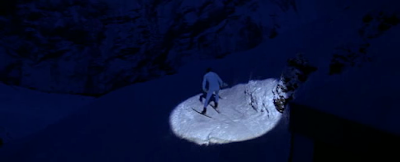
What’s great about the ski chase is that Bond has to work for it. So many Bond chases in other films make it look easy for him, but here, Bond is constantly having to re-escape. At one point, he loses one ski; at another, he has to lie in wait for his pursuers to come upon him, which results in a couple of fights atop a thousand-foot-high cliff.

OK, this ski chase is one of the best of all James Bond action sequences. It is almost perfectly edited, the way the tension builds from Bond putting on the skis to the guards realizing that he’s escaping, to Blofeld getting notified (his expression doesn’t even change as he picks up the phone, hears the report, and puts the cat aside to go give chase–though the cat protests!). The whole sequence marries together perfectly with the music, and at times the ski action times to the music, with the guards shifting almost in unison, as if we’re watching an action ballet.

Bond makes it down the mountain, to the charming Swiss village in the valley where there’s all manner of Christmas celebration and ice skating and happy people all over the place…and yet, the bad guys are there too, and Bond can’t get away. This is all pretty fascinating: many times in the series, we see Bond evade pursuers by putting a big crowd of people between them and himself. Here, though, it doesn’t work, and we become aware, through a series of quick cuts from the crowd to the pursuers to Bond back to the crowd and back again, that Bond is really, genuinely afraid. It’s not often at all in the 007 movies that we get to see Bond feel fear.
And, in keeping with the film’s reversal of quite a few formulas, Bond doesn’t escape on his own. He is rescued, by an unlikely heroine:
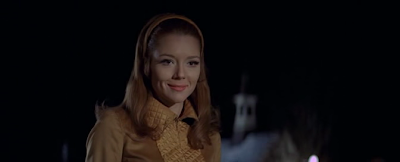
Tracy is there. She’s followed Bond to Switzerland, based on information from her father, and now she’s found him. She gets Bond out of that village, albeit not without being seen by the bad guys, who again give chase. With Tracy driving, Bond is the passenger in a high speed chase that takes us into a demolition derby.

And after that, they drive away, straight into a snowstorm that forces them to take shelter in someone’s barn. This scene is the emotional heart of the film, because Bond and Tracy don’t just do what Bond and any other girl would do when trapped in a barn during a snowstorm. They actually talk first, and they talk about something: their relationship with each other. Bond can’t tell her what really went on up at Piz Gloria, because he’s still an agent; Tracy says that they’ll just have to keep doing things the way they are. “Tracy, an agent shouldn’t be concerned with anyone but himself,” Bond says…and the way George Lazenby delivers the line makes absolutely clear that as true as it may be, Bond is sick of it. “I’ll find something else to do,” he says. This is as startling an admission as you’ll hear from James Bond. Tracy asks if he’s sure, and he is: “I love you, and I know I’ll never find another girl like you.” And thus does James Bond get engaged.
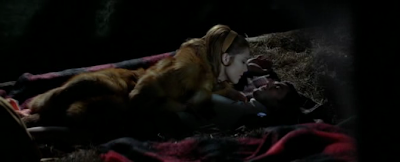
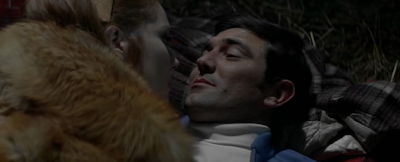
This scene is the scene in the film; if this scene doesn’t work, pretty much the entire film is sunk, because the entire subtext of the film is that James Bond is tired, he’s vulnerable, and he wants to do something else. Lazenby sells this scene so well that it’s almost heartbreaking, and as I’ve said for years, I defy any of Lazenby’s detractors to claim in seriousness that Sean Connery would have done this scene any better. (Frankly, as much as I love Sean Connery, I’m not sure he wouldn’t have done this seen worse. In his Bond films, he never presents a single hint of genuine vulnerability in his portrayal of 007. Which isn’t to say that Connery couldn’t do “vulnerable”, because clearly in his acting career we see that he could, but in playing Bond, he didn’t, and I’m not sure he would have done so here.)

Aside: again, no disrespect to Sean Connery is intended here at all. The man was a great actor, an Oscar-winner, who could do a lot of things. But the fact is that his boredom with James Bond was becoming obvious in THUNDERBALL and it stands out like a sore thumb in YOU ONLY LIVE TWICE. Maybe–maybe!–if they’d done OHMSS after GOLDFINGER he would have come invested in the project…but then, I’m not sure if Connery had been along for the ride that the entire rest of the production would have leveled up the way it did. Diana Rigg’s casting was partly because the lead was a total novice: they needed an experienced actress to draw out the performance they needed, which wouldn’t have been the case with Connery.

Ultimately, though, I find the whole wishful-thinking “If only Sean could have done this!” thinking not terribly useful. It’s the James Bond version of a Buffalo Bills fan imagining if Norwood hadn’t missed that kick. I also note that it’s always Connery who is mentally recast into this film; nobody ever wonders what if they’d brought in Roger Moore two films earlier than they did. And come to that, no one ever really wonders what if they’d brought Timothy Dalton in earlier–for A VIEW TO A KILL, say–or maybe kept Pierce Brosnan around for CASINO ROYALE. In the end, I honestly don’t see what it is that people see in Connery’s Bond that they want it here, or what they see in Lazenby’s Bond that they DON’T want. And I guess that’s all fine, “eye of the beholder” and all that, but it does vex me when I see or hear things in film or music that so many others do not.

The next morning, Blofeld and lackeys arrive at the barn, only to find that Bond and Tracy have already left, and are skiing away. There’s another ski chase – this one taking place by day instead of night – and again, it’s a close affair that ends when Blofeld uses a flare to set off an avalanche. Thus he captures Tracy, but assumes that Bond is dead (“A grave deep enough to prevent even 007 from escaping!”). Of course, Bond isn’t dead, but he is despondent that he has failed: Blofeld’s plan is alive, and the woman he loves is now his prisoner.
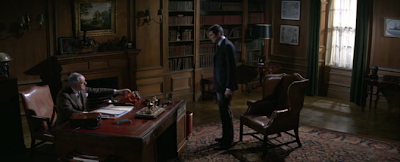
Back in London, Bond paces in M’s office as M is notified by his superiors that the United Nations plans to give Blofeld what he wants: a full pardon for all crimes as head of SPECTRE and full recognition of his title as “Count de Bleuchamp”. M seems oddly accepting of this, while Bond is thinking that if they can get to Piz Gloria before Blofeld’s deadline, they can destroy his center of communications and thus keep him from ever being able to psychologically order his patients all over the world to release his toxin. M refuses to go along with it, assuming that all Bond wants to do is save Tracy: “This department is not concerned with your personal problems.” Bond retorts, “This department owes her a debt. She saved my life.” Bond still fails to persuade M to allow an attack on Piz Gloria, so Bond organizes one anyway…using Draco and his men.

Again, Lazenby and Bernard Lee play brilliantly–yes, brilliantly–off one another. Lazenby’s angry, frustrated pacing; Lee’s quiet resignation and almost acceptance that they’ve lost. Returning to Connery versus Lazenby, I think it actually helps to have a different Bond in this film, to sell us on this very different relationship between M and James Bond.

This brings us to the film’s final action setpiece, the aerial attack led by Bond and Draco in helicopters against Blofeld’s headquarters. As the choppers approach, Draco has to convince the Swiss authorities that they are a Red Cross flight. As Blofeld and his men listen in on the radio transmissions, Tracy recognizes her father’s voice, realizes that the game is afoot, and starts using her feminine whiles to appeal to Blofeld, thus keeping him distracted and not realizing that he’s about to be attacked until the guns start shooting.

Seriously, does Tracy Bond get credit for being as smart as she is? Earlier in the film she sees right through her father’s creepy scheming, and here she recognizes his voice and puts together what’s happening, and then immediately shifts into distracting Blofeld just enough to keep him from putting his men on full alert until the gunships are upon them.

From here out, it’s pretty standard Bond film set-piece fare: explosions and gunfire, close fights, and so on. Bond slides on his stomach across the ice of a curling board, dispatching lots of bad guys in the process; meanwhile, Tracy has to fend off several goons on her own, further establishing her credentials as Bond’s genuine equal. At no point in the film, really, is Tracy ever a helpless damsel in distress, screaming “James!” as Bond tries to rescue her; instead, a number of times she rescues him. Anyhow, Draco’s men rout Blofeld’s, and plant explosives to destroy Piz Gloria. Bond manages to find Blofeld’s map of where his “angels of death” are all located, and is taking photos of the locations when Blofeld fires on him and then runs away. Bond gives chase, leading to a bobsled chase with Bond trying to catch Blofeld as Piz Gloria explodes behind him.

The chase ends with Blofeld being snagged by the neck in a tree; apparently Bond assumes that Blofeld is dead, which is ironic because that is the same mistake that Blofeld (and others) are always making about Bond, and this time it will have disastrous consequences.

If OHMSS had been somehow inserted into the timeline of Daniel Craig’s Bond, with the continuity between the films actually acknowledged rather than ignored, I have to assume that we would have eventually seen James Bond having to grapple with a bit of guilt on this particular point. Bond clearly assumes that Blofeld is dead, as do we, if we don’t know what is to come; no, we don’t see the body, but that shot of two feet swinging like that is a long-established cinematic way of depicting the result of a hanging.

Meanwhile, Bond goes off to live happily ever after: we see him purchasing Tracy’s wedding ring, and then putting it on her finger and wiping away her tears of happiness in a reprise of his gesture from the bullfight. Bond says his goodbyes to M and Q; he gives Draco back the one million pound dowry (“Her price is above rubies…or even, your million pounds!”, and then, after tossing his hat one last time to a crying Moneypenny, drives off into his new life with his bride.

It’s about here that I usually start to lose it, when watching this movie. There are lots of movies with sad endings, and I count among them many of my favorite movies. This one, as well. But when I stop and think on it a moment, On Her Majesty’s Secret Service is unique among movies with sad endings in that every time I watch the film, I desperately want the ending to not be sad. Just…this…once.

What happens is this: Bond pulls over on the side of a road that’s overlooking the sea, so he can pull some of the flowers off the car. He and Tracy enjoy some playful newlywed banter. Another car comes along…and it’s driven by Blofeld. In the backseat is Irma Bunt, his chief lackey; and in her hands is a machine gun. She sprays Bond’s car with bullets as he speeds past.
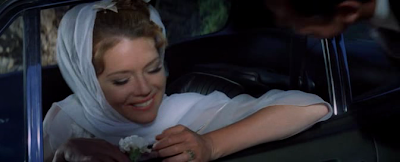
“It’s Blofeld!” Bond shouts, as he jumps back into the car. “It’s Blo–” he starts to say to Tracy, when he looks at her…and sees the single bullet wound in her forehead. Tracy is dead. Her body slumps into his lap as a policeman pulls up alongside on a motorcycle. Bond looks up at the policeman, and with the dazed calm of a person whose brain hasn’t yet caught up to what’s just happened, he says, “It’s all right, really, she’s just having a rest. We’ll be moving on soon…there’s no hurry, you see, we have all the time in the world.” Here Lazenby’s voice cracks as he leans down over her, kisses her forehead, and then buries his head as he begins to sob. John Barry’s instrumental arrangement of “We Have All the Time in the World” plays through these last few seconds. The music is heartbreaking, and reaches its final chord as we fade to the film’s final shot: the bullet hole in the windshield of James Bond’s Aston Martin.
Then, as the credits roll, the “James Bond Theme” smashes in, obliterating the mood from the beautiful melody of “We Have All…”. I’ve heard film music fans over the years argue that this is a mistake on the part of the filmmakers, and that the film should have used “We Have All…” as the end title, but I don’t agree – because it fits perfectly with the themes of the film. Time, Bond’s weariness as a secret agent, all of it is brutally illustrated by the drastic musical switch in moods at the end of OHMSS. As soon as the Bond theme starts, it is as if Bond is being told, “No, you don’t have all the time in the world. That was it. That was all the time you had.” Time is the relentless enemy of us all, and not even James Bond can stand in its way. No one has all the time in the world.

Even the arrangement of the Bond theme–using early synthesizers instead of the iconic guitar–lends to this movie’s cold, almost drone-like, rendition of the James Bond theme. There’s no other time in the entire series of Bond films where that theme sounds so bitter, so cold. The Bond Theme is a cultural icon, after nearly fifty years of these movies, that musically symbolizes thrills and coolness, but at the end of OHMSS, it’s anything but cool or thrilling. It’s angry, it’s sullen, and it’s unwelcome. We don’t want to hear it…and yet, the film forces it upon us, as it has forced cold, unblinking loneliness upon James Bond, at the moment when he thought himself to be free of it all.

I’ve occasionally wondered what might have been, had George Lazenby stuck around as Bond. I’m genuinely unsure, really. I think his performance in OHMSS is terribly underrated, and that he would have been just fine had he continued in the role. But also, the Bond films were about to undergo a significant transition into campy scripts and gonzo plots. Connery returned for the next one, Diamonds are Forever, in which Blofeld is again the villain – but that film doesn’t make a single mention of the fact that Blofeld killed Bond’s wife, and Bond never even seems angry with Blofeld, just mildly disgusted as he is with any other villain. And then Connery would leave, to have the role go to Roger Moore, who would then be saddled with the silliest scripts of all the Bonds (and yet, Moore, too, had his moments when he made Bond cold and ruthless, moments that are often forgotten or overlooked by people who tar the Moore era with the cloth of camp). It’s interesting, though, that Moore’s best Bond film, For Your Eyes Only, opens with Bond visiting Tracy’s grave.

Daniel Craig has just completed his run as James Bond, finally giving us a second version of James Bond who isn’t just a superspy but is also a human being who experiences genuine human emotions in addition to his normal duties of thwarting supervillains. It’s fitting that his final film bookends this one and takes it as inspiration. I’m glad to see the Bond series fully acknowledge On Her Majesty’s Secret Service as the great work that it is, and I’m also gratified to know that more and more Bond fans are seeing it that way, too.

We may not have all the time in the world, but we do have On Her Majesty’s Secret Service.

Share This Post