
The Ninth: One Symphony to Rule Them All


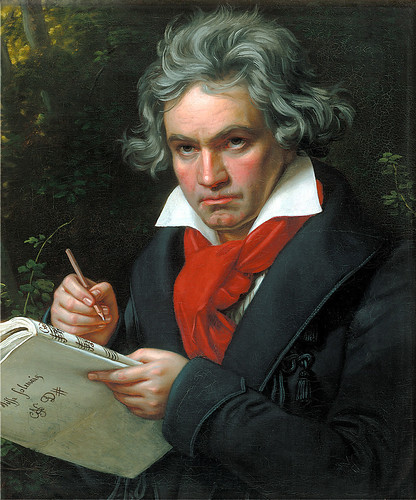
I’ll have one more Beethoven-related post to wrap this all up, which will mainly be a linkage piece; this post will serve as my main Grand Finale, though. And where else to end with Beethoven’s juggernaut of a masterpiece, the Symphony No. 9 in D minor?

Whether or not the Ninth is Beethoven’s greatest symphony is a matter of debate, and I’m not going to join it here. The main contenders seem to be the 7th, 5th, and 3rd, each of which have strong cases to be made. For me it comes down to the 7th and the 9th, and I probably have a stronger personal attachment to the 9th, since it was my first real deep dive into Ludwig van Beethoven’s symphonic world. Quite a starting point, eh?

It was when I was in high school and becoming keenly interested in symphonic music, to the point that I was examining orchestral scores in an attempt to unlock what secrets I could, with my level of training to that point. (Which was, ahem, not much. But I went ahead undaunted!) I remember the bookstore: A B. Dalton (remember those?) in the Monroeville Mall outside of Pittsburgh, when we were there visiting my sister, who was in college. There was a Dover edition of Beethoven’s Eighth and Ninth Symphonies, in full score.

Dover Publications used to make wonderful copies of music scores in fine books…and apparently they still do! I just now Googled the folks at Dover to see if they were still around, and there’s an active website, so that may be a place that starts taking my money soon…but anyway, I remember picking up the book in that B. Dalton and thumbing through it. At this point I knew nothing at all about either work, so I was completely baffled when I flipped to the last movement of the Ninth and saw…music for voices?

Was this a choral symphony?

Indeed it was…and is.

My sister actually gave me that book for either my birthday or Christmas that year; I procured a recording not long after. My band director dubbed me a cassette of the Ninth, and off I went. The recording was Herbert von Karajan, conducting the Berlin Philharmonic. You never forget your first Beethoven Ninth.

That the Ninth captivated me utterly is unsurprising, as it has been captivating its audiences ever since Beethoven wrote it. The premiere is one of the legendary events in all music, with the deaf composer sitting on stage as his work crashed and hummed all around him…and he heard none of it at all. Imagine the poignancy of one of the musicians, alto soloist Caroline Unger, at concert’s end, putting her hand on Beethoven’s sleeve to turn him toward the audience, that he might see what he could not hear: their applause. When you listen to the Ninth, as with all of Beethoven’s late works, you are hearing the musical realizations of a man who could only ‘hear’ the work in his mind.

Beethoven’s Ninth went on to become one of the most influential works of music ever written. He fired the imagination of many composers with this work, and indeed, the Ninth took on a nearly mystical air as the 19th century wound on. The Ninth was one of Richard Wagner’s favorite works, and it was deep inspiration to both Anton Bruckner and Gustav Mahler, both of whom felt superstitious angst as they approached their own ninth symphonies, as if Nine was a sacred barrier beyond which a symphonist dare not tread. Mahler, having already written eight symphonies when he set out write Das Lied von der Erde (“The Song of the Earth”), thought he might cheat the limit of Nine by not titling this work as a symphony, even though everyone believes it is. Even so, it didn’t buy Mahler much time: he would write his actual Ninth symphony and then die with only a few sketches written for his Tenth.

The Ninth is one of classical music’s true “event” works, often being programmed for concerts that are meant to commemorate specific events. One of the most famous of these was in 1989, when Leonard Bernstein conducted the work in East Berlin, leading an orchestra and chorus drawn from many nationalities. For this concert Bernstein changed the fourth movement’s focus from “joy” (Freude) to “freedom” (Freiheit), in celebration of the fall of the Berlin Wall just a few months earlier. There really is a universality to Beethoven’s Ninth that lends itself to such things. It’s a deeply human work, encapsulating the tortured journey toward joy as imagined by a great composer brought low by deafness.

I thought about writing a lengthy annotation of the Ninth, but time didn’t allow, and besides, I’m not sure if such a thing is really necessary. But there are so many moments in the Ninth that are sheer magic. Here are some of the spots that capture my imagination:

:: The opening bars, with the strings in tremolo, playing only the tonic and the dominant, so we don’t even know if we’re in major or minor key. It’s an opening of total mystery, leading to a stormy march of a movement that is sheer musical relentlessness.

:: And that fiery scherzo, whose opening motifs echo the main theme of the first movement, but in a rhythm that drives, drives, drives forward. Even the timpani gets into the act, pounding out that rhythm in moments that seem to come out of nowhere, no matter how many times I hear the work. But wait! Halfway through the scherzo, Beethoven changes his original time signature and provides, charmingly shocking, a genial “drum and fife” section that eventually yields back to the original scherzo.

:: The double variation of the third movement? I used to have trouble with this movement, not really understanding what Beethoven was up to. It’s certainly a very long movement that leads us into the depths of Beethoven’s mind, as one of the great writers of variations in music history. Somehow Beethoven finds new and enthralling textures each time he winds his way through the long melody that sustains the movement, and then toward the end come the two sets of giant fanfares that are answered by the strings. The woodwinds sing throughout, and the time is marked by pizzicato strings. It’s an amazing movement that once bothered me.

:: And then we arrive at the fourth movement, that gigantic movement that is by itself longer than some of Mozart’s entire symphonies. A stormy passage opens, leading to a remarkable passage where Beethoven quotes each of the first three movements, almost questioningly, only to have the low strings reject each one. After one last declaration by the low strings, we finally arrive where the entire symphony has been leading all along: the famous “Ode to Joy” chorale theme, played first by pianissimo low strings. Beethoven repeats the theme four times, adding to the voices each time (my favorite is the second statement of it, before he adds in the violins but also writes the most wonderful countermelody for the bassoons).

Then the original stormy passage from the movement’s opening bars reprise, before we hear the first of our voices: the baritone soloist, declaring that it is time for a more joyful sound. “Freude!” he cries out, and the choral passage arrives, with the soloists leading through a set of variations on the chorale theme, variations which are answered by the chorus, all of this building to an immense chord that is one of the greatest single chords in all of music…and then the bottom drops out and a Turkish march begins, with Beethoven doing one of his favorite tricks of off-setting the beat.

I won’t describe more than that, save to note that the symphony’s closing moments are one of classical music’s true moments of magnificence. I have never heard the Ninth in a live performance, but I can only imagine that if performed well, it can be an almost overwhelming experience. There is a vastness to the Ninth that makes it a colossus in itself, but this is not at all unique to the Ninth: Beethoven’s greatest works all enjoy this expansive quality, but none are quite so big in their concept as the Ninth. Few works achieve this sense of containing a universe in itself. With the Ninth, Beethoven moved beyond composing music and instead created a world.

Here is Beethoven’s Symphony No. 9 in D minor. Daniel Barenboim leads the West East Divan Orchestra, chorus, and soloists.
Share This Post

Beethovens Choral Fantasia: or, What Happens When You’re An Immortal Composer Who Needs a Piece for Piano, Vocal Soloists, Chorus, and Orchestra

 Now here’s a very unusual work indeed: a single-movement piece, roughly 25 minutes long, that features orchestra, solo piano, vocal soloists, and a chorus. Why would Beethoven have written such an oddly structured piece? Most likely, I figured, he wrote this piece for a very specific musical performance event…and that turns out to have been exactly the case. Beethoven put on a benefit concert for himself in December of 1808, which I mentioned the other day in the post about the Fourth and Fifth Piano Concertos. It was quite the program, involving a full orchestra, a chorus, vocal soloists, and himself as pianist, he wrote a work to specifically serve as the finale to the night’s music festivities.

The Choral Fantasy begins with a passage for solo piano that sounds almost like an improvisation–and upon doing a bit more research, I learned that Beethoven himself actually improvised the opening at that first performance. Then the orchestra joins in, and then the work has almost the feel of being a short concerto, starting with a rather portentous slow section that doesn’t last terribly long before arriving at a theme-and-variations that takes up most of the entire work. The feel at the beginning is of another piano concerto, but as the rest of the orchestra takes over the effect becomes quite charming in spots, including a ‘drum-and-fife’ section there the flute plays a lively dance while the piano provides the “oom-pah” part.

Eventually the voices arrive, and the Choral Fantasy becomes lyrical and thrilling. Listeners familiar with Beethoven’s Ninth Symphony may note a similarity in the Fantasy‘s main theme and that of the Ninth’s great finale. Some have even suggested that the theme in the Fantasy is actually an earlier idea that Beethoven had considered for the Ninth and either rejected or elected to use here. In any event, the ultimate effect is thrilling in a way that is very similar to that of the Ninth’s final movement, even if the Ninth is a far more profound work than this. I find the Choral Fantasy an absolute delight. Let me know what you think! Here it is:

Share This Post

Close Encounters of the Beethoven Kind

Beethoven

 I was fortunate in my music-making days to get to actually play Beethoven on three different occasions.

The first came via my piano teacher in high school, a lovely old woman named Margaret Hooker. She lived alone in a nice-sized house in Olean, NY, with a quite lovely backyard and a large music studio with two pianos in it, and she was well known as one of the area’s finest piano teachers. She had a lot of students, and her end-of-year recitals were always pretty big events. Thinking back on those recitals, I remember a lot of music, including one bad moment when I crashed and burned in the middle of the first movement of a Mozart sonata. There was one transition in that movement that always gave me fits, and I tended to nail it in practice no more than twenty-five percent of the time; the recital was not one of the twenty-five. I slammed to a halt, and Mrs. Hooker gently said, “Start right after that.” And after that I was fine. A terrible, humbling moment–but I redeemed myself the next year, by gum! The next year I played the absolute hell out of something. A piece by Edward MacDowell, if I recall correctly. I tend to get really motivated when I screw up badly.

But anyway, Beethoven! Any piano student of any skill will play a Beethoven sonata, or a movement of one, sooner or later. For many it’s the Pathetique Sonata, but for me it was other really common one: the Piano Sonata No. 14 in C-sharp minor, often called the Moonlight Sonata. This sonata, unlike many of its brethren, starts not with an allegro movement but with an adagio, putting the “slow” movement first in line. Still the form of the movement is that of a sonata-allegro movement, just in a very slow tempo that contrasts a series of arpeggios, repeating and repeating in hypnotic effect in the bass, with a repeated motif played by the right hand that struggles to be called a “melody”. I loved playing this piece because it appealed to my inner Romantic: I could linger on this piece and take long liberties with the rhythms; so much so, in fact, that Mrs. Hooker actually had to intercede a few times to tell me that “it’s slow, it’s not a dirge.”

I only played the first movement; though I did work on the second movement (a graceful minuet that I do wish I’d worked harder on), the year’s lessons ended before I could really get it polished, and the next year we worked on other things. I never even tried the last movement, which when you listen to the entire work seems to come out of nowhere with its stormy fire. I remember asking Mrs. Hooker about it, and she bluntly said, “I never teach the last movement.” When I asked why, she equally bluntly said, “I can’t play it.” She tried a few bars, and shrugged. “I can play a lot of things, but I’ve never conquered this one.” You gotta respect that!

(On a food note, Mrs. Hooker’s recitals are where I first learned about punch made by dumping an entire container of rainbow sherbet into a big bowl of 7-Up. I don’t know why I thought of that just now, but there it is.)

Here’s the Moonlight Sonata (named thus after Beethoven’s death!), performed by Anastasia Huppmann.

I still studied piano in college, for three years, though I don’t recall playing any Beethoven there. Beethoven did come up twice on the programs with the Wartburg Community Symphony Orchestra, conducted by Dr. Janice Wade (a professor to whom I took a strong initial dislike but came around rather quickly on; she ended up being one of my favorite teachers of all time, which is probably when I learned the lesson that I’ve carried with me for years, that first impressions are almost always bullshit). I don’t recall when exactly the Symphony No. 1 in C Major was on the program, but I think it was in my sophomore or junior year. This symphony is certainly Beethoven, but it is also firmly closer to Mozart and Haydn than to the heights to which Beethoven would take the symphony later in his life. As a member of the trumpet section, I found the First Symphony kind of dull from a performance standpoint; when Beethoven wrote this, the symphonic trumpets were still valveless instruments, only capable of sounding specific harmonics, so there was a whole lot of sitting and doing nothing until the big tutti moments when the trumpets would play a tonic and dominant or two, before returning to counting rests. We were probably tacit for the inner movements. Still, the piece was incredible to hear as it came together, and that in itself was a valuable experience.

Then, in my senior year, Dr. Wade brought in three soloists to play the Concerto for Violin, Cello, Piano, and Orchestra, a work most often referred to as the Triple Concerto. This work is…well, it’s a strange kind of work. The three soloists make for some odd writing, as I recall, and the trumpets had even less to do in this piece than in the First Symphony. So…and I admit this with no pride here…in the rehearsals I never played a note. I literally sight-read the damned thing at the dress rehearsal and again at the concert, and we were fine. That’s what the Triple Concerto is: it’s fine. It’s actually kind of a problematic work, maybe for Beethoven the equivalent of Shakespeare’s “Problem Plays”. I’ll let The Guardian explain:

Beethoven Triple Concerto: arguably the least successful of any of Beethoven’s mature concertos in the concert hall. It’s one of those pieces that never seems to get a performance that does it justice. Usually, you get po-faced seriousness when a big orchestra and three star names try to out-do each other, as the cello, violin, and piano soloists fight for the limelight. On disc, it hasn’t fared much better, and there’s an infamous Herbert von Karajan recording from 1969 with David Oistrakh on violin, Sviatoslav Richter on piano, and cellist Mstislav Rostropovich: it’s a nadir of gigantic egos trying to trump each other, a bonfire of the vanities from which Karajan and the Berlin Phil still somehow manage to emerge victorious.

(Richter himself said of it: “It’s a dreadful recording and I disown it utterly… Battle lines were drawn up with Karajan and Rostropovich on the one side and Oistrakh and me on the other… Suddenly Karajan decided that everything was fine and that the recording was finished. I demanded an extra take. ‘No, no,’ he replied, ‘we haven’t got time, we’ve still got to do the photographs.’ To him, this was more important than the recording. And what a nauseating photograph it is, with him posing artfully and the rest of us grinning like idiots.”)

The truth is that the Triple Concerto isn’t a concerto at all, since there’s no real dialogue between the orchestra and the soloists, and the three soloists carry virtually all of the musical argument themselves.

It’s a nice listen. It’s not bad, but if you’re working your way through Beethoven, from the greatest works on down, it’ll be a while before you get to the Triple Concerto and its not-terribly-profound geniality.

Here are the Symphony No. 1 and the Triple Concerto.

Share This Post

Beethoven: the Fourth and Fifth Piano Concertos

In a typical classical music concert today, you might hear a short work–an overture, perhaps–followed by a concerto, then an intermission, then a symphony. Or the concerto might be the featured work after the intermission, especially if your soloist is one of the greats. Generally you can count on the concert being over in 90 to 120 minutes.

Not so the concerts of Ludwig van Beethoven’s day. On December 22, 1808, Beethoven gave a concert consisting of his Fifth and Sixth symphonies, three movements from his Mass in C, a Fantasia for solo piano, a concert aria, the Choral Fantasia (a 25-minute work to which we’ll be returning!), and the Piano Concerto No. 4 in G Major. I’m guessing, conservatively, that this was about three hours of music, if not more. Wow.

I heard the Fourth Concerto many years ago at a concert in Olean, NY, when I was a kid. There was a local program called “Friends of Good Music” that brought classical music performers to town four or five times a year, and the Fourth was on one of the Buffalo Philharmonic’s programs one year. Or it might have been the Rochester Philharmonic–both orchestras were often featured on FoGM programs–and I think the pianist was Malcolm Frager, but I’m quite possibly wrong there, too.

The Fourth is quite a piece, and it might be the finest of Beethoven’s five piano concertos. It opens not with the orchestra but with the piano making an entrance that sounds almost improvisatory, before the normal proceedings commence. Beethoven’s integration of the soloist with the orchestra is never finer than in this work; a true partnership is at play, and for a convincing performance the soloist must be a virtuoso, to be sure, but also possessed of confident enough ego as to work alongside the orchestra. This is not soloist-with-accompaniment; this is a whole work.

In the minor-key second movement there is an amazing passage where the piano, playing softly, engages the orchestra in dialogue. The orchestra’s tone is firm, loud–perhaps even harsh. Meanwhile the piano is responding with statements of delicacy and softness. Apparently this movement was interpreted by early critics as Beethoven’s depiction of Orpheus and the Furies. Had Beethoven intended such a thing, surely he would have written that at the top of the score.

As is often the case with Beethoven’s concertos, there is no real break between the inner movement and the finale, and the effect is always scintillating as we’re into a rondo before we even realize it. Beethoven’s rondo here is as good as ever, and there is wonderful lyricism on display as we move toward the conclusion. When I heard this concerto live, I remember the soloist (I really think it was Frager!) literally bouncing off the piano bench with delight as he and the orchestra arrived together on that final chord.

Here’s the Piano Concerto No. 4 in G major. The soloist is Mitsuko Uchida. Note how carefully she sets up that very first chord! She is leaving nothing to chance, and she doesn’t care how long the audience has to wait; she’s going to do it right.

And then we come to the last of Beethoven’s piano concertos, which is honestly my favorite of the lot, and it’s one of my very favorites of all of Beethoven’s works. Beethoven himself never performed the Piano Concerto No. 5 in E-flat Major; by then he was too deaf to be able to perform a concerted work effectively. The work was premiered in Leipzig with Friedrich Schneider as soloist, but the Vienna premiere a few months later was performed by Carl Czerny, a name familiar to many former piano students as the man who wrote all those pages and pages of sixteenth-note fingering exercises. Czerny was a student of Beethoven’s.

This concerto, like many classical works, has carried another name into history, and also like many works, that name was not given by the composer themself. Beethoven didn’t call his Fifth Piano Concerto “the Emperor Concerto“, but it has been known as such ever since. The name came from the concerto’s publisher in England. While I’m not generally fond of names given to works by people who came along after the fact and which were not really approved by the composers, I always have to admit that in this case, Emperor works. This is a work of grandeur, bright and flashy and redolent of Imperial Vienna.

The concerto opens as boldly as a concerto can: the orchestra sounds an E-flat major chord, which is then supplanted by the piano playing a virtuosic series of arpeggios. Another chord, another virtuosic reponse, then a third chord and a final virtuosic response which leads to the main theme proper. What happens now is that Beethoven spins out an exposition section so finely crafted in its symphonic styling that, like in the Third Concerto, we forget entirely that we’re listening to a concerto at all. The theme is one of Beethoven’s best, but not to be discounted is the second subject, a motif that sounds in the horns while the strings soar above it, obliggato. All of this is wonderful listening and it comes before the soloist returns to the fray with an entrance that delights in its simplicity and clarity. From then on, we’re in pure Beethoven concerto-as-partnership territory.

The second movement boasts some of Beethoven’s finest lyricism in a way that seems to look forward to the famous Nocturnes of Frederic Chopin. The theme yearns and sings slowly and seductively, with the soloist again engaging in dialogue with the orchestra, and as peace falls at the end of the movement, the piano plays two sets of arpeggiated chords in what sounds like a kind of coda–but Beethoven is up to something else here, and as the piano suddenly strikes loudly into the final movement’s Rondo, we realized that those chords weren’t chords at all but rather snippets of the Rondo’s main theme. Beethoven’s inner trickster shows up once again in this, his last piano concerto, with a theme set on a rhythm that seems to just defy the bar line. It reminds me somewhat of the last movement of the Violin Concerto, and the ultimate effect is similar as the concerto finally comes to its conclusion.

And thus we come to the end of Beethoven’s concerto output. What Beethoven has done is to bring the concerto form to its logical height from the classical standpoint; what remains to be done with concertos is pure Romanticism. Beethoven stands so perfectly between the two that it can be argued that he is, in fact, both.

Here is the Piano Concerto No. 5 in E-flat Major, the Emperor Concerto, performed by Krystian Zimmerman and the Vienna Philharmonic orchestra, conducted by Leonard Bernstein. (And make sure to keep an eye on Bernstein, especially toward the end as it appears he is going to levitate under his own power.)

Share This Post

Beethoven: Piano Concerto No. 3 in C minor

 Beethoven wrote five piano concertos, and only one of these is in a minor key. I don’t want to reduce these things to the easily-refuted notion that “major key equals happy music, minor key equals sad music”, but there does often seem to be a degree to which a minor key brings out Beethoven’s brooding side more than the major keys do. This concerto is certainly the most inward-looking, the most introspective, off the five.


Where the previous two concertos opened with genial major themes, Beethoven’s Third opens with a generally low-key statement of the main march-like theme in the strings, and we actually spend what feels like a surprisingly long time awaiting the arrival of our piano soloist; if one listens to a recording without video, one might trick oneself into thinking they are listening to a symphony instead of a concerto at all. But once the soloist arrives, Beethoven’s great way of integrating the soloist and the orchestra together into a cohesive whole takes over.

The real magic of this concerto, for me, comes in the second movement, which opens with the solo piano playing a major-key theme that is romance-like. The transition from the first movement to the second always puts me in mind of Mozart’s Piano Concerto No. 20 in D minor, with its famous Romanze in its second movement. Then, the third movement arrives in one of Beethoven’s wonderful rondos, propelling us toward the end of the concerto with typical energy and verve, after starting on a quick motif, played softly and climbing upward throughout. This mysterious opening gives way to a sequence of chords that feel like Beethoven is calling a halt to the darker mood as he starts to segue into a cheerier one, though he isn’t quite done with the brooding introduction just yet.

Apparently the Third Concerto wasn’t even finished when Beethoven premiered it; according to the student who served as Beethoven’s page-turned at the concert (which had only had a single rehearsal for a concert which premiered not only the Third Concerto but the Second Symphony and an oratorio), the score from which Beethoven performed sometimes had blank pages and weird notations that the pupil later described as “hieroglyphics”–presumably some sort of shorthand meant by Beethoven to jog his own memory. Here is how author John Clubbe, author of Beethoven: The Relentless Revolutionary, describes that primiere:


In his Akademies [concerts Beethoven arranged for his own benefit], Beethoven would premiere his first four concertos with himself as soloist. Only the fifth and last, the so-called “Emperor” Concerto, dating from 1809, did he not play in public. By then his fading hearing did not permit a nuanced performance. Once Beethoven realized fully that his time as a piano virtuoso was over, he wrote no more piano concertos.


Although scholars usually date the Third Piano Concerto to 1800, Beethoven had likely worked on it already for several years. He employed his favored key of C minor. As was his wont, he continued to revise it right up to the hour of its first performance. Even then he still had not finished it. For the piano part he had only his erratically pencil-scrawled manuscript. Ignaz von Seyfried, who turned pages for him, recalled how the first performance went:


I saw almost nothing but empty leaves; at the most, on one page or the other a few Egyptian hieroglyphics wholly unintelligible to me scribbled down to serve as clues for him, for he played nearly all of the solo part from memory, since, as so often the case, he had not had time to put it all down on paper. He gave me a secret glance whenever he was at the end of one of the invisible passages, and my scarcely concealable anxiety not to miss the decisive moment amused him greatly.


Not finishing a work on time was not unusual for Beethoven. Nor did it overly bother him. He had lodged the concerto’s piano part deep in memory. He wasted nothing. Soloists then, unlike most today, did not play from memory. Audiences would have regarded doing so as eccentric. Only decades later did Franz Liszt begin the practice of playing from memory.

I often think that I wish I could go back in history and hear inaugural performances of some of the great works of the classical canon, but it’s worth remembering that performance standards now are honestly the highest in history. I suspect that could we truly hear what music sounded like in the early 1800s, we might well be shocked–and not in a good way. But still–to go back and hear Beethoven? Knowing that the score on his piano was simply for show?

Here is Beethoven’s Piano Concerto No. 3.


Share This Post

How he sounded back then….

Beethoven’s Symphony No 7 in A Major, op. 92, isn’t just one of Beethoven’s personal greatest works. It’s one of the greatest works of music ever composed, and its stature is such that it even rises beyond the history of music and into the history of art. Beethoven’s Seventh is in the same rarefied air as Michelengelo’s Sistine Chapel, Da Vinci’s The Last Supper, Wagner’s Ring Cycle, the Tale of Genji, the terra cotta warriors of China, Hamlet, and…you get the idea. When we engage with the Seventh Symphony, we’re engaging with one of the great works of human art.

But for today, let’s set aside the superlatives. I’m not really the best person to talk about the how and why of what makes this symphony so great, beyond its near perfection in its proportions, its emotional sweep from the sunny optimism of the first movement to the soul-rending meditation of the second, or the way the work culminates in a movement that has been described as “the apotheosis of the dance”. Instead, let’s try to hear the Seventh as it might well have sounded to those hearing it for the first time.

Though his hearing loss was progressing inexorably in December of 1813, Beethoven was still able to perform and conduct at this point in his life, although not for very much longer. Beethoven himself led the orchestra in the very first performance of the Seventh Symphony at a charity concert for victims of the Napoleonic Wars. (The same concert would also see the premiere of Beethoven’s strange potboiler, Wellington’s Victory.) The Seventh was an acclaimed success right from the very first hearing, and it has always been a beloved work, often showing up near or at the very top of lists of Beethoven’s greatest works. For me, I for many years ranked it second, just behind the monumental Ninth Symphony–but in recent years, I have reversed that view.

Over the last few decades, trends in classical music performance have led away from the kinds of excesses that were normal in the middle of the 20th century as orchestras have reduced their sizes and striven to perform works in something resembling the kind of air and style of their times. Some have gone even farther with this, though, leading to the rise of “period instrument” ensembles. These groups perform on instruments either directly dating to the Baroque or Classical periods, or on instruments carefully made to those standards. Strings instruments with strings made of genuine materials, flutes of wood instead of brass, trumpets with no valves, and even percussion instruments with heads and mallets made the same way they would have been made in the 1700s or 1800s.

It’s not just about the instruments themselves, either. It’s in the way they are played. Vibrato in the strings is greatly reduced, percussion sounds sharper, and the woodwinds often more piercing. The conductors, too, adhere as much as they can to the standards of music when it was composed. Tempi are often faster, and interpretive flashes tend to be kept to a minimum. All of this is in an effort to present as authentic to the music’s time a performance as possible. Of course, since recordings didn’t exist, all of this hinges on our knowledge of the instruments themselves and on our knowledge of performance standards of the time, based on writings left by people in attendance back then: accounts of concerts, pedagogical materials, and so on.

The ensemble in the performance of the Seventh Symphony below is the Orchestra Revolutionnaire et Romantique, founded in 1989 by conductor John Eliot Gardiner (who also conducts this performance). This recording is part of a cycle of Beethoven’s nine symphonies, which I happen to own on compact disc someplace in the archives. Gardiner and his orchestra are among the leading performing groups in the historically-informed performance movement, and I love his Beethoven cycle a great deal. Some listeners avoid historically-informed performance (which I’ve just now, as I researched this piece, is the preferred term now for “period performance”!) because they may expect a rather clinical and unemotional, and thus unmoving, approach to the music-making.

But look! If it’s true that Gardiner and the ORR have, in fact, managed to reproduce Beethoven’s Symphony No. 7 in something approaching what those first audiences heard…well, how could that possibly be clinical or unmoving? The Seventh was, as I have indicated, virtually beloved from its first hearing. Beethoven knew what he was doing, after all. Great music can’t be suppressed entirely, and it certainly isn’t suppressed here. Instead, it shines.

Here is the Symphony No. 7 in A Major, op 92, by Beethoven, performed by John Eliot Gardiner conducting the Orchestra Revolutionnaire et Romantique. Imagine hearing this in a concert hall in Vienna on December 8, 1813. Imagine hearing this along with musicians such as Louis Spohr, Johann Nepomuk Hummel, Giacomo Meyerbeer, and Antonio Salieri (who, in real life, had a long and successful career in music after the death of Mozart, whom he did not poison or manipulate into drinking himself to death as he composed a Requiem).

If I ever get my hands on Doc Brown’s Delorean, I will probably use it to travel back to the premieres of some of the great masterworks of music history, starting here.

Share This Post

Beethoven and Billy Joel (yes, really)

 In the wonderful movie Mr. Holland’s Opus, Richard Dreyfuss plays Mr. Holland, a classically-trained composer who needs to make ends meet so he gets a job as a high school music teacher and band director. He figures this will be an easy gig leaving him plenty of time to write his masterworks, and yet, very quickly he is buried by the difficulties of a job he never saw himself doing.


After a lot of teeth-gnashing and garment-rending over his complete inability to reach his students, he decides to change his approach. He sits down at the piano in front of his class, which is full of students who have come to view him with near disdain, and he says something like, “Who can tell me what this piece is?” and he starts to play. They all brighten up: “Lover’s Concerto!” they all say, and he smiles and says, “Wrong!” as he informs them that the piece is actually the Minuet in G by JS Bach.

Mr. Holland is making a larger point about the connecting tissue between the staid, almost cute, little minuet and the thrill of honky-tonk, but it’s also worth noting, for our purposes here, that pop musicians have made it a standard practice to not just write their own melodies, but to feel free to swipe melodies wholesale from the work of classical masters. Big-voiced ballad belters would be lost without “All By Myself”, which takes its tune from Rachmaninov’s Piano Concerto #2. The entire show Kismet wouldn’t even exist if it hadn’t been able to mine Alexander Borodin for its tunes (I knew the song “Stranger in Paradise” long before I knew the “Polovtsian Dances”).

And Billy Joel did the same thing in his song “This Night”, in which he cheerfully apprehends for his own purposes the melody from the second movement of Beethoven’s Piano Sonata no. 8 in C minor, the “Pathetique” (previously featured here). That melody is one of Beethoven’s finer ones, and the movement comes as a welcome lyrical respite after the storm of the sonata’s opening movement; the Joel song is…well, it’s a perfectly nice Billy Joel song, but it’s not exactly one of his better-known efforts, even despite the fine pedigree of its chorus. Maybe that’s even partly why? To me, the song loses a bit of authenticity by virtue of its melody putting me in the mood to turn off Joel and turn on Beethoven.

But it’s another indication of Ludwig van Beethoven’s long musical reach in the 250 years since his birth, isn’t it? Not even the “Piano Man” is immune.

Here’s “This Night”.


Share This Post

Two Hundred Fifty

Music is the one incorporeal entrance into the higher world of knowledge which comprehends mankind but which mankind cannot comprehend.


–Ludwig van Beethoven


Beethoven

Two hundred fifty years ago today, Ludwig van Beethoven was likely born.

We don’t know if this is his actual birthdate. All we can surmise is that he was likely born on this date because he is known, by church records, to have been baptized on December 17, 1770, and it was common practice in his time for infants to be baptized the day after their birth.

I’m not done with Beethoven yet, not by a longshot! I’ll be celebrating his life and music for the rest of this month, right up until December 31. But for now, here are some things that others have written about him.


Harold Schonberg, from his book THE LIVES OF THE GREAT COMPOSERS:


The difference between Beethoven and all other musicians before him–aside from things like genius and unparalleled force–was that Beethoven looked upon himself as an artist. Where Mozart moved in the periphery of the aristocratic world, anxiously knocking but never really admitted, Beethoven, who was only fourteen years Mozart’s junior, kicked open the doors, stormed in, and made himself at home. He was an artist, a creator, and as such superior in his own mind to kings and nobles.


Edna St. Vincent Millay, “On Hearing a Symphony of Beethoven”:


Sweet sounds, oh, beautiful music, do not cease!
Reject me not into the world again.
With you alone is excellence and peace,
Mankind made plausible, his purpose plain.
Enchanted in your air benign and shrewd,
With limbs a-sprawl and empty faces pale,
The spiteful and the stingy and the rude
Sleep like the scullions in the fairy-tale.
This moment is the best the world can give:
The tranquil blossom on the tortured stem.
Reject me not, sweet sounds; oh, let me live,
Till Doom espy my towers and scatter them,
A city spell-bound under the aging sun.
Music my rampart, and my only one.


Schonberg:


Beethoven had decidedly revolutionary notions about society, and Romantic notions about music. “What is in my heart must come out and so I write it down,” he told his pupil Carl Czarny. Mozart would never have said a thing like this, nor Haydn, nor Bach. The word “artist” never occurs in Mozart’s letters. He and the composers before him were skilled craftsmen who supplied a commodity, and the notion of art or writing for posterity did not enter into their thinking. But Beethoven’s letters and observations are full of words like “art”, “artist”, and “artistry”. He was of a special breed and he knew it. He also knew that he was writing for eternity. And he had what poor Mozart lacked–a powerful personality that awed all who came in contact with him. “Never have I met an artist of such spiritual concentration and intensity,” Goethe wrote, “such vitality and great-heartedness. I can well understand how hard he must find it to adapt to the world and its ways.” Little did Goethe understand Beethoven. With Beethoven, it was not a matter of adapting himself to the world and its ways. As with Wagner later on, it was a matter of the world adapting its ways to him.

Jan Swafford, from THE VINTAGE GUIDE TO CLASSICAL MUSIC:


Above the proscenium in Boston’s Symphony Hall, one name rests in a marble medallion, presiding over the music like a resident demigod: Beethoven. In many concert halls around the world that design is repeated in one form or another. The reason for this single-minded iconography is that most of these halls were built in the nineteenth century, when Beethoven was the unquestioned sovereign of composers, seeming to epitomize all music. Common opinion in this century has inherited that attitude.


Albert Einstein:


It would be possible to describe absolutely everything scientifically, but it would make no sense. It would be without meaning, as if you described a Beethoven symphony as a variation of wave pressure.


Victor Hugo:


[In Beethoven’s music] the dreamer will recognize his dreams, the sailor his storms, and the wolf his forests.


Hector Berlioz:


In the life of an artist thunderclaps sometimes follow each other in quick succession as in great storms, when the clouds, charged with electricity, seem to bounce lightning around and blow up a hurricane.

I had just had a double vision of Shakespeare and Weber, when immediately on another point of the horizon I saw the immense figure of Beethoven arise. The shock I received was almost comparable to that from Shakespeare. He opened up a new world in music, just as the poet had unveiled to me a new universe in poetry.

Leonard Bernstein in THE JOY OF MUSIC:


Many, many composers have been able to write heavenly tunes and respectable fugues. Some composers can orchestrate the C-major scale so that it sounds like a masterpiece, or fool with notes so that a harmonic novelty is achieved. But that is all mere dust–nothing compared to the magic ingredient sought by them all: the inexplicable ability to know what the next note has to be. Beethoven had this gift in a degree that leaves them all panting in the rear guard. When really did it–as in the Funeral March of the Eroica–he produced an entity that always seems to me to have been previously written in Heaven, and then merely dictated to him. Not that the dictation was easily achieved. We know what agonies he paid for listening to the divine orders. But the reward is great. There is a special space carved out in the cosmos into which this movement just fits, predetermined and perfect…Form is only an empty word, a shell, without this gift of inevitability; a composer can write a string of perfectly molded sonata-allegro movements, with every rule obeyed, and still suffer from bad form. Beethoven broke all the rules, and turned out pieces of breathtaking rightness. Rightness–that’s the word! When you get the feeling that whatever note succeeds the last is the only possible note that can rightly happen in that instant, in that context, then chances are you’re listening to Beethoven. Melodies, fugues, rhythms–leave them to the Tchaikovskys and Hindemiths and Ravels. Our boy has the real goods the stuff from Heaven, the power to make you feel at the finish: Something is right in the world. There is something that checks throughout, that follows its own law consistently: something we can trust, that will never let us down.


Here is what might well be the most famous piece of classical music ever written. Try and listen to it anew, if you can: not just to the thundering opening that is almost a cliche now, but to the varying moods of the slow movement, and the scintillating way the scherzo builds into the soaring chords that dispel the clouds and return us from the land of C-minor to that of C-major. There’s a reason that the Fifth Symphony is one of classical music’s foundational stones. If Beethoven had written nothing else in his life but this symphony, his place would be ensured.

Thankfully, he wrote so much more than this.

Happy Birthday, Ludwig van Beethoven! Your music endures, and thus, so do you.


Share This Post

Beethoven: Why?

 On the eve of what is likely Beethoven’s two-hundred fiftieth birthday, one might ask, “Why do we still listen to him? Why is this music still potent? Why is it still relevant?”

More tomorrow and for the rest of the month, but…this is why. All it takes is being willing to listen, and to go where the music takes you, and Beethoven does all the rest.

Thanks to Sheila O’Malley, who shared this with me over on her blog.

Share This Post

Beethoven and “Wellington’s Victory”: when a genius mails it in

 There’s something about the work that results from a genius deciding to just…go on autopilot for a bit. Beethoven found himself in 1813 being requested by a friend to write a piece of music for an automated music device, basically a wind-up machine with wind instruments and such, not unlike a player piano but a bit more complicated. The gizmo was called a panharmonicon, and I wouldn’t mind hearing what one of these sounds like. Apparently Beethoven wrote a piece too large for the actual machine, so he expanded it further for full orchestra with a lot of extra percussion and brass, and then he performed it at a concert benefitting surviving soldiers of the Battle of Hanau. The work is a musical depiction of Wellington’s defeat of Joseph Bonaparte, and as such it is simply called Wellington’s Victory.

The music starts with snare drums, playing softly and getting louder, as if to suggest the marching infantry. Then…well, it’s not really a piece on describes or analyzes. It’s a series of popular martial tunes, some of which are still familiar to this day. There is also a sequence of actual “battle” music, complete with muskets. The whole thing is just…well, it’s a fun listen. It really is. It is also impossible to take seriously. There is no sense at all that Beethoven put any serious effort into this piece whatsoever. He needed a piece that could be played by a machine, so he wrote a mechanistic potboiler. And yet…well, it’s Beethoven. When a towering genius does something that for them is no real effort whatsoever, they still have a habit of turning out something of interest.

And Beethoven himself knew this, because when the thing was criticized, he made a rather pointed retort: “What I shit is better than anything you could think up.” Ahhh, Beethoven. Ever the social charmer, even when he was right.

Here’s Wellington’s Victory. The thing that staggers my mind about this piece is that it was programmed on the exact same program as his genuine masterpiece, his Symphony No. 7. One of the enduring masterworks of not just music, but of all Western art…and a trifle commemorating a battle no one much remembers. It’s the kind of thing that makes you remember that Abraham Lincoln’s little speech at Gettysburg wasn’t actually the headlining event that day; that was a two-hour droning oration that Lincoln followed with ten sentences that endured into history.

Share This Post