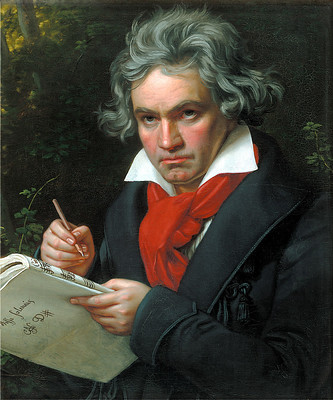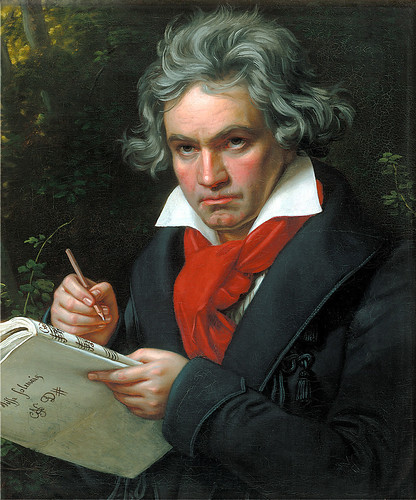

Beethoven: The Piano Concertos, part 1: Concertos 1 and 2

 Ahhh, the numbering of the works of the classical masters! If you’re old enough, you may well remember owning an LP of Dvorak’s Symphony No. 9 (From the New World), but it would have been labeled as his Symphony No. 5, before scholars renumbered it. Likewise, Beethoven’s Piano Concerto No. 1 in C Major was actually the second piano concerto he wrote, after the one that would later be published as the Second Concerto. (There had also been an unpublished student work, but we don’t need to consider that one here.) Beethoven chose to publish this concerto first, so the numbering reflects not the compositional order but the publishing order.

Classical music can be confusing.

So let’s listen to both concertos, No. 1 in C Major, and No. 2 in B-flat Major.

Both of these works reflect the youthful classicism of Beethoven’s early period. In each of these concertos you hear the strong influences of Mozart (who was already gone) and Haydn (who was not). But in each you do catch glimpses of the more expansive Beethoven to come, the Beethoven who would take classical forms and stretch them to unprecedented lengths. More important than that, though, is that in each work you hear Beethoven’s humor and musical wit, which are characteristics not always called to mind when considering this composer. Of particular note for me in a Beethoven concerto is the third movement, the rondo, when Beethoven always seems to have a great deal of fun with the rhythms, almost making the listener wonder, at first, where the bar line and the beat even are. There’s a feeling of syncopation even where there’s no technical syncopation happening at all.

In the first performance I am featuring here, of the Piano Concerto No. 1, the Israel Philharmonic Orchestra, conducted by Zubin Mehta, is joined by pianist Khatia Buniatishvili, who is a wonderful artist I’ve just discovered this year. She plays with technical control that is amazing to behold, and she’s also one of those pianists who does put on a bit of a show as she plays. (Her hair would be quite the distraction if she were playing from the score as opposed to memory.) But note also how attentive she is when she goes tacit and the orchestra picks up the main thrust of the music. Buniatishvili performs truly as a partner with the orchestra and with Maestro Mehta, and it’s a fantastic performance.

In the second performance, the Piano Concerto No. 2 is played by soloist Martha Argerich and conductor Daniel Barenboim, leading the West-East Divan Orchestra. Some years ago I listened to the entire cycle of the Beethoven symphonies that Barenboim and this orchestra performed at the BBC Proms, and this combination of musicians has, to my ear, a particularly special touch with Beethoven. Argerich is, of course, an absolutely brilliant musician of Argentine and Swiss descent, and she brings here the weight of experience and years of musical training and insight to her performance of the Second Concerto. Which was really the first…but we won’t go into that again.
Share This Post

Beethoven at 250: The Cello Sonata no. 5

 For most casual listeners, the words “Beethoven” and “sonata” almost always indicate one of the sonatas for solo piano, and with good reason; the piano sonatas comprise some of the greatest writing for piano in music history, and they are important listening for anyone. And if you happened to be a piano student of any skill, likewise your piano teacher eventually had you work on one of Beethoven’s sonatas.

However, Beethoven didn’t just write sonatas for piano alone. He also wrote sonatas for solo violin and piano, and for solo cello and piano.

Before turning to a specific sonata, it’s interesting to look at the term itself. Sonata is an Italian term, which differentiates an intrumental work to be played rather than a vocal work to be sung (a cantata). Over time, especially in the Classical era when forms began to settle in to certain sets of expectations, a sonata became somewhat standardized as a large-scale work of three movements, which in turn were usually in a standardized sequence: an allegro which used a form in which a single melody (or maybe two) were stated, then developed, before being played again one final time before ending; a middle movement which was usually in a slower tempo; and a fast finale, often much faster than the first movement, and often in a Rondo form. The structure of the first movement–intro, theme, development, recapitulation, coda–became so entrenched that it in itself became known as sonata, or sonata-allegro, form. So important did sonata-allegro form become that it became the almost universal form in first movements of symphonies.

Of course, the history of the symphony is as complicated as that of the sonata, and as Classicism gave way to Romanticism and then to Modernism, adherences to standard forms came and went and came again. Even Beethoven was not always locked into the expected forms: he would start a three-movement piano sonata with a slow movement (the “Moonlight”), or he would write two- or four-movement sonatas. It is best, when thinking about musical forms and definitions of musical terms, that one remember the wise words of Captain Hector Barbossa of Pirates of the Caribbean fame: “The code is more what you’d call ‘guidelines’ than actual rules.”

And when you’re a towering genius like Beethoven, who is literally shaping the course of music history for centuries to come, well then…the guidelines are there to be ignored at will. 

After all that, let’s turn to Beethoven’s Sonata for Cello and Piano No. 5 in D Major, which follows all the usual rules and adheres to the usual structure. Beethoven wrote this sonata at the same time as the one preceding it, the Sonata No. 4, in 1815 when his deafness was reaching its endpoint. He was entering what historians have called his “third period”, which is when his most introspective and profound music seems to have resulted.

This sonata is apparently less frequently performed than the Sonata No. 3 (which as of this writing I have not heard), which I find interesting. The Fifth Sonata begins with a simple declarative statement by the piano, which sounds twice, seeming to hesitate after each sounding, before taking off into the initial allegro. The movement then propels through its formal demands before drawing to a close before the listener really expects. The second movement puts the cello’s lyrical strengths on display, before a final movement that is fugal in nature. When the entire work ends, it is with a feeling of reflective abstraction as Beethoven, only left with his inner ear at this point, is transcribing sounds he can only imagine.

As much as I love the violin as a solo instrument, the cello is not to be slighted in its uses. The technical demands of the instrument are entirely different from those of the violin (which Beethoven had already mastered). Playing the cello has its own physical demands, and the instrument’s voice resides in a much lower register, which means that it has to be treated differently than the violin if it is to be heard in full partnership with its accompanying instrument. Beethoven clearly understood the cello as well as he did the violin, judging by the results in this sonata.

Share This Post

Beethoven at 250: The Ruins of Athens

 One reason that film music often struggles to get mainstream acceptance as music worthy of interest on its own is the fact that film music is always dependent on the film for its inspiration and genesis. Film composers don’t tend to have a great deal of freedom in their work, and they have to compose their scores to accommodate the timing and rhythm of the film given them to score. Obviously some of these composers are masters in their own right and create great works even with these constraints, but the constraints are still there.

Music as an aid to storytelling is best seen, prior to the movies and even after them, in the world of opera, but there is a smaller arena where the great composers of the 19th century often found themselves dealing with at least some of the same constraints that film composers would later confront. I’m talking about incidental music for plays.

Some incidental music has gone on to be quite famous indeed, seen as masterpieces on their own. Felix Mendelssohn’s work for A Miidsummer Night’s Dream is one of the enduring classics, and one of its melodies has even become a traditional recessional in modern weddings. Hector Berlioz also wrote incidental music, as did Mozart, Schubert, Schumann, Bizet, and Grieg.

And so did Ludwig van Beethoven.

What’s interesting about a lot of incidental music is that, Mendelssohn’s work for Shakespeare excepted, the music has outlived the plays in nearly every case. Schubert’s music for Rosamunde is well known (and in that case, mainly for the overture alone), but the play is almost completely forgotten. Likewise with Beethoven’s fine music for a play called The Ruins of Athens. This play was written by August von Kotzebue for performance at a new theater in Pest, and if it’s been performed anywhere in the last hundred years, I’d be shocked. But because one of music’s greatest of all masters wrote incidental music for it, the play isn’t completely forgotten.

Beethoven’s suite of incidental music is one of his more pleasing works, even if even this group of pieces is rarely heard except for the Turkish March movement. The suite is not purely instrumental, featuring movements for voices and orchestra. It’s all suitably dramatic but also very much Beethovenian. For all his anticipation of Romanticism, Beethoven was even at his most ostentatious always grounded in classical proportion and form. This suite, with its drama and genial melodies, doesn’t so much seem to anticipate Wagner as look back at (and, in so doing, extend the reach of) Mozart, and it does so with the geniality of the Beethoven who wrote the Pastoral Symphony.

I’ve long maintained that one need not necessarily have seen a film to appreciate its score on a separate listen, and when people question me on this point, all I need do is point to music like Grieg’s Peer Gynt Suite or Beethoven’s The Ruins of Athens and ask, “Do you really need to see a forgotten play to appreciate this music?”

Share This Post

Beethoven and the Outdoors

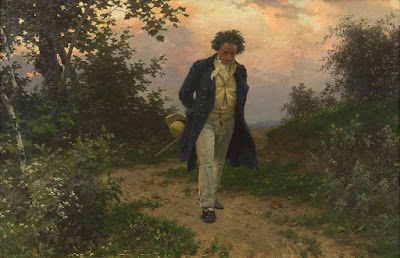
“Beethoven’s Walk in Nature”, Julius Schmid

 One thing that I have in common with Ludwig van Beethoven is that we both find creative rejuvenation in regular walks in the woods near our homes. I don’t know of any canine companionship that Beethoven might have enjoyed, but I have a dog with me at almost all times when I am walking through the forests of Chestnut Ridge Park, or Knox Farm, of Hunters Creek, or Sprague Brook, or Letchworth. Beethoven would escape almost daily to the woods around Vienna.

Even in Beethoven’s time, pollution was a problem in the city, and Beethoven likely felt it necessary to his physical health to get out of the city on a regular basis. I wonder how he applied those walks along forest trails to his musical life! Did he hum to himself, trying out musical ideas as he strolled? Did he take manuscript paper, quill, and ink with him so he could jot down ideas as they came? Or did he simply take a more meditative approach, using the walks to calm his often troubled soul so that when he returned to his chambers and his piano and his ink and paper, his mind was in a place to actually create?

It doesn’t precisely matter how Beethoven’s love of nature moved him to create; all that matters is that it did. His music abounds with examples of this inspiration, but the most famous and obvious is in his Symphony No. 6, the “Pastoral”, in which Beethoven uses five movements (not four!) to more suggest the emotions of walking in nature than musically depict it. This makes the Pastoral Symphony one of the earliest examples of “program music”, even if Beethoven’s desires were more impressionistic in nature. Nevertheless, in those five movements, Beethoven deftly creates a series of emotional moments–“melodic moments of feeling,” as Wagner would later say–that do suggest a natural setting.

The movements suggest the feelings of refreshment and delight upon arriving in the countryside, and then a scene by the side of a rushing brook. The third movement is a folk dance, followed by a storm and then by the feelings of rain-washed newness that follow a good summer storm. The entire symphony is lyrical and beautiful and at times even charming–note the folk dance in the third movement, which has a lively tune played off the beat by the oboe and a bassoon accompaniment that sounds like the bassoonist can only play three notes–and there’s real drama when the storm arrives, before peace settles again. The storm has been frightening, but also rejuvenating.

Here is Beethoven’s Symphony No. 6 in F Major, the Pastoral. Few works with more lyrical delight exist.

Share This Post

The other Beethoven piece that everybody knows

 If you took piano lessons as a kid for any length of time, you probably played some Beethoven. And if that’s the case, then the odds are very good that the Beethoven you played included his Bagatelle No. 25 in A minor, more familiarly called Für Elise. And if you never did take piano lessons, odds are that you’ve heard this piece. If not for his Fifth and Ninth symphonies, there’s a good chance that Für Elise would be the most familiar piece Beethoven ever wrote.

And that’s interesting, because it turns out that the piece was never heard in Beethoven’s own lifetime, and in fact would not be discovered by the musical world until four decades after the composer’s death. The piece is quite short; in fact, the word “Bagatelle” refers to a small, short piece for piano. And the title? “For Elise”? That seems obvious, right? Beethoven wrote the piece as a gift for someone named Elise…but some scholars have agreed that this is based on a misreading of Beethoven’s legendarily awful handwriting, and what he actually wrote on the manuscript (which is now lost) was “For Therese”.

Who was “Therese”? Well, this article explains:

Therese was 18 years old and one of Beethoven’s piano students. Her father was a medical doctor who treated Beethoven for some of his many illnesses. Beethoven was quite taken with her from their first meeting and soon began heaping great praise on her piano skills, which weren’t all that notable. There was probably some flirting on Therese’s side, as it would have been very flattering to have a famous musician like Beethoven falling all over himself to impress her. He started cleaning up, ordered new clothing, and even combed his wild mane of hair. 

Last but not least, he wrote her a piece of music, composed deliberately for her skill level. All seemed well, at least to Beethoven. Then everything came crashing down. Although we don’t know exactly what happened, later letters to and from Beethoven speak of an unfortunate incident at the Malfatti home. Beethoven had a little too much punch and behaved rudely with Therese, and she rejected him outright. In a later letter to Therese, Beethoven wrote about the piece he had written for her and invited her to find its hidden meaning. “Work it out for yourself, but do not drink punch to help you,” he wrote, apparently referring to the unfortunate incident that ended their relationship.

Also interesting is how this piece, apparently an unpublished trifle that Beethoven didn’t even keep a copy of for his own archives, came down to us:

It was found in Therese’s personal papers in 1851, 41 years after it was probably written. A small piece, Beethoven gave it its formal name, “Bagatelle”. But it was what he wrote at the top of the page that not only gave this piece its informal name, but also created a mystery that has fascinated students of the history of Für Elise ever since. 

At the top of the page, Beethoven wrote (translated from German): “For Elise on 27 April to remind you of L.V. Bthvn”. Ludwig Nohl, a German music scholar, discovered the original manuscript in Beethoven’s own handwriting among her musical papers, transcribed it, and published it in 1867 in a book he edited of Beethoven’s letters. The original has since been lost, so we have had to rely on Nohl’s copy of it. 

Imagine having something you just tossed off one night becoming one of the enduring works of all classical music, so enduring that the piece has become on its own a kind of cliche. Try listening to it again, though, beginning to end! Note the way the harmonies and the melody blend together so you can’t have one without the other, and note the contrasts between the famous main melody and the less-familiar intervening sections. And if your memories of your piano teacher are pleasant ones, think of them, too!

(My teacher, Mrs. Hooker, never had me play Für Elise. My personal gateway to Beethoven was the “Moonlight” Sonata.)

Here is Für Elise.


Share This Post

A Fourth of Beethoven

Beethoven

I often feel a bit sorry for Beethoven’s Symphony No. 4 in B-flat major. It just doesn’t get talked about that much. Symphonies 1 and 2? Those get discussed as the early works they are, when Beethoven was just starting to move beyond the Haydn and Mozart influences on his work. Then, of course, comes the epochal milestone in music that is the Third, the mighty Eroica, famed for the original dedication to Napoleon Bonaparte, which Beethoven ripped asunder when he learned that his French hero had declared himself Emperor.

And of course, there is the Fifth, the great and glorious Fifth, perhaps the single most performed symphony of all time, a work whose opening bars comprise music that is as familiar to the ear as the Mona Lisa is to the eye. Even the Sixth, the Pastoral, gets more respect than the Fourth, with its wonderful rustic tone-painting.

Rivers of ink have been spilled over the centuries since the Seventh arrived, one of the grandest masterpieces in all of music history, and even the Eighth–the slight, small, intimate Eighth–gets some love here and there. And we’ll come back to the magnificent edifice that is the Ninth later this month. But there, seemingly alone in the middle of the most perfect collection of symphonies ever composed, is the Fourth, the sunny and genial Fourth.

There is no “Fate knocking on the door” here, nor is there a funeral march in place of a traditional slow movement. There is no “apotheosis of the Dance” to be found in the Fourth, nor is there a plaintive depiction of the woods around Vienna that Beethoven loved so much, and certainly there is no wonderful hymn to Joy.

All there is in this work is Beethoven smiling.

The first movement kicks off with a long minor-key introduction, perhaps hinting at serious thoughts to come…but when we arrive at a series of chords that finally resolve into our home key of B-flat, all the clouds disperse and what follows is pure sun and cheer. The genial mood carries into the slow movement, which is dominated by a pulsing rhythm that puts one in mind of Haydn’s “Clock” Symphony, with the same degree of amiability. Toward the end of the movement there is a moment of pure delight as the horn, clarinet, flute, and strings exchange arpeggiated passages.

Our third movement, a scherzo, doesn’t thunder or storm the way Beethoven scherzos often do. This one flits and jokes, with Beethoven giving us rhythms that don’t quite feel like they line up. There is some fantastic writing for the woodwinds in this movement, especially for the bassoons in the middle. And the finale is pure energy, not quite as propulsive as what would come later in, say, the finale to the Seventh, but compelling in the forward momentum of its moto perpetuo construction, before it finally arrives at the thrilling coda.

Why has the Fourth never quite become as beloved as so many of–if not all of–the other eight of Beethoven’s symphonies? I honestly do not know, but I wonder if part of that is because we often seem to like our Beethoven with at least some of his characteristic darkness. We want to hear at least a little of the man who shook his fist at the thundering clouds when he was on his deathbed. We’re not sure what to make of this odd Fourth symphony, a work in which this composer who went deaf and who struggled mightily to make musical sense of the ideas he scrawled in his notebooks seems to be largely in a mood of brightness and good cheer.

Maybe, maybe not. All I know is that I really do love the Fourth.

Share This Post

Tone Poem Tuesday: The Beethoven Jubilee Begins!

Beethoven

 This is the month when Ludwig van Beethoven turns 250 years old…fifteen days from now, to be precise. In honor of this, I’ll be stepping up the frequency of Beethoven-related posts–not quite daily, I expect, but there will be a lot of Beethoven this month, with a special post on the 16th, Beethoven’s actual anniversary. Let’s kick things off with an overture to one of Beethoven’s signature works, his only opera, Fidelio. Among Beethoven’s passions–in fact, after music, maybe his greatest passion–were the ideas of freedom and liberty. Beethoven lived in a deeply revolutionary era (I am reading a book about this aspect of his personality right now, but more on that later in the month), and he believed deeply in the liberal ideals that France would express as Liberté, Egalité, Fraternité. These values inform his opera, in which a woman goes undercover as a man to rescue her husband, who has been unjustly accused. The opera itself is a great work, and its overture (which was the last of four that Beethoven composed for it, being ever the perfectionist) is representative of many of Beethoven’s finest aspects as a composer.

Let there be Beethoven!

Share This Post

Tone Poem Tuesday

 First off, I think it’s high time I admitted that this series has morphed away from an exclusive focus on tone poems toward a general focus on whatever piece of classical music I’m grooving on at any point in time, so that’s what it’s going to be, even if I continue to call it “Tone Poem Tuesday” for reasons of alliterative nature (and the fact that I don’t really feel like launching a new posting series with new title). OK? OK!

So, naturally, let’s turn our attention to a piano concerto.

Florence Price, a Black composer who lived from 1887 to 1953, has appeared a number of times in this space over the last several months, and when 2020 is over, I wonder if her music might not be the finest musical discovery I make this year. Every work of hers I hear is vibrant and full of drama and color, and this concerto is no exception. It is lush and romantic in its orchestration, but distinctly Black in its musical language and its thematic material.

The work is in a single movement that nevertheless has three distinct sections within: the big first “movement”, the slow second movement, and a spritely third. We open with a solo trumpet sounding the first notes of what will be the first section’s main theme, a tune that is redolent of a spiritual, and that theme does in fact dominate a movement that is as big and bold in its statements as any great Romantic concerto. Then, in the slow movement, there is another gorgeous melody with a strong folk-like character (its pentatonic nature makes it even sound less moored in a specific time and place), before the final dance-like allegretto begins. It sounds like ragtime to me, but on reading a bit, apparently the finale is based on the juba, a specific dance from the plantations that predated ragtime.

Price’s concerto is one of the most delightful things I’ve heard all year, and I’ve heard a lot of delightful music this year. There is sweep and energy and emotion and lyricism and, in the end, a compellingly rhythmic dance that leaves the toe tapping, if I may invoke a rather tired cliche.

And it does all this in roughly eighteen minutes. Florence Price does something wonderfully economical here.

The work was performed in the early 1930s, with Price herself as the soloist, but unfortunately it appears to have utterly disappeared since then, until apparently in 2012 a composer named Trevor Weston was commissioned to recreate the work based on orchestral parts. Price’s own autograph score is long lost. Once again I am struck by how tenuous our grip truly is on the artistic work of our forebears.

Here is the Concerto in One Movement by Florence Price. Please give it a listen! And really, give it at least two. It deserves it.

Share This Post

“Stuck at home”

 A quite lovely article appears in The Buffalo News by Jeff Miers, describing his struggle with the degree to which the COVID pandemic has disrupted his lifestyle. It’s not just his leisure that’s affected; it is literally his entire life. Miers writes about music and the arts for the News, and with a beat like that, he’s required to be out in the city almost all the time, interacting with music and art and musicians and artists. This has been his life for decades, and now, all of a sudden, he’s been forced to…stay at home.

The Wife and I often comment that it’s strange how this particular pandemic has basically forced so many other people into our lifestyles: we don’t go out a lot at all, and when we do it’s mainly to eat someplace, so getting takeout is just fine with us. My trips out by myself tend to be solo trips to the library, or jaunts to a local park to walk The Dee-oh-gee in solitude. We simply don’t find ourselves often in situations that involve lots of people are in social situations. But our lifestyle isn’t the only lifestyle, and Mr. Miers (who is, by the way, quite a fine writer whose work I usually enjoy) had felt the pinch very keenly:

After months of telling myself that I was far too fortunate to demand such a luxury, I finally admitted that I needed some help, that the ways in which I warded off depression and anxiety in the past – all of them involving music – were no longer enough. I began seeing a mental health therapist, virtually. She immediately pointed out that, in addition to the difficult situation with my parents, I was also quite likely in a state of shock resulting from a core feature of my existence – the live music experience, which has occupied my time an average of five nights a week for 30 years – being ripped away. Allowing myself to admit this, and to mourn it, in a sense, has helped me greatly.

In the course of his article he notes how he discovered that his son’s girlfriend is actually the granddaughter of a noted jazz musician named Roosevelt Wardell. I found an album of Wardell’s on YouTube, and though I am no expert on jazz by any means, I greatly enjoyed it! This record is quite a compelling listen. You never know which direction art will take in reaching us. Some guy asks a girl out, introduces her to his parents; Dad turns out to be a local writer who mentions her grandfather in a newspaper article, and now I’m listening to a jazz record.

The wheel turns, man.

Here’s that album, by the way.

Share This Post

Beethoven at 250: The Violin Concerto

 I’ve been listening to Beethoven’s Concerto in D Major for Violin and Orchestra a lot over the last few months, and I’ve been struggling to frame how I want to write about it. It’s such a scintillating work, full of wit and sparkle–qualities one doesn’t always associate with a composer who, while on his deathbed shook his own fist at the thunderstorm raging outside–that stands out all the more when one considers that the Concerto was a failure in Beethoven’s lifetime and did not take its rightful place in the repertoire until several decades after his death.

But last month, Edward Van Halen died, and that gave me a new way to think about this piece. Bear with me!

Mr. Van Halen was a self-taught musician, but he was also a curious one who had a strong love of classical music. He would even sprinkle quotes from favorite classical works into his solos on occasion. While his father, a musician himself, encouraged Eddie (and brother Alex) to learn music, Eddie never learned formally; he never learned to read music from the page. Everything for him was done by ear, and he had the kind of ear that only the very greatest of music virtuosi can boast.

Not unlike the inner ear of Ludwig van Beethoven, who would continue composing his greatest works even after his own physical ears had stopped working entirely.

My main thought in drawing Eddie Van Halen into a discussion of Beethoven’s Concerto for Violin and Orchestra isn’t just that both men had amazing ears, though. A concerto is as much a work designed to put a performer’s virtuosity on display as it is a musical work with specific architecture. What makes the concerto such a compositional challenge is that the composer must balance the virtuoso’s need to display their skill with the task of crafting a work that is satisfying musically. Plenty of less successful concertos exist that allow for all manner of virtuosic pyrotechnics, either from the piano or the violin or some other solo instrument, while failing to incorporate the soloist into the musical aspects of the work.

(Then there are works that go the other way: Hector Berlioz’s second symphony, Harold In Italy, had been specifically commissioned by Nicolo Paganini, who wanted to show off his skill on a new viola he’d acquired, but Berlioz turned in a symphony with little to offer by way of virtuosic display opportunities. Paganini never performed the work.)

Beethoven’s Violin Concerto does for the violin what Eddie Van Halen would do with all of his blazing guitar solos. Even when Eddie was “shredding” as hard as he could, there was always melody in his playing. You can always pick out the tune in an Eddie Van Halen solo, and sometimes a Van Halen song will feature a second solo, shorter this time, that is nothing but pure melody (“Dreams”, which might well be my favorite Van Halen song, does this to wonderful effect).

Beethoven does the same thing in his Violin Concerto. Whenever the violinist plays, even during the cadenzas, you never get the sense that they are simply showing off. Every note that Beethoven writes contributes to the whole, for one of the most complete concertos I know. The concerto begins surprisingly, with five soft taps of the timpani before the woodwinds give us our first hint of melody. Beethoven’s symphonic hand is firmly guiding us, to the point that when the soloist finally enters, it’s almost surprising as we remember that we are actually hearing a concerto and not a symphony.

The first movement, comprising more than half the entire concerto’s total time, is an epic movement in itself, and yet it teems with the kind of optimism that we don’t always associate with Beethoven. This is assuredly the same composer who wrote the Seventh Symphony, and if the inner movement isn’t as meditative as that great symphony’s amazing second movement, it is still a lovely movement of introspective beauty before it closes not with a resolution but with an unresolved minor chord that leads to a short cadenza that is likewise unresolved–until the soloist brings us into the rondo of the last movement. And that last movement is full of Beethoven’s humor. Again, a facet of Beethoven’s that is often overlooked–but listen to how that rondo theme seems somehow to put the beats in the wrong place (until you hum it and realize that it’s quite correct). Hear the way the soloist must make very wide leaps in the violin’s register, and one musical joke where the soloist has to pluck two notes, pizzaicato, before bowing the next immediately.

Near the end of the work, when Beethoven almost gives the soloist free rein, there is a remarkable sequence of passages in which the soloist plays three brief flashy runs that soar into the upper register, alternating with brief orchestral passages. Even there you can hear melody, as those soaring runs are a part of the work’s musical fabric and are clearly not just there for a violin virtuoso to enjoy. Even the concerto’s very last bars contain good humor, as the soloist leads the orchestra to its final chords.

This approach to writing for a soloist in a concerted work, in which the soloist is musical partner first and virtuoso second, really does put me in mind of Eddie Van Halen’s best work as a rock guitarist. There really is a line that connects the two. So it seems to me, anyway.

Here is violinist Hilary Hahn, performing Beethoven’s Concerto in D for Violin and Orchestra, with Leonard Slatkin conducting the Detroit Symphony Orchestra.

Share This Post