Today I heard a striking choral work on WNED, but I missed the piece’s introduction. I’m old enough to remember when this kind of thing was a pain! If you heard a song or piece but you missed the radio personality’s intro, you had to wonder what the song was and hope to hear it again. Nowadays, with WNED, I can go to the station’s website and look at their playlist to figure out what I heard…or I can actually hold my phone up to the speaker and let it listen to the piece and try to identify it. This works a surprising amount of the time. Yes, I’m still vexed that we don’t have moonbases and giant spaceships under construction to launch Phase One of our colonization of Mars, but a device in my pocket that can (among other things) identify music? Now that is something.
The piece was “i carry your heart” by Eric Whitacre. It’s a setting of a poem by e.e. cummings, whose birthday it is today, which I suppose is the “hook” that WNED cited to play the piece. You can read cummings’s poem here (I would reproduce it here directly, but it’s cummings, which means that the typography is important and I don’t want to screw it up), and the ever-brilliant Sheila O’Malley has a big post about cummings here.
And here is “i carry your heart” by Eric Whitacre. It’s quite a wonderful piece, at times evocative of plainchant or a medieval madrigal.
It took me a while to start loving rock music. I heard a lot of it as a kid (benefits of having an older sister, which I did not appreciate at the time because there are things you need years to figure out, especially when you’re a not-terribly-smart nine-year-old), but for various reasons none of it really captured my attention until the early-to-mid 1980s. Part of it might have been a kind of peer-pressure, as I did tire of being the kid who had no idea what all of my friends were talking about when they started discussing music. Another part of it was the arrival of MTV, which even I, as a geeky kid, thought was pretty cool.
We didn’t have MTV at our house for a while, because it took several years before the cable company ran the lines out our road to where we lived. But I would watch a lot of MTV at a couple friends’ houses, when I did sleepovers and the like. There’s a lot of nostalgic hay to mine in the music videos of those first few years, but I’ll keep it to just one group here, for what are probably obvious reasons.
There was one very strange video I enjoyed in particular. It actually had a filmed introduction; the music didn’t start for a minute or two. Our opening scene has a spectacularly nerdy kid being put on the school bus by his mother. This dude is so nerdy that when his mother flattens his hair with her fingers, it squeaks. She’s giving him the standard spiel about making friends and having a good year and whatnot, but our boy–named “Waldo”–is not having in, replying to her in a voice that can’t possibly be his: “Awww, Mom, you know I’m not like the other guys! I’m nervous and my socks are too loose.” No dice; off to school goes Waldo, after discovering that the bus is loaded with what the 1980s held to be the standard “degenerate” types of kid.
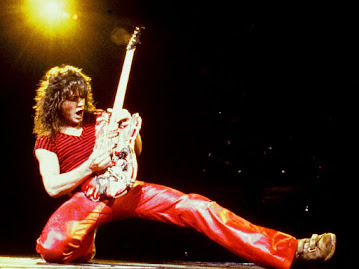
Then our music starts, with some wild drums, and then the most blazing electric guitar work I had heard to that point in my life. And that guitar work remains the most blazing guitar work I’ve ever heard. The song, and video, were called “Hot For Teacher”, and the band was a hard rock group called “Van Halen”. That astonishing guitar playing? That was a guy named Eddie Van Halen.
That song, and the others from the album 1984 were my introduction to Van Halen. I would learn not long after that while I’d just discovered these guys, Van Halen had actually been around in a big way since the late 1970s after toiling in obscurity for several years before that, and that 1984 was their sixth studio album. Soon after that album came out, some internal drama happened with the band that led to their lead singer, a charismatic but troublesome guy named David Lee Roth, to leave the group; luckily there was another lead singer available by the name of Sammy Hagar who was between bands at the moment, so he slid right in and the band accommodated him, making new music in new styles to reflect the style of their new lead man, all the while maintaining the focus on the hard-but-fun rock.
And through all of that was the guitar work of Eddie Van Halen.
The music of Van Halen was a big part of my teen years, and I’ve never lost my love of it, though eventually I didn’t buy the albums anymore. 5150, the first Van Halen album with Hagar aboard, was the first rock album that I played almost literally to death, to the point where I knew each and every song on that album backward and forward. I’d quickly get up to speed on all of the Roth-era albums as well, each of which is full of great rock music (well, Diver Down is really kinda meh, isn’t it?), but I am probably one of the only people around who can honestly say that I don’t have a genuine preference between the DLR and Sammy eras…or, as some people phrase it, “Do you prefer Van Halen, of Van Hagar?”
In all honesty, though, if you put a gun to my head and said “Play the first Van Halen song that jumps into your head!” I will probably wind up selecting “Dreams” from 5150 or “Right Now” from For Unlawful Carnal Knowledge before I choose any DLR song. That might not be a “preference”, but there it is.
Of course, Van Halen’s history got even more convoluted later on, when I had kind-of moved on from listening to them on a regular basis. Hagar was out, Roth was back in; Roth was out, and a guy named Gary Cherrone was in (for one album, that most people speak of in the same hushed tones as the Star Wars Holiday Special). Hagar was back! Hagar was gone again! Roth was back! Roth was out! Roth was back again! And so on.
Eventually Eddie Van Halen’s years of hard living started catching up with him, with news and rumors of his various health troubles, winding up in the end with cancer…and that’s what finally took him away from the world, at the age of 65.
What to say about Eddie Van Halen’s guitar playing? Well…yes, he could play fast and he could do astonishing things with the guitar. But what always got me was the tone of his playing. There was often a sense of cheer behind it, of happiness, of warmth. A lot of great rock guitar playing often seems obsessed with speed for the sake of speed, and the electric guitar can sound almost angry and snarling in a lot of guitar solos, especially in 1980s-era “hair band” hard rock. Eddie’s tone was always clean and pure, and there was almost always melody there, even in the midst of his virtuosic displays of pure skill and talent. Eddie Van Halen made music with the guitar, and his solos always blend into the songs and seem a part of the song. Many guitar solos of the era sound like what they are: rhythmic cadenzas stuck in the middle of the song, where the singer stops singing but the bassist and drummer keep on going.
Eddie Van Halen made the guitar sing and laugh, and in a few songs he even made it seem like it was about to cry. The man wasn’t just a guitar god, he was a musician. Eddie Van Halen was to the guitar, for me, as Vladimir Horowitz was to the piano or as Hillary Hahn is to the violin or as Tine Thing Helseth is to the trumpet. In his best work, he isn’t just “shredding”, he’s making music. And that’s what I’m going to remember Eddie Van Halen for: the music.
Thanks for the music, Eddie. It was always good, and quite a lot of it was great.
A word about this last one, the live performance of “Best of Both Worlds”. My paternal grandmother died in 1986, when I was just about to turn 15, on the morning that this performance was recorded. It was a deeply sad day; she was the first significant loss of my life. It was a Friday. After making the arrangements that morning, my father drove all the way home from Philadelphia, where Grammy lived, and then I remember my parents going out to hang out with their friends on what was a difficult night. I stayed home, as I typically did. Grammy’s passing didn’t really hit me until my father told me, after he got home, that she had remembered me during her brief hospital stay; apparently someone had said something that had triggered her memory of me. I lost it after that, and I remember being deeply sad for the next several hours, until I idly turned on the teevee and channel-flipped to MTV, which had the Video Music Awards (MTV’s big awards show–do they still have the VMAs anymore?), and not long after I tuned in, MTV went to a live segment of none other than Van Halen, in New Haven, CT. They were on their big tour for the 5150 album, their first big tour with Sammy Hagar. This performance is the one to which MTV cut. Maybe it seems weird, but watching them do “Best of Both Worlds”–which is one of the best songs on that album–jolted me out of my funk. It was still a sad time, and Grammy’s death was just the start of what was a generally godawful sophomore year of high school for me, but…at least there was Van Halen. Always Van Halen. To this day, I can rely on Van Halen to cheer me up when I’m stuck in the mud.
So, yeah. Thanks again, Eddie. (And Sammy, and Dave, and Michael, and Alex. And heck, you too, Gary.)
Ennio Morricone, one of the greatest of all film composers, has died. He was 91. His music was often expansive and melodic, evocative and emotional. I often find his work hard to characterize, to be honest, but his finest work is often meditative and introspective. He often took a non-intuitive approach to scoring certain films, like his famous work on the “Spaghetti Westerns” of Sergio Leone. He wasn’t about to strive for the Americana-west sound of an Elmer Bernstein or a Dmitri Tiomkin
One of the finest albums of film music I know is a collaboration album he did years ago with Yo Yo Ma, performing selections from his film scores. I cannot recommend this album highly enough, especially if you’re new to Morricone and you have no idea where to start. That can happen with composers as prolific as Morricone was.
Beethoven’s Piano Sonata No. 18 (Op. 31, No. 3) has been a favorite piece of mine for years…and for years I didn’t know what it was.
I first heard part of it–not the whole work, but a single movement–at my piano teacher’s annual end-of-year recital, when a former student of hers returned from college to offer up a quick surprise encore. He play the second movement of this sonata, which is one of the most infectious pieces I know. The movement is a rambunctious and, dare I say it, playful march in a brisk 2/4 time, with one of those Beethovenian melodies that sticks in the head as soon as you hear it.
This sonata is unusual in its construction in that it is in four movements and not the usual three, and that none of the movements is a proper slow movement. The entire work is warm and almost humorous, which is not something one typically expects from Beethoven. However, Beethoven’s cultural image is often unfair in itself. This sonata clearly comes from the same mind as the Seventh Symphony and even the Sixth before it, especially that wonderful dance in the Sixth where the bassoon keeps making off-beat entrances.
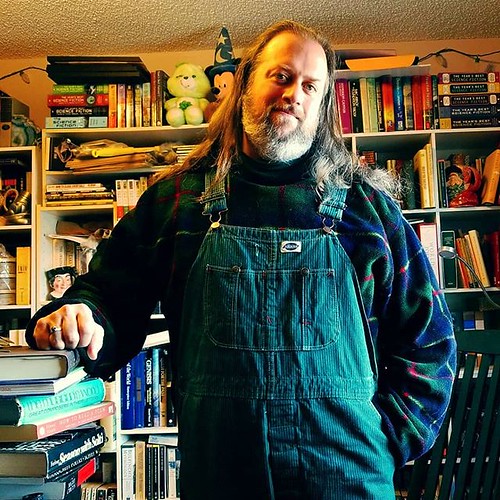
This performance is excellent, although if you’re a traditionalist in your views on deportment in the concert hall, the fact that the pianist is wearing overalls may be distracting. If that’s the case, turn your screen off and keep listening, because he performs this sonata wonderfully. As for me, I’m trying to ignore that he’s wearing his overalls incorrectly.
I won’t post a poem each day of this National Poetry Month, but I’ll try to do so as often as I can! Here’s one I found in a collection of music poetry I have, which fits right in with my year-long focus on Ludwig van Beethoven. This sonnet, by Edna St. Vincent Millay, is titled On Hearing a Symphony of Beethoven. Note that Millay does not specify which of the nine symphonies she has just heard! It could as easily be the light and good nature of the 1st, or the power of the 3rd, or the majesty of the 5th, the dance-like awe of the 7th, or the storm-turned-to-joy of the 9th.
Sweet sounds, oh, beautiful music, do not cease!
Reject me not into the world again.
With you alone is excellence and peace,
Mankind made plausible, his purpose plain,
Enchanted in your air benign and shrewd,
With limbs asprawl and empty faces pale,
The spiteful and the stingy and the rude
Sleep like scullions in the fairy tale.
This moment is the best the world can give:
The tranquil blossom on the tortured stem.
Reject me not, sweet sounds! oh, let me live,
Till Doom espy my towers and scatter them,
A city spellbound under the aging sun,
Music my rampart, and my only one.
The lines that hit me hardest here are the ninth and tenth:
This moment is the best the world can give:
The tranquil blossom on the tortured stem.
Unlike a painting or a sculpture or even a poem, a symphony (or any piece of music) can only exist in time. You can’t linger on a particular melodic moment that especially strikes your ear, the way you might stop in an art gallery to spend more time gazing upon a particular painting on the wall. Music is only meaningful in time, and thus music only exists as a momentary thing. Beethoven’s Fifth Symphony does not exist in the same sense that Michelangelo’s David exists. Every performance is a singular event, ephemeral and blossom-like.
And since we’re here, let’s just go ahead and have a Beethoven symphony. We could hardly do better to honor Edna St. Vincent Millay. Here is the Symphony No. 2 in D Major, with Daniel Barenboim conducting the West-Eastern Divan Orchestra at the BBC Proms in 2012.
As I noted a while back (before The Virus took hold of our collective imaginations), I’m spending a lot of 2020 digging into the world of Ludwig van Beethoven. I’m currently reading a “life and works” book about him, and I plan to read a few more books about him before this year is out. One thing I learned that I didn’t know is that while most of Beethoven’s works carry opus numbers, not all of them did. Some of these are works that only survived in fragmentary form, while others are youthful works that an adult Beethoven–whose main source of income was the publishing and printing of his works–kept out of the public eye, likely because he considered them his ‘student’ works. These were gathered and numbered in the 20th century under the designation Werke ohne Opuszahl, or “Works without opus number”, abbreviated as “WoO”. As I’ve been listening to more Beethoven of late, I’ve listened to a number of these WoO works, and I present two here.
First is a piece of chamber music: the Piano Quartet No.3 in C Major (WoO 36, no. 3). A piano quartet is basically a string quartet with the second violin removed and a piano substituted. Piano quartets are generally uncommon, and the three Quartets in the WoO 36 group are the only ones he composed. In fact, they were never published until after his death, and Beethoven wrote the three Piano Quartets when he was only 15. They show a heavy influence of Mozart, and according to my reading, they even use some of Mozart’s thematic material, although I couldn’t tell you where. The work is charming and, well, pleasant in the most wonderfully Classical way. And he wrote this when he was fifteen. Yikes!
And if Beethoven at 15 was impressive, let’s turn back the clock to when he was just 12. This is, by all accounts, the first published piece Beethoven ever wrote, when he had undertaken lessons with Christian Neefe, one of the most prominent musicians in his hometown of Bonn, Germany. As an exercise, Neefe had assigned his young student to write a series of variations on a march by a composer named Ernst Dressler, and this seven-minute work is the result. It’s not particularly profound, but one can definitely tell that this was a twelve-year-old with a keen ear and a strong sense for thematic possibilities.
More Beethoven to come! We’re only just getting started.
Since St. Patrick’s Day is approaching, I thought I’d listen to some Irish and Celtic music while at work today. A good starting point for such a mood is always The Chieftains, so I looked up one of my favorite albums of theirs, Fire in the Kitchen. This isn’t exactly considered an “official” Chieftains album, as its selections were all recorded on the spur-of-the-moment as they toured in Canada and appeared with a number of that country’s notable Celtic acts, but it is quite a wonderful album anyway. One of my favorite tracks is this haunting rendition of “My Bonny Lies O’er the Ocean”, sung hauntingly by a woman named Laura Smith.
It suddenly occurred to me that I know nothing at all about Laura Smith, so I looked her up.
Jean Sibelius is a composer with whom I am in constant need of discovery. His work is sometimes warm and melodic and fully Romantic, but other times there is an austerity to his music, a certain emotional coolness and introspection that is sometimes difficult to get a handle on. Sibelius seems to be fond of repetition of sounds and musical figures, which can create a dreamy quality in his music. This is an example of the latter voice of Sibelius: no Finlandia-esque fireworks are on display here, just a sense of meditative motion as Sibelius musically describes (or so he says) a carriage ride in the darkness, followed by the arrival of sunrise.