Magic Friday!

Maybe we should stop calling it “Black Friday”. I mean, if we take the day after Thanksgiving as the de facto start of the Christmas season, and if we consider the Christmas season to be the year’s most magical period (and I certainly, absolutely do), then maybe we should call it “Magic Friday”. Just a thought that popped into my head while listening to this piece of music by John Williams: “Flight to Neverland”, a concert arrangement of several of his themes from the movie Hook.


Happy Magic Friday, folks!

Share This Post

Secret Weddings

SamuraiFrog writes about two cues from the Braveheart score:

It’s sort of a touchstone for me now. Becca and I had been dating for about six months when this movie came out, and it was really this movie that made me aware of how much Becca actually liked film music. That was a passion I didn’t share with many people, mostly because people my age seemed to think it was weird to not be into pop music or rap or whatever was right there on the radio. Becca listened to this soundtrack over and over, and we grew closer over a shared love of film scores. That was sort of important to me; sometimes she’s just not into something that I am, and I’m glad this is one thing that she shares with me.

This rang a bell in my memory: I wrote a post in appreciation of the Braveheart score myself, some time ago; turns out that it was more than ten years ago. Wow.

And yet…I still return to this CD, again and again, because of the first ten tracks (which comprise the music up to and including Wallace’s victory at Stirling). In the film, Mel Gibson strove for a very dreamy atmosphere, in which gestures are slowed down, dialogue is spoken at a measured pace, and characters hold one another’s eyes. The emotional core of the film comes early, in those scenes of quiet courtship between Wallace and Murron (Catherine McCormack), when love is expressed by a quick and private smile or a shared glance as they pass each other within a crowd. This is where Horner’s score shines.

The two tracks to listen to here are “Wallace Courts Murron” and “The Secret Wedding”, both of which are long and quiet, and yet, surprisingly complex. The only rhythm in these two tracks is provided by a harp that is so distantly placed one is at first not even certain if it is even there. The melody Horner creates for these two lovers is a very long one indeed, and he varies it slightly each time it is heard — first in the violins, then in the wavering tones of the kena flute (played with thick vibrato) and finally, most memorably, in a long line for solo oboe that is as heartbreaking a passage of music as I have ever heard.

The first half of Horner’s Braveheart score constitutes some of the finest film music I know, haunting and atmospheric and lyrical. The score’s back half does let up somewhat, as does the film, but that first half is so strong that it carries what comes after.

Share This Post

My Birthday Number One Song List

So today I turn 43. Yay. Let there be dancing in the streets…and for the street-dancing, I can provide a handy songlist!

SamuraiFrog and Roger both did this, and I’m never one to let something like this pass, so here’s a look at the songs that were topping the Billboard charts on each of my birthdays, starting with Birthday Zero, September 26, 1971. Roger and SamuraiFrog did a more extensive thing, looking at the songs on either side of their birthday chart-topper, but I’m just going to list the ones that were Number One ON my birthday. It’s just easier.

1971: “Maggie May”, Rod Stewart. (I’m not a huge Rod Stewart fan, but I don’t dislike him, either.)

1972: “Baby Don’t Get Hooked On Me”, Mac Davis. (This does not ring a bell at all.)

1973: “Delta Dawn”, Helen Reddy. (My main familiarity with this song springs from its use on an episode of Friends.)

1974: “Can’t Get Enough Of Your Love, Babe”, Barry White. (Barry White falls into the same general category for me as Rod Stewart: singers I never go out of my way to listen to, but whose appearance on the radio never makes me want to change the channel, either. This is a good song, anyway.)

1975: “Fame”, David Bowie. (Nothing to add here.)

1976: “Play the Funky Music”, Wild Cherry. (Heh! I actually do like this song.)

1977: “Best of My Love”, The Emotions. (I missed, by five days, having my birthday’s Number One be Meco’s disco rendition of the theme from Star Wars. Can you believe that!)

1978: “A Taste of Honey”, Boogie Oogie Oogie. (Huh?! Never heard of this.)

1979: “My Sharona”, The Knack. (This song had some staying power, didn’t it? It was number one starting a full month before my birthday that year, and stuck around for ten days or so after. As for the song…not a favorite of mine. I find it kind of annoying, actually.)

1980: “Upside Down”, Diana Ross. (Don’t know this one. The next Number One, a little over a week later, would be Queen’s “Another One Bites the Dust”, which is classic.)

1981: “Endless Love”, Diana Ross and Lionel Richie. (This was Number One for even longer than “My Sharona”, from August 15 to October 17. I don’t care for this song.)

1982: “Hard to Say I’m Sorry”, Chicago. (I have never liked Chicago.)

1983: “Tell Her About It”, Billy Joel. (Not my favorite Billy Joel song, but I do like it. It’s catchy and fun.)

1984: “Missing You”, John Waite. (I shrug my shoulders, as this rings no bells at all. A couple days later, “Let’s Go Crazy” by Prince would take over.)

1985: “Money for Nothing”, Dire Straits. (Oh yeah! I love this song. In fact, this whole album is fantastic.)

1986: “Stuck With You”, Huey Lewis and the News. (I am just fine with this. In fact, I’ve always kind of felt that Huey Lewis’s bubblegum-for-the-1980s act has been underrated for years.)

1987: “Didn’t We Almost Have It All”, Whitney Houston. (This became Number One right on my birthday that year. I guess it’s OK. I was never big Whitney Houston fan…she’s in the Rod Stewart category for me.)

1988: “Don’t Worry Be Happy”, Bobby McFerrin. (Oh God, this song was so irritatingly ubiquitous that year. I can live out the rest of my days and never hear it again, thank you very much.)

1989: “Girl I’m Gonna Miss You”, Milli Vanilli. (Huh. Wouldja look at that. You know, I’ve always wondered, if the songs were good, they didn’t stop being good just because it turned out that the guys we thought were singing them weren’t, right? Why didn’t the world just track down the folks who actually did the songs and make them the New Big Thing?)

1990: “Release Me”, Wilson Phillips. (Unfamiliar with this, and given my personal history with popular music, I expect that to be mostly the way of it from here on out.)

1991: “I Adore Mi Amor”, Color Me Badd. (Yup. No idea at all.)

1992: “End of the Road”, Boyz II Men. (I couldn’t hum a note of this if you held a gun to my head.)

1993: “Dreamlover”, Mariah Carey. (I think I can name two Mariah Carey songs. This is not one of them.)

1994: “I’ll Make Love To You”, Boyz II Men. (If by some miracle I managed to hum a note of the last Boyz II Men song on this list, this one would get me killed. I’m noticing by this point that songs stay Number One for a lot longer, so I’m wondering how the metric changed. This song would be replaced by another Boyz II Men song, by the way, which marks the first time in my life that my birthday’s Number One was replaced by a song by the same artist.)

1995: “Gangsta’s Paradise”, Coolio. (Wow, I know this one! Huzzah! Incidentally, it was replaced a few days later by one of the two Mariah Carey songs I can name, “Fantasy”.)

1996: “Macarena”, Los Del Rio. (This was Number One for three months, starting August 3 of that year. Wow. This was probably because of the dance fad, I’m assuming. The song itself has this odd earwormy thing going on.)

1997: “Honey”, Mariah Carey. (No clue.)

1998: “I Don’t Want to Miss a Thing”, Aerosmith. (Yeah, I know this one…and yes, I kinda like it. It definitely belongs in the pantheon of arena rock band power ballads.)

1999: “Unpretty”, TLC. (No idea. The only TLC song I’m familiar with is “Waterfalls”.)

2000: “Music”, Madonna. (No clue whatsoever. Aside from her much-derided cover of “American Pie”, I have no idea what Madonna has done musically since she starred in Evita.)

2001: “I’m Real”, Jennifer Lopez. (No idea.)

2002: “Dilemma”, Nelly. (I have no idea who Nelly is.)

2003: “Shake Ya Tailfeather”, Nelly, P Diddy, and Murphy Lee. (??? Although this is the first repeat artist from one year to the next on my birthday.)

2004: “Goodies”, Ciara. (???)

2005: “Gold Digger”, Kanye West. (??? I sense a theme forming here….)

2006: “SexyBack”, Justin Timberlake. (Now I’m wondering at what point this exercise becomes a waste of time.)

2007: “Crank That (Souja Boy)”, Soulja Boy Tell’em. (An artist who topped the charts less than a decade ago. I’ve never heard of him until now. In fact, is it a “him”? Or is this a woman, or a group? I have no idea whatsoever.)

2008: “Whatever You Like”, TI. (???)

2009: “I Gotta Feeling”, the Black Eyed Peas. (Wow, one I’ve actually heard. Kinda catchy, in the “I can take it or leave it” category. This song was Number One for over three months, starting in July that year.)

2010: “Teenage Dream”, Katy Perry. (This isn’t leaping to mind, but at least I’ve heard of Katy Perry.)

2011: “Someone Like You”, Adele. (Holy shit, a song I’ve heard from an artist I like! Adele makes me happy.)

2012: “We Are Never Ever Getting Back Together”, Taylor Swift. (I don’t know this song, but I do like Taylor Swift, believe it or not. I like her voice.)

2013: “Roar”, Katy Perry. (Not familiar with this one.)

2014: “All About That Bass”, Meghan Trainor. Yeah…who’s she? Never heard of her. The number two song this year is by Taylor Swift. Come on, Taylor. If you’d worked a little harder we could’ve had another year of confluence. Oh well, maybe later I’ll track down this Meghan Trainor’s song and see what it’s all about.

Well, that’s that, folks. We’ll check back in a year, and in the meantime, as Mr. Kasem always said, “Keep your feet on the ground and keep reaching for the stars!”

Share This Post

How do I get to Carnegie Hall?

A reader asks a good question:

How much should a 10-year-old trumpet player practice daily?

As in all such things, it depends. Such guidance should really be given with the advice of the kid’s music teacher, who knows a lot better than I what kinds of material are being practiced, what skill level the kid has reached at this point, and so on.

For instance, 10 years old put a kid roughly in the area of 5th grade, which likely means they very likely have no more than one year of trumpet playing under their belt. That’s not a lot. If they started in 4th grade and have been playing a year, then twenty minutes a day is probably reasonable. If they’re just getting started this year, then twenty minutes a day is probably more of a goal to reach by the end of the year than a perfect starting point; for beginners, fifteen minutes is probably a good starting point. I would try to get to twenty minutes by the end of the year, and then try to reach 30 minutes a day by the time they’ve reached junior high. If they’re still playing in high school, and if the kid is showing real interest in playing, then the target should be an hour a day. And all this might well be tossed out if it turns out that the kid has some serious passion for music, because then they’ll want to practice more than any arbitrary goal anyway.

Studying a musical instrument is something that requires discipline, but it also requires motivation. It’s easy for practice, especially for beginners, to settle into a drudgery that’s just something to get through as quickly as possible. For most kids, music lessons start as a social thing, in school, as part of a band; the act of sitting in a room by oneself “practicing” isn’t really something that a 10 year old kid has a great deal of experience with, so it’s hard for them to get the habits down, and learn how to practice. My own experience was that I spent the better part of a year or two just flailing around, not really practicing much, until teachers and my older sister took some time and showed me how to practice. Giving a kid a piece of music and saying “Work on this” is well and good, but if the kid doesn’t know how to work on it, then practice time becomes a boring exercise in playing through a piece badly a few times and then putting the horn back in the case.

I had a teacher once who had me working on some concerto or other — maybe the Haydn, maybe the Arutunian — and he said to me, “You can play this concerto just as well as Maurice Andre can. (Maurice Andre was one of the greatest trumpet players of all time.) You can play every note just as cleanly and precisely as he can. You know what the only difference is? He can do it faster than you can.” This teacher taught me to slow a piece down to the point where I could play it perfectly, even if that meant slowing it down so much that it was unrecognizable. Then, he said, gradually increase the speed. If you find you can’t play it perfectly at a certain speed, back it off again and work at it until you can. Eventually you get it so you can play it up to tempo. (And at the same time, this process develops all the various skills along the way so the next piece won’t take so long to get to tempo.) That’s what I mean by teaching how to practice. This guy, Mr. Rudgers at the Bristol Hills Music Camp, showed me a good way to work at a piece. It helped.

Another thing is that you never know if, or when, the motivation is suddenly going to strike. A kid might frankly suck at the trumpet for two, maybe even three, whole years before they wake up one morning and decide that they’d rather not suck anymore, or that Wow, that other kid is really good and hell, I can be just as good as that kid if I work at this and hey, maybe practicing isn’t so bad in the first place. I know that can happen, because that’s the way it was with me: I was a shitty trumpet player and got made fun of relentlessly by the other kids in band because I was shitty until I decided “OK, I am now going to work on not being shitty.” That’s not a decision you can make for your kid. Eventually everybody decides they’re going to be good at something. If it’s music, great. If not, then at least they’ll hopefully learn enough to have a greater appreciation for music in the future. And besides, a person can be passionate about more than one thing. My active life in music is long over, and occasionally that’s a source of rare regret for me, but had I stayed in music, it well may be that a couple of princesses never take to the stars. Who knows.

I’d also suggest that parents should not treat practice time as a daily home recital. All the parent should really do is enforce the agreed-upon duration of the practice session, and that’s about it. Unless you’re a musician yourself, don’t say anything, other than an occasional “Hey, I can hear that your sound is getting a lot better!” Do not say anything like “Gee, Timmy, that one piece you played sounds like you need to work a lot more on it.” Believe me, Timmy knows, and shame is not the emotion you want Timmy carrying into his interactions with music. And even if you do know a lot about music…back off anyway. It’s really for the best. Parental expectation is also not a great thing to have to struggle with when you’re also trying to remember the fingerings for D-natural and A-flat. (Along these lines, unless the instrument is the piano and therefore the thing is wherever it is, let the kid practice in their room or some other room with a door. Don’t make them practice in the living room while you’re there paying bills or watching the evening news or making dinner in the adjoining kitchen. Practicing should not be done with an audience, and the only reason practicing should be heard by parents at all is to know that it’s getting done.)

Let’s see, what else? Oh, yeah — when I say “twenty minutes a day” or “an hour a day”, I don’t mean each and every day. Practicing seven days a week isn’t wise, in my opinion. Now, passion may arise and then the kid will practice every day because they love playing, but even then, I’m of the view that a day off is good. It’s good mentally, for what I hope are obvious reasons, but it’s also good physically. Playing an instrument involves the use of muscles, and in quite a few cases (especially among the wind instruments), the muscle use is strenuous indeed. If you don’t believe me, watch a great trumpet player sometime, or a horn player, or an oboe player, or any instrument. Making air vibrate the way it’s supposed to inside a wind instrument requires making the muscles of one’s face and neck do things that they don’t normally do. Those muscles are collectively referred to by the word embouchure, and like all such muscle groups, they can be overstressed, injured through misuse, and worn out. The effects of a hard practice session or rehearsal on a trumpet player’s embouchure are similar to the effects on a weight-lifter’s muscles after a lifting session, so for the exact same reason, wind players should take a day off here and there, or if they do play, it should be something low-stress, like long tones in the low register. That’s more the equivalent of stretching than exerting. I always found, though, that after a week of playing several hours a day (between group rehearsals and practice sessions), taking a day to not play at all (often Saturdays while I was in college) made me a lot stronger when I played again on Sunday.

For a 10-year-old, it’s probably best to set a daily time as practice time, as much as that’s possible. Eventually it will hopefully become sufficiently ingrained that they’ll practice on their own, but to start with, the expectation that every day at, say, 5:30 they are to go practice for their fifteen or twenty minutes will help. Maybe let them not practice on Fridays or Saturdays, or some other weekday if they’re on a soccer team or something like that.

And finally, maybe try not calling it practice. I once knew a drummer who said, “I don’t practice. I play.” The word “practice” just has the sound of required daily boring routine. Saying “Hey, Timmy, it’s 5:30! You need to go play your trumpet for a while!” simply sounds better than “Hey, Timmy, it’s 5:30, you need to practice.” Practicing sounds like what you do until you’re good enough to play. Maybe we’d have better luck with our kids and their music lessons if we enforced the idea that it’s all an act of play. I have a notion that we call it practice because in that way we can trick our ever-so-Puritan American minds that we’re not actually wasting time learning to play music, and I say, the hell with that. It’s all play. Playing is good.

So let your kid play.

Share This Post

Symphony Saturday

Next up: Felix Mendelssohn.

Mendelssohn is a composer I’m not terribly familiar with, I’m sorry to say. Like many of the great musical prodigies, he lived quickly and died young, when he was only 38 years old. In those thirty-eight years he produced a large amount of music with a great deal of staying power: orchestral music, choral music, piano works, and sacred music. I remember playing one of his Songs Without Words back during my piano playing days in high school and college, and Mendelssohn’s Violin Concerto is one of my favorite works of classical music, ever. That concerto is seriously amazing, and if you have a chance, seek it out — as one of the most popular of all concertos, there are performances a-plenty to select from on YouTube. That work is full of gorgeous melody and some truly magical moments.

But we’re about Mendelssohn the symphonist today, so here is his Symphony No. 4. It’s the third symphony he wrote, but he was never quite satisfied with it, so it pretty much stayed in a drawer until after his death. (Side note: People who complain about George Lucas futzing with his movies should really read up on the history of classical music sometimes. There are a lot of beloved works that had multiple versions, and works whose “final” versions are only “final” because those are the versions that existed when the composer died.) This symphony is often called “the Italian”, because it was intended by Mendelssohn as something of a musical depiction of the feelings from his trips to Italy. Mendelssohn wrote a lot of music like this, what I call “travelogue” music — music that’s not intended as precisely pictorial in nature, but music that is inspired by specific places, in which he strives to capture what he feels as the character of those places in his own musical language. It’s important when listening to a piece like, say, Mendelssohn’s Hebrides Overture, to remember that we’re hearing the impressions of a foreign land as channeled through the brain of a German. This problem arises again and again, throughout a great deal of the history of classical music. The filtering of ethnic or national character through a foreign musical language is a constant.

So, the Italian symphony doesn’t sound particularly “Italian” to me, but as noted, that’s not really Mendelssohn’s goal. It does sound like what it is: a danceful, rhythmic symphony with a great deal of charm. Here is Mendelssohn’s Italian symphony.


Next week, we’ll hear another Mendelssohn work, and then we’re off to the Land of Liszt!

Share This Post

Symphony Saturday

This post got swallowed by The Move That Ate Tokyo, but now that routine is at long last shaping up at Casa Jaquandor 2.0, it’s time to get back to this. We’ll continue with the symphonies of Robert Schumann, this time with his Symphony No. 3. Numbering musical works by composers is often a messy affair. This one is numbered ‘3’ of his four symphonies, but it is the last symphony that he wrote. Why 3 and not 4, then? Because 4 was published before 3. Is that counterintuitive? It is to me, but I’m not a musiciologist, so what do I know?

This five-movement symphony bears some structural resemblance to Beethoven’s Sixth Symphony, the “Pastoral”, and like in the second, Schumann combines classical German form and orchestration with his own sense of Romantic lyricism. This symphony has a lot of energy, and even in the slow movements one can sense the forward momentum of the work. Lovers of film music may find a bit of the main melody of the first movement awfully familiar sounding, as there is a section of the main theme from James Horner’s Willow score that sounds eerily similar. The reason for this is an old topic of debate among film music fans.

Anyway, here is Schumann’s Third Symphony, the “Rhenish”.


Next week: Felix Mendelssohn!

Share This Post

But on the other hand….

Last week I cited an example of why I find most interactions of the fannish variety maddening anymore, and thus I don’t bother. Fairness would seem to dictate that I give a rare good example, so here’s something written by a fellow named Nicolai Zwar, whom I know from way back in the days of Usenet! He and I didn’t agree across the board, but his opinions were always worth hearing, because they were usually sensible.

Here he is responding to someone who has opined that they only need to own one version of a given musical work.

[This is a quote to which Nicolai is replying.] David told me the following in 1971: ” With film scores you buy the (one) record, or you don’t. With classical a music piece might have 50 records of the same music opus. I only buy one good, solid performance of the music, I don’t want the other 49 records. I want different records in my collection, not duplicates of the same music.”

A perfectly acceptable practice.

[Nicolai’s words now] Sure, to each its own.

It’s far removed from my listening habits though. If the music has any worth or interest to begin with, it should also be worth to be recorded and performed.

For me, it is about the music, and it is NOT about any given recording of the music. Music is a breathing, living, fluctuating thing.

I don’t like my listening experience of Brahms, Beethoven or Stravinsky to be caged into a single recording. That’s like saying you won’t ever see another version of HAMLET because you have already seen a good one. In case of Beethoven, for example, two of my favorite recordings of the sixth symphony are MILES apart in interpretation. I would not part with either, and I do have several more.

I recently picked up the Salonen recording of Stravinsky’s Le Sacre du printemps… even though I already own several recordings of that piece. Still, when I listened to that, it sounded all fresh and unexpected again.

A musical score is like a play. The written notes are there to be performed. Just because it has been performed very well before does not mean it should not be performed again. Great actors and great directors can do great things with a great play just like great conductors and great orchestras can do great things with a great score. And often, the resulting performances (of either play or score) differ considerably. For me, that is part of the enjoyment of listening to a new recording of a score I already know.

Now I will grant that not all film scores necessarily possess the substance to require several interpretations; lots of it is first and foremost “functional” music, but in case of Rozsa, I’d say: hell, I am very happy if at least some of his works exist in more that one version. They are that good.

Owning multiple recordings of works has never struck me as an odd thing. It’s not just for classical lovers, either; why do so many live concert recordings of various artists exist? Why would you want to hear a concert album of the Beatles, when you already have Sgt Pepper’s Lonely Hearts Club Band? This explains it all.

Share This Post

Symphony Saturday

Today we come to the end of Hector Berlioz’s symphonic output, during which we’ve seen that Berlioz was one of the most unique of symphonists, refusing to adhere to the standards of the symphonic form. This work is no exception. Here we have the Symphonie funebre et triomphale, which was originally written for concert band or military band. Berlioz later added optional parts for strings and choir. Berlioz was commissioned to write this symphony by the French government for use at a ceremony honoring the tenth anniversary of the July Revolution, one of France’s numerous Revolutions in the 18th and 19th centuries. Berlioz wasn’t terribly enamored of the existing government of his day, but figuring that 10,000 francs was 10,000 francs, he dusted off some old, abandoned works of his and reconfigured them for this piece. Apparently the first performance — with an enormous ensemble that couldn’t be heard very well outdoors — was something of a fiasco, but this symphony became fairly popular during Berlioz’s lifetime.

The Symphonie funebre et triomphale is in three movements: The Funeral march, the Funeral oration, and the “apotheosis”. In this piece Berlioz looks backward to the state of French ceremonial music from the early 19th century, with the enormous funeral march to begin and the triumphal march to conclude. The central movement, with its beautiful melody for solo trombone, comes as a welcome respite between these two large, spectacle-filled movements.


Next week: Robert Schumann.

Share This Post

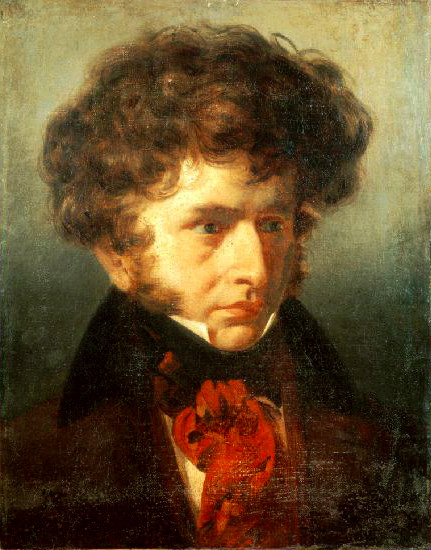
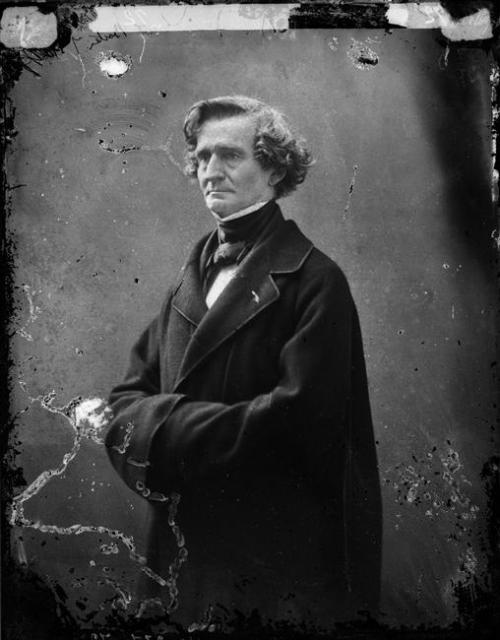
Hector and Me: My relationship with France’s greatest composer

This is a repost of a piece I wrote — oh my God! — over ten years ago, on the bicentennary of the birth of Hector Berlioz. I’m reposting it as prelude to today’s Symphony Saturday post.

In the movie Mr. Holland’s Opus, there is a wonderful scene – one of many – when Mr. Holland’s wife, Iris, is quite upset at her husband’s under-enthusiastic response to her news that she is pregnant with their first child. Mr. Holland, of course, realizes how he’s stepped in it, and he attempts to describe to his tearful wife his feelings about becoming a father. Like everything else in his life, he relates it back to music. What he says is this, in a rough paraphrase:

“When I was a kid I used to go to the record store every day, and the guy there would tell me what to listen to. One day he hands me a John Coltrane album and tells me to go home and listen to it. So I did, and I hated it. I mean, I just hated it. And I hated it so much that I had to listen to it, every day, over and over again, until I figured out why it was that I hated it so much. And while I tried to figure out why I hated it, I finally realized that I loved it. And to this day, I love John Coltrane. (beat) You telling me about our baby was like me coming to love John Coltrane all over again.”

That pretty much sums up my experience with the music of Hector Berlioz.

It was a pretty prosaic introduction, actually: high school band, when I was in ninth grade. We had just performed our fall concert the night before, and now it was time to start on some new pieces for our winter and spring activities. Two pieces of sheet music I’d never seen before turned up that day at rehearsal: something called Le Carnival Romain by a guy named Berlioz, and something called March to the Scaffold, also by this Berlioz fellow. We attempted sight-reading Carnival for most of the rehearsal, but since we were a high school band we had to take it incredibly slow at first, and as anyone who’s heard the piece will attest, most of it is a spirited vivace. Not the best way to make my acquaintance with Berlioz.

But then, the next day – that was when we started digging into March to the Scaffold.

So it’s a March, I can tell. That means a pretty brisk tempo, right? That’s what I expected, Mr. Young Band Student, after a steady diet of Sousa and K.L. King and “Entry of the Gladiators” and whatnot. But not this piece. It starts out with muffled drum sextuplets, which are answered by this weird syncopated figure in the low woodwinds. (No high school bandmember likes the sound of low woodwinds. Take it from a member of the trumpet section who used to join his brassplaying mates in inventing euphemisms for the low woodwinds that frequently involved metaphoric flatulent bovines. Luckily, I would later realize that those instruments do wonderful things. Like, say, the opening bars of March to the Scaffold.)

The piece went on, getting louder in places and having strange and sudden bursts of loudness from the brass – always fun – and then, at long last, a wonderful marching melody for the trumpets and the rest of the brass. (We trumpet players pretty much define the membership of any ensemble as “the trumpets and the rest of the instruments”.) Now I was a bit happier; after some weird and jocular opening stuff we get to the “meat” of the March, and everything would be fine.

Except after that melody ends (it’s stated twice, unless you observe the repeat which we did not), well, the March gets even weirder. The glorious brass melody is replaced with snarling, biting brass figures, the woodwinds scream, the rhythms become more insistent and driving, the guy behind me on the timpani starts pounding away, everything builds and builds and builds, and it gets crazier – until everything stops, and there’s this tiny wisp of melody on a solo clarinet. This is cut savagely short two bars later by a resounding whack by the whole group, some descending woodwind notes, and then a series of fortissimo chords ending the whole thing.

It was all very weird, and I didn’t understand any of it. The piece made no sense.

Well, we rehearsed that damned thing for a few days before the band director decided to reject it in favor of something else. At some point he let us in on the fact that the March to the Scaffold actually is a piece of program music. The story is simple: a guy is being “marched” to the scaffold where the guillotine awaits. He’s going to his execution; hence the dark beginnings and the frenetic stuff in the second half. And that bit of clarinet melody at the end? That’s the guy thinking of his lover one last time before the blade drops. Whack!

So, I thought, “OK, it’s interesting. Big whoop. At least I’ll never have to play that weird stuff again.”

A few months pass, and I’m in a record store thumbing through the budget-priced cassettes. Something strikes me: a cassette with this Berlioz fellow’s name on it. Picking it up, I see that it’s a recording of something called Symphonie fantastique; and perusing the back of the thing, I see that the fourth movement of this symphony is none other than the March to the Scaffold. Intrigued, and made adventurous by the $3.99 price tag (I’m a lot more likely to be musically adventurous when the recording is cheap), I bought the thing and took it home. I played the tape a few times, mainly just skipping right to that March just so I could hear the way the orchestra’s supposed to sound, and not a band arrangement (although it must be said that a lot of fine work gets done in band transcriptions). I had to admit, the March to the Scaffold was quite a bit more effective in its intended medium.

But I still didn’t like it.

Skip ahead a month or two when, on a lazy day, I happened to ask my band director a few questions about how to read a full score. He responds by handing me a book and telling me to figure it out on my own. The book is, I see, entitled The Symphony, 1800-1880, and opening it, I find that it is nothing more than eight or nine symphonies, each by a different composer, in the full orchestral score. Every part, from the flutes down to the double basses and including all the percussion, is laid out side-by-side. Here, I see, are the composers’ secrets: Beethoven’s Eroica, Mendelssohn’s Italian, Brahms’s Third (which, sad to say, is the only one of Brahms’s four symphonies that I’ve never liked), and…the Symphonie fantastique by Hector Berlioz.

I couldn’t wait to get home. In went the tape, onto my lap went the book, and I started following along. I kept up well through the first movement’s slow, dreamy opening, but I got lost a few times during the subsequent allegro. And then, about the third time I heard the main melody of that first movement, I realized that this was the melody that that single clarinet is quoting at the very end of the March to the Scaffold. And that same melody turns up in the second movement, a lilting waltz; and in the third movement, a ravishing pastoral slow movement; and in the last movement, which is titled “The Witches’ Sabbath”!

It wasn’t just the March to the Scaffold that was telling a story, I realized: the whole symphony is telling a story.

And as I taught myself how to read a score, by following along with the Symphonie fantastique, I became entranced and enchanted with the things this Berlioz does with the orchestra. Why use the flutes to double the melody in the violins? Well, it doesn’t sound the same, does it? Makes it more “dreamy”….and when he restates the waltz theme in the second movement, he uses a harp for the waltz rhythm and the woodwinds for the melody…and an part for solo cornet…and that opening of the third movement! Depicting the shepherds of the hills with an English horn and an offstage oboe answering it! Depicting a thunderstorm in a slow movement!…and a demonic dance of the witches, complete with the Dies Irae and that weird sound by having the violins turn their bows over and slap the wooden bow against the strings!

Over time, I realized that it didn’t really matter what the story of the Symphonie was; even then I had started being skeptical about music and its ability to “depict” anything concrete. What was more important is that I hated Berlioz, and then it was as if the Fates conspired to force me to re-evaluate him. And I did. Did I ever. I sought out other works by Berlioz, and then I read more about his life.

That was when I was hooked.

I have always thought that I would have been most comfortable in the Romantic era, and in the life of Berlioz I found proof. Here was a man of powerful appetites and desires: a man who fell in love with an actress when he saw her onstage in Hamlet, and he fell so completely that he ended up writing the Symphonie fantastique in her honor. (And could it be any surprise that, when he finally managed to marry her, it did not turn out well?) Here was a man who refused to adhere to the forms of his day: only one of his four Symphonies has the traditional four movements, and that one is heavily programatic with extensive use of a solo viola; he never wrote a concerto; he invented whole new groupings of instruments; for his Requiem he supplemented his full orchestra with four brass bands placed at the ordinal compass points in the Cathedral. Here was a man whose greatest literary loves were Shakespeare and Virgil, and here was a man whose music to this day has never been as appreciated within his homeland of France as outside it. Here was a man whose greatest work, Les Troyens, was never performed in his lifetime. Here was a man who viewed art in such stark terms that Schumann said of him: “Berlioz does not try to be pleasing and elegant. What he hates, he grasps fiercely by the hair; what he loves, he almost crushes in his fervor.” That sounds familiar to me. I have myself been accused of going overboard in praise for things I admire, and going equally overboard in my attacks on things I dislike. But in this I have had good company, n’est ce pas?

How keenly I remember my disappointment when I watched the remarkable film Impressions de France at Disney World’s Epcot, a thirty-minute travelogue of stunning French scenery scored with great French classical music – but not a single note of Berlioz! And how proud I was to have a scene in a Star Trek movie when Riker enters Picard’s quarters and finds the Captain listening to blazing, fiery operatic music. “Bizet?” Riker asks. “Berlioz,” answers Picard. In moments like these I realize that I take Berlioz personally. His music is my music, and if much of the world does not share that opinion, what of it? I, in admiring Berlioz, stand in the company of Wagner and Liszt. Pretty good company, that.

Ultimately, I think that every thoughtful person has that “tortured artist” whom they love dearly. For some it’s Jim Morrison, or maybe John Lennon. Some respond to Sylvia Plath; others are moved by the sufferings of Van Gogh or Mozart. I think that if we’re lucky enough to find someone who suffered for their art in much the same way that we see ourselves suffering (even if not nearly so dramatically), and we find them at the right time, the tumblers can somehow fall into place and something deep within our soul is unlocked. It’s ours forever — truly ours, in that sense that even when we find someone else who claims to love what we love, we’re skeptical. Nobody loves Berlioz the way I love Berlioz.

And so be it.

Share This Post

Symphony Saturday

Beethoven’s Symphony No. 7.

There’s honestly not a great deal I can say about this work that hasn’t been said before and better. It’s one of the towering masterworks of all of music, and likely of all human art. The Seventh is that extraordinary. In this work you encounter the type of perfection that makes you marvel the notion that it emerged from a human mind at all.

Setting aside all that, Beethoven here crafts a work that seems to contain nearly every human emotion in its pages, with the gorgeous meditation that opens the work, the profound depth of the second movement, and the last two movements that abound in dance rhythms. Beethoven’s Seventh Symphony is one of those works of art to which I turn when I am feeling generally down about the human race. We have the capacity to do this, why not better?

My very favorite passage comes early in the first movement (3:30 in the first movement), and may well be the single finest transitional passage in all of classical music. The orchestra seems, just for a second or two, to be bogging down in bar after bar of dueling scales, when they all seem to get stuck on the same note, handing it back an forth between the flutes and the violins. A rhythm haltingly emerges…and then takes over as Beethoven slides into a melody of pure delight.

And amazing, he does it again, this time letting that same rhythm come boiling up and out of the orchestra’s depths (start at 7:30). Beethoven is so good at building up to something, isn’t he? You can always feel his energy gathering. There’s no mistaking with him, none at all, that something is coming.

Here’s the Seventh.


Is the Seventh Beethoven’s greatest symphony? Now that’s an interesting question. I discussed this once with someone on a Usenet group, and the case in the Seventh’s favor is extremely compelling. Next week, we’ll wrap up Beethoven with the other contender to the title of Greatest Beethoven Symphony.

Share This Post