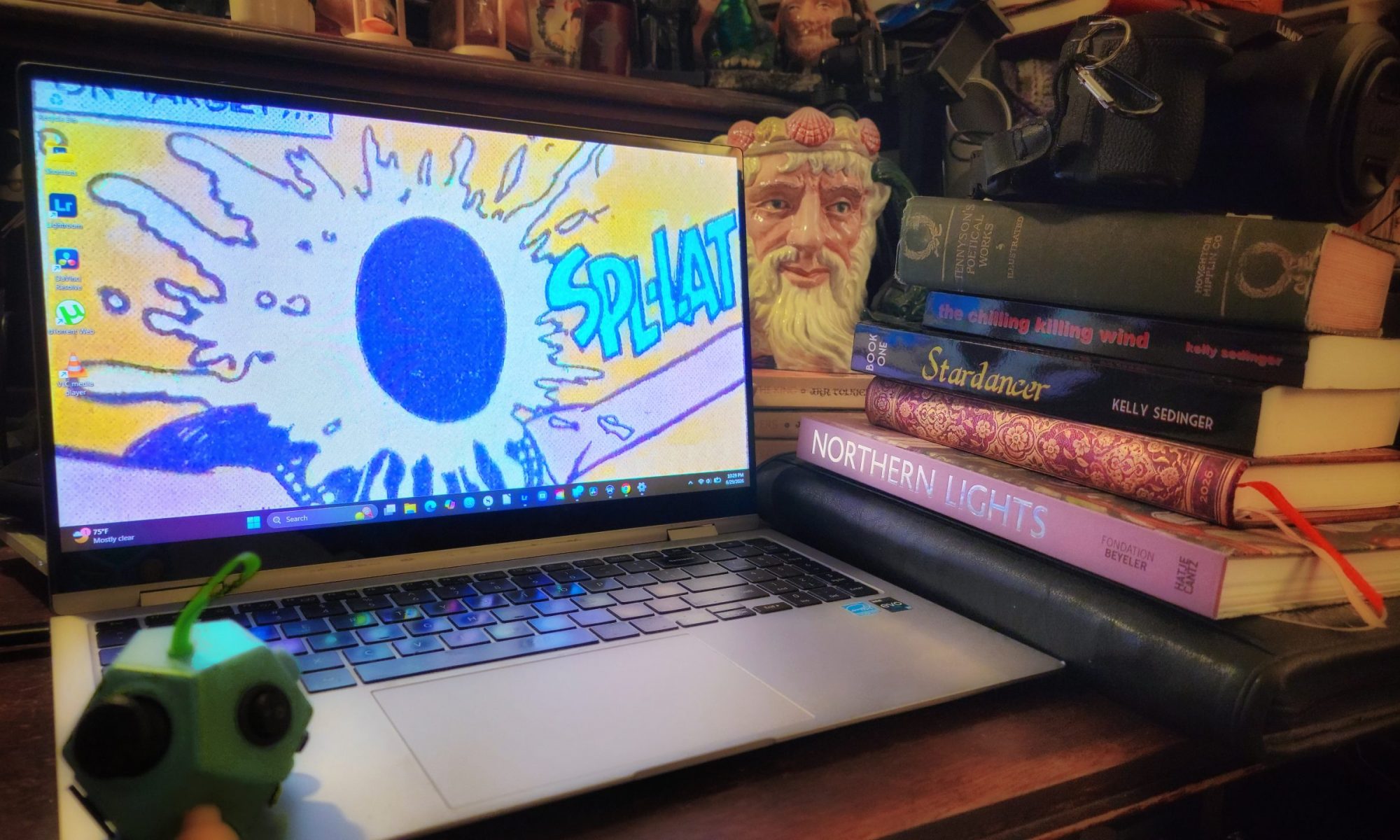
This is a repost from a couple of years ago. I chose to repost this, about a book by astronomer Sara Seager, because it has lodged in my brain since I read it.
I generally try to avoid reading grief memoirs, for various reasons that mainly boil down to…well, I’ve had enough grief in my life already and I know that more is on the way someday*, and it’s a subject I don’t much enjoy plumbing any more than I have to. But sometimes I find a grief memoir that piques my interest and I read it anyway. Smallest Lights is such a book, and I am very glad that I read it. It’s so much more than a grief memoir, really. It’s about science and love and life and death and love again and parenthood and dealing with autism.

It’s also beautifully written.
Not every planet has a star. Some aren’t part of a solar system. They are alone. We call them rogue planets.
Because rogue planets aren’t the subjects of stars, they aren’t anchored in space. They don’t orbit. Rogue planets wander, drifting in the current of an endless ocean. They have neither the light nor the heat that stars provide. We know of one rogue planet, PSO J318.5-22–right now, it’s up there, it’s out there–lurching across the galaxy like a rudderless ship, wrapped in perpetual darkness. Its surface is swept by constant storms. It likely rains on PSO J318.5-22, but it wouldn’t rain water there. Its black skies would more likely unleash bands of molten iron.
It can be hard to picture, a planet where it rains liquid metal in the dark, but rogue planets aren’t science fiction. We haven’t imagined them or dreamed them. Astrophysicists like me have found them. They are real places on our celestial maps. There might be thousands of billions of more conventional exoplanets–planets that orbit stars other than the sun–in the Milky Way alone, circling our galaxy’s hundreds of billions of stars. But amid that nearly infinite, perfect order, in the emptiness between countless pushes and pulls, there are also the lost ones: rogue planets. PSO J318.5-22 is as real as Earth.
There were days when I woke up and couldn’t see much difference between there and here.
Sara Seager is an astrophysicist at MIT whose main body of work involves exoplanets, their discovery around other stars, and analyzing them for signs of life. Among other things, if you wonder how on Earth (literally!) we can look for life on planets lightyears away that nobody in our lifetime (or, likely, in our great-grandchildrens’ lifetimes) will ever see directly, this book will give you some hints as to how that search is currently going. (It involves ingenious analysis of light coming from those planets. It really is amazing, when you think about it, the degree to which light energy is the main carrier of information in this universe of ours.)
In her book, Seager discusses her own work and the degree to which her work has shaped her personal life, and how her personal life has shaped her work in return. Her first husband was a man of considerable energy, whom she met on a canoeing trip; their courtship progressed on more canoeing trips all over the place. But he developed cancer, which eventually killed him at a terribly and unfairly young age. Thus this brilliant astrophysicist, whose work is an important part of the current growth of human knowledge of our universe, finds herself a single parent attending meetings of the local widow’s club, figuring out the nature of this new world she’s been thrust into. It’s the cruelest of ironies, I suppose, that this woman whose life’s work is understanding the universe and seeking other worlds suddenly finds herself in a new world, one that’s familiar to people who have known deep grief, where everything is the same and yet everything is deeply different.
Throughout Seager’s book, I found myself frequently hit in the heart by some of her observations:
:: Everybody dies instantly. It’s the dying that happens either quickly or over a long period of time. Mike spent a long time dying: eighteen months separated his diagnosis and his death.
:: There have been lessons I have chosen not to teach. Not all knowledge is power; not all things are worth knowing. Max and Alex [her sons] never saw Mike’s body. They did not see him leave the house.
:: [On the Widow’s club] All of our children had become friends. They didn’t gather because their fathers had died; they gathered because it was fun. There is a reason every children’s book is written from the perspective of the child. Children don’t care about adult concerns. We think of children as helpless when they are the embodiment of resilience, more impervious to outside forces than we could ever be again. Despite their suffering, our kids still knew pure joy.
:: Sometimes you need darkness to see. Sometimes you need light.
:: I don’t think it’s an accident that there’s a mirror at the heart of every telescope. If we want to find another Earth, that means we want to find another us. We think we’re worth knowing. We want to be a light in somebody else’s sky. And so long as we keep looking for each other, we will never be alone.
I love that last one (which actually closes the book, so apologies for the ‘spoiler’). Seager casts loneliness not in terms of presence but in terms of action: we’re only truly lonely when we accept that we are alone and stop seeking others to enrich our lives. True loneliness, really being alone, comes of a permanent turning inward, of looking down and not up. And really, how else would someone who loves the stars see things?
The Smallest Lights in the Universe is a wonderful book that stands in stark contrast, it seems to me, to the view of science as cold and mechanical and mathematical, an enterprise that somehow forgets about emotion and wonder. No less a genius than Walt Whitman expressed this view, in “When I Heard the Learn’d Astronomer”. But the numbers and the proofs surely don’t have to get in the way of the wonder; rather they inform it and give it focus. Science is not an impediment to love and life. Science is a part of those things. Sara Seager’s book shows us how.
Share This Post