Launch

What an amazing photo:

An external high-definition camera on the International Space Station captured the launch plume of the SpaceX Falcon Heavy rocket after it had ascended to Earth orbit following its liftoff on Sunday, Jan. 15, 2023, from NASA’s Kennedy Space Center in Florida. The space station was flying 262 miles above the Atlantic Ocean just after an orbital sunset at the time of this photograph.

Via.


Share This Post

The Snowflake Cluster

I saw this photo the other day on the NASA Marshall Space Flight Center’s Flickr stream, and my jaw dropped:

What is this? Here:

Newborn stars, hidden behind thick dust, are revealed in this image of a section of the so-called Christmas Tree Cluster from NASA’s Spitzer Space Telescope. The newly revealed infant stars appear as pink and red specks toward the center and appear to have formed in regularly spaced intervals along linear structures in a configuration that resembles the spokes of a wheel or the pattern of a snowflake. Hence, astronomers have nicknamed this the “Snowflake Cluster.”

Star-forming clouds like this one are dynamic and evolving structures. Since the stars trace the straight line pattern of spokes of a wheel, scientists believe that these are newborn stars, or “protostars.” At a mere 100,000 years old, these infant structures have yet to “crawl” away from their location of birth. Over time, the natural drifting motions of each star will break this order, and the snowflake design will be no more.

Our universe will never cease to amaze me with its gigantic and massive beauty.


Share This Post

“Sokath, his eyes uncovered!”

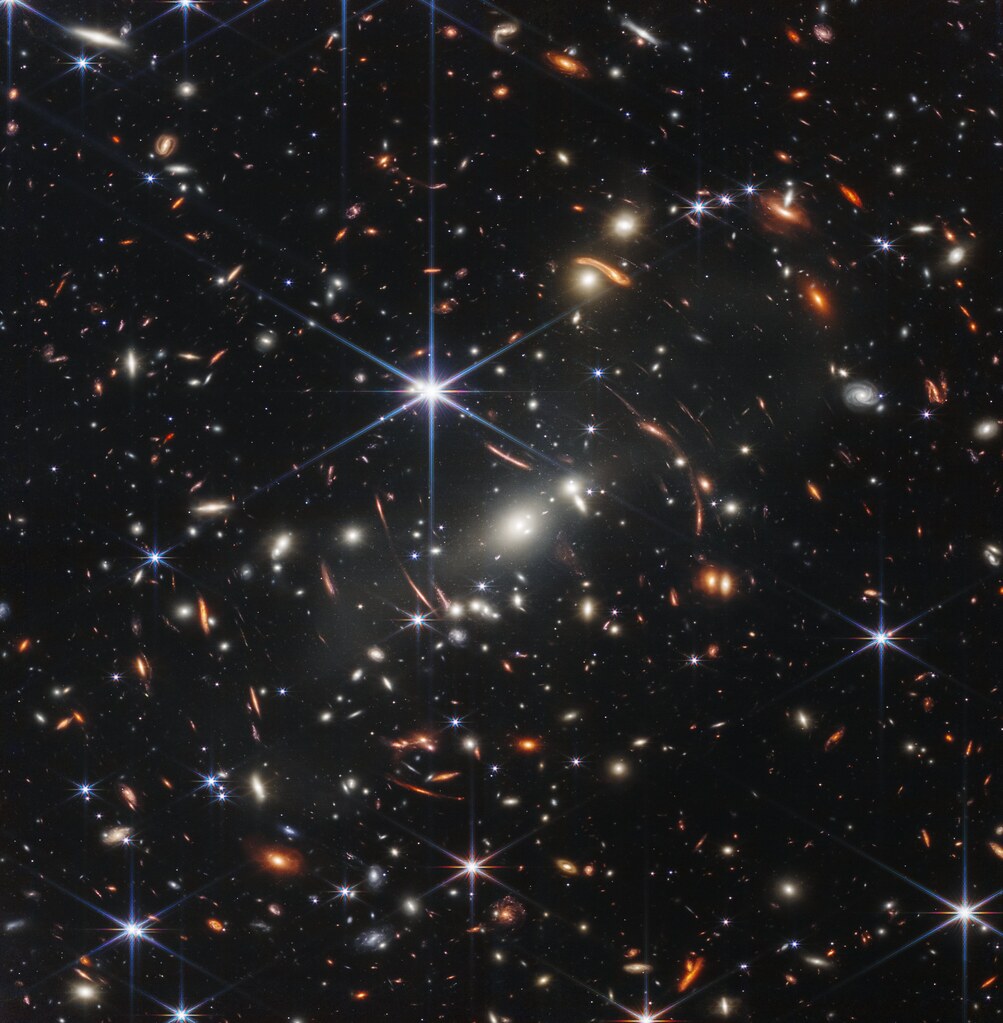
The James Webb Space Telescope has returned its first imagery, and a teaser image was released today:

The field of vision here is the size of a grain of sand held at arm’s length. That absolutely astonishes me. Also, the visible “warping” effect, like a partial fish-eye lens, is because the galaxy cluster seen here acts as a “gravitational lens”, bending the light waves that have been traversing the Cosmos for billions of years.

More, so much more, to come. Webb is one of the most exciting things I can remember, and I’m so glad that even in times as dark as these humans haven’t shut down the quest for wonder and knowledge. Darkness doesn’t last, but science and knowledge do!

(image credit)


Share This Post

Tab Closing Day

Time to close out some tabs I’ve had open for a while:

::  The Future Republicans Want

A look at the unbelievably fascist document that is the official platform of the Texas Republican Party:

The fundamentalist religious fervor perhaps extends most strongly to gay rights and others of alternative sexual lifestyles. The platform directly declares that “Homosexuality is an abnormal lifestyle choice” and that “We oppose all efforts to validate transgender identity.” §§ 143–144 (p. 21). The Republican platform seeks to ban gay marriage.

And that’s just one example of the awfulness therein.

::  The Message of the Republican Party: Don’t Tread On Me, I Tread On You.

The press does not want to have a direct conversation with you about what’s really at the heart of Republican messaging. As a former Republican who now consistently votes for the Democratic Party in US elections, I will. When I came to realize what the true message of the Republican Party was, I was out, and have been voting Democratic ever since.

Here is the Republican message on everything of importance:

  1. They can tell people what to do.
  2. You cannot tell them what to do.

This often gets mistaken for hypocrisy, there’s an additional layer of complexity to this (we will discuss this later in the piece), but this is the basic formula.

::  Dear Republicans: We Tried Your Way and It Does Not Work

By 1982 America was agog at the “new ideas” this newly-invented GOP was putting forward. They included radical tax cuts, pollution deregulation, destroying unions, and slashing the support services the New Deal and Great Society once offered people (because, Republicans said, feeding, educating, or providing healthcare to people made them dependent).

Their sales pitch was effective, and we’ve now had 42 years of the so-called Reagan Revolution.

It’s time to simply say out loud that it hasn’t worked.

::  Bill Altreuter, a Buffalo trial lawyer, on the Supreme Court:

I don’t see the path out. Even if we were able to pack the Courts with jurists who believe in now outdated concepts like stare decisis all that would mean would be that we would be acknowledging that the Supreme Court is an unelected super-legislature. It actually always has been, but before this there were recognized limits on how far the Court could go. That’s gone now.

Increasingly we’re in a place where the only way to really fix things is to blow it all up and start over with an all-new Constitution, and when you consider how the one we have was a messy document full of compromises and good-enough’s that none of the rich white men who wrote it even liked very much, well, what are our chances of getting it right?

::  Roger’s thoughts on Independence Day are not much rosier than my own.

::  ‘An old strain of English magic had returned’: stars on why they fell in love with Kate Bush

This has been an interesting phenomenon to watch unfold the last month or so: a song by 80s singer Kate Bush featured prominently in an episode of the new season of Stranger Things, which has in turn led to an enormous resurgence of interest in Bush herself. The Internet and social media have exploded with discussions of Bush and her songs. I am always happy to see older cultural material get another crack at the limelight; we are too focused on the new-and-shiny as a culture, and it depresses me that lots of good things disappear if they don’t have their Big Moment quickly enough when they’re new.

In my particular case this is helpful because somehow I managed to completely miss Kate Bush in the 80s. I have no memory of her music at all, none whatsoever. I don’t know how this came to happen, but I have a few suspicions, and it had to do with (a) the music I was consuming in 1985 or so, and (b) how I was consuming it. I liked rock and pop a great deal back then! I spent too many hours in front of MTV, and I owned a lot of rock and pop records. But even so, most of my music listening around that point focused strongly on classical, and that didn’t let up until…well, it hasn’t, actually, though I’ve added other genres along the way.

My consumption of rock and pop had nothing at all to do with the usual way of hearing such music, the radio; in the Southern Tier there wasn’t all that much radio at all other than what was powerful enough to reach that far from Buffalo, and when we were driving around, my father asserted the “Driver chooses the music!” rule, which meant country music a lot of the time. So as far as pop and rock went, if I didn’t hear them on MTV, I didn’t hear them at all. I don’t know if Kate Bush made music videos, but I don’t recall seeing them much, if she did.

And that just means I have something new to explore!

::  Meet Jillian Hanesworth, Buffalo’s new–and first ever–poet laureate!

::  And finally, fireworks…in space!!!

Not fireworks, actually:

Since July 4th is a time when many enjoy fireworks, here is this image of a supernova that looks a lot like a fireworks explosion. Explosions of actual stars are a focus for scientists who hope to better understand their births, lives, and deaths and how they interact with their surroundings. Using NASA’s Chandra X-ray Observatory in 2015, astronomers have studied one particular explosion that may provide clues to the dynamics of other, much larger stellar eruptions. This is an image of GK Persei, an object that became a sensation in the astronomical world in 1901 when it suddenly appeared as one of the brightest stars in the sky for a few days.

Amazing!


Share This Post
On Dams

While on my lunch break the other day, I watched this short film about dam removal on streams in the Hudson River watershed. Fascinating film, with amazing photography (well-worth watching in full-screen HD). Were there a place I could say my soul resided, it would likely be alongside one of the forest streams of America’s Northeast.


Share This Post

WHAT IS TAKING SO LONG!!!

The very first alignment images from the James Webb Space Telescope are coming back:

From the Marshall Space Flight Center’s Flickr page:

On March 11, the Webb team completed the stage of alignment known as “fine phasing.” At this key stage in the commissioning of Webb’s Optical Telescope Element, every optical parameter that has been checked and tested is performing at, or above, expectations. The team also found no critical issues and no measurable contamination or blockages to Webb’s optical path. The observatory is able to successfully gather light from distant objects and deliver it to its instruments without issue.

Although there are months to go before Webb ultimately delivers its new view of the cosmos, achieving this milestone means the team is confident that Webb’s first-of-its-kind optical system is working as well as possible.

Months to go? Sigh!

This is going to out-Hubble the Hubble, but still…the waiting!


Share This Post

An item of local geography

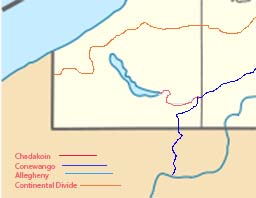
A good marker of being an adult is when you find yourself regretting the lack of attention you paid in one class or another in grade school. In my case, sometimes it’s Earth Science, and I really did pay quite a bit of attention in that class! But geology was never really my thing, so I just kinda got through it. And now, I notice things about the world and I wonder how they got to be that way. Here’s a good case in point from my neck of the woods. This image (screen-captured from Google Maps, thanks, Google) is Chautauqua Lake in Western New York’s Chautauqua County.

Chautauqua Lake is a big lake, about seventeen miles long and two miles wide at its greatest width. Like the Finger Lakes, it was formed by glacier activity, but the glacier activity that formed Chautauqua Lake was actually different than what formed the Finger Lakes, so Chautauqua is not considered a Finger Lake for this reason. (Plus it’s a hundred miles away from the nearest Finger Lake and it faces the wrong direction!)

You can see that right in the middle it narrows to a really short distance, which used to be the only car crossing on the lake, by ferry. We rode that ferry a lot when I was a kid, but quite soon after we got here the lake was spanned by a bridge for what was then NY17, the Southern Tier Expressway, but which is now Interstate 86. Chautauqua Lake is a very popular resort lake, with tons of recreational uses of its waters and lots of cool stuff in the towns surrounding it.

In the picture you can see Lake Erie to the northwest, less than ten miles away. New York is a state of several varied watersheds: the Finger Lakes, for example, all empty into the Lake Ontario watershed (which then feeds the St. Lawrence River to the Atlantic Ocean), and where I live, all streams eventually flow to Lake Erie and then the Niagara River, and so on. Other watersheds further east flow south to the Susquehanna or Delaware Rivers, and thus to the Atlantic; then there are the waters that drain into the Hudson and reach the sea at New York City.

I never really gave it much thought, but I always assumed that Chautauqua Lake emptied into Lake Erie, since it’s so close by; you could walk from Mayville to the Lake Erie shore at Westfield in a couple of hours. It turns out this isn’t the case! There’s a river in Jamestown, NY, called the Chadokoin, which I always thought fed Chautauqua Lake. Turns out the reverse happens: the Chadokoin is the lake’s outflow, and it confluences with another local stream before joining the Allegheny River somewhere south in Pennsylvania. The Allegheny makes a confluence with the Monongahela River in Pittsburgh, famously creating the Ohio River, which then flows southwest to the Mississippi.

Via Wikipedia

It turns out that there is a divide, called the Chautauqua Ridge, that runs roughly east-west just north of Chautauqua Lake. That divide is all that geology needed to divert waters from the Great Lakes just a handful of miles away, to the Gulf of Mexico, over a thousand miles away. If you’re a drop of fresh water, which side of a hill you fall on determines how long your journey is before you reach salt water again. That amazes me.

Share This Post

Starbirth, in progress

I saw this image on one of NASA’s Flickr streams and I had to share it. It’s a Hubble image of a star-forming region called the “Chameleon Cloud Complex”. Look how gorgeous this is!

Here’s some explanation:

The segment in this Hubble composite image, called Chamaeleon Cloud I (Cha I), reveals dusty-dark clouds where stars are forming, dazzling reflection nebulae glowing by the light of bright-blue young stars, and radiant knots called Herbig-Haro objects.

Herbig-Haro objects are bright clumps and arcs of interstellar gas shocked and energized by jets expelled from infant “protostars” in the process of forming. The white-orange cloud at the bottom of the image hosts one of these protostars at its center. Its brilliant white jets of hot gas are ejected in narrow torrents from the protostar’s poles, creating the Herbig-Haro object HH 909A.

More, including the full-resolution image, here.


Share This Post

Godspeed, John Glenn!

(A repost from exactly ten years ago, because today is the SIXTIETH anniversary of John Glenn’s flight on Friendship 7! I’ve fixed a bit of wording and removed a dead link.)

Image credit: NASA

Sixty years ago today, astronaut John Glenn launched in a spacecraft called Friendship 7 and became the first American to orbit the Earth. Here’s a wonderful documentary, assembled by NASA after the mission’s end, detailing the events of Glenn’s mission, from pre-launch preparations to Glenn’s post-splashdown arrival on the aircraft carrier.

I watched this film way back in third grade, when our class was doing a research project on space; I remember Mrs. Grosbeck, our teacher, looking with some dismay at the two giant film reels for this movie and realizing that we’d have to watch it in two installments. (That’s something I recall from watching educational movies in school: seeing the teacher pick up the film reel, and noting its size which would therefore indicate its length. Big film reels, meaning longer films, made us happy. If it was a small one, someone in class would say something like, “Awww, a short one.” Good times!) I’ve looked for this film on YouTube and in other places a few times over the years, and I’m thrilled that it’s finally available. I could watch archival NASA footage for hours. It reminds me that there was a time when you could read about NASA and not see the phrase “budget cuts” in the next sentence.

I love the style of this film — listen to the portentous narration, loaded with patriotic fervor and the clear belief that space exploration is obviously what’s next. “Today, John Glenn and the Mercury team challenged space…and they won!” And while all this goes on, a stirring music score throbs away in the background. A documentary like this would be dismissed today as slavish propaganda, and I suppose, in a way, that it is…but you know what, I just don’t care. Our space program in the 1960s, even though we might wish it was less motivated by a desire to beat the Soviets, was a time of greatness that we achieved because we just plain wanted it. And it saddens me to think that our era of space exploration was so short that a landmark mission, fifty years ago, now seems almost quaint.

Come on, America! Why are we messing around? The stars are awaiting us!

Image credit: NASA


Share This Post