I see at AICN that a sequel or two to Independence Day may be in the works. Such a project has long been rumored; this has been on-again, off-again ever since the original movie came out in 1996 and did lots of business. I actually loved ID4 and I still think it’s just amazingly fun to watch (note to self: show ID4 to the kid), even though its plot doesn’t make one bit of sense, even before Jeff Goldblum defeats the aliens with his Macintosh Powerbook.
Of course, that makes you wonder how the sequel would go:
Jeff pulls out his iPhone and dances his fingers across its touchscreen for all of five seconds. Almost immediately the alien ships start dropping out of the sky like flies.
ALIENS: SSSHHHIIITTT….
But I digress. While reading the news item quoted on AICN, something stood out for me:
IESB has received a tip that Will Smith is now locked for not only Independence Day 2, but also a third installment. The plan would be to shoot both films back-to-back. Whether the studio opts to go the Matrix route and release the two films six months apart or do like the Pirates of the Caribbean sequels and split them by a year remains to be seen. According to our sources, if all goes according to plan, the sequel(s) could shoot as early as 2011.
This would be Emmerich’s next directorial endeavor after his William Shakespeare thriller Anonymous. This would also come after Will Smith’s next (which will be either The City That Sailed or Men in Black 3). So this wouldn’t interfere with those projects.
Did you catch that?
This would be Emmerich’s next directorial endeavor after his William Shakespeare thriller Anonymous. This would also come after Will Smith’s next (which will be either The City That Sailed or Men in Black 3). So this wouldn’t interfere with those projects.
Wait…what? A William Shakespeare thriller? As in, the Bard as some kind of action hero?
I really did. I loved the thing. It hit so many of my sweet spots that I found myself utterly involved in it barely fifteen minutes in. Even with its dialogue that often barely manages to rise above the level of “serviceable”; even with its Cameron-style foreshadowing delivered with all the subtlety of a ball-peen hammer to the forehead; even with its cardboard cut-out villains who have almost no depth, no characterization, and no complexity to their motivations other than money-making and gratuitous warmongering.
I loved it despite those flaws, because Cameron is just such a damned good storyteller that he can usually make big flaws disappear into the background and yes, because the visuals amazed me.
I was going to write a long piece about the movie, but then I decided to just go the “randomly unconnected thought” route. So here are random thoughts about Avatar:
:: Yes, I lost myself in the visuals. The movie was just beautiful to look at. I was awestruck by one shot after another. Especially the tree that has the spores that bob in the air like jellyfish, and the way the ground lights up when the Na’vi walk on it.
:: No, I wasn’t bothered by the word “Unobtanium”. Sure, maybe they should have come up with a name of their own, but really — if they’d done that, no one would remember it as soon as the lights came back on at the end of the movie. And besides, if you look at the names of some of the lab-created elements on the periodic table, some of them are just as goofy: “Californium”, anyone?
:: The movie seems to paint the military with a pretty broad brush, but I think Cameron was trying not to do this, although not terribly successfully. He does make clear that these aren’t actual US military (a point Gregg Easterbrook missed completely when he bitched about the movie on his Tuesday Morning Quarterback column, but I’m not looking for the link right now), by pointing out that they’re hired by whatever corporation hired them and by showing them, in a briefing scene toward the end, as being not all guys in fatigues but also fat guys in crappy T-shirts. But Cameron didn’t do enough to draw this distinction, so his depiction of military, seems kind of damning. (Of course, I’m not sure how fair this perception is, since in the course of the film we only really get to know two military people other than our hero, Jake Sully: the helicopter pilot with a conscience, and the lunatic “Roger Ramjet” who is the main baddie anyway.)
:: The movie is not original in the least degree, except for one idea that never really gets any kind of great SFnal treatment: the notion of the movie’s biosphere as being an enormous information transfer thing. Cameron flirted with a really nifty idea there, in positing that the spiritual “We’re all connected!” thing common to “savages” is an actual physical reality on this planet, but he didn’t take it far enough. That should have been the starting point for an amazing movie, not the ending point. It really is “Dances With Wolves In Space”, but I was fine with that.
:: In talking about the movie in his football columns, Easterbrook (again no links, because I’m lazy) kept referring to the movie as a “cartoon”, thus displaying the commonly held belief that animated movies are inherently lesser works than live-action movies. Easterbrook can suck it.
:: James Horner’s score is OK. There are a couple of big moments when the score takes flight, but for the most part, if you’ve heard Horner a few times, you know what to expect here.
:: Sometimes I really wish James Cameron would hand his script to someone and say, “Can you make this a little more subtle, please?” The movie was awash in the occasional foray into dialogue so clunky it made me laugh (a lot of the warmongering military talk fell in this vein), and as usual, Cameron sure likes to beat us over the head with foreshadowing. “Wow, that body-suit weapon thing looks cool! I sure hope someone goes mano a mano with that guy in that suit!” “So, you say that there’s this one flying beastie whom nobody’s ever been able to ride? Interesting….” “You can theoretically transfer everything from one brain to another? That may come in useful….”
:: For the most part, Avatar is…well, it’s a movie. I liked it a lot. I had a great time watching it. It entertained me. I don’t see it as some kind of magnificent game-changer, though. Visually it raises the bar. Story-wise, it’s just good.
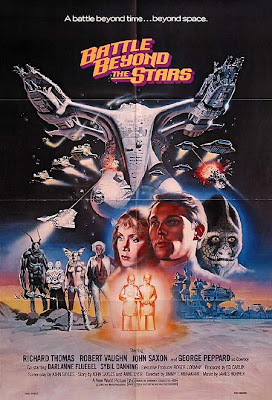
Remember my post a short while ago about the goofy 1980 B-movie space western Battle Beyond the Stars? I just figured that post represented a pleasant trip down geek memory lane for me and maybe a few others who recalled that obscure film. I certainly never figured that Battle was any kind of going concern.
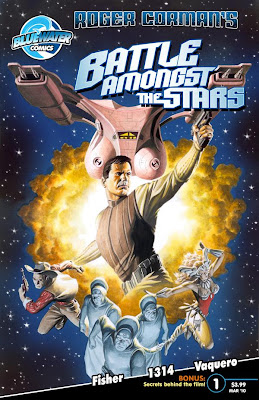
Well, guess what: Battle actually is a going concern. It’s being revisited, in the form of a prequel comic book!
I am so going to read this.
Details here. The world needs more space opera comic books!
Battle Beyond the Stars is a movie that seems to confound expectations. If you watch it expecting a good movie, you’ll be disappointed. But on the other hand, if you watch it expecting a bad movie, you may be disappointed in the other direction.
Battle came out in 1980, one of a string of flicks to come out in the years after something happened in 1977 to suddenly make the entertainment industry think that there was a market out there for science fiction, especially in the form of explodey-spaceshippy-goodness. Battle was produced by Roger Corman, the king of the low-budget movie who nevertheless also served as a talent scout for later Hollywood geniuses, the most notable being a special effects artist who designed the spaceships for this movie and who later went on to bigger things. His name? James Cameron.
I saw Battle when I was in fourth grade. It was part of a double feature at the local movie house, the first film being a flick called Starcrash. I’ve never seen Starcrash since, although I do have a downloaded copy on one of my hard drives. Starcrash is legendary for being a bad movie, although I recall liking it when I saw it. Battle was the main event of the feature, though, and I was really looking forward to it, mainly because the nine-year-old me had thought that this trailer just looked awesome:
That trailer had run on a bunch of movies leading up to the release of Battle so I was really stoked when it came out. And when I saw it? Well, I was nine. I loved it. It had aliens and spaceships and lasers and things exploding and a cute girl. I got the soundtrack album, featuring music by a composer named James Horner, and I played that album a lot over the years, wearing it out and grooving to what I thought was the best explodey-spaceshippy movie music I’d heard outside of a Star Wars film. (Of course, my sample size was very small, I didn’t know film music enough to hear Horner’s huge debt to Jerry Goldsmith in the score, and I didn’t know enough about orchestration or performance to recognize a score that was recorded on a shoestring budget and which featured some really bad orchestrations, such as the track “Cowboy and the Jackers” which does things to the trumpet section that may be in violation of several international treaties.)
I saw Battle once more when it showed up on network teevee a few years later, and still liked it, and then I didn’t see it again for many years. I may have caught it in a cable broadcast sometime in the 1990s, but I’m not sure. I didn’t see it again in its entirety until just last week. How does it hold up? Well, movies like this don’t really “hold up” – that’s the wrong way to look at them. I had no illusions that it was some unheralded gem of SF moviemaking, but I was pleasantly surprised that it’s not that bad, either.
So, what about Battle Beyond the Stars, anyway? What’s it about? It’s very simple: The Magnificent Seven in space. That’s it. Literally.
We open with a giant enemy ship traveling through space (at a very slow pace, even though it has six enormous thrusters that are constantly firing).
The ship is ruled by our villain, Sador of the Malmori. Who are the Malmori? Are they a race of aliens? An empire? A family? We’re never told. Anyway, his ship approaches a planet called Akyyr (that’s how I’m spelling it, anyway), which, seeing that it is inhabited by peaceloving folk who only own one spaceship (which is a weather station), decides that he’s going to conquer it. So he hovers his enormous ship over them, projects his enormous face over their heads, and says, “I have come to conquer you.” (This he does after destroying the weather ship, just because he’s evil. The weather ship had been occupied by two guys who display the Akyyrian attitude by greeting an enormous and malevolent-looking spaceship by grinning, saying “Look! Visitors!”, and then contacting it by asking, “Could you identify yourself, please?”)
Anyway, Sador gives the Akyyrians seven days (“risings of your red giant”) before he’ll come back and finish conquering them. Why the delay? Who knows, but it gives the Akyyrians time to send one of their local young men, a boy named Shad (played by Richard Thomas as John-Boy Walton in space), off in the other ship they own, the secret one once piloted by the old blind guy who used to be an adventurer, to round up some help in the form of mercenaries.
The ship Shad flies is probably the single most famous thing from Battle Beyond the Stars. The ship is simply named “Nell”, and sure enough, it’s run by a computer by that name who speaks with the voice of a cranky lady. What’s most memorable about the ship, though, isn’t her personality; it’s her shape:
This ship is one of the more famed B-movie spaceships in movie history. You know you’re talking to a knowledgeable geek when the mention of the movie Battle Beyond the Stars draws the rejoinder, “Oh yeah, the movie with the ship that’s shaped like a pair of breasts!” The ship is more than that, though – it looks like a feline body with female breasts and then a couple of wings where the ship’s guns are, which sweep up and out, spread out to look like…well, it’s a very feminine ship. (And it was designed by a young filmmaker who was cutting his chops with Corman’s production crew, the afore-mentioned James Cameron.)
Anyway, Shad goes off in search of mercenaries he can hire to fight off Sador. On the way he meets a taciturn fellow named Gelt (Robert Vaughn), who only wants a meal and a place to hide from the apparent galaxy’s worth of folks who are after him:
He meets a ship commanded by a group of aliens who have third eyes on their foreheads and who use telepathy to do stuff:
He meets a “Warrior Valkyrie” named “St. Exmin”, played by Sybil Danning:
Given that her screentime involves her looking like this, it’s almost a crime that Danning doesn’t get more of it. She does, however, have one of the goofiest lines in movie history, and boy, does she deliver the hell out of it:
The other girl there is Nanelia (Darlanne Fluegel), who is every bit as naïve about people as Shad is, which makes her a perfect fit for him. She, too, gets far too little screentime, because she’s really cute. I remember her being one of the first females onscreen to impress me with her cuteness. I mean, look how cute she is in that clip, when she giggles at the prospect of learning how to “tingle, tangle, prangle” her new love interest from this warrior in the goofy headdress! Yeah, Nanelia is really, really cute:
Most memorable, probably, is the Space Cowboy Shad recruits who goes by the name “Space Cowboy”, played by George Peppard:
Cowboy is an arms runner who ends up leading the Akyyrian planet defense with the weapons he’d been running to a planet that Sador has just wiped out. Cowboy is extremely cool, although it’s hard not to expect him to grin and say, “I love it when a plan comes together!” But he does have one of the niftiest gadgets I’ve ever seen in a skiffy movie: he has a gizmo on his belt that dispenses Scotch and ice. (Why a Space Cowboy is drinking Scotch and not bourbon is never explained.)
And there are some aliens who are basically actors in rubber suits. You know how it is. Anyway, a big battle ensues (the Battle beyond the stars!), in which quite a few of the recruited mercenaries die heroically before Shad and Nanelia finally figure out how to do Sador in. I know, I just spoiled the movie, but what of it? Who would watch a movie like this and even consider the possibility of a bummer ending?
The clip above aside, there’s some witty stuff in the course of the flick, and one nicely done moment after Gelt (Robert Vaughn) dies, involving Shad’s bargain with him (a meal and a place to hide). There are also some exceedingly goofy moments, and like all B-movies, some of the stuff that happens isn’t explained very well at all (such as a scene in which the telepathic-collective aliens make their own stealth attack on Sador that involves sacrificing one of their own and a transplant of arms, believe it or not).
Of course, we have to have a romance between Shad and Nanelia, and it’s your typical awkward stuff (“Do they have kissing on your planet?”), but at the end, when victory has been won and all that are left are our hero and heroine returning to Akyyr, instead of ending with some neat dialog and some delightful snogging, we get Shad quoting at length from the “Varda”, the sacred text that the denizens of Akyyr are constantly quoting throughout the film. Weird stuff – the kid should be finally taking his big step into manhood, and instead he wants to recite from the holy book of a pacifist planet that sounds like The Art of War.
Battle Beyond the Stars is not a good movie. Nor is it a bad one. If you’re attuned to it and willing to go where it wants to go, it’s a fun little flick, if you’re into movies where the villain who is trying to conquer the planet Akyyr gets to shout in triumph at the end, shortly before his unimagined demise, “Akyyr is mine!”, followed by leading his entire bridge crew in sinister bad-guy-who’s-just-won-the-lottery laughter.
In other words, it’s the kind of movie that can only appeal to your inner nine-year-old. And that’s not a bad thing to be, is it?
AICN reports that John Carter of Mars is now shooting. I loved the first book in Edgar Rice Burroughs’s series when I read it some time ago (note to self: read the rest of those books), and I have to admit to being thrilled at the possibility of a good movie springing from that book. We’re talking serious skiffy adventure here, folks — for all the plaudits heaped on so many great SF novels for their forward-looking and insightful delvings into the nature of humanity and our place in the universe and how we deal with our technology and the threats we face from without and within, sometimes I want a story that can be illustrated thusly:
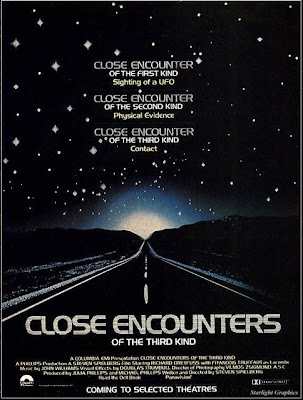
After the Buffalo Bills managed to lose at home to the Cleveland Browns by a score of 6-3, despite holding the Browns to just two completed passes on the day, I decided that I was done watching them for the year and instead instituted a little tradition for The Daughter and I (since The Wife works on Sundays) called “Instead of the Buffalo Bills Theater”. What this basically means is that instead of the Bills game, we watch a movie instead. It’s a lot more fun than watching boring, badly-played football by a team that’s probably not going to be here anymore pretty soon anyway. So, one film we recently watched was an old favorite of mine that I hadn’t seen in a long time, it turns out: Steven Spielberg’s UFO classic Close Encounters of the Third Kind.
Describing the plot probably isn’t necessary, but maybe it is – the movie is over thirty years old, after all. Its opening scenes establish, via subtitle, that the events we’re watching take place in the “Present Day”, although the illusion is harder and harder to maintain, the farther out we get from 1970s-era cars, hairstyles, and architecture. Still, we open rather mysteriously as a bunch of government operatives arrive at a crappy little town – or maybe it’s not even a town – in the middle of a desert in Mexico. Why is this group, led by a Frenchman, here? To investigate just why a group of fighter planes that disappeared in 1945 have shown up there, with no trace of the pilots. (It’s the famous Flight 19, which disappeared without a trace while on patrol over the Caribbean.) A local, an old man who looks as poor as his surroundings, tells the investigators that “The Sun came out last night”, and that it sang to him. He is mysteriously sunburned.
This is the first of a series of very odd events that take place, all around the world: a ship turns up in the middle of the Gobi desert, the entire population of a city in India is singing a series of tones given to them from the sky, series of numbers are broadcast to a radio telescope that seem to be the latitude and longitude for Devil’s Tower, Wyoming. As all this goes on, with the shadowy government people investigating it (just who they are and who they answer to is never really explained, although at one point they’re seen to be driving around in vehicles marked “UN”), two people in Indiana are drawn in via psychological “messages” given to them (and many others, apparently). Electrician Roy Neary is out investigating a power outage when he truck stalls and is flown over by a UFO; single mother Jillian Guiler is awoken to find that her son Barry has run off into the woods after all of his toys have turned on. Both Roy and Jillian become more and more obsessive over time as the visions being implanted in their brains become stronger and stronger. Both of them are put through harrowing experiences: Roy loses his job and his family becomes more and more estranged by his increasingly crazy behavior, with the final straw being when he decides to build an enormous Devil’s Tower sculpture in his own living room, while little Barry, Jillian’s son, is actually abducted by the aliens in what is one of the more harrowing sequences Spielberg has ever directed. (To this day, the scene of Barry’s abduction is scarier to me than anything M. Night Shyamalan has done.)
Eventually Roy and Jillian learn, along with others, that they are actually being called by the aliens, although they don’t know who the aliens are, to Devil’s Tower for the arrival of the Mother Ship, even though they’re still not sure what’s going on and may well be heading into their deaths. (The Devil’s Tower region has been cleared of all people via the news of a train derailment that has spilled thousands of gallons of toxic gas into the air in those parts – or so the government has reported. It turns out that there was no toxic gas and that the livestock in the region was knocked out by the use of a sleep aerosol. One wonders how they’ll explain this once everything’s done – “Our bad, your cows were asleep, but everything’s OK, come on home now” – but one also suspects that once the explanation for just why Devil’s Tower and everything around it had to be cleared out gets made public, the apologies for the sleep gas will be the least important thing going on. I’d love to know what happens after CE3K, but more on that a bit later.
So the mother ship arrives, and turns out to be benign. Everything going on has simply been the aliens’ way of saying “Hello”, and in the end, all the people they’ve “abducted” are returned, including the pilots of Flight 19, little Barry Guiler (who is genuinely sad to see the aliens go), and a bunch of others. But before the aliens leave again, they take someone with them again, this time voluntarily: they choose Roy Neary. His selection and boarding of the ship, as John Williams’s magnificent score quotes “When You Wish Upon a Star”, is the film’s emotional high-water point. The ship leaves, and the credits roll.
I’d be fascinated, though, to know what happens the day after. What happens? I’d assume they can’t keep all this a secret, and that word of the First Contact will get out. So what then? What would the world be like once we know, for all time, that we’re not alone? The film makes no suggestions thereof; neither does the later film Contact, which is content to allow many to believe that the first contact didn’t even happen. And not just the world in general, but what would it be like, being Roy Neary’s wife and learning of what became of him? Learning that he wasn’t crazy, and that it was all part of a plan by these aliens? Her actions (getting increasingly upset with Roy before finally concluding that he’s literally gone crazy and become dangerous enough that she leaves him, taking the kids with her) are entirely reasonable, and while it is to Spielberg’s credit that he doesn’t present her actions as unreasonable, we are left to wonder what it will be like for her to learn that no, Roy wasn’t crazy after all.
Spielberg grew up in a broken household himself, and it is something of a recurrent theme in a lot of his early movies. The family in ET is a broken home; even in Raiders of the Lost Ark, Indiana Jones is shown to be estranged from his father figure, Abner Ravenwood, and is later shown in Last Crusade to be somewhat estranged from his actual father. I read somewhere that Spielberg has admitted that if he were to make CE3K today, he wouldn’t just have Roy Neary go off with the aliens without so much as a farewell to his family or something similar. And yet, Neary’s actions themselves, as presented in the film, aren’t unreasonable either. He doesn’t have the chance to explain anything to his family, because he doesn’t understand any of it, and by the time he does understand it, the time to leave is upon him, if he wishes to take it. On this one level, then, the film’s resolution somehow seems both wrong and right at the same time. It’s an odd thing, really, and only as we watch the film do we realize that we have no real idea at all of what the aliens were about in the first place. Spielberg makes no attempt to explain any of this. Where are they from? Where are they going? When do they plan to bring Roy back? Do they plan to bring Roy back? We never learn one answer to any of these questions, and the reason seems more practical than anything else: the film just doesn’t have room for the answers. There’s no point at which it would make sense for anything to be explained. That fascinates me.
Technically, the film still looks wonderful, even now that it’s more than thirty years old. There are only a few moments that genuinely appear dated – a shot of Ronnie Neary in her “sensible shoes”, a shot of the old-school dashboard radio in Roy Neary’s electricians’ truck – but everything looks natural enough, so it’s generally easy to get into the spell of the film. The effects are amazing, crowned by the mothership, whose arrival is one of the most stunning special effects sequences ever filmed. Now, I’m not one to wax poetic about the model-making era of movie effects or to decry the way things look now that it’s all done with computers, but that doesn’t mean I’m not often amazed by the artistry involved in the great effects spectacles of the past. This is one of them.
CE3K is one of those films that doesn’t get enough recognition for how influential it is. There’s a great deal in its production design, its approach to atmosphere, and even its music that would show up in later efforts like The X-Files and other conspiracy or horror shows and films of the 90s and 2000s. I always take note, of course, of John Williams’s score, which makes heavy use of atonal dissonances throughout but which also gradually moves toward a tonal climax toward the end, and of course, there is the masterful way Williams incorporates the aliens’ musical communication motif into the tableau of his scoring at film’s end. (If ever I start my own Geek version of the Freemasons, our secret handshake will incorporate the musical hand signals from CE3K. Anybody can make the Vulcan salute from Star Trek, but how many people know the hand signals from Close Encounters?)
Remember: this means something. This is important.
I’ve read a couple more space opera novels lately:
:: The Price of the Stars by Debra Doyle and James MacDonald was actually a re-read for me. The first time I read it was almost eight years ago, and I remember liking it but finding it a bit disappointing; it felt, at the time, like a retread of a number of tropes from Star Wars used in the service of a fairly unremarkable plot. Someone else, in the interim (I don’t remember who it was), told me that it was a better book than that, so I decided to give it another go. Glad I did.
Yes, it does present a very comfortable read for someone whose primary fascination with space opera is Star Wars. Our heroes all wield blasters, except for the more mystical warriors who carry a more antiquated weapon (staffs, in this case). Yes, the heroes fly around in a circular-shaped starship that was an ordinary freighter before it was souped up into one of the fastest ships in the galaxy. Yes, we’re in the wake of a galactic war. And so on. But I found the central story (a woman starpilot who has tried to make a life away from her famous family and their political connections is drawn back in when her mother is assassinated and her father charges her with finding out who did it) a lot more interesting this time out than I did the first time.
But this time, I wasn’t as bothered by all that as I was the first time. Maybe it’s that I’ve read a lot more SF in general and space opera in particular since then, or maybe it’s something else, but The Price of the Stars actually is a highly entertaining read. I look forward to continuing the series, called Mageworlds, of which this is the first. The first book is fun and breezy, but it also leaves behind enough questions so as to make for a desire to return to this universe. (Who and what are the Mageworlds, for example?)
:: The Price of the Stars is good old pulpy adventure space opera, but Pandora’s Star by Peter F. Hamilton is what they’re calling “New Space Opera” these days: it’s full to bursting with SF ideas, along with lots of other stuff. Lots of other stuff. Pages upon pages upon pages of other stuff. If The Price of the Stars is a potboiler, Pandora’s Star is an entire kitchen, staffed by a single mad chef of enormous skill.
Pandora’s Star is a doorstop of a book, by an author who likes to produce doorstops. Set in a new universe called the Commonwealth, Hamilton tells a story that begins with a brief flashback to humanity’s first landing on Mars — and then flashes forward several hundred years to an astronomer who is studying a binary star system a thousand light years distant, when, as he is looking at the star through his telescope, the star disappears. An exploratory mission is sent to the star, which turns out to have been completely enclosed — along with its sister star — with an enormous energy field. What’s behind the energy field, and why was the star enclosed? One of these questions is answered, and another is left open for the next book in the duology (Judas Unchained).
Hamilton’s story literally explodes all over the place, on dozens of planets. There are underground political movements that rely on terrorist tactics; there are singularly devoted detectives; there are scientists and starship officers; there are rich families struggling to maintain their power and poorer families looking to gain it; there are aliens who travel the stars simply by walking from one planet to another (yes, that’s what I said); there is a human society where people are regularly “rejuvenated” and where death itself has become rare (and even where dead people can be “rebirthed”), and where, in one of my favorite notions in the book, interstellar travel is conducted not by supralight-drive starship but by trains that simply roll through planet-based wormholes.
Pandora’s Star ends with a wild bang of a cliffhanger, so I’m greatly looking forward to reading the second book. (I’ve already noticed that Judas Unchained has something that Pandora’s Star really could have used: a list of the dramatis personae. Sometimes it gets a bit difficult keeping track of who’s who in Hamilton’s universe, but it’s worth it. This is as entertaining an SF read as I can recall, and a high-water mark in my ongoing space opera obsession.
:: Ron Moore confirms what many have suspected over the years: that the technobabble on Star Trek: The Next Generation was just made up, fill-in-the-blanks type stuff.
“It became the solution to so many plot lines and so many stories,” Moore said. “It was so mechanical that we had science consultants who would just come up with the words for us and we’d just write ‘tech’ in the script. You know, Picard would say ‘Commander La Forge, tech the tech to the warp drive.’ I’m serious. If you look at those scripts, you’ll see that.”
This comes as absolutely no surprise, obviously. The over-reliance on technobabble has always been what keeps me from ranking TNG as high as The Original Series or Deep Space Nine, both of which had much greater emphasis on their characters. TNG was at its best when it used character to its advantage, but so often it felt as if the producers just didn’t trust their characters and their cast to carry the weight fully, which is why we ended up with so many episodes where a problem is discovered, we investigate the problem for a while, and then wait until the last ten minutes when Data or Wesley would come up with the pulse or beam or blast of some kind of particle that would fix the problem with the space-time continuum.
:: That said, I was recently discussing Star Trek ’09 (which is how I now refer to the recent movie, which I discussed some months ago) with a friend at work, who was baffled as to why I had such a hard time buying into the events of the movie when I would cheerfully swallow the idea of, say, the Genesis Device. I thought that a fair question: why did I have such a hard time with the notion of a drop of “red matter” creating a black hole in the middle of a planet, while I would accept the idea of a torpedo the size of a refrigerator converting a dead planet into one with a nice biosphere?
Well, I don’t know, really. Part of it is probably how the ideas are treated. The Genesis Device is constantly referred to as an “experiment” in Trek II and shown as an outright failure in Trek III, for one thing. For another, though, the Genesis Device didn’t come on the heels of a long list of Star Trek doomsday devices, substances, and elements. The Genesis device was a new item, but now, with Trek ’09, I’ve heard a lot more along the way. Trilithium, which can halt the nuclear reactions in a star. The Tox Uthat, which does the same thing. There are many more in that vein. It gets harder and harder for Star Trek to come up with threats like these.
It also hurts the cause of the “Red Matter” when the film in question is chock-full of all manner of SF whoppers. I’ve generally found that I’ll accept something that is clearly bollocks as long as it’s not literally bollocks. That’s another part of why I can accept the Genesis Device: my brain accepts it as a fully fictional item, and I’m fine. But Trek ’09 gives us things like black holes taking one back in time, supernovas that threaten to destroy the entire galaxy, and so on. By the time we get to an explanation of “red matter”, Trek ’09 has, for me, worn out its quota of scientific-implausibility forgiveness.
:: A tiny detail also glared out at me upon re-watching the movie. At one point, Kirk, and the rest of our heroes, are at Starfleet Academy, where he decides to take the Kobayashi Maru test for the third time. In a scene with McCoy, he says he’s taking it “tomorrow”. That night, though, he’s making out with a green-skinned cadet who happens to be Nyota Uhura’s roommate. Uhura comes in and describes a distress call she’s just intercepted from the Klingons, in which an entire Klingon armada has been destroyed by a Romulan ship. OK.
Cut to the next morning, when Kirk is beating the Kobayashi Maru test after reprogramming it. This causes scandal, so there is a full tribunal of, it appears, all of the Starfleet cadets in Kirk’s class. As the tribunal goes on, a distress call from Vulcan comes through, causing Starfleet to mobilize its fleet. Off everyone goes to their ships, with cadets first being assigned to various vessels, then flying to them by shuttle. Some legerdemain on McCoy’s part gets Kirk on board the Enterprise, and after some more stuff surrounding the launch, Kirk listens to the ship’s briefing on what’s happening and realizes that Vulcan is under attack. He races to the bridge to tell Captain Pike what he’s learned…citing the attack on the Klingon fleet as evidence. So far so good…except that he says that the attack happened last night.
Wait a minute.
So, all of the above has happened in one day. Kirk’s reprogramming of the Kobayashi Maru test, his taking of the test, the suspicion and investigation of his possible cheating, the mobilization of Starfleet and the launch of an entire fleet whose crews haven’t even been assigned yet. Yeah, I have trouble with that.
:: I’ve decided that, at long last, I believe the entire Kobayashi Maru test to be complete BS.
We’ve seen the Kobayashi Maru test twice now: in Star Trek II: The Wrath of Khan, and in Star Trek ’09. The idea seems pretty simple: it puts a cadet into a situation from which there is no possibility of a “win”, and thereby tests what the cadets do in a “no-win” situation.
The scenario depicted in both instances is the same: a distress call is received from a damaged ship, the Kobayashi Maru, in the Neutral Zone. It’s illegal to enter the Zone and is seen by Klingons as an act of war, so the cadets have a hard choice: respect the Neutral Zone and allow the Kobayashi Maru to die, or embark on a rescue mission. Both films establish, through dialog, that rescue is impossible, so then the choice becomes fight-or-flee. So the possible resolutions seem to be these: attempt no rescue, attempt a rescue but abandon it as soon as the shooting starts, and attempt a rescue and go down in flames with the ship. Hence the “no-win” scenario.
In Wrath of Khan, Admiral Kirk tells Saavik that the Kobayashi Maru test is a “test of character”, presumably to see how cadets deal with the “no-win scenario”. It’s “facing death”, Kirk says: “How we deal with death is at least as important as how we deal with life”. And later on, when Saavik learns that Kirk actually cheated to beat the test, she replies: “Then you never have faced that situation. Faced death.” I’ve always found that line extremely odd. Kirk hasn’t “faced death”? The guy who stood and watched as Edith Keeler died, who had to kill his own best friend (Gary Mitchell), and so on and so forth? He never “faced death” because he cheated his way out of a fake test? Right.
In Trek ’09, we have the afore-mentioned tribunal after Kirk cheats. Spock tells Kirk that he has failed to grasp the point of the test: it is to ensure that cadets in command situations have “experience fear” and dealt with it in a command situation.
So, the Kobayashi Maru test is, basically, a device to make cadets “face death” and “experience fear”. But the problem is this: by its very nature, the Kobayashi Maru test can do neither of those things.
If you’re a Starfleet cadet taking the Kobayashi Maru test, the problem is this: you know you’re taking a test. How can you “experience fear” or “face death” in any kind of meaningful way when you know that you are not on the bridge of a starship but in a simulator on the planet Earth? You are not facing death when you know that you’re not actually ordering a starship into the Neutral Zone to rescue a ship that doesn’t exist, and you can not be filled with fear — other than the typical kinds of academic fear, such as what will my fellow cadets think of me when I fail this again or how embarrassing will the post-test talk with the professors be — when you know that you’re not facing any kind of real situation.
Basically, the Kobayashi Maru test by its very nature can reveal nothing meaningful about those who take it. It’s an interesting diversion and nothing more. (And really, the only reason they came up with it in the first place was so that Trek II could fake us out at the beginning, since everybody knew that Spock was going to die at the end of the flick — I know that when I saw the movie as a ten-year-old kid, I saw Spock “perish” as the bridge burned after the Klingon attack, and I thought, “Wait, they killed him in the first five minutes?!”)
Interestingly, this kind of test was actually handled in much more convincing fashion in an early episode of The Next Generation, called “Coming of Age”. In this episode, Wesley Crusher is undergoing testing to see if he makes it into Starfleet Academy yet. It’s all typical academic stuff, although there’s something called a “Psych Test”, which is tailored to each student individually based on their psychological profile. The day comes for Wesley’s, and he goes into the room where he’s to take it, whereupon he hears a distant explosion. Getting up and leaving to investigate, he finds that a laboratory down the hall has erupted into fire, endangering two scientists. The room is about to be sealed, and Wesley can only get one guy out himself, so he makes his choice and drags the one guy he can out before the room is sealed, killing the other scientist.
Of course, the whole explosion was the test, and both scientists are fine. The test for Wesley was to see if he could, in a desperate situation, make the kind of decision that cost someone their life (since his father had died years before when another officer had made a similar decision). But what made it effective was that at no point during the test did Wesley ever realize that this was the test itself. The Kobayashi Maru test isn’t like that at all; especially not in Trek ’09, when the cadet in the Captain’s chair can actually see the professors watching him, in the overhead galleries.
:: Finally, I hope the next movie reveals that Gaila, Uhura’s green-skinned roommate, wasn’t killed in the incredibly-short Battle of Vulcan. I found her both hot and cute. For a green-skinned Orion girl.
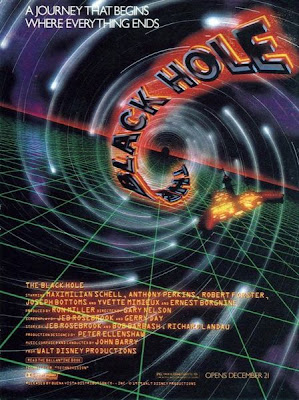
Hey, remember the movie The Black Hole? I ran across a clip of it on YouTube the other day, and I’ve been thinking a bit about it. Maybe I should track down a DVD at some point. (Spoilers here, but the movie’s 30 years old, so….)
The fine folks at Disney made The Black Hole in 1979. It was their entry in the “Hey, the kids do sure like that Star Wars, so we needs ourselves a space movie too!” sweepstakes that resulted in lots of space opera stuff, some of it not bad (Battlestar Galactica), some of it campy but fun (Battle Beyond the Stars), some of it weird (Moonraker), and, naturally, some of it downright awful (Starcrash). So in 1979, along came The Black Hole, which flopped at the box office. I suspect that word-of-mouth wasn’t that great, and maybe by then the whole space-flick thing was getting a little tiring anyway and besides everybody knew that the real thing, in the form of The Empire Strikes Back, was less than a year away.
But The Black Hole isn’t bad. Neither is it all that good. It’s solidly in the middle, occasionally approaching “good”, and then veering back toward “bad”, but never setting itself up at either pole. So ultimately it’s a pretty vexing movie — was it a good movie inside a bad one, or a bad movie inside a good one?
Our story: a small spaceship, the Palomino, is in deep space when it starts on its journey back to Earth. On the way it comes across a black hole, and perched on the edge of the hole is an immense spaceship which turns out to be the USS Cygnus, which was reported lost years before. Here’s the Cygnus, which is one of the most beautifully-constructed movie spaceships ever:
Investigating, they discover the Cygnus in the command of Dr. Hans Reinhardt, who operates his ship with the aid of a crew of humanoid drones, a squadron of security robots, and one very nasty robot named “Maximilian”. Here’s Maximilian:
Pretty menacing, eh? Especially as he doesn’t walk but rather floats around in the air and is equipped with a buzz-saw weapon which he uses on one unfortunate character later on (who tries to defend himself with a thick folder stuffed with papers — self defense FAIL).
Anyhow, it quickly becomes apparent that Reinhardt is crazy and planning to fly his ship into the black hole. In keeping with movie crazies of all stripes, Reinhardt refuses to let the crew of the Palomino leave, so now there’s a race against time: can our heroes escape before the crazy guy and his crazy robot take them on a journey into certain death?
It’s actually a kind of nifty plot, and watching the movie, I always get the impression that the Disney folks, in looking for a way to cash in on the post-Star Wars SF craze, looked for any script they could find, optioned this one, and then, well, Disney-fied it up a bit. There’s some serious stuff in this movie, lots of beautiful production design, and even a number of moments of genuine “sensawunda”. Here, for example, is the bridge of the Cygnus:
Seriously, that’s a gorgeous bridge, isn’t it? And nothing at all like the bridges or cockpits of big spaceships in movies to that point, where there’s a screen or window at the front and everybody’s facing it.
But then, along comes the Disney “We gotta make this for kids too!” stuff. Enter our heroic robot, VINCENT, whose design just screams out, “We need an R2-D2, only cuter!”:
And later on, after we’ve gotten used to VINCENT, we meet an earlier model, who is called in the film — I kid you not — “Old BOB”:
Old Bob is voiced by Slim Pickens. Can’t have a movie without an old-timer to tell the heroes what’s really goin’ on, I guess. (VINCENT and BOB are acronyms, of course, but I’m too lazy to Google what they stand for.) And our heroes end up in a firefight at one point with some very goofy looking security robots:
Well, Imperial stormtroopers they ain’t, although I did like their double-barreled blasters.
So, do they escape? Well, yes — and no. They get free of Reinhardt, by stealing his personal ship (or something like that), but it turns out that it, too, is programmed to go through the black hole, so in they go, after the Cygnus has already been destroyed. This is all well and good, of course; the black hole itself is the film’s gun on the mantelpiece, and we’ve got to see it go off, right? This brings us to the film’s final scenes, in which we see not just what happens to our heroes as they go through the black hole, but also, in one of the oddest sequences to ever appear in anything with the Disney imprint, what became of Reinhardt and Maximilian:
Imagine what that felt like for a nine-year-old kid sitting in a theater! Evil genius and murderous robot somehow fuse together in some kind of sexual-looking event, and then end up presiding over Hell? Huh-whuh?!
Ultimately, The Black Hole is too slow-paced to be really exciting; its camp elements undermine the more successful moments of mystery and impending doom; its mysteries make the camp stuff all the more irritating. But still, it’s kind of a fun flick to watch — especially if you can arrange to be drunk when those last six minutes arrive.
Notes on a couple of space opera reads I’ve done lately:
:: I greatly enjoyed Andre Norton’s Moon of Three Rings a few months back, so more recently I read another by her, The Zero Stone. Where Moon of Three Rings was more planetary romance than space opera, The Zero Stone actually is full-on space opera.
Murdoc Jern is a jeweler by trade, who has learned the ropes of the business from his father and is now traveling the galaxy with a business associate, trading in rare gems from many different worlds, when his associate is killed and Jern has to make his escape by taking refuge aboard another ship. Jern also possesses a ring whose stone is deeply powerful and deeply mysterious — the “Zero Stone” of the title — and it soon becomes clear that everyone is basically after him for the stone.
Eventually his only trusted companion is a brilliant psychic cat named Eet. (Well, he’s an alien who is very cat-like, not an actual cat.) With Eet at his side, Jern must evade numerous villains and adversaries in order to win his freedom. I don’t want to say more than that, because the story is fairly rollicking and wide-ranging, despite its mere 221 pages in the old edition that I own. The story takes us to odd worlds and shows us interesting aliens, all the while telling a fairly gripping tale about greed and peril and freedom.
I find reading older science fiction novels refreshing, in a way. The authors of the 1950s and 1960s had to take a “get in, tell the tale, get out” approach to storytelling, packing their galaxy-spanning notions along with interesting characters and drama into much shorter books than are the norm today. I love a florid and long epic as much as the next person, but there’s often something just invigoratingly pleasant about reading a book that has an epic story in less than half the length of an almost-standard novel today.
(I’ve now discovered that The Zero Stone has a sequel called Uncharted Stars, which I just happen to already own. Huzzah!)
:: More modern, and thus more epic and thus longer, is In Conquest Born by CS Friedman. This is a big story told on a very large canvas. Two races, the Braxana and the Azeans, have been at war for a very long time as their respective empires have spread across the stars. Our focus is on one warrior from each culture: Zatar from the Braxana, and Anzha from the Azeans, who find themselves endlessly opposing each other, bringing the endless war to a deeper and more personal level. This book is as much character study as it is story, alternating between Zatar and Anzha as their respective lives become more and more intertwined as the book progresses.
While I liked In Conquest Born a great deal, I must confess that I wanted to like it more than I did. The characters are well-drawn and well-developed; they are complex, with motivations that aren’t always easy to understand. The main problem I had with the book was that it often felt somewhat disjointed. There are times when the book doesn’t feel so much like a novel as a collection of inter-related short stories and novellas about the same characters. Also, there are quite a few plot threads that never seem to go anywhere or get visited again. Those aren’t deal-breaking quibbles, though; I greatly enjoyed In Conquest Born and recommend it.