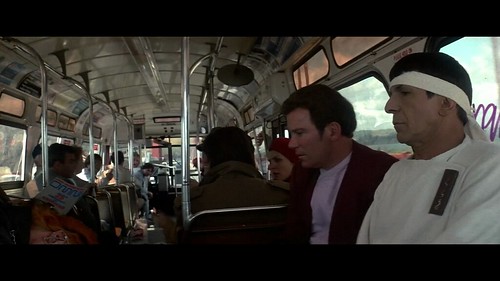
"Double dumb-ass on you!"


"Double dumb-ass on you!", originally uploaded by Jaquandor.

So I was watching Star Trek IV: The Voyage Home last night, and one little detail caught my eye during the scene where Kirk and Spock are riding the BART bus over to Sausalito so they can visit the Cetacean Institute and plot their rescue of two whales. This very brief shot comes right after Spock nerve-pinches the rude punk-rocker. Why did I screengrab this?

Because if you look close, you can see that a rider over on the left there, a couple of rows in front of Kirk and Spock, is holding a copy of the late and long-lamented OMNI Magazine. If I could resurrect a single periodical publication, at the same level of quality as at its height, I’d choose OMNI. That mag was such a fun read. The only thing now that comes close is WIRED, but WIRED lacks OMNI‘s willingness to go right into areas of pure speculation, if not outright mysticism.

Maybe now that they’ve brought whales into the 23rd century, Kirk and company could bring OMNI into the 21st!

Share This Post

You keep using that word….

John Scalzi, having previously displayed some very odd notions about what “good design” is all about (and having been factually wrong in the process), turns his eye from Star Wars to Star Trek. Unfortunately, the results are about the same: he gets some things wrong (the Probe in STIV is not attempting to “destroy everything”), he makes some odd assertions (his bit about phasers is just weird), and instead of talking about “design” he ends up talking about scientific plausibility. I mean, sure, “Red Matter” is one of the worst Maguffins I myself have ever seen in a movie, but what on Earth does that have to do with design?

Now, weird design choices in Star Trek aren’t that hard to find. Since there’s no real reason for it to be there, putting the bridge on top of the ship where it’s totally exposed is an odd choice. In the most recent movie, the design of the Romulan mining ship makes no sense, what with catwalks over yawning chasms and everyone splashing through ankle-deep water and all. But there’s more to critiquing design than saying that Red Matter is full of crap.

Oh well. This is clearly another attempt by John to get the geeks fired up, so mission accomplished!

Share This Post

Moving forward – the same direction as always.

I wrote once before on the initial graphic novel set in the Firefly universe, Those Left Behind. Now there are two such graphic novels; Those Left Behind has been joined by Better Days. While I’ll pretty much jump at nearly any chance to revisit this universe, neither of these two graphic novels is completely satisfying, which is oddly disappointing considering my belief that comics is the ideal medium for the Firefly universe to live on, if live on it does.

The problem with each one boils down simply to the fact that they are too short. It took me about twenty minutes to read each one; they’re just too slight. It’s really pretty frustrating; you would think that comics would give Joss Whedon room to breathe with his Firefly tales, but apparently these books are collections of miniseries that were mandated at just three issues apiece. The result are fun stories full of that Firefly flair that nevertheless flash by, without a real sense of the stories being fleshed out or with the subplots resolved too quickly or not given enough room to breathe.

Those Left Behind is apparently intended to lead right into the movie Serenity, and thus sets up things like Shepherd Book having left the ship when the movie starts and the two “Hands of Blue” pursuers of River Tam having been replaced by The Operative. Thus, parts of Those Left Behind probably won’t make sense to anyone who hasn’t seen the movie, or if they do make sense, they won’t realize how things are resolved at the end of the story.

Better Days tells a “standard” Firefly story; this could have been an episode of the show, really. The crew performs one of its less-than-legal jobs, but unlike most jobs Captain Reynolds and crew take on, this one results in a huge payday, resulting in the crew getting to indulge some fantasies as to what they would do if they had lots and lots and lots of money. (Jayne’s fantasy is a hoot, and River Tam’s is…well, you’ll have to read it yourself.) It’s a good story, but again, it contains one too many subplots for a story that is only being told in three issues. Also, since the page count is at a premium, the action sequences in these comics tend to be hard to follow. They almost seem like individual frames taken from filmed action sequences, and as such it’s often hard to understand who is doing what.

This is all a shame. I don’t know if Firefly has a future in comics or not; while I enjoyed these two books, I can’t think they really helped the cause at all. Three issues here, three issues there – that’s no way to sustain interest in the ‘Verse. Bummer.

(Apparently a third Firefly comic, one which fleshes out the background of Shepherd Book, is on the way at some point.)

Share This Post

How long until George Lucas reboots Star Wars?

UPDATE: Broken link fixed.

Apparently Bryan Singer is on the cusp of directing a Battlestar Galactica movie. That doesn’t seem terribly noteworthy, since the show just ended — except that the movie, by all reports, won’t have anything to do with the recently completed show! Instead it will draw upon the original material for the 1978 Glen A. Larson show.

So a show that was on thirty years ago, and was already rebooted into a very successful show that ran for several years, will now be rebooted again into a movie franchise. Huh?!

Look, I like Bryan Singer, actually. I didn’t care for The Usual Suspects, but everything I’ve seen since then by Singer has been pretty good. (And yes, I include Superman Returns.) And I’m all for explodey-spaceshippy space opera goodness on the big screen. But this “rebooting” craze has to hit a wall at some point, doesn’t it? Isn’t there any impetus anymore to come up with something new?

Share This Post

Staring back….

I’ve written on The Abyss before, but I just watched it again a little while ago, and if anything, I love it even more. This is one of those movies that gets better each time I watch it. I genuinely believe it’s an underrated classic, overshadowed by the films in James Cameron’s oeuvre that bracket it: Aliens (which I don’t like) and Terminator 2: Judgment Day (which I consider classic).

For those who haven’t seen The Abyss: it’s set in the late 80s, before the end of the Cold War. A US nuclear submarine is cruising near an extremely deep trench in the Caribbean (the titular “abyss”), when it’s buzzed by some kind of underwater phenomenon that travels extremely quickly with astonishing maneuverability, and which interferes with whatever electrical systems it comes near. Is it some kind of Soviet weapon? Or something else? They don’t find out, and the sub is caught in the turbulent wake of the “bogey” just as its electrical systems all go haywire, meaning that the sub can’t avoid crashing into the walls of the trench. The sub goes down, eventually coming to rest a couple of thousand feet down, flooding and killing all the sailors on board, but not before they can launch their log buoy.

So a recovery mission is launched. The problem is that the Navy can’t get its recovery equipment and vessels into the region before the hurricane that’s on its way will get there, so they recruit the crew of an experimental undersea oil drilling platform, “DeepCore”, (referred to throughout the film as “the rig”) to do the job of inspecting the sunken sub. A team of Marines are sent down to the rig to help, and of course, the Marines don’t get along terribly well with the oil workers who populate the rig; and the Marines are accompanied by the rig’s designer, the alpha-female Lindsay Briggman, who happens to be the estranged wife of the rig’s foreman, Virgil “Bud” Briggman. Hilarity ensues as the hurricane on the ocean surface results in great damage to the rig under the sea, as Bud and Lindsay battle one another, as the Marines execute their own orders without telling anybody else, and as the commander of this bunch of Marines starts to show signs of underwater psychosis. Add to that a race against time as the rig is cut off without its replenishing oxygen supply, the strange underwater bogeys that may or may not be aliens, and the nuclear menace when the Marines’ secret orders turn out to involve removing a warhead from the sunken sub.

(You know, I’m not sure they’re Marines. Navy SEAL’s, perhaps? I don’t recall. Yeesh. And I just watched the movie.)

Anyhow, I’ve never understood why this movie doesn’t have a better reputation than it does. Not that its reputation is bad, mind you; my general sense is that it’s well-regarded, but it wasn’t really embraced by the general public. One reason is probably the theatrical cut of the film, in which the role of the undersea aliens is a bit reduced, and in which one of Cameron’s main subplots, the Cold War tensions being exacerbated by the rescue operation in waters very near Cuba, was completely cut from the movie.

That’s not entirely a bad thing, since while I do think the Director’s Cut is better than the theatrical cut, it’s not across the board better. The problem is that James Cameron has never, not once, been a filmmaker who counts subtlety among his bag of tricks, so the Cold War stuff is driven home hard, hard, hard. We see news reports highlighting the events between the US and the Soviet Union, which is all well and good, except that Cameron also throws in some odd “Joe Citizen” interviews in which supposed people on the street say things like “Geez, the Russians love their kids too, so why are we doing all this?” This stuff doesn’t work very well, and more on some other problems with the Cold War subplot in a bit.

What really works with this movie – really, really works – is the creation of a complete setting that is totally believable, filled with details that feel totally plausible. To my knowledge, there’s nothing at all like Deepcore anywhere in existence, but the movie has extensively thought out what such an undersea drilling rig would be like and what life would be like for the men and women working there, with the result that the setting works. That’s worldbuilding, in the best sense of the word. Everything looks real, like it has a purpose. Everything clanks and clunks like metal on metal; the ceilings and walls are covered with pipes that constantly drip water in various places; the place is cold and dark and dank, and yet the people who work there consider it home, and they live in the place with an eerie acceptance of the awesome pressure of water all around them. There’s also a keen sense of family among the cast: the crew of the Deepcore rig really do seem to have been working together for a number of years. They know the same songs, they share the same in-jokes, and they speak to each other in the kind of shorthand that only people who have worked in close quarters for a long time can do.

The film draws much of its tension from the claustrophobic settings of the rig, which are made even more claustrophobic by the fact that they’re a mile underwater. There is also palpable sense of fear, both fear of the unknown and fear of the possible nuclear disaster unfolding. There are a number of very finely-done action sequences, foremost among these being a chase sequence involving two submersibles. And the movie also features one of the more creative riffs on the “defuse a bomb by cutting the correct wire” meme I’ve seen.

The music is by Alan Silvestri. It’s mostly a serviceable score that doesn’t really call attention to itself, but like most Silvestri scores, it’s got some nice ideas and fine moments.

What don’t I like about the movie? Well, the ending always feels like a small let-down. In the Director’s Cut, the entire last act ends up feeling not unlike The Day the Earth Stood Still. It’s mostly effective, but again, Cameron’s lack of subtlety actually harms things a bit, when he chooses to drive home the film’s anti-nuke message with all the delicacy of a brick thrown through a plate glass window. Still, I’m always deeply touched by the aliens’ final reason for not causing the seas to wipe the Earth clean of the human menace. (And, to be frank, the visuals in the film’s very last scene always look fake to me. I wish they’d have found a better way to shoot some of what happens at the very end.)

Tiny quibbles, though. I watch The Abyss once every year or two and it always feels fresh and exciting to me. It’s a terrific movie that should have a higher reputation than it does. I consider it a modern SF classic.

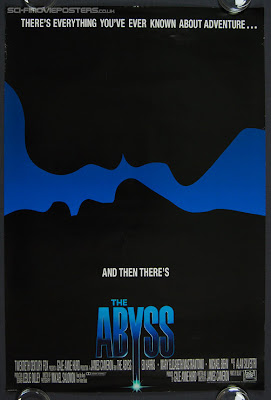
EXTRA NOTES: I’d never seen the poster art above until I Googled about a bit for an image to use for this post. I like that image, a lot — the blackness surrounding the deep blue of the dark water, forming the profiles of the man and woman. Cool poster! Image taken from here.

Also, back when I was doing Unidentified Earth posts, I had a location I was going to use but never did, because I figured nobody would get it. But it’s really cool. The underwater scenes for the movie were filmed in the containment building of an unfinished nuclear power plant near Gaffney, South Carolina; they actually built a scale set for the DeepCore rig and then filled the containment building with water around it. It turns out that the DeepCore set has never been dismantled, and can still be seen there…and on Google Maps’s satellite images. Here is the location:

And here are some photos taken by a couple of folks who actually hiked onto the site to see the abandoned set.

Share This Post

Still Trekkin’

SamuraiFrog has a nice post wherein he runs down his thoughts upon a re-viewing of the first six Star Trek movies, otherwise known as the “Original Cast” films. I’m in partial agreement with him on certain points, partial disagreement on others (my views can be found in my STAR TREK Redux series of posts from the early days of this blog; links are in the sidebar). I do have a few random thoughts:

:: TMP is a good movie, and I’ve never much disliked all the effects stuff in the film. Few of the Trek films take their time. Does this one take too much time? It’s possible, I guess. But I don’t mind it.

:: I did rewatch Wrath of Khan recently and I’m still of two minds on the movie. It’s very well-made, but it’s not as perfect as many think.

:: Search for Spock really is uneven — the inexperience of its director is evident, as is its small budget, and parts of its plot are terribly, terribly thin. But the last ten minutes make up for a lot, in my view.

:: Voyage Home is really good.

:: I like Final Frontier more than SamuraiFrog did. There is a ton of stuff wrong with that movie, but I still feel that it’s an ambitious failure. I don’t hate it at all. I also don’t agree that the film missteps in ‘resurrecting’ Spock’s inner turmoil at his father’s rejection of him; Sybok thinks he’s hit on Spock’s secret anguish, but he doesn’t know that this has been resolved for Spock through his death and resurrection and his father’s acceptance. Spock needs no prompting at all from Kirk to tell Sybok that no, he’s still not joining Sybok’s cause.

:: Undiscovered Country is not, for me, quite the “fan service” film that SamuraiFrog believes it to be. It only partly serves to bridge the Original Series and TNG, but that’s really only a tiny piece of the movie’s subtext, and only intense fans are going to recognize Michael Dorn as Worf’s grandfather. Any “fan service” subtext is more from the film’s clear intent to retire the original cast The film is topical to a higher degree than any Trek film before or since, though — it came out in 1991, hot on the heels of the end of the Cold War.

And the last ten minutes or so of Undiscovered Country is one of my favorite movie farewell scenes, ever.

So there!

Share This Post

“Eight astronauts strapped to the back of a bomb. My bomb.”

A friend of mine sent me a copy of a science fiction movie from a couple of years ago called Sunshine, which I’d never heard of before. And it’s really a very good film.

The plot isn’t terribly complex: at some indeterminate point in the future, the Sun is “going out”, but some physicist figures out how to make a kind of “solar bomb” that can restart the Sun. A ship is sent to deliver this bomb into the Sun, but that expedition fails for unknown reasons, so a second expedition is sent. Shortly into the movie, the ship – called Icarus II, for obvious reasons, with the first ship, the failed one, being Icarus I — passes beyond a spot beyond which they can send no more messages back to Earth. From that moment on they are alone, and from that moment on, things start going awry.

First off, this is a movie that knows how to handle an implausible Maguffin. If a Star Trek; The Next Generation episode had a star going out and the crew trying to “restart” it, we’d be treated to at least one scene, if not more, in which lots of folderol about subatomic particles and space-time continua and the like would be bandied about in hopes of making it all sound as though it’s not what it is: pure BS. Instead, this movie gives the whole “dying Sun” thing exactly as much explanation as I give here in this post. The movie doesn’t care about the plausibility of the premise or how it could be glossed over; an opening monologue establishes the situation in four or five sentences, and then we’re on board the Icarus II.

This movie falls into that most reliably involving of genres: the “diverse group of people have to get something done by a certain time or absolute disaster will unfold, and meanwhile, everything that could possibly go wrong does” tale. Will the crew have enough oxygen for a return trip? Will the ship suffer damage in a meteor storm? Will the bomb even work? Will they succumb to whatever mysterious fate awaited the Icarus I? Will they manage to keep their psyches in check? The answers to at least a few of those questions are “No”, which is what makes for a gripping movie.

The film takes its time in getting moving, introducing us to its characters and creating some real sense of wonder in a few terrific scenes, such as one man’s desire to look upon the brightest sunlight he can, and another when the entire crew gathers before an immense viewscreen to watch a transit across the solar surface of the planet Mercury. When the tension starts to increase, it does so slowly at first, and then things get worse faster and faster, as the ship gets closer and closer to the sun. There are many excellent character moments — most of the characters in the film are memorable people, refreshingly enough — and the various moral dilemmas they all end up facing all seem quite real. Visually, the film is extremely well done; the effects aren’t terribly complex, but they don’t need to be and despite the film’s plot involving the sun going out, everything the movie shows us feels plausible enough. You really get the feeling that if we build a big ship for an expedition to the Sun at some point, that’s what the ship is going to look like.

The movie starts out slowly, and builds up its tension until it’s one of the more effective SF thrillers I’ve seen. There is a gradual shift in tone in the film — I don’t want to say too much, but eventually there’s a killer on the loose — but it all worked for me, very well. This movie drew me in and did so quickly.

The performances are all terrific; the cast is necessarily small, and fortunately there is excellent chemistry amongst them, which is an essential ingredient for a film as tightly focused as this one. The only actor I recognized by name was Michelle Yeoh as one of the crewmembers, although I was impressed by Rose Byrne (who, when I looked her up, turns out to be the actress who played Dorme in Star Wars Episode II: Attack of the Clones, a performance of a bit part that I praised a short time ago) and Cillian Murphy as “Capa”, an actor whose looks remind me eerily of Judson Scott. (Holy crap, Judson Scott is about to be 57 years old! How did that happen!)

I recommend Sunshine highly. I found it a deeply satisfying SF film.

Share This Post

Opening hailing frequencies, Captain

UPDATED below.

Seldom have I been more conflicted over a movie than I am over Star Trek. I mean, wow, am I of two minds on this movie. It’s as if the film has managed to split me right down the middle, which calls for something I haven’t done in a while on this blog: a full-on geek-out of epic proportions. Beware SPOILERS! I hold nothing back.

I loved watching it. Absolutely loved watching it. I don’t remember a more enjoyable piece of pure entertainment than Star Trek. Maybe the first Pirates of the Caribbean movie. As a piece of pure moviemaking, Star Trek is just about as good as it gets. Seriously. The cast is all wonderful, the direction outstanding, the editing is spot-on – there are maybe two or three minutes in the whole movie where the pacing flags a little, and those moments are over just as you notice that the moment in question is running a bit on the long side.

How about that casting? Chris Pine and Zachary Quinto are the most important players here, obviously, as James T. Kirk and Spock. Both are superb. What’s so impressive is that neither man tries to ape their forebears, William Shatner and Leonard Nimoy, instead choosing to create the characters as written for them, and yet also capturing the essence of the characters we all know so well. Karl Urban’s Leonard McCoy is just terrific; most commenters seem to think he’s just giving an eerily accurate impersonation of DeForrest Kelley, but I don’t think that’s quite fair. His McCoy is acid-tongued and emotional, and he gets to zip off the iconic “I’m a doctor, not a ____” line as well as make an angry reference to Spock as a “green blooded ____”, but surely that’s the essence of McCoy, not just of DeForrest Kelley. The remaining bridge crew is all superbly cast, even if there are a few too many riffs on Chekov’s thick Russian accent. (And of course, we all know that Chekov wasn’t on the Enterprise from the launch of Kirk’s captaincy, either. But more on continuity and canon later.)

Eric Bana as Nero, the Romulan villain, is OK, I guess. He doesn’t get much to do except look really angry and revenge-driven. He’s not an interesting villain, actually. Better is Bruce Greenwood as Captain Christopher Pike, who is presented as a father-figure to Captain Kirk. He has a ton of screen presence and charisma, which is exactly what that part needs; if Kirk’s going to grow into that, we need to see an example first.

Yup, this is how to make a movie, all right. Problem is, I’m not sure it’s how to write one. As great a time as I had watching it, I fear that Star Trek is kind of like the M. Night Shyamalan film Signs: the more you think about it afterwards, the less good it looks. (And nobody gets to say “But it’s a movie, you’re not supposed to think about it!” Nonsense.)

Plotwise, storywise, and to some extent characterwise, Star Trek is kind of disappointing in some regards, disappointing in others, and downright annoying in still others. The problem is that relatively few of the developments in Star Trek‘s story make sense. Some are contrived, others are just full of that good old fantasy element of SF, “handwavium”. Now, it’s true that virtually all SF relies to a certain extent on handwavium, but Star Trek positively drips with it.

While I noted above that there are virtually no boring moments in Star Trek, there are plenty of moments that made me think, “Hey, wait a minute.” Taking just one, Spock’s marooning of Kirk on the ice planet: first, doesn’t that seem a bit Draconian? Doesn’t the Enterprise have a brig he can lock Kirk up in? Second, how lucky is it that Kirk is marooned a mile or two from a crappy ice cave where Spock Prime (as he’s called in the movie’s credits) is hanging out, conveniently located to explain the whole plot? And then, how lucky is it that both of these fellows are marooned a mile or two farther away from the crappy outpost where Montgomery Scott is cooling his heels? This whole sequenced bugged the living hell out of me. In fact, Spock Prime’s presence irritated me. But more on that later on, as well.

I recall reading some positive reviews that cited the movie’s ability to avoid Next Generation-like reliance on technobabble to make its impossible stuff happen, but does it, really? A beach-ball sized glob of “red matter” is used, one drop at a time, to create black holes in the center of planets, thus destroying them? A drill that cuts holes to planetary cores? Temporal rifts? All of this is technobabbly, handwavium BS. Again, nothing against handwavium, but Trek has always made some attempt to make its nonsensical stuff seem believable. Sometimes that’s a case of “show, don’t tell” – note that in Wrath of Khan, no discussion at all is given to how the Genesis Device actually works; it just does. And I’d accept the handwavium here, if there wasn’t a lot of other complete nonsense going on that was avoidable. Spock refers to a single supernova that threatens to “destroy the entire Galaxy”. How the hell is one supernova going to do that? The blast wave of the nova, even if powerful enough to destroy a galaxy, would take centuries upon centuries, literally thousands of years, to traverse the entire Milky Way. This was complete nonsense that jolted me out of the movie. Ditto the way Spock is able to stand there on Hoth Delta Vega and watch as Vulcan is destroyed. There’s no way those two planets are that close. They would have to be orders of magnitude closer together than Earth and Mars. This, too, was complete nonsense that jolted me out of the movie. In fact, in terms of plausibility, this is the second-worst thing I’ve ever seen in a Star Trek movie. (The worst is Soren’s missile in Generations, the one that flies from the planet surface to the star in about eight seconds, leaving a contrail as it goes.) And then there’s the whole “going through a black hole takes you back in time” nonsense. This isn’t even close.

Other things bothered me about the movie, as well. For all the stuff early in the movie about James T. Kirk being a screwup and a delinquent, he undergoes a massive shift when he gets on board the Enterprise: suddenly he’s uber-competent and right about everything. There’s no real sense of growth to Kirk in this movie; one minute he’s the screwup with potential and the next he’s displaying “command fitness” out the wazoo. What lessons, really, does Kirk learn in this movie? He really doesn’t learn any, which is unfortunate. Everybody else learns from him, but he’s presented at the beginning of the movie as needing to learn the most.

I also didn’t like the Kobayashi Maru test. I’d like Kirk to have acted the part more, instead of just lazily goofing his way through a test that he knew he’d win. I’d have liked it if it had been the way he originally described it in TWoK: “I reprogrammed the simulation so it was possible to rescue the ship.” (My emphasis.) Instead, he simply reprograms it so he will rescue the ship. That was disappointing.

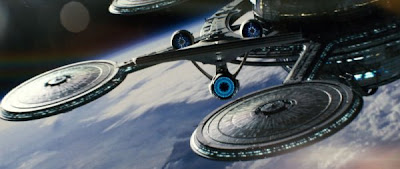
In terms of the film’s general look and appearance: I didn’t dislike the new Enterprise as much as I thought I would, honestly. I’m not big on how the rear ends of the warp nacelles light up when the ship is going to warp; the nacelles aren’t thrusters, after all. (I know they’re dumping all of the previously established canon as far as events in the series, but surely they’re not summarily dumping everything, right? The fictional idea behind warp drive still has to be the same, or else the creators here are just being dishonest.) The bridge is still too bright, too Apple Computer like, and the front viewscreen is no longer a viewscreen, but an actual window, apparently. (And there’s one shot in the movie that seemed to me to indicate that the bridge is now at the bottom of the saucer section! I could be wrong here – the shot was over in seconds – but if I’m right, that’s a huge change, and not one I much like. Why would a new timeline lead to a completely new design of starships? Did anyone else see this shot?)

And that brings me to the time travel stuff. I’ve had mixed feelings about this, ever since the film’s writers started giving interviews in which they indicated that they’re not resetting the Trek continuity to zero but rather kicking off a new timeline in which nothing has changed. The implication is that all the “standard”, or “canonical”, adventures of Kirk and company are still happening, to the Kirk and company in that timeline, where now we’re going to be following the adventures of Kirk and company in this timeline. This is, of course, pure handwavium, of the “have our cake and eat it too” variety. That’s all well and good for the writers, but is that really what happens in Star Trek?

Consider the chain of events. Apparently, in “Trek Prime”, Nero gets all pissed off and takes a mining ship after Spock’s attempt to save the galaxy from the exploding supernova destroys Romulus. But they end up going through the black hole and back in time (ouch). Pretty soon, Nero commits an act that changes history: he attacks the Kelvin, causing George Kirk to die heroically instead of living to raise his son. Now, everything is different. History has been changed.

Freezing the action right there: a few of the very best episodes of Trek ever made involve the changing of history. Most famous is “The City on the Edge of Forever”, in which Dr. McCoy, driven mad by an accidental overdose of some drug, jumps through the Guardian of Forever and winds up in 1930s New York, where he somehow prevents Edith Keeler from dying. Keeler goes on to found a peace movement that keeps the US out of WWII, allowing Germany to take over the world because they develop the atom bomb first. Also, just about every list of the best episodes of The Next Generation I’ve ever seen cites “Yesterday’s Enterprise”, in which the Enterprise-C gets thrown forward in time before it can accomplish what it needs to accomplish, again changing history (this time resulting in a Federation at war with the Klingon Empire). Both times, it’s taken for granted that history must be restored.

Other Trek time travel adventures include Assignment: Earth, in which the Enterprise travels back to 1968 and very nearly ends up a party to changing history again, and “Tomorrow is Yesterday”, when the Enterprise accidentally ends up in 1967 Earth and is seen by an Air Force pilot, whom they then beam aboard the ship and then realize have to beam back without his knowledge of having been there, lest history be changed. The best of the TNG movies, First Contact, has the Borg going back in time to take over Earth in the 21st century and preventing the Federation from ever existing; Captain Picard and the Enterprise-D have to fix history.

So, returning to the current Star Trek: Spock ends up with Nero back in time, and soon realizes that Nero has changed history. With all of that precedent in Trek lore for restoring the proper timeline, what does Spock do?

Nothing. And consider, he’s got his own ship, he knows how to travel in time (he calculated the equations for the time travel to get some humpback whales once), and failing time traveling in his own ship, Spock knows of an uncharted planet where resides a device called the Guardian of Forever. He could try to set things right…and doesn’t. He just accepts the “new timeline”, and at the end of the movie, is seen going off with the rest of the surviving 10,000 Vulcans who are left in the galaxy to re-establish their culture.

I’m sorry, but what the hell is that?!

Seriously, here, WTF? Why would Spock just blithely accept his fate in the “new timeline”? This makes no sense whatsoever. It would have been poetic, maybe, if Spock had tried, but failed, to set things right; maybe that could have ultimately been how Spock finally dies for keeps, and in all the “Hey, we gotta fix what we screwed up in time traveling!” stories ever made, I only remember one in which the time traveler doesn’t get it exactly right. And that’s a segment from one of the “Treehouse of Horror” episodes of The Simpsons. They could have had Spock being unsuccessful in restoring history, and realizing at the end that history is just going to go on now, in its rewritten state; that would have been poignant and gutsy.

Instead, we get this: Spock acting in very un-Spockish way, and some stuff about new timelines co-existing with old timelines from the creators. However, nobody in the movie indicates that the old timeline is still intact and just a dimension or two over to the left, so as far as they’re concerned, this is the way things are gonna be. All of that leaves me to believe that the writers’ babblings in the press about co-existing timelines was just as bunch of made-up nonsense to mollify the fans, who are annoyed at the prospect of a Jim Kirk who will never meet Edith Keeler.

Here’s my problem with that whole “co-existing timelines” thing: it renders the old stories irrelevant. Suddenly there turns out to be a lot less at stake than there might have been otherwise. Why should Kirk allow Edith to die, if he knows that there’s another timeline out there somewhere in which she does die, so why not just save her and have her love? Everything just becomes a bunch of dull counterfactuals. That’s what bothers me about the concept of a reboot – or rather, this particular concept of a reboot.

On reboots in general: they’re not all comparable. People like to justify this Trek reboot by citing Battlestar Galactica, the Batman movies, or the James Bond films. None of those comparisons hold, though. The original BSG lasted just nineteen episodes, so there’s really not much to cheapen by the existence of a reboot. Batman had four movies before the reboot with Batman Begins, and comics movies are a special case, anyway, since the movies exist outside the continuity of the comics in the first place. That leaves Bond – but the whole notion of James Bond being the same guy in Die Another Day and Dr. No is just silly on its face, so this isn’t the same kind of thing. It’s the reality of what exists right now, but the logic just doesn’t hold up.

Another note about canons and continuity: even if I grant that we’re in a new timeline now that starts with the destruction of the Kelvin, there’s still a remaining fact that the producers didn’t seem to realize: you still have to respect the established canon to that point. Which means that you have to deal with certain realities of Star Trek canon: Kirk has an older brother named Sam, who doesn’t appear to exist in the movie. You know who else has an older brother? Spock. So where is Sybok? And so on.

I also didn’t care for some of the depiction of the Vulcans in the movie. For a race devoted to logic and the suppression of emotion, they sure are a goofy bunch, as shown in Star Trek. A culture that advanced only manages to get 10,000 people off the planet? And the response of the “Elders”, whose job it is to keep the culture alive, to the imminent threat of planetary catastrophe is to go hide in a cave? And I’m sorry, but Sarek should never openly admit to loving Amanda. We know that he loves her, and that he shows it in the best Vulcan way, but to say “I married her because I loved her” just stood out as a staggeringly un-Vulcan thing to say. There’s no way Mark Lenard would have stood for that line! And McCoy refers to his divorce, but does his daughter Joanna exist in this timeline?

Other random observations and things:

:: We all know that James T. Kirk is a womanizer, but I didn’t much like how this movie depicts him as having an eye for anything that has the attributes of being a female and having a pulse. This can be chalked up to his being more of a delinquent slacker in this movie than Kirk Prime, but still, it got a bit annoying.

:: I like Michael Giacchino’s score a lot, although I would have liked to hear more of the classic Alexander Courage Trek Fanfare. At times the score called out for it, and it wasn’t there.

:: Why on Earth does Leonard Nimoy give the “Space, the final frontier” speech at the end? By the logic of the film, we should be hearing Chris Pine’s voice there. That made no sense.

:: I just loved the design of the end credits, with all of those nifty alien worlds and stuff. It looked like updated versions of the kinds of planets you used to see on the covers of cheap SF paperback novels.

:: So Nokia is going to survive the next 200+ years as a company? Really?

:: I had no problem with the relationship between Spock and Uhura. That’s fine with me.

:: It probably would have made the cast overstuffed a bit, but I would have liked to see Chris Chapel and Janice Rand in there somewhere.

:: Lots of people are wondering where Nero disappears to for twenty years. My assumption is that his nifty, bad-ass mining ship took some serious damage when it got rammed by the Kelvin, and making repairs to a ship from the future when the technology doesn’t exist probably takes a while. Twenty years? Well…the movie asks us to swallow the notion that a bit of “red matter” the size of a marble can destroy a planet, so why not?

:: But as for Nero’s ship — I didn’t get the design. What are all those appendages for? And why is the “flight deck” filled with ankle-deep water? A ship from the 2300’s doesn’t have floor-drains and plumbing?

:: I’m sorry, but I hated that they were building the Enterprise on Earth’s surface…and there goes another bit of continuity, too. Remember, in TOS, the Enterprise was not a new ship when Kirk took command; the events of “The Cage” are specifically indicated in “The Menagerie” to have taken place thirteen years earlier. That would mean that technically, the Enterprise should already be cruising around under Captain Pike’s command when young Kirk is joyriding in the hot-rod. I know, we’re in a new timeline, but there are limits to what I’m willing to accept as having been changed here. Enterprise should not be virtually out-of-the-box new when Kirk takes over the center seat.

:: The moment where Sulu screws up going to warp speed echoes a similar moment in an old Trek tie-in novel by Vonda McIntyre, called Enterprise: The First Adventure. That novel is a telling of the “Trek Prime” first voyage of the Enterprise under Jim Kirk’s command, and in fact, it’s actually a decent novel, well worth checking out. Kirk’s assignment to the Enterprise is what ultimately causes his break-up with Carol Marcus, and soon he’s getting to know a new crew. Anyway, there’s a moment at the beginning where the Enterprise is leaving spacedock, and Sulu messes up, causing the ship to lurch or something like that.

:: So, what’s next for Trek? The sequel has already been greenlit by Paramount, so I assume in two or three years we’ll be queuing up for Star Trek II…again. JJ Abrams has observed that the Enterprise crew could always meet Khan Noonian Singh again…for the first time, again. Or something like that. I personally don’t want that; nor do I want to see Borg again. Surely we can actually get a new adventure? Actually see some exploring of strange new worlds and new life and new civilizations? You know, going places boldly? In fact, it might be nice to have an exciting SF Star Trek adventure that never has the ship firing phasers or torpedoes. But if we have to bring back old Original Series characters for updating, how about some of the others? How about Klingon commanders Kang and Koloth? How about Harcourt Fenton Mudd? But really: how about a new adventure? Continually revisiting old characters is still fan-service for the Trekkers, and even they probably get tired of the same old thing every time out. (Of course, it’s to be noted that the least successful previous Trek flicks are the ones that tried to show something new instead of posing sequels or follow-ups to previous stories: TMP, The Final Frontier, and Insurrection. But then, I actually like those movies more than most, so….)

Well, anyway, Star Trek is a movie that bugged me, vexed me, annoyed me…and also entertained the crap out of me. Weird. JJ Abrams is a good director. I’m not much impressed by his writing, but his directing is spot on. (I know, he didn’t write Trek. I’m referring to past scripts of his.) I’ll be getting the DVD, you’d better believe it. All complaints aside, the movie did manage to hit my “explodey spaceshippy space opera goodness” sweet spot. Good on them for that much!

(Other blogger reviews I enjoyed were Jason Bennion, here and here; Snell; and Torie Atkinson.)

UPDATE: OK, I expected one, and I got it: a snooty comment from someone saying “You think too much. It’s just a movie.” Well, if I want to take that attitude into a movie, I’ll go see whatever Michael Bay’s got coming out. I expect more from Star Trek, and I didn’t get it here. Yes, it’s a wildly fun movie to watch. No, it doesn’t make any damn sense. The best Star Trek stories are the ones that are entertaining and manage to make sense; this movie got half the equation right. That’s my position, and I’ll think about it as much as I want.

Share This Post

“He’s so…human.”

Prompted by this post by Snell, which I quoted in Sentential Links yesterday, I’ve been thinking a bit about one of the bigger misfires in Star Trek history. I’m thinking of Lieutenant Saavik.

Saavik first appeared in STII: The Wrath of Khan, played by Kirstie Alley. (OK, I’ll admit it, she was among my first celebrity crushes.) As TWoK opens, the Enterprise is no longer a flagship in the fleet, but is instead pretty much of a training vessel, being used to teach Starfleet cadets the ins-and-outs of being Starfleet officers. Saavik is the highest-profile of these youngsters whom we meet in the movie; as the film opens, she is taking the infamous Kobayashi Maru test, which turns out to be a test of character in judging how prospective command officers deal with no-win situations. (Saavik’s resolution results in a ship blown to bits by Klingons.)

At first glance, we see that Saavik has the pointed ears of a Vulcan, but her actions throughout the film show that she isn’t the cool, level-headed Vulcan we might expect from, say, Mr. Spock; in point of fact, Spock in the teevee series showed less emotion than Saavik does in TWoK. This is almost certainly due to Saavik’s generally-accepted backstory: she is not pure Vulcan, but half-Vulcan and half-Romulan. This is never specified in the movies, but in the novelizations and in the original screenplay, so I think it can be taken pretty much as canon at this point.

There were occasionally new crew members to think about in the Trek movies, and Saavik was perhaps the most memorable. She is extremely intelligent, ambitious, and observant; however, she comes off as also deeply uncomfortable with herself and struggling to figure out just who she is and what her purpose may be. This represented a wonderful contrast with the remainder of the Enterprise crew, who by the time of TWoK were all experienced veterans who were so good at their jobs by now that it pretty much became necessary to make justifications for them being at their old posts after so many years. (Spock is now Captain of the Enterprise, supervising the training missions; Scotty is the trainer for the engineering cadets, Chekov is First Officer on Reliant, and it’s generally accepted, as depicted in the novelization, that Sulu has just been promoted to Captain as well. As for Uhura, I’m not entirely sure.) Anyway, Saavik’s career is just getting started. And she is in awe of Admiral James T. Kirk.

By the end of TWoK, Saavik has, interestingly enough, not been depicted as having reached some kind of definitive stopping point in her “growth” as a person. She’s learned that Kirk isn’t some unapproachable god but basically just a guy who screws up a lot and yet figures out ways through it all; she’s been through an extremely difficult crisis; she’s lost her mentor in Captain Spock. (And, according to the novelizations of TWoK and The Search for Spock, she has picked up a lover in David Marcus.)

When next we see Saavik, we’re into TSfS and she is on board the science vessel Grissom, which has been dispatched to investigate the newly formed Genesis Planet, along with David Marcus (who is Kirk’s son, for those not keeping score). But she is now no longer played by Kirstie Alley, but by Robin Curtis:

Along with the change in actresses we now note a major change in Saavik’s personality, too: whereas all through TWoK we see that there is a lot of emotion brimming under Saavik’s surface, in TSfS she is almost entirely all-Vulcan, all the time. Except for one or two scenes, she seems like a female Spock. The only time Saavik 2.0 comes close to showing actual emotion is when she reports to Admiral Kirk that David Marcus has been killed, and at the very end of the film, where she finds herself unable to hold Spock’s gaze (because the film has implied, not terribly strongly, that she had Vulcan sex with Spock while on the Genesis planet). Saavik 2.0 is a pale reflection of Saavik 1.0, an awful disappointment; the character has gone from being one of the most interesting new additions to Trek to being someone who is merely along for the ride.

Robin Curtis’s Saavik 2.0 would return in The Voyage Home, but very briefly. She is now no longer a part of the crew, and she only appears in a short scene at the beginning of the movie to tell Kirk something about David’s death. The existence of the scene kind of strains credulity a bit; they’ve all been on Vulcan for three months, and right now is the first time Saavik’s found the opportunity to tell him that David died bravely? Meh. Then we see Saavik standing beside Amanda Grayson (Spock’s mother) as the Enterprise crew lifts off in their captured Klingon Bird of Prey. And that is the last time we ever saw Lieutenant Saavik.

(Yes, Saavik would show up in various Trek novels and comics, but those honestly don’t count, as much as I loved some of the novels that I read and the DC Comics incarnation of Trek.)

So what happened? Why did a potentially interesting character vanish? Well, there were attempts to bring Saavik back, over the years. The character of Valeris in The Undiscovered Country, the traitor Vulcan, was originally intended to be Saavik; I’m glad they didn’t go that route, personally. Also, Saavik was intended to show up in a nonspeaking cameo in an episode of The Next Generation, but apparently Kirstie Alley wanted too much money so that idea was shot. (One wonders why Robin Curtis wasn’t even asked — but the answer is, of course, that no one would have recognized her. By the time of TNG, Alley was one of the better known actresses in the US, thanks to Cheers.)

The general perception is, almost without exception, that Saavik 1.0 (Alley) was better than Saavik 2.0 (Curtis). I’ve never yet met a Trekker who liked Saavik 2.0 more. Many tend to fall into the usual trap of blaming the actress, but as usual with such things, I’m not sure that’s fair. Curtis didn’t write the character as basically someone for David Marcus to talk to in TSfS, nor did she make the odd decision to ignore the fact that Saavik 1.0 had arched eyebrows while Saavik 2.0 had pointed Vulcan ones. I read an interview once with Robin Curtis in Starlog in which she described how hard it was playing a Vulcan correctly, especially with the guy who pretty much invented Vulcan acting directing her on that film. She recalled Leonard Nimoy constantly telling her to make her line delivery dryer, dryer, dryer. Well, she’s definitely dry in TSfS.

It’s an odd thing, but it’s clear to me that Saavik 2.0 is a writing mistake, and not a performance one. (For the most part, anyway. No one would seriously claim that Robin Curtis had as much charisma onscreen as Kirstie Alley.) I don’t really think that the Trek producers had any real idea of where they were going with Saavik, as they wrote the “trilogy” of Treks II, III and IV. Each film had different writers, for one thing, but I would have hoped that producer Harve Bennett would have steered things a little more, as far as Saavik was concerned. An amazingly interesting character is introduced, and then completely retooled, and then just dropped aside without fanfare. That’s a sad thing.

However, we should also remember what Trek was like back then. TWoK was made on the basis of TMP‘s box office success, but it was budgeted much lower. Ongoing Trek movies were by no means a sure thing, and new teevee series like TNG weren’t even in the talking stage at that point. It’s pretty clear that Saavik was bungled a bit, but it’s not as if there was much opportunity to plan for Saavik in the future of Trek. TWoK was not made with TSfS in mind, and neither was TSfS made with TVH in mind. Trek was being done on a project-by-project basis, which explains, as least in part, how the promising Lieutenant Saavik was allowed to fall through the cracks.

And now I’m thinking, if this alternate-timeline Trek reboot does well, maybe Saavik will come in for better treatment when she comes along…in about twenty years.

Share This Post

Permission to come aboard?

Well, now I officially want to see the damned new Star Trek movie. I still have my misgivings and I’ll probably bitch up a storm about it afterwards, but I genuinely want to see it in the theater now.

Over at AICN, there’s all kinds of coverage of last night’s surprise premiere in Austin, TX. What happened was this: the audience there was supposed to see a preview chunk of footage from the new movie, which would then be followed by a screening of a restored, pristine print of Star Trek II: The Wrath of Khan. Well, instead, they showed ten minutes of Khan and then pretended to have a projection problem, during which Leonard Nimoy came out and asked the audience, “Wouldn’t you rather see the new movie?” Audience goes nuts, and the new flick is screened.

Now that’s the way to do it, huh?

As for the new movie, here’s an interesting and non-spoiler review that is positive, but not gushingly so. But I still want to see the movie…not so much because of Trek, but because, I think, it’s four years since Revenge of the Sith. I need a good dose of big screen space opera, and Trek seems to be the only game in town.

Share This Post