
Thoughts on THE FORCE AWAKENS, Episode II: Wait, what?! (or: Stop me if you’ve seen this movie before!)

Might as well jump in with my biggest problem with The Force Awakens, right? Well, as I watched the movie the first time, and again the second time, and again still the third time, I found myself saying the same two words over and over and over again:

“Wait, what?”

Take it from me, folks: in any kind of storytelling endeavor, be it a movie or a novel or a teevee show or comic book or anything at all, you do not want your audience saying “What, what?” a lot. If you can avoid it at all, great, because every “Wait, what?” constitutes a moment when your audience has left the story and is instead trying to piece together the logic of your tale. “Wait, what?” makes things difficult. “Wait, what?” is a thing to be avoided.

But The Force Awakens is full to overflowing with “Wait, what?” moments, and every single one of them made me crazy, because I do not want to be sitting there watching a Star Wars movie and thinking “Wait, what?” all the time.

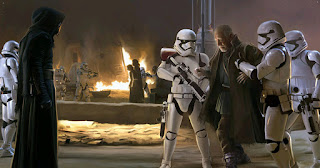
The first “Wait, what?” happens in the movie’s opening minutes. We’ve seen the opening crawl, and the ominous sight of a NextGen Star Destroyer crossing in front of a planet. We’ve seen Imperial First Order troop transports, loaded with stormtroopers on their way to engage. Then we’re in some dusty village where everyone lives underneath tents, and in one particular tent, some old dude is handing a flash drive to some Rebel New Republic Resistance pilot, saying something about “This will make things right” and mentioning the “Balance of the Force”. The flash drive, we will learn soon enough, contains a piece of a map that leads to the location of Luke Skywalker.

This is quite the Maguffin, and that is about as much explanation as we get for it. At all. Why does this map exist? Who made it? Why is it a fragment? Almost none of this is explained. Based on the little bits of context the movie provides in two different conversations that come much later in the movie, I am guessing that the map shows the locations of Jedi Temples which are in systems not known on any charts, so without any names, you have no idea what you’re looking at. If you use this fragment with the rest of the map, you can figure out which is the first Jedi Temple, which is where Luke might have said he was going.

This doesn’t really make sense, though, does it? The fragment contains other stars and systems too, so how hard would it be to match the known systems in the fragment map to charts of the known Galaxy, and then use that information to figure out where the uncharted systems are?

This does seem to me to be an interesting call-back to Attack of the Clones, however, because part of that film’s plot hinged on the deletion of a particular star system from the Republic’s maps. Also, while it’s never stated outright, it’s heavily implied in The Empire Strikes Back that Dagobah does not appear on standard charts either. So there is precedent for this, but the movie doesn’t give enough to go on, and what it does give, it gives in throwaway lines that are so quick, you miss them.

More problematic is the old guy. Who the hell is he? What’s he doing with this piece of map? Where did he get it? The film doesn’t answer any of that at all, and frankly…it needs to. It doesn’t have to give the entire backstory of this fellow, but there has to be something. There’s a very old meme in adventure stories, where the old grizzled treasure-hunter shows up with the treasure map and hands it off to Our Hero before dying of the knife in his back or whatever, and that would be OK. This could even be set up with a few lines of dialogue. But instead, the movie implies other things about this guy. He’s got a personal stake here. He is invested. His delivering of this map to Poe Dameron is a moral act, and a few minutes later, when he knows he is doomed, he mouths off to Kylo Ren. Now this fellow is actually interesting, but the movie blows him off, so he’s not a character. He’s a plot convenience.

And now that our Rebel Resistance hero has the Info That The Empire First Order wants, and he’s about to get captured, what does he do with it? He sticks it into his trusty astromech droid and sends the droid out into the wilderness of a desert planet. This brings us to another big problem with this movie: “Stop me if you’ve seen this flick before.”

A lot of my problems with The Force Awakens boil down to either “Wait, what?” or “Stop me if you’ve seen this flick before.”

We’re on a desert planet, called Tatooine Jakku, where apparently some massive battle took place, to judge from the wreckage littering the planet surface. Nevertheless, there are these enormous machines and ships, full of parts and metal that are worth money, and…exactly one scavenger digging through it all. What gives with that? What economy is this? Is Jakku an important world in any way? We never know. It’s just a backdrop.

Which brings me to another series of “Wait, what?!” questions. This film’s worldbuilding is awful, and I hate to say that, but it is.

Let’s look back at A New Hope. Everything is explained very clearly and elegantly: there’s a Galactic Empire, and there’s a Rebellion. That’s it. Simple, easy. We know how powerful the Empire is, and we know that the Rebellion is just getting started but is still very fragile. We also know that the Empire hasn’t been around all that long, by virtue of the Emperor having only now been able to get rid of the Senate (a move that is met with skepticism by the Emperor’s own flag officers). In a fairly small amount of dialog and exposition, we learn a lot about the political state of affairs as A New Hope begins.

Contrast that with The Force Awakens, which gives us the First Order which is apparently rising from the ashes of the Empire…but how? How big is it? How strong are they? How big is the Republic and how strong is it? Why is the Resistance seemingly a totally separate thing from the Republic? How is the First Order strong enough to build a weapon that can wipe out the Republic with one shot? What does the loss of Starkiller Station mean to the First Order, and what does the loss of Coruscant the Hosnian System mean to the Republic which may or may not be part of the Resistance (oh wait, reverse that).

We know who the “bad guys” are, but that’s not really enough, because no real goals are ever discussed for either the good guys or the bad guys, other than some very Hitler-ian scenery-chewing by General Hux and the requisite “We’re doomed!” from the Resistance, unless they can figure out how to dismantle the Starkiller Station. (That nobody ever raises their hand and says, “Maybe we just go someplace else until we figure out how to destroy it?” is also annoying.)

But back to Jakku, where our friendly important-data-carrying droid is rescued by a local, who then takes the droid on as a companion while she waits for a family that isn’t coming back. Why is she still waiting after all these years (which she has even marked, day-by-day, on her wall)? Who knows. The movie isn’t going to explain that, because JJ Abrams really loves his mysteries and not explaining things. This is not new; it is, in fact, one of his most maddening habits as a storyteller.

Along the way we meet Kylo Ren, who thinks that finding the map to Luke Skywalker (who, for a missing guy, sure seems well-known by everybody) is so important that he has an entire Star Destroyer attached to the job, including General Hux, the military leader of the entire First Order. That strikes me as strange, since in Raiders of the Lost Ark, we don’t have Hitler himself digging in the sands of Tanis. What’s up with that, Lawrence Kasdan? You wrote both films.

The Millennium Falcon is there on Jakku, sitting in a junkyard? Well, OK…we get a quick explanation of this from Han Solo, in which he lists the last four people who have successively stolen the ship. That’s fine, although conceptually…well, it seems to me that the Falcon should be berthed in the Coruscant version of the Smithsonian. But instead, here it is, waiting to be flown by Rey, who hasn’t shown a single hint of being a good pilot until this moment. This isn’t a fatal thing, really; A New Hope commits the same mistake, positing several times that Luke Skywalker is a great pilot, for which we never see any evidence until he straps in to fight the Death Star. So I’ll allow this, but it’s still maddening, because all it takes is a simple exchange:

FINN: How did you know how to fly this ship?

REY: It’s been sitting on that lot for years. I like to sneak in and…pretend.

FINN: Not even pretending could make you fly it that well.

REY: Huh.

Not everything has to be explained, but a little acknowledgment of the mystery goes a long way.

(And for that matter: Does it strike anyone else as odd that Poe Dameron takes this potential traitor stormtrooper at face value? That he doesn’t even question it when this stormtrooper says, “I want you to fly me out of here!”?)

Also note that about this point, our Maguffins change. The map to Luke takes a back seat, and we’re instead trying to figure out where the Resistance base is. Why does the Resistance need a secret, hidden base that the First Order can’t find? Who knows…but A New Hope had that same thing, so we have to have it here, too. Never mind that it made sense in the earlier film.

We meet Han Solo – I’ll have more to say about his reversion post-ROTJ from respected General to “loser who owes lots of people money and can’t get his shit together” later – who gruffly escorts Rey and Finn to Endor some forest planet, where they go to a bar so they can meet Maz, who will somehow help them get to the Resistance in the…whatever system it’s in. If there’s an explanation for this detour, I missed it…maybe something about how apparently the Millennium Falcon is the single most traceable ship in the universe now, for some reason. (This makes no sense. Han says that it those criminal gangs were able to find him by tracing the Falcon then the First Order must be coming too, but why would they have been searching for Han by looking for the Falcon, which hasn’t been in his possession in years? That would be like trying to track me down by searching for the Volkwagen Rabbit I drove in 1996.)

Of course, the only reason for any of this is to bring Maz into the story, so she can serve as Force-mystic. Fine; we have to have a Force-mystic of some sort…but she serves absolutely zero purpose other than to be a Force-mystic. Seriously: the only reason she’s in this movie is to jumpstart Rey on her Force-journey. In this five-minute sequence, we cram in all of the first steps in Rey’s Campbellian journey: her Call to Adventure, her Supernatural Aid, her Refusal of the Call. Who is Maz? The film has no interest in telling us. And in what might be the most jaw-dropping of the movie’s “Wait, what?!” moments, we learn that Maz has been keeping Luke’s original lightsaber, the one that was Anakin’s, in a box n her basement. Probably next to her piles of old newspapers and Galactic Geographics.

Look, I really don’t mean to snark here, but…that moment really bothered me, because it had no explanation and no set-up. Last time we saw that lightsaber, it was tumbling into the central reactor shaft on Cloud City after Darth Vader had lopped off Luke’s hand. There must be a hell of a story involved in that lightsaber’s presence in Maz’s basement, but we don’t get it…or even a hint of it. We do get Maz saying basically, “It’s a long story and I don’t have time,” which is…well, look. That sucks. It’s terrible. That lightsaber is one of the iconic artifacts of the Star Wars story, and just sticking it in there with no explanation at all is incredibly lame. It’s a moment that had me wondering if Abrams and Kasdan even cared about the internal logic of their story. To draw a parallel to an earlier Kasdan script, it’s as if Indiana Jones shows up in Egypt to look for the Ark, finds the Map Room, despairs of figuring out how to use it, and only then does Marion show up, unintroduced, to hand him the Headpiece to the Staff of Ra and say, “Use this.”

This is where we get our first hint that Rey is Force-sensitive, by the way – in the middle of this entire sequence that has no backing from the larger tale.

And worse, now we have not one but two Maguffins in this movie, neither one of which has any kind of explanation that really helps. The “map to Luke Skywalker” gets a little bit of explanation, but it’s split up all over the movie. Han Solo tells us that when Luke vanished, he might have been looking for “the first Jedi Temple” (why? Don’t ask), so maybe the map isn’t so much a map to Luke as it’s a map to what Luke was looking for. A little later on, C-3PO indicates that the locations on the map seem to be uncharted star systems, so it’s a map devoid of context or starting point.

Hey! Maybe there’s a dead knight in that Jedi Temple whose grave is carved with the name of the planet where the map starts! Well, wrong movie, but the whole “two unexplained maguffins” thing feels like if Raiders of the Lost Ark had sent Indiana Jones after “the lost Ark” without telling us what the Ark is, and then halfway through, had the Holy Grail show up.

Now there’s a Godawful sequence in which the Empire First Order fires its superduperhyperspecial weapon, the Starkiller Station (after General Hux delivers one of the worst Evil Military Leader speeches I’ve ever seen in a movie). It apparently fires multiple blasts at once, and apparently the blasts travel through hyperspace, to destroy a bunch of planets at once, including the planet where the Republic is based. It’s the destruction of Alderaan, amped up to eleven, complete with horrified people on the doomed planet watching the Death Ray coming down to incinerate them.

Big Imperial weapon blows up planet as demonstration of its awful might.

Stop me if you’ve seen this movie before.

And the sequence is a partial call-back to something that got a lot of criticism in an earlier Abrams movie, Star Trek 2009, which gave us Spock standing on a planet in another solar system watching as Vulcan got destroyed, as if a planet in another solar system is still close enough to look bigger than Earth’s moon. It was bullshit then, and it’s bullshit in this movie too. Our heroes look on in horror at the sky as the Starkiller (in another star system!) fires its weapon to destroy some other planets (also in another star system!).

Wait, fucking what.

It was nonsense in Star Trek and it’s nonsense here.

Look, no one expects massive amounts of scientific accuracy in a Star Wars movie, but you can’t just rub our noses in it, either. If the Death Star showed up right this second and blew up planets in the Alpha Centauri system, we wouldn’t see a damn thing for four years. I find it hard to believe JJ Abrams didn’t craft this sequence as a specific “Eff you!” to the people who criticized his Star Trek movie.

And now, let’s talk about Starkiller Station. It’s a planet-destroying space station carved out of a planet itself (Wait, what?), that drains energy from its sun (wait, what?) and can apparently fire through hyperspace to destroy planets in other star systems (wait, what?). Does it drain its sun entirely and then it has to relocate? How is the First Order, which is nowhere near as big as the Empire was, able to build something that’s orders of magnitude bigger than either Death Star? And if they can do that…well, I’m reminded of critiques of SPECTRE in the James Bond movies: Why would an organization with enough money to run these schemes (such as carving a rocket station out of a volcano) go to such criminal lengths to make more money, when clearly they could just make all the money in a legit way?

But I digress. Starkiller Station bothered me, and not just on story terms. It’s something of an article of faith among many Star Wars fans that Return of the Jedi is when George Lucas started losing it, when he got greedy and just wanted to make toys, and when he lost all storytelling sense and just gave us another lazy Death Star. I don’t agree with any of these, but they’re real things that you hear a lot in talking about these movies.

A second Death Star in ROTJ? Uncreative laziness. A third one, even bigger, in The Force Awakens? Well now, see, we’ve been hating on Lucas and so we have to love this non-Lucas Star Wars movie, so out come a lot of very goofy arguments like “These stories are based on mythology which is often cyclical so it’s OK to have the same story beats recur.”

My reply? No, it isn’t.

Lucas told three very different stories in the Prequel Trilogy, but he managed then to have Anakin face the same kinds of choices that Luke had to later make, thus casting Anakin’s fall and Luke’s rise against each other. That’s the mythical recurrence, not the constant reliance on Death Stars. But the entire last act of the movie is all about Starkiller Station, and we pretty much stop caring entirely about either of the two Maguffins that dominated the film’s first two acts, the map and the lightsaber.

And how does the Starkiller Station tale come out? Well, we have to identify a weakness in the station’s design. (Stop me if you’ve seen this flick before.) The weakness will make the station unstable and destroy it. (Stop me if you’ve seen this flick before.) But the Station is heavily shielded, so Han Solo will have to spearhead a small mission to deactivate the shields. (Stop me if you’ve seen this flick before.) When that’s done, the X-Wings will have to make a heroic attack run to exploit the weakness. (Stop me if you’ve seen this flick before.) As the battle happens, there will be a countdown until the station can fire on the Rebel Resistance base. (Stop me if you’ve seen this flick before.) And all the while, Princess Leia (now General Organa) will stand around a tactical display table, looking concerned. (Stop me if you’ve seen this flick before.)

I’m sorry, but this entire sequence – which is meant to be the Big Climax – really sucked the wind out of whatever story was left. It goes on too long, it alternates between yuk-yuk laughs and Big Emotional Beats, and worst of all, it contains nothing that we’ve never seen before in a Star Wars movie. I have no idea why Abrams and Kasdan felt the need to do the movie this way, but Ye Gods, you know what would have been awesome? A Star Wars road/quest picture, in which all these people are seeking the clues to the location of the Last Jedi Knight. Instead, that story is set aside and we get yet another SuperDuper SpaceFortress whose destruction is nowhere near as tense as the first two (especially the first one), because there’s no real sense of what they’re trying to do other than “Hit it over and over again with everything you’ve got,” as Poe Dameron tells us at least three times. In the original Death Star sequence, way back in A New Hope, there was a lot of tension because there was a time factor and because someone had to hit a target that was very hard to hit in that short time. Here, the approach is literally, “We’ll just blast it a lot in hopes that we blast it enough in our allotted time to destroy it.”

One scene in this whole sequence really bugged me: the deactivation of the shields themselves. Chewbacca gets the drop on Captain Phasma, and then Han and Finn get her to do their bidding with so little effort that I literally thought of a scene in The Princess Bride at this point. And if you’re trying to make a seriously engrossing adventure space opera epic, you do not want me thinking of The Princess Bride:

YELLIN is pressed against the main gate. WESTLEY, INIGO, and FEZZIK close in.

WESTLEY: Give us the gate key.

YELLIN: (every ounce of honesty he’s got) I have no gate key.

INIGO: Fezzik, tear his arms off.

YELLIN: Oh, you mean this gate key.

Everything ends up OK, though, kinda-sorta. The Empire First Order gets its ass kicked and loses its SuperDuper SpaceFortress, but they’ll live to fight another day. The Resistance? Well, they’ve won, but apparently the Republic has just been destroyed, so who knows, since they seem to consist at the end of the film of a few dozen fighters. The future is clouded, and the Empire First Order is almost certainly gearing up to strike back. Stop me if you’ve seen this flick before.

Oh yeah, that guy. Who’s he? Dunno. Heaven forbid the movie tell us.

I’ve also heard a lot of arguments excusing the incredible lack of exposition in The Force Awakens by appealing to A New Hope, which likewise dropped viewers into a story in medias res, and only filled in details as it went. The big citation here is the single-line mention of “the Clone Wars”, which are never explained until decades and four movies later. Thing is, the Clone Wars are not especially relevant to A New Hope; what matters is that Luke’s father was not a freighter pilot but rather a Jedi Knight who fought in the most recent Big War. The unexplained stuff in The Force Awakens, however, really is important to the story. It matters how Luke’s old lightsaber just shows up out of the blue. It matters why the Millennium Falcon has been sitting in a trash-heap for years, and why Rey can fly it. The Force Awakens is a JJ Abrams story through-and-through: not explaining stuff has been his stock in trade for years. And hey, he’s successful. Doesn’t mean I have to like that aspect of what he does. The only time this habit of his has really worked, in my opinion, is in the Mission: Impossible movie he directed, where the good guys and bad guys spend the entire movie vying for possession of a computer drive or something – and at the very end, when Tom Cruise has saved the day, he says to his boss, “So what’s on this hard drive, anyway?” That worked there, though, in an odd way, given the nature of intelligence communities, where it’s often the game that matters more than the object. Here…not so much.

(And gee, how does R2-D2 know exactly when to awaken and cough up the rest of the map? And if he has the map…R2’s a machine. Is there no tech-geek in the Resistance who can hack into R2 and get the damn map? The answer to that is, of course, No, and to the prior question, R2 knows when to wake up because that’s when the movie needs him to wake up. This is lazy storytelling of the, dare I say it, first order.)

As for Lawrence Kasdan, well – I would accuse him of knowing better, but then, in his most famous and successful script prior to this one, he failed to explain just how Indy knew that looking on the power of the Ark was a bad idea and used units of measurement that imply that Indy is four feet tall.

And you can not tell me that a lot of this stuff is explained elsewhere, like in other novels or comics or roleplaying game background materials or, frankly, anyplace else. The movie is the story I come to see, and the explanatory material for what happens in the movie needs to be in the movie. I shouldn’t have to do a research project to understand what’s going on in a movie.

I’ll say this in closing for this section: it’s a good thing that JJ Abrams is a very good kinetic director, because even with all its enormous problems in the story arena, it’s still a very entertaining movie to watch.

In the next segment, we’ll discuss issues pertaining to the characters. (The film makes out better on this score, but again, not without some major reservations.)

Part Three: Poe, Rey, Me

Share This Post

Thoughts on THE FORCE AWAKENS, episode I: The Phantom Lucas

So. The Force Awakens.

I liked it. A lot. I loved a lot of the things in it.

But I don’t think I loved it, overall.

It’s a weird thing, seeing Star Wars just keep on truckin’. I had mostly made my peace with the notion that when Revenge of the Sith ended, the story in which I’d been so invested ever since I was six years old was finally done. I mean, sure, there were novels galore and animated teevee stuff and the like, but the core tale was complete. But then, a few years ago George Lucas decides to sell the whole kit-and-kaboodle to Disney, and they immediately greenlight an entirely new trilogy. Even as I’ve read reports on production, and watched the various trailers, I have to admit to having felt a certain level of disconnect. It just doesn’t feel to me like the story is continuing. The Force Awakens is billed as Star Wars Episode VII, but to me it has the distinct air of being Star Wars: The Next Generation, Episode I.

And that’s fine. It really is. Maybe Star Wars: The Next Generation can eventually win me over, just as its Star Trek forbears did. We’ll see. After seeing The Force Awakens three times I must admit that my reaction is not quite as glowingly positive as it is for many other observers.

Maybe that’s partly because I actually like the Prequel Trilogy, and thus I have no particular emotional need for this movie and its follow-ups to atone for sins that I don’t think Episodes I, II, and III ever committed in the first place. I’m not looking at The Force Awakens through Prequel-colored glasses. I didn’t really need anything from The Force Awakens at all, other than to tell an interesting and original story and do it well.

That’s where my problem with the film lies. Its story isn’t interesting enough. It’s a clearly recycled story, and while it did do a lot of things well, it didn’t tell that story as well as the first time I encountered it. It further hurts that the story The Force Awakens retells is the story from the very first ever Star Wars movie, A New Hope, with tropes from the other two Original Trilogy films thrown in (with what felt to me a stiff dose of Joss Whedon and Firefly for good measure).

I don’t want to beat the movie up too badly on this point, because it’s certainly true that pastiche of earlier genre films (as well as novels and comics) was a big part of the genesis of Star Wars in the first place. But the things that went into the first pastiche in the 1970s weren’t nearly as big a cultural icon as Star Wars is now, and when a story gets as self-referential as this one does, it can get problematic. I did find the storytelling in The Force Awakens problematic at points, especially the first time I saw the film, and I started a post about my concerns…

…but then an interesting thing happened. I started hearing from a non-trivial number of people that the movie actually improves upon a second viewing, as certain plot points are clarified a bit and as certain scenes take on additional emotional resonance when you know they’re coming. The latter point there is not without precendent: Roger Ebert himself used to argue that Casablanca is actually more effective the second time out, when you see the film’s first act knowing the source of Rick Blaine’s cynicism, and I’ve found that more than a few novels are better on a second read (including my beloved The Lions of Al-Rassan). I’ve heard people often say of certain beloved stories that they wish they could see or read it again for the first time, but I’d rather have the first two or three experiences back. The more you look, the more you see, and I am happy to report that this is most definitely true for The Force Awakens. I liked it substantially more when I saw it the second time. The third viewing? That one left me loving the things I already liked, and a little grumpier about the things I didn’t, because the things I didn’t are mostly small things, matters of exposition, that could have mostly been dealt with by adding a few lines of dialogue here and there.

So, let’s get to it.

It seems like everybody is about “ranking” these movies, but I don’t much go for that; any ranking of the Star Wars movies I have goes like this: A New Hope, The Empire Strikes Back, all the rest, in no particular order, and I love the rest. There are no Star Wars movies that I dislike, and I am long on record as not hating the Prequels. When I say that I think The Force Awakens is about as good as The Phantom Menace or Attack of the Clones, I actually don’t mean that as any kind of insult.

Where to begin, then? With George Lucas, of course.

As the sale of Lucasfilm to Disney was being publicized, it came out that Lucas had actually started working on developing his ideas for Episodes VII, VIII, and IX. I guess once a Star Warrior, always a Star Warrior…but then Disney decided that it wanted to go its own route, and basically told Lucas: “Thanks for your service, we’ll keep your ideas on file, but we’re going in our own direction.” Which meant that any established “Expanded Universe” continuity was out the window, and any remaining ideas that Lucas had were jettisoned, as well.

Now, I’d frankly be quite interested to hear what Lucas had in mind. I assume he was going to continue with the adventures of the Skywalker family, because as he noted in an interview with Charlie Rose, he had always seen Star Wars as a family saga, first and foremost, with generational concerns and heredity and drama between fathers and sons and so on. I saw some people poo-poo that notion, but Lucas is speaking truth here, as anyone who actually knows anything about Star Wars (and, particularly, its development in its earliest stages, back in the 1970s) can attest. Lucas’s earliest drafts contain a lot of that kind of thing, and it’s worth remembering that at various early stages, Star Wars was subtitled, “From the Adventures of Luke Skywalker.”

I’ve no idea where Lucas was thinking about going with the Skywalker family (or even if he was), but I assume that he was doing so, keeping the main saga about this one family. With The Force Awakens, there is some of that, but the feeling is somewhat muted, as we only know the parentage of one of the new characters: villain Kylo Ren, who is a Skywalker on his mother’s side (Leia), but is also a Solo. Now, the film hints very strongly that newcomer Rey is a Skywalker as well, but nothing is confirmed, which I found a bit irritating. JJ Abrams and Lawrence Kasdan seem to be under the impression that there have to be familial secrets to only be revealed at key points, and they seem to think that leaving Rey’s parentage unresolved is some kind of incentive to keep coming back. We’ll get back to that point later, though.

As I note, Disney’s current approach to Star Wars seems to be, quite simply, to put out a movie with the Star Wars name on it every year until they start flopping. That will happen, eventually, but who knows how long it will take. And no, I’m not rooting for that to happen, but it does signify a change in Star Wars, to an ongoing, open-ended thing, instead of what it once was: a core story surrounded by a lot of other “satellite” tales. We know there’s a current trilogy of “Saga” movies on the way – the seventh, eighth, and ninth episodes – and three “anthology” films, each of which tells a separate and self-contained tale within the Star Wars mythos. Thing I wonder is, if the films are still making money once those have all been released – and barring a significant drop-off in quality, there’s no reason to think that’s likely to happen any time soon – will Disney just move us right into Episode X? And what then? Another thirty years down the road for the characters?

I don’t know. But I honestly am bothered by the shift to Star Wars as an open, unending thing. But then…what’s another term for a serialized tale that doesn’t really end at any point, that just keeps moving the conflicts down through newer generations?

Soap opera.

I read some people poo-poo-ing George Lucas’s notion that Star Wars was originally conceived as a soap opera, but there’s a good chance that’s where Disney’s ultimately going with it. I don’t know that that’s necessarily a bad thing, but it is something that is at odds with how I’ve always viewed Star Wars. I don’t think that Lucas ever intended the entire story to be open-ended to this degree. We’ll see.

Before I end Part One of this review, there’s something else George Lucas said in that Charlie Rose interview that I think bears addressing. It’s the now-infamous “white slavers” line, in which he says that he partly felt, when he sold the franchise to Disney, that he was selling his “kids” to “white slavers”. He laughed and immediately moved on to something else, clearly having realized that he’d made a bad metaphor there, but the moment did bite him in the arse when the interview was made public, and he had to issue an apology for it. Some other folks on the “We’ve hated Lucas for years” bandwagon seized the bait, obviously, in a predictably ugly bit of “Oh, shut up George, you got your four billion” and the ongoing insistence by every Lucas-basher in the world that he still needs to atone for not only the sins of the movies he wrote and directed that they didn’t like, but also the movies like Indiana Jones and the Kingdom of the Crystal Skull, which he merely produced.

When I first heard that “white slavers” quote – and really, that was a staggeringly tone-deaf metaphor for Lucas to use – I figured he was taken aback by Disney’s pedal-to-the-metal, “Star Wars movie-a-year for the foreseeable future” approach. Having seen the interview and heard that quip in context, I think it’s much more innocuous than that, word choice aside. I think he’s just voicing the same feeling that anyone who has ever willingly parted with something they loved, something that was a part of them. I think of Forrest J. Ackerman’s legendary science fiction memorabilia collection here, which he had to start selling off late in his life to finance medical treatments and such. I imagine that whenever you spend your life doing a thing, and then you sell the fruits of it and the ownership of it to someone else, even if you trust them completely, there’s still going to be a feeling of betrayal, that you’ve let down the collection or the movie franchise or whatever it is. I think that’s a very human and normal thing for George Lucas to think, and it’s too bad he said it such a terrible way.

That’s where I’ll leave off here. The review continues in Episode II….

Part Two: Stop Me If You’ve Seen This Movie Before

Share This Post

May the SQUEEEE be with you!

So of course I watched it:


Random reactions:

:: Interesting how the first couple of trailers were about revving up the excitement level for the return of Star Wars, with money shots like the crashed Star Destroyer, the Millennium Falcon in combat, and Han Solo’s line, “Chewie, we’re home.” This time the focus is on setting the mood that this is a new story and that our heroes of old are just that, heroes of old. We’re into Star Wars: The Next Generation territory here.

:: First dialogue exchange in the trailer, via voiceover:

“Who are you?”
“I’m no one.”

Was anyone else expecting the first voice to reply, “A lie!”?

:: I like the quiet mood at the start. Interesting choice. Muted music, the creaking of the rope as our masked heroine descends into what looks like an abandoned landing bay.

:: Setting up characters: an anonymous junk collector on a desert planet. A stormtrooper whose ship has crashed. A villain who seems to be worshipping Darth Vader (wonder how he got the mask — was he on Endor at the time of the battle?).

:: The music swells and suddenly we’re seeing the Falcon as the old Love Theme from The Empire Strikes Back surges. Cool.

:: Han Solo is bearing witness about the events he witnessed. He is bearing witness about The Force. Remember how he was when we first met him, blowing off the Force as “simple tricks and nonsense”? Calling it a “hokey religion”? This is the weathered, wiser Han Solo.

:: And speaking of that, anyone now agreeing that Han should have died in Return of the Jedi can shut it.

:: Lots of interesting action shots….

:: Very brief shot of a droid that looks like a direct homage to the robots from Castle in the Sky. I’m interested to see this film’s visual look. Might Hayao Miyazaki have been an influence? How awesome would that be, to see another Japanese master’s work echoed in Star Wars!

:: “The Force is calling to you. Just let it in.” I wonder who is hearing this?

:: No Luke Skywalker. We know he’s in the movie, but he’s been almost completely absent from the film’s marketing. Obviously there’s some kind of surprise in store regarding Luke.

:: The trailer ends, musically, with an ethereal chord and a single French horn sounding the Star Wars theme. Great moment.

Obviously, a trailer isn’t a movie, so we won’t know if JJ Abrams has delivered until December. But this trailer sure gave me the old familiar goosebumps. Man, what a great couple of months November and December are shaping up to be! James Bond, Star Wars, and The Song of Forgotten Stars all get new installments! Wow!

Share This Post

Let’s talk about STAR WARS!

Some random thoughts on recent Star Wars stuff (or not-so-recent Star Wars stuff that is nevertheless new to me:

As Episode VII draws nearer and nearer, we are seeing more groundwork being laid for the fictional state of affairs in the Star Wars universe, with only the new materials being produced from this point on being considered “canon”, along with the original films and the Clone Wars animated series. I assume that Episode VII will be written so as not to assume knowledge of everything that’s already happening, but the non-film media stuff has been essentially rebooted, with a lot of new stuff scheduled to come out soon (or has come out already, in the case of many comics).

The first big release appears to be a novel by Chuck Wendig, called Aftermath. In this book, we apparently get to see the shifting in Galactic politics after the defeat of the Empire at Endor. Starwars.com has released a sample of the new book, and I did read it. My reactions?

Well, it’s definitely well-written. It moves along briskly and sets up some story stuff that I’m curious about pursuing. However, there are a couple of tonal issues I have. The first is pure taste on my part: Wendig writes the novel in present tense, and quite frankly I have never liked present tense in my fiction. It takes some very good writing indeed to pull me into a story that’s been written in present tense. I don’t know why this is, but it’s just the way I’m wired.

Slightly more troubling to me, though, is the tone of the story. We begin with the celebration on Coruscant and the toppling of the Emperor’s statue, which is shown to us at the very end of Return of the Jedi (the Special Edition, that is). In the movie, we cut from this back to the party on Endor. Wendig, though, reveals that while we’re watching friends hug Ewoks, smile at Force ghosts, and then listening to the music as the end credits roll, the remaining forces of the Empire are cracking down and the people have to arm themselves with chunks of stone from the statue to defend themselves. I suppose that’s a logical thing to assume happening, but…I don’t know. There’s something about the tone of Wendig’s excerpt that makes me worry about the grimdarkification of Star Wars. Gritty fighting in the streets amidst political chaos is a fine trope, but I’m just not sure it’s the kind of trope I look for in Star Wars, which is to me about the mythic and the fantastical.

But we’ll see. It’s entirely possible that I’m wrong. It is just a short sample, after all.

And then there’s the video footage that was screened by the Star Wars people at San Diego Comic Con. It amounts to something of a third official trailer for Episode VII, and here it is:


I’m of mixed mind here. I do like what I’m seeing, and I hope that this video is roughly indicative of the overall “look” of Episode VII when it drops. This stuff looks great, and I can’t wait to see it. But something bugs me here, too: this video is a bit heavy on the anti-CGI commentary, constantly coming back to the “Look! Practical effects and models!” mantra, almost like the refrain of a song. I’m generally of the mindset that there is no inherent superiority to practical effects, or to CGI, as long as the story is good and the effects are artfully done. Yes, I’ve seen a lot of bad CGI, where shots are composed for no other reason than to say, “Look what we can do!”, but I’ve seen my share of awful “practical effects” over the years as well.

So why the “Yay! Practical effects!” cheerleading in the video? Well, this is where the conspiracy-theorist in me comes out. I wonder if this isn’t code-speak for Star Wars fans who hated the Prequels. One of the most common complaints about those movies (unfairly, in my mind) is the overreliance on CGI, so I’m wondering if all that talk about practical effects isn’t just the current Star Wars producers’ way of saying to the fans, “It’s OK. We got this. George Lucas isn’t involved. We’re giving you what you want.” I’m getting this faint whiff of this movie, and the Star Wars stuff to come, as being fan service to those who hate pretty much everything since 1980.

Another piece of evidence here? In an interview apparently consisting of yes-no questions, JJ Abrams was asked if there are midichlorians in the new movie. He said “No”. Now, that’s not in itself a bad thing; if there’s no story reason for midichlorians to be mentioned, then they shouldn’t be mentioned. To maintain otherwise would be similar to demanding that every Star Trek story must include Klingons. But many of the articles (case in point) I’ve read on this have taken exactly the tone that bothers me: “It’s OK, we’re going to ignore as much of what George Lucas did as we possibly can.” This might be wishful thinking on the part of the people writing these articles, but JJ Abrams and the rest of the Episode VII crew have not exactly been expending great effort to suggest any admiration for the Prequel Trilogy at all, which reinforces, in my mind, the idea that the goal is to let those films be “out there” but pretty much ignored completely. And that irritates me.

(Besides, people tend to be spectacularly wrong about the damn midichlorians, anyway.)

Let’s see, what else? I watched thirty minutes or so of a documentary called The People vs. George Lucas, which is pretty much what it sounds like: an exercise to air complaints about George Lucas. The first fifteen or twenty minutes are fairly benign, providing something of a background on the degree to which Star Wars has shaped culture the last 38 years. A little of this goes a long way, but there it is. However, about twenty to twenty-five minutes in, we get to the complaints, starting with the Special Editions. After about five minutes of listening to people bitch about Han shooting first, I turned the thing off and didn’t watch the rest. These complaints were just embarrassing to listen to. One guy said something about how it was like George Lucas gave us all the best coloring books as kids but then he showed up and took away our coloring books and…come to think of it, that complaint might well have been when I stopped watching. It was so nonsensically over-the-top, and the tone was so persistently whining, that I just wanted to punch everybody in the movie.

And I agree that Lucas should never have changed that scene.

The degree, though, to which “Han shot first!” has become a shibboleth amongst Star Wars fans is kind of creepy to me, though. Leave me out of it.

So I shut the documentary off, well before it could get to the Prequels.

However, the news is not all bad or troubling! Years ago, when The Phantom Menace first came out, there was a series of articles on Space.com called “The Phantom Heresies”, which delved into that film’s mythic structure (under the assumption that it actually did not suck ). I greatly enjoyed those articles, which shaped a lot of my thinking about the Prequels over the years, including when I wrote the “Fixing the Prequels” series. Well, it turns out that the person who wrote those articles, one Paul Hamilton, has a blog called The Star Wars Heresies. I’ve started dipping into it, and it’s interesting stuff, albeit from a more academic-style viewpoint than I usually take when writing about this stuff. Hamilton also wrote a book on these same types of issues, which I will probably check out at some point. (It’s a bit on the expensive side, even for an ebook, but I’ll get it eventually.) And from his blog I found another, The Star Wars Prequel Appreciation Society, which also seems to be full of interesting stuff. (I’ve not dug much into it yet.)

Let’s see, what else? Not much, really. Just waiting for the new movie and to hear what John Williams does with the music. I hope that the disturbances I’m feeling in The Force come to nothing, but you never know….

Oh, and this is a pretty nifty image (from the international trailer for The Force Awakens):

Share This Post

A few random thoughts on STAR WARS stuff

::  I am officially in SQUEEE!!! mode for The Force Awakens. That’s all about that.

::  How about Star Wars: Rogue One? I’m more intrigued by this than SQUEEE!. I’m not really sure that this is a story that needs telling, but it might be interesting. I’m more on the fence about the idea of a gritty war movie in the Star Wars universe. The gritty. shades-of-gray type of space opera war story has already been done to perhaps canonical effect in the Battlestar Galactica reboot series. As always, the proof will be in the doing.

::  The newest news this week (‘newest news’ is a really bad turn of phrase, but I’m going with it) is that the next “Anthology” movie (which is what they are collectively calling the stand-alone, non-episode Star Wars movies) is a Han Solo movie. I’m guessing that this will be something of an origin story, showing us the young Han. This will be interesting stuff, to be sure; it’s clear in the original movies that Han has quite a history, and we didn’t learn much of it at all. This could be very interesting, indeed.

The real issue with the Han Solo movie will be tone. It seems to me that this one might need to be the most purely fun movie of the coming flood of Star Wars movies. I hope that we don’t get a story that posits some kind of traumatic childhood for Han, or that postulates some other kind of massive tragedy in his youth that leads to him being the cynical pirate he is when we meet him in A New Hope. The thing is, he’s not all that cynical; it really doesn’t take much to get him to stick around long enough to bail Luke out at the Battle of Yavin. Han’s cynicism is more selfishness than the defeated fatalism of Captain Malcolm Reynolds of Firefly.

In fact, I wouldn’t mind not having much of an “origin” story at all. Why not just have an early adventure of Han’s? We don’t necessarily need to see Han meet Chewbacca, either. All those story beats are really obvious, aren’t they? Not that I wouldn’t be happy seeing them, but I think it would be a blast to have the movie open with Han and Chewie already together, already having adventures, and maybe — in the very first scene, maybe the very first shot — Han plays the hand at cards that wins him a new ship. Maybe he doesn’t like the new ship very much at first.

I hope there’s a lot of the Millennium Falcon in the Han Solo movie.

::  Oh, and one more thing? The Han Solo movie must be titled Star Wars: Never Tell Me The Odds. This is not negotiable, Disney and Lucasfilm!

I also have some thoughts on the current run of Star Wars comics, but those deserve their own post.

It’s a fun time to be a Star Wars fan, innit?

Share This Post

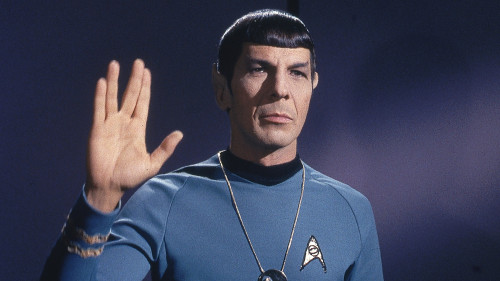
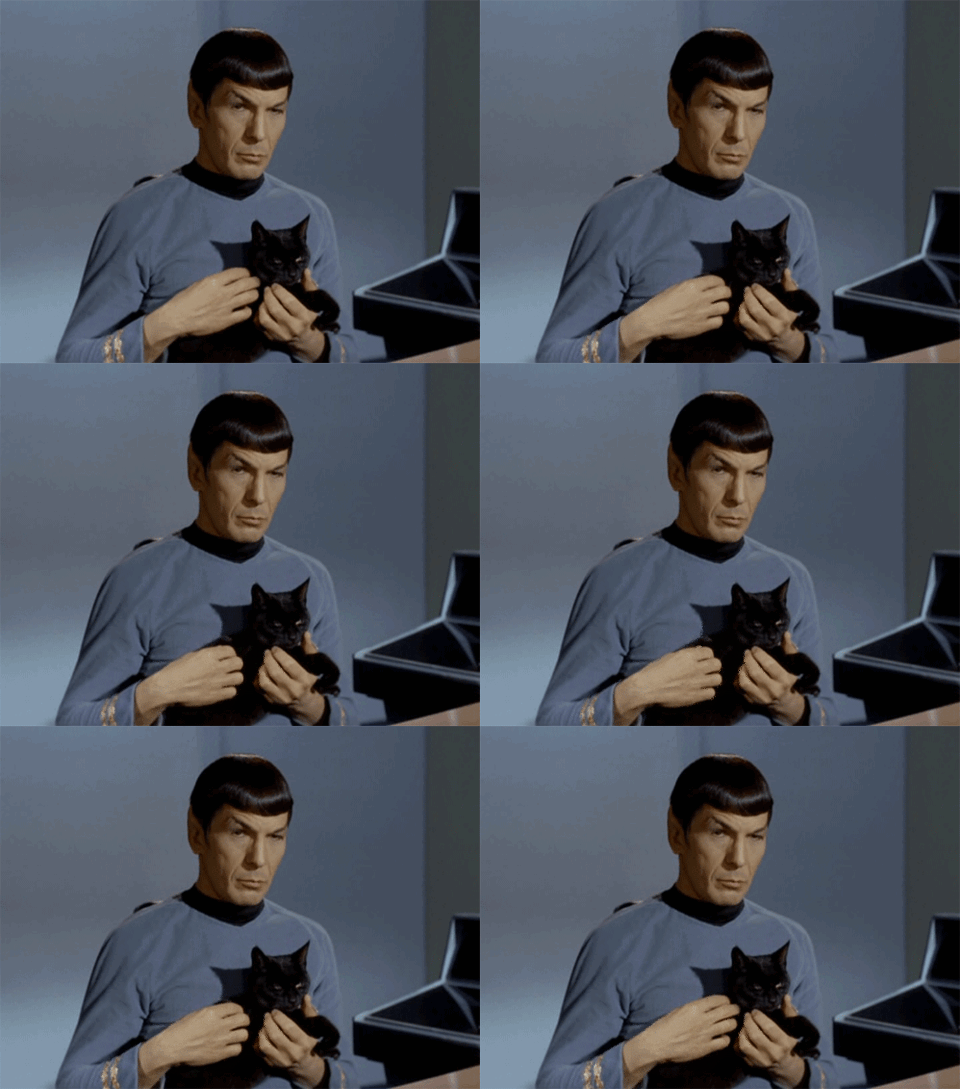
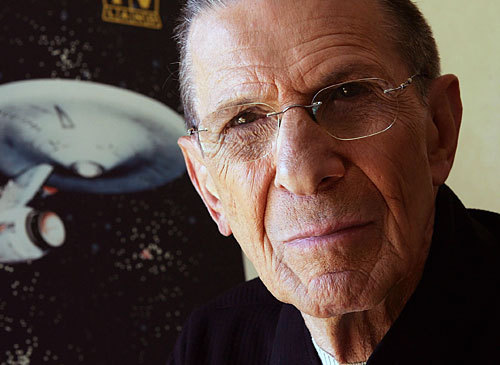
Love, Logic, and Why I Don’t Write Dystopia: Some Rambling Thoughts on the Occasion of Leonard Nimoy’s Passing

When The Wife and I were on our honeymoon, one of the stops was the Boston Museum of Science. I’m always a fan of science museums. During our visit, we saw a movie in their OmniMax theater. I don’t remember what the movie was, to be honest, but I do recall a bit at the beginning of the show, when the lights dimmed and a voice sounded over the speakers, which said something like this:

Good afternoon! The movie will begin shortly, but before it does, we need to properly calibrate our theater’s sound systems for use. To do this, we have enlisted the aid of a person who grew up in this very neighborhood. You may find his voice familiar.

This was followed by a beat of silence, and then another voice said:

Hello. Who put the BOMP in the BOMP shoo BOMP shoo BOMP; who put the RAM in the RAMALAMADINGDONG.

The second voice, the “local kid made good”, was Leonard Nimoy’s. I think most folks in the audience recognized that voice before he actually said “This is Leonard Nimoy”; his voice was, actually, one of the most familiar I ever knew. Gravelly and distinguished, that voice was, and Nimoy knew how to use it, which words to emphasize and where to pause just ever-so-slightly for effect.

I don’t remember a time when I wasn’t aware of Leonard Nimoy on some level. More precisely, I should say that I don’t remember a time when I didn’t know who Mr. Spock was. I remember Star Trek episodes very early on, all the way back to the first house I ever lived in. Trek was my sister’s thing, but I remember vague images from it. The most specific one I have is at the end of an episode called “Friday’s Child”, when, at the end, all is well and the female guest star’s character has given birth, and observing Dr. McCoy making baby talk to the kid, Spock asks why baby talk is a thing at all.

A lot can be said about Nimoy and Spock, and a lot has been said about Nimoy and Spock over the years. Most fascinating to me was Spock’s arc through the six “Original Crew” movies, from his attempt in The Motion Picture to purge himself of emotion to his own resolution of the “Kobayashi Maru” test to his rescue to his work to put his own brain back together (interesting that no fewer than three major Trek stories, one episode and two movies, devoted large amounts of time to putting Spock’s brain and mind back together), and finally to the confident, competent officer we saw in The Undiscovered Country. In that film, when Kirk and McCoy get in serious trouble and are arrested, Spock just calmly assumes command and immediately begins the investigation to find the evidence to free them. Through that film, Spock acts with a calm acceptance that the truth will come out, that they will find the evidence, and that they will find it by searching for it calmly and logically. It is of a piece with his line in the film about the need for faith, to trust that “the Universe will unfold as it should”.

My personal favorite Spock moment comes at the end of what is certainly one of the very best Trek episodes ever, “The City on the Edge of Forever”. Knowing that if he allows Edith Keeler to live, the future will change and Starfleet and the Federation will never happen, Kirk stops McCoy from pulling her out of the path of the oncoming car. McCoy rages at Kirk:

“You deliberately stopped me. Jim! I could have saved her! Do you know what you just did?!”

And Spock — ever calm, ever logical, ever accepting of what must be — simply says:

“He knows, Doctor. He knows.”

Nimoy knows that he can’t express sadness in that line. He cannot express heartbreak or the awfulness of the choice that Kirk has just had to make, and all the same, Nimoy conveys that Spock knows these things. He knows these things, he knows that they are real, and he does not belittle them in any way.

Since I’ve no memories at all of a time before Star Trek, it’s fair to say that it — along with Star Wars, obviously — are the biggest influences of mine in terms of my notion of what the world will look like, hundreds or thousands of years in the future. Will we always face problems and struggles and very real difficulties? Absolutely. But I don’t believe in dystopia. I cannot, will not believe that there is a future in the offing when the world is wrecked and everything is in ashes and only a very few are living well while the rest of humanity exists in dimly-lit squalor. I cannot, will not believe that, and that’s why I cannot, will not write it.

I believe that whatever difficulties and challenges we eventually face, we will do it from a brightly-lit viewpoint where it’s always clear how far we’ve already come. I believe that when we take to the stars, our ships will be beautiful and that they will explore with grace, and that we will confront our futures with logic and science as well as warmth and a twinkle in the eye that’s always there.

Why do I believe those things? In large part, because of a teevee show and some movies that Leonard Nimoy starred in.

After his long and prosperous life, Leonard Nimoy now belongs to the past. But he’ll always be a part of my future…my “Undiscovered Country”.

Share This Post

So here’s a new wrinkle on things….

On a discussion board at TheForce.net, there’s a thread devoted to positive articles about the Star Wars Prequel Trilogy. And wouldn’t you know it! My “Fixing the Prequels” posts get a mention!

And then it gets a little strange. Seems that at least a couple of fans over there don’t think I love the Prequel Trilogy enough. I can remember this happening two other times since I started writing those posts, and it always feels a bit odd to encounter folks who take me to task for insufficient Prequel-love. It’s almost always the other way ’round, and in all honesty, we’re talking about a world in which “You like the Prequels!” is a shorthand for “You’re a dummy and you have no idea what you’re talking about and we can remove you from any discussion of movies at all!”

So, what’s the basis for my insufficient Prequel-love? One person says this:

The Byzantium Shores fella is a bit peculiar, in that he includes the PT in his 50 favorite films list, yet proceeds to eviscerate all three of them via rewrites.

I don’t think I’d change a frame of my fifty favorite movies–that’s why they’re my favorites. They absorb and envelop me, without discernible imperfections. (I’ve never watched The Maltese Falcon and thought, “Gee, this Bogart/Lorre exchange is a bit on the dry side. I know what’ll spice it up!”)

And then another replies thusly:

Oh, yes. I find that a bit strange and a little distasteful, as well.

“I love this film, but I’d change this, and this, and this, and this, if I could!”

It’s somewhat like saying, “I love my girlfriend, but if this were different, and this, and this, and this, she’d be heaps better.”

Some love.

Uh-huh. OK. I see what you’re getting at here…but…well, I’m sorry, but this is just dumb.

The idea being expressed here is that if you really really really and truly truly truly love something, that means that you can never think it’s flawed in any way. To love something is to be of the belief that it is perfect. I don’t think I’m unfairly reading these two quotes, either — the first person says that his “favorite” films work on his “without discernible imperfections”. And then the second person agrees with that goofy bit about “I love my girlfriend but….” nonsense.

First of all, if what I do in those posts can be described as “eviscerating” the movies, then I hope these folks never watch the Red Letter Media guy in action. Or pretty much read any randomly selected article about the Prequel Trilogy, ever. “Eviscerated”? I went out of my way to point out nearly each and every thing I loved about those movies in those posts, some of which were big things and some of which were tiny moments that got ignored by the haters. Many of my tweaks are just that: additional lines of dialog added into scenes I leave otherwise intact. I don’t even counsel the removing of the infamous “I don’t like sand” line from Attack of the Clones. I said it many times while writing those posts: my goal wasn’t just to highlight the bad but to also shine the light on the good, of which there is a lot in those movies.

More importantly, though, is this business of “loving” the movies. I would hope that when we talk about how I “love” my wife and how I “love” a movie, we’re talking about two different notions with the word “love”, because otherwise, it’s just creepy. But let’s unpack that a little anyway, shall we? Because the fact is, I love my wife despite some real flaws, and I know that she loves me despite some gaping holes in my character. Love does not render one blind to flaws or imperfections. Love means that the flaws and imperfections are not enough to derail the love itself. That these two don’t seem able to grasp this is rather distressing.

I’m reminded of something Leonard Bernstein once wrote, in an essay about Gershwin. He cast this particular essay as a dialog between himself and a friend (a Broadway producer, if memory serves), and at one point, Bernstein lists a lot of flaws in Gershwin’s Rhapsody in Blue. He takes the work to task for basically being a collection of tunes stitched together with cadenzas and other kinds of rather unconvincing transitional material, and he sounds rather harsh in doing so, prompting the other guy to remark, “Wait a minute: you’ve performed the Rhapsody any number of times and have also recorded it on several occasions. Don’t you like it?”

“I adore it,” Bernstein replies.

“Then how can you take something you adore and riddle it with holes?”

Bernstein then says, of the Rhapsody in Blue, that despite its glaring flaws he adores it because “What’s good in it is so good that it’s irresistible.” And that is generally how I feel about the Prequel films: they are flawed. They are bumpy and uneven. They have moments that fall flat, They even contain scenes that are downright bad. But you know what? I still love them. I love the Prequel Trilogy because what’s good in them is so good it’s irresistible.

I love a teenage figurehead queen deciding that she’s not going to be the easy target for the bullying Trade Federation. I love the slightly rogue quality in Qui Gon Jinn. I love that the Jedi never realize there’s even a threat until way too late. I love how Palpatine hides in plain sight and executes his plans almost in full view. I love that Anakin’s fall from grace is brought about by his desire to clutch tightly on things he loves, almost echoing what Leia Organa would later say to Grand Moff Tarkin: “The more you tighten your grip, the more star systems will slip through your fingers.” I love that Anakin’s wrong choices will frequently mirror choices his own son will face decades later. I love planetwide cityscapes and battles in the rain with bounty hunters. And I love that a Gungan ne’er-do-well finds redemption on the battlefield, even if his arc is somewhat mishandled by too many trips to the comedic well.

I love a lot of other things about the Prequel Trilogy, and I don’t have to pretend that its missteps aren’t real to still find them, on balance, to be engaging, fun, and moving films that draw me in emotionally every time I watch them.

Share This Post