
Striking Back

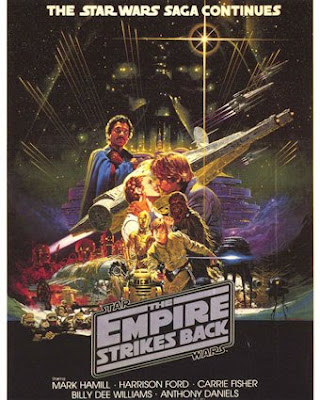
So, thirty years have passed since the release of Star Wars Episode V: The Empire Strikes Back. Wow, I guess. As luck would have it, I watched the film not too long ago — a couple of months, probably — and it still holds up extremely well. This is unsurprising, of course; the film is a bona fide classic.

I’ve read some tributes here and there around the Interweb and around Blogistan specifically, and I’ve found myself of mixed mind about the good words being said about the movie, mainly because a very large portion of comment seems to be of the “Wow, remember thirty years ago when Star Wars didn’t suck?” variety. I’m saddened by that, but hey, nothing I can do about it, either. It gets tiring, though — it seems that every event or happening or milestone that returns Star Wars to public consciousness is followed by the usual “George Lucas is the richest hack in history” comment. Oh well. Par for the course. Put it this way: I’m not much looking forward to 2013’s 30th anniversary of Return of the Jedi.

Empire came out when I was just eight years old, living in Hillsboro, OR. I didn’t see it for a few weeks after it came out, and yet, in those pre-Interweb days, I was able to go see the sequel to Star Wars three or four weeks after its release with zero idea of its story, other than what I’d seen in the TV commercials and such. I knew there was a snowy planet where the Rebels were fighting these big metal dinosaurs, I knew that there was a space chase through some asteroids, and I knew that there was a new character played by some guy named Billy Dee. That’s about it. I certainly had no idea that there was a Jedi master named Yoda, and I was actually surprised when the goofy little green guy in the swamp turned out to be Yoda. I was horribly dismayed when Han Solo got put into carbon freeze, but I thought, “Hey, no prob, they’ll save him before the movie ends.” Yeah…my first ever experience with a cliffhanger.

And I had no idea whatsoever that Darth Vader might be Luke Skywalker’s father.

How was this possible? Well, again, it was pre-Interweb, and pre-cable teevee, and all the rest of that. Also, I was lucky that my school district at the time let out for summer vacation in the first days of June, so Empire had been out for all of two weeks before I lost most contact with my schoolmates, most of whom hadn’t yet seen the movie either. So there was nobody to spoil the thing for me. I went into that movie almost completely blind. Empire was the last Star Wars film I was able to do that with.

Empire is, of course, now nearly universally hailed as the best of all Star Wars movies. There’s a lot to that, to be honest; the film earns its reputation with a superb script, amazingly paced and shot action sequences, a darker turn of events, and what may well be the best music John Williams has ever written. When pressed, I will almost always name A New Hope as my personal favorite Star Wars film, but the pro-Empire arguments are compelling.

Empire‘s beloved status really only started to grow after Return of the Jedi came out three years later. I don’t think it’s so much because Jedi was a bad film, as much as Empire‘s nature — being the middle act of a three-act story — meant that it could only really be appreciated once all the acts were out there, and the middle act’s true function and relation to the rest of the story could be judged. If I preferred Empire when I was a kid, it was mainly because it was shinier and newer than the older, more familiar film.

Here, in tribute, are my two favorite tracks from the entire brilliant score to The Empire Strikes Back. Empire was the first record album I ever bought with my own money. I didn’t even have my own record player at the time, and I had to listen to it in my parents’ bedroom when I wanted to hear it. I’d later get a record player that Christmas (it also had an 8-track tape player!), and Empire was the first thing I played on it. I played that album (a 2-LP set) to death over the next few years, wearing out the gatefold record jacket and putting numerous pops and scratches into the LP’s grooves themselves. Back then, John Williams would arrange his albums to make a “better listening experience”, which meant that tracks were not arranged on the album in the order they were heard in the film and that tracks from entirely different parts of the film were sometimes combined into a single track on the album. I played that album so much that even now, when I listen to subsequent remasterings of the Empire score, with all the tracks in film order, my brain still expects the original album order, with its tracks bearing titles like “The Heroics of Luke and Han”.

The first track is my favorite action cue from the score. Many fans would cite “The Asteroid Field” as theirs, but for me, it’s “The Clash of Lightsabers” all the way. This track underscores the second part of Luke’s duel with Vader, after they’ve moved from the carbon freezing chamber to a mechanical anteroom where Vader starts using the Force to hurl machine parts at Luke. It begins mysteriously and becomes more and more ominous as Vader toys with Luke; the music howls when the big window behind Luke is shattered and the wind begins to pour through the room, sweeping Luke out into the shaft, where he manages to catch onto the gantry and pull himself to safety. Then we cut (at the 1:38 mark) to Leia, Chewie, Lando and the droids as they work their way back to the Millennium Falcon. Lando’s theme (at the 2:00 mark) plays as he announces the evacuation of Cloud City. The rest of the track builds and builds (love the great brass bit starting at 2:36) which ends in first triumph as R2-D2 opens the door to the landing platform, and then the desperate version of the film’s Love Theme as the heroes race for their ship and freedom. This is one of my favorite action cues in all film music.

Second is from earlier in the film, on Dagobah: “Yoda and the Force”. This scene is, for me, the philosophical and emotional heart of just about all of Star Wars, when Yoda takes advantage of the sinking of Luke’s X-wing into the swamp to try to get through to Luke as to what it truly means to feel the Force. It’s a wonderful cue, from the meditative string writing to the noble statement of Yoda’s Theme as he lifts the ship from the water.

Happy birthday, Empire. You’ve never looked better.
Share This Post

I hope it tingles and tangles and prangles my transistors!

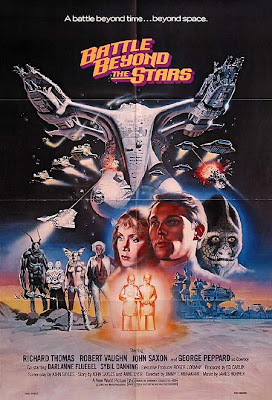
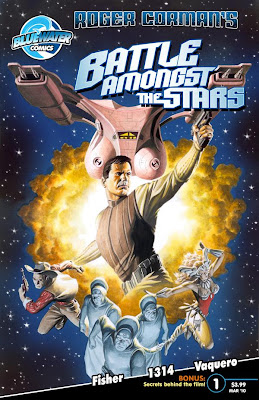
Remember my post a short while ago about the goofy 1980 B-movie space western Battle Beyond the Stars? I just figured that post represented a pleasant trip down geek memory lane for me and maybe a few others who recalled that obscure film. I certainly never figured that Battle was any kind of going concern.

Well, guess what: Battle actually is a going concern. It’s being revisited, in the form of a prequel comic book!

I am so going to read this.

Details here. The world needs more space opera comic books!

Share This Post

“I have come to conquer you!”

Battle Beyond the Stars is a movie that seems to confound expectations. If you watch it expecting a good movie, you’ll be disappointed. But on the other hand, if you watch it expecting a bad movie, you may be disappointed in the other direction.

Battle came out in 1980, one of a string of flicks to come out in the years after something happened in 1977 to suddenly make the entertainment industry think that there was a market out there for science fiction, especially in the form of explodey-spaceshippy-goodness. Battle was produced by Roger Corman, the king of the low-budget movie who nevertheless also served as a talent scout for later Hollywood geniuses, the most notable being a special effects artist who designed the spaceships for this movie and who later went on to bigger things. His name? James Cameron.

I saw Battle when I was in fourth grade. It was part of a double feature at the local movie house, the first film being a flick called Starcrash. I’ve never seen Starcrash since, although I do have a downloaded copy on one of my hard drives. Starcrash is legendary for being a bad movie, although I recall liking it when I saw it. Battle was the main event of the feature, though, and I was really looking forward to it, mainly because the nine-year-old me had thought that this trailer just looked awesome:

That trailer had run on a bunch of movies leading up to the release of Battle so I was really stoked when it came out. And when I saw it? Well, I was nine. I loved it. It had aliens and spaceships and lasers and things exploding and a cute girl. I got the soundtrack album, featuring music by a composer named James Horner, and I played that album a lot over the years, wearing it out and grooving to what I thought was the best explodey-spaceshippy movie music I’d heard outside of a Star Wars film. (Of course, my sample size was very small, I didn’t know film music enough to hear Horner’s huge debt to Jerry Goldsmith in the score, and I didn’t know enough about orchestration or performance to recognize a score that was recorded on a shoestring budget and which featured some really bad orchestrations, such as the track “Cowboy and the Jackers” which does things to the trumpet section that may be in violation of several international treaties.)

I saw Battle once more when it showed up on network teevee a few years later, and still liked it, and then I didn’t see it again for many years. I may have caught it in a cable broadcast sometime in the 1990s, but I’m not sure. I didn’t see it again in its entirety until just last week. How does it hold up? Well, movies like this don’t really “hold up” – that’s the wrong way to look at them. I had no illusions that it was some unheralded gem of SF moviemaking, but I was pleasantly surprised that it’s not that bad, either.

So, what about Battle Beyond the Stars, anyway? What’s it about? It’s very simple: The Magnificent Seven in space. That’s it. Literally.

We open with a giant enemy ship traveling through space (at a very slow pace, even though it has six enormous thrusters that are constantly firing).

The ship is ruled by our villain, Sador of the Malmori. Who are the Malmori? Are they a race of aliens? An empire? A family? We’re never told. Anyway, his ship approaches a planet called Akyyr (that’s how I’m spelling it, anyway), which, seeing that it is inhabited by peaceloving folk who only own one spaceship (which is a weather station), decides that he’s going to conquer it. So he hovers his enormous ship over them, projects his enormous face over their heads, and says, “I have come to conquer you.” (This he does after destroying the weather ship, just because he’s evil. The weather ship had been occupied by two guys who display the Akyyrian attitude by greeting an enormous and malevolent-looking spaceship by grinning, saying “Look! Visitors!”, and then contacting it by asking, “Could you identify yourself, please?”)

Anyway, Sador gives the Akyyrians seven days (“risings of your red giant”) before he’ll come back and finish conquering them. Why the delay? Who knows, but it gives the Akyyrians time to send one of their local young men, a boy named Shad (played by Richard Thomas as John-Boy Walton in space), off in the other ship they own, the secret one once piloted by the old blind guy who used to be an adventurer, to round up some help in the form of mercenaries.

The ship Shad flies is probably the single most famous thing from Battle Beyond the Stars. The ship is simply named “Nell”, and sure enough, it’s run by a computer by that name who speaks with the voice of a cranky lady. What’s most memorable about the ship, though, isn’t her personality; it’s her shape:

This ship is one of the more famed B-movie spaceships in movie history. You know you’re talking to a knowledgeable geek when the mention of the movie Battle Beyond the Stars draws the rejoinder, “Oh yeah, the movie with the ship that’s shaped like a pair of breasts!” The ship is more than that, though – it looks like a feline body with female breasts and then a couple of wings where the ship’s guns are, which sweep up and out, spread out to look like…well, it’s a very feminine ship. (And it was designed by a young filmmaker who was cutting his chops with Corman’s production crew, the afore-mentioned James Cameron.)

Anyway, Shad goes off in search of mercenaries he can hire to fight off Sador. On the way he meets a taciturn fellow named Gelt (Robert Vaughn), who only wants a meal and a place to hide from the apparent galaxy’s worth of folks who are after him:

He meets a ship commanded by a group of aliens who have third eyes on their foreheads and who use telepathy to do stuff:

He meets a “Warrior Valkyrie” named “St. Exmin”, played by Sybil Danning:

Given that her screentime involves her looking like this, it’s almost a crime that Danning doesn’t get more of it. She does, however, have one of the goofiest lines in movie history, and boy, does she deliver the hell out of it:

The other girl there is Nanelia (Darlanne Fluegel), who is every bit as naïve about people as Shad is, which makes her a perfect fit for him. She, too, gets far too little screentime, because she’s really cute. I remember her being one of the first females onscreen to impress me with her cuteness. I mean, look how cute she is in that clip, when she giggles at the prospect of learning how to “tingle, tangle, prangle” her new love interest from this warrior in the goofy headdress! Yeah, Nanelia is really, really cute:

Most memorable, probably, is the Space Cowboy Shad recruits who goes by the name “Space Cowboy”, played by George Peppard:

Cowboy is an arms runner who ends up leading the Akyyrian planet defense with the weapons he’d been running to a planet that Sador has just wiped out. Cowboy is extremely cool, although it’s hard not to expect him to grin and say, “I love it when a plan comes together!” But he does have one of the niftiest gadgets I’ve ever seen in a skiffy movie: he has a gizmo on his belt that dispenses Scotch and ice. (Why a Space Cowboy is drinking Scotch and not bourbon is never explained.)

And there are some aliens who are basically actors in rubber suits. You know how it is. Anyway, a big battle ensues (the Battle beyond the stars!), in which quite a few of the recruited mercenaries die heroically before Shad and Nanelia finally figure out how to do Sador in. I know, I just spoiled the movie, but what of it? Who would watch a movie like this and even consider the possibility of a bummer ending?

The clip above aside, there’s some witty stuff in the course of the flick, and one nicely done moment after Gelt (Robert Vaughn) dies, involving Shad’s bargain with him (a meal and a place to hide). There are also some exceedingly goofy moments, and like all B-movies, some of the stuff that happens isn’t explained very well at all (such as a scene in which the telepathic-collective aliens make their own stealth attack on Sador that involves sacrificing one of their own and a transplant of arms, believe it or not).

Of course, we have to have a romance between Shad and Nanelia, and it’s your typical awkward stuff (“Do they have kissing on your planet?”), but at the end, when victory has been won and all that are left are our hero and heroine returning to Akyyr, instead of ending with some neat dialog and some delightful snogging, we get Shad quoting at length from the “Varda”, the sacred text that the denizens of Akyyr are constantly quoting throughout the film. Weird stuff – the kid should be finally taking his big step into manhood, and instead he wants to recite from the holy book of a pacifist planet that sounds like The Art of War.

Battle Beyond the Stars is not a good movie. Nor is it a bad one. If you’re attuned to it and willing to go where it wants to go, it’s a fun little flick, if you’re into movies where the villain who is trying to conquer the planet Akyyr gets to shout in triumph at the end, shortly before his unimagined demise, “Akyyr is mine!”, followed by leading his entire bridge crew in sinister bad-guy-who’s-just-won-the-lottery laughter.

In other words, it’s the kind of movie that can only appeal to your inner nine-year-old. And that’s not a bad thing to be, is it?

Share This Post

To Barsoom!!!

AICN reports that John Carter of Mars is now shooting. I loved the first book in Edgar Rice Burroughs’s series when I read it some time ago (note to self: read the rest of those books), and I have to admit to being thrilled at the possibility of a good movie springing from that book. We’re talking serious skiffy adventure here, folks — for all the plaudits heaped on so many great SF novels for their forward-looking and insightful delvings into the nature of humanity and our place in the universe and how we deal with our technology and the threats we face from without and within, sometimes I want a story that can be illustrated thusly:

(image via)

Share This Post

To the Stars in Ships!

I’ve read a couple more space opera novels lately:

:: The Price of the Stars by Debra Doyle and James MacDonald was actually a re-read for me. The first time I read it was almost eight years ago, and I remember liking it but finding it a bit disappointing; it felt, at the time, like a retread of a number of tropes from Star Wars used in the service of a fairly unremarkable plot. Someone else, in the interim (I don’t remember who it was), told me that it was a better book than that, so I decided to give it another go. Glad I did.

Yes, it does present a very comfortable read for someone whose primary fascination with space opera is Star Wars. Our heroes all wield blasters, except for the more mystical warriors who carry a more antiquated weapon (staffs, in this case). Yes, the heroes fly around in a circular-shaped starship that was an ordinary freighter before it was souped up into one of the fastest ships in the galaxy. Yes, we’re in the wake of a galactic war. And so on. But I found the central story (a woman starpilot who has tried to make a life away from her famous family and their political connections is drawn back in when her mother is assassinated and her father charges her with finding out who did it) a lot more interesting this time out than I did the first time.

But this time, I wasn’t as bothered by all that as I was the first time. Maybe it’s that I’ve read a lot more SF in general and space opera in particular since then, or maybe it’s something else, but The Price of the Stars actually is a highly entertaining read. I look forward to continuing the series, called Mageworlds, of which this is the first. The first book is fun and breezy, but it also leaves behind enough questions so as to make for a desire to return to this universe. (Who and what are the Mageworlds, for example?)

:: The Price of the Stars is good old pulpy adventure space opera, but Pandora’s Star by Peter F. Hamilton is what they’re calling “New Space Opera” these days: it’s full to bursting with SF ideas, along with lots of other stuff. Lots of other stuff. Pages upon pages upon pages of other stuff. If The Price of the Stars is a potboiler, Pandora’s Star is an entire kitchen, staffed by a single mad chef of enormous skill.

Pandora’s Star is a doorstop of a book, by an author who likes to produce doorstops. Set in a new universe called the Commonwealth, Hamilton tells a story that begins with a brief flashback to humanity’s first landing on Mars — and then flashes forward several hundred years to an astronomer who is studying a binary star system a thousand light years distant, when, as he is looking at the star through his telescope, the star disappears. An exploratory mission is sent to the star, which turns out to have been completely enclosed — along with its sister star — with an enormous energy field. What’s behind the energy field, and why was the star enclosed? One of these questions is answered, and another is left open for the next book in the duology (Judas Unchained).

Hamilton’s story literally explodes all over the place, on dozens of planets. There are underground political movements that rely on terrorist tactics; there are singularly devoted detectives; there are scientists and starship officers; there are rich families struggling to maintain their power and poorer families looking to gain it; there are aliens who travel the stars simply by walking from one planet to another (yes, that’s what I said); there is a human society where people are regularly “rejuvenated” and where death itself has become rare (and even where dead people can be “rebirthed”), and where, in one of my favorite notions in the book, interstellar travel is conducted not by supralight-drive starship but by trains that simply roll through planet-based wormholes.

Pandora’s Star ends with a wild bang of a cliffhanger, so I’m greatly looking forward to reading the second book. (I’ve already noticed that Judas Unchained has something that Pandora’s Star really could have used: a list of the dramatis personae. Sometimes it gets a bit difficult keeping track of who’s who in Hamilton’s universe, but it’s worth it. This is as entertaining an SF read as I can recall, and a high-water mark in my ongoing space opera obsession.

Share This Post

By the light of the guttering candle

It’s been a while since I updated the books that The Daughter and I have been reading at bedtimes, so here are some capsules. Some of the most satisfying and entertaining reading I’ve done lately has come at night, as I read these books aloud to The Daughter, one chapter per night. What’s nice about reading aloud is that you can’t skim. At all. When reading silently, I do tend to slip into skimming once in a while, if I sense that I’m reading a passage that may not entirely be crucial to the action. Reading aloud re-directs my reading attention to each individual word, and I find myself noticing some more details occasionally that I might otherwise not notice. I also notice word rhythm a lot more, and which words actually work together sonically. This fascinates me.

A problem that occasionally crops up deals with dialogue, particular in instances where two characters are conversing. It’s not uncommon to find authors simply drop dialogue attribution altogether for a bit, since it should be easy for a reader to keep track of who’s talking. But I wonder sometimes if that’s true when reading this kind of thing aloud, so sometimes I’ll hedge a bit and throw in my own attribution, a “he said” or “she said” where the author didn’t. I suppose I could adopt other voices for different characters, but…well, no, I don’t want to do that.

Now for specific books:

:: Over the last couple of years, when I’ve been in the kid-lit sections at the local bookstores, I’ve noticed a glut of pirate tales on the shelves. I suppose the popularity of the Pirates of the Caribbean films has been the major factor here. We’ve picked up a couple of these titles, but the only one we’ve read thus far is Pirate Curse, by Kai Meyer. Meyer is a German author whose books are translated for English audiences, and Pirate Curse is the first installment in a trilogy.

Of the pirate books I’ve seen all over, all of them seem to employ supernatural goings-on. I’m not sure why this is the case, since surely a compelling pirate story could be written for kids (or adults) without ghosts or magic or whatever. I seem to recall that a fellow named Robert Louis Something wrote a highly-regarded story about a pirate whose name went on to grace a chain of fast food joints that offer deep-fried seafood, but I digress. Pirate Curse involves just that: pirates who are cursed.

As is always the case with children’s books, our heroes are children. A pirate girl named Jolly is what pirates call a “Polliwog”: she has the ability to walk on water. When her ship is ambushed and sunk in a trap, she is the only survivor, escaping to an island where she meets a farmboy named Munk, who also turns out to be a Polliwog. Munk’s parents are killed in another supernatural attack a short while later, and Jolly and Munk are fleeing for their lives, falling in with a mysterious man called the Ghost Trader as they try to evade the growing evil force called “The Maelstrom”.

This is a very exciting book, and we’re looking forward to returning to this series in the future. Its protagonists are engaging and sympathetic, there’s the requisite mystery of the Ghost Trader, the usual mysterious figure of authority whom I’m sure will turn out to be far more than he seems, there are fun battles and daring escapes. At times I did wonder if the book might have been a bit on the dark side, but The Daughter seemed to take it in stride. Recommended, if you like creepy pirates-and-ghosts tales with a lot of adventure in them.

:: Some time ago we read a book called Larklight, by Philip Reeve. This book looked so intriguing on the shelf at Borders that I picked it up, in hardcover, knowing nothing about it. It is a steampunk space opera that assumes that the universe actually operated the way science thought it operated back in the Victorian era: the luminiferous ether exists, people can breathe in space, and so on. The spaceships are basically sea galleons in space, powered faster than light by traveling the “Golden Roads” when someone performs an alchemical operation called the “Chemical Wedding”. The book featured the adventures of a brother and sister, Art and Myrtle Mumby, who live in a space mansion called Larklight. They fall in with a space pirate named Jack Havock (I think we need a moratorium on pirates named “Jack”) and his crew as they investigate a threat to Earth by a race of evil spider-like creatures. They also meet a spy for the British Empire (which now, naturally, extends into space) named Sir Richard Burton (whom, I suppose, is not translating the 1001 Nights) and a number of other fine people, few of whom are actually human. Larklight was a fabulously fun read, and we dutifully kept an eye out for the promised sequel.

Since then there have been two sequels: Starcross and Mothstorm. I don’t want to say too much about the plots of these books, except to note that Reeve’s wild and wooly Victorian steampunk worldbuilding continues to be a delight. We have asteroids connected by a railroad, time traveling, crusty space sailors from spaceports on the moons of Jupiter, strange things on the planet Mercury and stranger things beyond Neptune, diseases that turn people into trees, and more. These books are the most pure fun reading I’ve found since the early volumes in the Harry Potter series. The books are written in the first person, mostly from Art’s point of view, with occasional chapters from Myrtle’s point of view; Reeve very nicely maintains a completely different voice for each character. There are lots of footnotes which Reeve uses ingeniously to do his infodumping, and the books are illustrated nicely.

There was one spot at which I wanted to reach into the book and slap Reeve. During a space battle sequence, he wrote a paragraph in which he describes a ship “shaking, rattling, and rolling” as it evades “great balls of fire” and the characters suffer through a “whole lot of shaking going on”. I groaned and then had to stop reading to explain why I was groaning to the kid. I wish Reeve hadn’t done that.

So, if you’re wondering how a Victorian steampunk space opera can possibly work, check this series out.

:: Some time ago we read Lloyd Alexander’s classic Chronicles of Prydain. The Daughter loved it, although she never really said that she loved it. I know because it comes up in conversation now and then, such as when a character named “The Bard” in the book we’re reading right now came up and she said, “You mean, like Fflewddur Fflam?” So I was happy to use my reading time with her to revisit Alexander’s less-noted Westmark Trilogy, which I think is the equal of Prydain. Thus far we’ve read the first two books, Westmark and The Kestrel.

In the Prydain books, Alexander explored themes of coming-of-age, of the nature of heroism, and the nature of duty. While some of those themes are revisited in Westmark, Alexander is more interested here in more mature notions: freedom and its limits, the best type of government, whether violence is ever justifiable.

Set in a kingdom called Westmark, the era is roughly analogous to the French Revolution; pistols, muskets and bayonets are the weapons of choice here. In the first chapter we meet a young man named Theo who works as an apprentice to a printer in a time when freedom of the press is greatly curtailed. He quickly finds himself on the run from the law, taking refuge with a con-man named Las Bombas and his dwarf companion Musket; along the way they meet a street urchin girl named Mickle and a revolutionary beloved by the sophisticated city youth named Florian. He also comes to the attention of the kingdom’s chief minister, Cabbarus, and gradually Theo finds himself in the midst of turmoil engulfing the whole of Westmark.

This trilogy is as much about politics and concerns of adults as it is about coming of age and heroism. Alexander doesn’t shrink from the fact that many who are called “heroes” are people who have committed acts of questionable heroism for reasons that weren’t entirely noble; he also doesn’t shrink from the fact that great conflicts can arise between people who are genuinely trying to make a good world as best they can, and he presents few, if any, easy answers. At times the story gets pretty dark, actually, but it’s still exciting, briskly paced, and full of memorable characters.

I’ll report back when we finish the trilogy.

Share This Post

Trekkin’

A couple of Star Trek related notes:

:: Ron Moore confirms what many have suspected over the years: that the technobabble on Star Trek: The Next Generation was just made up, fill-in-the-blanks type stuff.

“It became the solution to so many plot lines and so many stories,” Moore said. “It was so mechanical that we had science consultants who would just come up with the words for us and we’d just write ‘tech’ in the script. You know, Picard would say ‘Commander La Forge, tech the tech to the warp drive.’ I’m serious. If you look at those scripts, you’ll see that.”

This comes as absolutely no surprise, obviously. The over-reliance on technobabble has always been what keeps me from ranking TNG as high as The Original Series or Deep Space Nine, both of which had much greater emphasis on their characters. TNG was at its best when it used character to its advantage, but so often it felt as if the producers just didn’t trust their characters and their cast to carry the weight fully, which is why we ended up with so many episodes where a problem is discovered, we investigate the problem for a while, and then wait until the last ten minutes when Data or Wesley would come up with the pulse or beam or blast of some kind of particle that would fix the problem with the space-time continuum.

:: That said, I was recently discussing Star Trek ’09 (which is how I now refer to the recent movie, which I discussed some months ago) with a friend at work, who was baffled as to why I had such a hard time buying into the events of the movie when I would cheerfully swallow the idea of, say, the Genesis Device. I thought that a fair question: why did I have such a hard time with the notion of a drop of “red matter” creating a black hole in the middle of a planet, while I would accept the idea of a torpedo the size of a refrigerator converting a dead planet into one with a nice biosphere?

Well, I don’t know, really. Part of it is probably how the ideas are treated. The Genesis Device is constantly referred to as an “experiment” in Trek II and shown as an outright failure in Trek III, for one thing. For another, though, the Genesis Device didn’t come on the heels of a long list of Star Trek doomsday devices, substances, and elements. The Genesis device was a new item, but now, with Trek ’09, I’ve heard a lot more along the way. Trilithium, which can halt the nuclear reactions in a star. The Tox Uthat, which does the same thing. There are many more in that vein. It gets harder and harder for Star Trek to come up with threats like these.

It also hurts the cause of the “Red Matter” when the film in question is chock-full of all manner of SF whoppers. I’ve generally found that I’ll accept something that is clearly bollocks as long as it’s not literally bollocks. That’s another part of why I can accept the Genesis Device: my brain accepts it as a fully fictional item, and I’m fine. But Trek ’09 gives us things like black holes taking one back in time, supernovas that threaten to destroy the entire galaxy, and so on. By the time we get to an explanation of “red matter”, Trek ’09 has, for me, worn out its quota of scientific-implausibility forgiveness.

:: A tiny detail also glared out at me upon re-watching the movie. At one point, Kirk, and the rest of our heroes, are at Starfleet Academy, where he decides to take the Kobayashi Maru test for the third time. In a scene with McCoy, he says he’s taking it “tomorrow”. That night, though, he’s making out with a green-skinned cadet who happens to be Nyota Uhura’s roommate. Uhura comes in and describes a distress call she’s just intercepted from the Klingons, in which an entire Klingon armada has been destroyed by a Romulan ship. OK.

Cut to the next morning, when Kirk is beating the Kobayashi Maru test after reprogramming it. This causes scandal, so there is a full tribunal of, it appears, all of the Starfleet cadets in Kirk’s class. As the tribunal goes on, a distress call from Vulcan comes through, causing Starfleet to mobilize its fleet. Off everyone goes to their ships, with cadets first being assigned to various vessels, then flying to them by shuttle. Some legerdemain on McCoy’s part gets Kirk on board the Enterprise, and after some more stuff surrounding the launch, Kirk listens to the ship’s briefing on what’s happening and realizes that Vulcan is under attack. He races to the bridge to tell Captain Pike what he’s learned…citing the attack on the Klingon fleet as evidence. So far so good…except that he says that the attack happened last night.

Wait a minute.

So, all of the above has happened in one day. Kirk’s reprogramming of the Kobayashi Maru test, his taking of the test, the suspicion and investigation of his possible cheating, the mobilization of Starfleet and the launch of an entire fleet whose crews haven’t even been assigned yet. Yeah, I have trouble with that.

:: I’ve decided that, at long last, I believe the entire Kobayashi Maru test to be complete BS.

We’ve seen the Kobayashi Maru test twice now: in Star Trek II: The Wrath of Khan, and in Star Trek ’09. The idea seems pretty simple: it puts a cadet into a situation from which there is no possibility of a “win”, and thereby tests what the cadets do in a “no-win” situation.

The scenario depicted in both instances is the same: a distress call is received from a damaged ship, the Kobayashi Maru, in the Neutral Zone. It’s illegal to enter the Zone and is seen by Klingons as an act of war, so the cadets have a hard choice: respect the Neutral Zone and allow the Kobayashi Maru to die, or embark on a rescue mission. Both films establish, through dialog, that rescue is impossible, so then the choice becomes fight-or-flee. So the possible resolutions seem to be these: attempt no rescue, attempt a rescue but abandon it as soon as the shooting starts, and attempt a rescue and go down in flames with the ship. Hence the “no-win” scenario.

In Wrath of Khan, Admiral Kirk tells Saavik that the Kobayashi Maru test is a “test of character”, presumably to see how cadets deal with the “no-win scenario”. It’s “facing death”, Kirk says: “How we deal with death is at least as important as how we deal with life”. And later on, when Saavik learns that Kirk actually cheated to beat the test, she replies: “Then you never have faced that situation. Faced death.” I’ve always found that line extremely odd. Kirk hasn’t “faced death”? The guy who stood and watched as Edith Keeler died, who had to kill his own best friend (Gary Mitchell), and so on and so forth? He never “faced death” because he cheated his way out of a fake test? Right.

In Trek ’09, we have the afore-mentioned tribunal after Kirk cheats. Spock tells Kirk that he has failed to grasp the point of the test: it is to ensure that cadets in command situations have “experience fear” and dealt with it in a command situation.

So, the Kobayashi Maru test is, basically, a device to make cadets “face death” and “experience fear”. But the problem is this: by its very nature, the Kobayashi Maru test can do neither of those things.

If you’re a Starfleet cadet taking the Kobayashi Maru test, the problem is this: you know you’re taking a test. How can you “experience fear” or “face death” in any kind of meaningful way when you know that you are not on the bridge of a starship but in a simulator on the planet Earth? You are not facing death when you know that you’re not actually ordering a starship into the Neutral Zone to rescue a ship that doesn’t exist, and you can not be filled with fear — other than the typical kinds of academic fear, such as what will my fellow cadets think of me when I fail this again or how embarrassing will the post-test talk with the professors be — when you know that you’re not facing any kind of real situation.

Basically, the Kobayashi Maru test by its very nature can reveal nothing meaningful about those who take it. It’s an interesting diversion and nothing more. (And really, the only reason they came up with it in the first place was so that Trek II could fake us out at the beginning, since everybody knew that Spock was going to die at the end of the flick — I know that when I saw the movie as a ten-year-old kid, I saw Spock “perish” as the bridge burned after the Klingon attack, and I thought, “Wait, they killed him in the first five minutes?!”)

Interestingly, this kind of test was actually handled in much more convincing fashion in an early episode of The Next Generation, called “Coming of Age”. In this episode, Wesley Crusher is undergoing testing to see if he makes it into Starfleet Academy yet. It’s all typical academic stuff, although there’s something called a “Psych Test”, which is tailored to each student individually based on their psychological profile. The day comes for Wesley’s, and he goes into the room where he’s to take it, whereupon he hears a distant explosion. Getting up and leaving to investigate, he finds that a laboratory down the hall has erupted into fire, endangering two scientists. The room is about to be sealed, and Wesley can only get one guy out himself, so he makes his choice and drags the one guy he can out before the room is sealed, killing the other scientist.

Of course, the whole explosion was the test, and both scientists are fine. The test for Wesley was to see if he could, in a desperate situation, make the kind of decision that cost someone their life (since his father had died years before when another officer had made a similar decision). But what made it effective was that at no point during the test did Wesley ever realize that this was the test itself. The Kobayashi Maru test isn’t like that at all; especially not in Trek ’09, when the cadet in the Captain’s chair can actually see the professors watching him, in the overhead galleries.

:: Finally, I hope the next movie reveals that Gaila, Uhura’s green-skinned roommate, wasn’t killed in the incredibly-short Battle of Vulcan. I found her both hot and cute. For a green-skinned Orion girl.

OK, I’m done geeking out for now.

Share This Post

Into the Hole

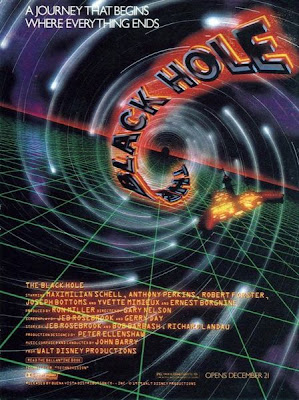
Hey, remember the movie The Black Hole? I ran across a clip of it on YouTube the other day, and I’ve been thinking a bit about it. Maybe I should track down a DVD at some point. (Spoilers here, but the movie’s 30 years old, so….)

The fine folks at Disney made The Black Hole in 1979. It was their entry in the “Hey, the kids do sure like that Star Wars, so we needs ourselves a space movie too!” sweepstakes that resulted in lots of space opera stuff, some of it not bad (Battlestar Galactica), some of it campy but fun (Battle Beyond the Stars), some of it weird (Moonraker), and, naturally, some of it downright awful (Starcrash). So in 1979, along came The Black Hole, which flopped at the box office. I suspect that word-of-mouth wasn’t that great, and maybe by then the whole space-flick thing was getting a little tiring anyway and besides everybody knew that the real thing, in the form of The Empire Strikes Back, was less than a year away.

But The Black Hole isn’t bad. Neither is it all that good. It’s solidly in the middle, occasionally approaching “good”, and then veering back toward “bad”, but never setting itself up at either pole. So ultimately it’s a pretty vexing movie — was it a good movie inside a bad one, or a bad movie inside a good one?

Our story: a small spaceship, the Palomino, is in deep space when it starts on its journey back to Earth. On the way it comes across a black hole, and perched on the edge of the hole is an immense spaceship which turns out to be the USS Cygnus, which was reported lost years before. Here’s the Cygnus, which is one of the most beautifully-constructed movie spaceships ever:

Investigating, they discover the Cygnus in the command of Dr. Hans Reinhardt, who operates his ship with the aid of a crew of humanoid drones, a squadron of security robots, and one very nasty robot named “Maximilian”. Here’s Maximilian:

Pretty menacing, eh? Especially as he doesn’t walk but rather floats around in the air and is equipped with a buzz-saw weapon which he uses on one unfortunate character later on (who tries to defend himself with a thick folder stuffed with papers — self defense FAIL).

Anyhow, it quickly becomes apparent that Reinhardt is crazy and planning to fly his ship into the black hole. In keeping with movie crazies of all stripes, Reinhardt refuses to let the crew of the Palomino leave, so now there’s a race against time: can our heroes escape before the crazy guy and his crazy robot take them on a journey into certain death?

It’s actually a kind of nifty plot, and watching the movie, I always get the impression that the Disney folks, in looking for a way to cash in on the post-Star Wars SF craze, looked for any script they could find, optioned this one, and then, well, Disney-fied it up a bit. There’s some serious stuff in this movie, lots of beautiful production design, and even a number of moments of genuine “sensawunda”. Here, for example, is the bridge of the Cygnus:

Seriously, that’s a gorgeous bridge, isn’t it? And nothing at all like the bridges or cockpits of big spaceships in movies to that point, where there’s a screen or window at the front and everybody’s facing it.

But then, along comes the Disney “We gotta make this for kids too!” stuff. Enter our heroic robot, VINCENT, whose design just screams out, “We need an R2-D2, only cuter!”:

And later on, after we’ve gotten used to VINCENT, we meet an earlier model, who is called in the film — I kid you not — “Old BOB”:

Old Bob is voiced by Slim Pickens. Can’t have a movie without an old-timer to tell the heroes what’s really goin’ on, I guess. (VINCENT and BOB are acronyms, of course, but I’m too lazy to Google what they stand for.) And our heroes end up in a firefight at one point with some very goofy looking security robots:

Well, Imperial stormtroopers they ain’t, although I did like their double-barreled blasters.

So, do they escape? Well, yes — and no. They get free of Reinhardt, by stealing his personal ship (or something like that), but it turns out that it, too, is programmed to go through the black hole, so in they go, after the Cygnus has already been destroyed. This is all well and good, of course; the black hole itself is the film’s gun on the mantelpiece, and we’ve got to see it go off, right? This brings us to the film’s final scenes, in which we see not just what happens to our heroes as they go through the black hole, but also, in one of the oddest sequences to ever appear in anything with the Disney imprint, what became of Reinhardt and Maximilian:

Imagine what that felt like for a nine-year-old kid sitting in a theater! Evil genius and murderous robot somehow fuse together in some kind of sexual-looking event, and then end up presiding over Hell? Huh-whuh?!

Ultimately, The Black Hole is too slow-paced to be really exciting; its camp elements undermine the more successful moments of mystery and impending doom; its mysteries make the camp stuff all the more irritating. But still, it’s kind of a fun flick to watch — especially if you can arrange to be drunk when those last six minutes arrive.

Share This Post

Thrusters and Blasters and Spaceships, oh my!

Notes on a couple of space opera reads I’ve done lately:

:: I greatly enjoyed Andre Norton’s Moon of Three Rings a few months back, so more recently I read another by her, The Zero Stone. Where Moon of Three Rings was more planetary romance than space opera, The Zero Stone actually is full-on space opera.

Murdoc Jern is a jeweler by trade, who has learned the ropes of the business from his father and is now traveling the galaxy with a business associate, trading in rare gems from many different worlds, when his associate is killed and Jern has to make his escape by taking refuge aboard another ship. Jern also possesses a ring whose stone is deeply powerful and deeply mysterious — the “Zero Stone” of the title — and it soon becomes clear that everyone is basically after him for the stone.

Eventually his only trusted companion is a brilliant psychic cat named Eet. (Well, he’s an alien who is very cat-like, not an actual cat.) With Eet at his side, Jern must evade numerous villains and adversaries in order to win his freedom. I don’t want to say more than that, because the story is fairly rollicking and wide-ranging, despite its mere 221 pages in the old edition that I own. The story takes us to odd worlds and shows us interesting aliens, all the while telling a fairly gripping tale about greed and peril and freedom.

I find reading older science fiction novels refreshing, in a way. The authors of the 1950s and 1960s had to take a “get in, tell the tale, get out” approach to storytelling, packing their galaxy-spanning notions along with interesting characters and drama into much shorter books than are the norm today. I love a florid and long epic as much as the next person, but there’s often something just invigoratingly pleasant about reading a book that has an epic story in less than half the length of an almost-standard novel today.

(I’ve now discovered that The Zero Stone has a sequel called Uncharted Stars, which I just happen to already own. Huzzah!)

:: More modern, and thus more epic and thus longer, is In Conquest Born by CS Friedman. This is a big story told on a very large canvas. Two races, the Braxana and the Azeans, have been at war for a very long time as their respective empires have spread across the stars. Our focus is on one warrior from each culture: Zatar from the Braxana, and Anzha from the Azeans, who find themselves endlessly opposing each other, bringing the endless war to a deeper and more personal level. This book is as much character study as it is story, alternating between Zatar and Anzha as their respective lives become more and more intertwined as the book progresses.

While I liked In Conquest Born a great deal, I must confess that I wanted to like it more than I did. The characters are well-drawn and well-developed; they are complex, with motivations that aren’t always easy to understand. The main problem I had with the book was that it often felt somewhat disjointed. There are times when the book doesn’t feel so much like a novel as a collection of inter-related short stories and novellas about the same characters. Also, there are quite a few plot threads that never seem to go anywhere or get visited again. Those aren’t deal-breaking quibbles, though; I greatly enjoyed In Conquest Born and recommend it.

Share This Post

Moving forward – the same direction as always.

I wrote once before on the initial graphic novel set in the Firefly universe, Those Left Behind. Now there are two such graphic novels; Those Left Behind has been joined by Better Days. While I’ll pretty much jump at nearly any chance to revisit this universe, neither of these two graphic novels is completely satisfying, which is oddly disappointing considering my belief that comics is the ideal medium for the Firefly universe to live on, if live on it does.

The problem with each one boils down simply to the fact that they are too short. It took me about twenty minutes to read each one; they’re just too slight. It’s really pretty frustrating; you would think that comics would give Joss Whedon room to breathe with his Firefly tales, but apparently these books are collections of miniseries that were mandated at just three issues apiece. The result are fun stories full of that Firefly flair that nevertheless flash by, without a real sense of the stories being fleshed out or with the subplots resolved too quickly or not given enough room to breathe.

Those Left Behind is apparently intended to lead right into the movie Serenity, and thus sets up things like Shepherd Book having left the ship when the movie starts and the two “Hands of Blue” pursuers of River Tam having been replaced by The Operative. Thus, parts of Those Left Behind probably won’t make sense to anyone who hasn’t seen the movie, or if they do make sense, they won’t realize how things are resolved at the end of the story.

Better Days tells a “standard” Firefly story; this could have been an episode of the show, really. The crew performs one of its less-than-legal jobs, but unlike most jobs Captain Reynolds and crew take on, this one results in a huge payday, resulting in the crew getting to indulge some fantasies as to what they would do if they had lots and lots and lots of money. (Jayne’s fantasy is a hoot, and River Tam’s is…well, you’ll have to read it yourself.) It’s a good story, but again, it contains one too many subplots for a story that is only being told in three issues. Also, since the page count is at a premium, the action sequences in these comics tend to be hard to follow. They almost seem like individual frames taken from filmed action sequences, and as such it’s often hard to understand who is doing what.

This is all a shame. I don’t know if Firefly has a future in comics or not; while I enjoyed these two books, I can’t think they really helped the cause at all. Three issues here, three issues there – that’s no way to sustain interest in the ‘Verse. Bummer.

(Apparently a third Firefly comic, one which fleshes out the background of Shepherd Book, is on the way at some point.)

Share This Post