Game theory

One of the most prominent authors in the “New Space Opera” movement is Iain M. Banks (who apparently also writes fantasy, but under the name “Iain Banks”, without the ‘M’), whose highly-regarded novels are all set in a far-future society called “The Culture”. It’s the ultimate human paradise, apparently, with all needs taken care of by society and with people having achieved a status of near immortality. (Death is probably still a certainty, but it’s put off for a very long time when the only ways you can die are to perish in various mishaps or the like.) Banks also represented a fairly large gap in my SF reading history, which I’ve begun to correct, starting with The Player of Games.

Now, the fact that I haven’t read much Banks isn’t entirely my fault. Banks is a British writer, which means that for various reasons I’m not really privy to, his work has had a spotty publishing history here in the US. (In fact, the copy I own of Banks’s Consider Phlebas, which I bought in Canada, is specifically labeled on the back cover: “Not for sale in the US”.) Of late Banks’s older Culture novels have started to appear again, courtesy the Orbit label, so I can finally start collecting him, which I intend to do, seeing as how I enjoyed The Player of Games a great deal.

Our hero in The Player of Games is Jernau Morat Gurgeh, a man who is one of the greatest, if not the greatest, gamers of the entire Culture. He plays nearly every game that has ever existed, and he plays each one at an extremely high level. He is one of the greatest masters of strategy games to ever live, and as the book opens, he is bored. Desiring new challenges, he learns of a far-off star empire whose entire society revolves around a game that is so massive and so complex that whoever wins the game becomes Emperor. Gurgeh is entranced by the notion of such a game, and he undertakes the journey to the Empire of Azad to play their game. What unfolds there is fascinating, occasionally harrowing, and always surprising.

Gurgeh is an interesting character. Banks doesn’t portray him terribly heroically; in fact, Gurgeh is quite flawed. But his flaws don’t necessarily stop us from rooting for him, even when a stupid act on his part results in his being blackmailed by a sentient robot drone. The whole book is also based on a very nifty idea, this game whose very complexity determines who will rule the Empire. It is to Banks’s credit that he doesn’t really try to give a good description of the game or its rules; he throws out little details here and there that suggest aspects of the game, but for the most part he leaves it all up to the reader. That’s a wise choice, seeing as how the reader’s imagination is really the only place where a game like this could exist.

The book also has some wonderful Sfnal touches, the most striking being the planet whose biological life cycles are based on the frequency with which a fire that constantly circumnavigates the globe sweeps by. I’ve also been told that a key motif in Banks’s Culture novels is that the starships tend to have distinctive names that are often jocular in nature. One ship is called the Limiting Factor, which isn’t terribly funny, but another is called the Kiss My Ass, which kind of is. Having not read any of the other Culture books, I found The Player of Games a fine introduction to a milieu that is apparently very large and complex. The book remains pretty well on point throughout, with fine pacing and a cast of characters that isn’t too unwieldy to keep straight. It’s a different kind of space opera, to be sure; this isn’t the kind of space opera that has great fleets of warships pumping energy rays at one another. But it is, most definitely, space opera. And it’s a fine one. I’m looking forward to continuing exploring the Culture.

Share This Post

Spaceships that go “Whoosh”!

No matter how far afield I go, I always return to my true reading love: space opera. Here are notes on a few recent space opera reads, with qualification in one case.

:: As I noted when I posted about John Scalzi’s Old Man’s War, military SF isn’t really my thing. I like it once in a while, but a lot of times, Mil-SF seems to come too close to being “war porn”: fiction for people who really like war. My space opera tastes require some of that good old “sensawunda”, along with some elements of the fantastic. Usually you won’t find that in Mil-SF in great degree. Well, you don’t find that in great degree in Scalzi’s OMW follow-up The Ghost Brigades, either, but what you do find is a compelling story with finely written characters and a complex and fascinating plot that deepens our view of the universe Scalzi had set up in his first novel.

For those not up to speed, in OMW we learn that Earth is the homeworld for the expansion of the human species throughout space. Unfortunately, lots of other alien species are also trying to expand throughout space, and it turns out that Scalzi’s alien races aren’t of the Star Trek type, willing to be lived along with in peace and harmony after Captain Kirk or Picard drops by to kick-start them out of whatever weird habit it is that they’ve got going on. No, Scalzi’s aliens hate humans and want to kill them, and for the most part, Scalzi’s humans hate the aliens and want to kill them right back. So the stellar human government, the Colonial Union, has created an army of enhanced humans called the Colonial Defense Force (the CDF), whose ranks are filled with the elderly from Earth who want to leave their world behind and get a new lease on life (by taking on a new, enhanced body). Hence the title Old Man’s War.

Mentioned also in OMW was the “special elite forces” of the CDF, the “Ghost Brigades”, whose ranks are filled not with elderly recruits but with soldiers specifically cloned from the DNA of the dead. This second novel focuses attention on these special forces soldiers and the trials they face as clones. The plot is fairly simple, at the outset: the Colonial Union is facing a daunting alliance of three alien races, who are being aided by a traitorous human who is giving the aliens information on the Colonial defenses. In an attempt to access the memories of this traitor – who has left behind a clone in an attempt to fake his own death – the CDF proceeds to “grow” a new soldier out of the traitor’s clone’s body, a soldier named Jared Dirac, whose memories do, in fact, later begin to surface. The questions become not just where is the traitor and what has he done, but also why he has done it at all. The answers to these questions are pleasantly surprising.

The Ghost Brigades is a stronger book, overall, than OMW, which was much less a plot-driven tale than an episodic one. TGB maintains a tighter pace, which picks up quite a lot of steam as the climax nears, and the resolution is particularly satisfying, if a tad bittersweet. (Yes, bittersweet. In a Mil-SF novel.) I was especially pleased that some of the questions I had about the ongoing political nature of the OMW universe are explored here; I figured Scalzi had some answers up his sleeve, and here he gives them. TGB is a terrific read. I give it two stars. Why only two? Because Scalzi says something mean about the Ewoks in the book, and that’s just not nice. Otherwise he’d get three and a half.

(I’m pretty sure I recall Scalzi indicating that his intention with TGB, at least in part, was to write a book in a series where it wasn’t necessary to have read the first one. Since I’ve read the first one, I can’t say for sure how well he achieved that goal, but my sense is that if you haven’t read OMW, you might not pick up on some nuances in TGB but you’ll be able to understand the book just fine.)

:: Somewhere I got the idea that Andre Norton’s Moon of Three Rings was a space opera, but it’s not. It’s got some of that space opera feel, but the entire book takes place on a single planet, with nothing happening in space per se, which makes it not space opera but space opera’s sister genre, planetary romance. Oh well. I love a good planetary romance as much as a good space opera, just as long as I know I’m reading one so I’m not getting halfway through the book and thinking, “Where are all the spaceships?” (Now, there is a sequel to Moon of Three Rings which I haven’t yet read, called, I think, Exiles of the Stars. Maybe that’s a space opera? I’ll report back when I read that one.)

Anyway. To my knowledge I’ve never read any Norton before, which makes her a pretty big hole in my SF reading life. Andre Norton died a few years ago, and she was one of the most prolific SF writers of the 20th century. How she managed to slip through the cracks of my reading life until now, I’m not sure, but I’m glad to have finally got round to her and I plan to read more of her in the future.

Moon of Three Rings takes place on the planet Yiktor, where the trade ship Lydis has just landed. Crewman Krip Vorlund decides to go out and see some sights, eventually taking in a “beast show” – an exhibition of Yiktor’s exotic wildlife – that is run by a charismatic priestess named Maelen. Before Vorlund can return to his ship, however, he is kidnapped by a “Combine” which intends to use Vorlund as a tool to gain weapons from the space traders in order to continue their conquest of all of Yiktor. Maelen comes to Vorlund’s rescue, but her method is somewhat unique: she causes Vorlund to switch bodies with a beast of Yiktor called a “barsk”. The barsk is a wolf-like beast, and now Krip Vorlund finds himself in a race against time: he is evading his pursuers at the same time he is trying to recover his own body and then make it back to his ship before it blasts off again.

As noted, this was my first encounter with Andre Norton. It took me a little while to get into her style, but once I did, I realized that she had a finely honed voice and a gift for descriptive imagination. Her alien environments are alien enough to be exotic but not so alien as to be unrecognizable, and she is able to convey the nature of various beings without resorting to easy metaphors (like my use of “wolf-like” in the preceding paragraph). One thing that did take a bit of getting used to was likely specific to this novel: she alternates between the viewpoints of Krip Vorlund and Maelen every couple of chapters, but each is written in first person, so it was a bit difficult getting used to this. Fortunately she varies the voices of these characters nicely, and I noticed that she didn’t do the obvious thing of basically saying, “OK, now let’s go view these same events through the other person’s eyes now.” Each time the viewpoint changes, the story keeps going from the place the other character had left it. I appreciated that.

I don’t know how much Norton I’ll ever get to read; she was very prolific. But I definitely plan to read more.

Finally, a regular reader of this blog and a regular correspondent of mine offered up a recommendation way back when I first announced my desire to read as much space opera in one lifetime as I can: an old book called Space Viking by H. Beam Piper. Just finding this book proved a bit difficult. Several times I would locate a copy on eBay, only to get outbid on it (or have to pass it up in moments of lean economic activity). The book has actually shown up on Project Gutenberg, so I figured I would have to read it that way eventually – until a few months ago when I was in Barnes&Noble and just happened to see that Space Viking had been reissued in mass-market paperback by Cosmos Books. Score! Anyway, Space Viking was one of the books I took with me on my trip out west for my mother-in-law’s funeral. I started it on the plane ride home, and finished it over the subsequent weekend.

What’s Space Viking about? Well, it is a tale of murder and revenge, of love and loss, of space wars, of rogues and knaves, of court politics and the nature of history, lots of worlds, lots of characters, and nice big spaceships. And it packs all that into under 250 pages. No overwriting here, nosiree, Bob.

As the book opens, Lord Lucas Trask is marrying his beloved, a woman named Elaine; however, before the ink is dry on their marriage license, Elaine perishes in an attempt by an insane local noble to kill both her and Lord Trask. After the murderer escapes by stealing the newly built starship Enterprise, Trask decides to go after him and pursue revenge by becoming a “Space Viking”. Space Vikings are precisely that: men who raid lesser worlds and steal their goods. In this way Trask begins to build a force, which over time becomes influence over several worlds, which over more time becomes the beginnings of something of an Empire. Meantime, the whole revenge thing percolates in the back of his mind.

It’s really something of a throwback to read something like Space Viking, a book which is more than forty years old. It doesn’t read like “Old SF”, though, at least as far as I can tell. Sometimes when I read old SF novels, they really do seem old; not so this one. Its scientific content isn’t all that great, but Piper is more concerned with exploring themes of morality and history than dealing with the newest scientific ideas of the day, and his focus is constantly on his characters and their actions instead of the settings and the “Gee whiz” stuff.

Anyway, track down Space Viking. It’s a terrific read.

Share This Post

Opening hailing frequencies, Captain

UPDATED below.

Seldom have I been more conflicted over a movie than I am over Star Trek. I mean, wow, am I of two minds on this movie. It’s as if the film has managed to split me right down the middle, which calls for something I haven’t done in a while on this blog: a full-on geek-out of epic proportions. Beware SPOILERS! I hold nothing back.

I loved watching it. Absolutely loved watching it. I don’t remember a more enjoyable piece of pure entertainment than Star Trek. Maybe the first Pirates of the Caribbean movie. As a piece of pure moviemaking, Star Trek is just about as good as it gets. Seriously. The cast is all wonderful, the direction outstanding, the editing is spot-on – there are maybe two or three minutes in the whole movie where the pacing flags a little, and those moments are over just as you notice that the moment in question is running a bit on the long side.

How about that casting? Chris Pine and Zachary Quinto are the most important players here, obviously, as James T. Kirk and Spock. Both are superb. What’s so impressive is that neither man tries to ape their forebears, William Shatner and Leonard Nimoy, instead choosing to create the characters as written for them, and yet also capturing the essence of the characters we all know so well. Karl Urban’s Leonard McCoy is just terrific; most commenters seem to think he’s just giving an eerily accurate impersonation of DeForrest Kelley, but I don’t think that’s quite fair. His McCoy is acid-tongued and emotional, and he gets to zip off the iconic “I’m a doctor, not a ____” line as well as make an angry reference to Spock as a “green blooded ____”, but surely that’s the essence of McCoy, not just of DeForrest Kelley. The remaining bridge crew is all superbly cast, even if there are a few too many riffs on Chekov’s thick Russian accent. (And of course, we all know that Chekov wasn’t on the Enterprise from the launch of Kirk’s captaincy, either. But more on continuity and canon later.)

Eric Bana as Nero, the Romulan villain, is OK, I guess. He doesn’t get much to do except look really angry and revenge-driven. He’s not an interesting villain, actually. Better is Bruce Greenwood as Captain Christopher Pike, who is presented as a father-figure to Captain Kirk. He has a ton of screen presence and charisma, which is exactly what that part needs; if Kirk’s going to grow into that, we need to see an example first.

Yup, this is how to make a movie, all right. Problem is, I’m not sure it’s how to write one. As great a time as I had watching it, I fear that Star Trek is kind of like the M. Night Shyamalan film Signs: the more you think about it afterwards, the less good it looks. (And nobody gets to say “But it’s a movie, you’re not supposed to think about it!” Nonsense.)

Plotwise, storywise, and to some extent characterwise, Star Trek is kind of disappointing in some regards, disappointing in others, and downright annoying in still others. The problem is that relatively few of the developments in Star Trek‘s story make sense. Some are contrived, others are just full of that good old fantasy element of SF, “handwavium”. Now, it’s true that virtually all SF relies to a certain extent on handwavium, but Star Trek positively drips with it.

While I noted above that there are virtually no boring moments in Star Trek, there are plenty of moments that made me think, “Hey, wait a minute.” Taking just one, Spock’s marooning of Kirk on the ice planet: first, doesn’t that seem a bit Draconian? Doesn’t the Enterprise have a brig he can lock Kirk up in? Second, how lucky is it that Kirk is marooned a mile or two from a crappy ice cave where Spock Prime (as he’s called in the movie’s credits) is hanging out, conveniently located to explain the whole plot? And then, how lucky is it that both of these fellows are marooned a mile or two farther away from the crappy outpost where Montgomery Scott is cooling his heels? This whole sequenced bugged the living hell out of me. In fact, Spock Prime’s presence irritated me. But more on that later on, as well.

I recall reading some positive reviews that cited the movie’s ability to avoid Next Generation-like reliance on technobabble to make its impossible stuff happen, but does it, really? A beach-ball sized glob of “red matter” is used, one drop at a time, to create black holes in the center of planets, thus destroying them? A drill that cuts holes to planetary cores? Temporal rifts? All of this is technobabbly, handwavium BS. Again, nothing against handwavium, but Trek has always made some attempt to make its nonsensical stuff seem believable. Sometimes that’s a case of “show, don’t tell” – note that in Wrath of Khan, no discussion at all is given to how the Genesis Device actually works; it just does. And I’d accept the handwavium here, if there wasn’t a lot of other complete nonsense going on that was avoidable. Spock refers to a single supernova that threatens to “destroy the entire Galaxy”. How the hell is one supernova going to do that? The blast wave of the nova, even if powerful enough to destroy a galaxy, would take centuries upon centuries, literally thousands of years, to traverse the entire Milky Way. This was complete nonsense that jolted me out of the movie. Ditto the way Spock is able to stand there on Hoth Delta Vega and watch as Vulcan is destroyed. There’s no way those two planets are that close. They would have to be orders of magnitude closer together than Earth and Mars. This, too, was complete nonsense that jolted me out of the movie. In fact, in terms of plausibility, this is the second-worst thing I’ve ever seen in a Star Trek movie. (The worst is Soren’s missile in Generations, the one that flies from the planet surface to the star in about eight seconds, leaving a contrail as it goes.) And then there’s the whole “going through a black hole takes you back in time” nonsense. This isn’t even close.

Other things bothered me about the movie, as well. For all the stuff early in the movie about James T. Kirk being a screwup and a delinquent, he undergoes a massive shift when he gets on board the Enterprise: suddenly he’s uber-competent and right about everything. There’s no real sense of growth to Kirk in this movie; one minute he’s the screwup with potential and the next he’s displaying “command fitness” out the wazoo. What lessons, really, does Kirk learn in this movie? He really doesn’t learn any, which is unfortunate. Everybody else learns from him, but he’s presented at the beginning of the movie as needing to learn the most.

I also didn’t like the Kobayashi Maru test. I’d like Kirk to have acted the part more, instead of just lazily goofing his way through a test that he knew he’d win. I’d have liked it if it had been the way he originally described it in TWoK: “I reprogrammed the simulation so it was possible to rescue the ship.” (My emphasis.) Instead, he simply reprograms it so he will rescue the ship. That was disappointing.

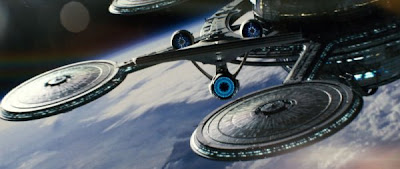
In terms of the film’s general look and appearance: I didn’t dislike the new Enterprise as much as I thought I would, honestly. I’m not big on how the rear ends of the warp nacelles light up when the ship is going to warp; the nacelles aren’t thrusters, after all. (I know they’re dumping all of the previously established canon as far as events in the series, but surely they’re not summarily dumping everything, right? The fictional idea behind warp drive still has to be the same, or else the creators here are just being dishonest.) The bridge is still too bright, too Apple Computer like, and the front viewscreen is no longer a viewscreen, but an actual window, apparently. (And there’s one shot in the movie that seemed to me to indicate that the bridge is now at the bottom of the saucer section! I could be wrong here – the shot was over in seconds – but if I’m right, that’s a huge change, and not one I much like. Why would a new timeline lead to a completely new design of starships? Did anyone else see this shot?)

And that brings me to the time travel stuff. I’ve had mixed feelings about this, ever since the film’s writers started giving interviews in which they indicated that they’re not resetting the Trek continuity to zero but rather kicking off a new timeline in which nothing has changed. The implication is that all the “standard”, or “canonical”, adventures of Kirk and company are still happening, to the Kirk and company in that timeline, where now we’re going to be following the adventures of Kirk and company in this timeline. This is, of course, pure handwavium, of the “have our cake and eat it too” variety. That’s all well and good for the writers, but is that really what happens in Star Trek?

Consider the chain of events. Apparently, in “Trek Prime”, Nero gets all pissed off and takes a mining ship after Spock’s attempt to save the galaxy from the exploding supernova destroys Romulus. But they end up going through the black hole and back in time (ouch). Pretty soon, Nero commits an act that changes history: he attacks the Kelvin, causing George Kirk to die heroically instead of living to raise his son. Now, everything is different. History has been changed.

Freezing the action right there: a few of the very best episodes of Trek ever made involve the changing of history. Most famous is “The City on the Edge of Forever”, in which Dr. McCoy, driven mad by an accidental overdose of some drug, jumps through the Guardian of Forever and winds up in 1930s New York, where he somehow prevents Edith Keeler from dying. Keeler goes on to found a peace movement that keeps the US out of WWII, allowing Germany to take over the world because they develop the atom bomb first. Also, just about every list of the best episodes of The Next Generation I’ve ever seen cites “Yesterday’s Enterprise”, in which the Enterprise-C gets thrown forward in time before it can accomplish what it needs to accomplish, again changing history (this time resulting in a Federation at war with the Klingon Empire). Both times, it’s taken for granted that history must be restored.

Other Trek time travel adventures include Assignment: Earth, in which the Enterprise travels back to 1968 and very nearly ends up a party to changing history again, and “Tomorrow is Yesterday”, when the Enterprise accidentally ends up in 1967 Earth and is seen by an Air Force pilot, whom they then beam aboard the ship and then realize have to beam back without his knowledge of having been there, lest history be changed. The best of the TNG movies, First Contact, has the Borg going back in time to take over Earth in the 21st century and preventing the Federation from ever existing; Captain Picard and the Enterprise-D have to fix history.

So, returning to the current Star Trek: Spock ends up with Nero back in time, and soon realizes that Nero has changed history. With all of that precedent in Trek lore for restoring the proper timeline, what does Spock do?

Nothing. And consider, he’s got his own ship, he knows how to travel in time (he calculated the equations for the time travel to get some humpback whales once), and failing time traveling in his own ship, Spock knows of an uncharted planet where resides a device called the Guardian of Forever. He could try to set things right…and doesn’t. He just accepts the “new timeline”, and at the end of the movie, is seen going off with the rest of the surviving 10,000 Vulcans who are left in the galaxy to re-establish their culture.

I’m sorry, but what the hell is that?!

Seriously, here, WTF? Why would Spock just blithely accept his fate in the “new timeline”? This makes no sense whatsoever. It would have been poetic, maybe, if Spock had tried, but failed, to set things right; maybe that could have ultimately been how Spock finally dies for keeps, and in all the “Hey, we gotta fix what we screwed up in time traveling!” stories ever made, I only remember one in which the time traveler doesn’t get it exactly right. And that’s a segment from one of the “Treehouse of Horror” episodes of The Simpsons. They could have had Spock being unsuccessful in restoring history, and realizing at the end that history is just going to go on now, in its rewritten state; that would have been poignant and gutsy.

Instead, we get this: Spock acting in very un-Spockish way, and some stuff about new timelines co-existing with old timelines from the creators. However, nobody in the movie indicates that the old timeline is still intact and just a dimension or two over to the left, so as far as they’re concerned, this is the way things are gonna be. All of that leaves me to believe that the writers’ babblings in the press about co-existing timelines was just as bunch of made-up nonsense to mollify the fans, who are annoyed at the prospect of a Jim Kirk who will never meet Edith Keeler.

Here’s my problem with that whole “co-existing timelines” thing: it renders the old stories irrelevant. Suddenly there turns out to be a lot less at stake than there might have been otherwise. Why should Kirk allow Edith to die, if he knows that there’s another timeline out there somewhere in which she does die, so why not just save her and have her love? Everything just becomes a bunch of dull counterfactuals. That’s what bothers me about the concept of a reboot – or rather, this particular concept of a reboot.

On reboots in general: they’re not all comparable. People like to justify this Trek reboot by citing Battlestar Galactica, the Batman movies, or the James Bond films. None of those comparisons hold, though. The original BSG lasted just nineteen episodes, so there’s really not much to cheapen by the existence of a reboot. Batman had four movies before the reboot with Batman Begins, and comics movies are a special case, anyway, since the movies exist outside the continuity of the comics in the first place. That leaves Bond – but the whole notion of James Bond being the same guy in Die Another Day and Dr. No is just silly on its face, so this isn’t the same kind of thing. It’s the reality of what exists right now, but the logic just doesn’t hold up.

Another note about canons and continuity: even if I grant that we’re in a new timeline now that starts with the destruction of the Kelvin, there’s still a remaining fact that the producers didn’t seem to realize: you still have to respect the established canon to that point. Which means that you have to deal with certain realities of Star Trek canon: Kirk has an older brother named Sam, who doesn’t appear to exist in the movie. You know who else has an older brother? Spock. So where is Sybok? And so on.

I also didn’t care for some of the depiction of the Vulcans in the movie. For a race devoted to logic and the suppression of emotion, they sure are a goofy bunch, as shown in Star Trek. A culture that advanced only manages to get 10,000 people off the planet? And the response of the “Elders”, whose job it is to keep the culture alive, to the imminent threat of planetary catastrophe is to go hide in a cave? And I’m sorry, but Sarek should never openly admit to loving Amanda. We know that he loves her, and that he shows it in the best Vulcan way, but to say “I married her because I loved her” just stood out as a staggeringly un-Vulcan thing to say. There’s no way Mark Lenard would have stood for that line! And McCoy refers to his divorce, but does his daughter Joanna exist in this timeline?

Other random observations and things:

:: We all know that James T. Kirk is a womanizer, but I didn’t much like how this movie depicts him as having an eye for anything that has the attributes of being a female and having a pulse. This can be chalked up to his being more of a delinquent slacker in this movie than Kirk Prime, but still, it got a bit annoying.

:: I like Michael Giacchino’s score a lot, although I would have liked to hear more of the classic Alexander Courage Trek Fanfare. At times the score called out for it, and it wasn’t there.

:: Why on Earth does Leonard Nimoy give the “Space, the final frontier” speech at the end? By the logic of the film, we should be hearing Chris Pine’s voice there. That made no sense.

:: I just loved the design of the end credits, with all of those nifty alien worlds and stuff. It looked like updated versions of the kinds of planets you used to see on the covers of cheap SF paperback novels.

:: So Nokia is going to survive the next 200+ years as a company? Really?

:: I had no problem with the relationship between Spock and Uhura. That’s fine with me.

:: It probably would have made the cast overstuffed a bit, but I would have liked to see Chris Chapel and Janice Rand in there somewhere.

:: Lots of people are wondering where Nero disappears to for twenty years. My assumption is that his nifty, bad-ass mining ship took some serious damage when it got rammed by the Kelvin, and making repairs to a ship from the future when the technology doesn’t exist probably takes a while. Twenty years? Well…the movie asks us to swallow the notion that a bit of “red matter” the size of a marble can destroy a planet, so why not?

:: But as for Nero’s ship — I didn’t get the design. What are all those appendages for? And why is the “flight deck” filled with ankle-deep water? A ship from the 2300’s doesn’t have floor-drains and plumbing?

:: I’m sorry, but I hated that they were building the Enterprise on Earth’s surface…and there goes another bit of continuity, too. Remember, in TOS, the Enterprise was not a new ship when Kirk took command; the events of “The Cage” are specifically indicated in “The Menagerie” to have taken place thirteen years earlier. That would mean that technically, the Enterprise should already be cruising around under Captain Pike’s command when young Kirk is joyriding in the hot-rod. I know, we’re in a new timeline, but there are limits to what I’m willing to accept as having been changed here. Enterprise should not be virtually out-of-the-box new when Kirk takes over the center seat.

:: The moment where Sulu screws up going to warp speed echoes a similar moment in an old Trek tie-in novel by Vonda McIntyre, called Enterprise: The First Adventure. That novel is a telling of the “Trek Prime” first voyage of the Enterprise under Jim Kirk’s command, and in fact, it’s actually a decent novel, well worth checking out. Kirk’s assignment to the Enterprise is what ultimately causes his break-up with Carol Marcus, and soon he’s getting to know a new crew. Anyway, there’s a moment at the beginning where the Enterprise is leaving spacedock, and Sulu messes up, causing the ship to lurch or something like that.

:: So, what’s next for Trek? The sequel has already been greenlit by Paramount, so I assume in two or three years we’ll be queuing up for Star Trek II…again. JJ Abrams has observed that the Enterprise crew could always meet Khan Noonian Singh again…for the first time, again. Or something like that. I personally don’t want that; nor do I want to see Borg again. Surely we can actually get a new adventure? Actually see some exploring of strange new worlds and new life and new civilizations? You know, going places boldly? In fact, it might be nice to have an exciting SF Star Trek adventure that never has the ship firing phasers or torpedoes. But if we have to bring back old Original Series characters for updating, how about some of the others? How about Klingon commanders Kang and Koloth? How about Harcourt Fenton Mudd? But really: how about a new adventure? Continually revisiting old characters is still fan-service for the Trekkers, and even they probably get tired of the same old thing every time out. (Of course, it’s to be noted that the least successful previous Trek flicks are the ones that tried to show something new instead of posing sequels or follow-ups to previous stories: TMP, The Final Frontier, and Insurrection. But then, I actually like those movies more than most, so….)

Well, anyway, Star Trek is a movie that bugged me, vexed me, annoyed me…and also entertained the crap out of me. Weird. JJ Abrams is a good director. I’m not much impressed by his writing, but his directing is spot on. (I know, he didn’t write Trek. I’m referring to past scripts of his.) I’ll be getting the DVD, you’d better believe it. All complaints aside, the movie did manage to hit my “explodey spaceshippy space opera goodness” sweet spot. Good on them for that much!

(Other blogger reviews I enjoyed were Jason Bennion, here and here; Snell; and Torie Atkinson.)

UPDATE: OK, I expected one, and I got it: a snooty comment from someone saying “You think too much. It’s just a movie.” Well, if I want to take that attitude into a movie, I’ll go see whatever Michael Bay’s got coming out. I expect more from Star Trek, and I didn’t get it here. Yes, it’s a wildly fun movie to watch. No, it doesn’t make any damn sense. The best Star Trek stories are the ones that are entertaining and manage to make sense; this movie got half the equation right. That’s my position, and I’ll think about it as much as I want.

Share This Post

Permission to come aboard?

Well, now I officially want to see the damned new Star Trek movie. I still have my misgivings and I’ll probably bitch up a storm about it afterwards, but I genuinely want to see it in the theater now.

Over at AICN, there’s all kinds of coverage of last night’s surprise premiere in Austin, TX. What happened was this: the audience there was supposed to see a preview chunk of footage from the new movie, which would then be followed by a screening of a restored, pristine print of Star Trek II: The Wrath of Khan. Well, instead, they showed ten minutes of Khan and then pretended to have a projection problem, during which Leonard Nimoy came out and asked the audience, “Wouldn’t you rather see the new movie?” Audience goes nuts, and the new flick is screened.

Now that’s the way to do it, huh?

As for the new movie, here’s an interesting and non-spoiler review that is positive, but not gushingly so. But I still want to see the movie…not so much because of Trek, but because, I think, it’s four years since Revenge of the Sith. I need a good dose of big screen space opera, and Trek seems to be the only game in town.

Share This Post

Boldly going?

I’ve just watched the new trailer for Star Trek, and I’m still troubled. On the one hand it looks like a trailer for a kick-ass space opera action movie, which would be right up my alley, except they’re calling it Star Trek and using the names of characters I’m already deeply familiar with. Yes, it bugs me that they’re changing everything. No, I don’t know why it doesn’t bother me that the producers of the James Bond movies are doing roughly the same thing — but then, the Bond series is a different animal, which never came to grips with the fact that the world was constantly changing and yet their character was staying the same. I don’t know — but the new Trek movie looks like it might be kinda-sorta cool, but I still hate what they’re doing with Kirk and company.

To me, it’s like if the Bond people not only did a reboot of the Bond movies, but invented a completely new backstory for him — maybe make him the son of an IRA leader or something. But every single bit of new Trek promotional material that comes along makes me think one thing: this might be cool if they’d just change the names of the people involved. How about not making it a Trek movie? Just for kicks?

Anyway, here’s the trailer:

See, right off, there’s what bugs me. Kirk is apparently the delinquent doofus who gets pushed into enlisting by someone else. And the Kirk in my imagination would never utter something like “Why are you talkin’ to me, man?” Ugh.

UPDATE: Spurred on by Belladonna in comments, I came up with what I think is a better analogy: what they’re doing with Kirk strikes me as if somebody made a movie of Oliver Twist in which Oliver was not an orphan but a runaway from home. I like it when I get challenged to explain myself better!

Share This Post

The Operas of SPACE!!!

My leading light, reading-wise, continues to be the wonderful SF subgenre of space opera. I’ve done some more reading along that line the last few months.

Margaret Weis wrote a space opera trilogy called Star of the Guardians back in the early 1990s, of which I recently read Book One, The Lost King. Weis is far better known as half of a writing duo, the other half being Tracy Hickman, that produces in prolific fashion the Dragonlance novels. For this series Weis went it alone, although Hickman provides an introduction wherein she declares that Star of the Guardians is not science fiction but rather “Galactic Fantasy”. What’s the difference? Well, it’s pretty much the same difference that’s always illuminated between space opera and hard science fiction, although Hickman seems to hold hard SF in some disdain, saying that SF is about our love of technology while “Galactic Fantasy” is about our hopes and dreams in the future.

I’m not sure what to make of that, but The Lost King is a pretty fun and breezy read. It’s fairly obviously indebted to Star Wars, using a lot of tropes from that “universe”, which at the time of Weis’s writing consisted of the movies and little else. The story takes place in the aftermath of a Galactic Civil War, in which a benevolent if inept monarchy was replaced by a dictatorial Republic, which is led by a harsh and controlling President who rules through the actions of his military and his Warlords. One of these Warlords, Derek Sagan, is tasked with tracking down the last living heir of the deposed Starfire dynasty, a young man named Dion, who is being protected by the last of the Royal Guardians. Dion flees with a mercenary ship captain named Tusk, and on the way they make the acquaintance of another Guardian named Lady Maigrey. Warlord Sagan, it turns out, does not wish to kill Dion Starfire outright; instead he has plans of his own (which aren’t totally revealed in this first book of the trilogy).

The story of The Lost King is nothing that anybody who’s read this sort of tale. As Weis notes, her story is far more reliant on the tropes of epic fantasy than SF, and what SF tropes are present are straight out of space operas like Star Wars, which many SF fans don’t even admit as SF in the first place. It’s not the most notable book I’ve read by a long shot, but it’s got some things to recommend it; most notable are the character interactions between Warlord Sagan and Lady Maigrey (who have a long history that wasn’t always antagonistic), and between the mercenary Turk and young Dion Starfire. Weis does a good job creating a cast of characters who have history behind them that explains their actions and motivations.

The Lost King is a promising beginning to a potentially nice space opera trilogy. It’s not a great book, by any means, but it’s worth seeking out for a breezy, entertaining “beach novel” kind of space opera.

Share This Post

“If I ever kill you, you’ll be awake, you’ll be facing me, and you’ll be armed.”


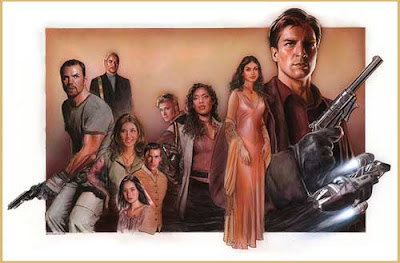
A few months back I finally addressed a monstrously huge hole in my science fiction, space opera loving resume: I watched all of Firefly, every bit of it, including the movie Serenity. I realize I’m very much late to the game on this, but hey, late to the game still means I’m a player. Or something like that.

Firefly, for those who haven’t paid attention, is a show that Joss Whedon created back in 2002, after Buffy the Vampire Slayer ended. It’s an SF show set something like five hundred years in the future where humanity has colonized a distant star system that consists of, well, lots of planets and whole ton of moons that have been terraformed for human colonization. The “Core Worlds” are the rich and powerful planets of the system, and these worlds form the basis of “the Alliance”, which is the somewhat despotic government. The outlying worlds and moons are a mix of independent planets and moons and some dependent on the Alliance. The show takes place several years after the end of a civil war in which the “Independents” fought unsuccessfully against the encroaching Alliance; the spaceship that serves as the main location of the show, Serenity, is a Firefly-class freighter named for the deciding battle in the war, Serenity Valley, in which our lead character, Captain Malcolm Reynolds, fought on the side of the Independents. Got all that? (Yes, it’s weird that the show is titled for the class of ship rather than the title ship itself. By that logic, Star Trek should have been titled Constitution, because the Enterprise is a Constitution-class vessel.)

So, when the show starts, Reynolds (often called “Mal” for short) is commanding his beat up old ship with its small crew as they go from job to job to pay their way, with many of these jobs being of the less-than-legal sort. This can mean smuggling illegal goods from one world to another, or salvaging valuable cargo from spacewrecked ships, or stealing valuable medicines from Alliance hospitals for sale on the challenged outer worlds. This also leads Mal and company into the employ and/or business association with all manner of unsavory characters, some of whom are very dangerous people indeed.

In looking about online for commentary about the show, much has been made about the show’s atmosphere. I’ve often heard Star Wars described (at least A New Hope, not so much the rest of the series) as a Western set in space, but I’ve frankly never seen that as being a fair or accurate label. In the case of Firefly, it’s entirely accurate, not only in the fact that everyone dresses like they’re in a Western, Mal’s preferred weapon is a six-shooter, everyone talks in that Western way (you’ll know what I mean if you see the show), everyone dresses in a Western way (long coats, wide-brimmed hats, lots of facial hair all over the place), the main mode of transportation on many of the poor worlds the show visits is the horse, and many of the settlements on those worlds are exactly the kinds of dusty towns you’d see in any Western. This appears to be a problem for some viewers, but it never really bugged me all that much. I would have liked to have seen a little more variety in the kinds of settings on the show, but I there was some of that, after all (one world has rich people living in floating cities that hover above an ocean), and lodging such complaints about a show that was only around for fourteen episodes and a movie seems a bit churlish. The obvious rejoinder from Whedon and company is, “Yeah, yeah, we’d have got round to that if Fox hadn’t canceled us after jerking us around for half a season.”

OK, as to that last: FOX’s shabby treatment of certain shows and not others is something of infamous legend in teevee fandom circles, but FOX’s record in the case of Firefly is particularly bad. About the only thing they could have done to show less confidence in the show and to guarantee its eventual demise would have been to simply not have greenlighted it in the first place. FOX execs weren’t overly enthusiastic about the show’s two-hour pilot episode (which in itself is astonishing, as that pilot could have been transposed to the movie screen as-is for one hell of a SF movie), so they ordered the pilot shelved and another hastily shot, which is why the show’s second episode, “The Train Job”, was aired first. Then FOX continued to air the episodes in whatever screwy order they felt like airing them in, which in turn screwed the show because, while it wasn’t exactly a serial, Whedon and company were creating quite a bit of continuity with recurring characters and storylines. The wonderful pilot episode wasn’t aired until the show’s fate was already sealed, and the show’s timeslot was a disaster: FOX took a show that was heavy with continuity and in a genre that traditionally has to struggle to gain an audience and put it on Friday nights at 9:00. Now, maybe FOX was thinking back to the earlier days of the network when they had The X-Files in that timeslot and they kept it there since they didn’t have much of anything else to air anyplace, but those days were long gone by the time Firefly came along. (Remember, NBC in the 60s was able to finally drive the final nails into Star Trek‘s coffin by giving it a Friday time slot.) In any case, FOX’s treatment of Firefly makes ABC’s treatment of Once and Again look like the very picture of network support. Again, I think of Jon Lovitz’s bitter quip to David Letterman some years ago when FOX canceled his own critically-loved but ratings-challenged show The Critic: “FOX? They should spell it with a ‘U’.”

But back to the show. One claim I’ve heard is that lots of fans find Malcolm Reynolds compelling because he’s what Han Solo might have been if he hadn’t been “softened” in Return of the Jedi. I don’t see that, actually. First, I never thought Solo was “softened” at all. But what happened is that Reynolds’s character arc is pretty much Han Solo’s character arc in reverse.

When we first meet Han Solo, he’s a pirate and a smuggler, making his living by using his ship to transport the goods belonging to one criminal low-life or another. In fact, when we meet him, he’s just earned himself the anger of one of his “clients” because he’s lost cargo belonging to one of his criminal bosses. But as the Star Wars story progresses, Solo falls in with the Rebellion, hangs with them for a while, and while aching to return to his former life, eventually finds himself converting to their cause and becoming a true believer. The cynical criminal becomes an idealist. Mal Reynolds, however, started out as the idealist hero, fighting a losing fight with the side he believes in. (When an Alliance officer questions him about it, saying “You fought on the wrong side”, Mal replies, “I fought on the losing side. I’m still not convinced it was the wrong side.”) The opening scenes of the pilot show the last moments of the Battle of Serenity Valley, when Mal believes that his side in on the verge of victory, just as soon as his air support arrives – when word comes that his commanders have decided to throw in the towel and those fighting are ordered to lay down arms. Just like that, Mal’s cause is defeated, and he becomes bitter and cynical. Han Solo is the criminal who finds something to believe in and fight for; Mal Reynolds loses the thing he had to believe in and fight for, and thus becomes a criminal.

(Now, when I say that Mal Reynolds is a “criminal”, I’m saying that some of what he does is illegal. He’s not afraid of doing things that are illegal, but he’s not at heart a criminal in the sense that he lives to break the law. Robin Hood and Ernst Stavro Blofeld are both “criminals”, if you take my meaning.)

This all changes a bit in the feature film Serenity that somehow managed to get made after the show’s cancellation; the major theme of the film is everyone around Mal trying to figure out what, if anything, he actually believes. The film gives us an answer, but it’s not an easy answer at all, and Mal’s actions in the film are as consistent with one set of beliefs (that someone must stand up to the Alliance) as with another (that Mal’s days as a fighter-for-something are over, and all he wants now is freedom).

But anyway. Firefly has become as beloved in SF fandom as anything I can remember, and it’s truly a bummer to note that the lackluster box office of the follow-up Serenity movie likely means that we’re unlikely to ever see another Firefly show or movie again. There have been a few comics series taking the story further, and that to me is probably the best format we can expect for continued Firefly goodness (if not actual novels; I’d read original Firefly novels if they existed). So, for the time being, what we’ve got is what we’ve got. That being the case, Firefly as it stands is a surprisingly complete body of work.

In just fourteen episodes, Firefly creates an SF universe that feels plausible and real, populates it with characters we can know and care about, and tells involving stories using all that in the mix. Watching the show’s episodes in the correct order, via the DVD set, I noticed how fully-imagined the show was right from the beginning. Firefly stands in marked contrast to any of the Star Trek series, each of which required a season or two to really settle into a rhythm. The characters’ voices are all established from the first moments, which is something you don’t often see. Thus, there’s nothing in Firefly that reminds people of, say, Mr. Spock in the early episodes of Star Trek emoting all over the place since it hadn’t yet been decided that Vulcans suppress their emotions. This is a show that really learned the lessons of Star Wars in that it made all its technology look like it does something. I particularly appreciated the episode “Out of Gas”, where Serenity is crippled by the failure of an engine part that’s about the size of a can of coffee. That may have struck some as implausibly, but being a maintenance worker myself (but not quite up to the level of a Keylee or a Montgomery Scott), I’ve seen lots of big machines felled by comparatively tiny parts. Remember: the space shuttle Challenger was doomed by a piece of rubber that wasn’t even part of the ship itself, and the Apollo 13 mission was nearly destroyed by a faulty wire.

Also of interest was the show’s approach to establishing its universe. Lots of SF shows, like the Star Treks, insist on showing us one new world after another, and only start to use recurring characters when the show is established. (DS9, by virtue of its stationary setting, broke this habit, much to its credit; I still hold it as the best post-TOS incarnation of Trek.) Firefly, however, gives us recurring characters right off the bat: con-woman Saffron, criminal boss Niska, low-grade but ambitious hood Badger. This is more evidence of how well-designed the show was, and another reason to be annoyed at the show’s ultimate failure.

In terms of casting, Firefly was, as far as I can tell, perfectly cast, at least in its leads. Everybody seems to not be playing their roles so much as inhabiting them, and the chemistry amongst this crew is established very early on. Other touches are equally pleasant: the swearing in Chinese (and the constant hints that China became the dominant culture of Earth before the diaspora), and it only took a few hearings before my ears accepted the word “Goram” as a surrogate for “goddamn”. Fictional expletives are always tricky (“Felgercarb!” being a notable example, from BSG), and using Chinese and one made-up English one is a nifty way to solve that particular problem.

Was Firefly perfect? Of course not, but its general level of quality was astonishing for a show that never had the full backing of its network. What might have been! I can’t believe that we’ve seen the last of this crew or heard the last of their stories. It’s too promising a world, and its existing canon is too high-quality to languish forever. Or so I can hope.

(Image above via.)

Share This Post

To Boldly Geek

The official first trailer for JJ Abrams’s Star Trek reboot is out. Having watched it, I can say once again regarding this project: Meh. I’m still not sold on the idea of rebooting Trek in the first place (If we’ve gotta have Trek, surely we can tell lots of new stories without tossing aside established continuity, and why do we even gotta have Trek in the first place? It’s a wide wonderful SF world out there, let’s go see some uncharted planets!), and as far as this particular project goes, I’m still less than enthusiastic. Here’s the trailer:

It’s a nice looking trailer, especially the space battle stuff, although I do pine for the days when every Trek tale on the big screen didn’t need to have the Big E out there, phasers and photon torpedoes a-blastin’ away. I’m more concerned with the character stuff. The trailer alternates a bit between Kirk and Spock, first showing a Kirk who’s apparently a hothead kid who is constantly flouting the rules. Then we see that Spock’s main trouble is the fact that he’s half-human and half-Vulcan.

As to the latter, well, duh, and frankly, after the entire run of the Original Series and six feature films with the original cast, I don’t think there’s a whole lot of more interesting comment to be made about this. Yeah, Spock is the product of two worlds, and not entirely comfortable in either. If Abrams really reboots everything, resetting the entire Trek continuity to zero (as some rumors have him doing), then the entire arc of Spock’s life as a character is gone too, and that bugs me a bit. In the last two “Original Cast” Trek movies, we get to see a Spock who finally figured out his place in both of his native cultures, and the character didn’t suffer for the lack of all that angst. Maybe this can be handled interestingly, but I fear that it will seem like a trip into familiar territory.

And then there’s the former, James T. Kirk. The popular concept of this character is that he’s a womanizing rule-breaker, but I’ve always thought that the rule-breaking idea of him is overdone a bit. Kirk is a man who takes rules seriously at times, sidesteps them at others, but he’s a guy with a fearsomely strong moral compass. I’m worried that Abrams’s movie will defuse this a bit, turning Kirk into the archetypal hothead who learns to tamp it down a little. I saw somewhere online the analogy that the trailer looks like “Top Gun in space”, and that’s not off the mark. In truth, I hated the Kirk-as-a-kid-driving-the-hotrod bit. How does that square with the notion, established in the original series, that Kirk as a young man was incredibly straight-laced, so much so that his best friend (and future first officer) Gary Mitchell would describe Academy Cadet Kirk as “a stack of books with legs”, or that one particularly gleeful troublemaker named Finnegan would decide that Kirk was such a stick-in-the-mud that he made Kirk the butt of all of his jokes? What was always so interesting to me about James T. Kirk was that underneath the veneer of a handsome young man who had an eye for the ladies, who had the bright smile and the twinkle in his eye, and who would always err on the side of what he thought was right even if the regulations said something different, one could find beating the heart of a very serious man. A man who took duty extremely seriously. The trailer doesn’t really suggest that’s what Abrams is doing with Kirk, and that potentially bothers me.

(Now, of course, we are just talking about a trailer here, and trailers are notorious for not accurately showing what movies are really like. Maybe Abrams has a very serious Kirk indeed, but it’s hard to square that with Kirk engaging in life-threatening stunts like driving a car to the brink of a cliff, and it doesn’t help the impression I have of Abrams’s Kirk that every production still that’s been released so far has Abrams’s Kirk making a very smug facial expression.)

Finally: where the Hell is Dr. McCoy in this trailer?! I think I got a glimpse or two of him, but that’s about it. And if that’s any indication of the role McCoy plays in Abrams’s reboot, then he can have his reboot and I’ll keep my eight bucks next summer when this comes out. The key dynamic that made the Original Cast work so well wasn’t the chemistry between Kirk and Spock, but the triple-chemistry between Kirk, Spock, and McCoy. These three men have an extremely deep friendship that survived Edith Keeler, an extremely deep friendship that compelled two of them to set aside their entire lives to go after the one they thought dead but still in need. Dr. McCoy is every bit as important in Original Cast Trek as Kirk and Spock. If Abrams moves him into the background at all, making him more along the lines of Scotty and Uhura and the rest, I’ll be irritated.

Again, I’m basing this all on a two-minute trailer, so maybe I’ll end up full of bird poop on all this. That would be fine with me, but to the extent that past performance indicates future results on stuff like this, I’m still not enthused, because I’ve just never found the JJ Abrams Kool-aid to be my cup of tea. Alias was mildly entertaining, but it never grabbed hold of me, and for my money, LOST is just a bunch of people brooding on an island. I’m certainly not thrilled about a state of affairs where Firefly is dead outside of comics but we’re getting JJ Abrams’s take on Star Trek.

We’ll see.

Share This Post

Whills, and the Journals they keep


Star Wars poster draft, originally uploaded by Michael Heilemann.

THE date for Star Wars fans is, of course, May 25, 1977, when the very first film was released way back when; but I see via The Dude that there’s actually an earlier date: April 17, 1973, which is when Lord George, Duke of Lucas, sat down with legal pad and No. 2 pencil in hand to start cobbling together his first draft of The Star Wars.

For we obsessives who have delved into those early drafts (The Jedi Bendu Script Site is an invaluable resource), it’s fascinating to see which elements of Lucas’s first writings made it into the first films, and then to further see everything come full circle as some of those very early notions, set aside for the Original Trilogy, eventually turned up in the Prequel Trilogy (the planet Utapau, Darth Maul’s attack on Qui Gon in the Tatooine desert, and so on). It all started coming together way back in 1973.

(By the way, the image here is taken from a Flickr gallery of Ralph McQuarrie’s amazing conceptual art for the Star Wars films. His art was instrumental in selling the concept to the studios, and is well-worth checking out. Be sure to click through to the large version of this early poster concept, just to read the dummy credits at the bottom. Try to imagine Star Wars with songs sung by Andy Williams!)

Share This Post

The Big E

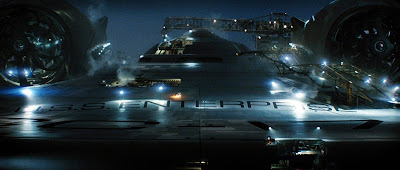
The USS Enterprise under construction in JJ Abrams’s upcoming Star Trek movie:

That’s a pretty cool image, even if shots of the Enterprise in drydock are getting a little passe, aren’t they? I mean, the various Enterprises are shown in drydock in eight of the existing movies already. If you look closely, you can make out the front of the warp nacelles, flanking the saucer section behind. Maybe it’s a trick of perspective, but those nacelles seem awfully close, don’t they? And big? I wonder what the actual Big E for the movie will look like. I suppose it’ll be like every iteration of the Big E: same basic shape but some different bells and whistles.

I’m still not wild about Abrams in charge of Trek, but then I’m not terribly wild about Trek anymore anyway. We’ll see.

Share This Post