Recent Reading (KidLit edition)

In reading to The Daughter at night, we’ve recently started to read chapter books a bit at a time, each evening, as opposed to the single-volume storybooks that were the rule until then. This has opened up lots of new vistas for reading, and it’s really rejuvenated a time of night that had for a while felt more like a chore than a treasured portion of our daily routine. I’ve generally tried to choose books that are slightly above her reading level, so as to keep her challenged and exposed to new stuff, and I’ve tried to choose books that I’d like to read as well.

(UPDATE: A reader asks how old she is; The Daughter is eight, and she’s in third grade.)

Here are some of the books we’ve read:

:: Danny the Champion of the World by Roald Dahl. This is simply one of my favorite books of all time, be it for children or adults. This one is just sheer, total delight. This story of a young boy living alone with his mechanic father in rural England is full of charm, humor, and also some excitement when our hero, young Danny, learns his father’s deepest and darkest secret. It’s a wonderful “underdog blue-collar folks against the arrogant wealthy” type of tale, with one of the best endings I know. Why this book hasn’t been done into a proper movie, I can’t imagine. (Apparently it was filmed in Britain, but I’ve never seen it or even heard of that production until now — a TV film for the BBC, perhaps?)

:: James and the Giant Peach, also by Roald Dahl. This was new to me, actually; I love Dahl, but somehow I got through childhood without reading this one, although I did see the Tim Burton-produced movie several years ago, which turns out to have added quite a bit to the story. No matter; the main portion of the tale, in which James is liberated from the clutches of his vile Aunts when he comes into the possession of a giant peach, and the friends he makes inside that peach when he meets the insectoid denizens of the fruit, is the real meat of the story. This is classic Dahl, in which supernatural doings are presented simply as a normal part of the world, and in which our author thinks nothing of having the hero’s parents killed by a rhinoceros on page one.

:: Stormbreaker, by Anthony Horowitz. We bought this book at the book fair at the school’s Open House this year, mainly because it had a really cool cover. It’s actually a halfway decent book, the first in a series of spy thrillers featuring thirteen-year-old Alex Rider, who is recruited by MI6 after his caretaker uncle is murdered while investigating an enigmatic industrialist who is about to donate free computers to every school in Britain. It’s a pretty violent story, and there were times in the reading that I wondered if it would have been better left until she was older. She really enjoyed this one, however, finding the suspense sequences pretty spine-tingling. I imagine we’ll be tracking down the subsequent volumes in the future.

:: Larklight by Philip Reeve is an amazingly fun book. We had a blast with this one, as we’d hoped, given that the book is subtitled “A Rousing Tale of Dauntless Pluck in the Farthest Reaches of Space”. It’s literally a steampunk space opera: a SF adventure that assumes that certain scientific theories of the nature of the universe long-since disproved in the real world are actually true. Hence, the book posits the existence of the aether, strange beings on every planet, spaceships that literally look like seafaring vessels in the sky. There are space pirates, malevolent aliens living in the ruins of Saturn, ancient races on Mars, a spacefaring British Empire, and a harrowing journey into Jupiter’s Great Red Spot. If you can accept the nature of the world Reeve has created here, Larklight is a rollicking blast of a story. We recommend it highly. Of all the books we’ve read lately, this is the one that earned the most heartfelt howls of protest from The Daughter when I told her that the page we were on was where we’d stop for the night.

Reading. I like it.

(Each of these books is good on the merits, so don’t eschew them if you don’t happen to have kids around.)

Share This Post

Stuff!

Some lazy linkage for a snowy Thursday evening:

:: Lynn Sislo hasn’t posted in several days. As she lives in Oklahoma, I assume that this is due to the ice storm they had in those parts. I hope she’s back online soon.

:: Do check out this wonderful article about visual injokes in Pixar’s movies. I love stuff like this.

:: I suppose I should start reading Terry Pratchett sometime soon. He has been diagnosed with Alzheimer’s.

:: When I become Supreme Ruler of Teh Universe, my first decree will be that all gas stations shall be one-way only, and that it will be illegal to swing your car into the opposite direction just because the one open pump is on the opposite side of your car as the gas cap. I am really tired of trying to figure out how to line up for a pump, when more often than not, the cars at the pumps will be facing me no matter which way I queue up.

:: Via Michael May I see that Joss Whedon’s not done with the Firefly universe, and will tell more stories there in the best medium for the job: comics. In fact, he’s apparently already done a comic of Firefly; I’ll have to track that down. It’s called Those Left Behind; the new one will be called Better Days. Cool. (Note to self: finish watching Firefly and then watch Serenity one of these days.)

Share This Post

Fixing the Prequels – The Phantom Menace (part three)

part one
part two

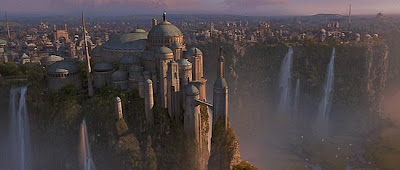
Continuing our re-imagining of The Phantom Menace, we are now at the droid invasion of Naboo and the rescue of the Queen.

Before I begin, a couple of points that have occurred to me since I posted the first two installments of this series:

:: The words “Roger Roger!” should never be uttered by a battle droid or anybody else. First, “Roger” as a response to a command is way too Earth-reminiscent for a Star Wars movie. Second, “Roger Roger!” makes me think of the classic scene in Airplane!. You know the scene I mean. All we need is a droid named “Oveur” and we’re all set.

:: In comments to the last post, Jason makes the point that the Gungan’s use of a pidgin form of English doesn’t work; he’d just give them an alien tongue of their own and use subtitles, the way most alien species in Star Wars are handled. I suppose that’s a fair point, but for the most part, the pidgin thing never really bothers me (except in places where it gets too hard to understand), and if we subtitle the Gungans, we’d have to explain how everyone understands them or have protocol droids standing around to do translating or whatever.

OK, onto the movie. The droid army has landed in the forests of Naboo and are now advancing on Theed, the capital city. This whole sequence is pretty effective, I think, except that we don’t really get a sense of the population of Naboo. This is actually a more generic problem I’ve always had with TPM; there’s just not that much of a sense of the Naboo society. As the battle droids and their machines enter Theed (the capital city of Naboo), we should see the citizenry being rounded up and taken to the “camps” that the droids refer to. Now, this being Star Wars and all, this doesn’t have to be a Schindler’s List type of thing; it doesn’t need to feature brutal violence a la the liquidation of the Krakow ghetto. But there isn’t that much sense of a forced invasion in the finished movie. There should be some shots of battle droids rounding up normal people, forcing them out of their homes, little kids being forced apart from their friends and toys, and the like.

There’s a brief shot of Queen Amidala standing at a window watching sadly as the droid armies enter her city. At this point, I’d add something like this:

Queen Amidala watches as the droid armies approach the palace. In the distance, her citizens are being rounded up and led away. A transport approaches, and Nute Gunray disembarks. Captain Panaka comes up to her from behind.

PANAKA: My Lady, we must take you into hiding.

AMIDALA: I will not go into hiding. My fate will be that of my people.

PANAKA: My Lady, please.

AMIDALA: Go, Captain. I will come when I am ready.

Panaka recognizes that he will not win this argument and leaves. Amidala turns to one of her handmaidens, who is standing nearby.

HANDMAIDEN: Your Majesty?

AMIDALA: We must do what we discussed before. We have very little time.

HANDMAIDEN: I will serve you well, My Lady.

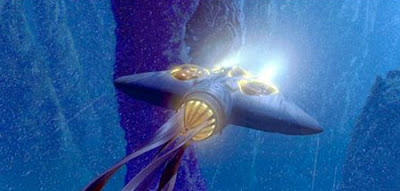
And then we’d cut to the Bongo emerging from the water, in the middle of the river.

Seeing this the first time, we of course wouldn’t know what plan the Queen is hatching, but it would establish that there is a plan. Thus, in the third act of the film when the Queen reveals that she has been “hiding in plain sight” all along, using her handmaiden as a decoy, we’d already be prepared for it: the old idea of Anton Chekhov’s that the gun that is fired in the third act needs to be on the mantelpiece in the first act. Also, from a standpoint of character, we’d get a hint that maybe this young girl of a Queen isn’t quite as naïve and overmatched in the face of superior force than we’ve been already led to believe.

OK. The two Jedi and Jar Jar arrive in the middle of Theed and come ashore. In the original script there’s some stuff about their narrow escape as their sub is pulled over a waterfall (this was actually filmed and can be seen as a deleted scene on the TPM DVD). No, I wouldn’t restore this; it doesn’t really add much. I would add a small bit of dialogue after the Jedi have come ashore:

OBI WAN: We’re too late, Master. The droid army is already here.

QUI GON: We must still find the Queen, and if she is already a prisoner, we will free her and take her to Coruscant. (turns to Jar Jar) Go in peace, Gungan. Your debt to me is paid.

JAR JAR: But where will mesa go? Mesa does not know–

QUI GON: (waves hand) You will go someplace else.

JAR JAR: Mesa go someplace else.

Jar Jar wanders off; Qui Gon and Obi Wan run off in another direction.

QUI GON: In a large city like this, the largest streets will lead to the Palace. That is where we must go.

There’s a scene where the Queen and her entourage are escorted as prisoners out of the Palace; Nute Gunray says something like “In time the suffering of your people will compel you to sign the treaty.” All I’d change here would be to add something to Gunray’s line like, “You should have given us permission to use your trade routes when you had the chance. Now you will all pay a heavier price.” I’d only add that in order to give some small idea as to what the dispute here is, in the first place.

We would then see the Queen’s entourage being led away from the Palace, while they would be shadowed by Qui Gon and Obi Wan, who are waiting until they reach a perfect secluded place to spring their attack. Before they attack, I’d have them observe the approaching party using a pair of macrobinoculars, mainly because the view through macrobinoculars is one of those iconic visuals of the original trilogy. And I’d have an exchange like this:

OBI WAN: The Queen – she is a child!

QUI GON: She is young, but hardly a child. Judge her not by her age, young padawan…she is the same age you were when you accompanied me against the uprising on Ord Mandell.

OBI WAN: Yes, master.

Why do this? Well, it would disarm the whole “They elected a teenager to rule their whole planet!” thing a bit, and even better, it would predispose the audience to take Anakin Skywalker more seriously when we meet him later on.

When their attack on the droids finally comes, I’d have them jump down from the balcony as in the movie, with Qui Gon leaping forward to engage the battle droids on his side of the fight. Meanwhile, Obi Wan would do the same – and, referring back to his failure earlier (see previous post) to seal his lightsaber before going underwater, he’d try to ignite his saber only to see the blade flicker and fail. I’d have the action sequence progress then with Qui Gon doing his “tiptoe through the battle droids” thing, but with Obi Wan having to evade blaster fire and fight the droids without the benefit of his lightsaber. He’d use the Force to toss one droid into another, to dodge laser blasts, and the like. He’d have to think fast, of course, and get creative with the Force, and maybe he’d even be overmatched at first before he gets his bearings and figures things out until Qui Gon saves him:

OBI WAN: I am sorry, Master.

QUI GON: You did well using the Force, young Padawan. Just have more care in the future. The Force will guide you. Always trust it.

SIO BIBBLE: [this is the white-haired governor guy, one of the Queen’s main advisors] Who are you?

QUI GON: I am Qui Gon Jinn, and this is my apprentice, Obi Wan Kenobi. We are the Ambassadors, sent by the Chancellor to force a settlement.

HANDMAIDEN: (the same one as before) The Chancellor sent Jedi Knights as his ambassadors?

The Queen silences the handmaiden with a glance.

PANAKA: Your negotiations have failed, Ambassador.

QUI GON: Our negotiations never took place. The situation here is far more explosive than even the Chancellor predicted. Your Highness, we must take you to Coruscant and meet with Chancellor Valorum.

PANAKA: Leave Naboo? With the Queen gone, the Federation army will only tighten their grip on the system!

OBI WAN: There seems to be little we could do to prevent that, even if we stayed.

QUI GON: If the Federation takes you, they will destroy you.

SIO BIBBLE: They wouldn’t dare!

PANAKA: They need her to sign a treaty to make their occupation of Naboo legal. They can’t afford to kill her.

QUI GON: They have dared much already, sir. They have dared to blockade your system’s trade routes, and they have dared invade a fellow sovereign system of the Republic. Their actions are not those of a powerful Federation embroiled in a simple trade dispute with a small and peaceful system. There is no logic to what they have done here, unless something else is at work that we do not yet know. Your Majesty, my feelings tell me they will destroy you if you stay.

The Queen glances at her handmaiden, who nods.

HANDMAIDEN: We go where you go, Majesty.

AMIDALA: Then we will go to Coruscant and plead our case with the Senate.

Sio Bibble nods.

SIO BIBBLE: With you at his side, Senator Palpatine may be able to convince the Senate to help us.

QUI GON: Do you have a ship?

PANAKA: In the main hangar. This way.

He gestures to a passage that leads through a tunnel beneath a larger building. However, as they begin to move, two battle droids emerge from the shadow and level their blasters at the party.

BATTLE DROID: Freeze! Hands up, prisoners.

Qui Gon’s lightsaber is in his hand instantly, but even as he ignites the blade and moves forward, a giant stone flowerpot drops from a balcony above and crushes the battle droids. All eyes look up to the balcony to see a grinning Jar Jar, who has pushed the flowerpot from its ledge.

JAR JAR: Hello!

Jar Jar drops nimbly to the pavement.

JAR JAR: Mesa tried to find my way back to the forests, but mesa got lost…and then mesa heard fighting, and since wesa Gungans are warriors–

QUI GON: Well done, my friend. You may be a warrior yet, and I see now how hard it truly is for anyone to banish you.

Jar Jar grins.

QUI GON: Now, your ship, Captain?

PANAKA: Grab their weapons. This way.

His men take up the blasters of the dead battle droids; the currently weaponless Obi Wan grabs one too. Then they run off into the city.

I like how Lucas has one of the handmaidens speak up in his original scene, a bit out of place; this ends up making sense later on when we learn that she is the Queen after all. I’d emphasize that, just a little, by having it happen more than once. Also, note that there’s a reason now for Jar Jar to be tagging along, and he’s even proven his worth a little. (Also notice how he’s always getting cut off in mid-sentence.)

I also like how Lucas made the situation on Naboo rather confusing, putting the Jedi off their game a bit because of the seeming lack of a point behind what’s going on.

Now we’d cut to the hangar bay, where the Queen’s entourage would enter, led by the two Jedi:

PANAKA: We need to free those pilots.

OBI WAN: (brandishing blaster) I’ll take care of that.

Qui Gon approaches the battle droids guarding th ship’s entrance, while Obi Wan approaches the droids guarding the captive pilots.

QUI GON: I am an ambassador to the Supreme Chancellor of the Republic. These people are under my protection, and I am taking them to Coruscant.

BATTLE DROID: You are under arrest!

The fight would take place pretty much as in the film, but with Obi Wan using the blaster he’s commandeered instead of his lightsaber to dispatch the battle droids guarding the pilots. Ric Olie, the head pilot, would start warming up the ship’s engines as the others board. Then, as Qui Gon and Obi Wan stand at the bottom of the entry ramp, keeping an eye out for other battle droids, I’d add this exchange just before they board the ship themselves:

OBI WAN: No destroyer droids. This is going well.

QUI GON: Droids are slow to react to the unexpected. The blockade ships will be ready for us, though. Come.

They turn to board the ship, but just before doing so, Qui Gon turns back to his apprentice, takes the blaster from his hand, and tosses it aside.

QUI GON: When we’ve escaped into hyperspace, please fix your lightsaber. You’re a Jedi, not a Corellian.

OBI WAN: Yes master.

And then the ship would blast off into space.

In our next installment, we meet some really important folks: Darth Maul, R2-D2, and a kid named Anakin Skywalker who will have an important role to play in the entire Star Wars tale. Also, in the next installment we’ll fix the single worst scene in Star Wars history. Tune in!

Share This Post

Fixing the Prequels – The Phantom Menace (part two)

part one

As we continue fixing The Phantom Menace, we have reached the point where Qui Gon and Obi Wan have escaped death on the Trade Federation ship and are sneaking down to the surface of Naboo. There’s a scene where Queen Amidala speaks to Nute Gunray, and this scene is followed by the Queen conferring with her highest counselors. I would change none of this. I like the mystery here as it’s unfolding: the Queen’s belief that the ambassadors have arrived and commanded the Federation to make settlement, while the Federation insists that the ambassadors have never arrived. Likewise, the scene in the Naboo throne room is well done, and I’d leave that alone completely. Where I’d start tweaking things is when we reconnected with the two Jedi.

Remember, Qui Gon and Obi Wan have stowed away on separate ships and plan to meet somehow on the planet surface. Nute Gunray warns his battle droid captain that the two Jedi are no longer aboard the ship in orbit, and that they are therefore almost certainly stowing away. This sets up a bit of sneaking around for the Jedi, but this sneaking around didn’t happen onscreen, which is a bit of a pity. In reality, the original script has things going slightly differently as was filmed. As the droid army ships land, we see Obi Wan pop his head out of a pond, look around, and then disappear again beneath the water. Then we’d cut to the Viceroy warning the droid captain that the two Jedi have escaped the orbiting ship and are therefore likely on the planet. And after that, we meet Jar Jar Binks.

Okay. Before getting to specifics, let’s discuss Jar Jar in general. Basically, Jar Jar is probably the single most hated facet of the prequel trilogy. While I never hated him – in fact, I rather like him – he’s got some serious execution problems. He gets a bit too much screen time, and he’s almost uniformly the goofy screwball for the entire time, not getting a moment where he can just stand there are quietly talk until late in the movie, by which time it’s too late. So that’s a place to begin with fixing Jar Jar.

It’s also interesting to note that Jar Jar isn’t just along for the ride; he has a definite character arc, mainly in TPM but also in the remaining PT. Jar Jar is the annoying kid who screws up a lot, but who has a lot of heart and ends up doing fairly well by himself and by his people. Where Lucas errs, then, is in not showing us early enough that Jar Jar has quite a bit of potential.

When we first see Jar Jar, he’s among the creatures running wildly in fear away from the giant droid army transports that are literally plowing their way through the forests of Naboo. Qui Gon is among these creatures, and finds Jar Jar directly in his way. Jar Jar, panicking, grabs onto Qui Gon and falls down, dragging the Jedi master to the ground with him, where they lay still as the droid transport moves right over the top of them. How to make this better? Well, I’d show a dispirited, lonely Jar Jar wandering lonely through the woods, searching for food – maybe he’d find a worm and reject it for taste – when he’d suddenly note an animal running by…and then another…and another, until it’s a full-fledged stampede. Then he’d see Qui Gon coming.

After the droid transport passes, I’d revise the ensuing dialog a bit:

QUI GON: You almost got us killed! Are you brainless?

JAR JAR: I spake.

QUI GON: The ability to speak does not make you intelligent. Now get out of here!

JAR JAR: No! No…mesa stay with you. Mesa help. Mesa Gungan. Wesa warriors.

QUI GON: That won’t be necessary. Now go…

At this point, Obi Wan comes bursting out of some nearby vegetation, closely pursued by a battle droid on a floating attack vehicle. Qui Gon quickly dispatches the battle droid, and attention once again turns to Jar Jar. However, in the shooting script, there’s a bit that answers the question of why Obi Wan didn’t just destroy the battle droid himself. It seems that he got his lightsaber soaked and now the battery’s dead. I like this, and I’d keep it. Here’s the gist of what I’d do:

QUI GON: I see you’re wet…did you seal your lightsaber before going under?

OBI WAN: (sheepishly) I forgot, Master. I was near to being discovered, and —

QUI GON: Indeed.

He takes Obi Wan’s lightsaber and tries to ignite it; the blade fizzles and shorts out.

QUI GON: It’ll dry out in time, although it won’t work perfectly until you replace the crystal. Remember, Padawan, this weapon is your life.

OBI WAN: Yes, Master.

Reading through the shooting script, I find a lot of little touches that I really think would have enhanced the final product. I wish that George Lucas had been a bit more willing to indulge longer running times in the PT. Another benefit of including this bit would be to presage an exchange in the next film, and to further establish the teacher-student relationship between Qui Gon and Obi Wan.

Anyway, we move on to Jar Jar’s statement that the Jedi should go to the Gungan city, the hidden city. Here again I’d have Jar Jar point out that the Gungans are warriors. In fact, I’d drive this point home, the idea being that Jar Jar’s big problem is that he’s a failed warrior in a civilization of warriors. Other than that, I’ve always liked the entire bit with Jar Jar first saying that the Jedi should go to the Gungan City, then saying that he can’t take them there because he’s banished, and Qui Gon and Obi Wan manipulating Jar Jar’s fears to convince him to take them to the Gungan City after all: “Do you hear that? That is the sound of a thousand terrible things headed this way.” “And if they find us, they will smash us, crush us, and grind us into oblivion!” I like that exchange a great deal.

So we’re at the lake where Jar Jar points out that they are going underwater. Here again I’d have Jar Jar point out that the Gungans are warriors, maybe in noting that the Jedi shouldn’t expect a warm welcome – something like, “Gungans are warriors and no liking strangers, so don’t expecting a warm welcome.”

And as long as I’m going into detailed stuff about TPM, I frankly think that the first sight of the Gungan city, as they swim over an underwater cliff and see all those golden bubbles hanging there before them, is one of those beautiful sights that fill each of the Star Wars movies. That’s one of the visuals that makes me a Star Wars fan.

The scene with Qui Gon and Obi Wan requesting aid of the Gungan rulers doesn’t really work as well as it should. First of all, that facial tic of Boss Nass’s – the one where he suddenly shakes his head and wobbles his jowls back and forth – needs to go. I’m not really sure what that’s all about.

Second, the scene should play the differences between the Gungans and the Naboo up a little more, and again, accentuate the “warrior Gungans” thing a bit more:

OBI WAN: When the droids have taken control of the Naboo, they will come after you.

BOSS NASS: Wesa no think so. They not knowing wesa are here. And wesa warriors! We can fight them if they come.

OBI WAN: But you and the Naboo form a symbiont circle. What happens to one happens to the other. You must see this.

BOSS NASS: Dissen not true. Wesa no need the Naboo, wesa no care about the Naboo, and the Naboo no care about us. Yousa must leave now.

QUI GON: (waves his hand) Then speed us on our way….

And so on. When we get to Qui Gon’s intercession on Jar Jar’s behalf, I’d again alter the dialogue slightly:

QUI GON: What’s to become of Jar Jar Binks?

BOSS NASS: Hesa been banished three times, and hesa come back each time! So hesa to be punished.

I especially like here the benevolent smile Boss Nass gives when he indicates that Jar Jar is to be “punished”, followed by Jar Jar’s swallow of fear. The rest of this scene plays out all right, and then we’re into the whole transit through “the planet core”.

Now, I know that they’re not really going through the planet’s core. And I have no problem with that, OK? So no complaining about that. The entire underwater sequence of TPM has actually always been one of my favorite parts of the movie, and the only changes I would make would be mostly cosmetic. Jar Jar, for example, talks too much through the whole sequence.

There’s a line in the script that isn’t heard in the movie; Obi Wan asks of Qui Gon something like, “Master, why do you keep dragging these pathetic life forms with us?” I don’t know why that line got cut, since its echoing line later on the movie (on Tatooine) is still present. I suspect that it makes Obi Wan too much of an egoist jerk, but I’d rather that line have stayed. As they pilot the sub away from the Gungan City, something like this:

JAR JAR: Through the Core? In a bongo? Dis is nutsen.

OBI WAN: Why do we always end up with some pathetic life form tagging along with us?

QUI GON: All life is bound by the living Force, young Padawan, and even the strongest Jedi needs allies.

JAR JAR: Where we going?

QUI GON: You’re navigating, aren’t you?

JAR JAR: I no go through the Core in just a bongo! We get crunched dere!

QUI GON: Well then, the Force will guide us.

The sub steers into a deep hole, followed by a giant fish.

OBI WAN: Why were you banished, Jar Jar?

JAR JAR: Dis a longo tale but small part be…mesa clumsy.

OBI WAN: You were banished because you were clumsy?

Jar Jar looks sadder and sadder.

JAR JAR: Mesa never be Gungan warrior now.

In the actual script (and the film), Jar Jar goes on to describe some of the clumsy things he’s done. The problem is that it’s hard to understand what he’s talking about in the first place (what’s a “heyblibber”?), and it only serves to fill up some time while the big fish looms behind them. I think it works better if it’s just left at Jar Jar being clumsy, something we already know, and the unexplained nature of his banishment serves to better underscore his disappointment in himself (enhancing his character arc) and the manner in which he’s not representative of most Gungans.

Anyway, now the big fish attacks. I’d like to have seen this drawn out slightly before the even bigger fish attacks the big fish, freeing the sub. That said, Qui Gon’s sage observation that “There’s always a bigger fish” is a good line.

There’s a brief scene next on the bridge of the Trade Federation ship, where Nute Gunray reports to Darth Sidious that the invasion is going well. But he omits any mention of the Jedi who escaped, and when his second-in-command points this out, Gunray replies, “No need to report that to him until we have something to report.” I like this scene, and wouldn’t change anything about it.

Back to the sub, where they’re cruising along through the water when they lose power. I’d add an observation here as to the cause – “The smaller fish did some damage before the bigger fish got him, Master” – and then let it play out as in the movie. I like Jar Jar’s shrill panic, especially when the get the lights back on and find that they’re right in front of some other beastie. In fact, I’d have milked that a bit, and had Jar Jar’s shrieking go on a few seconds more before Qui Gon conks him out with the Jedi Nerve Pinch. (Well, that’s basically what it is, right?) However, instead of having Obi Wan say “You overdid it” – was Qui Gon not supposed to conk Jar Jar out? — I’d have Obi Wan simply say, with great relief, “Thank you!” For freakishly obsessive Star Wars fans, this would echo a similar moment between Han Solo, Princess Leia, and an incessantly-talking C-3PO in The Empire Strikes Back.

After they’d escape the second beastie to another bigger fish, I’d like to hear something like this:

QUI GON: We’re getting closer to the Naboo City. I can feel it in the Force.

OBI WAN: Good. I don’t know how many more bigger fish are going to save us, down here.

JAR JAR: (moaning from his sleep) Are wesa dere yet?

So there we have it: a beginning to the redemption of Jar Jar Binks. Next time, we’ll look at the invasion of Naboo, the rescue of the Queen, and the beginnings of Padme’s subterfuge.

Share This Post
Readin’

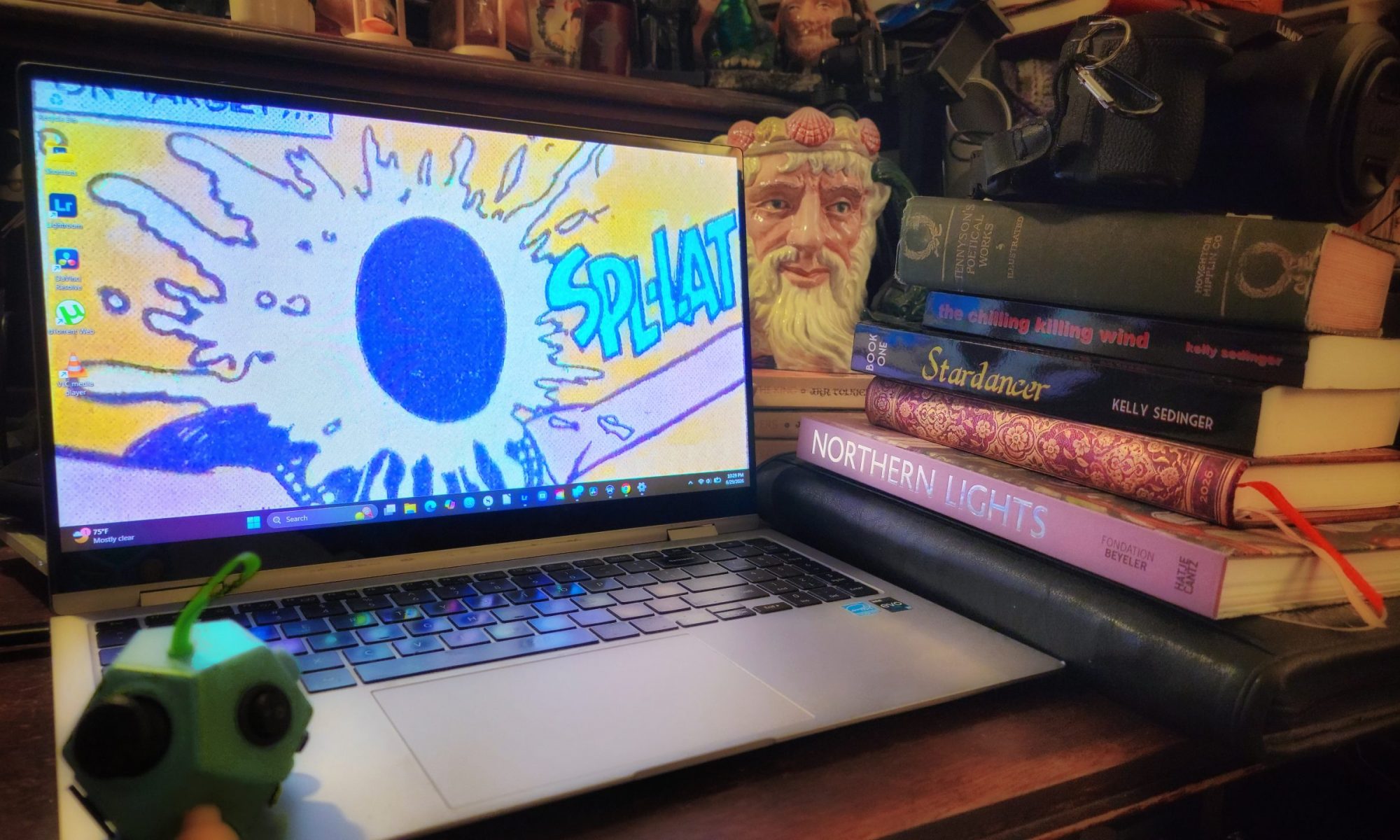
Time to catch up on some recent reading I’ve done:

:: As research for a short story I finished drafting a few weeks ago, I read a fascinating book called Stradivari’s Genius: Five Violins, One Cello, and Three Centuries of Enduring Perfection by Toby Faber. This is exactly what the title suggests: an examination of the violin making of Antonio Stradivari, the great Cremonese master whose hand produced stringed instruments that have never been surpassed in quality despite the fact that Stradivari died in 1737. I was most interested in the early parts of the book, the ones that deal specifically with violin making and the technical aspects of Stradivari’s craft, but the remainder of the book traces five specific Stradivarius instruments through the history of Western music. It is a fascinating survey of classical music history not from the typical point of view of the composers, but from the instruments that play the music.

:: My space opera reading project continues at its stready, if slow, pace. A short while back I read A Princess of Mars by Edgar Rice Burroughs (published in this omnibus). Strictly speaking, this isn’t space opera at all, but rather its sister genre, planetary romance. After reading some early space operas months before, I expected the Burroughs work to be enjoyable but generally suffer the same faults of anachronism commonly found by contemporary readers in early SF. I was surprised to find that this was actually not the case, at least to a much lesser degree. Burroughs, it turns out, was a much stronger writer than E.E. “Doc” Smith or Edmund Hamilton, and thus his work seems to fare better in the light of the decades that have passed since he penned these tales. (I say “seems to” because, after all, I’ve only read the one Burroughs book thus far.) A Princess of Mars turns out to be tremendous fun, a rollicking tale of adventure in which Captain John Carter is mysteriously transported from a cave in Arizona to the plains of Mars, where he falls in with various cultures of beastly beings, engages in fights to the death, discovers tremendous powers and abilities, escapes various dangers, and falls in love with the titular Princess of Mars, Dejah Thoris. Make no mistake: this is one fun book, and you can bet I’ll be returning to Barsoom sometime soon. (“Barsoom” being what the natives of Mars call their world.)

Of course, in reading a book like A Princess of Mars, one must suspend disbelief entirely. We now know that Mars holds no ancient civilizations that existed thousands of years before we emerged from the primordial ooze of our own planet, and we likewise now know that there are no canals on the Red Planet. I always find, though, that whether I’m reading Burroughs or a writer like Leigh Brackett, I just don’t care if the stories invent their Marses out of whole cloth.

While I was reading this I saw via Jason Bennion that Pixar is developing the Barsoom novels into a possible trilogy of movies. Now having read A Princess of Mars at last, I’m not sure what to make of this. I don’t know if the books can, or even should, be filmed as they are. Fiction from the early 20th century tends to be, well, less politically correct, and there were a number of spots in A Princess of Mars where I felt a bit of human, or even male, chauvinism creeping into the story. Additionally, the book contains more than a few scenes that are not suitable for the kinds of audiences at whom Pixar tends to aim its films. We’ll see.

:: The Andromeda Stories is a manga that I picked up, assuming it to be space opera, but so far it’s more of a mix of planetary romance and science fantasy. No matter; it’s actually quite engaging. The story involves a world called Cosmoralia where the crown Prince is about to get married and become King; meanwhile, a strange star appears in Cosmoralia’s sky, and then disappears as something strange crashes in a remote part of the planet. Of course, this presages invasion. Subplots include the birth of twins to the new Queen, and the identity of a mysterious female warrior. It’s all enjoyable stuff, even if the book’s lettering style makes it hard to read at times. I find that with reading manga, it’s not the reading right-to-left thing that trips me up, but rather the stylized lettering and the fact that the Japanese sound effects (the “BAM” and “ZOOM” and “KRA-POW!” stuff) are left untranslated. (In the case of the latter, there’s not really a way around this that I can see, other than destroying the feel of the panel by removing the Japanese onomatopoeia and replacing it with English.) Anyhow, I’m liking this story and definitely plan to get the next two volumes as they appear, as well as seeking out the earlier To Terra, by the same creative team.

:: Sticking with space opera, I’ve read a few stories in the anthology The New Space Opera, edited by Gardner Dozois and Jonathan Strahan. So far I’m highly impressed with this antho. The four stories I’ve read thus far are “Saving Tiamaat” by Gwyneth Jones, “Who’s Afraid of Wolf 359” by Ken MacLeod, “The Emperor and the Maula” by Robert Silverberg, and “The Art of War” by Nancy Kress. I enjoyed each of these tales, although I found the Silverberg the finest. There’s a lot of fine fiction here, and I’m looking forward to the follow-up volume.

:: Returning to comics, I was in the library and spotted Joss Whedon’s name on a graphic novel, so I grabbed it. It’s called Fray, and it turns out to be a “Vampire Slayer” story, although one set some indeterminate time in the future from the Buffy TV show, with a new slayer in the lead. Her name is Melaka Fray, and by trade she’s a thief who steals antique artifacts for her criminal boss, when she’s approached by a demon who informs her of her true heritage as a vampire slayer. There’s a new vampire uprising taking place, and it’s Melaka’s job to destroy it. The main problem is that Melaka has no real sense of her own heritage as a slayer, and little desire to live up to it.

As one who found the few individual episodes of Buffy I ever watched quite entertaining but who never bothered to learn the show’s dense mythology in order to really get into the show, I was glad that this graphic novel gives pretty much exactly as much backstory as is needed to understand what’s going on. I assume that a lot of this stuff will be old hat to Buffy fans, but for me, it was easy swallowing. The book also boasts a lot of the snappy dialog one expects from Joss Whedon.

All of this, plus Whedon’s admission in the foreword that he plans to write more comics, makes me wonder why on Earth no one’s decided to do a series of Firefly stories as comics. Talk about a perfect medium for keeping those characters and settings alive!

:: Back to short fiction. As always, The Year’s Best Fantasy and Horror offers a huge amount of excellent fiction in books that are worth buying just for the introductory essays on the status of the genres alone. This year’s edition features, as always, a large amount of short fiction. Good stories here that I’ve read so far are “In the House of the Seven Librarians” by Ellen Klages, “Lionflower Hedge” by Ira Sher, and the delightfully twisted “Dog Person” by Scott Nicholson.

:: Some years ago a friend sent me a copy of The Land of Laughs by Jonathan Carroll. Over the course of two or three moves, this book wound up on a back shelf, forgotten until last week when the friend goosed me about it. Thus I read it in just a few days. What a remarkable tale this is! Thomas Abbey is a quiet teacher in a Connecticut school who harbors an intense fascination for the books of childrens author Marshall France, so much so that he wishes to write a biography of the man. Into his life comes a young woman named Saxony Gardner, who shares his fascination with the same author. Together they begin delving into Marshall France’s life, eventually traveling to his final hometown of Galen, Missouri where they find that France was…ah, but that would be telling. I’ll just note that what starts as a literary love story gradually shifts into horror. Carroll’s characters are among the best I’ve seen in a book; I had that rare feeling of getting to know the people in the story, as opposed to merely watching them. And even though a back cover blurb promised that “the epilogue is a masterpiece of surprise”, I was still surprised when I got there. This is a great book.

And that’s what I’ve been up to, reading-wise.

Share This Post

Fixing the Prequels – The Phantom Menace (part one)

Long-time readers will know that I am a member of that terribly small, but incredibly zealous, band of folk: those who admire and enjoy the Star Wars prequel trilogy. I enjoyed, and continue to enjoy, each one of them, and I refuse to view them as disastrous films done in by George Lucas’s money-grubbing hubris. The Daughter and I just watched The Phantom Menace this past weekend, and damned if I still can’t see what it is about that movie that everybody hates with such fury.

But while I do openly admit to loving these films – long posts about each film can be found linked in my sidebar – I do also admit that the films are flawed. Not fatally flawed, in my view, but there are things in each prequel film that could have been done better. So, in this series of posts, I’m going to set out exactly what I think should have been done differently. We’ll start, obviously, with The Phantom Menace, and then proceed on to Attack of the Clones and, finally, Revenge of the Sith.

First, a couple of points about this fairly Quixotic project. One, I’m not going to be bitching a lot about who should have been cast in this or that role (well, with one exception, but that’s less about the actual performance given and more about the character in question) or directed. This isn’t going to be a “Lucas is Teh Suck as a director!” kind of thing, OK? Two, I’m not going to vastly rewrite the prequel stories, because I think the stories and plotting of the prequels are quite solid and well done. What I’m more about here is fleshing out the stories themselves so they work better, not tossing them out entirely. I’m not doing fanfic here. Lastly, for the sake of brevity, I shall employ the following abbreviations:

TPM = The Phantom Menace
AOTC = Attack of the Clones
ROTS = Revenge of the Sith
ANH = A New Hope
TESB = The Empire Strikes Back
ROTJ = Return of the Jedi
PT = Prequel Trilogy
CT = Classic Trilogy

So, on to The Phantom Menace. Here’s how TPM would look if I’d made it.

Intro scenes.

I remember when the backlash started against this film, quite a few commentators complained about the text of the opening crawl, about trade routes and taxation and whatnot. “The film’s thirty seconds old, and I’m already bored!” went the refrain, and frankly, what a stupid refrain that was. The American Revolution, after all, had its routes in clashes and quarrels over taxation and trade routes and the like, and yet no one complains about American Revolution stories on an a priori basis. So the opening crawl stays.

Next, the sequence with the Republic ship landing on the Trade Federation cruiser. I actually like this opening too, and I wouldn’t change anything about it, save one small detail: the accents of the Trade Federation guys. Not because of all that idiotic stuff about them looking and sounding “Chinese” (for my money, they always sounded less Chinese and more like Count Dracula – I kept waiting for them to express their desire to “sok your blod”), but because they’re frankly hard to understand much of the time. The only time in TPM that Darth Sidious is actually referred to by name comes in one of these early scenes, and the accent makes the name almost unintelligible.

There’s also a bit in the original script where two worker droids in the landing bay note the arrival of the Republic ambassadors; one says something like “A Republic cruiser! Do you think that’s trouble?” And the other replies, “I’m not made to think.” I like that exchange and I wish it had been included in the movie.

So, the Republic ship has landed, and the two Jedi ambassadors have been escorted into a waiting room. Here’s where the first thing I’d correct about the prequels crops up: the relationship of Obi Wan Kenobi and Qui Gon Jinn. What’s wrong here is that the script, as filmed, doesn’t really draw the student-teacher relationship strongly enough. This is the young Obi Wan, the impulsive one who would make some bad decisions later on; this is the young Obi Wan on whom the older Obi Wan in the Classic Trilogy would look back somewhat ruefully. We don’t get enough of a view of Obi Wan as the student who doesn’t know everything.

This scene has Obi Wan noting that he feels something strange out there in the Force, something “elsewhere…elusive”. This should have been given to Qui Gon; his greater experience with the Force should make him the one feeling that something is amiss with this otherwise simple-looking matter of a trade dispute. It should have gone like this:

QUI GON: I have a bad feeling about this.

OBI WAN: I don’t sense anything.

QUI GON: This is supposed to be a simple trade dispute, and yet there’s something elsewhere…elusive. Learn to listen to the living Force, young Padawan, and it will tell you things that are not readily apparent.

OBI WAN: Master Yoda has said that I should focus my attention on where I am, and what I’m doing. The future is always in motion.

QUI GON: Yes, well…Master Yoda and I have had our disagreements.

OBI WAN: How do you think the Trade Viceroy will react to the Chancellor’s demands?

QUI GON: These Federation types are cowards. Blockading a planet with minimal defenses is one thing, but defying two Jedi ambassadors? The negotiations will be short.

Something like this would establish Qui Gon as the clearly superior Jedi in this scenario, as well as plant the notion of Qui Gon as something of a Jedi rogue. One of the underappreciated aspects of the entire Prequel trilogy, in my view, has always been the extent to which the Jedi are depicted: many commentators seem to miss the fact that the PT depicts not the Jedi in their prime, but the Jedi when they are in serious decline as an order, when their focuses have become too inward and when they have become too arrogant and decadent in their own power. Here we’d highlight the notion that all is not perfect in the Jedi world, by establishing the notion of a Jedi Master disagreeing with Yoda, who at the time TPM came out was the only true Jedi master (along with Obi Wan Kenobi) with whom we were familiar.

I also like the opportunity to have Obi Wan’s lines reflect a bit of dialogue spoken to Luke in The Empire Strikes Back. In truth, I think that the PT did a fair job of harkening back to the CT, but I’d make the parallels even stronger.

Next, we have the Trade Federation guys confer with Darth Sidious. This scene works pretty well, I think, except that again it’s undermined a bit by the thick accents of the Federation baddies. Also, there’s some dialogue from the original script that didn’t make it into the final scene. Additionally, I’d have the Federation guys show some fear and fealty to Sidious when his hologram appears, something like this:

A hologram of DARTH SIDIOUS appears before Viceroy Gunray and his lackies.

SIDIOUS: I instructed you to not contact me except in the event of emergency, Viceroy.

GUNRAY: Forgive me, Lord Sidious, but the Chancellor’s ambassadors have arrived, and they are Jedi knights.

SIDIOUS: The Chancellor involved the Jedi? That was unexpected.

DOFINE: [this is the other Federation guy] Your plan has failed, My Lord. We cannot go against the Jedi.

SIDIOUS: You fear two Jedi more than you fear me, Dofine? Viceroy, I don’t want this stunted slime in my sight again!

Dofine slinks away.

GUNRAY: Then what shall we do, My Lord?

SIDIOUS: Nothing has changed. A confrontation with the Jedi was inevitable, so we must act now. Begin landing your troops on Naboo.

GUNRAY: Invasion? So soon? Is that…legal?

SIDIOUS: I will make it legal.

GUNRAY: And the Jedi?

SIDIOUS: The Chancellor should never have involved them in this matter. Kill them immediately.

The hologram fades. Gunray turns to his subordinates.

GUNRAY: Begin jamming the communications from the planet, and prepare the armies for invasion.

DOFINE: Yes, Viceroy…but how will we kill the Jedi?

GUNRAY: Droids. Lots of droids.

Then cut back to the rest of this sequence as it unfolds in the film; I’ve always found this whole sequence pretty effective. The only change I’d make is that when the destroyer droids arrive, I’d draw attention to Obi Wan’s suddenly being overmatched: he would try to hold them off himself for a moment or two while Qui Gon continues to cut through the door. This would highlight the notion that he’s young and impulsive. Qui Gon would thus have to stop cutting through the door in order to bail out his young Padawan.

There’s also a line that I like in the original script; Obi Wan remarks, as they’re fighting battle droids, “Offhand I’d say that this mission is past the negotiation phase.”

Oh, and the business with the two Jedi suddenly displaying super speed in escaping the destroyer droids? I’d ditch that and have them escape in some other way – maybe by cutting open a coolant pipe or something to make a distraction. The super speed thing doesn’t really work; it’s a Jedi ability that is only seen this one time and never really comes into play again even though there are times when it seems just what the doctor ordered. The less of that, the better.

Finally, the two Jedi arrive in the landing bay, where they discover the droid armies boarding their ships for the invasion of Naboo. Here I’d highlight the Jedi’s surprise that the Trade Federation is actually invading.

OBI WAN: Battle droids?

QUI GON: It’s an invasion force. They’re invading Naboo.

OBI WAN: From a dispute over trade routes to invasion? I don’t understand.

QUI GON: Nor do I. They destroy our ship, try to kill us, and now an invasion…something else is at work here. We have to warn the Naboo and contact Chancellor Valorum. Stow aboard separate ships, and we’ll meet on the planet.

OBI WAN: Yes, Master. At least you were right about one thing: the negotiations were short!

And then we’re on to Naboo. Next up…the rehabilitation of Jar Jar Binks.

(Seriously.)

Share This Post

Shhhh! Writer at work!


Writer at work, originally uploaded by Jaquandor.

Stop botherin’ me. I’m writin’ here.

Sorry about the dearth of posting the last few days, folks, but the week here at Casa Jaquandor got a bit unexpectedly busy over the last few days. Not bad busy, just a whole lot of stuff that ended up on the plate and being more time-consuming than I’d figured at the time. Plus, I’ve been fending off a minor head cold. Regular posting should begin again tomorrow.

By way of a progress report: I’ve been doing a lot more fiction writing lately — I finished a draft of a horror story a few weeks ago (which is now laying fallow for a time before I edit it) and I’ve started my first-ever actual attempt at a SF story (about two-thirds of the way through the first draft). I’ve also started noodling about with a space opera novel concept I’ve had percolating about my head for a few years now (this one, actually, although I started it over completely) and, believe it or not, a screenplay. And I also mean, once the Halloween festivities are over, to finally get back on track with The Promised King. I’ve also been doing some more reading, movie-watching, music-listening, and I have some longer essays in the hopper for eventual appearance in this space. So, fear not, regular readers: new content is in the offing!

I’d like to thank everyone who has delurked already, and welcome any other lurkers to do likewise, if you’re comfortable. I truly appreciate the fact that anyone at all thinks this blog worth following!

In closing, here’s a nifty item: the Top Ten Sound Effects of the Star Wars movies:

This list is almost perfect: One sound is, in my opinion, inexplicably absent. Which one? Why — that’s for you all to guess! (For extra credit, guess which one I’d replace.)

Share This Post

Make ready my ship, general!

I keep meaning to post about various books I’ve read lately, and I keep putting off the post. So now I’ve got several such posts to write! First, three recent reads on the Space Opera front:

:: Dread Empire’s Fall: The Praxis, by Walter Jon Williams. The basic idea behind the Dread Empire’s Fall trilogy is that much of the galaxy has been conquered and brought into the Empire of the Shaa, a fairly mysterious alien race, under a guiding philosophy called “the Praxis”. But as The Praxis opens, the last of the Shaa rulers is about to die, which means that their Empire is about to undergo some serious change — change that one of the Empire’s dominant races, the insectoid Naxid, are plotting to exacerbate by basically rising up and taking over. In this book, Williams engages in the good old standard plot where one minor military officer recognizes the signs of enemy conspiracy but can’t convince his higher-ups that there’s anything going on…so he has to take matters into his own hands. (None of this is spoiler, really, since it’s all spelled out on the back cover blurb.)

What’s good about the book is? Well, Williams’s universe has more of a sense of hard-SF plausibility about it than most “space opera war-in-a-Galactic-empire” tales. The movements of starship fleets take weeks and sometimes months to execute, and the battles aren’t matters of giant ships getting really close to one another and then firing lasers back and forth, but rather ships from great distances firing missiles and then waiting hours to see if they hit anything. The combat sequences are really well done here, and they’re a nice change from things like the Battle of Endor in Return of the Jedi. Particularly welcome is the way Williams can set up these kinds of space battles without devolving into the kind of terminal infodumps that cause the books of, say, David Weber to grind to a halt when they should instead be ramping up to real excitement.

Williams’s characterizations tend to be limited, I found. The two “lead” characters — Lt. Gareth Martinez and pinnace pilot Caroline Sula — are sharply drawn, with lots of motivation behind them. Few of the other characters are so three-dimensional, I found.

The biggest problems I had with this book were in the world-building and in the pacing. This first book of the trilogy is called The Praxis, and yet we learn very little about this guiding religion of the Shaa empire. I suppose it’s at the heart of the way the society Williams creates is almost entirely stratified according to class, but “the Praxis” itself doesn’t seem to factor much into the story. Additionally, little is learned of the Shaa themselves. Williams does an excellent job of showing us his world, but I found too little sense of just why this world is the way it is.

The pacing was the biggest problem. Too much of this first volume feels like wandering through backstory — and, in the case of pilot Caroline Sula, it actually is wandering through backstory, as her past is shown through long flashbacks into her earlier life. There’s literally more than two hundred pages of set-up and character stuff before we ever actually get to the meat of the story, and I have to admit that I came close to setting the book aside several times before the tale finally kicked in.

Nevertheless, I enjoyed the second half of The Praxis sufficiently that I plan to read the second installment (and, unless that one completely blows, eventually finish the trilogy). If you decide to pick this one up, just keep plowing through those first 230 pages or so. It gets a lot more interesting later on.

:: Sigil is a comics series that I’ve picked up in TPB format, starting Mark of Power. Thus far, what happens is that a group of four wildly-different individuals are brought together by circumstance in the midst of a war between humanity and a reptilian race called the Saurians. Our hero, Samandahl Rey, is for some reason branded on his chest with the mark of the Sigil, some kind of mark of great power, which he uses in a moment of rage to annihilate a large part of a city. Rey and his three new cohorts have to flee, all the while seeking revenge on an old Saurian enemy of Rey’s, whilst also fleeing government agents who want to acquire this new weapon that can destroy entire cities.

At least as far as the first volume goes (containing eight or so issues of the original comic), this thing is just about all-action, all the time. So far I’ve found it a fun read, and I’ve already picked up the next two volumes in the series. The art thus far is pretty good, although I found the action sequences a bit hard to follow, artistically.

:: I really got a kick out of The Metabarons, though. This series relates the sprawling saga of a race of genetically-perfect warriors called the Metabarons. Imagine if the Jedi had been warriors along the lines of Conan the Barbarian, and you’ll have it.

These stories are full of lust, blood, war, sacrifice, and exactly the kind of Big! Bold! Gestures! that I tend to crave in story. If melodrama isn’t your thing, then avoid The Metabarons like the plague. But there’s just something hugely operatic about this series, in a Wagnerian way. The art is stunning — panoramic and beautiful. It took me twice as long to read Book One of Metabarons as it did to read Book One of Sigil, because the art is so intricate. (It must also be admitted that the dialogue of Metabarons tends to the dense, and almost stilted, language of The Big Epic. Partly this may be due to the fact that the story was originally written in French and then translated, but while I had no problem with it, other readers may find the dialogue not to their liking either.)

I’m a bit confused about the publishing history of the Metabarons series in TPB format. There seems to have been two separate publications of these tales, under two different titles, so one has to pay careful attention when buying these to make sure that one’s actually buying the right volumes and not simply buying the same volumes with different names. Book One, for example, seems to exist as both The Path of the Warrior and Othon and Honorata, published by two different companies (Humanoids Publishing versus DC Comics). I’m also not sure if each book contains the same groupings of issues, so if one mixes and matches from both — which I’m doing — there’s a possibility of either duplicating material, or missing material entirely.

Share This Post

Ad Astra

Time, I guess, for a little SF book blogging!

:: Here’s one of the great all-time opening paragraphs:

This was a Golden Age, a time of high adventure, rich living, and hard dying…but nobody thought so. This was a future of fortune and theft, pillage and rapine, culture and vice…but nobody admitted it. This was an age of extre,es, a fascinating century of freaks…but nobody loved it.

When I note that SF has had to scrape and fight for every tiny morsel of respect it’s ever been grudgingly offered by the Keepers of the Literary Canon, and I contrast that anti-SF attitude with writing like that paragraph, I invariably end up wondering if the Keepers of the Canon actually ever bothered reading any SF. Seriously, folks, Alfred Bester could write.

We’re talking Bester’s novel The Stars My Destination here, one of the great masterworks of all science fiction. Crammed into this fairly short book — my hardcover copy, a recent reissue of the book by the SFBC, ticks in at 212 pages, and toward the end of the book when Bester hits his stride with some of the more mind-bending stuff, he engages in some typographic pyrotechnics that take up entire pages — is a revenge tale, a love story, a mystery, another mystery, some space opera goodness, more mystery, a depiction of a massively corporate society, yet more mystery, daring escapes, and an iconic anti-hero twenty years before Stephen R. Donaldson introduced us to Thomas Covenant.

After a brief and fascinating introduction to the world of the novel (if you’re going to start your novel with an infodump, you’d better be as good a writer as Alfred Bester), we make the acquaintance of Gulliver Foyle (“Gully” for short), a mechanic’s mate on a space ship who also happens to be the sole survivor of the ship’s destruction. He’s floating along in space, eeking out a survival of sorts for months within the flotsam of the ship’s wreckage, when another ship comes by and…flies away again, leaving Foyle to die. Foyle becomes driven by the need to exact revenge upon this ship, the Vorga, and its crew who abandoned him without a single attempt at a rescue. From there the story barely pauses as the single-minded revenge story gradually increases in scope until Gully Foyle himself turns out to be…nah, I’m not going to spoil it here. Read the book.

I knew coming into this book that Bester was a great writer, having enormously admired a number of his short stories (“Fondly Fahrenheit” is of particular note). Even so, I wasn’t prepared for how good The Stars My Destination is.

:: From there I turned to Leigh Brackett and her book The Coming of the Terrans, which is a collection of five novellas set on Mars. But not the Mars we’d recognize today; this is the Mars as imagined by writers who toiled twenty years before the Viking landers unmasked the Martian landscape. (In fact, in a brief foreword passage inside the book’s front cover, Brackett notes that the astronomers of her day were quickly “reducing these dreams to cold, hard, ruinous fact”. This collection was published in 1967, a full ten years or so before the Viking landers touched down.) Brackett’s Mars is still a world of canals, ancient civilizations, deserted alien cities set at the side of long-dry oceans, and newer cities where the upstart humans from nearby young world Earth mingle with the Martians whose dying world boasts a history measured in millennia.

Strictly speaking, Brackett’s work here isn’t space opera, but its cousin, planetary romance. (I tend to think of planetary romance as space opera where nobody goes to space.) All of the tales in this book have an elegiac tone, and several have as main characters scientist-types who are searching for some kind of glory amongst the artefacts of long-dead Martian cities. For an idea of the kinds of stories that await within this book, one only need note the titles of the novellas within. They include “The Beast-Jewel of Mars”, “The Last Days of Shandakor”, and my favorite, “Purple Priestess of the Mad Moon”.

Well, maybe not: those titles sound pulpy in nature, but Brackett was no pulp hack as a prose stylist. Some might argue that a writer of her talent should have aspired to better than these kinds of pulp tales, but to my way of thinking, somebody‘s got to be writing the pulp tales, and a pulp tale by a good writer is always preferable to a literary tale by a hack.

I also find that with stories like this, it’s no real difficulty to summon up the suspension of disbelief necessary to buy into a Mars that has actually been inhabited for centuries by fabulous societies of aliens, any more than I find it hard to grant for the purposes of a story that many ages ago there was a land of heroism and darkness called Middle Earth whose only surviving records to our day were in the form of a Red Book found in Westmarch. Your mileage may vary. Suspension of disbelief is a tricky thing, after all.

:: I’ll be reviewing this book for GMR in a week or so, but I just wanted to note a wonderful observation within its pages, by Harlan Ellison:

An observation: it is my theory that the full and total explanation of the behavior of babies and kittens is that they spend all their time trying to make that which is moving, stop; and that which is stopped, move.

Now that is as true as anything I’ve ever read, anywhere.

Share This Post

Stalkin’

A week or so ago I finished reading Deathstalker by Simon R. Green as part of my space opera obsession. This book was a mixed bag for me — sufficiently positive that I’ll grab the next book at some point, but since I know the series has six or seven books in it, the quality will have to improve a bit if I’m going to commit to the whole thing.

As our story begins, there’s a guy named Owen Deathstalker who lives on some backwater planet, where he’s happy to go along his everyday life and not worry too much about the workings of the politics of the Empire in which he lives. His life is shattered when the Empress Lionstone (great name, that) declares him an outlaw and strips him of his hereditary title as head of the Deathstalker clan. Owen finds himself with a series of questionable companions with whom he plans to form a rebellion against the Empire.

Now, there’s some other stuff that happens, too — lots of time is spent detailing the various intrigues within the Imperial court and the clan loyalties that swirl around the Empress. In fact, Green spends too much time on that aspect of his story, so much so that at one point Owen Deathstalker, the title character in this inaugural book in a long and ambitious series about this character, disappears from the book for about 150 pages or so as we follow the trials and tribulations of Clan Wolfe and Clan Campbell.

Other things are problematic as well; Green’s tone shifts all over the place. At times the book is a riveting space opera adventure, but at other times it almost reads like a parody of a space opera adventure. Our main villain, the Empress Lionstone — commonly referenced as “the Iron Bitch” — gets her first major opportunity to vent her imperial wrath and show her lethal teeth when some resistance fighters infiltrate one of her parties and humiliate her with, of all things, a pie in the face. That’s a good indicator of how odd this book feels at times: it’s an at-times graphically violent space opera that takes us to many worlds in its 500-some pages, follows multiple plotlines involving a pretty large cast of characters, gives us warriors who can spontaneously summon tremendous powers from within themselves, gives us clones as secondary citizens and oppressed telepaths, features ancient weapons and artefacts of alien origins, has ships hyperspace-ing from one end of the galaxy to the other at will, and…pie-throwing. Um…OK. Nothing against pie-throwing in principle, of course — I’m a fan of the old edible missile — but here it just had me thinking, “What?”. Some reviews I’ve read indicate that Green is working at actual parody or pastiche here, but I must have missed an awful lot of the jokes.

Other things with the characters don’t fare so well. The Empress basically comes off as your standard autocratic ruler who is sadistic and brutal in her eagerness to remain in power, but that’s about it. There’s nothing to grab onto as a character there. The most sharply-drawn characters are people who seem like they should be minor characters, and the guy whose name is on the front of the book — Owen Deathstalker — gets kind of short-shrift for much of the work. (It gets better at the end.) Also, certain surprising revelations aren’t handled terribly well; one is absolutely no surprise at all, and the other is a surprise but then doesn’t seem to matter when the character in question dies soon thereafter.

But still, for the most part Green keeps the pages turning, and he’s got some gift for prose (I quoted the first couple of paragraphs here, and I still maintain that that is one heck of an opening passage). I just hope the series either (a) settles down a bit in the next few books, or (b) throws caution to the wind.

Share This Post