Happy Birthday to the Maker!

 Happy birthday to George Lucas!

Happy birthday George Lucas! #StarWars #GeorgeLucas

It’s no accident, or exaggeration, when I say that George Lucas is the biggest influence on my storytelling. Star Wars imprinted on me at a very young age, and it is still my guiding star, even with all the other influences that I’ve blended (and, let’s be honest, pillaged and stolen from).

I’ve gone so far as to dedicate The Savior Worlds to Mr. Lucas. In terms of the stories that are in my heart, I may not owe him all of them, but I owe him a whole damn lot of them.

Thank you, Uncle George!

The dedication page for THE SAVIOR WORLDS. I would not be the storyteller I am today without George Lucas's work. It's just that simple. #HappyBirthdayGeorgeLucas #StarWars

Share This Post

“Can you tell me how to get to Mandalore?” “This is the way.”

 A couple weeks ago, we finished watching Season Two of The Mandalorian, so here are my thoughts on the show, including thoughts on Season One. None of this is in any particular order. In fact, it’s pretty damned random, because that’s how I blog. This is the way.

(Note: I know that his name is actually “Din Djarin”, but I’m going to refer to him as either “The Mandalorian” or “Mando”, as he is dubbed by the Carl Weathers character.)

ITEM the ZEROTH: OK, before I begin talking specifically about The Mandalorian, I have to once again complain about how lax the Internet is with spoilers. Many are careful, but it seems to me that most are not, and even if the ones who are not do not actually constitute a majority, there are enough of them out there that it really doesn’t matter. We did not watch The Mandalorian as it unfolded; we waited until the seasons were complete to enjoy them. This, of course, meant that nearly every major development was spoiled for us.

When the era of streaming shows began, the original Netflix-led model was to make the entire show and then put all the episodes online at once, so you could watch the entire series in a weekend if you wanted to. Now, the streaming services seem to be leaning more toward an adaptation of the original broadcast model, in which one episode is dropped a week for however many weeks it takes to get the entire thing out there. That’s how The Mandalorian worked, with the result that within a day or two of each episode appearing online, the major events would be spoiled. And brazenly so! I’m not talking about people posting “WHOA!!! Did you SEE what happened on MANDALORIAN tonite!!!” and then discussing in the threads. No, they would post the spoiler right in the text so you had no chance to avoid it…or they’d post “SPOILERS!” but then also attach a screenshot from the show that had the spoiler right in it.

Disney very clearly structured the marketing of The Mandalorian, before Season One, to keep the appearance of Grogu (then dubbed by fandom “Baby Yoda”) a surprise at the end of Episode One. That surprise lasted, I think, mere hours. I knew about “Baby Yoda” before noon of the very next day, and this went on for every major development in the show, over both seasons, right up to the appearance of Luke Skywalker.

I don’t know that there’s a solution to this, but it is most definitely an irritating aspect of 21st century fandom and geek culture. I’m not super-militant about maintaining my spoiler-virginity on everything I watch, but I would like the choice there to be mine.

On to actual stuff from the show:

ITEM THE FIRST: It’s cool how this show has easily added its catchphrase, “This is the way”, to the Star Wars lexicon. A lot of Star Wars teminology eventually does so, starting with “May the Force be with you!” being on everybody’s lips way back in 1977, and leading up to Prequel terms like padawan and youngling showing up in general conversation. Now we have “This is the way”. I also liked [character]’s habit of finishing his thoughts with “I have spoken!”. This one hasn’t caught on as well, but I like it and I try to use it from time to time.

This is a good thing for writers of sci-fi and fantasy to do, I think. People have things that they say repeatedly, out of ritual or habit, and I like it when writers of such material create such–is there a word for what I’m talking about?–slogans. George RR Martin is really good at this in A Song of Ice and Fire, as an example.

Having Mandalorians salute each other with “This is the way” is a really cool way of establishing their insular, internal culture.

ITEM THE SECOND: It’s something of an article of faith that Star Wars, at least at first in A New Hope, was essentially a Western translated into a space opera. I’ve never quite bought into this notion. It seems to me less that Star Wars was a space Western than Star Wars used older tropes that many Westerns use as well. Star Wars‘s influences do include Westerns, but they also include the films of Akira Kurasawa, many of which also share tropes with Westerns without actually being Westerns. This show, more than any other of the Star Wars projects of the post-George Lucas era, put those tropes on display. You have the lone hero who lives his lonely life going from place to place, you have the dusty frontier outposts, you have the minor chieftains or warlords or outlaws who are ruling their little regions.

But again, I wouldn’t say that The Mandalorian is a Western. I’d say that it shares a similar feel, with all those tropes. The closest analogue is the great Japanese manga Lone Wolf and Cub, which has a lone Samurai warrior traveling throughout old Japan, as he cares for his infant companion.

ITEM THE THIRD: In all honesty, I was never a big Boba Fett fan (more on him below). That said, it’s interesting to finally get some of the backstory about the Mandalorian warriors. Our hero’s commitment to his order’s rules and laws gives him plenty of opportunity for internal conflict as he negotiates a deeply dangerous universe.

ITEM THE FOURTH: This story is set in the years after Return of the Jedi, when the Empire has fallen but the New Republic is still trying to gather its strength. This is a largely unexplored part of Star Wars lore. I liked seeing pockets of remaining Imperial strength, as surely much of the old infrastructure will keep on functioning, even in the absence of the Emperor. Factions will be jockeying for power, which is definitely something we see in this show. The show’s structure dealt with this better in Season One, I think, as it showed our hero and baby Grogu moving into and out of these stories that are still going on.

But in Season Two, we start off with thrilling episodic adventures that take us from one world to another as Mando and baby Grogu have interesting adventures. This part of the series felt like the old Marvel Star Wars comics, the ones that were the first-ever tales told in the Star Wars universe beyond the scope of any movie. At that time, there was only one movie and just the barest beginnings of all the mythology that would unfold over the next four-and-a-half decades of Star Wars storytelling, so you had tales that had Han and Chewie going to a dusty backwater world for a Magnificent Seven type of adventure (and that was way more of a “space Western” than A New Hope ever was!), and then Luke and company had an adventure in a little local war on a planet that was nothing but oceans, and then there was some intrigue on a space casino…well, you get the point. Back then, the only Star Wars storytelling in town was a sequence of fun space adventures. In its best episodes, for me, The Mandalorian hearkened back to that feel.

Toward the end of Season One, our hero and his young charge run afoul of an Imperial official and his still-loyal soldiers who are looking for young Grogu (who hasn’t been named yet, by this point), and the first season ended with a bit of a cliffhanger that made clear that our Imperial official, Moff Gideon, was going to be a continued problem. And that was pretty cool, as it’s still interesting that all the Big! Grand! Events! that have redefined Galactic history elsewhere (Vader killing Palpatine, the Rebels defeating the Empire) really haven’t had that great an effect in the Outer Rim. Still, my hope was that all the Empire-versus-New Republic stuff would be kept firmly in the background.

Sadly, about halfway through Season Two, the tone shifts completely, away from the cool adventures and into Bigger Mythology, which is when I started to lose a bit of my enthusiasm. Mando learns that Grogu is clearly a powerful being, and that he can only be safe with a member of a race of wizards called “Jedi”, who were apparently a major enemy of the Mandalorians at one point. This quest, for Mando to deliver Grogu to “his people” (not necessarily his species, which has still never been named!), forms the backbone of the second season: Moff Gideon is still searching for Grogu for his own purposes, while Mando is trying to get him to the Jedi. As this story takes over, we’re squarely back in Empire-versus-Jedi again, albeit looking in from the outside.

Structurally, this quest takes on a repetitive note: someone tells Mando that they’ve heard of a Jedi or something Jedi-like on some planet; he goes to that planet and finds what he can find, but it’s not the right place, so he’s told…”Go to this planet instead.” There’s a kind of lather-rinse-repeat feel in the middle episodes of Season Two because of this.

Then there’s an episode which a lot of fans were really looking forward to: Mando goes to a planet where he’s heard there’s a Jedi, but it’s actually Ahsoka Tano, a character from the Clone Wars animated series (which I haven’t watched). Ahsoka was a Jedi padawan way back when, but since the fall of the Jedi and the rise of the Empire she’s been on her own (and my understanding is that she’s actually left the Jedi order, for whatever reason). There’s an adventure here, and then at the end of the episode, Ahsoka says that no, she can’t take Grogu and train him, but if Mando goes to [insert planet], he’ll find someone! So off we go again. Meanwhile, Ahsoka captures the episode’s Villain-of-the-Week and demands, before the episode ends, “Where is Grand Admiral Thrawn?”

Nothing ever comes of that. It’s just there.

And that’s my main problem with the back half of Season Two: just about all of it feels like set-up for stuff to come later, or fan service, or an odd tying together of seemingly every story and every character who is already out there.

This has actually been a long-time problem with Star Wars, and it can infect other large franchises, too: for worlds that are supposedly incredibly vast, it sure is odd how everyone ends up knowing everyone else. When Boba Fett showed up in Season Two, I had to go look up the character’s history post-Return of the Jedi, because I just haven’t kept up with a lot of it. (Remember, if all you watch is the movies, the last word on Boba Fett was that he got eaten by the Sarlacc, so to find him quite alive and well is a bit of a shock…but then, in every post-ROTJ story ever, starting with Marvel’s own comics back in 1983, he’s gotten himself spit out by the Sarlacc, because writers just can’t quit the guy.) In The Mandalorian, it’s never mentioned how Fett got out of the Sarlacc, so I figured I’d check it out. It turns out that in all the comics and books (and maybe shows too, which I haven’t watched), Boba Fett has had a long history in which he has interacted at one point or another with everybody in the Star Wars universe.

Surely not all of Star Wars needs to boil down to “Ain’t nothin’ but a family thing.”

But to go back to Ahsoka Tano’s mention of Grand Admiral Thrawn…that’s nothing but set-up for something to come. Ditto all the mentions of retaking the Mandalorian home planet, or whatever. For the entire back half of Season Two, I felt like I wasn’t watching a story but rather a long sequence of set-up events, like the end-credits scenes from MCU movies, each expanded to episode length.

ITEM the FIFTH: There’s a lot more fan service in Season Two than there is in Season One, but for the most part I was cool with it…until the very end. It was nice seeing Boba Fett’s ship again, and yes, I’ll admit an internal squeal when I realized he was going to deploy the seismic charges (the most underrated weaponry in all of Star Wars: how can you not love a bomb that detonates with a colossal electric-guitar TWANGGGGG!) But this show really went way too far with the idea that Imperial Stormtroopers are terrible shots. In scene after scene after scene after scene, we see Mando and his allies picking off the Stormtroopers one by one, while the Stormtroopers flail and fire randomly and seemingly can only win by virtue of sending hundreds of themselves into battle against two people.

But the worst fan service comes at the very end of the last episode.

Judging by the reactions I saw online after this episode aired, I am in a very small minority here…but I did not like Luke Skywalker’s appearance.

First, from a pure storytelling stance, it was pure Deus ex machina. Our heroes are backed into the corner, there seems to be no way out…and along comes, at just the right moment, the Greatest (and, currently, Only) Jedi in the Galaxy to bail them out, carving his way effortlessly through the legion of battle droids (who, having been disposed of earlier in episode, manage to turn around and show back up again, in a kind of Diabolis ex machina to make the Deus necessary). This whole scene seems visually designed to echo the Darth Vader scene at the end of Rogue One, which is another scene that I, contrary to just about everyone else, greatly dislike.

Now, by the time I got around to watching this I had been long-spoiled (thanks, Internet!), but even so…while everyone else was cheering at this, I found it just…well, sigh. And not just because it was Deus ex machina, but it put me in mind of the Sequel Trilogy of movies, whose events lie a decade or two in the future of these characters. Luke takes Grogu off to properly train him in the ways of the Force…but here’s the thing. We know from those movies (about which I need to write some final thoughts, I guess) that Luke’s efforts to establish a new Jedi order come to spectacular ruin. It’s entirely possible that Kathleen Kennedy, Jon Favreau, and Dave Filoni (the current High Poobahs of the Star Wars enterprise) have ideas to the contrary, but since we know that eventually Luke Skywalker ends up depressed and dejected on Ahch To as the Empire’s remnants rise again as the First Order and come very close to retaking the Galaxy, and since in none of those events does an older and fully-trained Grogu show up to do useful stuff, I have to assume for now that Grogu is simply one of Luke’s students who is later murdered by Ben Solo/Kylo Ren.

I know, there’s a lot of story that can unfold between now and then, and maybe we do get a story later on someday of Grogu’s Last Stand…or maybe the Star Wars writers can actually come up with a satisfying way of sparing Grogu the fate of falling before the Knights of Ren and also not playing a part in the whole First Order War. (Or maybe they end up just retconning those movies out of existence, which would in all honesty not bother me at all, as much as I love The Last Jedi.)

ITEM the SIXTH: To bring this back to a positive note, since I really did enjoy both seasons on balance even with my reservations and my genuine distaste for Season Two’s ending, I love this show as a production. It just looks fantastic, with a lot of imagination in its visuals and yet still firmly tied to familiar Star Wars aesthetic. The end credits are even worth watching, as they scroll over illustrations of scenes from each episode that stylistically hearken back to the great Ralph McQuarrie paintings that helped George Lucas establish his visual vocabulary for Star Wars in the first place. The music is neat, adding a whole new sound world to the Star Wars universe and moving well beyond the general John Williams sound. And despite my misgivings noted above, the writing is often excellent! Individual episodes move quickly and the dialogue is surprisingly crisp and witty.

What really makes The Mandalorian work as well as it does is the acting, though. There’s not a bad performance to be had here, and each actor in this show creates a unique character. I would single out Pedro Pascal for special mention here, since except for a couple of scenes, he has to convey everything through body language and his voice work…and it works completely. Mando is as vivid a character as any in the Star Wars universe.

As for the other main lead? Grogu is terribly well-done, isn’t he? I haven’t looked it up at all, but I assume that he is a blend of CGI and puppetry. He’s cute, but not nauseatingly so; he has real facial expressions and at times his behavior is not cute at all. I have to admit that I hope Season Three somehow manages to reunite our Lone Wolf with his cub.

ITEM the SEVENTH: I also want to note the nifty spaceship design in The Mandalorian. The aesthetic here is much more Original Trilogy Star Wars than Prequel Trilogy Star Wars; everything here is old and used and lived-in and beaten up. Living spaces are tight and cockpits are cramped and ships look and sound like what they are: machines that have been put through their paces and asked to do things that they were never built to do in the first place. Mando’s ship, in particular, is great, and it’s quickly become one of the iconic ships in all of Star Wars. It’s sad that it got destroyed at the end of Season Two. (I do note that its outboard thrusters, which rotate on their axes depending on where the thrust is directed to go, owe a conceptual debt to the Serenity of Firefly fame.)

ITEM the EIGHTH: I loved the music for this show! It’s Star Wars meets the spaghetti westerns, indebted both to John Williams and to Ennio Morricone.

IN CONCLUSION, YOUR HONOR: I really did enjoy both seasons of The Mandalorian and I’m looking forward to what is to come. I do hope, however, that the show steers back toward being its own mostly-self-contained thing, and not a vehicle for backdoor-piloting other Star Wars stories. I also hope that it doesn’t delve too much into larger stories about Galactic politics and ancient wars. I have absolutely nothing against those things! But…I’d like to think that Star Wars can still be more than that. There’s nothing wrong with smaller stories where the stakes aren’t galactically high. In fact, sometimes the most compelling stakes are the small ones, and I prefer The Mandalorian when it’s concerned with a few people trying to hold on to what they have.

Like a Western. In space.

I have spoken.

(art credit)

Share This Post
Recent reading: Space wizards, zombie apocalypses, reflections of Paris, universes ending, and a LOTR-but-not-LOTR fantasy

 A few more books I’ve read of late:

::  I can’t possibly keep up with the eternal flood of new books that is Star Wars publishing, but I do try to pick and choose the ones that sound good or come with good referrals. Last year, Lucasfilm announced a new project in their Star Wars publishing empire: a new series within the larger overall tale that focuses on life in our favorite galaxy far, far away two hundred years before the rise of the Sith, the fall of the Republic, and the arrival on the scene of a couple generations of Skywalkers. This series is called The High Republic, and it depicts the Republic at is height and the affairs of the Jedi as they act as the guardians of peace and justice and all that.

Light of the Jedi, Charles Soule

The High Republic is going to play out in books, comics, and who knows what else (no filmed entertainment set thusly has been announced yet, but who knows what the future may bring, as currently Star Wars is changing directions on an almost monthly basis). It all starts with Light of the Jedi by Charles Soule, and…well, it’s not bad, but it’s got a lot of room to get better.

Light of the Jedi has to do a lot of heavy lifting: it has to establish the time period we’re in, which means that it has to show all the ways this time period contrasts with the one with which we’re most familiar. It also has to establish the new threat that the Jedi are going to be facing through all this, which can’t be the traditional Sith because canon has already established that the Sith have been gone for centuries and they stay gone until Darth Sidious steps into the open around the time of The Phantom Menace. Light also gives us a lot of viewpoint characters, probably too many, all having adventures that play out over relatively short chapters.

The sad result is that Light of the Jedi ends up feeling overstuffed and underfocused, so that in its attempt to be really exciting it ends up under-engaging. I have to admit that I came close to DNFing this book halfway through, and ended up skimming a lot of the last act. It’s a shame, because there is interesting stuff here and it does set up some possibly exciting story possibilities to come. The book does the job of getting The High Republic out of the gate, but it’s not the galloping start it should have been.

::  I’m reading more indie books of late, which I should do because I’m an indie author myself, and which everybody should do because there’s a lot of great writing out there beyond the world of the standard publishers. I’ve been following author Anna Vera on social media for a while, and I finally got around to reading her book When Stars Burn Out, a dystopian science fiction novel about the zombie apocalypse and the human response to it.

When Stars Burn Out, Anne Vera

I freely admit that this genre is not generally my cup of tea, which is to say, it’s almost never my cup of tea. But I do enjoy it on a selective basis when it’s handled well, and Vera is one of the ones who handles it well. There is darkness and grim death here, because how could there not be, but for once it’s not wildly overdone with spectacular deaths just for the sake of deaths (like in, say, The Walking Dead). There are intriguing mysteries and an interesting society of people trying to live without becoming zombies themselves, and the character work is particularly good. Heroine Eos Europa is a fascinating person, and I hope to read more of her adventures soon.

::  I’ve had Paris to the Moon by Adam Gopnik on my shelf for years, and I finally got around to it. I have to admit to finding it slightly disappointing. I was expecting a travel book, but it’s really not that; it’s a collection of essays Gopnik wrote in the 1990s for The New Yorker about his and his family’s experiences in Paris when they packed up and moved there. It’s all well-written and all, but unlike the best travel writing, Paris to the Moon‘s essays feel distinctly rooted in a particular time and place, and from a particular vantage point. I felt an odd disconnect while reading it, like perusing the mundane dispatches from someone’s life decades ago.

Paris to the Moon, Adam Gopnik

It’s not bad, though! Not at all, and if life in Paris interests, there’s much here that’s interesting. I cite one passage, which I found particularly amusing:

Late last year the French government assembled a committee to choose a name for the vast new stadium that’s being built in a Paris suburb. The committee included an actor, and “artiste”, some functionaries, and even a few athletes. It took a long time deliberating over its choice. Names were submitted: Some people liked the idea of naming the stadium after Verlaine or Saint-Exupery, and lots of others liked the idea of calling it Le Stade Platini, after Michel Platini, the great French soccer player. At last, late in December, the committee announced that it had come to a decision, and the government decided to broadcast the verdict on television. The scene was a little like the end of the Simpson trial: the worried-looking jurors filing to their seats, the pause as the envelope was handed to the minister of youth and sports, the minister clearing his throat to read the decision to the nation. The stadium that would represent France to the world, he announced, would be called (long, dramatic pause) Le Stade de France. The French Stadium. “Banal and beautiful at the same time,” one journalist wrote. “Obvious and seductive. Timeless and unalterable.”

I suppose there is something oddly comforting, albeit in a kind of depressing way, in learning that the bureaucratic way of spending a lot of time and money coming to a perfectly boring decision isn’t something unique to the United States.

::  Katie Mack’s The End of Everything (Astrophysically Speaking) is a book about the end of our universe.

The End of Everything, by Katie Mack

Apparently the current state of science has a handful of scenarios by which our brightest minds think our universe will end, and Dr. Mack has written this helpful, clearly-written, and humorous (given the subject matter) book summing it all up. If you like a bit of science to help back up your low-level existential dread, The End of Everything is the book for you! Yes, there are passages that I didn’t entirely understand, but Mack does a very good job of explaining how we came to our current theories of how the universe began, and given our understanding thereof and of how the universe works now, how we might expect it to end. Her ultimate takes aren’t terribly optimistic (for ideas on what the end of the universe might look like from the standpoint of sentient starfaring civilizations, Michiu Kaku is the author to seek out), and there’s something particularly chilling about what’s called the “Heat Death” of the universe, as ultimately the unending expansion of space results in our skies growing ever, ever darker as the stars become too far from us for light to ever arrive. But, as Dr. Mack writes:

In fact, the one thing that all the universe-ending scenarios we’ve already discussed have in common is that they definitely aren’t coming around anytime soon. As far as we can tell from our best understanding of physics, we have at least tens of billions of years before even the most extreme version of a sudden Big Crunch reversal could occur, and no Big Rip could be less than a hundred billion years off. A Heat Death, considered by most to be even more likely, would be so far into the cosmic depths of the future that we hardly have terms to describe it.

So there’s that. Of course, she writes this just before sequeing into a chapter about a “Vacuum Decay”, in which a bubble of true vacuum forms someplace and expands at the speed of light, destroying everything it takes in as it expands. This, apparently, is a thing that can happen at any time, and since the horizon of the destructo-bubble’s edge moves at the speed of light, we’d never know it was coming. For all we know, there could be a universe-destroying bubble right now someplace, expanding toward us at the the speed of light…and depending on where it is, that’s how much time we’d have left. So…sleep tight, I guess!

::  Finally, a re-read of a book I liked a lot as a kid. Between 7th and, I think, 9th grades, I went on a huge epic fantasy reading kick. I read a lot of epic fantasy back then, between roughly 1982 and 1986. (After that I fell into spy and espionage fiction in a big way.) In those years, epic fantasy was far more dominated by the JRR Tolkien model than it is now, thankfully. I love JRRT, but wow, did the genre need some new thinking for a long time. Luckily that new thinking has long since arrived and the genre is healthier for it…but for years fantasy novels seemed really stuck in the same trope wonderland, and the biggest title in the post-JRRT swords-and-dwarves-and-elves type of fantasy was Terry Brooks’s The Sword of Shannara. I read Sword once, back in my junior-high days (along with its two immediate sequels, The Elfstones of Shannara and The Wishsong of Shannara), but I’ve never revisited them since…until now. A while back I was shopping at my local Savers store and I found the original three Shannara books in the Used Books section*, so I picked them all up. Last week I finally re-read Sword, and…well, it was like dipping my toes in Heraclitus’s river. It’s not the same river it was when I was thirteen.

The Sword of Shannara, by Terry Brooks

It’s close to forty years since I read Sword all the way through, so I don’t remember much of it at all from back then, except that I do remember finding it kind of padded back then. Nothing specific, but I definitely recall skimming through chapters I didn’t really care that much about. And lo and behold…that happened again.

In Sword you have the Tolkien model almost in its entirety: a malevolent Dark Lord is threatening the existence of everything, while the races of Man (it was the 70s, so yes, it’s called “Man”), Dwarves, and Elves don’t really get along terribly well. There’s a single magical weapon, though, that can prove the Dark Lord’s undoing, and it can only be wielded by a specific individual who happens to be a member of a peaceful, pastoral people who live about as far away from the Dark Lord’s palace as you can get. A wizard-like figure who is known all over the world for his strange comings and goings arrives to send our young hero on his quest, which after many dangers leads him to a single quest to find the magic weapon. On this quest he is joined by a…what should we call it? A “fellowship”?…helpful team comprising men, Elves, Dwarves, and our hero and his pastoral buddy.

Off they go to deal with the weapon and the Dark Lord, but eventually their “fellowship” is forced to break apart, and the others go off to deal with specific wars and stuff while Our Hero proceeds to his ultimate journey into the Dark Lord’s realm, which is a barren desolate wasteland of dust and sharp mountains.

I don’t want to sound dismissive, but Sword really really does read like a Tolkien clone for people who wanted more Tolkien but who didn’t want to re-read Tolkien for the 80th time. All the tropes are here, with just about all the story beats; what Sword seems most to accomplish is reducing the Lord of the Rings from its 576,000 words down to about 226,000. This isn’t always a good thing, as I found it very hard to care about some of the “side adventures” that Brooks takes us on in the back half of the book. We meet a guy named Balinor early on, but we get little of his backstory until much later, which we get right before the book diverts us to his struggles against his crazy jealous brother. I found it nearly impossible to care about any of that.

Ultimately I found Sword a slog to get through this time. Brooks overwrites and overdescribes to an amazing degree, and from a stylistic standpoint, his paragraphs are way too long, sometimes lasting entire pages. And look, I know he wrote this in the 1970s, but still: it’s a 726 page book, and our first (and only) female character doesn’t show up until we’re well past page 400.

I do plan to read the other two books in the trilogy at some point. I remember liking Wishsong most of all from these, and I’ve also heard that Brooks’s various explorations in the Shannara universe after these initial volumes perk up quite a bit. I don’t know if I’ll go any farther past Wishsong, but…you never know.

* I don’t know about anybody else’s Savers location, but the Used Books section at my local one almost always has something worth grabbing. I never leave that place without a book or two. Not huge hauls, but there’s always something!

Share This Post

Something for Thursday

Today is the 40th anniversary of the release of Star Wars Episode V: The Empire Strikes Back! I have a longer piece in the works for The Geekiverse, but for now, here is John Williams leading a pretty good music group in one of the most famous themes he has ever composed: the “Imperial March” from that very film.

And the music group? None other than the Vienna Philharmonic Orchestra!

Share This Post

Of Cackling Emperors and other things….

OK, so now that I’m done cranking out the words every day in a final push to complete a novel draft, what should we talk about? Why…how about the teaser trailer to Star Wars Episode IX that dropped a few weeks ago?

If you haven’t seen it, here it is:


As with all teasers, there’s simultaneously a lot to unpack there and…there’s nothing to unpack there. Teaser trailers are designed to tantalize in any of a hundred different ways, and since this thing showed up online during the Star Wars Celebration fan festival, the Interwebs have been all a-tizzy as they try to read the tea leaves.

Well, never one to leave a muddle of wet tea unscrutinized, here are some random thoughts of my own!

1. As the Lucasfilm logo fades in we hear breathing. It’s Rey, and our first glimpse of anything in the trailer is Rey herself, standing alone in the middle of a desert wasteland. This is already reminiscent of the first shot of the trailer for The Force Awakens, in which we saw Finn also standing alone in the middle of a desert wasteland…but where Finn looked visibly afraid and distraught, Rey’s manner is one of calm. She is relaxing into…a moment.

2. Luke Skywalker’s voice: “We’ve passed on all we know,” and Rey pulls out her lightsaber. It’s the Anakin-and-Luke model that she’s been sporting through this trilogy, but…it was broken in two when she and Kylo Ren Force-battled to claim in in The Last Jedi, so now it’s been reforged. The lightsaber is now Anduril to the original Narsil, if I may.

3. Luke, continued: “A thousand generations live in you now.” This establishes that Rey is, after all, the last Jedi. It’s all down to her.

4. Onscreen text: “Every generation has a legend.” This calls back to the “Every saga has a beginning” line in that first trailer way back in 1998 for The Phantom Menace. Interesting choice, given the lengths this creative team went during the TFA build-up to differentiate their movie from the Prequels.

5. A TIE ship zooms across the same landscape, approaching Rey. It’s flying right-to-left, kicking up a cloud of dust. This echoes the pod race from TPM, but reversed (the pod race mostly went left-to-right), and also the attack of the Resistance X-wings from TFA, when they streaked across a lake and kicked up water spray (and also went left-to-right).

6. The TIE ship bears down, Rey runs, we don’t see who’s flying the ship although I guess we’re supposed to assume it’s Kylo Ren, and then…Rey does this big slow-motion backflip toward the ship, with her lightsaber ignited. Hmmmm. This is not the type of action move we’ve ever really seen in a Star Wars movie. We cut away as the music erupts into a powerful rendition of Princess Leia’s theme, which is, for all intents and purposes, the Star Wars music of choice for really big emotional beats.

7. A ship flying through mountains to a city at night on some planet. No idea. Someone online noted a similarity between that ship and the one that Rey envisioned during her Force-dream in TFA, the ship that presumably carried her parents away as young Rey screamed “Come back!” But I don’t know.

8. Kylo Ren in action. I guess we have to see him, but Kylo Ren remains for me one of this trilogy’s least well-executed factors. He’s reforging his mask, he makes a power move in a fight with his goofy lightsaber.

9. Finn and Poe on some desert planet. The same one Rey’s on? Maybe. Finn seems to be holding Rey’s staff, and Poe Dameron is standing behind him on a rock outcropping that looks a bit like one of those from Obi Wan Kenobi’s skulkings-about on the planet Geonosis way back in Attack of the Clones. Hmmmm….

10. The Millennium Falcon, flying through hyperspace as LANDO F***ING CALRISSIAN laughs with glee. I’m not gonna tell you I’m not excited to see Lando in action again, because I am! I do continue to think that this trilogy’s use of the classic characters has not been handled as well as I would like. But anyway, the Falcon exits hyperspace but we don’t get to see where. Hmmmm….

11. Onscreen text: “The Saga comes to an end.” Well, yup, I suppose. I continue to view this story as not the third part of a saga but as a tacked-on thing added on by someone other than the author. Unfair? Maybe. But this trilogy, even with all its merits (and it does have them, even if most of them are in The Last Jedi), just doesn’t feel to me like an organic continuation of what went before.

12. A series of quick cuts: speeder vehicles including ones so small they look like Quidditch brooms, Poe and Finn and C-3PO in some kind of action shot, and then…fingers caressing what looks like one of the medals Luke and Han got for blowing up the Death Star in ANH, and Rey hugging Leia. I’m interested to see how this movie constructs a satisfying narrative for Leia out of pre-existing cut footage from the last two movies, now that Carrie Fisher is gone.

13. A wide shot of our heroes! Rey in the foreground, with Finn, Poe, C-3PO, BB8, some new droid, and Chewbacca all behind her. They have the classic “There it is!” expression that all movie adventurers get when they crest the last rise before whatever it is they’re looking for.

14. Then we cut to the other view: what they’re looking at. It’s an ocean shore, with crashing waves and…way out amongst the rocks…a giant piece of metal wreckage with a particular indentation in it, circular. It’s a crash chunk of a Death Star.

15. Luke: “No one is ever really gone.” Cut to black, and….

16. The unmistakable laughter of Emperor Palpatine.

17. The trailer ends with the title card: STAR WARS, and then the episode’s subtitle: The Rise of Skywalker.

OK. Operating under the assumption that this teaser is designed to create all kinds of misdirection and speculation-fodder for thoughts that will turn out false, we should go down the rabbit hole anyway! But first, here’s a cool moment from the trailer’s first screening at STAR WARS Celebration. The fans are cheering and going nuts…and then the lights come back on and there, on stage, all by himself, is actor Ian McDiarmid, who played Palpatine in the first six films. It’s a great moment, and really, shouldn’t we all admit now that McDiarmid created one of the iconic villains in movies in Palpatine?

Watch:


“ROLL IT AGAIN!” Love it!

All right. So. The trailer.

Again, most of this will almost certainly be false.

First, the title: The Rise of Skywalker. What does that mean?

Well I don’t know, but I do not think it will mean that Rey’s backstory from TLJ, of being a nobody born to worthless parents, will be retconned. A lot of fans seem to think that JJ Abrams is going to be using this movie to walk back all the stuff that many fans recoiled against in the last film, but Abrams was involved in TLJ‘s production. He executive produced it, and Kathleen Kennedy has overseen all of these movies. Rian Johnson was not simply handed a wad of cash and told “Come back to us with a Star Wars movie.”

Plus, the creative team has made no bones about their using this trilogy to put the entire “Skywalker Saga” to bed, so that moving forward after Episode IX, any new Star Wars stories will be non-Skywalker tales. I’m fine with that, to be honest. It’s a big galaxy, after all. Lots of stories to be told.

But the title is The Rise of Skywalker, so if the saga is ending, what can be rising? One fan theory has the Jedi ending entirely with a new brand of Force-users coming in the wake of these events, called “Skywalkers”. Maybe. Or maybe this title simply refers to the Skywalker family’s final coming-down on the light side of the Force, after decades of being good then bad then good then bad again.

The problem there is that in this movie there’s only one Skywalker descendant left, and that’s Kylo Ren. If he’s the one who is supposed to balance the Skywalker clan’s books with regard to the Force, it implies that he gets a redemption arc, which I’m not that interested in seeing, on pure story grounds: We already had a Sith redemption arc with Darth Vader. And these films have been a lot more up front with Kylo Ren’s evil, right down to his murdering his own father, Han Solo. Can Kylo Ren be redeemed? Of course he can. These movies have already established it. But for me, a Kylo Ren redemption arc would feel like one more echo of the Original Trilogy in a trilogy that has too many such echoes already.

Maybe Rey, when all is said and done and all of the remaining Skywalkers have died, takes on the name herself, kind of like how in Titanic Rose took the surname Dawson when she arrived in New York on the Carpathia, in tribute to Jack Dawson who died saving her from the sinking ship. In that way the Skywalkers would end…but they would also rise. Maybe.

Second, what about that Death Star?

I’d hoped that we could have a Star Wars story that does not involve a giant planet-destroying weapon, and yet, here we’ve got a wrecked Death Star. Fan speculation here centers on just which of the two Death Stars we’ve seen destroyed this is: Is it the one from A New Hope, crashed on Yavin IV or another of Yavin’s moons? Or is it the one from Return of the Jedi, crashed on Endor after its destruction? And if that’s Endor we’re looking at, are the Ewoks all dead, having been wiped out in a planetary calamity of a big piece of Death Star falling out of the sky?

Maybe it’s neither.

There was a lot of galactic history outside of just the movies. Remember that the Prequels established that the Death Star was at least in the conceptual stage as far back as Attack of the Clones, and that we saw the very beginnings of a Death Star shell under construction at the very end of Revenge of the Sith, whose events took place a full two decades before the Original Trilogy.

That shot has always been slightly problematic, hasn’t it? Is that supposed to be the very Death Star that would later show up in A New Hope? Did it really take twenty years to build it?

Maybe the one in the Episode IX trailer is neither of the two Death Stars from the OT. Maybe it was a prototype. Remember above, when I noted that the rock formation that Poe is standing on looks more than a little like some of those seen on Geonosis, the planet where the Death Star was first designed.

From The Rise of Skywalker

From Attack of the Clones

Again, I’m probably completely wrong in this, but this is what makes it fun!

So, what if our heroes are on Geonosis, where construction first began on the Death Star? According to the new canon established by Disney after their kinda-reboot, the Empire eventually moved Death Star construction away from Geonosis and sterilized the planet, killing all of the Geonosans. But maybe a prototype that was never operational was scuttled, and maybe that wreckage fell onto an already-dead planet, winding up at the edge of a Geonosan ocean.

Remember, from Rogue One we know that Death Star development took many years and ran into huge technical problems that were only surmounted once Galen Erso was brought in by Orson Krennic to figure out how to make the superlaser work. So maybe the crashed Death Star is one that was never close to working…but there’s something important about it.

Maybe…Kyber crystals, which power many weapons in the Star Wars universe, from lightsabers to Death Star superlasers.

Much rumor about Episode IX has at least part of the plot revolving around a secret mission that our heroes are entrusted with by General Leia Organa. Maybe that mission is to find the crashed Death Star and recover its Kyber crystals, for the Rebellion to use against the First Order. Maybe this time it’s the Rebellion that’s trying to build a super weapon, which would actually make sense, given how the Rebellion’s numbers were reduced in TLJ to the carrying capacity of the Millennium Falcon.

So, enough about Death Stars. What about our friend the Emperor? Old Papa Palpatine? Well, I was a bit surprised to head his laughter, along with everybody else. I’m less thrilled about this, since we’ve already had a Palpatine-back-from-the-dead story (in Dark Empire, a comics series that came out in the 90s and became an accepted part of the “Star Wars expanded universe,” as the non-film content before Disney’s Lucasfilm purchase came to be known). Also, a very-much still-active-after-all-these-years Palpatine negates yet another of the happy-ending outcomes of Return of the Jedi, if it turns out that Darth Vader’s self-sacrifice wasn’t to kill Palpatine but to just inconvenience him for a few years.

No, I’m not in love with the idea of Palpatine showing up again. But…here he is, apparently. In some form.

Backing up a bit, we have Supreme Leader Snoke, murdered by Kylo Ren in TLJ. I’ve been pretty open about my frustration regarding Snoke and his personification of what I see as some serious worldbuilding errors in this trilogy. Snoke is completely without backstory of any kind, which has always annoyed me. I’ve always been bothered by the fact that these movies give no explanation for how the triumph at the end of Return of the Jedi ended up being pretty much meaningless and that the galaxy went to shit anyway. We’re given this evil Force user (Snoke never actually claims the mantle of “Sith”), with no hint of where he came from or who he is or anything at all. And then he’s killed and that’s that for Snoke.

Or is it?

First of all, I’ve wondered if Snoke actually was killed in TLJ, because Luke Skywalker clearly establishes that for a Force user of sufficient power, projecting a physical copy of oneself across the universe is a thing. Maybe Snoke was doing that and thus was never in that Throne Room.

But maybe Snoke was just a simulacrum operated by Palpatine, or a mere puppet for Palpatine…or maybe Snoke actually was Palpatine. Maybe Palpatine has been a disembodied Force spirit who moves from one body to the next. Heck, springing off my point just above…maybe Palpatine was Force-projecting a copy of himself into the Throne Room in Return of the Jedi! Maybe Vader wasn’t throwing anybody into the shaft at all!

Well, probably not. But if Palpatine’s around in a way similar to the way that Yoda and Luke and others are, maybe this makes Kylo Ren the proxy stand-in for the entire line of Sith, just as Rey is for the Jedi.

You never know…and all this navel-gazing may end up completely refuted by the next trailer. I guess we’ll see…but we’re a mere eight months away from this movie’s release. Revealed, all shall soon be….

Share This Post

“Happy beeps, buddy. Happy beeps.” (Thoughts on THE LAST JEDI, conclusion)

part 1
part 2
part 3
part 4
part 5
part 6
part 7
part 8
part 9

So here we are, at long last: the last installment of my longform review of The Last Jedi! Huzzah!! We have now reached the “Random Observations and Thoughts” part of the review, so here’s a bunch of stuff in no particular order or with any particular logical through-line. Here we go:

::  The Last Jedi may well be the most beautiful Star Wars film ever made. This is a series that has always amazed on the visual level, but this movie goes above and beyond. It is full of astonishing visuals that make it amazing to look at, shots that are wonderfully composed. Look at some of these compostions:

Even more than that, though, is the way a lot of the film reflects George Lucas’s own visual style, particularly as was established in the Prequel Trilogy. Throughout the Prequels, Lucas rarely let the camera come to a stop. He was always moving, either panning or zooming in or zooming out. Even during scenes of quiet conversation he would alternate cuts between speakers and the camera would be zooming, creating a kinetic quality even to conversations that should have been static. Rian Johnson does much the same in TLJ, more often than not having the camera moving even during shots that don’t seem to call for it.

Johnson engages other visual call-backs, too. When Kylo Ren is flying his fighter and lining up for the shot to kill Leia, there are quick cuts from him to Leia and back again, reminiscent of the similar cuts between Luke and Vader at the end of The Empire Strikes Back, as the Falcon is fleeing. With some of the most striking visuals in any Star Wars movie, TLJ nevertheless makes it clear that we always are looking at a Star Wars movie.

::  Random quibble: Doesn’t it seem like the First Order always seems to have a Big Gun that blows up whatever they need to blow up at any one time? We had Starkiller Base in the last movie, which could blow up every planet in a star system from quite a long ways away. Then we have the dreadnought at the beginning of this movie, which can obliterate capital ships with a single shot (I assume, anyway–we never get to see it fire). Then, when faced with a nearly impregnable steel door sealing off the Resistance base, out they roll with a “Battering Ram cannon”! All this hyper-specificity of their Big Guns is getting a little odd.

::  Random observation: The humanoid dude on Canto Bight, who reports Finn and Rose to the police for having parked their shuttle on the beach? I love that he had a southern accent. I thought that was cool. “Yup, there’s those shuttle-parkers!” We’ve now heard “Yup” in a Star Wars movie.

::  I really really really love this movie’s opening battle sequence. The whole thing is just really well done, from Poe Dameron’s taunting of Hux all the way to Leia’s slumping in her chair when she sees the price they’ve paid to destroy one Imperial ship. This sets the tone: one moment of triumph and victory, but it means nothing at all. There are a lot of great moments in that battle. I especially like Paige Tico’s desperate attempts to get the bomb launch control, and the close-up on half her face as the explosions that will kill her mount below, and the look on Captain Canady’s face as he realizes he is screwed.

::  Speaking of Captain Canady, I like how this movie depicts the second-tier First Order officers as being experienced and even somewhat competent. Canady’s growl of “Of course they are” when he’s told that the Resistance is attacking with bombers is great, as is that other officer’s when Poe Dameron is verbally poking General Hux: “I think he’s tooling with you, sir.”

::  Of all the characters in this new Disneyfied Star Wars, BB8 is the clear champion at picking up the mantle of his obvious precursor, R2-D2.

::  Speaking of R2, if you didn’t tear up when he played Leia’s original “Help me, Obi Wan Kenobi” speech to Luke, I don’t want to know you.

::  In all the commentary I’ve seen about Luke’s lifestyle on Ahch-To, everybody focuses on the sea-cow things that give blue milk. Fair enough, but nobody mentions that utter bad-assery of his spear-fishing technique.

::  As is often the case with Star Wars movies, storylines that have different characters going to different planets seem to occupy different timeframes. It’s hard for me to square the time that Rey spends with Luke with the short timeframe that the rest of the movie occupies. This same thing happened in The Empire Strikes Back, when Luke’s training on Dagobah seems like it should take a lot longer than Han and Leia’s adventures on the Falcon. A single line from Luke could have fixed this:

LUKE: There are certain planets in the galaxy…planets that are strong with the Force…where time itself seems to slow down. So maybe if I stay here long enough, nine hundred years I will reach, too.

Just a thought.

::  You know what’s never mentioned much at all in Star Wars until this movie?

Reading.

I’m trying to think of an instance where books are mentioned at all in Star Wars, and this is the first time that I can recall. And even here, the idea of reading is paid short shrift, when Yoda gets Luke to admit that he hasn’t actually read the “sacred Jedi texts” with the pithy observation that “Page turners, they are not.”

And yet Rey swipes the books, so when the tree is burned, nothing is destroyed. This is interesting to me. Clearly Rey will need to become a self-taught Jedi, which is interesting in itself. I wonder how that will go.

:: I wish I could credit this correctly, but I saw it online someplace a couple weeks ago and I have no idea where. But the idea is this: Luke’s actions at the end of TLJ constitute the single most Jedi moment in Star Wars history, in terms of what we know of actual Jedi teaching. He takes an utterly pacifist approach and, for a moment, brings the Galaxy’s strongest military to a complete stop. He uses the Force for “knowledge and defense only, never for attack” (Yoda’s onetime words). It’s really something.

::  Plot hole: according to the movie, tracking ships through hyperspace has been “impossible”. And yet…the Empire tracked the Millennium Falcon through hyperspace (via a homing beacon) way back in A New Hope! Oops.

::  Admiral Holdo’s piloting of the frigate at light speed into Snoke’s ship is one of the movie’s more impressive moments (especially with the way the soundtrack drops to pure silence for several seconds). One wonders, though, why at various points in the previous movies nobody solved big problems by doing the same thing. Couldn’t the Rebel Fleet arrive at Endor and, as soon as the shield is down, put one of their big ships on auto-pilot and hyper-crash the Death Star II? Or is it a desperation move on Holdo’s part, a “Well, nobody’s ever tried this before” kind of thing?

::  Speaking of Admiral Holdo, I loved her character and I wish she hadn’t had to die. Alas!

::  I prefer the crystal fox things over the Porgs.

::  So Yoda can do Force stuff in the “physical” world even though he’s part of the Force now? Kinda makes me wonder if he could have been a bit more helpful to Luke in the second duel against Vader. Hmmmm.

::  I continue to be impressed with John Williams’s work on these movies! This score is rather different. There are really only two new themes in evidence, a hopeful and optimistic theme for Rose Tico, and a theme for Luke’s exile. The rest of the score is a revisitation of existing themes, but everything melds together wonderfully. I notice in this trilogy that the old “Rebel Spaceship Fanfare” has become a theme for the Millennium Falcon. Also some re-use of earlier material might seem lazy, but it works. The quote of the “TIE Fighter Attack” music from A New Hope when the Falcon blazes into the crystal cave is utterly thrilling, and I loved hearing Yoda’s theme and the piano version of Leia’s theme. John Williams never fails to deliver with these movies, and as he’s already indicated that Episode IX will be his last, I hope he can go out on an equally high note.

::  Speaking of Episode IX, what to expect? Well…I’m not super optimistic, because JJ Abrams is writing and directing. Sorry, Geek Lords, but while I’m fine with his directing, I remain on the “Unimpressed” side when it comes to his writing. Rian Johnson took the pieces left by Abrams and Kasdan in The Force Awakens and did what I consider to be a pretty damned good job, telling a story that I actually love despite the fact that I dislike a lot of its starting points and premises. What will Abrams do? Who knows. Johnson took some creative risks, but Abrams seems to often play it fairly safe in these sorts of things, so I wouldn’t be surprised if what we end up getting mirrors Return of the Jedi more than The Last Jedi mirrored The Empire Strikes Back.

Further, I do rather expect some disjointed storytelling. This entire trilogy does not convey to me a sense of being any one person’s story; it feels like storytelling-by-committee, and I suspect that will continue. The story of the Skywalkers will likely feel like it is limping to its conclusion while the movie keeps doing the job of setting up the new trilogies and teevee shows to come. Whatever their flaws, George Lucas’s first two trilogies were always focused on the story; sadly, the story now feels like it’s a secondary thing, even as good as TLJ is. And that’s sad.

But what might Abrams actually do? Well, I dunno. He’s got to rebuild the Rebellion from the handful of people on the Falcon. He’s got to deal with the fact that Princess Leia must die between films (I consider recasting a non-starter). He’s got to deal with Rey’s blossoming with the Force. And a lot more. I doubt that anything will happen in Episode IX that will alleviate the awful worldbuilding of the first two movies in this trilogy, so that’s a flaw that ain’t going anywhere.

Will Rey’s parentage turn out to be what Kylo Ren said it was? Maybe.

Will Snoke stay dead? Maybe…but maybe not. If Luke Skywalker could project a physical copy of himself across the galaxy, why couldn’t Snoke?

I hope that however things wind up, in the end we see Rey, Finn, and Chewie (and probably a few of those damned porgs) flying off in the Falcon to have adventures together.

And there had better not be any kind of redemption arc for Kylo Ren. Screw that guy.

And…well, that is finally about it. That wraps up my long-arsed review of The Last Jedi. See you in December of 2019, folks!

Share This Post

Attack of the Screw-ups (Thoughts on THE LAST JEDI, part 9)


part 1
part 2
part 3
part 4
part 5
part 6
part 7
part 8


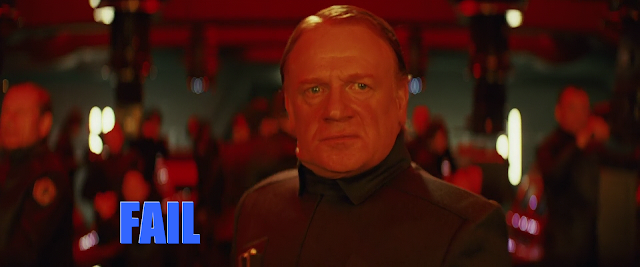
Ye Gods, there’s a lot of failure in this movie, on all sides. Nearly everybody fails in this movie at least once. I don’t recall a story so completely full of capital-F FAIL in quite some time. Let’s take a photographic tour of all the FAIL in The Last Jedi!!!

Seriously, that is a lot of screwing up, across the board. What gives?

For me, all the failure in TLJ is one of the most interesting things about its story. Over the course of the movie everybody fails at one thing or another.

The First Order attempts multiple times to snuff out what’s left of the Resistance.

The Resistance takes out one of the First Order’s biggest ships, but at way too high a price.

The Resistance attempts to flee to safety, but fails.

Kylo Ren tries to kill Leia, and fails.

Finn tries to flee the fleet so that Rey won’t fall to danger, but he is stopped by Rose.

Finn and Rose fail to deactivate the First Order hyperspace tracker thingie.

Phasma fails to kill Finn and Rose.

The Resistance tries to flee its doomed last ship in cloaked vessels, and fails.

Snoke thinks he sees what Kylo Ren is thinking, but fails to his own doom.

Rey thinks to appeal to Kylo Ren’s good side, and fails.

At the end, the Resistance is trying to call for help…but fails. Meanwhile the First Order is closing in, with more than enough firepower to win the war right then and there…but they fail.

Only in the film’s last act does anyone succeed…maybe. Luke Skywalker manages to command Kylo Ren’s attention, and therefore the rest of the First Order waiting, while what’s left of the Resistance can get away. Meanwhile, Luke’s would-be pupil, Rey, who hasn’t really learned a hell of a lot about the Force in his presence, steps up to rescue the fleeing Resistors.

All this failure strikes a keenly interesting tone for this so-very-different Star Wars tale, combined with the film’s very short timeframe and its deeply intimate feel. TLJ makes the war feel like a war of attrition, with all the compounding failures piling up on one another. By the end, when the Resistance numbers less than twenty people, Rey can’t even see a way forward. But Leia can, and assures her that there actually is one, in point of fact.

This, then, is the difference in the failures. The failures of the First Order, of Snoke, of Kylo Ren, all feel like failures of over-confidence and hubris. The Resistance’s failures, though, are something different. They are fighting the good fight, trying to ensure not victory but survival. This leads to the kinds of stories that get told again and again over fires. As a result, the Resistance’s failures feel like lessons being learned and valuable experience being gained. The Resistance is leveling up, while the First Order is not. Kylo Ren clearly believes that there are no more lessons for him to learn…while Rey knows that she is just getting started.

And in the end, all the failure by our heroes has the best result of all, as Luke has already told us.

Next up: Concluding thoughts and random impressions and speculations.

Share This Post

“Are you the fellow who designed St. Paul’s?” “No, that’s Christopher WREN. I’m….” (Thoughts on THE LAST JEDI, part 8)


part 1
part 2
part 3
part 4
part 5
part 6
part 7

Hey!

Hey guys!

If Kylo gets together with a bunch of his buddies, is that a Ren-fest?

OK, fine. But let’s talk about Kylo Ren anyway.

I keep getting this feeling in these two movies that Kylo Ren should be a really interesting character. Adam Driver gives it his all, and he almost single-handedly elevates the character, but the problem with Kylo Ren that TFA had is the same one that TLJ continues. The basics just aren’t there, and TLJ doesn’t really do much to correct the issue like it did with its heroes. Kylo Ren remains little more than a scenery-chewing villain who wants to be evil for no discernible reason. We still have zero idea of his motivations beyond that he wants to be powerful and kill Jedi and stuff, but we still have no idea why. We have no idea what tempted Ben Solo to the Dark Side. We still have no idea what awful choices he made to get to this point. We still have no idea at all how Snoke got his hooks in him. There are a couple of flashbacks to the final moment of his turning, but they are treated in Rashomon-like fashion, and anyway, the last fall isn’t really all that interesting, when you get to it.

Kylo Ren was pretty much always on his way down, and TLJ tells us nothing new about him at all.

In Star Wars, falling to the Dark Side is always presented as about the most tragic thing that can happen to a person. It’s a complete abdication of great promise, this decision to use one’s innate powers for awful ends. Kylo Ren’s story should be doubly so–he is the son of Han Solo and Leia Organa–but again, we learn nothing of it. And again, as with Snoke, it’s no good to simply say “Well, we didn’t know anything about Darth Vader’s fall either,” because again, what you can do in the opening chapters of a story isn’t the same as what you can do farther on when you know your universe and what can happen within it.

Kylo Ren is deeply angry, but why? He has all this rage for his parents and for Luke, but why? He talks vaguely about needing to destroy the past–“Kill it, if you have to”–but again, why??? What is the point of all this? Is he just tempted by power and nothing else? Maybe he is, but then the films should acknowledge that…and frankly, I don’t look to Star Wars for meditations on the banality of evil.

Reasons are completely absent, and so are his desires. Why is he so invested in working with Rey? He’s only just met her a few days before. Is it because he senses someone as powerful as he is? Maybe, but maybe not–the film supports either reading. Likewise, until the moment he strikes, there is no indication that he intends to kill Snoke and take over. Is this an idea that has just occurred to him? Who knows? The moment is interesting as a second fratricide, actually. Snoke is the second father-figure that Kylo Ren kills in a matter of a few days. And yes, Snoke is a father-figure. How else to describe the wounded look on Kylo Ren’s face after his scolding early in the movie? That’s the look of a son who has just been tongue-lashed by the father he has been itching to please.

But again…why has Kylo Ren forsaken his own father for this guy?

We don’t know.

I don’t ever get the feeling of knowing Kylo Ren. He is pretty much a total mystery. Rey claims to feel “conflict” within him, but there is nothing at all for us to base that on…and she turns out to be completely wrong, anyway. He has killed his real father, he kills his second father, he is prepared to kill his mother. He talks of “killing the past” but he lives with all the various trappings of the Sith and the Empire: he is as big a slave to the past as anyone else.

Ultimately I have no idea what to make of Kylo Ren as a villain. I have no idea where he wants to go or why he wants to go there or why he hates where he’s been. Adam Driver’s terrific performance aside, ultimately this new Star Wars trilogy is really faltering with its villains, and it’s a shame.

Next: TLJ and failure. Are we almost done? Maybe! Maybe not! Tune in and find out!

Share This Post

Snokin’ in the Boys Room (Thoughts on THE LAST JEDI, part 7)


part 1
part 2
part 3
part 4
part 5
part 6

If the main heroes were underdrawn in TFA, the villains were doubly so. The First Order’s origins were completely unexplained, as was its power differential: was it the Empire reborn, or was it some insurgent effort? How did it have the means to build a superweapon over twice as large and powerful as either Death Star, which the Galactic Empire could only manage to build twice? How was the First Order managing to stockpile its armies with troopers kidnapped apparently as kids, and yet managing to do this with no one at the Republic noticing a sudden and massive uptick in child abductions? How much territory did they control? If this mission to get the map to Luke Skywalker is that important, why is a rookie space janitor on the away team? And who was Supreme Leader Snoke and where did he come from?

TFA was almost comically deficient in its worldbuilding with regard to its villains, and to add insult to injury it gave us General Hux, who was an annoying enough character to begin with before he was the central figure in what I have decided is, for now, the Single Worst Scene In Star Wars History: the “Space Hitler” speech. That scene was so bad that it actually eclipses the “Jar Jar meets Padme” scene from The Phantom Menace.
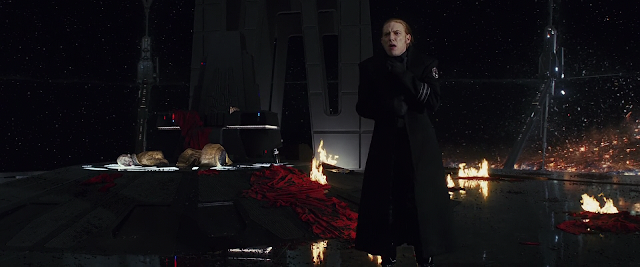
The villains of TFA were awful across the board, including Kylo Ren, whose motivations were as unexplained as Rey’s or Finn’s. They were little more than mustache-twirlers, people who were evil just because they were evil. One could answer “Who cares?” to a lot of my questions about their backgrounds and motivations, and I suppose that’s kind of fair. “We never knew Palpatine’s backstory in the Original Trilogy!” one might say. Or, “We never found out why Vader fell until four or five movies in!” Yeah, OK.

But.

When things happen in a story matters. In the first film or two or three, when you were basically in the first part of your story, you can get away with leaving some things for imagination or for Part Two. You don’t have to explain who Palpatine is and why he became Emperor; all that matters at the outset of your story is that there’s an Empire and he’s the one ruling it.

Now, however, we are eight episodes into this story, and what’s more, we’ve been told that after the happy ending of the first part we’re supposed to accept that none of it ended up meaning anything, that there’s a new Empire in town with a new red-lightsaber-wielding dude in charge, and so on. Well, I submit that if you do that when you get to your last few chapters, you need to put some work into explaining it.

Sadly, while Rian Johnson’s script for TLJ has a lot of things going for it, its treatment of the villains is for the most part not one of them.

Let’s start with my favorite, General Hux.

(NARRATOR VOICE: Hux is not his favorite.)

Hux fares a bit better this time out. There’s no embarrassing Space Hitler speech, and actor Domnhall Gleason does a nice job conveying Hux’s arrogant self-satisfaction: the way he smirks a lot and strides about with his hands behind his back. His job is still mostly to act mean and threaten the Resistance with utter destruction, but he does get a few interesting moments. Just a few, though. Mainly Hux is still the guy whose job it is to yell “Fire!” when the Resistance ships line up in the crosshairs. There is some nice development of the tension between Hux and Kylo Ren, including a moment after Snoke’s death when Hux, noticing Ren on the floor, starts to draw his blaster as if to kill Red and take over.

The opening scene uses Hux’s self-inflation to nice comic effect, actually: he is talking on the radio to Poe Dameron, and he’s going into full Space Hitler mode, when Poe breaks in and says something like “I’m sorry, I was waiting to talk to Hux. Is he there?”

Hux is, though, a pretty generic character. We are told nothing about him at all. He’s not much fun to root against, because let’s be honest–at no point does anybody really think that Hux might win.

Next up? Captain Phasma.

All the TFA pre-release publicity made Phasma sound like a total bad-ass…and then she turns out to be utterly useless, a complete waste. She is so staggeringly worthless in TFA that I was frankly astonished that a novel about her earlier “adventures” was commissioned by Disney. Delilah S. Dawson wrote it, and I’ve heard good things about it, but I doubt I’ll read it because I expect I’d have a terribly hard time squaring Dawson’s well-drawn character with the useless mirrored-shades armor character in the movie. In TLJ Phasma doesn’t show up until late. She acts a little menacing, babbling about how executions should hurt, and then all hell breaks loose and Phasma only sticks around long enough to get her ass kicked by Finn and then call him “Rebel scum” before falling through the collapsing deck into a giant rolling ball of fire. (I hope she’s dead this time.) We do get this one nice exchange, courtesy of Phasma:

PHASMA: You’re always scum.
FINN: Rebel scum.

I like that, but to bring Phasma along just to have that discussion seems a little weak to me.

There’s actually a deleted scene from TLJ where Finn taunts Phasma by pointing out that she deactivated the Starkiller Base shields, so really, that defeat is on her. I can see why they cut it–it’s nice and all, but it’s not needed. Phasma isn’t interesting enough to constantly show up. She’s kind of this trilogy’s Boba Fett…although Fett actually did get something done, back in the day.

Ultimately I find it telling that the only Imperial character who strikes me as being especially competent is the Captain of the Giant Death-Dealing Star Destroyer in the first scenes, and he gets blown up for his troubles.

And now to Snoke.

Snoke, Snoke, Snoke.

You know, you’d like to be able to hate your villains and hiss when they show up on screen, but Snoke is just…a giant nothing. That’s all he is. There is literally nothing there. We are still told nothing about where he came from, how he rose, what his motivations are, where his powers come from, whether he considers himself a Sith…none of it. Snoke is a complete cypher, a giant fill-in-the-blank, and it bugs the hell out of me.

Some, again, have argued that it doesn’t matter. After all, in the Original Trilogy we knew nothing of Palpatine–in fact, we didn’t even really know that his name was Palpatine. But again, so what? We’re not in the Original Trilogy now. We’re eight episodes in, and the sixth episode ended on a note of triumph that the seventh episode completely negated, without explanation. This is not good storytelling, and to the extent that a great deal of Star Wars relies on its villains, it’s not good worldbuilding either. I’m not saying that we need a complete backstory on Snoke, but something to go on would help. As it is, he’s merely the Star Wars equivalent of one of the lesser James Bond villains. (Quick! What was the bad guy in Die Another Day trying to accomplish? You don’t know, do you?)

Snoke’s rise could play into one of this trilogy’s apparent thematic concerns: that the Force need not be eternally separated into Jedi and Sith. Surely there are Force-users who have naught to do with the orthodoxy of either group, and surely there are some who are enormously powerful and evil. The Prequels hinted at this when they had the Jedi initially refuse to train Anakin even though he was clearly very special. These movies are hinting at Force-use that goes beyond the simple Jedi-Sith spectrum, but they are also somehow deeply hesitant to really explore that angle. Kylo Ren pays a bit of lip service to the idea, but note that despite his whole “Kill the past!” thing, his entire support structure is The Empire 2.0, with stormtroopers and star destroyers and AT-ATs and TIE fighters.

Of course TLJ has Kylo Ren kill Snoke in a shocking twist (I really was surprised), but this would have been even more interesting if we had the slightest idea who Snoke was. As it is he’s just an obstacle for Kylo Ren to overcome on his way to whatever it is that he wants, and that’s a problem too–but more on that another time. Besides, is Snoke really dead? Who knows? If Luke could cast a physical projection of himself across the universe, who’s to say that Snoke couldn’t do the same thing? Maybe, maybe not. For now it remains the case that Snoke, for all his tall height and nifty-looking guards (in red, echoing Palpatine’s–quite the break with the past there) and his incredible-looking throne room, is just paint-by-numbers, and barely that. I expect we’ll get Snoke’s story at some point, but it’ll be in a novel or comic or something–not in the movie where it belongs.

Which brings us to the actual most interesting villain in TLJ: DJ, the hacker-thief played by Benicio Del Toro. For the first time since Lando Calrissian we have a Star Wars character who is genuinely motivated by little more than self-interest. DJ openly points out that his main concern is money, and he displays virtually no moral compass whatsoever. He steals a ship to rescue Finn and Rose, and he agrees to help them in their scheme to deactivate the First Order’s hyperspace-tracker thing, but he also points out that the owner of the ship he’s stolen profited by business dealings with both the First Order and the Resistance.

It’s all business to DJ, so when he finally betrays them for money, it’s not the least bit surprising. He just shrugs and tells them that some days you win and some days you lose, in the most nihilistic claim in a Star Wars movie since Han Solo’s “I’m not in it for you, I’m in it for the money” all the way back in A New Hope. But there’s no last-second redemption for DJ, no last-minute heroics to show that his heart really is in the right place. He takes the money and goes, never to be seen again (at least in this film). The addition of DJ and his neutral morality is a fascinating thing for Star Wars, and it’s interesting to note that of all this film’s villains, we know the most of DJ’s motivations and character.

It will be interesting to see if DJ returns in Episode IX–maybe the Rebellion finds itself with no choice but to roll the dice on him again. Or maybe he just goes away, never to be heard from again, except for when he inevitably turns up in a novel or comic.

This all brings us to the main villain of TLJ, but…more on Kylo Ren next time. Tune in, Star Warriors!

Share This Post