Enjoy. Or not. (I did.)



The official site of Kelly Sedinger: Reader, writer, photographer, and dreamer
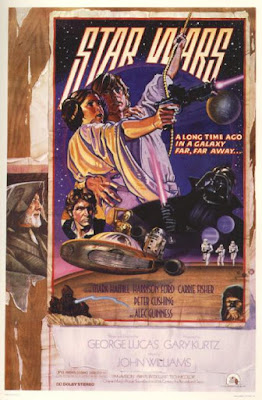
I finally saw it, though, with my sister, who is six years older than me.
I didn’t like it.
It was very loud. It opened with big words flying through space and then there was loud spaceships and talking robots (one of whom only talked in beeps and whistles). There was a girl in white and a bad guy in black whose breath sounded weird. There was a desert planet with weird dwarf-creatures and a kid named Luke who lived with his aunt and uncle. (The uncle could be pretty gruff if Luke was goofing off, to which I could relate.) There were more loud spaceships and one really really big spaceship shaped like a giant ball. There was a guy dressed in black and white who helped the farm kid, and this guy had a giant ape-man friend. There were swords made of light and even more spaceships and a big battle in space.
All of that, and I didn’t understand a lick of it.
In my defense, I was all of five years old at the time.
Until Star Wars, my movie experience was pretty much limited to stuff like Bugs Bunny Superstar and Disney live-actions like The Shaggy DA (which contained a hoot of a pie fight). Then there was this movie with loud spaceships and robots and a farm kid and a bad guy in black and…well, I had no idea what to make of this movie.
Luckily for me I had my sister, who is six years older than me.
She went all-in for Star Wars. She ate it, drank it, breathed it. She talked about it a lot, and gradually her enthusiasm began to win me over. She explained the story to me because I hadn’t understood it all that well, and I decided that I wanted a part of her enthusiasm for my own. So I went with her to see the movie a second time.
I have never ever ever recovered.

I’ve been thinking a lot about Star Wars as it nears and achieves 40 years, and I find myself relating to it most as a storyteller myself. As a writer I tend most to look at Star Wars through the prism of story. Many stories have had a deep effect on me, on the stories I want to tell, and the way I go about telling them, but none moreso than Star Wars, even as the Star Wars story itself has changed over the course of its four decades. Most of the core ideas are still there, though, as Star Wars is now no longer in the hands of its creator, George Lucas. Star Wars is still a tale of heroic adventure unfolding in the sky. It is still a tale not just of the wars but more well-focused on the people fighting that war. It is a tale of improbably redeemable villains, of the way our paths mirror those of our parents, and of finding love in the face of desperation. It is a tale of family.
I can’t help thinking in most, if not all, of these terms every time I write a story, no matter which genre it’s in. Star Wars made me want to be a storyteller (what is playing with action figures, if not storytelling?). It also taught me that stories can focus at times on more mystical matters, and it taught me that story is an excellent way of addressing the challenges people face in their hearts. Most importantly, though, Star Wars taught me about heroes and quests and the wise elders who try to guide the heroes on their way.
Other stories have come since Star Wars arrived, and many have come to places almost as near to my heart. It’s not only stories, either; it’s all of creative art, really:
Lloyd Alexander’s Prydain Chronicles
The Lord of the Rings
Casablanca
On Her Majesty’s Secret Service
My Fair Lady
Cosmos
Much Ado About Nothing
The House with a Clock in its Walls
The Lions of Al-Rassan
Mary Stewart’s Arthurian trilogy (plus The Wicked Day)
Berlioz’s Symphonie fantastique
Rachmaninov’s Symphony No. 2 in E minor
Invisible Touch by Genesis
Once and Again
Princess Mononoke
These are all things — and there are more — that are at the center of my creative life, but none has ever quite dislodged Star Wars as my Prime Mover. Star Wars is, and continues to be, my Platonic Ideal of what story is.
Even so, I haven’t always kept as close an eye on Star Wars as a massive universe as many. I’ve read only a small handful of all the many novels and comics written over the years, and I haven’t played any of the video games. For me, my appreciation focuses pretty exclusively on the movies themselves, and not just the wonderful Original Trilogy but also the admittedly uneven — but still, in my eyes, uniquely compelling — Prequel Trilogy and even to a smaller extent the recent “Rebirth” movies, The Force Awakens and Rogue One. Those form the core.
Star Wars is as strong now as it ever was, and it is very likely even stronger. It has more fans than ever, and it is now in the hands of a corporate power whose pockets are deep enough to maintain it at a very high level for decades to come. More fans are created every day, it seems, and yet…I do have to admit to feeling a certain level of possibly grumpy oldsterism. Sure, you kids can love Star Wars and in fact I hope that you will, and that your love for Star Wars will lead you to other things. But I came in on the ground level. My memories may be hazy, but I do remember a time before Star Wars.
I believe that every story one writes — or rather, every story that I write — should be, in one way or another, a love letter, either to someone or something. The Song of Forgotten Stars has many influences, but it is ultimately my love letter to Star Wars. If not for Star Wars, there’s no way I would be writing this story. It’s not just about the internals of Star Wars, though: it’s about the way Star Wars impacted me and shaped my life and helped reflected certain relationships in my life. Put it this way: There’s a reason why the two main characters in my Forgotten Stars books are two Princesses, one of whom is six years older than the other. It’s a dynamic that makes sense to me on a lot of different levels.
I also know, from reading a lot about the making of Star Wars over the years and about the life of George Lucas in particular, that the way by which a creative work comes into existence is often a messy one. Lucas’s manner of creation is eerily similar to my own, or maybe vice versa. Lucas is someone who starts out by following ideas in any direction they might go, and only gradually whittles things down and discards this notion or that idea until a streamlined story starts to emerge. I work the same way, at least in part. My rough drafts are often very messy and they always contain entire ideas that I remove entirely, for one reason or another. Lucas has done so much mixing and matching of ideas over the decades (remember that for him, Star Wars is 47 or 48 years old, depending on where he dates The Beginning) that he at times seems to be misremembering his own history. I know how he feels. There are times when an idea seems so organic that it’s hard to claim it for my own. Even if it is.
So thank you for forty years, Star Wars! And may the Force be with you, forevermore.

So last week the first trailer for Star Wars Episode VIII: The Last Jedi hit. Here it is!
Assuming that the trailer is representative of the film, this movie has potential to end up being the most beautiful Star Wars movie yet, in terms of the visuals. There are some gorgeous shots here, my favorite being the distant shot of Rey practicing with her lightsaber on the island.
Luke is also apparently not faking his whole “depressed Jedi teacher” thing, as hinted in The Force Awakens. From what little we see or hear, Luke Skywalker sounds old, tired, and weary of the whole thing. I still don’t know that I like this turn of events, and I remain convinced that surely the writers crafting this part of the story could have figured out a way to engage the emotions and have danger without undermining all the victories of the original trilogy. There’s a sense here of, oh, as if Victor and Ilsa’s plane at the end of Casablanca had to turn around and land again, due to engine trouble.
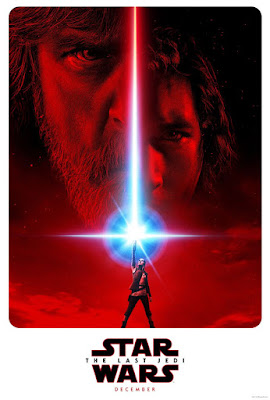
Also released was the first poster for The Last Jedi:

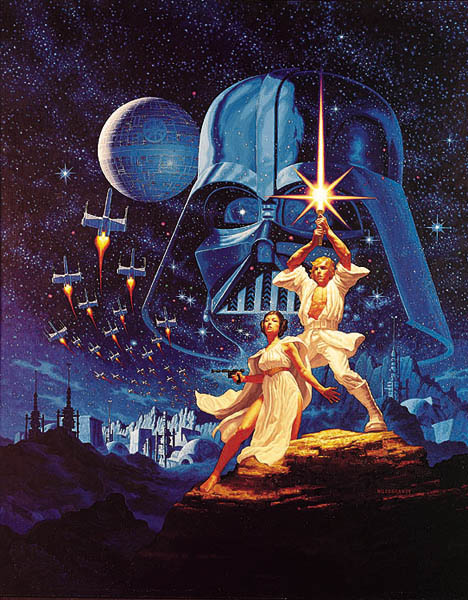
It’s OK as well. Nothing earth-shaking. The lightsaber blade, with the starburst right at the pommel, is a callback to the famous Brothers Hildebrandt poster for Star Wars, way back in the day. The faces of Luke and Kylo Ren, looming over Rey, seem to indicate that they will be battling for Rey herself; she appears to be caught in the middle of these two men. This is all a lot of tea-leaf reading, I admit, but I’m not really wild about the notion of these films making us wonder if Rey will tumble to the Dark Side or stay with the Light. Again, we’ve seen that story before. But I could be wrong, and I’m willing to see.
I also find it fitting that Kylo Ren’s face is notably smaller than Luke’s, because Luke is the ultimate hero of much of Star Wars, and frankly, as a villain Kylo Ren is simply not that interesting to me. Finally, as a visual note from the poster, that starburst at the lightsaber blade’s base is surrounded by a multi-ringed halo that seems suggestive to me of Captain America’s shield.
So, a nice trailer and a nice poster. Red seems to be a dominant color this time out, with the red lettering of the Star Wars logo and the red background in the poster and even the planet in the trailer whose soil seems to be a red dust. Red is typically the color of the Sith lightsabers, so…well, again, we’ll see.
Meantime, we’re two weeks out from Guardians of the Galaxy v. 2….


So there’s a new STAR WARS movie in town.
Yup, we finally saw Rogue One, on the day after New Year’s. This was not due to any lack of enthusiasm, mind you, but simply the travails and tribulations of trying to find large blocks of time for seeing movies around the Holiday season. Rogue One thus turns out to be the first Star Wars movie that I did not see in its opening weekend since The Empire Strikes Back.
No, none of that matters or has any bearing on what I thought about the movie. So, what did I think of the movie?
Short version: I liked it, quite a bit. I had some complaints and quibbles along the way, but there was nothing in this movie that I found disturbing or annoying (well, almost nothing). So I liked it a lot more than I liked The Force Awakens.
Nothing in this movie is necessary, which an interesting place to start. When Disney bought Lucasfilm, and Star Wars with it, the lay of the land very quickly became clear. Disney was not going to be content with the six existing movies, and they immediately greenlit Episode VII. They soon thereafter made clear that they weren’t going to be content with the old model, either, wherein the new Star Wars movies were spaced three years apart. No, they wanted at least a movie a year, in order to make the Star Wars “cinematic universe” almost as much a going concern as the Marvel one. Now, I’m not sure we’ll ever get to multiple Star Wars movies a year, but until these things stop making money, we’re getting at least one a year.
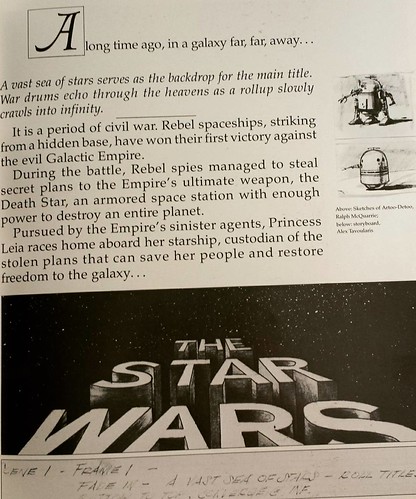
However, Disney knew that they couldn’t get Episode VIII done that quickly, so they announced a series of stand-alone films that would alternate with the “Saga episode” films. Rogue One is the first of these, and we learned very early what it would be about. Remember back to the opening crawl of the very first Star Wars movie ever? Episode IV: A New Hope (once known, quaintly enough, simply as Star Wars) starts off by giving us this bit of background:
It is a period of civil war. Rebel spaceships, striking from a hidden base, have won their first victory against the evil Galactic Empire.
During the battle, Rebel spies managed to steal secret plans to the Empire’s ultimate weapon, the DEATH STAR, an armored space station with enough power to destroy an entire planet.
Pursued by the Empire’s sinister agents, Princess Leia races home aboard her starship, custodian of the stolen plans that can save her people and restore freedom to the galaxy….
Rogue One is the story of those Rebel spies, the ones who manage to steal the secret Death Star plans while the Rebel ships are busy winning their first victory against the Empire.
In all honesty, when I heard that this was what Disney was doing with this movie, I wasn’t terribly thrilled. This is simply not a story that anyone has ever wanted to hear, is it? Has anyone ever wondered about those spies and how they stole the Death Star plans? I certainly haven’t. It’s like wondering why no one has ever made a movie telling the story of those ill-fated German couriers with the letters of transit in Casablanca, the ones whose murder by Ugarte (Peter Lorre) is reported in that film’s first minute. We don’t need a movie about how a single scientist on the planet Krypton diagnosed that world’s doom; what matters is that world’s single survivor, the baby Kal-el. Nobody needs to see the tale of how Ben and May Parker came to be the guardians for young Peter.
But someone decided that the theft of the Death Star schematics was a story that needed telling, so tell it, they have.
In truth, I still wonder about that. I wonder if this film isn’t partly an attempt by Disney to have the cake and also eat it, by making a standalone Star Wars film that is nevertheless pretty safe. The Star Wars story is so well-known by this point that not much background needs established in Rogue One, and indeed the film gets started and off to the races pretty quickly. There is apparently some technical problem with building the Death Star, and the Empire needs the services of one of its geniuses to fix it. The genius, however – a guy named Galen Erso – is living in seclusion on some planet someplace – hiding, in fact – and the Empire goes to get him, sending Director Krennic himself to fetch the genius. Krennic is the officer who is actually in charge of building the Death Star. After some stuff in which Galen’s wife is killed and his daughter Jyn goes into hiding, Galen is taken anyway.
Flash forward fifteen years or so, when young adult Jyn finds herself targeted by the newly forming Rebel Alliance, because of her father’s position as designer of this new “giant weapon” that they’ve heard the Empire is building. The rest of the film is mostly about that: the coming together of a team of ragtag rebels, each with a different specialty or skill, as they set out to steal the plans for this new super weapon, called “the Death Star”. Somehow Galen has coded a message to Jyn, and when she plays it, he tells her that he has built a weakness into the armored space station.
So basically Rogue One is a kind-of The Guns of Navarone in space, with all the various trappings of Star Wars. For the most part, the film is gripping and entertaining. It’s on the long side – maybe a little too long, especially during the ending sequence which pretty much abandons the main story in favor of some straight-up fanservice, but more on that in a bit. And somehow, despite maybe being a little too long, I felt like we never really got a good feel for the characters aside from Jyn and the droid K-2SO. Even Cassian Andor, the Rebel agent who gets the whole thing rolling by busting Jyn out of Imperial prison, is something of a cypher.
We learn even less about the rest of our ad-hoc strike team. There’s an Imperial pilot who has defected, although we never really learn why. We likewise don’t learn a whole lot at all about our blind warrior-monk or his mercenary friend, aside from the fact that we need some bit of mysticism in a Star Wars movie, and these two provide it. This is actually interesting: Chrrit Imwe, the blind monk, is nevertheless apparently a Force-user of some sort – or at least, he is someone whose life evidences a certain devotion to the Force. He keeps saying “I am one with the Force and the Force is with me,” almost as a mantra, and it’s hard to make the case that he’s not using the Force at points. Again, we have a broadening of the idea of Force-users – begun in The Force Awakens (although it may have begun earlier, in the cartoon shows that I haven’t watched) – who don’t fall into the Jedi-Sith dichotomy.
I don’t think it’s entirely a flaw that the characters in this film are generally fairly broadly sketched. This is a long story, with a lot of moving parts, and there’s not really a great deal of extra time to be dealing with characters backgrounds. A little more would have been helpful, though. There’s a reason why these kinds of movies, like The Guns of Navarone, tend to run on the long side. You need to establish the characters so that when they inevitably start dying, it matters. And I did feel something when some of the characters began expiring during the final battle, so there’s that. I don’t think Rogue One is fatally flawed by inattention to character, at all. I just would have liked a little more.
I was concerned during the film’s production about the tone that was promised. The filmmakers, in various statements, seemed to be indicating a very dark and gritty film was in the offing, so much so that I was worried about the Battlestar Galactification of Star Wars. This hasn’t really happened. The film is substantially darker in tone than most of the Star Wars entries – although it’s nowhere near as grim as Revenge of the Sith – but there is still heroism and even fun to be had along the way. For the most part, the movie earns its emotional beats. In fact, the film earns its emotional beats much more satisfactorally than did The Force Awakens. While I don’t think we get to know the characters as well as we should have, we do still get to know them better than we did in TFA, so when the price for victory starts getting paid, there is real emotion there.
More broadly, the film is darker than many of its predecessors, and it’s dark in a pretty interesting way. There are more shades of gray here than usual in a Star Wars movie, and the shades of gray that we see are those presented to desperate people who are presented with awful choices, as opposed to the shades of ever-increasing darkness we see in people who are moving from the Light Side toward the Dark. Rogue One gives us characters who aren’t in it for the goodness of the cause, but who aren’t motivated by money or power either.
My biggest complaint with Rogue One lies not with the heroes but with the villains. I’ve read a lot of praise for the film in this department, so maybe I’m in the minority here, but I don’t think the movie is entirely successful with the villains. Director Krennic, who is supervising the building of the Death Star, is pretty uneven. At times he is a technocrat, seemingly interested only in what he’s building as an intellectual exercise. This is the most interesting version of him: the man who wants to build this appalling weapon mainly to see if he can do it at all. He doesn’t seem terribly interested in the Empire itself, or vested with any special loyalty to the Emperor. However, at other times he is presented as mustache-twirlingly as every other Star Wars villain, most notably in the film’s opening scenes when he visits ruin about Galen Erso’s family in order to secure his assistance in his project.
Krennic is at times a fearsome commander, and at other times a fearful lackey himself. We meet Governor Tarkin who bosses Krennic around left-and-right, and we also have Krennic visiting Darth Vader himself on what I assume to be Vader’s “home” (a castle-like fortress built over a literal river of molten lava on what looks kind of like Mustafar). A lot of people were thrilled to see Vader in this movie, but in none of his scenes did he seem necessary to me. Vader’s inclusion felt like it was stuffed into the movie almost as a means of “rehabilitating” the image of Vader. The most common trope I’ve heard is that Rogue One made Vader “scary again”, and that it was finally cool to see Darth Vader cut loose with a lightsaber and do evil shit. I point out that we saw exactly that in Revenge of the Sith, just that back then it was his pre-black suit days. A lot of fans don’t seem to consider Vader Vader until he’s ensconced in the black armor and the iron lung, which seems wrong to me.
Likewise, the film’s last few minutes don’t work for me. Again, lots of people love those last few minutes, but for me they feel wrong somehow. Vader chasing Rebels through the corridor with his lightsaber, while they are doing a relay-race thing to get the Death Star plans onto the Tantive IV, was kind of a reach. Likewise, Princess Leia’s appearance in the very last scene didn’t work for me at all. In fact, it pretty much kicked me out of the movie entirely. Part of that, I’m sure, was the jolt of having had Carrie Fisher die just a week or two earlier, which cast a pall over the scene that there’s no way the filmmakers could have predicted.
But in terms of story, that bit doesn’t work for me either. This implies that the beginning of A New Hope takes place literally minutes after the ending of this movie, for one thing. For another, it doesn’t fit with what’s established at that film’s beginning. When Vader takes over the blockade runner at the beginning of A New Hope, Princess Leia protests that she is a member of the Imperial Senate on a diplomatic mission to Alderaan. Vader knows that he claim is bullshit – “If this is a consular ship, where is the ambassador?” – but Leia wouldn’t even be able to make that claim with a straight face if she has just literally fled the scene of the Battle of Scarif. Likewise, Vader’s lines to Leia – “Several transmissions were beamed to this ship by Rebel spies” – doesn’t work at all if the plans weren’t transmitted but rather somehow run by a series of heroic-but-doomed Rebel soldiers who just manage to hand it through the blast door before it seals.
There is also too much Tarkin in this movie. I have to admit that I lost some interest in the various political machinations between Tarkin and Krennic as the film progressed. A little of this stuff went a long way, and Rogue One has too much of it. It takes focus off Krennic a bit, and worse, it lessens him. Krennic becomes something of a pathetic figure by the film’s end, not a fearful one, and in honesty, he’s not even essential, is he? We have him on Scarif at the end, giving us the confrontation that it seems we have to have – villain and hero in a mutually precarious spot – but I have to admit, by the time we got the Battle of Scarif really rolling, I’d lost interest in Krennic. His worst moment has to be the way it takes him a very odd length of time to realize that the Rebels are here to steal the Death Star plans, and this ends up feeling to me like Die Hard’s Deputy Police Chief Dwayne T. Robinson: “I think they’re goin’ after the lights!”
I don’t want to rip on this stuff too much, but I do think this points up a certain structural flaw with this story as it’s conceived. It’s The Guns of Navarone in Star Wars, but we can’t end with the destruction of the guns, can we? Our big victory here is the acquisition of the plans, which we know happens during a big battle. For me, everything that comes after our heroes have won – after Jyn and Cassian die, having beamed the plans out – is pretty much filler.
I also don’t want to be too hard on the movie for its big action climax, because aside from the very last moments, it’s a fantastic battle. I love that the stakes keep rising as more and more ships get involved, until the Death Star itself shows up. The “limited power blast” from the Death Star’s superlaser is a good touch. I did find the digital re-use of battle footage from A New Hope distracting, but…well, when you’ve seen a movie as many times as I’ve seen A New Hope, there’s not really a way to avoid that, is there? This battle is hectic and violent and thrilling, it’s edited together beautifully, and I like that there are real objectives, not just The Force Awakens’s final battle which boils down to “Hit it as hard as you can!”
Oh, and I’d be remiss if I didn’t address the fact that Rogue One fixes a major plot hole in A New Hope – or at least, that’s what a lot of people say it does. Luke Skywalker is able to destroy the Death Star by taking advantage of a tiny weakness in the battle station, and this film gives us an explanation as to why the Empire was dumb enough to leave that weakness in there (it was actually planned sabotage by Galen Erso). It’s ridiculous, the idea seems to be, that the Empire’s ultimate weapon can be destroyed so easily, by firing a torpedo down a thermal exhaust port.
Here’s my problem with this line of thinking: This is not a plot hole and it never has been.
The complaint always seems to be along the lines of, “Why would the Empire build such a huge weapon with such an obvious design flaw?” Or, “Why is the Death Star so easy to destroy?”
Well, in the first place, let’s consider the kind of story that Star Wars is. For all its spaceships and planets and rockets and laser guns and whatnot, it’s a mythic story, and most of its tropes come from mythic fantasy, not from science fiction. And in mythic fantasy, the trope of the Immense Villain with the Tiny Weakness is a very, very old one. We’re talking David-and-Goliath here, or Beowulf-and-Grendel. Odysseus versus the Cyclops. Bard versus Smaug.
The Death Star’s weakness, small and unnoticed, is perfectly in keeping with these kinds of stories. Complaining about it years later is to misunderstand the whole nature of the tale.
But here’s the other thing: the Death Star is not easily destroyed! Consider the Battle of Yavin. General Dodonna briefs the pilots:
The Empire doesn’t consider a small one-man fighter to be any threat, or they’d have a tighter defense. An analysis of the plans provided by Princess Leia has demonstrated a weakness in the battle station.
The approach will not be easy.
You are required to maneuver straight down this trench and skim the surface to this point. The target area is only two meters wide. It’s a small thermal exhaust port, right below the main port. The shaft leads directly to the reactor system. A precise hit will start a chain reaction which should destroy the station.
Only a precise hit will set up a chain reaction. The shaft is ray-shielded, so you’ll have to use proton torpedoes.
Remember all that? And remember the room full of pilots murmuring at the inherent difficulty of the task? Remember Wedge protesting that it was “impossible, even for a computer”?
No, the Death Star was not easily destroyed. Thirty ships made up the attack force. Only three end up returning. Of the thirty that flew, only two actually got to take a shot at the exhaust port, and only one actually hit it, and that was because that pilot had decided to use the Force instead of his computer when making the shot, and he only got to do that much because of the timely intervention of a particular space pirate.
Destroying the first Death Star was not “easy” at all, and when people imply (or state outright) that it was, it seems to me that they’re cheapening one of the great action sequences in all of movies. And that, I cannot abide.
(No, this isn’t just me defending the honor of my favorite movie, either. I can admit flaws in my favorite movies. See the Fixing the Prequels posts, or note my admission that my love of Casablanca aside, the letters of transit really are complete bullshit.)
I also think that there was probably a bit too much fanservice in Rogue One. We have Darth Vader, of course, and Governor Tarkin shows up (more than I expected, to be honest). But there are walkers in battle, and a Mon Calamari commander of the Rebel fleet. Bail Organa shows up very briefly, referring to his need to enlist an old friend of his (Obi Wan Kenobi, we assume) before saying that he has to get back to Alderaan. (We, of course, know that he will never leave.)
Some fanservice is fine, but there does get to be too much. An unnamed Rebel pilot with the Red Five call sign is shown dying, explaining how Luke Skywalker gets to have that same call sign at Yavin. Footage from A New Hope shows us Red and Blue Leaders. A land battle involves Imperial walkers. Earlier in the film, Jyn Erso bumps into someone on a crowded street, who turns out to be the very ruffians that Luke Skywalker bumped into in the cantina in A New Hope. I found a number of the callbacks distracting, and I do hope that future Star Wars films have less of that, moving forward. (The Force Awakens also had way too much fanservice for my taste.)
What does all this mean for Rogue One, then? Well, I’m not sure that the movie really needed to address the “weakness” in the Death Star at all. It really only serves to give Galen Erso a more sympathetic nature, I suppose. If not for that whole business, I wonder if audiences would have been nearly as invested in Jyn’s search for her father. I’m not sure, because the movie would be different without it. How to make Galen sympathetic if he goes along with building the Death Star? I’m honestly not sure. But anyway….
I don’t want to seem like I’m being too negative on Rogue One, because it really is an engaging movie, and probably the most directly satisfying trip to the galaxy far, far away in some time. I do wish the villains had been a bit more even, and I’m not at all sure that we needed Darth Vader at all. Those are not major complaints, though, because the movie mostly gets the story with its heroes right. It’s a long movie, but I really wasn’t much conscious of the running time, and as the final battle unfolded, seeing the fates of the characters unfold was still highly effecting. (None of this can possibly be a surprise, can it? In this subgenre of the war movie, it’s gotta be a given that most of the heroes are going to die.)
It will be interesting to see how the future “standalone” Star Wars movies fare. The next one is the Han Solo movie, which I maintain still must be titled, Never Tell Me The Odds.

Some geeky stuff!
:: Star Wars Episode VIII has itself a title:
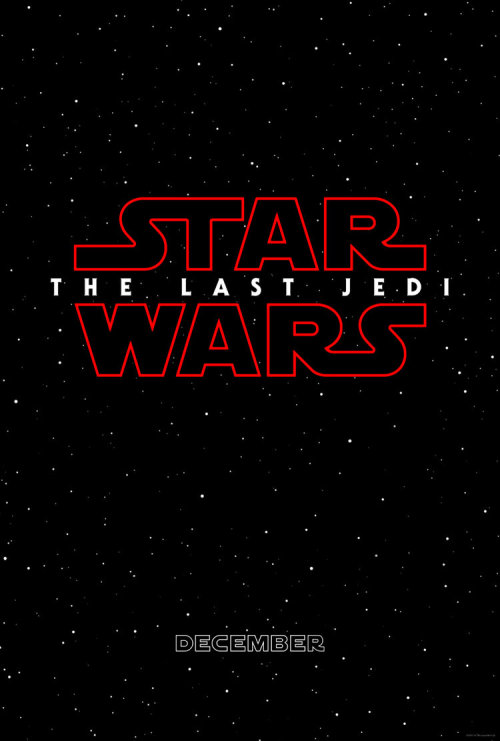
I honestly don’t have an opinion of this as a title. Star Wars titles tend to be greeted as events, and then…well, they’re titles. OK, The Last Jedi.
It does break a little with previous “middle installment” titles from previous Star Wars trilogies. The opening films generally have three-word titles that suggest a story beginning: A New Hope, The Phantom Menace, The Force Awakens. Then, previously, we’re had four-word titles that indicate a middle installment based on action: The Empire Strikes Back, Attack of the Clones. But this breaks that “tradition”. Is this a problem? Not really. If the movie’s terrific, they could call it Jedi Boogaloo for all I care.
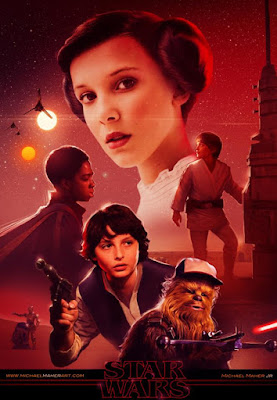
:: This has been making the rounds of Facebook the last few days: a poster for Star Wars in which the characters are re-cast as the kids from Stranger Things.

The artist, Michael Maher, has done quite a bit of cool Star Wars art, as well as other things. Check out his work!
:: I have no idea how I missed this show’s existence entirely, since I have to think this would have been right up my alley when I was seven or eight years old, but miss it I did. It was an NBC show called Supertrain.
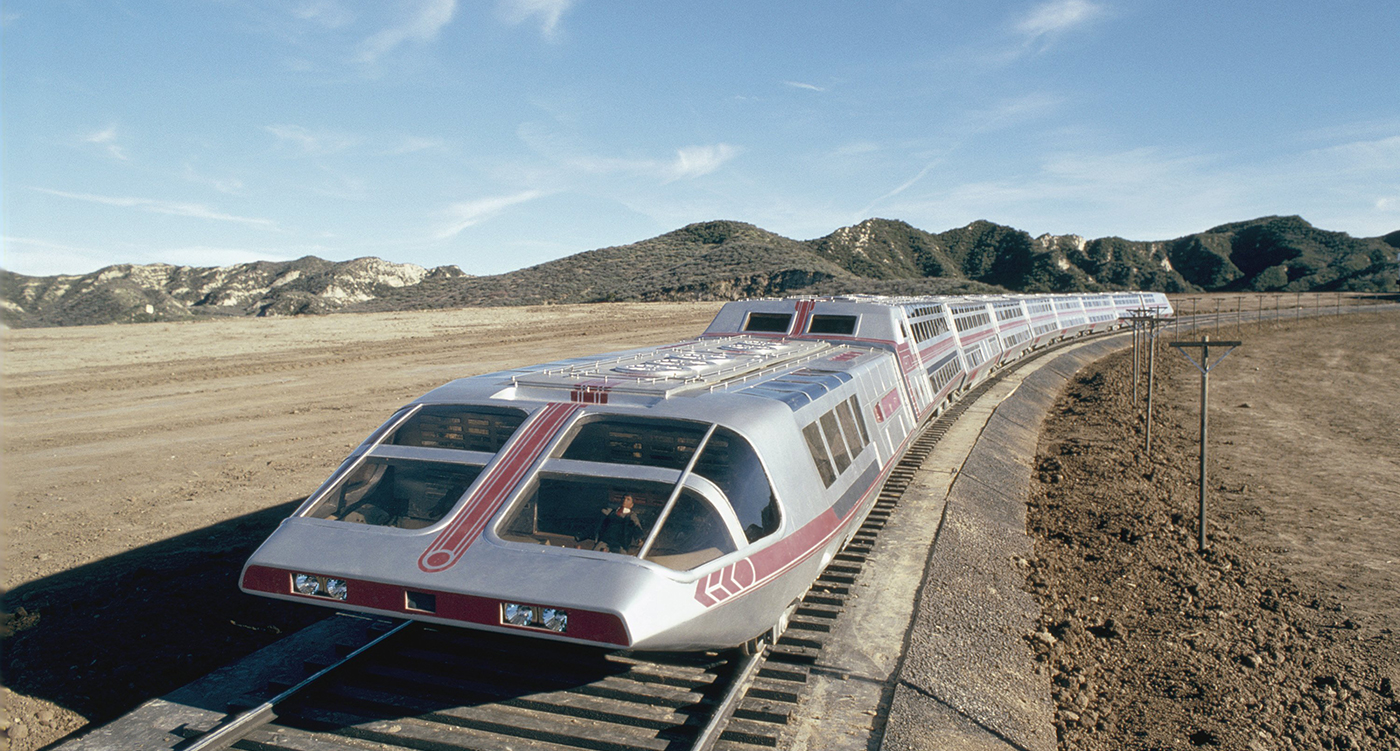
The show is described thusly:
The series was one part sci-fi, one part The Love Boat. It revolved around a nuclear-powered bullet train that could travel from New York to Los Angeles in 36 hours and had amentities like swimming pools and shopping centers.
Just like The Love Boat, the plot focused on the passengers and their connecting storylines. Supertrain could have been a minor a hit, but there was one issue. It cost way too much money.
New York to LA in 36 hours? WOW!!! In an era when planes can do it in six! I assume the show had some explanation for why there were no planes.
Apparently to make the show look good, the producers had to make really large and expensive models. Look at this thing:

Unfortunately, the show’s big budget took an even bigger hit when — well, anybody who ever played with an electric train must know what happened.

My favorite part of that pic is the guy standing in the foreground, wreckage behind him, cigarette in hand as he undoubtedly wonders if he’s ever going to work in this business again.
Apparently the ratings were awful, leading to desperate casting stunts like Tony Danza and Zsa Zsa Gabor, making the show another in the 1970s-era super-genre of shows designed to have rotating All-Star Casts every week. Fantasy Island and The Love Boat meet…Silver Streak? I dunno, but this concept for a show seems gonzo enough to have really appealed to me as a post-Star Wars kid.
I recently read a fascinating book about the Star Wars phenomenon, titled How STAR WARS Conquered the Universe: The Past, Present, and Future of a Multibillion Dollar Franchise. Written by journalist Chris Taylor, the book traces the history of Star Wars, not as purely a “making of” story, but as a cultural phenomenon. It’s a terrific book that I reviewed on Goodreads, but I wanted to revise and extend those remarks a bit.
This book is one of the most even-handed accounts of Star Wars and the work of George Lucas that I have read. There isn’t much axe-grinding here, which I greatly appreciate. Taylor is interested in just how this thing called Star Wars came to be one of the dominant pop-culture forces today, tracing the influences that led a young George Lucas to think more and more obsessively about his “little space movie”, and then tracing its own influences on those who came after and showing some of the many and surprising ways that Star Wars has enhanced and influenced the lives of several generations of fans, geeks, and whatever else has come afterwards.
Star Wars started as one movie that wasn’t even supposed to be 20th Century Fox’s big picture for 1977, but it became an enormous force, as everyone knows. It is certainly, along with Star Trek, likely the single biggest influence on my creative life, and it’s inspired an astonishing amount of activity over the years, from comics to music to books to fan films to cosplayers, some of whom have organized into the largest amateur costuming group in the world after the Society for Creative Anachronism. All that, from the imagination of a filmmaker from Modesto, California who only became driven to succeed after he nearly died in a car crash in his youth.
From my perspective, the best parts of the book are those that home in on George Lucas’s creative process. A lot of ink and a lot of pixels have been deployed over the years in discussing Lucas, many times in derision. What emerges in this book – and in others I’ve read, such as Rinzler’s wonderful Making of… books for each of the original Star Wars films – is a man with a deeply non-linear creative process. Lucas’s approach seems to be to generate ideas by the dozen, and then mix-and-match them in various ways until something coherent begins to emerge. Sometimes his earliest ideas are set aside only to return many years later, and sometimes his early ideas stick around through most iterations of story.
The genesis of Star Wars, as it went from being an enormous and ungainly thing bogged down in dozens of names and jargon terms, was a very messy process, and it’s always amazing to me to see the long litany of notions that came and went. There are ideas that Lucas entertained in 1975 that would not show up on film until thirty years later (such as the planet Utapau, present in the earliest drafts of Star Wars, when it was called The Star Wars, and which would not actually show up on film until Revenge of the Sith). In this way, Lucas reminds me of some favorite artists of mine, like composer Hector Berlioz, who would think nothing of using a melody in an early work and then using it again many years later, if he felt that he still had use for it.
The messiness of Lucas’s storytelling process stands at odds with things he says later about his own process, which is something that a lot of people have used as a source of criticism. Lucas is often thought to have promised a nine-episode Star Wars saga back in the days of the Original Trilogy, but his actual statements were that he had written an enormous story and then cut it in half, resulting in the Original Trilogy being the second half; the seventh, eighth, and ninth episodes were only conceptual in nature. This seems to be partly true, but Lucas didn’t so much cut an original story in half as he kept reducing his focus. The “Star with Episode IV” approach seems to be more emergent than intentional, which is not a bad thing.
Here, from the book, is just such an example of one of Lucas’s old ideas resurfacing much later on:
The moment Lucas decided to add a kind of rational, scientific component to Jedi knowledge of the Force, in Episode I – the infamous “midi-chlorians,” microscopic organisms that are supposed to help the Force bind to living beings – long-time fans revolted. It didn’t matter that, as Lucasfilm protested, the midi-chlorians are not supposed to be what the Force is actually made of – just a biological indication of its presence. If you dig deep enough into the Lucasfilm archives, you’ll find Lucas talking about midi-chlorians as early as August 1977. “It is said that certain creatures are born with a higher awareness of the Force than others,” he said during a role-playing exercise designed to help him flesh out Star Wars concepts after the original movie. “Their brains are different; they have more midi-chlorians in their cells.” This didn’t matter either. What fans actually want, it seems, is as little detail as possible. They want twenty-eight words, and nothing more.”
The twenty-eight words Taylor refers to is the simple description of the Force given by Ben Kenobi in A New Hope, and nothing more. Without rehashing the whole midi-chlorian thing, it’s certainly interesting that Star Wars fans seem to want to leave things open and mystical and unexplained in a lot of cases. They certainly stand in contrast to, say, fans of JRR Tolkien, who want as much detail as humanly possible, to the point of learning to speak fictional languages and developing their grammars beyond what Tolkien created. (I still maintain that the midi-chlorians are not a category error but a storytelling one. Their existence adds exactly nothing, story-wise, to the Star Wars saga.)
This book also provides some evidence in favor of an oft-cited notion, that Lucas functions best when he has a strong voice to tell him “No.” By the time of the production of the Prequels, Taylor describes Lucas as so revered that literally no one goes against him in any way at all. I’ve never been totally convinced of this, and I’m still not. Producer Rick McCallum doesn’t come off terribly well, being shown as mainly a yes-man, but still: Lucas brought in script help for all three Prequels, in acknowledgment of his own weaknesses in the writing department. (Which are, in my view, a bit overblown.) Taylor’s own negative opinion of the Prequels stands, but to his credit, he does give voice to some pro-Prequel voices, and he acknowledges that they are not the irredeemable films that many have deemed them. (I’d rather he hadn’t even mentioned that awful Red Letter Media guy at all, though.)
Taylor seems fairly bemused, in the closing chapters, by the fact that Star Wars fandom has only strengthened over time, even in the face of three Prequel films that are, shall we say, less than beloved. As the book closes, Lucas has sold it all to Disney, but even then he was starting to knock around ideas for Episodes VII through IX, the ones he had previously said he’d never do. One ends up wishing that George Lucas would simply come out and admit that Star Wars has been his life. That wouldn’t be so bad a thing, would it?
Ultimately, Taylor’s book does a wonderful job of tracing the growth of Star Wars in our cultural life, and he also shows how it came to utterly dominate the life of its creator, a complex man whose own skills, great as they are, were not always a match for what was in his head. I’m grateful for the book’s portrayal of a George Lucas who is flawed genius, instead of a hack who just happened to get lucky a couple of times. I hope Taylor gets to revise the book in five or six years, once the Saga again stands complete. Unless, of course, Disney decides to fire up production on Episode X in due course….