

Oh Captains, my Captains: Ten Captains

There’s no doubting it, folks: Captains are cool. Captain is probably the coolest rank, right ahead of General. Lieutenants are OK, and Commanders are fine. Colonels seem to be mostly desk-jockeys and out of touch; Privates and Corporals are just getting started, while Admirals mostly seem to wistfully recall the days when they were Captains. Yup, Captain is where it’s at, folks.

At least, in the world of fiction, Captain is where it’s at. So here is a tribute to fictional Captains of all sorts: ten Captains from fiction that I like a lot.

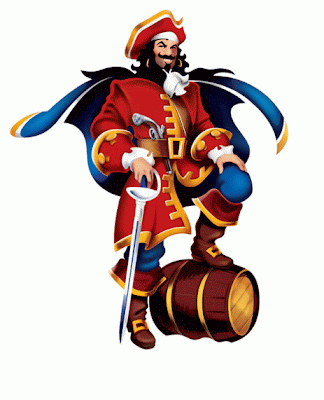
But first, a couple of special mentions to two real-world Captains. I’m a huge fan of Captain Morgan, of course.

And then, of course, there’s The Captain:

OK, on to the fictional Captains, listed in no particular order:

1. Faramir, Captain of Gondor.

Ah, Faramir — a man who devoted his life to service to Gondor, only to be continually snubbed by a father who doted on his elder son to begin with, and later became a lunatic driven mad both by grief and by his unwise consultations with one of the Palantiri. Into his hands, completely unwittingly, fall two Hobbits and the Ring of Power, but proving his quality, the young Captain of Gondor releases the Hobbits on their mission — and is rewarded by his father with the impossible task of charging the now-overrun city of Osgiliath. But all ends well for Faramir in the end as he weds the beautiful Eowyn of Rohan.

More on Captain Faramir.

2. Captain Benjamin Franklin “Hawkeye” Pierce.

I wasn’t the biggest fan of M*A*S*H when I was growing up, mostly because I now know that by the time I was really aware of the show, it was past its point of highest brilliance; later on, in my late high school and college years, I would see quite a few of the earlier season episodes and realized how good the show had been at first. Not to imply that M*A*S*H was crap in its latter years; far from it, actually, but the show’s high mark was when Trapper John, Frank Burns, and Colonel Blake were still around. But anyway, Captain Pierce was the show’s anchor through every season, combining irreverent suspicion of authority with an unflagging sense of what was right.

3. Captain Honor Harrington.

Honor Harrington is the Captain of a series of space ships in David Weber’s long-running series of novels that tell her adventures. In truth, I’ve only read two of them, but I do plan to read more of them, as Honor Harrington is a fantastic character. She’s clearly meant to be an analogue of that other, more famous, nautical captain of literature, Captain Horatio Hornblower, right down to the initials. Weber’s series of books tells the tale of her adventures and her rise through the ranks of the Royal Manticoran Navy.

4. Captain Geoffrey Thorpe.

Of course, we can’t have a list of favorite Captains without including a couple of pirate captains, and Captain Thorpe is one of the best. Played by Errol Flynn in the movie The Sea Hawk — which happens to be one of my favorite films of all time — Captain Thorpe is the finest of pirates. He is gallant, daring, swashbuckling, and he commands the loyalty of everyone around him. His piracy is motivated by patriotism, as he preys upon Spanish ships and interests in the unacknowledged service of Queen Elizabeth I. Oh, and Captain Thorpe also has a way with the ladies as well.

5. Captain Jack Sparrow.

Captain Sparrow is, for my money, one of the great screen characters of the last ten years. I love him for his complexity: he’s a scheming scoundrel, but he is also gallant when the need is called for and is motivated by a strong moral code that is all his own. That, and he’s often utterly hilarious. I think that the first time we see him, in Pirates of the Carribean: The Curse of the Black Pearl, is one of the best movie entrances of all time:

What I also find funny about Captain Sparrow is that he’s so insistent on being acknowledged as a Captain, and yet, in the three movies, he doesn’t really spend much time being a Captain — he’s constantly losing his ship and trying to get it back. At one point he even tries convincing Davy Jones that he’s not actually a Captain, since he lost his ship to mutiny, but Jones snaps back, “Then you were a poor Captain but a Captain nonetheless. Have you not spent these last years introducing yourself as Captain Jack Sparrow?”

INTERLUDE

Before continuing my list with the last five of my Ten Favorite Captains, there’s another category of Captain that bears a bit of discussion. There are lots of notable fictional captains who, for various reasons, weren’t very good captains, or perhaps they were good captains but in the stories in which we meet them, they are undone by circumstances beyond their control, or perhaps they’re captains in situations where their captaining skills aren’t really much tested.

I was going to mention Captain Smith of Titanic here, but then I remembered that he’s not fictional. Still, ordering his ship to full speed after learning that there are icebergs about isn’t the kind of thing that puts one into the Captain Hall of Fame. On an actual fictional tangent is Captain Harrison of the SS Poseidon, who, after telling his corporate boss that he’s an “irresponsible bastard” for ordering the ship to full speed despite bad weather, goes ahead and orders the ship to full speed despite bad weather. (His ship ends up capsized, and he ends up drowned, for his troubles.)

Star Trek fans will remember that a generally accepted bit of canon, although it didn’t appear in the films, is that Hikaru Sulu was supposed to be the first captain of the USS Excelsior, but his involvement in the Khan-Genesis incident resulted in him being bumped from that assignment and the ship given to an overbearing, arrogant, pompous ass named Captain Styles. Styles also committed the unforgivable Trek character sin of downplaying the legendary exploits of the Enterprise (“I can’t wait to start breaking some of the Enterprise‘s speed records tomorrow!”), so his comeuppance — having to sit on the bridge helplessly as his ship ground to a halt after he’d ordered warp speed — was quite welcome. Captain Sulu would later, indeed, get command of the Excelsior.

And then there’s Captain Will Decker, who was Captain of the Enterprise right up until the moment when it became necessary for the Enterprise to actually go somewhere. Once that happened, Decker was supplanted as Captain as another guy (who will be discussed later in this post) took over. Decker got a consolation prize, though, when he physically melded with an enormous machine-intelligence to become…well, I don’t know what. But it sure looked cool!

I suppose that we’ll never know how good Captain Clarence Oveur was at his job, but if he hadn’t eaten the fish for dinner, we’d never have witnessed Ted Stryker’s redemption for the death of George Zip.

Proving that apology to one’s superiors may be a good policy but it’s still not any guarantee of future success is Captain Lorth Needa. But being in the right place at the right time — i.e., the execution due to incompetence of your direct superior — sure worked out well for Captain Firmus Piett, didn’t it? It’s the age-old method of career advancement: just hang out, do your job well, don’t screw up, and sooner or later you’ll have to move up when the person ahead of you blunders badly.

6. Captain Jean DeWolff.

Jean DeWolff was a recurring supporting character in the Marvel Comics universe, mainly in the Spiderman titles. She was very tough and unrelenting, often wearing a beret on the job; she was also supportive, if not downright friendly, toward Spiderman. Unfortunately, Captain DeWolff met an untimely end in a storyline that was one of the best Spiderman tales of the 1980s, although she has apparently turned up anew in the “Ultimate” line of Marvel comics.

7. Captain Barney Miller.

Now if there’s a most-underrated classic sitcom ever, Barney Miller has to at least be in the running. That show was hilarious and full of great and memorable characters, and yet I never see it mentioned in lists of great old teevee shows. What gives!

The show was one of the great formulae for comedy: the workplace of eccentric weirdos, seen through the relatively sane eyes of a single character. In this case, our island of sanity is Captain Miller himself, who has to deal with detectives with who are all neurotic about different things and the endless stream of red tape and paperwork that get in the way of police work. I loved this show and would love to see it again.

(I love that, according to the show’s Wikipedia page, many police professionals viewed the show fondly, some to the point of addressing Hal Linden, who played Barney Miller, as “Captain”.)

8. Captain Han Solo.

Oh come on, you knew he’d be on here. Come to that, those of you still reading who have been around a while no doubt know which two captains are going to round out this list, but let’s plug on, anyway.

So. Han Solo, captain of the Millennium Falcon, the fastest hunk of junk in the galaxy, which made the Kessel Run in less than twelve parsecs. He’s a captain of his own ship and he’s got the undying loyalty of his copilot, Chewbacca. His ship isn’t that big, so he makes his living not by hauling freight but by smuggling contraband. He’s in hawk to a gangster, and he doesn’t much believe in anything…yet. He’s the archtypal scoundrel with a heart of gold, the money-loving mercenary who can’t tear himself away from his new friends when they need him, even if it means ending up inside a block of carbonite. When we meet him he’s the amoral rogue, following the bag of coin, but at the end, he’s found a cause and has fought and sacrificed for it. All the while, being a pretty good Captain.

9. Captain Malcolm Reynolds.

Oh yeah, you’d better believe it. Back when I wrote about Firefly, I noted that Malcolm Reynolds — “Mal” to his friends, even though River Tam points out that “Mal” is French for “bad” — undergoes a character arc that is pretty much the reverse of Han Solo’s. (Solo is the rogue who becomes an idealist fighting for a cause; Reynolds starts off fighting for a cause but becomes a rogue when he’s defeated.) What occurred to me in writing this post is that Reynolds also somewhat parallels another of my captains above: Captain Jack Sparrow. Both men are motivated by two beliefs: their belief in freedom, and their belief that a ship — for Sparrow, the Black Pearl, and for Reynolds, the Serenity — is the key for a man to have true freedom. Both men are, also, scoundrels with hearts of gold who can be extremely dangerous when crossed. And both have their own unique ways of speaking.

He’s also fiercely loyal to those he has chosen to surround himself with. In the course of the show, he ends up with a doctor and the doc’s sister on board, both of whom are fugitives who make life more difficult for an already-shoestring operation. But in one episode, when the doctor and his sister fall into trouble, Mal Reynolds comes back for them. Later, the doctor asks him why he’s done this, since just leaving them would have made things much easier; Captain Reynolds replies, “You’re on my crew.” The doc presses the point, asking again, and Reynolds says again, “You’re on my crew. Why are we still talking about this?”

Here’s a good Malcolm Reynolds moment:

10. Captain James Tiberius Kirk.

Yup. The best Captain ever. This is a Captain who will romance the woman, punch out the bad guy, lock phasers on target, reprogram vital tests to his advantage, destroy his own ship to take out some Klingons, steal his own ship back to go get his friend’s body, go back in time to find some whales because the Vulcan whose brain isn’t quite all there yet says he should, fight a Gorn to the death and then refuse to kill him, mouth off to a Federation envoy when he’s ordered to babysit some storage bins filled with “quadrotriticale”, talk any out-of-control robot into a logical conundrum so extreme that it burns out its own circuits, and…well, Jim Kirk does it all. That’s why he’s awesome.

And there we have it. Thanks to Captains everywhere!

(Lest there be any misunderstanding whatsoever, let me iterate that not one word of this post is to be interpreted as a statement of any kind of opinion on the real world military, and not one word of the first graf of this post, specifically my statements about ranks other than Captain, is meant to be taken seriously in any way. If I have any real-world Colonels among my readership, no, I do not really think you’re a desk jockey.)

Share This Post

Ten Tools

The best part of my job, as a Maintenance Man, is the collection of tools I get to use on a daily basis. I love tools. Tools rock. I now get the same rush from heading into Home Depot or Lowe’s that I once got from walking in Toys-r-Us. It’s the same rush that I get from going into Borders or Barnes&Noble! Tools rock.

Since I do general maintenance work at The Store, I have to have a fairly wide variety of tools at my disposal. People who work in specific trades will find themselves using some tools and almost never any others Some fall into the category of tools that I don’t use very often, but which are indispensable when I need them. Others, however, are my everyday tools, the ones I find myself reaching for most often. Here’s a rundown on ten of these:

Eleven-in-one screwdriver.

This is on my person at all hours of the job, and I use it a lot at home, too. Most tool manufacturers make a multi-headed screwdriver, but the eleven-in-one from Klein Tools is my favorite: it’s solidly built and includes, as the name implies, eleven different driver options: Slotted 1/4″ and 3/16″, Philips #1 and #2, square drive #1 and #2, two Torx sizes, and three nut drivers (3/8, 5/16, and 1/4″). If I were a wizard in the Harry Potterverse, this screwdriver would be my wand.

Tape measure.

Well, of course. I always need to measure stuff. I carry a 30′ Stanley Leverlock tape. I think their FatMax tapes look cool, but I suspect they would simply add too much weight to my belt.

Diagonal pliers.

Occasionally called “dikes” for short, or “small wire cutters”. I use these many times throughout the course of a typical day — so much so that I actually wear the blades out every so often. I have to buy a new pair once a year or so. I don’t mind because these tend to be fairly cheap; I get ’em at Target for five or ten bucks.

Telescoping magnet.

This gadget is extremely useful to me, although one’s mileage may obviously vary. It’s a nicely strong magnet about the size of a pencil eraser, stuck on the end of a pen-sized tool that can telescope out to a length of about two feet. The obvious use is grabbing screws that one drops inside a piece of machinery or equipment, but for me, the true use of this thing is in my usual duty of hanging advertising signage throughout The Store. For this task we use thin steel hooks of varying lengths, and it’s in this type of job that the telescoping magnet really earns its keep.

Cordless drill.

By a very wide margin, this is the most frequently used power tool in my arsenal. (Mine is a Dewalt 18V, if anyone cares.) Drilling holes, driving screws of many types — rare is the day that I don’t get the drill out of its case at some point.

Utility knife.

I also find myself often having to cut things, score things, or mark things. The utility knife is indispensable. I use a standard one, the familiar kind of knife, the most often, although I’m probably going to buy a smaller utility knife as to cut down on the size of stuff in my pockets.

Voltage tester.

Sometimes called a “tick”, this is a highly useful device in my job, where I often have to move electrical equipment — refrigerated cases, food prep equipment, and the like — from one place to another. I often have to test a power line to see if there is voltage present. Just hold this doohickey to the line or insert the probe into the receptacle’s hot terminal, and if it beeps, you’ve got voltage.

Pliers.

Pliers are important tools; I use them almost daily. I use groove-lock pliers (“Channellocks”) the most, with the linesman’s pliers and the needlenose pliers coming in second, depending on the job I need to do. Interestingly, the most traditional kind of pliers, the good old slipjoint pliers, are the one kind of pliers that I nearly never use.

Spirit level.

As noted above, I am frequently tasked with the hanging of signage throughout The Store, be the signage directly fastened to walls or hung from the ceiling. A level is essential to this task, because, believe me, if you hang a sign so that it is crooked in the slightest degree, you’ll hear about it.

Miter saw.

Of the power saws at my disposal, the miter saw is the one I use the most, because I most often need to cut trim pieces or other kinds of similar materials for various “finish” jobs throughout The Store. The other power saws that I have at my disposal are a table saw, a circular saw, a saber saw, and a reciprocating saw. Cutting things is fun!

Of course, the tool I actually use the most frequently, far and away, is the pencil, but that’s boring — who wants to read about a pencil?

Share This Post

Ten Filmscores

Some time ago a reader asked me to recommend a list of filmscores that represent a good place to start with exploring the wonderful world of film music. I’ve been kicking that request around for a long time, and I’m finally going to attempt an answer.

The problem is that film music is a very large field, despite that it looks, at the outset, to be fairly small. But consider: films have been around for around a century, and films have had music pretty much the entire time. The world of film music runs the gamut from composers who knew some of the great masters to composers who started their careers in rock bands. Erich Wolfgang Korngold knew Mahler and Strauss; Danny Elfman was in Oingo Boingo. Both are beloved in film music circles, often times by the same fans. There is film music written in the dense German Romantic tradition; there is film music written in the Impressionistic tradition; there is film music written in the atonal tradition; there is film music written in the neo-Romantic tradition; there is film music that draws heavily on jazz or other ethnic musical traditions.

Clearly, then, it would be impossible to distill all of film music down to a single list of ten carefully-chosen scores, and that’s not what I’m after here. This list is just a starting point: what I’d recommend to a musically curious person who said, “Hey, what’s film music all about, anyway?” This is in no way intended to be a Top Ten Film Scores of All Time, although there isn’t a score here that I don’t include among my very favorites.

(These are in no special order, by the way. I’m writing them as they come to me.)

1. Vertigo, Bernard Herrmann.

Herrmann is considered one of the greatest of all film composers, and with very good reason. His body of work comprises dramatic music of the highest order. He was especially good at composing music that could sum up, very succinctly, the emotional fabric of a film. Herrmann was Alfred Hitchcock’s composer of choice for most of his films. His most famous bit of music is probably the “slashing strings” figure from Psycho, but I choose Vertigo because it’s more subtly suggestive of unhealthy and obsessive love. It is lush and sumptuous music that nevertheless fills the listener with a sense of disquiet. This is psychological music of the first order.

2. Casablanca, Max Steiner.

Steiner was one of the foremost composers of what film music fans tend to refer to as the “Golden Age”. Why was it golden? Well, in those days, musical literacy was a lot more common than it is now, so the directors and producers could be assumed to know something about music, which meant that they would understand what their composers were talking about, and be more inclined to listen to what they had to say. The idea of a director needling a composer because his score did not reflect the temp-score closely enough would have been laughable. Composers were treated as important members of the film-making team, and the music was generally taken more seriously. (Of course, I also think that the appellation “Golden Age” reflects a certain degree of taste on the part of many listeners of film music, a matter of stylistic preference. Much film music of this period was orchestrally dense in the Germanic symphonic tradition.) Casablanca gives us a perfect example of a filmmaker being able to call on musical literacy that is no longer assumed to be essential to a good education: in the famous scene where Victor Laszlo, incensed that the Germans are raucously singing their German anthems, commands the band at Rick’s to play La Marseillaise. Producer Hal Wallis instructed Max Steiner to score this scene for full orchestra, rather than use the scoring for the band onscreen, in order to make the moment that much more iconic. How right he was.

As for Steiner’s score to Casablanca, it’s a fascinating listen not just because it’s a fine, fine score in its own right, but because Steiner is able to create an emotionally and dramatically engaging score mainly using two melodic ideas that aren’t his own: La Marseillaise, and the song “As Time Goes By”. Steiner employs a lot of minor-key quotes from the French anthem, suggesting that Casablanca is full of French people who can’t be free, and of course, “As Time Goes By” is the film’s love theme.

Casablanca‘s score yields yet another of the great anecdotes of luck or fortune that led to the film being as good as it is. Steiner, professional as he was, hated “As Time Goes By”, and lobbied hard to have the song tossed aside in favor of something original that he would write. Steiner very nearly got his way, but this would have required re-shooting several scenes, because the song is actually referred to by title in the film’s dialogue. Those reshoots were impossible, however, because by this time, Ingrid Bergman had already moved on to her next role and cut her hair very short for whatever that film was. So “As Time Goes By” stayed.

Anyway, Casablanca is valuable to a first-time listener because it’s so easy to trace the melodies through it, from beginning to end.

3. Chinatown, by Jerry Goldsmith.

Noir scores of the 40s and 50s tended to be full-orchestra affairs. As fine as they often were, they also tended to be just as lush and Romantic in their sound as a great many other scores of those eras. With Chinatown, however. Jerry Goldsmith wrote a score using a very small ensemble, and he spotted the film sparingly, allowing silence to do its work when it is the best tool used. Chinatown also employs some compositional styles that would have been used by the composers of the period in which Chinatown takes place – prepared piano, atonal effects, and a jazz-influenced main theme, heard during the opening credits played by a solo trumpet.

4. Ben Hur, by Miklos Rozsa.

If there’s a film music lover out there who doesn’t love at least one score to one of the old Biblical epics, I’ve yet to meet that person. The large-scale Biblical epics of the 50s and 60s tended to all boast fine scores, and in many cases, the scores outshine the films themselves by their quality. King of Kings, The Greatest Story Ever Told, The Robe — all films that aren’t seen much anymore at all, but their scores are beloved by film music fans of all ages. For my money, Rozsa’s Ben Hur score is the very best of this subgenre.

These films all tend to give adjectives like “lush” and “Romantic” a new meaning, and Ben Hur is no exception at all. It features a full-sized orchestra and chorus, and the score plays for well over half of the three-hour-plus film’s running time. It’s a thematically rich score as well, featuring many themes along its long journey, and it is by turns thrilling, moving, Romantic, and it is especially tinged with a strong spiritual tone, as Rozsa’s music is required to suggest the holiness of Christ in a film where Christ is a character who is never seen from the front and never heard to speak. Ben Hur is one of the greatest of all film scores, and it’s also one of the most accessible to those who are unfamiliar with film music listening in the first place.

5. The Godfather, by Nino Rota.

Here is a different kind of epic score for a different kind of epic. It is intimate and melodic, as befitting a film whose focus is on a single family and its deeds and misdeeds through several decades. If the score’s musical language seems somewhat limited, that is probably by design, as the film’s focus itself is intensely limited, with the story involving the Corleones through the years, without ever really acknowledging the outside world. Rota’s approach to scoring the film is to infuse each scene with a sense of nostalgia, musically suggesting us the sad passing of an age, even if that age is one of violence and crime and death.

6. The Magnificent Seven, by Elmer Bernstein.

This is, perhaps, the definitive score to a Western. Its sound reflects one of the most influential of twentieth century composers, Aaron Copland, with its thrilling rhythms suggestive of no other place on Earth than the Old West and Mexico, and with its theme, which is one of the most famous melodies ever written for a movie. Bernstein’s career spans the same time, almost exactly, as Jerry Goldsmith’s, and both composers came of age roughly at the tail end of the “Golden Age”. Both then were major composers of the “Silver Age” (which I take to start roughly in the mid-1970s and last until around the early 1990s, although good luck getting filmscore lovers to agree on what the “Silver Age” actually is). And both died just a few years ago, after being active nearly until the end of their lives. Bernstein was nominated for an Oscar just months before his death (for Far From Heaven).

7. Star Wars Episode IV: A New Hope, by John Williams.

Well, duh. But seriously, it’s one of the iconic filmscores of all time; it’s an outstanding example of a leitmotif-based filmscore; and it’s an orchestral masterpiece. Simple as that. (And no, it’s not “ripped off from Holst”.) Williams has been one of the major voices in film music for the last forty years, and in this score you hear why.

8. Apollo 13, by James Horner.

In the clip below, I link the actual scene instead of the isolated music for the reason that this clip, almost more than any other, illustrates just how the ebb and flow of a well-composed score can propel a film’s emotional climate along. This scene, without music, would just sit there on the screen, with certain shots lasting an absurdly long time and others feeling incredibly out of place. The music here starts out solemnly and builds a bit before ebbing back down, and in the seconds before the launch itself, you can hear the music rising and falling, undulating beneath the action, in much the same way that our breath quickens during those final seconds of the countdown before the triumph of the launch itself.

The score uses a Copland-esque sound as well, but in a different way from Bernstein in Magnificent Seven; Horner also supplements his orchestra with synthesizers in nice ways that don’t stand out horribly. (I don’t think Horner has ever been as good as he was in the mid-90s.)

9. Blade Runner, by Vangelis.

The film is considered by many (not by me, although I do kind of like it) to be a classic, and one of its most defining elements is its score, by Greek composer Vangelis. What’s primarily notable is that the score is almost entirely electronic (the only non-electronic thing that I can recall in it is the saxophone in its gorgeous love theme), and it’s on that basis that I cite the score here. The world of Blade Runner is one of the most visually amazing in all of film – the visual design has proven to be extremely influential ever since, in the world of science fiction cinema – and Vangelis produces a score that is a perfect counterpart to it. In the sequence below, the main titles and first few visuals from the film, note the way Vangelis chooses to musically depict the future cityscape we first look upon. At the very first glimpse, 2019 Los Angeles looks hellish and dystopian, but the Vangelis music works against that impression, with a synthesized “harp glissando” as the city fades into view, almost musically symbolizing the curtain going up; and note that rather than write grim and dystopic music (the kind of thing that seems to dominate techno music today), Vangelis’s music is primarily music of awe. In fact, it’s eerily beautiful.

Aside: in searching out that clip, I noticed something interesting. In the clip above, note the “big melody” that is heard at about the 2:58 mark, when we are looking across the city and we cut to the eye of someone looking out over that city. Now watch this clip of the famous “I’ve seen things” speech by Roy Batty at the end of the movie (particularly starting at about the 2:25 mark). It’s the same melody. Is Vangelis telling us that it was Batty’s eye we saw back at the beginning of the film, looking out over the city? Are we seeing some of the things that he has seen? This is the kind of thing that paying attention to film music can bring up.

10. Princess Mononoke, by Joe Hisaishi.

Here we have a great example of Japanese film music, as well as music for an animated film. Animated films can rely on their music to a much greater degree than live action, and this is as good an example as I’ve ever heard – in fact, for my money, Joe Hisaishi is writing some of the finest music for films anywhere today. Music for animated film can sometimes get overlooked, even by film music lovers, for many reasons. Many animated films use songs along the way, and many of the more recent ones are outright musicals, which tend to require different kinds of discussion than “regular” film scores. But musical storytelling is still musical storytelling, and Hisaishi is one of the best.

Pick those up, explore them, and you’re well on your way.

Share This Post

Ten Little Things in “Pulp Fiction”

I remember when Pulp Fiction came out. I was watching Siskel and Ebert one night, and one of the movies they reviewed was this drama set in and around the LA underworld, and they gushed over its quirky twists of story and its crackling dialog. Even though at first glance the movie didn’t seem like the kind of thing that would interest me, the one scene they showed really caught my attention: Sam Jackson, holding a gun to Tim Roth’s face, and shouting at his girlfriend offscreen: “We’re gonna be like three Fonzies here. And what’s Fonzie like? Come on, Yolanda, what’s Fonzie like?”

“C-c-cool?”

“Correctimundo. And that’s what we’re gonna be. We’re gonna be cool.”

For some reason I heard that exchange and thought, “Wow, I gotta see this movie.” Apparently it had won whatever the big prize is at the Cannes Film Festival (the Palme d’Or, obviously), and it was now in wide release. I think I went to see it by myself the next day, at the multiplex in Olean, NY. It was an afternoon matinee. I was the only one there. I’ve seen movies before when I was one of less than ten people in the audience, but as far as I can recall, to this day Pulp Fiction is the only time I have literally been the only person in the theater. And that movie, over the next two-and-a-half hours, rocked me something fierce. I’d never seen anything like it at all: the non-linear way the story unfolds (or, I should say, the way the stories unfold), the way the dialog just whips about with each character having his or her own voice. The camera work that almost imperceptibly heightens the tension at various places. The way the movie went for laughs in horrible ways: I’ve never seen, before or since, successful comedic sequences that arise out of drug overdoses or accidental shootings in the face.

The next time I saw Pulp Fiction in the theater, a couple of months later, it was a late night showing at a multiplex in Buffalo, near the University. The theater was packed for that one; by this point Pulp Fiction was a pop culture sensation, and it was only weeks away from losing Best Picture honors to Forrest Gump. Weird. I don’t know if I was actually one of the first people on the Pulp Fiction bandwagon, or if it just felt that way because I saw it by myself in a backwater town early in its release. But wow, what a movie.

I watched it again a few weeks ago, for the first time in several years. I have a friend at work with whom I’m always quoting the movie (we like to express frustration by either claiming to be “mushroom-cloud layin’ m*****f*****’s”, or “tryin’ real hard to be the Shepherd”), but as far as actually watching it, I hadn’t done that in a really long time. So when I finally got to see it again, a lot of stuff in it seemed new to me again.

As with any really good movie, what makes it work are, in large part, the tiny details one can find in it: the little visual or aural tics that maybe weren’t even planned, but by being there, just make it all the more real. Here are ten tiny details from Pulp Fiction that I love, in no particular order.

1. Vincent’s “church usher” pose. The early scene where Jules and Vincent are retrieving the briefcase from the hoods who are trying to steal it from Marcellus Wallace reaches its famous climax when Jules begins to recite his gonzo version of Ezekiel 25:17. The camera cuts from Jules to Brett (the hood in the chair who’s about to die), and when you see Brett, in the background you see Vincent, gearing up for the execution. The way he does it, though, is pretty nifty. He takes out his gun, cocks it, and then holds it pointing down with his hands clasped in front of him, in a way that always reminds me of the pose the ushers strike in any church service just before they’re supposed to come forth and do something (pass the collection plates, direct worshippers to Communion, whatever). It’s a terrific pose.

2. Rear-projection when driving at night. There are two sequences in the movie that depict people in cars at night that are done in stylized fashion, like they used to do such sequences when making movies in the 1940s. It’s obvious that John Travolta isn’t really driving when Vincent is stoned on his way to pick up Mia Wallace; likewise, it’s obvious that Bruce Willis and the woman playing the cab driver aren’t really driving a cab during their conversation about what it felt like for Butch to pummel the other boxer to death in the ring. The rear projection in both cases is grainy, jerky, and black-and-white. But in the film’s other driving sequences, when the tension is up (Vincent speeding an OD’ing Mia to the drug dealer’s house for the andrenaline shot, Butch driving back to his apartment to get his watch when he knows such a move could get him killed, the unfortunate moment when Vincent’s gun discharges while pointed at Marvin’s face), or when there purposely isn’t supposed to be any tension at all because we don’t know anyone yet (the “Royale with Cheese” discussion) those sequences are shot for real.

3. When Mr. Wolf sips Jimmie’s coffee, he, too, notes its high quality with a single facial expression.

4. In the film’s last scene, we get to see the robbery that Pumpkin and HoneyBunny had cooked up way back in the movie’s first scene. What’s great about this is the way that Quentin Tarantino stages that robbery; the two thieves are wildly nervous and over-do everything, making clear that this is the first time they’ve ever executed a crime of this nature. And what really drives that point home? The fact that these two, who have made robbing liquor stores their previous bread-and-butter, never think to do what anyone who’s robbed a restaurant before would know: to check the bathrooms.

5. Back in the “recovering the briefcase” scene, when Jules asks for a sip of Brett’s Sprite, he drains it instead, right down to the slurping sound that a straw makes when the pop is all gone; and all the while he’s giving Brett this stare that isn’t a cold stare, but a relaxed stare that makes utterly clear that Jules is in total command of this situation.

6. But are Jules and Vincent out of practice or something? Or is their chemistry off because Vincent is just back from three years in Amsterdam and thus hasn’t worked for a while? Because they walk into a situation where they admit beforehand they don’t know how many guys are up there, and they too don’t check the bathroom.

7. It’s not in the script, but when Lance (Eric Stoltz’s drug dealer) is describing to Vincent how to deliver the adrenaline shot to Mia’s heart, he says something like, “But she has a breast plate in front of her heart so you gotta pierce through that.” That is in the script. But in the movie, to emphasize the point, Lance mimes the stabbing motion three times, and Vincent asks: “Do I gotta stab her three times?”

8. At the end, after dispensing his wisdom to Pumpkin and HoneyBunny, when he’s sitting in the middle of a crime scene, Jules is so relaxed that he thoughtfully takes another bite of his muffin.

9. Stopping to eat in the middle of a dangerous situation doesn’t just happen there. I’ve always loved how Butch, in returning to his apartment and recovering his watch, while he has to know he needs to get out of there ASAP, stops to heat up a Pop-Tart. If he’d just left, none of the other stuff afterward would have happened, and he’d still have Marcellus’s price on his head.

10. Sounds in the film: Fabian’s excessive teeth-brushing. The way the first song during the opening credits is interrupted as the old-school manual knob car stereo is changed. Mia Wallace’s music, on a reel-to-reel tape player. When Mia’s OD’ing, we hear Vincent offscreen talking to her, and then we fade in on her drugged-out face, and we only know that Vincent’s found her when we hear his reaction.

I could go on a while, but I’ll leave it there. Generally, I tend to not like stories that glorify organized crime or criminal lifestyles the way Pulp Fiction does, but this film is different in its theme of redemption; the only character who gets to escape the life is the one who is given the epiphany that this isn’t the life he should be pursuing. (Although, to be fair, we don’t know that Jules successfully leaves the life; maybe Marcellus gets angry at his resignation and kills him? We never know.)

I suppose that one of these years I should watch Jackie Brown and Kill Bill….

Share This Post

Ten Classical Music “Warhorses” I Could Do Without

Every genre’s got ’em: works that are familiar to just about everybody who knows anything about that genre. These are the “Warhorses”. A list of warhorses doesn’t necessarily comprise a list of the very greatest works, but a list of works that a person with an average level of familiarity with the genre will have heard at least once. Science fiction’s warhorses might include 2001: A Space Odyssey, The Moon is a Harsh Mistress, and Neuromancer. A classic rock radio station’s warhorses will include “Stairway to Heaven”, “Hotel California”, and the like.

Warhorse pieces, though, can lead to a bit of cynicism on the part of performer and listener alike. For the sophisticated listener, the warhorses can be a bit annoying, taking up program space that might otherwise be used for music that isn’t played all that often. Want to hear one of Glazunov’s symphonies live? Good luck. But you’re never more than a few months away from being able to hear the Eroica again. That’s because the Eroica is a warhorse piece: one of those that appeals to people who “love classical music” as long as the classical music they’re hearing is classical music they’ve already heard.

Musicians, on the other hand, can get downright cynical about the warhorses. In my orchestral days in college, nothing made the hearts of the trumpet section sag harder than the appearance of a Beethoven symphony or concerto on the program. Why? It’s absolutely glorious music if you’re on the listening end, but if you’re sitting in the trumpet section, it’s music that makes you wish for the sweet embrace of death, so boring is it to play. You sit there for what feels like hours, counting out measures of rests that number on the hundreds before you make your entrance, in which you play the tonic or dominant on the beat. And then it’s back to counting rests. Likewise, with the warhorses, familiarity can really breed contempt, especially when you’re a lifetime orchestra member and you’re about to play the Tchaikovsky Sixth for the thirtieth time in your career.

But anyhow, works become warhorses for various reasons. Some even become warhorses despite their fate of not being terribly interesting works at all. Here are ten of those works from classical music that, for all their “warhorse” status, I just don’t like and could happily live the rest of my days never hearing again.

10. Maurice Ravel: Bolero.

God in Heaven, I hate this piece so! And Ravel himself wasn’t too fond of it, saying that it contains “very little music”. And he’s right: it’s a terrible, dreadful bore of a piece, droning on endlessly, piling on one repeat of that not-terribly-interesting melody after another. Sure, it’s full of stunning orchestral detail. It’s also full of dung. (And why is this work always cited for its sensual, sexy qualities? If Bolero is sex, it’s the brute force sex of a guy who’s going to get his money’s worth at the Mustang Ranch, by God!)

(If you must hear Bolero, look for the one conducted by Jean Martinon on the Angel label. He brings forth the orchestral details with amazing clarity.)

9. Antonio Vivaldi: The Four Seasons.

Remember that line in Sleepless in Seattle about the statistic that isn’t true but yet it feels true? Same thing about the oft-repeated jibe about Vivaldi that he wrote the same concerto five hundred times. No, he didn’t; that’s not true. But it feels true. For me, listening to different pieces by Vivaldi is like driving down two different street on Buffalo’s East Side. Sure, the houses are different, but hey, the rust is all still rust-colored. (Although, again in my college days, we played some Vivaldi piece that included a female chorus. I have no recollection of what the piece was, but my trumpet part was a blast. I still hated the piece, but man, that part was fun to play.)

(I don’t recommend owning a recording of The Four Seasons. Nothing good can come of it.)

8. Pachelbel: Canon in D.

What’s the most thankless task in classical music? I would guess that it would either be playing the snare drum part in Bolero, or playing the ground bass in Pachelbel’s Canon in D. Sure, it’s the most famous of all themes-and-variations. It’s also as worn out as that box of Arm-and-Hammer baking soda in the back of your fridge, second shelf, behind the jar of wheat germ you bought during your big Health Foods Kick of 2003.

(The only version of the Canon I can listen to anymore is the Canadian Brass version, which isn’t, well, canonical anyway. Ha! A pun!)

7. Tchaikovsky, 1812 Overture.

OK, you got me: sometimes I like to listen to the last three or four minutes, that last descent from the highest voices to the lowest before that big chorale tune kicks in, each phrase punctuated by some kind of rising bell figure, and then the famous final “Can Can” eruption. The problem with 1812 is that the piece lasts fifteen minutes, most of which consist of repetitions of material already heard six minutes ago. And how about that coda, which goes on and on and on and on and on, never letting the piece out of its cold, dead fingers? Nah. We’re almost two hundred years past 1812. Time to get over it.

(Just find one that’s really loud, with digital cannons. This isn’t a piece that displays the difference between a great conductor or an average one.)

6. Barber, “Adagio for Strings”

It’s actually a pretty amazing piece of music by itself, when heard for what it is: a piece of music. Unfortunately, years of use in movies and TV shows as underscore to serious scenes of portentous doom have taken their toll on this work. I’m now at the point where I can’t even listen to the thing anymore without thinking of all the various pop-cultural references that the work has accrued. Oh well.

(Leonard Bernstein conducts the LA Philharmonic in an excellent recording of the Adagio, coupled with a scintillating performance of Copland’s Appalachian Spring and Bernstein’s own Overture to Candide. That’s the one to get.)

5. Grofe, “Grand Canyon Suite”

This gets played an awful lot on the classical station in these parts, and it drives me crazy each time. I hate the main motif of the entire work, I hate the hokey Western stuff that sounds like what would happen if some kind of mutant child of Richard Strauss and Aaron Copland were made into a composer. Ugh.

(I don’t own a recording of this and I have no intentions of acquiring one, either.)

4. Mozart, “Eine Kleine Nachtmusik”

Yes, it’s Mozart. But it’s this piece’s opening bars – which are pretty much known by everybody on Earth, even if they can’t name the piece – are the main reason, I think, why so many casual music listeners tend to look down on Mozart as a genial composer of snuff-box music that is mainly nice but dull. Ask the random person on the street to hum some Mozart, and if they know any Mozart at all, this is what they’ll hum. That’s a shame.

(I do own this on disc, but I can’t remember who the performers are. I want to say that it’s the Cleveland Orchestra conducted by Christoph von Dohnanyi, but I’m not sure.)

3. Beethoven, “Pathetique Sonata”

I don’t dislike this piece at all; it’s just that this is the traditional First Beethoven Sonata of all piano students, so if one takes piano lessons as a kid and attends a couple of recitals each year, then one is guaranteed to sit through this sonata – or at least its first movement – at least ten times by the time one is eighteen. The work can be discovered anew when one listens to a great pianist doing it, say, Alfred Brendel, but it’s so oft-used as a training piece for students that listening to it anew requires substantial effort on my part.

(Brendel’s the ticket here. He’s recorded this more than once, I wager.)

2. Wagner, “Ride of the Valkyries”

I cannot listen to this outside of its original context, in the opera Die Walkure. This is another great bit of music that’s been beaten into the ground by years and years of pop-culture. I should note that I have no problem with pop culture, nor do I view the lines between pop culture and “real” culture to be eternally fixed and immutable. In fact, I’m not even sure those lines exist. But pop culture can ruin things on occasion, and for me, “Ride of the Valkyries” is one of those things. And I don’t even like the smell of napalm in the morning!

(I strongly recommend Wagner Without Words, the Cleveland Orchestra conducted by George Szell, by way of a Wagner excerpts compilation. The performances are great, and the selections are chosen and conducted with great care by Szell. The Ride doesn’t suffer as much under his hands, especially in the context of the entire program he creates on the recording.)

1. Holst, “The Planets”

Like everybody, I had my fixation with this piece when I was younger. But I tired of it fairly quickly, and now, it’s been over ten years since I listened to the whole thing in one go. Maybe I should try re-evaluating it one of these days, but here’s another problem with the local classical station: they tend to do a lot of playing single movements of multi-movement works, at least on their morning program, and “Jupiter” from The Planets is a very common selection. Each time I sit through “Jupiter” while driving to work, I end up saying to myself, “Yeah, I don’t need to hear that piece any time soon after all.” Yes, it’s dramatic music with superb orchestration; yes, it’s one of the most influential works for much film music of the twentieth century; yes, it’s incredibly popular. But it almost always bores me.

(Get Charles Dutoit conducting the Montreal Symphony, if you like this piece. That’s the recording of it that I have.)

So, what classical music could you all live a perfectly happy life never hearing again?

Share This Post

I know what you’re thinking, and you’re right.

The Top Ten Episodes of Magnum PI

This post is suggested by a recent post by Jason, wherein he reports that in the inevitable movie version of this old teevee show from the 1980s (because if it was on teevee in the 1980s, it’ll be on a movie screen soon enough, so bring on that Riptide movie! And Simon and Simon!), the role of Thomas Sullivan Magnum will be played by Matthew McConnaughey. Personally, I don’t have much of a problem with McConnaughey as an actor, but he’s got his own thing going on, and I don’t see him recreating the air that Tom Selleck brought to Magnum. Jason has the goods on Magnum as a character: at first glance, he’s a ne’er-do-well beach bum slacker, but underneath the exterior of shorts, floral shirts and a Detroit Tigers baseball cap is a fiercely intelligent, piercingly observant, and forceful man who can even descend into some pretty dark places. Can Matthew McConnaughey capture this? I don’t know. He’s been the doofus in a lot of doofus comedies, but he was also pretty good dramatically in Contact and Amistad, so, who knows.

Anyway, back to the show. Magnum, PI was a staple of Thursday night teevee in our home for pretty much the entirety of its run, although in its last couple of seasons it tended to be a little darker than my parents found to their liking. At its best, though, Magnum was always a terribly entertaining show. It had nifty detective stuff, nice action sequences here and there, some terrific cast chemistry, and a lot of wonderful character-driven conflict and humor. The continual battle of wills between Thomas Magnum and Jonathan Quayle Higgins was often played for laughs, but underneath it all was the fact that as different as these two men were and as crazy as they could drive one another, in the end, each would walk through fire for the other if they needed to.

So yeah, I was a big fan of Magnum, PI. Here’s a list of my favorite ten episodes. My summaries below are spoilerish, so if you’re watching the show on DVD for the first time, skip this post.

1. Memories Are Forever, parts one and two

Magnum established fairly early on that Magnum was married while in Vietnam to a French nurse, who was later killed in a hospital explosion. In this two-part episode, she turns up alive, and married to a Vietnamese general. It’s a thrilling episode, filled with intrigue and the tragedy of two lovers who cannot be together. (Hmmm…they should make a movie like that. Maybe get someone Bogart-esque to play the lead….)

2. Unfinished Business

The flip-side to the episode above, years later it turns out that Magnum has fathered a little girl with his former wife, Michelle. Both are murdered by yet another Vietnamese general (there were lots of these throughout the show’s run), and Magnum sets out for revenge. This is a gritty and intense episode, made especially memorable by Magnum’s standard voiceovers, which here take the form of letters he can no longer send to his daughter. (Of course, the series finale would establish that Lily, Magnum’s daughter, wasn’t killed after all.) Also notable is the performance by Lance LeGault as Colonel Buck Greene, a Navy Intelligence officer who recurs a number of times throught the series’s run to clash heads with Magnum.

3. Did You See the Sunrise, parts one and two

Another two-parter (or maybe it was a two-hour episode later split into two parts for syndication; remember when teevee shows had actual episodes of double length, as opposed to being regular-length episodes with extra commercials, or just two episodes run together end-on-end?) dealing with the Vietnam exploits of Magnum and friends (he, helicopter pilot TC, and club operator Rick all served there together). Here, a brutal Russian prison guard named Ivan they had the misfortune of meeting in Nam comes to Hawaii, having run up the ranks and become a diplomat. TC is brainwashed into attempting to kill Ivan, but the plot is more nefarious than that, and in the course of things, Magnum’s friend from the Navy, Lt. MacReynolds (“Mac”), whom Thomas is always bribing with food to get him classified information, is killed when the bad guys bomb Magnum’s Ferrari (without him inside, of course). The final scene, where Magnum finally confronts Ivan directly, presents the series’s most surprising ending.

4. Home From the Sea

This episode has no case for Magnum to solve. Instead, on the Fourth of July, Magnum is out at sea, paddling his surf-ski as part of his personal tradition of spending Independence Day alone. A speedboat knocks him off his surf-ski, and Magnum is alone in the ocean, during which he flashes back to his father’s last days. Meanwhile, his friends all have premonitions that Magnum is in serious danger. It’s a very effective episode.

5. I Witness

Magnum wasn’t always a serious show, however; often it put its tongue-in-cheek sense of humor on display. This episode is a good case in point: the King Kamehameha Club is the scene of an armed robbery, and Magnum has to figure out who did it, based on the clues buried in the varying accounts of the robbery he is given by his friends, whose clothes were stolen in the course of the robbery. The whole Rashomon thing may be something of a cliché these days, but here, as each person tells his story in a way that makes him look the best, the result is hilarious.

6. Luther Gillis: File 521

This episode pairs Magnum’s 1980s Hawaiian gumshoe with Luther Gillis, a St. Louis gumshoe who talks like he’s right out of a Dashiell Hammet novel. Gillis is working a missing persons case, and he ends up working with Magnum, much to Magnum’s chagrin. It’s pretty much the old “Two guys who can’t stand each other forced to work together” buddy story, but it’s done infectiously well. Gillis was a fan favorite, so he returned a few more times over the show’s run, but this first appearance was his best.

7. Laura

Like any popular teevee series, Magnum PI would occasionally feature big-name guest stars. Carol Burnett appeared a couple of times, for instance, but this grim episode brought in Frank Sinatra. The climactic sequence takes place without dialogue; just the sounds of the Honolulu streetscape backed by the throbbing chords of “Tonight Tonight Tonight” by Genesis (a stylistic riff, perhaps, on Miami Vice‘s use of “In the Air Tonight”). I only saw this episode a couple of times, but it is a standout.

8. Paper War

During the last season or two, there was a running gag involving Magnum’s hypothesis that Jonathan Higgins, the Major Domo of writer Robin Masters’s Hawaii estate (called “Robin’s Nest”), actually is Robin Masters. This is the episode where Magnum first draws that conjecture, as the occasionally combative relationship between the two men escalates into a fairly nasty prank war, culminating in one of the most hilarious bits in the show’s history: Magnum blowing up Higgins’s matchstick model of the Bridge on the River Kwai, while he’s whistling “Colonel Bogey” to Higgins over the phone. Later, in a standard bit of plot handling, when the two have decided that they can no longer coexist in any way, they’re locked together inside an elevator in an abandoned building, which is where Magnum starts suggesting that Higgins is Robin Masters. (The show would never officially clear up this point; it’s a pleasant notion, but it was clearly cooked up after the fact, when a number of earlier episodes establish people from Robin Masters’s past speaking to Robin as if he actually is Robin. But Higgins-as-Robin is a lot more satisfying, so…I dunno.)

9. Holmes Is Where the Heart Is

Another Special Guest Star episode here: Patrick Macnee, as an old friend of Higgins’s. Higgins has locked himself in the study at Robin’s Nest and is typing away on his old typewriter, while Magnum is desperately trying to figure out what it is that has Higgins behaving so obsessively. The story he’s writing is told in flashback: when his friend, played by Macnee, came to visit him some years earlier (before Higgins met Magnum), and turned out to be mentally ill, believing himself to be Sherlock Holmes. It’s a fun episode that has a very touching ending, and the framing story works because of the show’s great chemistry between Magnum and Higgins as adversarial friends.

10. Deja Vu, parts one and two

In lieu of the Special Guest Star, Magnum PI would indulge that other great stunt of hit teevee shows everywhere: the Special Location! Here, Magnum and friends travel to Great Britain, ostensibly to help set up the newest of Robin Masters’s estates, an English castle he’s calling “Robin’s Keep”. Here, while Higgins tries to train the ineffectual British guy who’s to do the same job here that Higgins does in Hawaii (this fellow played by Peter Davison, who is most famous as the Fifth Doctor on Doctor Who), Magnum becomes involved in some intrigue involving an old buddy of his from the Vietnam days who did assassination work in that war, and who turns out to have stayed in that line of work after it. There’s also a subplot involving Higgins’s reticence to drop in and visit his father, since the two haven’t spoken in years.

So there they are: ten episodes of Magnum PI. Funny thing is, I left out a bunch of episodes that I like a lot as well, so if I were to re-write this post tomorrow, I’d probably include nine completely new episodes (my Number One is pretty much a constant; that’s a truly great episode). Maybe the one, originally intended for the series finale until the show got picked up for another year, where Magnum is critically wounded in a gun battle and spends the episode as a ghost, hovering on the edge of death; or the one where a psychologically fragile Magnum thinks he’s seen his old friend Mac, dead for several years, very much alive on the streets of Honolulu; or the one where Magnum is paired with a modern day Samurai warrior (played by Mako). What a great show that was.

As a wrap-up, here are the show’s opening credits. It feels like Thursday nights on CBS again!

(Trivia question: Everyone knows that Magnum’s favorite baseball team was the Detroit Tigers. But what was his favorite beer?)

Share This Post

Top Ten Supporting Characters on “Seinfeld”

I think I’ll start doing random “Top Ten” lists of favorite things of mine, on whatever odd topics I can think of. (And feel free to suggest more topics, folks!) Those crazy kids at Tosy and Cosh have been doing this for a while, and as always, there’s no idea I’m not too crass to steal outright. So here we go with my first random “Top Ten” list: my favorite supporting characters from Seinfeld. (For the purposes of this post, I will define “supporting characters” as none of the four leads, no one who appeared in only one episode prior to the series finale, and none of Jerry’s revolving-door girlfriends. Oh, and no Newman or the Seinfeld or Costanza parents, because those characters are so recurring as to almost be regulars.)

10. Mr. Krueger.

The last of a long line of colorful bosses George Costanza had in the course of the series, this guy was probably overshadowed by the ultimate colorful boss, New York Yankees owner George Steinbrenner (famously shown only from behind). Krueger presided over his own fun bit of insanity in the workplace, though, most memorably thwarting George’s plan to adopt the nickname T-Bone and instead dubbing him “Gammy”. Krueger was played by Daniel von Bargen, who is one of my favorite character actors.

9. Bob “The Maestro” Cobb

The orchestra conductor who, despite the fact that he conducts third-rate amateur orchestras, insists that everyone call him “Maestro”, even during sex. (When Elaine lets out a squeal of “Oh, Bob!”, he stops and glares at her until she corrects herself.) He only appeared a couple of times, but they’re both hilarious appearances.

(By the way, in one of these episodes, Elaine starts ripping off some lyrics from a Verdi opera, and nobody bats an eye. When’s the last time a teevee show depicted a knowledge of opera as something perfectly normal?)

8. Susan Ross

Alas, poor Susan, to be engaged to George Costanza and then to die from the effects of licking toxic envelope glue. I think that Susan’s demise marked the emergence of a stronger meanness in the show’s comedic stance, although it remained mostly funny up until the end (I’ve never held with the general derision that the show’s last season has attracted). But as for Susan, she gets a mention because she so often was the straight-woman to the antics of our four leads, and the season in which she was George’s fiancee produced many of the show’s funniest episodes.

7. Mr. Wilhelm

George’s supervisor while working for the Yankees was hilarious, whether joining an office-cleaning cult or speaking to George in some kind of weird code using the Petula Clark song “Downtown”.

6. Kenny Banya

Jerry’s hyper-annoying fellow comedian, who enjoys success despite an apparent complete lack of comedic talent. Known for arguing over whether soup at a nice restaurant constitutes a “meal”.

5. Mr. Pitt

My favorite of Elaine’s bosses, the staggeringly eccentric Mr. Pitt launched from one obsession to the next with wild abandon: one week he hates ink pens, the next he’s obsessed with his socks, the next he loses hours staring at one of those 3D poster things, the next he’s unwittingly evoking Adolf Hitler. I was always disappointed that he didn’t stick around longer.

4. Bob Sakimano

OK, this is a bit of cheating, since (to my knowledge) we never actually see Bob Sakimano in any episode of Seinfeld. But his presence is always felt, as Kramer is constantly citing “my friend, Bob Sakimano” as justification that any of his hare-brained schemes will work perfectly.

3. Jackie Chiles

Chiles is an interesting character these days. He’s still hilarious in re-runs, many years after Johnny Cochrane rose to prominence in the OJ Simpson trial. Most times topical humor like the Chiles character becomes stale, but Jackie isn’t just a riff on a specific lawyer, but a riff on the whole notion of ambulance-chasing shyster lawyers.

2. Mr. Thomassoulo

George’s boss from a short-lived stint with a sporting-goods company. He only appeared in a couple of episodes, but he engages George in a nasty battle of wills, and at one point he demonstrates a surprisingly astute understanding of George’s character when he allows all employees access to George’s personal bathroom. Played memorably by Gordon Jump, who turns in a nice contrast to his soft boss from WKRP In Cincinnati.

1. David Puddy.

Elaine’s oafish, lugheaded New Jersey Devils fan boyfriend with whom she keeps breaking up and returning to, over and over again, sometimes several times in the same episode. Elaine’s intelligence and Puddy’s dense nature make for a hilarious couple.

Share This Post