Hmmmmm….

GhostCop (not the actual title) is going in fits and starts. I’m having trouble building up a sense of momentum on this one. I do suspect this book will be quite a bit shorter than either of the two Princesses In SPACE!!! books, both of which hit right around 180,000 words in their first drafts. This one looks to be leaner, maybe about 120,000 words.

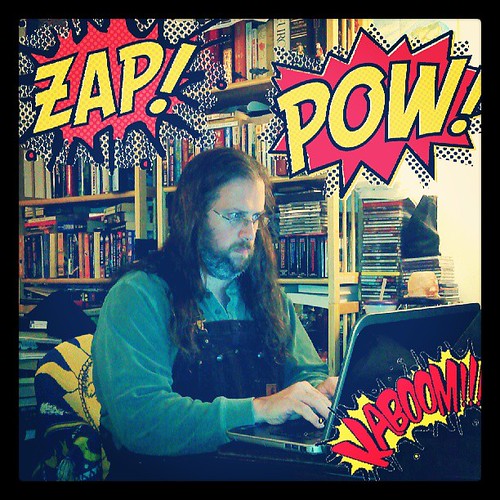
Anyway, that’s where things stand right now in the WritingVerse. Back we go! Zap! Pow!

Share This Post

Writing! Writing! Writing!

Finished one manuscript? Then start the next one! #AmWriting

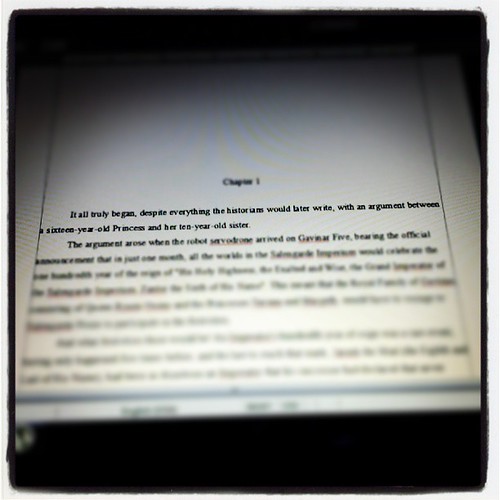
Behold the first word of the new Work-In-Progress, whose official Not Actual Title is…GhostCop!

Yes, I’m shifting genres and trying a supernatural thriller. No science fiction, no spaceships, no Princesses…just a normal Earth city, and the goings-on that happen there. I’m not sure what my word-count goal is for this book, but right now, I’m thinking it’ll be shorter than either of the two Princesses books. Maybe 120,000 words, but as I said, I’m not sure. I may not even set a goal on this one.

And no, it’s not about a cop who’s a ghost. Nor is it about a ghost who’s a cop. What is it about, then?

Hmmmmm….

(In other writing news, nothing new on the query front at all…but I’m sending a new wave of ’em out this weekend. And also, I had the very odd experience of dreaming about writing the other night. I almost never remember my dreams, so for all I know I dream about writing all the time, but this one was quite vivid. I dreamed that I said “Screw it!” and dove right back into editing Princesses II. What was weird is that I remember, in my dream, reading scenes that aren’t in the book. Not that they should be, because they didn’t make sense, but still…dreaming about it was very surreal. I take that as confirmation that my general strategy of allowing the book to fade in my consciousness for a few months is a good one.)

Share This Post

Stick a fork in it!

DONE!!! The 1st draft of "Princesses In Space II: Spacenado" (not the actual title) is finished! #AmWriting

At long last, after five months and eight days of wrestling with this story, the first draft of Princesses In Space II: Spacenado (not the actual title) is finished. And what a struggle this one was, at times. Wow, this was a tough book to do. I’m looking forward to editing, but I really need a bit of distance from this universe for a while, so the plan is to set it aside for my customary period of about three months. Unfortunately, that would put me into editing in November, which is NaNoWriMo, so instead I will not start editing until December 1.

I figure it should take me no more than two months, max, to go through the book, mark up the manuscript, and make the changes I decree necessary on the first time through, so my next goal is to have the manuscript into the hands of beta readers no later than Super Bowl Sunday, which is…the first Sunday in February. (I’m not looking it up right now.) What happens next? Well, obviously…another book! I think I’m going to take a whack at a notion I’ve had for a supernatural thriller for quite some time, and then, after that, give another shot at Lighthouse Boy (not the actual title), the fantasy epic I started but stalled on because I hadn’t given sufficient thought to the backstory. The thriller’s not-actual-title? I haven’t decided yet, but I will.

Why start something so soon? Well, here’s Stephen King, describing the output regimen of Anthony Trollope:

At the other end of the spectrum, there are writers like Anthony Trollope. He wrote humongous novels (Can You Forgive Her? is a fair enough example; for modern audiences it might be retitled, Can You Possibly Finish It?), and he pumped them out with amazing regularity. His day job was as a clerk in the British Postal Department (the red public mailboxes all over Britain were Anthony Trollope’s invention); he wrote for two and a half hours each morning before leaving for work. The schedule was ironclad. If he was in mid-sentence when the two and a half hours expired, he left that sentence unfinished until the next morning. And if he happened to finish one of his six-hundred-page heavyweights with fifteen minutes of the session remaining, he wrote The End, set the manuscript aside, and began work on the next book.

Now, I’m not gonna start writing the next thing immediately, as in, right now, but I may well start later today. Why not? What else am I gonna be doing with my time? There are stories to be told, man! Zap! Pow!!

Why yes, writing is exciting! #AmWriting

Share This Post

On Death and Villainy

John Seavey, one of the regular posters at MightyGodKing, writes at length about Norman Osborn, the human alter-ego of Spider-Man villain Green Goblin. I don’t much have a dog in that fight, but I did like two different side points Seavey made along the way.

First:

I have gone on record multiple times as saying that if contrived resurrections cheapen deaths, the answer is to stop killing off characters so frequently and not to have fewer resurrections. Killing off a character in a shared universe is generally an act of colossal arrogance and short-sightedness, a statement along the lines of, “Well, I can’t think of anything more to do with this character, and I’m the Most Creative Person of All Time! The only interesting thing left to do is kill them off.” It’s never true. There are always more interesting stories to be told with a living character than a dead one, and that’s what makes resurrections so inevitable no matter how contrived they wind up being. The blame should be placed squarely on the shoulders of the killing writer, not the resurrecting one.

I think death is kind of overrated as a narrative device. It’s kind of cheap, really, an easy way of amping up the stakes — just kill someone off, to show that everything is real, that we’re playing for keeps. I find that a lot of deaths in stories feel like they’re there more for narrative effect than for any other reason, and a lot of them end up ringing false when it’s obvious they’re supposed to be incredibly shocking.

Good examples of this can be found all over the place: A Song of Ice and Fire, for instance. (Game of Thrones, for you who know it by the teevee.) George RR Martin gets heaped with praise all the time for being willing to sacrifice main characters, but I’d posit that by the point we’ve now reached, it’s clear that he’s not sacrificing main characters at all; he’s just disposing of secondary characters at surprising junctures.

More oddly, though, is the odd notion that a character should develop only so much, and then they should die. This strikes me as deeply silly, and the two best examples I know are characters who didn’t die: Han Solo, and Martin Riggs (of the Lethal Weapon movies). Harrison Ford has gone on record in the past as believing that Han should have died in Return of the Jedi, because he’d reached the end of his narrative and because it would have given the story a lot more gravitas. And Lethal Weapon writer Shane Black apparently left the series after his intention to kill off Martin Riggs at the end of Lethal Weapon 2 — pretty much for the same reasons — was shot down by the producers.

The problem here is, our lives don’t end when we reach handy points in our development as human beings. Well, for some of us they do, but that’s just the accident of timing, not some existential thing about the Universe dispensing with us upon our reaching of our inner Zen. It’s a silly reason to kill off a character, and Seavey is one hundred percent correct: a character doesn’t run out of potential stories just because one particular writer does.

And besides, “Death as route to gravitas” is…well, it’s just plain overrated anyway. How many major, named characters among the protagonists die over the course of The Lord of the Rings? Two: Boromir and Theoden. That’s it. And yet nowhere in that entire story would I ever claim that the stakes don’t feel pretty damned high, nor that a price will have to be paid for victory.

(For the record: Yes, I do think that Joss Whedon overdoes death as well, but his deaths tend to be a lot more visceral, given his skills at getting me to care about his characters in the first place.)

And second:

(W)hen you go back and read the original Green Goblin stories, he wasn’t much of a villain. He was a C-list Kingpin wannabe who failed at everything he tried, lost pretty much every fight he was in, and whose only talent was in running away. He didn’t even really have a backstory, because Stan Lee and Steve Ditko couldn’t decide who he was going to be under the mask. (Ditko wanted it to be a totally unmemorable nobody, to show that villains didn’t always have to be someone important to the hero. Lee felt like they’d spent so long building up the mystery of the Goblin’s identity that the audience would be upset if it wasn’t someone they recognized. The dispute was one of the reasons that Ditko left the title.) Basically, the Green Goblin was by no means the most important of Spider-Man’s bad guys.

Now, I’m not sure about this, and a couple commenters in the thread over there take issue with Seavey’s description of Ditko’s views and departure from the series. But Ditko’s point here, even if it wasn’t really Ditko’s point, is a good one, an interesting one.

There was a very effective episode of Magnum, PI that did this to really extraordinary effect — so much so that it’s one of my favorite episodes of that series. Magnum receives a strange telephone call from a cackling guy who promises to kill and leaves Magnum bits of nursery rhymes as clues. This pattern repeats several times, and it becomes very clear that this killer knows Magnum well and has a very specific beef with him. It’s a very well-made episode — Magnum occasionally eschewed its Rockford Files-esque tone for a kind of “Hawaii Noir” mode, usually to very good effect — but what makes it stand out is the resolution. Eventually the killer stands before Magnum, unmasked and grinning and waiting for his sick payoff…and Magnum doesn’t recognize him. Even later, after the killer has been dealt with and the whole mess is over, Magnum doesn’t remember him at all. He has to go back into his own personal records to figure out who this guy is, and it turns out that Magnum investigate the guy’s wife some years back in a possible divorce case, but the case turned up nothing at all and Magnum didn’t even take the guy’s money. I don’t recall what caused the guy to spiral into insane killing, and there’s a good chance that the episode doesn’t even fill in that detail, leaving it a complete mystery. But that’s one of the things that makes it really memorable: that the villain isn’t some significant figure from Thomas Magnum’s past; it’s just some guy with whom he had a completely mundane association for a short time years before, so mundane that he doesn’t even remember him.

Of course, I can turn this back to Star Wars. One thing that really incensed fans as the Prequel Trilogy unfolded was the idea that at the very heart of the mystery that is Darth Vader is a pathetic teenager, a guy who couldn’t get over the loss of his schoolboy crush.

It’s a hard thing, explaining villainy. Sometimes no explanation whatsoever is the most disturbing way to go.

Share This Post

It was the best of times, it was the worst of times….

I saw, via Facebook, this fascinating article by Stephen King about opening lines. It’s very much worth reading, as is the follow-up article that solicits favorite opening lines from twenty-one writers.

Stephen King: There are all sorts of theories and ideas about what constitutes a good opening line. It’s tricky thing, and tough to talk about because I don’t think conceptually while I work on a first draft — I just write. To get scientific about it is a little like trying to catch moonbeams in a jar.

But there’s one thing I’m sure about. An opening line should invite the reader to begin the story. It should say: Listen. Come in here. You want to know about this.

How can a writer extend an appealing invitation — one that’s difficult, even, to refuse?

From the second article:

“Where’s Papa going with that axe?” said Fern to her mother as they were setting the table for breakfast. –E B White, Charlotte’s Web

Not the way you’d think a children’s book about a pig would open, and it instantly sets the central fear at the heart of this story: death.

I’ve been mulling this over a bit. The fact is, a great first line doesn’t really make me want to keep reading; nor does a bad one make me stop. I’ve read all manner of books that I love whose first lines I honestly don’t recall, and I’ve read books I didn’t care for whose first lines I do. So it’s not quite a cut-and-dried as all that. But a good first line is still preferable to a bad one or a lackluster one, and a good first line does reveal an author at work who has put some very real thought into things.

Great opening lines I remember? Well, I tend to think in terms of entire opening passages, rather than opening sentences. The way JRR Tolkien opens The Hobbit is utterly masterful: “In a hole in the ground, there lived a hobbit.” Right up front, we’re in the world of strange beings we haven’t heard of, who live in their subterranean world. He goes on to establish more of what a hobbit is and what they do in terms of living in holes, and by the end of the second paragraph, he’s got me hooked. And of course, there’s the famous opening paragraph to A Tale of Two Cities:

IT WAS the best of times, it was the worst of times, it was the age of wisdom, it was the age of foolishness, it was the epoch of belief, it was the epoch of incredulity, it was the season of Light, it was the season of Darkness, it was the spring of hope, it was the winter of despair, we had everything before us, we had nothing before us, we were all going direct to Heaven, we were all going direct the other way — in short, the period was so far like the present period, that some of its noisiest authorities insisted on its being received, for good or for evil, in the superlative degree of comparison only.

In science fiction, Simon R. Green’s Deathstalker has a wonderful beginning, even if the rest of the book doesn’t quite measure up. But for my money, my favorite opening line of all time doesn’t even come from a novel or other work of fiction. It is the way Carl Sagan brings us into Cosmos:

The Cosmos is all that is, or ever was, or ever will be.

Just thirteen words, and Sagan establishes that we are going to be talking about everything, and that the wonder is to be found everywhere. Amazing.

I was interested to read that Stephen King works very hard on his first lines, right up front, before moving on to the rest of the book. Yes, he’s Stephen King and I’m me, so what do I know, but I do the exact opposite: I charge in full-speed ahead and don’t pay any attention to the opening line until I’m into the editing phase. In the case of Princesses In SPACE!!! (not the actual title), I didn’t have an opening line until well into the first round of edits. I mean, I did have an opening line, but I came up with a different one.

And, for those curious, here it is:

The first line of "Princesses In SPACE!!!" (not the actual title). #AmWriting

How does it work? Well, I suppose we’ll see.

Share This Post
A brief writing update

So I’m finally into the final stages of Princesses In SPACE!!! II: The Princesses’ Bogus Journey (not the actual title). This is turning into a real slog, as far as getting the action down in actual words goes. This particular story has turned out to be a lot more adventure-oriented than its predecessor, with the result that I’m writing a lot more action this time around…and I never enjoy writing action. I can do it, but it’s always a struggle for me, and I find that when I’m doing action sequences is when I do the most backtracking, retroactive editing, and that sort of thing. This is, I think, the main reason why this book is turning out to be more difficult than I had planned. I really wanted to be done with it by the end of this month, but a mid-August finish is looking more likely. Which is fine, actually; I’m still not planning to revisit this manuscript, in terms of editing, until December.

As for Princesses I, what can I say? The Dance of Rejection continues, but one way or another, I will get this book out there, even if I join the ranks of the independents, which wouldn’t be an altogether bad thing, either.

Onward and upward!

Writing outside. Took me three times to get this passage right! #AmWriting

Share This Post
Charting the Progress…such as it was….

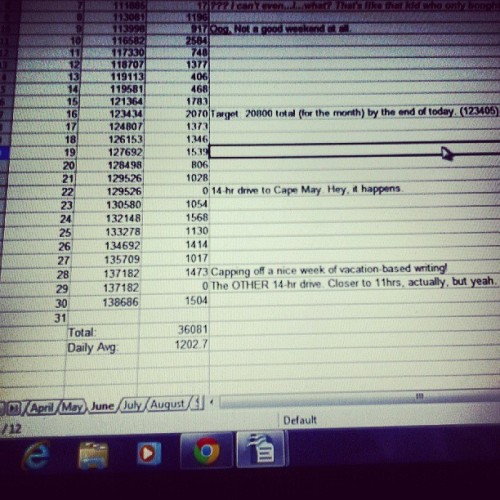
Here is how June shook out for writing:

Well…I’ll take it. I did fall short of the goal I set at the beginning of the month by nearly 3000 words, unfortunately. My daily average turned out nearly 100 words less per day than I had been aiming for.

It was a tough month, though — I lost two entire days to vacation-related driving, there was one day that involved a 4:00 am start at work, resulting in brain fry so extreme that on that day I only achieved 17 total words. Yes, one day I wrote two sentences. And there were a number of days when the going was pretty tough, because I was working my way through a part of the book that was a bit foggy in my mind going in, so I was doing the heavy lifting at the same time as the actual writing. Editing this book is going to be tough, I suspect; I know that there are a lot of fairly dodgy spots where I just basically cranked out prose that I mainly consider ‘placeholder’ prose. But one of my general attitudes on writing is “Ach, get something down and fix it later”, so this doesn’t bother me.

So, into July I go. I still hope to finish the first draft by the end of this month, but that may be a tall order. If that works out, then I should be able to let the manuscript age in a charred oak barrel until December! (That’s to leave time for NaNoWriMo.)

Onward and upward! Zap! Pow!

Why yes, writing is exciting! #AmWriting

Share This Post
Writing is like this, installment # 5748

Here’s another metaphor for what writing is like. Take the wonderful opening scene (sorry, I can’t embed the video) from Love Actually (a movie about which, if you say bad things, I will fight you — that’s no lie). Billy Mack, our drugged out singer, is recording a cover version of a classic oldie but with the lyrics ‘repurposed’ for Christmastime. OK? So he’s recording, and it takes several takes because he keeps getting it wrong. He gets more and more frustrated with himself, culminating in one of the best self-directed bits of profanity in movie history.
But then, he buckles down, dials in, and he nails it. And he knows it, he knows he’s nailed it, so he keeps going, getting into the moment. And he’s really creating something now! He’s got it!
And then, the realization hits him, and at the 1:54 mark in the video, he says to his producer, “This is shit, isn’t it?”

Even when it’s going great, you’re never far from the conviction that you’re still producing tripe and treacle. You’re never far from stopping typing, staring at the screen, and saying, “This is shit, isn’t it?”

That’s what writing is like.

Share This Post