The Great Bird

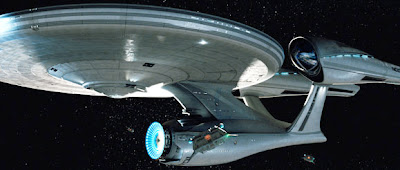
It appears that we now know what the Enterprise will look like when Star Trek reboots next year:

Well…I don’t know. I can’t decide yet if I like it or not. It certainly sticks to the classic shape, and the primary hull (the saucer section) looks fine, but the secondary hull (the engineering section) looks too small, squashed even, and the warp nacelles don’t look right to me at all, being too far forward (like you could step off the primary hull and step down onto the nacelles) and sporting that oddly-shaped flare at the front. Plus, the pylons connecting the warp nacelles to the secondary hull are bowed outward, making the ship look bow-legged. I do like the sleeker, wider pylon connecting the primary and secondary hulls, and the deflector dish looks nifty, too. From the presence of shuttlecraft in the picture and the fact that the fronts of the nacelles are dark, I assume this pic is from the ship in a drydock situation. I wonder what color the fronts of the nacelles will be once the ship is flying.

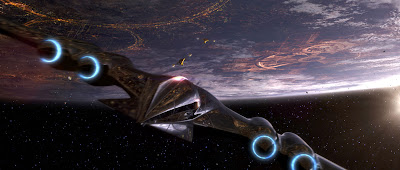
I don’t hate it, but it ain’t this, either:

We’ll see. It took me a long time of watching ST:TNG before I got really used to the Enterprise-D, which I always thought looked awesome from some angles and ridiculous from others. The Enterprise-E looked okay, although I haven’t seen the movies it appeared in enough to have a strong opinion.

Share This Post

Choose your next witticism carefully….

While I was on blogcation, a number of times I found things online or off that tempted me greatly to return to active posting before my arbitrarily-chosen return point of Election Night. Many of these things were political in nature, so I’m glad I didn’t post about them, but more than a few weren’t, and one blog in particular that I happened upon shortly after I went on hiatus (and before I’d decided that I’d likely return on Election Night) was one that just killed me to not be able to link. Well, now I’m back, so here it is:

I Expect You To Die!

On this blog, a person named Snell has been methodically reviewing each and every James Bond film leading up to this week’s American release of Quantum of Solace. His takes on the films aren’t identical with mine, but they line up in a lot of key ways, and his reviews make for extremely entertaining reading. I’ve had a grand time following this blog the last couple of months, and it bums me out that I can only share it now that its purpose is nearly done. But hey, archives are like diamonds: they’re forever! So go look. If you enjoy James Bond at all, check this one out.

I Expect You To Die!

Share This Post

The Balance in the Blood (part one)

This is a horror story I wrote more than five years ago. The concept behind the tale is most definitely the most horrific I’ve done thus far, and I’m still unsure of the moral point behind the story; I write here about people who commit acts of great evil for reasons that turn out to possibly be not quite so evil after all. It’s a long story, so I’m going to serialize it, one installment each week, over eight weeks. While the story never sold, each of its rejection slips bore the consolation-prize of a hand-scrawled note from an editor saying “Wow, almost good enough.” That surprised me greatly, since I could never make up my own mind about this tale. But here it is.

Willem Schliemann extends a shaking hand toward one of his six remaining African violets. This plant hasn’t blossomed in months, and he wonders why. The truth is that he isn’t very good at this. He whispers an expletive as he hears the truck engine outside. He grabs his cane and heads for the door.

“Good morning, Senor,” Miguel says as Willem walks out onto the porch. Miguel goes around back of the pickup truck and begins unloading Willem’s weekly supplies. He puts two crates on the porch and stops to wipe his brow. “Senor, how can you wear long sleeves today?”

“The warmth appeals to me,” Willem Schliemann says with a shrug. “Though I admit that I will never truly be used to sun and heat in December.”

“You’ve been here fifty years.”

“Fifty-four,” Willem says. Fifty-four years since he last saw the Fatherland, though no one calls it that now.

“Perhaps that is why your flowers do not bloom.” Miguel grins and wipes his brow again. “I’ll see you next week, Senor Schliemann. Oh, your mail.” He hands Willem a pack of mail tied with a string, and then he gets back in the dusty old pickup and drives away down the narrow dirt road. Willem breathes in the warm breeze from the Atlantic. He thumbs through his correspondence. A few bills, letters he exchanges with people around the world – none bearing his real name, of course. Argentines don’t question such things. He finds a letter from a particularly engaging correspondent, and he smiles. Then he sees the postcard on the bottom of the stack.

The card shows a place Willem remembers with perfect clarity through fifty-four years, a lifetime, of memories. The front gates of the concentration camp at Hamerstadt. There on the left is the spot where he stood at attention that morning. The grass is green, the paint on the buildings is flaking – but it is the same place. He waits for the chill to run through him, but nothing comes. Has it been too long? He turns the card over and reads where a feminine hand has written in German, “I have finally found you.” There is no signature. One is not needed.

Old Willem Schliemann looks up at the bright morning sky. He knows that she will be here tonight. Willem sighs, puts the mail aside, and goes about putting his supplies away. As he does so he glances at his stubborn violets.

Some blossoms are more delicate than others….

***

Willem Schliemann stood at attention near the front gate. His new uniform, stiff and scratchy and at least a size too big, hung loosely on his slight frame. His head still itched from being shaved three days before. Thirty other new conscripts stood with him, waiting in the cold April air for….something. Flecks of ash fluttered down from the sky like snowflakes, ash from the great smokestack that towered above the giant foundry building that was not really a foundry. Somewhere behind them Willem could hear a train arriving.

Attention!”

Commandant Gerhard Reger looked over his conscripts with a disgusted expression as a staff car pulled up in front of the phalanx. A man climbed out of the car’s back seat, and the Commandant turned to face him. “Herr Doktor,” Reger said. “A pleasure.”

“I’m sure,” the man said. Willem leaned slightly to one side to get a better look at this man. He was short, shorter than Willem. His black hair was slicked straight back and his thin lips were set in a tight frown. He wore a thick black overcoat with a sable collar, and a swastika-shaped lapel pin. He placed a pince-nez on his nose and looked over the conscripts. “Such a fine crop, Commandant. Our thousand-year Empire is now in the hands of sixteen-year-old boys.” He ignored the look of disgust on Reger’s face as he returned the pince-nez to his pocket and pulled out a slip of paper, which he handed to the Commandant. “This is the one I require,” he said. “I trust I have not picked a boy to whom you have formed….an attachment?”

Willem watched as Commandant Reger met the man’s gaze. He was close to the front and could hear what was being said, but even the soldiers in the very back row could not have missed the look of utter loathing in the Commandant’s eye. Reger faced the conscripts again and yelled out the name on the paper.

WILLEM SCHLIEMANN! STEP FORWARD!

Swallowing, Willem stepped forward and walked to the front of the line, where he returned to attention as the man, this Doktor, came down and looked him over. He smelled faintly of lavender.

“An honor,” the man said. “Please, come along.” He gestured for Willem to come with him. “You are assigned to me now.”

Willem glanced at the Commandant, who gave a single, curt nod. Willem joined the Doktor and climbed into the warmth of the staff car as a young soldier who was not much older than himself held the door open. When the driver was back behind the wheel the Doktor rapped twice on the forward window with his truncheon. The driver nodded, put the car in gear, and drove. Willem looked out the windows as they passed through the camp. There were many guards presiding over the comings and goings of hundreds of emaciated, prisoners. More than once he saw two soldiers dragging a dead body between them. The Doktor sipped from a flask and shook his head.

“Somehow I suspect our solution is not so final after all,” he said. “In the end, there are still more Jews than Nazis.”

“In the end?” Willem asked, surprising himself by speaking.

The Doktor nodded. “Italy is no longer with us. The Russians failed to oblige us by simply giving up. We have already lost France, and Hirohito hasn’t been able to command the total attention of the Americans. And, of course, the British….well, there it is.”

“There is still hope,” Willem said.

The Doktor eyed Willem suspiciously. “Fill an empty bag with hope, and you have an empty bag.” He capped the flask and returned it to his pocket. “My name is Wolf Muething. I am a physician by trade, although in recent years my work has gone in other directions.” He sighed. “I chose you because of your experience working with your uncle.”

Willem glanced sharply at the Doktor. “How do you know that?”

“He was my friend,” Doktor Muething said. “We were in school together, many years ago. I was very sad to hear of his passing.”

Willem nodded and looked away, mostly to hide the fresh tears welling up. He had been five years old when his father died and he’d gone to live and work with Uncle Gunther. Since then he had spent his days traveling with his uncle to the villages and farms all around the region. Willem had helped deliver babies, set broken bones, and tend to the dying. He had done everything that a country doktor would, and he had always supposed that he would become a physician himself.

Then, just six weeks before today, he had been at Uncle Gunther’s side, treating an elderly woman with rickets. Gunther complained of chest pains, and hours later he was dead. Uncle Gunther had been old, but he had never been sick for more than a day or two. The shock of his passing was compounded two weeks later by his conscription into the Army….and now he was apparently assigned to another physician. Looking at Doktor Muething, with his black hair and severe look that was the complete opposite of Uncle Gunther’s, Willem suspected somehow that he would not be delivering babies or setting broken bones.

Minutes later they arrived at their destination. Willem looked out the window at the small, low building. “Here we are,” Doktor Muething said. “Your new quarters will be over there.” He pointed to the dormitories across the street. These looked somewhat better than the mass quarters he had shared with the several hundred other new conscripts – if any housing in such a setting could ever be described as nice. “Come,” the Doktor said. “I would have a look at what they have built for us.” He waited for the driver to come open the door and then he climbed out, followed by Willem. He led the way up five stairs and inside.

It was a small medical laboratory. Clean, Willem noticed, definitely clean. The place still smelled like fresh paint, plywood and plaster; the stainless steel examination table in the center of the room gleamed in the sunlight that streamed in through the large windows. But as Willem looked closer he could see spots where the paint was too thick or too thin, where the wall panels didn’t fit together quite correctly, where electrical wiring was exposed. Another disposable building.

“Not bad for construction performed at gunpoint,” Doktor Muething said. “It won’t take me long to put things in order.”

Willem looked around at the rest of the laboratory, which wasn’t much bigger than the room where Uncle Gunther had based his practice. He now saw that the examination table was outfitted for surgical procedures as well. A cabinet on the right was stocked with chemicals and specimens preserved in formaldehyde. There was a packed bookcase, and between the bookcase and the cabinet there was a roll-top desk. Willem approached the surgical table. It was not as pristine as it had first appeared. Its surface was dull and scratched, and although it had been meticulously cleaned since its last use no amount of scrubbing could remove all the traces of blood from the collection grooves.

“You probably didn’t use a table like this, working for Gunther,” Doktor Muething observed.

“No,” Willem said.

“It should make you proud, having such an opportunity to help the Fatherland.” He took off his overcoat and hung it on the back of the chair in front of the roll-top desk. He was wearing a double-breasted charcoal-gray suit, and now he wore no swastika pin.

“I am honored to work for the glory of Germany,” Willem said.

The Doktor laughed, and Willem’s cheeks turned a bright crimson. What had he said that was funny?

“Forgive me,” the Doktor said. “I am an old man, and I have seen the Might of Germany plowed under twice in one lifetime.” He settled into the chair, the legs of which squeaked. “What we do here is not for Germany. What we do here, is for the betterment of Man. Out there”—he made a sweeping gesture—“the masses will not approve of what we do. They will hate it, condemn it, and some will try even to deny it. But they will benefit. We must learn what we can. Do you understand?”

Willem drew himself up straight. “You speak treason, Herr Doktor.”

“Hardly. Germany will survive; I merely question the form in which it shall be. Perhaps on that day we will be a wiser people.” He pushed himself up from the chair, walked over to the surgical table, and ran a finger down one of the blood-grooves. “Tell me, young Schliemann – are you a man of science?”

Willem shifted on his feet as he considered the question. Doktor Muething smiled.

“You are thinking,” he said. “Good. We haven’t driven you totally to automatic sentiments and easy platitudes.”

“I don’t understand the question, Herr Doktor.”

“And that, young Schliemann, is the beginning of wisdom.” Doktor Muething smiled. “There was a time, once, when the standard treatment for disease was prayer. It was thought that all maladies were caused by evil spirits, and that only God could restore health to an afflicted body. But centuries of science have taught us otherwise. What God would afflict, we can now put right.” He leaned against the table. “So much of what we have learned has come at the expense of the dead. What does this tell you, young Schliemann? What question should arise now, if you are truly of science?”

Willem thought for a moment. “Is there a limit to what the dead can teach us.”

Doktor Muething nodded. “And if the answer to that question is ‘yes’?”

The answer came as quickly as before, but Willem hesitated before saying it. “Then I would ask what we may learn from the living.”

“Precisely,” the Doktor said, and then he addressed someone behind Willem. “Are they here, Commandant?”

“Yes, Herr Doktor.”

Willem hadn’t heard Commandant Reger enter, but there he stood, waiting patiently in the doorway.

“Good,” Doktor Muething said. “Let us see them.”

Willem and the Doktor followed Commandant Reger outside, where six prisoners stood at attention under the watchful eye of eight rifle-wielding guards. Two guards would be enough, Willem thought, judging by the look of the prisoners. Doktor Muething stepped up and looked over each prisoner. There were four men and two women. Each had that sunken look of hunger, and each wore the yellow Star of David stitched to their ratty prison clothes.

“All Jews?” the Doktor asked. “No Gypsies or other undesirables?”

“All Jews,” the Commandant replied icily. “You were quite specific.”

Doktor Muething bid one of the male prisoners to open his mouth, and then he examined the man’s teeth. “Healthy enough, I suppose.”

He has a strange idea of health, Willem thought as the Doktor moved on to the two women. He very briefly looked over the older of the two, but he lingered on the younger. “Might I see your eyes, child?” the Doktor said as he lifted her chin with a single finger. As her head rose, her gaze flicked ever so briefly to Willem’s. There was no fear in her eyes, only quiet resignation. In health she would have been lovely, Willem thought. Even for a Jew.

The Doktor stepped away from the prisoners. “These will do.”

“You are truly a charitable man, Herr Doktor,” the Commandant said, making no effort to look at Doktor Muething as he addressed him.

Doktor Muething waved a hand. “Charity is hostility with an open hand,” he said. “Young Schliemann, we will begin tomorrow morning at precisely five o’clock. I assume that Gunther taught you punctuality?”

Willem nodded. Uncle Gunther had always carried three watches to ensure that he would never be late for anything. One of those watches was now Willem’s; he had inherited it along with Uncle Gunther’s stethoscope, the last proud artifacts from the life of a poor country doktor.

End Part One

Share This Post

Fixing the Prequels: Attack of the Clones (part one)

Well, I suppose I’ve waited long enough, so it’s time to return to a long time ago in a galaxy far, far away to pick my way through the second of the oft-derided, and in my view unfairly unappreciated, Star Wars Prequel Trilogy. So, bring ’em on: Attack of the Clones!

First, a couple of reminders from Fixing the Prequels: TPM:

1. I will be using these abbreviations throughout:

TPM = The Phantom Menace
AOTC = Attack of the Clones
ROTS = Revenge of the Sith
ANH = A New Hope
TESB = The Empire Strikes Back
ROTJ = Return of the Jedi
PT = Prequel Trilogy
CT = Classic Trilogy

2. This is not about ripping George Lucas a new one as a writer or director; nor is it about completely rewriting the PT from the ground up. Those who are looking for that kind of thing had best look elsewhere. My view toward the PT stands to this day: the films are very good, and often excellent; they tell gripping and fascinating stories; and they display amazing amounts of imagination. However, I do admit that they have flaws. Not fatal flaws, but flaws nonetheless. This series is about the flaws I perceive in the movies, and how I’d have fixed or avoided them.

As we go through AOTC, I may make some fairly surprising choices. In reconsidering this movie, it’s the prequel film to which I’d actually make the fewest wholesale changes. In light of what I see mentioned in discussions of this film, online and off, whenever the subject comes up, some of my choices might prove surprising.

So, with all prologue aside, it’s time to jump right in!

As with all Star Wars movies, we start with the opening crawl. Here’s the text:

There is unrest in the Galactic Senate. Several hundred solar systems have declared their intentions to leave the Republic.

This separatist movement, under the leadership of Count Dooku, has made it difficult for the limited number of Jedi Knights to maintain peace and order in the galaxy.
Senator Amidala, the former Queen of Naboo, is returning to the Galactic Senate to vote on the critical issue of creating an ARMY OF THE REPUBLIC to assist the overwhelmed Jedi….

Here’s a nifty beginning indeed. I remember all those people bitching about the politics in the opening crawl of TPM, but for some reason, here’s one that’s also political in nature, and yet, I don’t recall any complaints. In just four sentences, George Lucas creates a dangerous political situation that establishes that the Republic isn’t in a state of mere decay but in actual danger of collapsing; he names his new villain; and he establishes that the Jedi are meeting their match in their efforts to keep the peace. It’s one of the series’s better opening crawls.

Onto the opening sequence, which I’ve always loved. It’s mysterious and off-putting. Instead of the traditional pan down to the first planet of the movie, the camera pans up, for the only time in the Saga. The way this shot is done is a wonderful effect: we’re traditionally panning over a starfield, but then suddenly it seems that some of the stars are moving. A second later, Coruscant comes into view, and we realize that the moving stars are actually ships, hundreds of them, coming and going from the Galactic capital. Then the Naboo ships enter the frame from behind, a large transport ship escorted by three fighters. This transport ship has a unique low rumble, sounding like a World War II bomber, and as it approaches Coruscant, it begins to roll in order to properly orient itself with the planet.

It’s morning on Coruscant, and it’s very foggy, high up in the upper reaches of the cityscape. The tallest buildings poke through the clouds as the four ships come in to land. All’s well, until the explosion that kills Senator Amidala’s decoy. This was another terrific touch by Lucas: Padme’s use of a decoy through TPM is suddenly shown to have been a very good idea, one which she has kept in her bag of tricks.

In the original shooting script, we next cut to a sequence in the Senate, where Chancellor Palpatine announces Amidala’s assassination, which sparks new debate on the need for a strong response to the Separatists. Amidala then arrives, to everyone’s shock and delight, and begins to argue against military action. All of this was actually filmed and can be seen on the Deleted Scenes on the DVD, but cutting this sequence was a good decision on Lucas’s part; it really doesn’t do anything to establish the political situation that can’t be done in a much shorter time. (I’m not as thrilled with all of Lucas’s cuts from his original script for the final release, as we’ll see as we move on.)

So, in the film, instead of going from the attack on Senator Amidala to the Senate, we cut instead to the Chancellor’s office, where Palpatine and the Jedi leaders are discussing the situation. Here’s where I’d make the first significant alteration in the film. The problem is that in the movie as it was finally released, we don’t meet the film’s main villain until more than halfway through. When that happens, we need to know automatically that we’re looking at Count Dooku, and here’s where I’d make that correction:

INTERIOR: CHANCELLOR’S OFFICE – DAY

CHANCELLOR PALPATINE sits behind his desk with TWO RED-CLAD ROYAL GUARDS on either side of the door. YODA, PLO KOON, KI-ADI-MUNDI, and MACE WINDU sit across from him. Behind them stand the Jedi LUMINARA UNDULI and her Padawan, BARRISS OFFEE.

[ASIDE: This is the first time I’ve ever known that there was a Jedi named “Luminara Unduli”. A lot of the names in the PT tend to be clunky, but that is one wonderful name. Luminara Unduli!]

They are watching on the Chancellor’s immense viewscreen a news video of an elderly man, white haired and bearded, speaking before an audience of thousands in some alien world’s capital city. This is COUNT DOOKU.

DOOKU: You have all seen what has happened these last decades: the gradual erosion of a once great and proud Republic. Now, the Senate endlessly squabbles while the Chancellor accomplishes nothing, and the peace and harmony of every star system is threatened! Trade wars erupt with no enforcement of treaties! The crime syndicates take control of entire star sectors! The Jedi Knights dither over matters of doctrine while the people they are charged with protecting suffer! It is time for the Republic to either return to its roots, or cease functioning altogether!

The audience erupts in immense cheers. Palpatine, disgusted, makes a motion to Mas Amedda, who cuts off the transmission.

PALPATINE: So, your Count Dooku finds more converts to his cause.

YODA: “Our” Dooku he is no longer.

PALPATINE: His separatist movement grows stronger with every system he visits, and the people who come to follow him believe in him because he was once a Jedi, Master Yoda. And if the systems sworn to him begin signing treaties with one another, we could be facing a Galactic civil war.

PLO KOON: Which would make the creation of an Army of the Republic unavoidable, even though it goes against every tenet the Republic has ever stood for.

PALPATINE: I don’t know how much longer I can hold off the votes, my friends. More and more star systems are joining these Separatists. The attempt on Senator Amidala’s life has bought us time – I was able to dismiss the Senate into recess – but the vote will happen.

MACE WINDU: If they do break away from the Republic-

PALPATINE: I will not let this Republic, which has stood for a thousand generations, be torn in two. No matter how many speeches Count Dooku gives. My negotiations will not fail.

MACE WINDU: But if they do, you must realize that there aren’t enough Jedi to protect the Republic or enforce the Constitution. We’re keepers of the peace, not soldiers.

PALPATINE: Soldiers. Master Yoda, do you believe it will come to war?

YODA: The Dark Side clouds everything. Impossible to see, the future is. But do their duty, the Jedi will.

Now, in comes Senator Amidala and her contingent, including Bail Organa. for their audience with the Chancellor. Interestingly, they are announced as “the Loyalist Committee”, which seems to imply that the Separatist movement actually has some sympathy in the Senate, if not outright support. This isn’t really commented on, though, and soon we’re on to discussing Senator Amidala’s dangerous situation:

PADMÉ: Do you have any idea who was behind the attack?

MACE WINDU: Our intelligence points to disgruntled spice miners, on the moons of Naboo.

PADMÉ: But I think that Count Dooku was behind it.

There is a stir of surprise. They look at one another.

KI-ADI-MUNDI: He is a political idealist, not a murderer.

MACE WINDU: You know, M’Lady, Count Dooku was once a Jedi. He couldn’t assassinate anyone. It’s not in his character.

YODA: In dark times nothing is what it appears to be, but the fact remains for certain, Senator, in grave danger you are.

OK, here we have a bit of a problem. I’ve always felt that Padme’s suspicion of Count Dooku comes out of the blue; it’s not really set up at all. This ties into my original notion that Dooku’s introduction and establishment as the film’s new villain, combined with the fact that many don’t even realize he’s a villain until far too late, isn’t handled as well as it could have been. So I add an appearance via newscast by Dooku above, so when we meet him in person later on we’ll know who he is; also, I’d alter things in the conversation a bit to flesh out Padme’s suspicions:

PADME: Spice miners? I have had almost nothing to do with the policies that have aggrieved them. But I have been active in trying to resolve the Separatist crisis peacefully, and I have been named as a “Loyalist”. (Pause while she allows this to sink in) I believe that the Separatists were behind the attack. Perhaps even Count Dooku himself.

The Jedi look at one another in amazement; Palpatine leans back in his chair and adopts the stance of a fascinated observer.

KI-ADI MUNDI: My Lady, Count Dooku is a committed political idealist. He is not a murderer.

PADME: The Separatists have much to gain-

MACE WINDU: By killing you? How? All a high-visibility assassination could accomplish would be to drive sympathy in the Republic toward the Loyalists, and not the Separatists. It would make no sense.

PADME: Not everything always makes sense, Master Jedi. Remember the invasion of my own world, ten years ago.

MACE WINDU: I grant that, Senator, but Dooku was once a Jedi, and even though he left the order for arcane reasons, he is still bound by the Force. He couldn’t murder anyone.

With all this we have AOTC‘s first instance of one of the main recurring themes of the PT, namely, that a big reason the Jedi fall is that they’re almost always wrong about stuff. They can’t see the real threat even though it’s right in front of their faces, and even though Yoda and Mace Windu later on realize that they’re not seeing the whole picture, they still fail to totally grasp what’s going on. It’s all pretty chilling.

Continuing our scene, with a bit of dialogue I’m adding in (comment within):

PALPATINE gets up, walks to the window, and looks out at the vast city.

PALPATINE: Master Jedi, may I suggest that the Senator be placed under the protection of Your Graces?

BAIL ORGANA: Do you think that is a wise decision during these stressful times? From what I have heard, the Jedi are ill-equipped for bodyguard duties right now.

[ASIDE: As originally written, Bail Organa’s objection could be heard as him objecting not to the Jedi protecting Padme but to her receiving protection at all, so I clarify this.]

PADMÉ: Chancellor, if I may comment, I do not believe the…

PALPATINE: …”situation is that serious.” No, but I do, Senator.

PADMÉ: Chancellor, please! I don’t want any more guards!

PALPATINE: I realize all too well that additional security might be disruptive for you, but perhaps someone you are familiar with… say, an old friend like… Master Kenobi.

[ASIDE: I love the way Ian McDiarmid takes on a grandfatherly tone when he suggests this, even though he most certainly knows that Master Kenobi’s apprentice will be affected by being thrust together with Padme again.]

PALPATINE nods to MACE WINDU, who nods back.

MACE WINDU: That’s possible. He has just returned from a border dispute on Ansion.

PALPATINE: You must remember him, M’Lady… he watched over you during the blockade conflict.

[This line isn’t in the movie, but I like it.]

PADMÉ: This is not necessary, Chancellor.

PALPATINE: Do it for me, M’Lady, please. I will rest easier. We had a big scare today. The thought of losing you is unbearable.

AMIDALA sighs as the JEDI get up to leave.

MACE WINDU: I will have Obi-Wan report to you immediately, My Lady.

I do like the way the scene establishes that Padme is still pretty headstrong and unwilling to be pushed around, and also establishes Palpatine’s own gifts for manipulation. Good stuff.

And that’s a good place to leave off for the first post on AOTC. Next time, we’ll address something that’s always bothered me a little about how we meet Teenage Anakin. Excelsior!

Share This Post

Mush! I got yer mush here!

[I make no effort to avoid spoilers for a couple of the books discussed below.]

I’ve long established on this blog my predilection for mushy romance stories of all types, usually in film. But it occurred to me a few months ago that I wasn’t exploring the world of mushy romance stories in book form enough, so I figured I’d start with one of the Big Heads of the mushy romance tale working in books today. I figured I’d go with someone whose books have been made into at least several movies and who can be found at nearly any bookstore. Such authors aren’t terribly hard to find, so I was able to identify my pigeon fairly quickly.

Hence my recent reading of several books by Nicholas Sparks.

Sparks is…well, I’m not sure what he is. After four of his books, I’m not sure I want to admit to liking him. There’s something in each book thus far that’s pissed me off for some inexplicable reason, and yet, I’ve read four of the damn things so far, and I have every intention of reading a few more, at least. He’s maddening: Sparks is probably the most manipulative writer I’ve ever encountered, pulling stunts of chain-pulling and tear-jerking that appall me in their simplicity and yet still end up working to perfection. It’s like he just says on page one, “I’m gonna make you cry like a little girl and I’m gonna make you like it.” Does it work? Yup. Dammit.

So, which Sparks books have I read thus far? I started with True Believer, in which Our Hero is a writer of scientific articles debunking paranormal claims. He travels to one of the Carolinas (I don’t recall which one) to investigate some mysterious lights that appear in the local cemetery. There he meets, and becomes transfixed with, the local librarian, a fetching woman named Lexie. Sparks is pretty good at characterizing beautiful and smart women, it turns out; he makes his ladies seem like people you’d well, find yourself attracted to if you were the type of person to be the lead in a Sparks novel. Or something like that.

The second Sparks book I read was At First Sight, which I borrowed from a friend and discovered a few pages in is actually a direct sequel to True Believer. This one I didn’t like so much, mainly because the complications Sparks devises for the couple he introduced us to in the earlier book seem awfully contrived in some cases and downright gratuitous in others. I don’t want to give too much away, but there are parts of At First Sight that make me feel as if we could somehow learn what became of all the characters in Casablanca after the final scene, and if it turns out that Victor and Ilsa die in a plain crash on their way to America. Yeah, the book’s a bit of a downer. And yet, I did tear up at the end.

Then came Sparks’s nonfiction memoir, Three Weeks With My Brother, in which he goes on an around-the-world trip with his brother Micah. He alternates between telling us the tale of the trip and the tale of his upbringing as a kid with Micah and sister Dana. This, too, ends up being pretty depressing stuff as the book goes on. The family was dirt poor for all of Sparks’s youth, but hey, they had each other! Finally, though, the kids go off to college and everyone’s starting to prosper and finally the parents can afford nice things, including the horses that Mom has always dreamed of owning. And then Mom is thrown from a horse and dies of her injuries. This, as you might expect, plunges Dad Sparks into a terrible depression that lasts years and strains every single one of his relationships to the breaking point. But he’s finally moving out of the cloud and re-engaging life when…he’s killed in a car accident. And this happens about fifty pages before we learn that Dana’s brain tumor is back, and this time it’s not going away.

Yeah, if cheerful’s your thing, don’t read Sparks. He doesn’t do cheerful.

Which brings me to the last one I read, The Choice. This is Sparks at his most manipulative. A prologue has Our Hero going to the hospital where his wife works because he hasn’t talked to her in several months; he’s bringing flowers, in hopes that it will help things. So the scene is set: somehow these two met, fell in love and got married, but now they’re separated. Check. On we go. After a long (more than half the book) and, it must be admitted, deftly written courtship that lasts only a few days, Our Hero and Our Heroine fall in love and get married. And then we flash back forward, to find out why they’re separated.

Only, they’re not separated. Gabby’s in a coma from the injuries in a very bad car accident. Hence the book’s title, The Choice: will Our Hero pull Gabby’s plug, or not?

See what I mean? Shameless manipulation. Crass, even. Sparks should be ashamed.

And yet I lapped it up like a kitten laps up warm milk, and I’ll probably read more of this guy’s stuff. I see he’s got a new book out. Sigh…what on Earth is wrong with me?!

[NOTE: I wrote this post more than a month ago and saved it. Last night I finished reading Sparks’s Nights in Rodanthe, which is typical Sparks, all the way. I started asking myself about a third of the way through why certain aspects of the book were being told in past tense, a question which could only have one answer. And when I confirmed that answer, I started blubbering like a baby. I gotta stop reading this guy.

Just as soon as I borrow his latest from a friend.]

Share This Post

Tinkering….

I’ve been messing around with the look around here a little more. New life for the blog means some new window dressing is called for, no? Obviously I was finally able to flip-flop the two columns, which means that if any of the gadgets I have in the sidebar ever hang up (like the Flickr badge tends to do on occasion), it won’t gum things up to the point where the actual content takes forever to show up. Also, a new theme (water), with new mastheads that I’ll switch out on a pseudo-regular basis (again, water-themed, using movie screenshots involving the sea). Finally, I’m going with a static headshot for now.

I’m undecided about the fonts, but they’re a pain in the arse to mess with, so I may just leave it the way it is right now, unless the blog is now impossible for someone to read. (Which could just be my crappy writing, anyway.)

Share This Post

Some Thoughts on Contemporary Popular Culture

That’s actually a pretentious title for a post in which I’m going to geek out a bit. Huzzah! Back to the geekiness!

:: It did excite me that another attempt to bring everyone’s favorite Cimmerian, Conan the Barbarian, back to the big screen was in the offing. That excitement became past tense, however, when the big name most likely on board to direct turned out to be Brett Ratner, who has made a nice living out of making dull movies.

:: I’m actually enjoying Grey’s Anatomy this season, although I still think the show desperately needs another character or two. They’ve already added one — the new emergency medicine chief, who’s also an Iraq war vet with a penchant for maverick thinking — but another, cardiologist Dr. Erica Hahn, is about to depart, so that’s a wash. But the show’s generally been more interesting this year, what with backing off the constant fluctuations of the Meredith-and-Derek romance a bit, in favor of other characters. And Izzy Stevens hasn’t even gotten on my nerves yet, strangely enough, even after Katherine Heigl’s classless “Boy, did our writers suck last year!” rant last offseason.

:: I’m also really enjoying The Office, which has turned up the whole “office romance” thing about three notches, supplementing to the eternal sweetness of the Jim-and-Pam romance with Michael and the new HR woman, and the hilarious Dwight-Andy-Angela “triangle” (with Andy blissfully unaware that he’s even in a “triangle” to begin with).

There was a wonderful scene a few episodes ago that had Jim and Pam call each other on their cell phones at the exact same time, so each got the other’s voicemail, and they proceeded to leave each other messages that reflected the other, almost as if they were actually conversing. I love that show again.

:: My Name is Earl is still funny, but not side-splitting and not nearly as clever as it once was. I don’t think it’s done, but it’s definitely losing steam.

:: That Kath and Kim thing is awful. It reminds me of all those crappy sitcoms that NBC would trot out, one after the other every year, to take the timeslot between Friends and Seinfeld.

:: For campy fun, CSI: Miami is still your best bet. There’s not a thing to take seriously in that show. I love it.

:: On The Amazing Race, I picked out two teams to root for in the first minutes of the season premiere. So wouldn’t you know it: one of those teams got eliminated in that first show, and the other fell two weeks later. Oh well. There’s only one team that bugs me, and I don’t even hate them all that much. As far as who I’m rooting for, I’m not really sure. Maybe the Mom and her son. There’s certainly nothing like the Hippies to root for, or the Barbies to hate. And there’s certainly no Mirna, alas. This year’s edition did take us to New Zealand, home of host and gamerunner Phil, who introduced his dad to the contestants at that leg’s pit stop. Phil’s dad turns out to be a bit of a dirty old man, because when the team of pretty blonds arrived (eliminated later on), he gave them each a nice, lllooonnnggg hug. That’s how it’s done!

:: Wow, that covers just about all the regular teevee viewing I do anymore. Another few years, and unless I pick up some shows, I might be done with network stuff altogether. What else is there to look forward to? More boring lawyer shows from David E. Kelley?

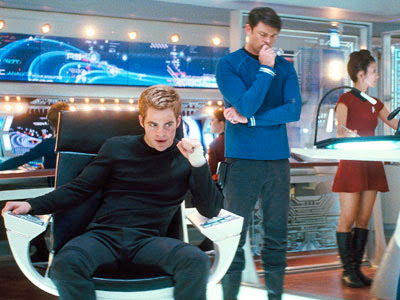
:: Some photos arrived online from the set of the new Star Trek movie. I’m still not excited about this at all, given how tired Trek became in its last years as a going concern and also given my general lack of enthusiasm for JJ Abrams. And this isn’t helping: the new bridge of the Enterprise.

That looks to me like what I imagine Steve Jobs’s bedroom to look like, not the bridge for the Federation’s greatest starship. That’s not a place where you lock phasers on target, it’s where you go to upgrade your iPod. Ugh.

:: Apparently a fourth Pirates of the Caribbean movie is in the works, with Russell Brand said to be joining the cast as Captain Jack Sparrow’s brother. Who’s Russell Brand? Well, I dunno, but I’m game for more Pirates stuff, since I greatly dug the first three (even At World’s End, which a lot of people thought wasn’t so good). I do hope that the new film moves into a new story or set of stories for Captain Sparrow and the rest of the Black Pearl gang, since it seems to me the tale of Will Turner and Elizabeth Swann is wrapped up nicely.

:: Michael Crichton died last week. I never read any of his books, but I did see a number of movies made from them (I liked the first Jurassic Park, and not so much the second), and I was a big fan for many years of ER (which Crichton created) until it managed the impressive feat of jumping the shark twice in one year. Crichton’s global warming skepticism was disappointing, but nobody’s perfect.

That about covers it for right now.

Share This Post

Books! (A quiz)

Here’s another quiz, that I found a few weeks ago at Sheila O’Malley‘s place. It’s about books. I’m writing this a few weeks before my return from posting, so a couple of answers may technically be inaccurate by the time this sees the light of Blogistan, but here we go!

What was the last book you bought?

On my birthday I treated myself to two items at Borders: this year’s edition of The Year’s Best Fantasy and Horror, edited by Ellen Datlow and Kelly Link and Gavin J. Grant, and an Everyman’s Library edition of the writings of Kahlil Gibran, a man whose writings have intermittently fascinated me over the last year or two, to the superficial degree that I’ve explored him at all. (Which is why I bought the book.)

The Year’s Best Fantasy and Horror series is an invaluable resource for anyone at all with any interest whatsoever in those genres. Not only are the books packed with amazing fiction, but the introductory essays, summing up the preceding year in those genres, are extremely good sources of reading suggestions. Even better are the essays on music, film and TV, and comics; if you want to know some great comics to read, just follow the suggestions in these essays. I’m glad to report that one graphic novel I read in 2008, Bryan Talbot’s stunning Alice in Sunderland, made the list.

Name a book you have read MORE than once

I don’t do a whole lot of re-reading of books in their entirety, but I do enjoy dipping into books again on a frequent basis. But there are some that I’ve re-read, and some of those I re-read fairly regularly. I read the following every three or four years:

The Lord of the Rings, JRRT (I’m due, actually; maybe this winter)
The Fionavar Tapestry, Guy Gavriel Kay (Another year, maybe.)
The Lions of Al-Rassan, GGK (my favorite GGK novel, by a good margin)
The Prydain Chronicles, Lloyd Alexander (Currently reading with The Daughter at bedtime; as of this writing, we have only two of the five books to go)
Quite a few of John Bellairs’s books. Why none of these have been made into movies is beyond me; I should think that The House with a Clock in its Walls, The Curse of the Blue Figurine, and The Treasure of Alpheus T. Winterborn would make terrific movies.
Cosmos, Carl Sagan.
On Writing, Stephen King
The Griffin and Sabine sequence (both trilogies), Nick Bantock. I gave this whole set to my best friend a year ago. I love the execution of this series.

There are a number of books I intend to read again sometime, hopefully soon: Christopher Moore’s Bloodsucking Fiends; Mary Stuart’s King Arthur quartet; all of GGK’s novels that I haven’t recently re-read (A Song for Arbonne, The Sarantine Mosaic) and the ones I haven’t re-read at all (The Last Light of the Sun, Ysabel).

Has a book ever fundamentally changed the way you see life? If yes, what was it?

Hmmmm…interesting question. Books don’t usually change my thinking as I read them; they take some time to work on me and to shift my soul about. In my college days, Zen and the Art of Motorcycle Maintenance and its sequel Lila: An Inquiry into Morals, by Robert Pirsig, made quite the impression, although I think about them less and less as time goes on. I re-read Zen a few years ago, and I remember noticing this time how whenever Pirsig reaches a really interesting, but potentially troublesome, spot in his philosophical meditations, he uses the fact that he’s writing in novel form to simply stop the philosophy and return to narrative.

I do recall that my own personal liberalism was faltering a bit back in 2002, only to have it strongly resuscitated when I read John Steinbeck’s The Grapes of Wrath.

How do you choose a book? eg. by cover design and summary, recommendations or reviews?

I do all of these. They always say you can’t judge a book by its cover, but you can sure judge if you want to buy it by its cover; that’s what browsing the bookstore is all about. Choosing a book is like trying it on for size, you know? I love good cover art, and it’s more likely to make me pick up a book to look at it.

Recommendations and reviews also go a long way. There are lots of authors I wouldn’t have ever experienced had I not received recommendations for them. That, to me, is the best part of reading blogs: constant reading recommendations!

Do you prefer Fiction or Non-Fiction?

Either. I’ll usually have one of each going at the same time, in fact. However, I tend to be a lot less rigorous about finishing non-fiction books that I am with novels; I tend to feel guiltier about not finishing a novel than I do about a non-fiction book. (Unless the novel is just dreck, in which case I generally give up pretty early on.) With non-fiction I’m a lot more willing to read until my attention for the book wanders, and then I skip through the rest of it, getting a general gist of things. I don’t really read non-fiction out of a need for research; I read non-fiction as a way of stoking my creative fires and giving my curious self something to do. I read fiction to satisfy my need for story.

What’s more important in a novel – beautiful writing or a gripping plot?

Writing, I think. Beautiful writing will keep me going through a book that may not even have a “plot” in the usual sense. I couldn’t describe the “plot” of The Lions of Al-Rassan in any useful way, for example. But the writing propels me forward. “Beautiful writing” isn’t just about description, though, or artfully-turned paragraphs; I consider things like the overall motion of a story to fall under that category as well.

Most loved/memorable character (character/book)

As usual with questions like this in quiz-things, I’m answering with a list:

Taran of Caer Dallben, Princess Eilonwy, and Fflewdur Fflam (The Prydain Chronicles)
Lewis Barnavelt, Uncle Jonathan, Mrs. Zimmerman (The House with a Clock in its Walls, and sequels)
Johnny van Dixon, Professor Childermass (The Curse of the Blue Figurine and sequels)
Diarmuid dan Ailell, The Fionavar Tapestry
Jehane bet Ishak, Ammar ibn Khairan, Rodrigo Belmonte, The Lions of Al-Rassan
Samwise Gamgee, The Lord of the Rings
David Bowman, 2001: A Space Odyssey
Tom Joad, The Grapes of Wrath
Tyrion, A Song of Ice and Fire

Which book or books can be found on your nightstand at the moment?

As of this writing, Pride and Prejudice by Jane Austen; Hollywood by Garson Kanin; The Arrival by Shaun Tan; the Flight series of comics anthologies; The Complete Correspondence of Robert and Clara Schumann; and The Daughter and I are reading Silver on the Tree, the final volume in the Dark is Rising sequence.

What was the last book you’ve read, and when was it?

Before this writing, Kushiel’s Dart by Jacqueline Carey. I loved it. Also The Bookhunter, a graphic novel I’ll post about soon.

Have you ever given up on a book half way in?

All the time. Life’s too short. I rarely decide that I hated a book, though, when I give up on it; my typical way of referring to the act of book-abandonment is to say that I “bounced off” the book. Whenever I decide that I’m just not invested enough in a book to keep going, I almost never decide it’s because I hated the book but rather than it’s either simply not my cup of tea, or maybe it is my cup of tea but I just wasn’t much in the mood for that particular tea. I’ve bounced off lots of books over the years; some of which I’ve come back to finish later, others I’ve not come back to yet. Some I’ve even stopped reading not for any reason relating to the quality of the book, but because life circumstances intruded. My best example of this is Guy Gavriel Kay’s A Song for Arbonne, which is the first GGK book I ever started. I found it at the Olean Public library when I lived there, and was struck by its cover; I checked it out and read a chapter or two. But a trip and some work stuff reared their heads and interrupted my reading; then the book was due so I let it go back to the library but mentally bookmarked GGK as an author to return to. (I eventually did, of course, when I read Tigana. Arbonne would be the third GGK I would finish.)

I’ve also started but failed to finish The Brothers Karamazov a whole bunch of times. I’m probably due for another attempt. For me, that book is like Everest and every time I set out from Base Camp, a big storm comes along and buries me in snow and by the time I dig my way out climbing season’s over. Someday, though, I’m gonna reach the summit of that book. And then I’m gonna come back down. Oh yeah.

Books I abandoned because I simply hated them? Hmmmm. There’s The Celestine Prophecy, which I hoped would be an Indiana Jones type of adventure (with its cover copy referring to ancient Peruvian manuscripts and the like), but instead it was mystical hogwash, complete crap. And I was really underwhelmed with Stephen King’s Dreamcatcher; I like King a lot, but I doubt very much I’ll ever bother returning to that one.

Share This Post

Fall Quizzes!!!

I didn’t see as many quizzes floating around Blogistan while I was hiatusing (shut up, that’s totally a verb), but here’s one I saw about a month ago at Electronic Cerebrectomy and Tosy and Cosh. It pertains to fall, which is by far my favorite season; where some people want to live in a place where it always feels like July, my wish is for October forever. Fall seems to have this connotation of dying and waning and the light fading before the dark of winter, but I always find fall a time of renewal, a time when I’m more energetic and the world seems more full of things that are possible. Weird? Maybe. But that’s me.

So it’s November, which means that the beauty of the season is pretty much past by this time, but we’re heading into the first cold days of winter, which are the most beautiful of winter’s days anyhow. So, on to the quiz:

Have you ever been apple picking?

Not in a long time. It was probably a field trip in school. But there are few pleasures like a fall apple.

Is there a dish you make/eat only during this time of the year?

The obvious, pumpkin-flavored stuff that you can’t get any other time of year. At Pumpkinville we always get two dozen pumpkin donuts and eat one dozen on the spot (they’re small donuts, so this isn’t as gluttonous as it sounds). Pumpkin ice cream is wonderful stuff, as is pumpkin beer. Apple cider, too, although that stuff is now available year-round. I prefer my cider cold; I’ve never been a big fan of hot cider.

Like many, the colder weather alters my moods, food-wise, in the direction of heartier fare, so while I’ll make a pot of chili at least once a month from October to April, that first pot in October is somehow always the best.

Will you attend a tail gate party this season?

Doubtful. A shame, that, since I’m told that we Bills fans do tailgating better than any other place on the planet, college or pro. Yeah, I’m throwing down the gauntlet.

When do you turn on the heat?

Sometime in October, usually, when the nights get so cold that The Wife orders me to run the heat or endure less-than-optimal sleeping conditions. We have an annoying annual habit – a tradition, I suppose you could call it – of having to call the apartment complex maintenance people to relight our pilot light every single year. Yes, we’re making that call this week.

How many sweaters do you own?

Seven or eight. I like sweaters, actually, although I tend to prefer solid colored ones to ones with funky patterns. But I do like sweater weather. I need to get some new sweaters, actually; my favorite ones are all getting old (although not ratty), and they’re all too big for my emlittling frame. (Yes, that’s word. “Emlittle” is the opposite of “Embiggen”, which all Simpsons fans have firmly ensconced in their personal lexicons.)

Are you fond of Nouveau Beaujolais wine?

Never had it, to my knowledge. But there is a wine available from the Johnson Estates, a Western New York winery, that puts me strongly in mind of fall and winter: Red Ipocras, which is a spiced red wine. I love the stuff. (Note to self: buy some Red Ipocras.)

Do you get excited about Halloween?

Yeah, kind of. It’s more fun to watch The Daughter get excited about her costume, and I always enjoy escorting her for trick-or-treating. We live around the corner from a fairly affluent neighborhood, so we always walk over there and shake them down for lots and lots of candy. (I do not like the fact that Daylight Savings Time now covers Halloween, so it’s absurdly light out when we set out for trick-or-treating. There’s a pleasure to walking around with a flashlight on that night, surrounded by hundreds of other kids with flashlights, that’s gone now. Daylight Savings Time is shite.)

How about Thanksgiving?

I adore Thanksgiving. It’s not just the food, although that’s nice. I love that there’s a holiday for sitting around with family and/or friends, for enjoying their company, for companionship and no pressure for gift-giving or any other ritual other than to be able to look around a bit and think, once or twice, that maybe I don’t have it so bad after all.

Is there an activity you do only in the autumn?

Well, yeah; all the pumpkin and Halloween related stuff. I was fortunate to grow up with parents who didn’t seem to think that raking leaves was worth the effort; I’ve never understood the point of this activity (aside from making the big pile to jump in). Let the leaves fall and stay where they are.

Have you ever burned leaves?

No raking, so no burning. I’ve burned lots of other stuff, though!

Do you own any ‘scarecrow’ decorations?

No. Maybe someday if we have a house.

Do you plant bulbs?

I refer the right honorable reader to the reply I gave some moments ago. (The previous question, actually.)

Your fondest autumn memory?

For a few years in the 90s, we went to Cedar Point each October. It was the perfect time to go: lines were shorter, the place was done up nicely for Halloween, and it was generally a blast. Snuggling close with one’s significant other on a giant Ferris Wheel on a chilly fall evening is a pleasure I wish everyone could have.

When does fall begin for you?

Emotionally, I’m ready for fall as soon as the Erie County Fair wraps up! It used to be held in late August, so it was pretty much the end of the Fair, one more week of summer vacation, and then school started again. This year the Fair was moved to the beginning of August, which screwed everything up.

I always hate that one little stretch of mid-80 degree weather we get in September. It’s fine in July (one nice consequence of weight loss has been that hot weather, while still not my cup of tea, isn’t nearly as unpleasant as it used to be), but in September, I want low 70s and 50s at night.

Really? Fall begins for me when I can wear overalls the entire day and not feel warm at any point.

What is your favorite aspect of fall?

Doesn’t the air seem more clear in October? Doesn’t the world just look a bit sharper? Aren’t the clouds fluffier, the sunsets wider in their spectrum? Isn’t it nice to see women who have tied their hair up all summer finally letting it down? And I’ll take the scent of autumn over that of spring any time.

What do you like to drink in the fall?

Pumpkin coffee, pumpkin beer, apple cider.

What is fall weather like where you live?

Fall is the best time to live in Western New York, period. The promise of fall makes our abysmal springs bearable.

What color is fall?

I think of it as orange. I’ve come to like orange a lot more in recent years.

Do you have a favorite fall chore?

Not especially.

What is your least favorite thing about fall?

We’ll usually have to endure a stretch of gloomy, rainy weather before the beautiful fall days break out; that stinks. And in Buffalo, it gets hard listening to the constant reminders: “It’s gonna snow soon!” Yeah, so? This is Buffalo! Why can’t we just embrace our snow and be happy with it?

What is your favorite fall holiday?

Thanksgiving, because there’s no risk of Milk Duds.

What’s your favorite kind of pie?

Apple, probably. But I also like pumpkin and cherry, for fruit pies. My cream pie tastes are pretty much limited to coconut and chocolate; I don’t like banana cream. I do love pie, though!

Do you have a favorite fall book?

Not specifically, no. But I have noted that in fall and winter my reading tastes, as far as fiction goes, tends to shift toward fantasy and horror; my SF and space opera moods tend to align pretty well with spring and summer. I wonder if that’s a left over association from the Star Wars movies being summer movies, reinforced by the Lord of the Rings films being winter films.

Fall: I like it.

Here’s another quiz I found, this one about Halloween in particular, which comes from Jason Bennion also by way of SamuraiFrog:

What were you last year for Halloween?

I never dress up for Halloween anymore. As I get older, this seems to me a pity. The notion of being someone else for a day is more and more appealing.

What are you going to be this year?

See the previous question: I’m myself.

Favorite costume you have ever worn?

The only costume I remember wearing, frankly, is the Captain Marvel costume my mother made for me when I was in kindergarten. The Big Red Cheese was my favorite superhero in my youth; I loved the guy and I couldn’t understand that other fellow who had the same powers, the guy from some planet that started with a ‘K’, but who didn’t get to go to the Rock of Eternity or channel the strength of six gods or something like that.

How do you spend your Halloween?

We usually have an earlier-than-usual dinner of takeout or quick eats someplace (this year it was Mighty Taco, yum!), and then we take The Daughter trick-or-treating into the rich neighborhood of palatial McMansions that’s right around the corner.

Are you or are you not going trick or treating this year?

We did, yes. Disappointingly, few houses were giving out Almond Joys or Mounds this year, which I always get to eat because The Daughter doesn’t like coconut and neither does The Wife. I, on the other hand, adore coconut.

Did or do you pull Halloween pranks?

No, I’m not much of a prankster, although I do enjoy the occasional harmless joke that I always wait around to see how it goes and immediately claim responsibility for. Anonymously egging somebody’s house and stuff like that? That’s for idiots.

Do you believe in ghosts?

No, but that doesn’t stop me from wishing that I lived in a world with ghosts.

Are you superstitious?

No, but I do have the tendency to think superstitiously on occasion, before my rational side speaks up and says “Nyet, dummy!”

Do you like caramel popcorn?

I do, and courtesy of an amazing recipe that my mother was able to pry from the reluctant fingers of a lovely woman she used to work with before she passed away (the woman, not my mother), I make caramel corn that just rocks. However, caramel corn snacks that come prepacked in plastic bags tend to be pretty uniformly disappointing, except for the “gourmet” kinds that show up at Christmastime in large plastic tubs and usually include nuts and cranberry raisins and that sort of thing in the tub.

Those popcorn balls that are always out there? Bleech.

Have you ever gone in the country to look for pumpkins?

As noted elsewhere, we go to an attraction called Pumpkinville every year. Of course, that’s a commercial pumpkin ranch, which is necessary because it’s very hard to hunt pumpkins in the wild anymore. Throughout the twentieth century we constantly encroached on the lands on which the wild pumpkins once roamed, and now, they can only be grown in captivity. Chalk up another natural tragedy to the conquering of the World by Man.

Have you ever been on a hayride?

Yes. I love a good hayride, and the one at Pumpkinville is never long enough for me.

Do you decorate your home for Halloween?

No, but every year I want to and don’t get around to it. I don’t do nearly enough seasonal decorating, in my opinion.

Have you ever been to a haunted house?

No, either real or feigned-for-the-purpose-of-entertainment.

Have you ever been to a graveyard on Halloween?

No. Maybe I should.

Have you ever attended a Halloween party?

Only one, when I was in college. (At least I think it was a Halloween party – it might have just been a normal costume party.) It was for people in the music department, so everyone had to come in a music-related costume. I went as our college’s oboe teacher, whom I was told I bore a passing resemblance.

(Huh, how ’bout that Internet! Here’s the guy in question. I don’t see the resemblance, myself, but then, I wasn’t always long-haired and bearded, either.

Do you watch scary movies on Halloween?

No, not really. I tend to enjoy reading horror more than watching it, for some reason. I’ve seen relatively few horror films.

Have you ever had your candy stolen from you?

No.

Did you ever steal any ones candy?

You know, if there is a Hell, and if there really are levels in Hell which are assigned accordingly to dastardly people on a heirarchical basis owing to what their evil deeds in life were, then it wouldn’t surprise me if the level devoted to people who steal stuff from children, including candy, is below the level where former dictators of Middle Eastern countries are ensconced.

Has anyone ever gotten hurt due to your prank?

I don’t do Halloween pranks, as noted above, and any jokes I do are the non-hurtful ones. So no.

Have you ever dressed as a witch/warlock?

No.

Are your parents into Halloween?

Not especially, so far as I know.

Interestingly, I never went trick-or-treating again as a kid after first grade. We moved to a town in second grade that, as I recall, didn’t do trick-or-treating at all (my memory could be faulty on this point, though), and after that, I decided it was more fun to just sit at the door and hand out candy to trick-or-treaters (because I would basically sit and eat candy right out of our own bowl). And when we moved to WNY, we lived in a house that was not in much of a “neighborhood” for trick-or-treating purposes.

The most hellish Halloween I’ve ever experienced, though, was Halloween of 1997, which fell on a Friday night. That was my last Halloween working for Pizza Hut, and because we got flooded with calls for delivery, I had to go out on the road despite the fact that I was a shift manager. On that night we told every customer who called that we were running longer than usual delivery times because of both the unusual level of volume and the fact that we ordered all of our drivers to exercise very high levels of caution what with all the kids out and about. Somehow, on that night, I managed to have to deliver to every customer who was a complete jerk about this (one guy actually said to me, “I don’t give a shit about those kids if my pizza’s cold), and I had to deliver to every customer who ordered that night who wasn’t participating in Halloween, which meant that I had to approach nothing but houses that had all their lights shut off in order to ward off the kids. (This, of course, made it incredibly hard to figure out which house I was going to at all, since when the lights are off, you can’t see the street numbers on the houses at all.) And tips that night, for me, were a complete disaster. The other drivers that night were making a killing, so how I managed to get to deliver to every jerkweed hick moron in Olean, NY, I’ll never know. By the time I got off work that night I wanted to punch something.

So, how were all of your Halloween experiences?

Share This Post

A bag of rocks?

So we watched It’s the Great Pumpkin, Charlie Brown last week, as is our annual holiday tradition; I think I’ve watched that show every time it’s aired since college, and a lot of times before that, as a kid. But some things in it kind of bothered me this time – stuff I’ve noticed before but always made peace with.

Mainly, Charlie Brown is really treated like crap by his schoolmates, isn’t he? I mean, this kid gets the shit end of the stick in just about every scene in which he appears, so much so that it’s amazing he has any friends at all. After the brilliance that is A Charlie Brown Christmas, here poor Charlie is merely the butt of the joke every time he’s on the screen. In the Christmas show, Charlie Brown is ridiculed for his selection of a tree and he’s referred to as a blockhead, but he also manages to have a number of civil conversations with his classmates and they ultimately treat him well, in keeping with the spirit of the season.

In Great Pumpkin, though, most of the humor derives from a kind of meanness, doesn’t it? Even the first big laugh, Linus’s horror when Lucy stabs the pumpkin with the carving knife, is funny because Linus is so traumatized. But back to Charlie Brown: there’s the kicking-the-football bit; there’s the “Your name got put on the wrong list” bit when he gets a party invitation he wasn’t supposed to get; there’s the humiliating way the kids sketch their jack o’lantern pattern on the back of his head.

Now, all of that’s still funny, and I still laughed at a bit of it. (Well, not the invitation list joke; that’s always struck me as unfunny in a mean way.) But the trick-or-treating results this time really gave me pause. The joke is, of course, that at every house, while all the other kids get candy, each time Charlie Brown gets a rock. It occurred to me, watching the show this year, that where every other mean joke at Charlie Brown’s expense is perpetrated by kids, the giving-of-rocks is done by the adults of the neighborhood.

Reading through vintage Peanuts strips as I’ve done off-and-on over the last few years, I’ve been struck by the fairly bleak undertone to the humor. Charles Schulz knew that kids were often mean, and it wasn’t that they were mean because they didn’t know how to be nice, but it’s often because they just like being mean. But in the trick-or-treat scene, we get meanness not just from kids but from the grownups too; Charlie Brown’s basically being told, “The whole world has decided that you’re worthless, kid. Go play with your bag of rocks.” Of course, there’s a moral message of some sort in the fact that Charlie Brown is a fundamentally good kid; else he would have started putting those rocks through the living room windows of all the jerks who gave them to the kid in the crappy ghost costume in the first place.

And that’s not even bringing up poor Linus’s fruitless, doomed conviction that there’s a Great Pumpkin who will reward his pumpkin patch for its sincerity. If Great Pumpkin has a moral lesson, as A Charlie Brown Christmas does, that moral is much grimmer and darker.

My favorite parts of the show are always the surreal “World War I flying ace” sequences. Is that the moral of this show, somehow? That a life of imagination is somehow more satisfying than that of everyday life in a neighborhood where the Halloween tradition is for all the homes to give out rocks to the kid with the worst costume?

Share This Post