Sunday Burst of Weirdness

Oddities abound!

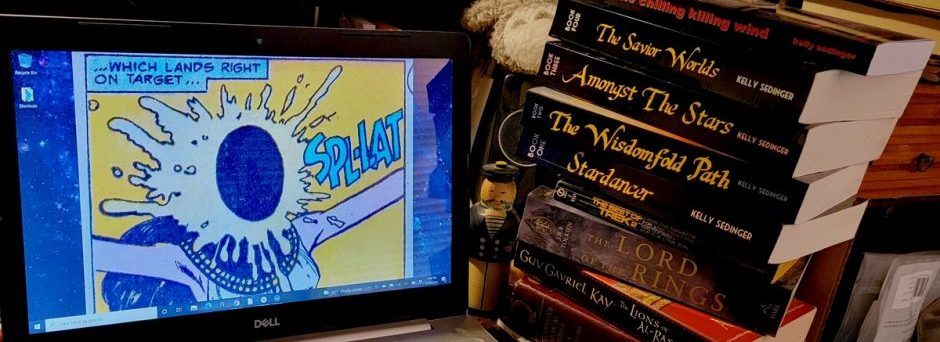
:: Living here in Buffalo, where snow is as much a fact of life as high property taxes and incompetent county government, our teevee weatherpeople tend to be fairly unexcitable when there’s big snow in the forecast. Unlike this guy from Baltimore:

:: The Abridged Atlas Shrugged. Wow, this would have saved me some time reading an awful, awful book…of course, I’d abridge it even farther:

“I’m an asshole,” John Galt said. “Come with me.”

“OMG!” Dagny squealed. “I’m an asshole too! Let’s elope!”

THE END

:: The Milky Way Transit Authority. I love this!

More next week.

Share This Post

“No sun, no moon, no stars over Al-Rassan”

UPDATE: Welcome, readers and followers of BrightWeavings! I’m in the process of re-reading all of GGK’s books leading up to the Under Heaven release. You can find earlier posts of mine on the subject of GGK here. Feel free to stick around!

When the Lion at his pleasure comes
To the watering place to drink, ah see!
See the lesser beasts of Al-Rassan
scatter, like blown leaves in autumn,
Like air-borne seedlings in the spring,
Like grey clouds that part to let the first star
Of the god shine down upon the earth.

I suppose many readers have the problem of the Favorite Author: after reading one of the Favorite Author’s books, it’s often hard to work up any enthusiasm for some book by some other author, putting those subsequent authors at a disadvantage. It’s even worse if one follows up a book by one’s Favorite Author with something by an author one has never read before; after all, what are the chances that some new fry is going to measure up to the Favorite Author?

That’s the problem I tend to have with Guy Gavriel Kay: reading him leaves me in the mood to read little else but more Guy Gavriel Kay. It’s been this way for years; I suppose I’ve bounced off more books I’ve read immediately post-Kay than anyone else. What’s the solution? Reading another favorite author, I suppose, but that can only put off the problem. Best to just keep trying books until something sticks.

And there’s the thorny sub-problem of the Favorite Author conundrum: the Favorite Book by the Favorite Author. Ah, now we’re treading on dangerous ground, because when you re-read your favorite book, that afterglow tends to stick around for quite a while, outshining the light of nearly everything else. So it is with me and The Lions of Al-Rassan. My own experience is that most fans of GGK will cite Tigana as their favorite, but not me. It’ll always be Lions.

The Lions of Al-Rassan is set in a land that has two names: Al-Rassan, as it is called by the Asharite lords who have ruled it for centuries, and Esperana, as it is called by the minor Kings in the north who dream of driving out the Asharites and uniting all of the peninsula under a single banner. The situation is basically a fantasy analog of the Iberian peninsula as Moorish rule was coming to an end, and indeed, GGK gives us our own Ferdinand and Isabella, in the persons of King Ramiro and Queen Ines of the realm of Valledo. But that’s getting ahead a bit.

I’ve noticed over my years of reading fantasy that a common theme in the best of the genre is the passing of ages and of kingdoms and of the onward march of history; even as one person’s great ambitions are being fulfilled, another is seeing a beloved kingdom pass into memory. That is the main theme of Lions, with the Asharites slowly but inevitably losing their grip on Al-Rassan, and the Jaddites slowly but inevitably bringing it under theirs. The Asharites are the “Muslims” of this world, the worshippers of the Stars of Ashar; the Jaddites are the “Christians”, worshiping the sun-god Jad. Caught in between them are the moon-worshipping Kindath, who are viewed with suspicion and derision everywhere they go. Thus the three great monotheistic faiths of our world are reflected in GGK’s fantasy world.

The book has a huge cast of characters, all of them memorable. Our attentions focus most on three: Jehane bet Ishak, a Kindath physician; Rodrigo Belmonte, a Captain of Jaddite cavalry from one of the three kingdoms of Esperana; and Ammar ibn Khairan, an Asharite poet, assassin, and mercenary warrior. I suppose that, in a sort of way, these three people form a love triangle of sorts, but calling it that reduces the very real and very complex emotional connections between three of the most memorable characters in any book I’ve ever read to the level of soap opera. GGK manages to create a very real, and ultimately heartbreaking, emotional fabric amongst these characters whose struggles alongside, and against, each other mirror the tensions of the struggles amongst three faiths dominant in a violent world.

Plot isn’t really a force in GGK’s best works; what he instead excels at is in depicting characters who are, like all of us, struggling between what we want to do and what we are allowed to do, whether by the conventions of our societies or the forces of history. Jehane, the Kindath physician, becomes beloved of Rodrigo Belmonte and his company of men, so much so that Rodrigo invites her to take up service with them. Jehane is forced to point out the troubling hatred of the Kindath evident in Esperanan society and history. All this leads to a number of deeply heartbreaking moments toward the end of the book, when Rodrigo and Ammar must finally confront the fact that they can only truly ever be adversaries. GGK’s master stroke with this book, as pertains to these two characters, is that he makes us wish for a world in which these two men can be friends, before confronting us with a world where not only can they not be, it becomes clear that they cannot even exist together.

The way Ammar ibn Khairan is allowed to show real anger on occasion, and to admit his own faults, keeps him from seeming almost too perfect of a character at times. I remember when I first read the book, I didn’t really have a good handle at all on Ammar until well over halfway through, because he is shown to be so many different things in the course of the novel. He’s one of the most celebrated poets in Al-Rassan; he’s a warrior of stunning skill; he’s an assassin, wanted dead and celebrated for heroism in the same culture at the same time; he’s a lover and a killer. Ammar’s nature is one reason the book seems to improve so markedly upon a re-read, when his nature becomes more and more clear. On this re-read, I was far more attuned to the interplay and contrast between Ammar and Rodrigo Belmonte, who is as strong and memorable a character as Ammar himself.

GGK’s gift for writing strong and three-dimensional female characters continues to shine here, as well. He gives women who strive in their own ways to better the world in which they live, even while operating within its constraints against them. Jehane is the main female character here, but there are others: wives, queens, concubines, mothers and daughters. Some are all of those.

Finally, the book’s verse ranks among the most captivating in all of GGK’s books. Poetry often plays a role in his novels, but in Lions, poetry is especially important, almost moreso than it had been in A Song for Arbonne, the book in which troubadors themselves are main characters. Here the poetry reflects the Andalusian verse of Moorish Iberia, and while there’s not a great deal of verse in the book, what there is is fascinatingly evocative. The verse is a big way that GGK is able to explore the central theme of the book, as noted above: the passing into memory of beloved things, and the difficulty in finding one’s way in a world that one no longer recognizes.

The Lions of Al-Rassan is a deeply brilliant book. And now, onto The Sarantine Mosaic. (Actually, as of this writing, I’m more than halfway through Sarantine Mosaic, which means I’m well on schedule to complete my GGK re-read before Under Heaven comes out.)

Share This Post

Laser Brain


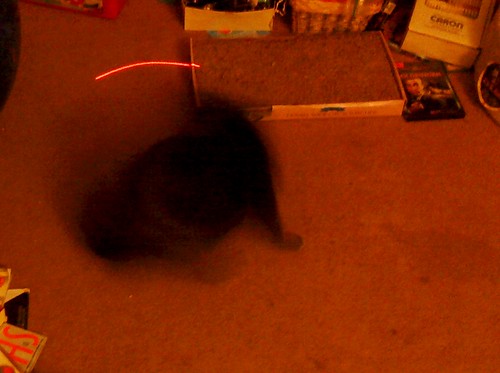
Laser Brain, originally uploaded by Jaquandor.

Here’s Lester, one of the resident cats here at Casa Jaquandor. The reason he looks all blurry is because he’s chasing a laser pointer. He just loves the laser pointer. I used to have one that I kept on a keychain, and he got to the point where he recognized the sound that particular keychain made when I picked it up, so he’d come running whenever he heard it because he knew he’d get to chase that bright red dot across the floor. Sometimes, of course, I was just picking up the keychain to get at something underneath it (I just kept it right out on my desk), so I’d look down and see Lester staring up at me, all wide-eyed.

The current laser pointer is actually embedded in a LED flashlight which has three settings: flashlight, laser pointer, and flashlight with laser pointer at the same time. Lester doesn’t yet recognize the sound of the flashlight as I pull it from my laptop bag, so I have to wave the laser around until it catches his eye.

Once I get him chasing the laser throughout the apartment, I like to get him in an open spot in the floor and then spin the laser around him, so he chases it in tight circles as though he’s chasing his tail. That’s what’s happening here. Cats plus Lasers equals FUN!

Share This Post

Poppity pop pop pop!

I love popcorn.

Love it.

Popcorn is one of my favorite foods, and I’m simply incapable of seeing a movie at the theater without popcorn. If I’ve just come from a big dinner, as part of a “dinner and a movie” type thing, I’ll still buy a small popcorn. I consumed popcorn whilst watching Schindler’s List, which is as un-popcorn a movie as has ever been made.

At home, I love popcorn a lot too. For years we’ve used microwave popcorn exclusively — usually a “light” version of a “Movie Theater Butter” flavor. Not the healthiest alternative, obviously, but we don’t indulge in popcorn all that frequently; once a week, at most. But the trouble with the microwave stuff is that it’s full of chemicals and that butter flavor is pretty fake. (Yeah, so’s the “buttery topping” they put on the stuff at the theater.)

Part of our general approach toward food in 2010 is to rely less on processed, chemical-laden food products. This, we quickly realized, could also include popcorn. So, we bought ourselves a popcorn popper.

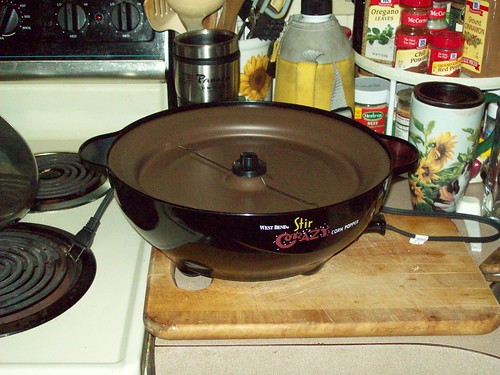
The Popcorn Popper I

It’s a StirCrazy, which we chose because that’s what we had when I was a kid. That old version worked wonders, and I realized that I missed that old, clean flavor of popcorn a great deal. The ingredients no longer include whatever chemicals and artificial flavorings go into the microwave stuff; now the ingredients are merely these: popcorn, oil, butter, and salt.

With the StirCrazy, you pour a few tablespoons of oil into the base, and then measure out your corn:

The Popcorn Popper II

Measuring is very important. Must always measure!

Then you pour that onto the hot plate as well and put the dome cover on top. The cover doubles as a serving bowl later on, but for now, it’s a cover and a butter-melter. Here it is:

The Popcorn Popper III

There’s an armature (basically a steel rod) that rotates at the bottom of the heat plate, constantly stirring the popcorn and oil. At the top of the dome cover is a well with holes in it; that’s where you put your butter. As the heat rise, it melts the butter, which then drips through the holes onto the corn. This arrangement works surprisingly well at getting butter all over the popcorn. (We use unsalted butter exclusively.)

Of course, one can attempt to help the process along by using heat vision, but success will be hard to come by:

The Popcorn Popper IV

In time the corn starts popping, slowly at first, but quickly filling up the entire dome cover:

The Popcorn Popper V

A minute later:

The Popcorn Popper VI

Once the popping slows, you unplug the popper, grab the handles, invert it, remove the hot plate, and voila! A beautiful bowl of popcorn. Salt, stir, and consume.

We’ll still keep microwave stuff around, because sometimes it’s just plain convenient to be able to nuke a bag as opposed to dragging the popper out. But generally, this stuff tastes so much better, with just good old unsalted butter, Kosher salt, and peanut oil. (I may try doing it with coconut oil sometime, just to see if coconut oil’s effect on popcorn is as pronounced as I’ve heard over the years.) The flavor was not only wonderfully clean and “unprocessed”, it took me back to my youth when we’d have a bowl of popcorn prepared just this way (using an earlier model of the same popper) during Family Teevee Night.

I can’t recommend this highly enough. If you have any love of popcorn at all, get a good popper. (And not an air popper, either. Those things result in crappy popcorn!)

Share This Post

With great power….

As part of “Instead of the Buffalo Bills Theater”, The Daughter and I watched, on three successive Sundays, the Spiderman movies. And in digging through my archives, I found my original post on Spiderman, and my original post on Spiderman 3, but I apparently never posted anything about Spiderman 2! So here, I will rectify that.

(Before I begin, I have nothing really to add to my original posts on the first and third films.)

OK, Spiderman 2. This is, simply, one of the best superhero movies I’ve ever seen. It’s almost right up there with Superman. It’s good because, like the best superhero movies, it inherently gets what its hero is all about. Now, that wasn’t a problem with Spiderman, but where the first film seemed a bit hesitant to allow its hero to really get anywhere, Spiderman 2 had no such problems.

The key to understanding Spiderman, as is the case with all great superheroes, is understanding his regular life alter-ego, Peter Parker. Superhero alter-egos often tended to be people with good and productive lives as civilians in addition to their superhero antics; the central brilliance of Spiderman has always been that about the only part of Peter Parker’s life that is not a slowly unfolding train wreck is his life as Spiderman, and even then we’re not always sure. Peter’s a guy with problems. He’s brilliant and motivated, but somehow he can’t put those two things together into a life that doesn’t involve constantly scraping the bottom of the money barrel, desperately clutching on to – and failing to keep – a job as a pizza delivery guy, failing to keep simple promises like “Sure, Mary Jane, I’ll be there at eight.” Peter Parker’s life is a total, complete mess, and it’s the kind of mess we can easily relate to – well, aside from the spider-powers and being hunted by deranged supervillains stuff.

Spiderman 2 gets all of this. Take its wonderful opening sequence, which has Peter trying to keep the afore-mentioned pizza delivery job. He has to go some clearly absurd distance in some clearly absurd amount of time – something like fifty New York City blocks in twenty minutes with eight pizzas – and he’s on his last chance. Off he goes on his motor scooter, and he’s doing pretty well for a while, until something happens that makes the scooter trip impossible. What’s a guy to do? Why, have Spiderman deliver the pizzas! Of course Peter can traverse the remaining distance in mere minutes, right?

Well…wrong. Even as he web-slings his way across town in minutes, he fails to make the delivery guarantee, the receptionist rolls her eyes and says “I’m not paying for those,” and Peter gets fired. Ouch. And of course, as everyone well-versed in the comics remembers, Peter is brilliant and yet has a hard time in school; he’s ambitious and yet can only find semi-reliable money in selling photos of himself as Spiderman to the Daily Bugle; he somehow can’t manage to get any kind of relationship going with a girl; his best friend has sworn to kill Spiderman; and to top all of that off, Peter makes the acquaintance of another in what will be a long line of brilliant scientist-types who miscalculate in an experiment that goes so awry as to turn them into supervillains. This time, it’s Otto Octavius, whose brain ends up fused with the mechanical arms he’s invented for himself, thus making himself into…Dr. Octopus!

One of the film’s masterstrokes is in how it creates its villain. Whereas in the first film Norman Osborne was something of a loon even before he went all the way around the bend as the Green Goblin, in the second film, Octavius is depicted as not just brilliant, but also warm and very likable. His fall into horrible villainy is a tragic one, even as we can somehow understand his motives after he becomes Dr. Octopus. The first two Spiderman movies really handled their villains well, which is a huge reason as to why they both worked.

So why did I like Spiderman 2 more than the first one? As I noted years ago, Spiderman bothered me not so much in the shortcuts in took in the Spiderman story but in the way it took them. Spiderman 2 commits no such errors along the way. Yes, we’re in movies, so we can’t have everything we’d want in a Spiderman movie, but the film gets all of its little touches right, along the way.

The most important detail to get right in a good Spiderman story is that things never go quite Spiderman’s way. Ever. Things go wrong for Peter Parker most of the time, and on the infrequent occasions when they actually go right, they do so in such a way that not only does it look to everyone else that Peter’s screwed up again, but he can’t even set the record straight without revealing himself as Spiderman. So we have Peter ending up late to Mary Jane’s big acting debut because he had to stop and save some random pedestrian from getting run over by a car along the way. Or, in one of the best tiny moments in the film, in the pizza delivery scene early on, Peter realizes he’s not going to make it. So he ducks into an alley and pops out seconds later as Spiderman, with the pizzas! Yay! Except some random passerby saw him go into the alley and saw Spiderman exit, so he yells out, “Hey! Spiderman stole that guy’s pizzas!” A throwaway moment that illustrates the fact that Peter can never get the credit for anything.

Spiderman 2 also works because it doesn’t commit the somewhat vexing errors with regard to Spiderman canon that the first and third films commit, primarily with respect to Gwen Stacy. Basically, there was almost nothing in Spiderman 2 to distract me from the business at hand. (Well, maybe one thing – the scene where Spidey literally unmasks himself in front of an entire crowd of people. That strained things a bit for me, but I could forgive it.)

Spiderman 3 would go on to commit a pretty impressive number of errors, even though I’ve never been as down on it as most people seemingly are. Nor have I ever been as down on Kirsten Dunst as many people seem to be, either. So basically, I wish the original creative team could come back and continue the work they started.

(BTW, in watching the three Spiderman movies again, I was more favorably impressed with Danny Elfman’s scores with the first two films than I was originally. They’re actually fairly subtle scores, but not as themeless as I had first thought. They’re still not favorite scores of mine, but they’re not bad.)

Share This Post

Star Wars Revisited

Last week I learned of the existence of a thing called Star Wars Revisited, which turns out to be a “Fan edit” — basically, some guy armed with a Mac put together his own version of Star Wars Episode IV: A New Hope. Well, OK, that’s simplifying a bit — he did quite a labor of love here, actually. Here’s a list of the changes “Adywan” made, using the Special Editions as his base film for moving forward. I was naturally interested in what this was all about, so I tracked it down, downloaded it, and gave it a viewing. I wasn’t exhaustive in watching it; I skipped forward a lot and basically watched what I felt like watching in about forty minutes. So what did I think?

Well, I’m not sure.

There’s some very cool stuff done here, make no mistake. It always surprised me that even when they did the Special Editions, Luke’s lightsaber still looked awful in the “training with the remote” scene. That’s fixed now. Other stuff that stood out? Well, Adywan added the two suns of Tatooine to the shot of the escape pod flying toward the planet. I thought that was kind of neat:

Most of the changes are small — looking at the list, in fact, many of them are things even I, who almost knows the film shot by shot at this point, wouldn’t have even thought of as errors that needed fixing. But even some of those changes are kind of cool, such as the new motion given to the ships during the Millennium Falcon‘s escape from Tatooine.

And this, the first appearance of the Death Star in the film, is pretty cool:

There’s a lot of stuff like that: new effects created by an amateur filmmaker that at this point look, for the most part, right at home alongside all the ILM stuff. There are some really nice new effects shots during the post-Death Star escape dogfight, for instance. And I’m sure most Star Wars fans will most appreciate this version of the film for two simple reasons: the Jabba scene that George Lucas “finished” and put back into the film for the Special Editions is gone again, and Greedo’s finger never touches the trigger of his blaster.

What didn’t I like? Well, for one thing, he completely resequenced the scene in Ben Kenobi’s home, where Luke first learns of the Force. Presumably this was to make the conversation flow better in terms of its topics, but…maybe it’s just that I’ve heard the original scene so many times, but it was horribly jarring. I think the original scene works fine.

There were also some things done with music that bothered me. When I was active on various film music discussion fora, it was funny to note that every time a rumor or report would show up about George Lucas tinkering with the Original Trilogy again, someone would immediately speculate as to whether Lucas would re-do the score of the original film to include the famous Imperial March that would only debut in The Empire Strikes Back. Lucas hasn’t done this, yet…but Adywan does. When we first see the Death Star, there’s the Imperial March, big as life. That bugged me — not only am I used to the film not having the Imperial March in it, but it also removes a key leitmotif from the ANH score at the moment when it needs to be heard the most. Didn’t like that. I also didn’t care for tracking in “Battle of the Heroes”, the dueling music from Revenge of the Sith, into the fight between Obi Wan and Vader. That just didn’t work either for me. Neither did some replacement of music during the Death Star battle.

What did work musically was a restoration of sorts. As the Battle of Yavin starts up, Red Leader says something like “Cut across the axis and try to draw their fire” as the ships engage in battle. At that moment, the score surges into a blazing rendition of the Force Theme in the trumpets. It’s as musically thrilling a moment as there is anywhere in all of Star Wars — but it was dialed down, and the ship engine sounds dialed way up, for the DVD releases of the films back in 2004. Adywan has fixed that, which makes me happy.

And for one last tantalizing thing: he’s re-done the destruction of the Death Star itself. Now, I kind of liked the Special Edition “Praxis Wave” when the Death Star exploded, but it’s gone. What’s really nice here is that Adywan has the Death Star exploding just as it’s firing its superlaser at the Forth Moon:

That’s a nice touch, there.

Of course, the existence of such a film raises the obvious question: how “definitive” is it? Nothing happens in it that changes any kind of Star Wars canon one iota, so is it a matter of viewer taste? Are we entering an era in which there will be more and more versions of films out there? Are we to pick and choose our personal Star Wars?

Share This Post

Lowering the bar a bit, are we?

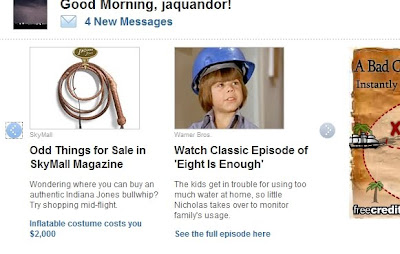
Here’s part of the AOL welcome screen that greeted me this morning:

Eight is Enough. “Classic” episode.

Sometimes the world scares me. Eight is Enough? Classic episode?! Are we now defining “classic” teevee as “that which was originally televised more than thirty years ago”? Because, if we are, the whole notion of shark-jumping is in for some unfortunate revision….

Share This Post