
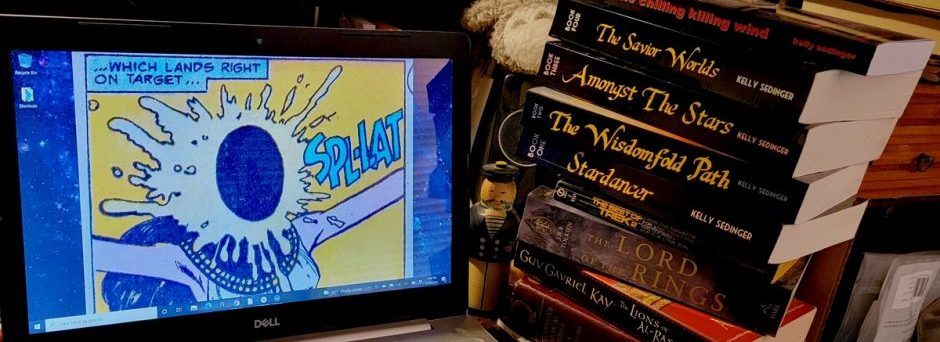
January Reading (From the Books)

I’m going to try, in 2022, to write a monthly recap of the books (and other things) I read each month. I had a good reading month and am well on my way to meeting my annual goal of 52 books! I track this on Goodreads, and I feel no qualms in including graphic novels in my reading; a good graphic novel is its own challenge and reward because the art demands attention as much as the words. I will also admit that I’m trying to get ahead of my Goodreads challenge a bit because I have some long “doorstop” kinds of books that I’d like to read this year, and those can really get time-consuming. (We’re talking Brandon Sanderson-sized epic fantasies and space operas later this year.)

So here’s what I read in January (or, a few items I started in December but only finished in January):

::  The God Equation: The Quest for a Theory of Everything, Michio Kaku. I’ve become a big fan of Kaku’s science writing over the last few years. As a science fiction writer (even one who tends to play at the George Lucas end of the pool, rather than the Arthur C. Clarke end), I feel it important to read some science every year, and Kaku’s work always keeps the “sensawunda” flowing. He writes big-scale, wide-eyed books about the Really Big Questions, and this one is no exception. If you want the kind of optimistic science writing that gives you the kind of feeling you might have had as a kid when you emerged wide-eyed from the planetarium show, Michio Kaku is your writer. (I confess that at times in his books I really can’t quite understand the more esoteric details of the things he writes about.)

::  Salt, Fat, Acid, Heat: Mastering the Elements of Good Cooking, by Samin Nosrat. This is the best kind of cookbook. Only about half of it is an actual collection of recipes; the rest is like a textbook in Cooking 101, in which Nosrat writes extensively about the how and why these four facets of cooking work the way they do to make food taste good. Reading this gave me much greater appreciation and insight into how to salt my food, why and when to add acid, what I can do with fat to enhance flavor, and the ways heat, applied in different ways, impacts flavor.

The book is richly illustrated, and it has fold-out charts that show how various ethnic cuisines around the world approach each individual element of cooking. Nosrat writes wonderfully, with a strong personal element in which she brings her personal experiences from working in the food world to bear. If you cook, you should check this book out.

::  For Small Creatures Such As We: Rituals for Finding Meaning in Our Unlikely World, by Sasha Sagan. Sagan is the daughter of Carl Sagan, who is one of my all-time heroes for many reasons: his scientific curiosity, his unyielding skepticism which was also bonded tightly to his unending ability to find wonder in what really is. Maybe some people were disappointed to learn that the surface of Mars is not segmented by great canals whisking water around the planet, but is instead rocky and thus far barren of liquid water and life; not Carl Sagan, who found the fact of the Martian surface even more wondrous than the dreamed-up version from the Edgar Rice Burroughs novels he read as a kid.

One common objection to atheism, especially the rigorously empirical version of atheism as endorsed by Carl Sagan, is the idea that absent any kind of spiritual force, our lives are directionless and meaningless. This is false for any number of reasons, but Sasha Sagan answers that objection in this book, and more than that, she endorses the embracing of rituals in our lives, even the ones that have religious origins, as a way of giving our lives meaning, direction, and purpose. Sasha Sagan is every bit as skeptical as her parents (her mother is Carl Sagan’s former wife, scientist and writer Ann Druyan) were as far as religion and spirituality go, but she writes refreshingly that skepticism need not mean a life devoid of ritual and the comfort that ritual provides.

Ms. Sagan writes with a lyricism that at times echoes Carl Sagan so strongly that it does feel, occasionally, like he is writing from “the beyond”. Of course, he isn’t…but his influence lives on, which is one of the points Ms. Sagan makes here.

A few quotes:

We all deserve holidays, celebrations, and traditions. We all need to mark time. We all need community. We all need to bid hello and goodbye to our loved ones. I do not believe that my lack of faith makes me immune to the desire to be part of the rhythm of life on this planet.

An old tradition is not intrinsically better than a new one. Especially when it is such a joy to make new ones up—ones that reflect exactly what you believe, ones that make sense of your life as you experience it, ones that bring the world a little closer to the way you wish it could be.

Gifts were exchanged, but the biggest gift was the idea that celebrations could be invented, that we could choose to honor what was most meaningful to us, that and the knowledge that spring was finally here.

On the scale of our human history, rituals like putting up Christmas trees, lighting menorahs, reading Hafiz, and baking rice dumplings are new. We humans have celebrated the earthly repercussions of our orbit longer than we’ve celebrated virtually anything. Before Christmas and Hanukkah, before monotheism or any other kind of theism, our ancestors were staring up at the stars, trying to gather clues about the changing of the seasons, the passing of time, and what the darkness might bring. The idea of marking the longest, coldest night with the knowledge that the warmth and light is not too far off, that is ancient. And no matter where we’re from, what religion we are, or to what ethnic group we belong, we can be sure that our ancestors, all of our ancestors, contemplated Earth’s place in the universe with awe. For them, it was sacred. And it still can be for us. Even more so because science has brought us a deeper understanding of the mystery and beauty of nature than our ancestors could have ever dreamed.

Sasha Sagan is not a scientist by trade, but she shows how you don’t have to be a scientist by trade to allow science and the rational approach to life govern you and guide you toward meaning that isn’t based on superstition or religion.

::  Eve’s Hollywood, by Eve Babitz. I read this on the strength of Sheila O’Malley’s paean to Babitz on the occasion of her passing last year. I really had no idea what I was getting into with this book, but after reading this by Sheila:

Let’s hear it for the outlaws of this world, particularly women outlaws. Let’s hear it for the swashbuckling romantics, the adventuresses dancing outside the perimeter of the picket fence, unprotected but free. Eve Babitz was their patron saint.

had to read something by Babitz.

I started this book, actually, on the plane to Hawaii, the last leg of that journey, which stared from LAX, so I think it fitting that I started Babitz’s memoir about growing up in LA while I was however-so-briefly in LA. My first hint that I was in for something very different was the dedication. There isn’t just one. Or two. Or three. Babitz dedicates her book to a cast of hundreds, in a dedication section that spans pages. Here is just one of her dedications:

And to the word, brouhaha.

Wow.

I wouldn’t dream of trying to sum up what Babitz writes about here. All of it is personal remembrance of a woman whose parents were friends with Igor Stravinsky, among others. (That’s the part that kept catching my eye. My entire life, Stravinsky is a genius composer who helped classical music kick Romanticism to the curb and embrace Modernism, the composer whose ballet The Rite of Spring cause a riot when it was premiered, but for Eve Babitz, he was a guy whom Dad knew and who showed up at parties.) Babitz’s Los Angeles isn’t a glitzy Beverly Hills experience, but it’s not the gritty place of Jake Gittes, either. It’s an interesting combination of the two, along with other incarnations of the same place. I’ve certainly never had the sense of LA that this book gives me. As the introduction (by Holly Brubach) states:

With a father who was a baroque musicologist and violinist under contract to Twentieth Century-Fox, a mother who was an artist, and a godfather who was Igor Stravinsky, Babitz grew up surrounded by a circle of illustrious family friends that included Edward James, Joseph Szigeti, Eugene Berman, Marilyn Horne, Kenneth Rexroth, and Kenneth Patchett, with poetry readings in the living room and premieres of works by Arnold Schoenberg under the palms.

A few quotes:

Studio musicians and musicians in general, men who have grown up practicing minute things their whole lives, are special. The general rules accepted by the players are that violin players are all lovers of women to an extravagant extent, oboe players are crazy and French horn players are sexy. Everyone else is square as square can be as far as I’m concerned, and if you go to an L.A. Philharmonic rehearsal you’ll see a bunch of accountants sitting around in plaid shirts and you’ll realize that musicians are the most innocent benders to Art there are. Imagine binding yourself into the confines of an orchestra, under the stick of a conductor, having to play what someone has written 200 years ago!

Stravinsky himself was Stravinsky. He was tiny and happy and brilliant and drank. He used to slip glasses of scotch to me underneath the coffee table when my mother wasn’t looking when I was 13. At my 16th birthday party, I wore white (very low necked white, of course) and he slipped rose petals down my top when my mother wasn’t looking.

Of course, gym teachers being what they are, they couldn’t just let us alone, they had to tell us what to do so they used to have “dance contests” with processes of elimination and envy and all that other stuff they have. The idea was to applaud who you thought was best—judgment by your peers, it’s called—and the ones who got the loudest applause won. Only the gym teachers decided which applause was loudest and it was never for the Pachuco couple no matter how obvious it was. Because how could kids who weren’t white and who’d been sent to Le Conte because they’d been expelled from other schools win? So the runner-up always won.

We were hot, the sea was one long wave to be ridden in, our skins were dark, and time even stopped now and then and let things shimmer since time, too, is affected by beauty and will stop sometimes for a moment. We didn’t know, as kids in other schools seemed to, what we were supposed to be, but we knew that somehow we were being taught something about life and that it couldn’t get much better. And when the sun began to set and we’d gather our things and walk silently back to the cars, we only wondered how the waves would be tomorrow in baked, half-conscious curiosity.

I remember reading something George Carlin wrote once, in which he talked about how much he loved and adored the New York City of his home; he closed by saying something like, “So why do I live in Los Angeles, then? Because the sun sets across the street from my house!” That’s the kind of sense I get of LA from Eve Babitz, only she’s kicking over rocks to see what’s underneath, and honestly, what’s underneath those rocks is utterly fascinating. I loved this book and I savored reading it.

::  The 13 Clocks, by James Thurber. I’m an old fan of Thurber’s, though I confess I’ve not read him in a very long time. I found this hardcover…someplace. I don’t honestly recall where: maybe a used bookstore in Ithaca, maybe one of the library book sales, I’m not sure. The story is a fantasy fable about a Princess whose father is an evil wicked Duke who promises her hand to the Prince who can complete the impossible quest set by the Duke. The book abounds with Thurber’s wordplay, so much so that it reads like a prose poem or actual formal verse, complete with rhyme schemes, set in type to look like verse. It’s frankly a delightful read, and it might be a good gateway for younger readers to Thurber’s kind of urbane wit that bites a little bit harder than you realize. I loved it.

If you can find a copy with the illustrations, please do so. The text is available in the Library of America’s Thurber volume, but without the illustrations, alas. (Thurber was also an artist who famously illustrated his own works, but apparently by the time he wrote this his eyesight had deteriorated too far for him to be able to do it himself.) Here’s an example of the illustration (by Marc Simont) in The 13 Clocks:

::  The Starship and the Canoe, by Kenneth Brower. Billed on the cover as “In the spirit of Zen and the Art of Motorcycle Maintenance, this is an exploration of the lives of two men, astrophysicist Freeman Dyson and his son, George. The elder Dyson is transfixed by the idea of the Orion Project, a proposal from the 70s for an interplanetary (or even interstellar) spacecraft that would use nuclear bomb detonations for propulsion. Basically the ship would have a very large shielding plate on its back end, and every once in a while a nuclear bomb would be chucked behind the ship to explode, giving the ship a kick forward. There’s something about that idea that sounds a bit absurd, but it would actually work and was seriously studied (Carl Sagan himself noted its potential in Cosmos) before international treaties banned the detonation of nuclear bombs in space.

Orion is the “Starship” of the title; the “Canoe” is a project of George Dyson’s. The Younger Dyson lives in the Pacific Northwest, as something of a quasi-hermit who builds a treehouse and uses paddle-boats (canoes, kayaks) to get around the hundreds of islands and island communities off the coasts of Alaska and British Columbia. As Brower gets to know him, Dyson the Younger is building a large sea-canoe that will accommodate six adults; Brower follows Dyson on various journeys up and down that coast as he meets people and acquires raw materials for his project.

The Dysons were somewhat estranged for many years, while Brower traces their lives in parallel, highlighting the ways their respective journeys mirror each other even while seeming wildly divergent. I found myself enjoying the chapters focusing on George more, mainly because of Brower’s nature writing, but Brower also does a good job of highlighting the ways these two men are very much alike.

There is very much a kind of 1970s “Search for oneself” vibe here, the kind of thing that makes me think of John Denver songs (not disparagingly, either, I love John Denver), but nevertheless, I was surprised at how much I liked this one.

Not a day passed without whales. The sound of their blowing was always around us, like the respiration of gods. We were trespassing, but with indulgence, I felt. We were like small boys who have sneaked into Neptune’s room and hear him breathing in his sleep.

::  The Sea of Trolls, by Nancy Farmer. I read this aloud to The Daughter years ago, and I remember enjoying it greatly. In fact, it might be the last book I ever read aloud to her, before she declared that she wanted to read herself at night–a wish I granted, though it made me sad to do so!–and we never finished reading the trilogy of which this is Book One. I found all three books on the Used Books section at Savers a while back (I always find something of value in the Used Books at Savers!), so I snapped up all three, and I’m reading the entire trilogy this year. It’s a Young Adult fantasy about a boy named Jack in Dark Ages Britain, who is learning from the local mystic when the Vikings come raiding. Jack and his little sister Lucy are abducted by the Vikings and proceed to have adventures and quests.

The Sea of Trolls is an exciting book, full of violence and magic and ghastly creatures and evil Queens and trolls and magic wells and enemies who become allies and allies who become enemies. It’s a complex tale full of memorable characters, and Farmer doesn’t sugarcoat things while also maintaining a sense of youthful fun. It reads like a more violent, slightly-more-adult Lloyd Alexander novel. I’m looking forward to the next two books.

::  Sergei Rachmaninov: An Essential Guide to His Life and Works, by Julian Haylock. I read this as part of my perparation for this coming April, during which I plan to do a bit of a “deep dive” into the music of Rachmaninov. This book is a short (under 100 pages) bio of the composer, well written but obviously not terribly deep. It’s a good starting point for exploring Rachmaninov’s life and world. (The book carries a label reading “Classic FM Lifelines”, so I assume there’s a whole series of these for various classical composers, to fill the need for bios longer than a single chapter in, say, The Lives of the Great Composers but shorter than long-form biographies.)

::  Firefly graphic novels: Watch How I Soar and The Unification War, vols 1 and 2. I love and adore the Firefly universe, and I’ve long had the sense that if further teevee or film tales from that universe are not forthcoming (and at this point, short of a straight reboot, the moment has probably passed), comics were the ideal medium for further storytelling in The ‘Verse. And lo, that’s exactly what’s happened! After some fits-and-starts, there has been a steady stream of Firefly comics tales over the last couple of years, which I’ve started exploring.

Watch How I Soar is a story, or rather a collection of vignettes, involving our beloved pilot Hoban Washburn (or “Wash”), as his life flashes before his eyes in the moments before…what happens to him toward the end of the movie Serenity takes place. This one might not be rewarding for anyone who isn’t already a fan of this universe.

The Unification War is the kind of tale Firefly did best: a story in which our heroes, who are just trying to keep on flying in the present, find their past deeds still coming back to haunt them. The story alternates between the present day and flashbacks to the “Unification War”, the big conflict that took place a decade or so before our “present day” in which the overbearing Alliance secured victory over the freedom-loving “Browncoats”. (I admit that as much as I love Firefly and its universe and characters, sometimes the whole thing feels like Star Trek for libertarians.)

Part of the delight of The Unification War is in the way the story keeps getting more and more complicated as things progress. Writer Greg Pak splits the crew up, sending each person into various perils that spin more and more out of control, until…well, there’s my problem. I thought that The Unification War was a two-part story. Turns out…it’s three. And I don’t have the third volume yet.

Sigh.

::  Alice in Sunderland by Bryan Talbot. I can barely describe this book. It’s billed on the cover as “An Entertainment”, and it certainly is that: a lone reveler wanders into a seemingly abandoned theater, whereupon he is present with a one-man show that incorporates a literary history of Alice in Wonderland, a biography of Lewis Carroll, a travelogue of Sunderland (a city in the UK), a meditation on stories and storytelling, and an exploration of history and meaning and the intersection of art and life. Alice in Sunderland is a staggering work where you never have any idea what’s around the next page turn: a tale about the ghosts that haunt old theaters? a tour of a tavern that’s a couple hundred years old? the life tale of an industrial robber-baron whose fingerprints are still on the landscape of this old city? a comics creator’s ruminations on the famous illustrations of John Tenniel? Who knows!

Talbot writes an immersive and dizzying work here, and the art–comprising traditional comics art, photographic collage, and other styles–is first-rate. I hold Alice in Sunderland as a masterpiece of the graphic novel form and a stunning example of the very best possibilities of the format.

Here is one spread from the book:

(Go here to embiggen.)

That’s all for January for me. What have you been reading?


Share This Post

C-c-cold

We’ve been in something of a Deep Freeze here in the 716 of late, with several days in the last couple of weeks bottoming out near zero, a similar number of days never getting much above ten degrees, and (I think) zero days in which we’ve gone above freezing. We’ve also had a good walloping of snow since January, as if to make up for a very mild December. That’s supposed to end this week with a brief warmup (we actually go into the 40s on Tuesday and Wednesday, so we’ll be able to melt some of this off before the next round possibly hits on Thursday or so), but…wow, it’s been cold.

Our house has a couple front-facing windows where we raise the blinds during the day and put them back down at night. Rosa (one of the two cats we adopted last year) loves looking out these windows, and she comes running each and every morning at blind-raising time. In warmer months she gets to sit on the window sill of the open window and watch the world go by, but in colder months she has to content herself with sitting atop the litter box’s roof and peering through the window.

The problem is that when we put the blinds down, moisture gets trapped there, where it condenses and eventually freezes. The result is that Rosa’s morning view looks like…this.

It’s hard being a cat, is all I’m saying.


Share This Post

My current reaction to a certain news item

There’s a thing that might be happening today, or it might not, and absent confirmation by the person who can confirm whether the hoped-for thing is in fact happening today, I will keep my reaction noncommittal. Moreover, everyone acting as if the thing that might be happening today actually is happening today would do well to listen to the wisdom of Mr. Toby Ziegler in this West Wing clip.

Or, failing that, Professor Jones’s wisdom from this scene in Indiana Jones and the Last Crusade:

INDY: Well? We made it!

PROFESSOR JONES: When we’re airborne, with Germany behind us, then I’ll share that sentiment.

Indeed.

Confirmation. I need it!


Share This Post

“Oh, so THAT’s what happens!” (A writing update)

“Good writers borrow from other writers. Great writers steal from them outright.”

–Sam Seaborn, “Twenty Hours In America (part two)”, THE WEST WING

I don’t know if I’m a great writer, but if that’s one of the qualities they need I’m well on my way, because I steal left and right from my betters and I don’t feel the slightest ethical qualm in doing so. The latest? I’m swiping an event and repurposing it from one of my most foundational fantasy texts. No, I’m not going to spell it out, because it’s a spoiler, and I’m just setting up in Book Five something that’s going to pay out in Book Nine.

I haven’t done an update on my fiction writing lately, so here’s just such a thing! It’s…going. It’s not going super well, but it’s not going badly, either. Sometimes progress comes in bug chunks of yardage; other times it comes just by moving forward a few inches.

I started drafting Book Five of The Song of Forgotten Stars in January of 2021. My goal (which I knew was unlikely) was to finish drafting it before we left for Hawaii. That was more than eleven months away at the time, and I’ve never finished a Forgotten Stars novel in anything less than a year, so I knew that was a stretch goal. But I got more than halfway there, so…yay! But I did bog down, unfortunately.

This happens pretty much every time, probably because of the spit-and-chewing-gum seat-of-my-pants method of writing. I’m not a plotter by nature. I have done the plot thing before, where I put together an extensive outline for the entire story before I draft…but what inevitably happens is that better story choices occur to me while drafting, so out the window the outline goes. My logic is thus to just cut out that middle-man and start drafting with little more than knowing who my characters are.

However, this usually gets me to a place where I have a complex situation set up but I don’t know how it ends, or I do know how my complex situation ends but I don’t know how to get there from here, i.e., where I am at the particular point in the story. These moments are the toughest for me, and they can trip me up for long periods at a time. I don’t really worry about this too much, because I know that all I need to do is think it through, slowly, until I realize either where I’m going or how to get there.

Now I’m in the process of figuring out the connective tissue between the spot I’m in with this book now and the ending.

In such moments, out comes the pen and paper.

Maybe it’s strange, but I find that I don’t like drafting in longhand…for fiction. But writing outlines and story notes? And drafting essays for this blog? That, I love doing in longhand! I find that the tactile difference in the process kicks my brain a bit, and the story starts to unknot itself. That’s what’s happening now.

Another issue with this particular book is that the structure is complex, so everything has to line up. Like George RR Martin’s Song of Ice and Fire books, each chapter in the Forgotten Stars books is from a different character’s point of view*, though unlike Martin I am very religious about limiting the number of characters who get POV chapters. (It’s only three, though the Interludes are a different animal entirely.) What does this mean for me? It means that I’m telling multiple stories in the same book, stories that are parallel and intersect each other, but which are also independent as well.

All of this requires some mental juggling, which is again where pen and paper come into play. As of now, I am still plotting out the last act of the entire book. I hope to return to drafting by the end of next week, and then…maybe by Memorial Day for completing drafting? That would be nice, because I still need to get The Jaws of Cerberus ready for publication, and then I really need to take a look at the long-completed first draft of the sequel to The Chilling Killing Wind.

And then, in 2023 (or sooner!), I start writing Forgotten Stars 6.

Whew.

These are the times that I do sympathize a little with Prince Humperdinck, evil cad though he may have been!

*Though the series did not start out this way! All of Stardancer is from Tariana’s POV; The Wisdomfold Path adds Margeth’s, and then with Amongst the Stars we get Penda Rasharri’s POV. The structure got even more complex in The Savior Worlds with the addition of a parallel story that’s told in a prelude, two interludes, and the postlude…but now I’ve settled on the structure that will see this story to its ultimate conclusion.

Share This Post

Something for Thursday (Mozart’s 256th edition)

This scene from the great film Amadeus might be the best simple explanation of Mozart’s astonishing genius I’ve seen yet. In the film, there is an opening for a lucrative job for which Mozart would be ideally suited, but Mozart is a master of both spending calamitous amounts of money and burning his bridges with people he needs to impress (and usually not even realizing he’s burning those bridges). His wife, Constanze, decides to appeal directly to Emperor Joseph’s Court Composer, Antonio Salieri, for help. She doesn’t know that Salieri already loathes Mozart, despite being in utter awe of his talent. In fact, Salieri loathes Mozart because of the degree of Mozart’s talent: he sees Mozart as a profane, disgusting creature of a man, and yet it’s this profane, disgusting creature of a man that God has apparently chosen as the vehicle for a transcendent level of talent.

For this job, composers are required to submit examples of their work, and Mozart feels that his talent is so obvious that he shouldn’t have to jump through this particular hoop. So Constanze goes behind his back, and this unfolds:

I should point out that as wonderful a movie as Amadeus is, as brilliantly made and acted and shot and musically performed by Neville Marriner and his Academy of St Martin in the Fields crew, and as amazingly complex it is in its depiction of the relationship between two artists who are on different planets as far as their skill is concerned, Amadeus should not be watched as any kind of historical document. Salieri was not a mediocrity who schemed to steal Mozart’s own work as his own and who engineered Mozart’s self-destructive personality until the man went to an early grave. Nor did Salieri himself live a life of a frustrated loner who eventually went insane after decades of watching his own work be neglected. Antonio Salieri was a deeply respected musician who taught Beethoven, and by all evidence he and Mozart were friendly rivals, and that’s it.

But for this one scene, the film gets Mozart entirely right: he really was the staggering genius from whom music poured over the course of 35 short years, music that astonishes to this day with its degree of classical perfection. It’s tempting to think of Mozart’s youthful demise and think, “If only he’d lived on!” How tantalizing that is, to imagine what a Mozart who lived to see the rise of Beethoven and the end of Classicism and the dawn of Romanticism might have produced. Had Mozart lived to the same age as Haydn, 77 years, he would have lived to 1833: long enough to hear all of Beethoven’s symphonies, all of Schubert’s work, all of Weber’s, and perhaps he would even have heard the youthful works of a deeply odd composer from Paris, one H. Berlioz.

Historical counterfactuals are only interesting as thought experiments, though, and we have to ultimately console ourselves with what actually exists–and in Mozart’s case, there is nothing tragic at all about his final silencing in 1791. There are many composers whose early deaths truly did rob us of a voice that might otherwise have gone on to produce work of towering greatness, so amazing is the work of their unfulfilled youth (and you can tune in next Tuesday in this space for a citation of one such composer), but Wolfgang Amadeus Mozart is not one of them. I’m thankful that Mozart was here at all. Mozart’s music is one of the exhibits I would advance for the defense if humanity was ever put on trial and ordered to defend the value of its existence.

Here is one of my very favorite of Mozart’s works, the Sinfonia concertante for violin, viola, and chamber orchestra, K. 364. A “sinfonia concertante” is somewhere in between a symphony and a concerto, being a work featuring a soloist (or, in this case, two soloists) with orchestra, but the emphasis is more on collective music-making than in virtuoso display. As a specific form, the sinfonia concertante is mostly limited to the Classical era; Romantic composers would write “double” or “triple” concertos, depending on what their soloist needs were. The idea of reducing the focus on virtuosity and more on musical partnership between soloist and orchestra would live on, though, in works like Berlioz’s second symphony Harold in Italy, and eventually in a number of tone poems that featured soloists as “commenters” on the orchestral proceedings.

I love this work dearly…as I do Mozart. Long may he be heard and remembered!

Share This Post

Two Doggos and a Cat

For lack of anything else to post today, here is Cane awaiting his breakfast:

He’s lived with us almost seven-and-a-half years and he still goes utterly apeshit for the same dinner he’s had every one of those nights.

Here’s a diptych of Carla sleeping:

So sweet! And she now gravitates to the yellow blanket, which means my plan is succeeding!
Note how she’s holding my hand with both paws.

Here’s Rosa, in a box:

It’s hard to tell, but I think this is the smallest box Amazon uses. Anything smaller goes in a padded envelope. Rosa isn’t huge, but she can compact herself down a lot!

And finally, here’s Remy being a dick to Rosa because she’s on the heat vent and he wants it:

I’m not gonna lie: Remy can be a big jerk.

So goes animal life in my household!


Share This Post

Tone Poem Tuesday

Every year when I watch the New Year’s From Vienna concert, there are pieces that are new to me. This makes sense! That concert draws from a big body of music, much of which is not heard much these days at all, but which was all once very popular. Once in a while, though, one of those new-to-me pieces lodges in my mind and I have to dig a bit farther into it.

The New Year’s From Vienna concerts focus mostly on the music of the Strauss family, presenting waltzes, galops, polkas, and other dance music from the height of Habsburg Vienna. Sometimes they do feature music by composers who were not Strauss family members: my boy Franz von Suppe is a common one, for example. And this year there was a waltz by Carl Michael Ziehrer, which is my focus today.

Ziehrer, it turns out, was a big name in 19th century Vienna–one of the bigger names outside of the Strauss family, actually. He was a rival of the Strauss family, developing a strong name for himself as a composer and bandleader. Sadly, his musical legacy, like many others, was doomed by the fall of the Habsburgs after World War I. Ziehrer’s work was forgotten and his earlier success disappeared entirely, and it was as a poor man that he died in 1922.

How nice, then, to see this work, a waltz of his, featured in a concert devoted to the Strauss family, but also to the larger heritage of the light dance music of 19th century Vienna, in the centenary of his death.

This waltz is called Nachtschwaermer, which apparently translates to Night Owl or The Night Revelers. I suppose it is therefore a depiction of the people who stay out until the darkest hours, trying to eke out one more drink, one more kiss, one more dance, before the lights go out. It opens with a trumpet fanfare, perhaps signaling the end of the day’s official business, and then a series of typically Viennese melodies spins out, including the orchestra singing as if engaged in a final folk tune and then whistling. It’s easy to listen to this and picture revelers, cavorting a bit drunkenly, staggering with good cheer through cobblestoned streets lit by torches as they sing the tunes they remember from the Viennese woods and hills.

Here is Nachtschwaermer, by Carl Michael Ziehrer, as performed just a few weeks ago by the Vienna Philharmonic Orchestra under the baton of Daniel Barenboim.

https://www.youtube.com/watch?v=rg8MPokT0aU

Share This Post

The problem with the playoffs is only one team gets a happy ending.

I haven’t written about football in this space (well, not this space, but you know what I mean) in years. I stopped watching football regularly more than ten years ago, and now I only watch if I happen to be someplace where it’s already on someone else’s teevee. But one would have to live under a rock to not know that a recent renaissance has taken place for the Buffalo Bills, after a long seventeen-year-long stretch of never making the playoffs and often being downright bad.

I’m not going to do a deep dive of any sort into yesterday’s playoff loss, a 42-36 defeat by the Kansas City Chiefs. You can find that sort of thing elsewhere–especially analyses of the self-inflicted wounds that were the special teams and defensive playcalling in the last 13 seconds of regulation time, when the Bills–owning a three point lead and just that long away from advancing–instead gave up a field goal to force overtime, and then a touchdown in OT to lose. What a sequence.

(I did not watch the game, by the way. I follow games online at times, seeing social media reactions and checking the box score in-progress. Why not? Sports got along just fine with most fans not seeing the games on teevee for decades.)

I will note, though, that the NFL’s overtime rules continue to be absolutely insane. It is inexplicable that they continue with overtime that makes it possible for a team to win while the losing team never so much as touches the ball. This defies all reasoning, and no other sport does it that way. Basketball and hockey have extra periods, and baseball just tacks on additional innings as needed, so the home team always gets one last at bat. Not so the NFL, which has decided that if the first team with the ball scores a touchdown, the game ends. But the game does not end if the first team only scores a field goal. This ridiculous kludge of a rule was what the NFL did after another notorious playoff game, one involving the San Diego Chargers and the Indianapolis Colts, if I recall correctly. The Chargers got the ball and won immediately on a field goal, while Peyton Manning, then one of the game’s biggest stars, watched in sullen silence before heading for the locker room.

The same thing happened last night: Buffalo’s Josh Allen, one of the games brightest stars these days, never got a chance. You can’t tell me that the NFL wants it this way. There’s a reason they scheduled Bills-Chiefs as the late game on Sunday of Divisional Playoff Weekend: because that’s the game most people would want to see. And yet, it ended in a lame coronation because of the league’s stupid overtime rule.

The way to fix this is, for me, fairly obvious: add ten minute periods as needed, and just keep playing until time expires and there’s a winner. I’d keep play moving by awarding no timeouts to either team, and I would eliminate the coin toss by simply positing that the visiting team gets the ball first. (Oh, and I’d also eliminate the opening coin toss as well. In baseball, the home team always bats in the bottom of the inning, and I’d do likewise in football: the visiting team receives the opening kickoff in the 1st, and the home team receives in the 3rd.)

A game’s stars need to play. The NFL’s current system allows for a possibility of the game’s stars being spectators to their own defeats. This is just absurd.

Also, on Josh Allen: my God, can you imagine having a quarterback put up the postseason that guy did, and still falling short? It’s astonishing, and it reminds me of a scene from Star Trek:

What’s happening here is that the Enterprise is participating in some simulated war games, pitting Picard against Commander Riker. But as they get underway, Data has just lost a strategy game like chess to some guy, leading him to conclude that he must be malfunctioning. Picard finally has to go tell him that no, he’s not malfunctioning, he just got beat.

Anyway.

That’s about all I have to say about last night’s game. It’s time for the offseason. The draft is in three months. Training camp’s in six. Better luck next year, Bills.


Share This Post

Bridges

There are songs that come free from the blue-eyed grass, from the dust of a thousand country roads. This is one of them.

The Bridges of Madison County, Robert James Waller

In a real way, an era of my life can be defined by novels I read with the word “Bridge” in the title.

This period started in the back half of my senior year of high school, when I read Richard Bach’s The Bridge Across Forever, a book (and author) with which I have a long and mildly complicated history:

But back to that afternoon in the bookstore: the last Bach title on that shelf was The Bridge Across Forever: a lovestory. Like One, its back cover copy consisted of a single, brief item:

If you’ve ever felt alone in a world of strangers, missing someone you’ve never met, you’ll find a message from your love in The Bridge Across Forever.

As a Romantic at heart, that single blurb caught me. I bought the book and proceeded to read it pretty quickly. Without getting into too many details, my love life in high school was non-existent; I didn’t go on my first date until about a month before I graduated, and I didn’t have what I could by any reasonable definition a “girlfriend” until I was in college. (I always suspected my general high levels of geekiness and my general low levels of good looks as being prime causes of this, but I digress.) There was something about that bit on the back cover of that book that really captivated me: Missing someone you’ve never met.

As I recall, I read The Bridge Across Forever over the course of a week or so.

The Bridge Across Forever started an almost literary obsession during which I read everything Richard Bach wrote over the next year or two, and I ranked him among my very favorite authors for a while afterward. There is something to be said about hitting particular authors when you are most susceptible to their own unique magic, and maybe it’s a bit judgmental of me, but I do think you can tell something about a person by which author hits them between the eyes in those formative years between, say, 17 and 19 years of age. A person who gravitated to Richard Bach–weird mysticism and refusal to deal honestly with the details of his life aside–is more likely to be a person I can groove with than someone who discovered Ayn Rand at that same time.

Bach lasted for me through college, though my fascination with him did start to wane a bit as other fascinations came to the fore. (During summer between my freshman and sophomore years, I found an old copy of John Steinbeck’s The Acts of King Arthur and His Noble Knights in the basement that had belonged to my sister, and that single book launched me into a fascination with Arthurian legend that has also blown hot-and-cold, but never died, to this day.) But then in 1992–either toward the end of my junior year or at the beginning of my senior year, I don’t recall exactly–a new book with “Bridge” in the title hit the world. The author was a guy who actually lived and taught at another college, the University of Northern Iowa, just twenty miles away from my own school. His name was Robert James Waller, and the book was called The Bridges of Madison County.

This book was a colossus at the time, a hugely successful nationwide bestseller that catapulted Mr. Waller to enormous fame, giving his next few books instant best-seller status that eventually faded. Bridges was even bigger, though, in Iowa, for obvious reasons: a hometown writer hit it big with a story set in the backwaters of Iowa, a state no one ever thinks of as “exotic”, with a story of passion and forbidden love. A nature photographer comes to small-town Iowa to take pictures of some covered bridges for National Geographic, and while there he meets a farm wife whose husband and kids are off at a state fair someplace. In the space of about 48 hours, they have an affair and decide that they are the love of each others’ lives…and then, because she cannot bring herself to leave her family, their relationship ends and they never see each other again.

This story was huge in 1992, and as all such things do, it led to a movie, starring Clint Eastwood as our photographer and Meryl Streep as our farmwife. General consensus seems to have decided that the film is actually better than the book, and it probably is. Like lots of folks back then, I bought a copy of Bridges and read it in about a day. It’s a really short book, actually, and it was attractively published in a small-sized hardcover. The cover is a pleasant aged-paper color, with an inset sepia-toned and weathered photograph of a covered bridge, and the words “A Novel” present in a stylized postmark stamp.

Each chapter heading has a photograph from a covered bridge–the work of our hero photographer, Robert Kincaid–and the book itself is set in a typeface I honestly don’t recall seeing again anywhere else. It’s a nice bit of book design, in all honesty.

As for the writing, well…it’s complicated.

For all the love The Bridges of Madison County received back in 1992, in the years since Robert James Waller has sadly become something of a literary punchline. It’s not hard to see exactly why, though I do think it’s a little unfair. For one thing, when you read Waller’s descriptions of Robert Kincaid–a lanky fellow in an old denim shirt and omnipresent orange suspenders–and then you look at a photo of Robert James Waller from around the time he wrote Bridges, it’s honestly not hard to envision this as a “Mary Sue” story in which Waller is basically writing himself into an erotic tale. I don’t know if there’s any biographical genesis for the story Waller tells in this book that would make it a de facto confessional piece, but I rather doubt it, for the most part. Surely that would have become common knowledge afterwards, and he did have a long career after that. (Waller died in 2017.) Still, I wonder if Waller’s wife read the book and wondered if he was trying to say…something. The marriage ended five years after Bridges came out…probably right around the same time that Richard Bach and Leslie Parrish were deciding they weren’t soulmates after all.

I didn’t love The Bridges of Madison County when I first read it in 1992, but I did like it just fine. For a story set in as down-to-earth a place as you can find, there’s a kind of mysticism that underlies the story, and my impression as I read it was as if Robert James Waller was coming from the same kind of place as Richard Bach, albeit with less overt New Age mystical mumbo-jumbo. Waller’s world is still a place of magic, where lyrical spells are cast in the golden haze of the sinking Iowa sun, particularly if you’re on a covered bridge over a lazy Iowa river (all rivers in Iowa are lazy, and if you don’t believe me, go to Cedar Rapids and look for the rapids sometime). Waller’s magic turns erotic in a way that Bach’s does not, once he moves us from the bridge to the candle-lit kitchen of a lonely Iowa farm house whose wife’s family is out of town. Bridges reminded me of Bridge, with less astral projection and more removal of clothes.

Reading the book again, I’m struck much the same way.

Also, reading the book again, I’m struck by Robert James Waller’s writing style. It’s…well, look…he’s not a bad writer! There are some really good passages in here, and he sets a scene very, very well, often choosing details that matter (such as when Francesca works to dig out the coffee cups that don’t have chips in them). But he also does some really strange stuff, mostly in the form of words he puts in Robert Kincaid’s mouth. This very odd bit of self-description, for one example:

I am the highway and a peregrine and all the sails that ever went to sea.

I do not pretend to have the slightest idea what that means.

And Robert has other speeches about manhood and how he is one of the last of the real cowboys and such. This snippet comes in the middle of a long (several pages long) speech about the loss of the cowboy or some such thing:

Eventually, computers and robots will run things. Humans will manage those machines, but that doesn’t require courage or strength, or any characteristics like those. In fact, men are outliving their usefulness.

OK, I guess. I was discussing this stuff online with a friend of mine recently who suggested that this was part of the whole “Iron John”, Robert Bly movement about masculinity that took place in the years around this novel’s publication. I don’t know enough about the Bly movement to assess that claim, but Waller’s constant description of Kincaid as more force-of-nature than human being always strikes me as odd. Richard Bach doesn’t even go that far.

Waller writes poetically, and his scenes work from the standpoint of the descriptive stagecraft, but it’s hard to home in on either of these two characters. Francesca is a bit easier to sympathize with, since I suspect we all have our “Am I living the correct life?” moments, but it’s not easy to buy her insta-romance with Robert Kincaid because it’s just not easy to buy Robert Kincaid. He doesn’t feel like a character to me; he feels like a device. And when their romance ends, in a moment that I know we the readers are supposed to find deeply sad and moving, the person who gets my sympathy is Richard, Francesca’s husband, who gets home at the end to a wife who will never love him again, if she ever did. Richard can sense something is wrong, something is amiss, something has shifted in his beloved wife. He is riding around with her, running errands, and Robert Kincaid drives past her one last time, on his way out of town forever:

Richard took the truck across the intersection heading north. She looked for an instant past his face toward Harry’s [Robert Kincaid named his pickup truck “Harry”] red taillights moving off into the fog and rain. The old Chevy pickup looked small beside a huge semitrailer rig roaring into Winterset, spraying a wave of road water over the last cowboy.

“Good-bye, Robert Kincaid,” she whispered, and began to cry, openly.

Richard looked over at her. “What’s wrong, Frannie? Will you please tell me what’s wrong with you?”

“Richard, I just need some time to myself. I’ll be all right in a few minutes.”

Richard tuned in the noon livestock reports, looked over at her, and shook his head.

And then, later on in a letter that Francesca has left for her kids once she has died–a letter in which she explains to her son and daughter just why Mom seemed emotionally distant for the rest of her life–there’s this:

I think Richard knew there was something in me he could not reach, and I sometimes wonder if he found the manila envelope when I kept it at home in the bureau [containing a compromising photo that Robert Kincaid had taken of Francesca]. Just before he died, I was sitting by him in a Des Moines hospital, and he said this to me: “Francesca, I know you had your own dreams, too. I’m sorry I couldn’t give them to you.” That was the most touching moment of our lives together.

I can’t lie: I hate that. I hate that at no point does Waller give us any sense that Francesca anguished in the smallest measure over the fact that she denied her husband the emotional intimacy that is supposed to come with marriage. She let him carry the knowledge that he had lost her, somehow, some time, all the way to his death. I hate that.

Waller structures Bridges in flashbacks: Francesca has died and her two kids are seeing to the final dispensation of the estate, when they find the box of stuff Francesca left behind to explain her choices, which end with her request to have her ashes scattered where she herself scattered Robert’s, by the bridge where they first met. We don’t even get to delve very deeply at all into how this affects these two people, now adults, who are learning that their own mother had emotionally wed herself to someone else.

Ultimately The Bridges of Madison County is a story that tries to put a happy gloss on adultery, by assuring us that the affair really was true love, and that it ended quickly, and that everyone lived…well, ever after, anyway. I find it a hard book to love and a hard love story to be captivated by. But once upon a time, it captivated a lot of people.

Robert James Waller returned to Bridges some years later, with an “epilogue” titled A Thousand Country Roads. This is a really strange book that feels to me like a cash grab, an attempt by an author who had lightning in a bottle once to try and grab that market again, this time with a book that purports to tell “the rest of the story”. Problem is, Bridges already assured us that there is no “rest of the story”: Robert Kincaid and Francesca Johnson had their affair in one weekend, he left town, they never saw each other again, end of story.

A Thousand Country Roads revisits Robert Kincaid after the affair, and we see Francesca a little too, but they never meet. They can’t, after all. The only thing this book can do is give us a scene where Robert and Francesca visit one of their covered bridges, but an hour or two apart, so they don’t meet. There’s a manipulativeness to A Thousand Country Roads that rankles, and it’s odd to have this book that calls itself an “epilogue” to the original book when the “epilogue” book is actually longer than the original!

But anyway, the period of my life when I was open to “mystic love”, that began when I read The Bridge Across Forever, almost certainly drew to a close when I read The Bridges of Madison County. I came to see love as more of a practical thing between two people, and less of a union of two luminous spirit-beings, or the fate-driven intersection of a woman and “a peregrine and all the sailing ships” Last Cowboy. I suspect this transition was driven by another fictional entity, a sitcom that showed up a year later called Mad About You…but that’s a post for another time.


Share This Post

Sigh

So, there’s a Person A, who is a writer and a blogger whose life and writings I’ve been following for a number of years now.

And there’s a Person B, who for some reason hates Person A and has been waging an Internet feud against Person A for years, to the point that Person B actually runs a blog devoted to attacking Person A. It’s some really creepy shit: the posts are filled with “anonymous” comments of support for Person B, each and every one of which is almost certainly written by Person B who is posing as their own crowd of supporters. The whole thing is just bizarre, and Person B is in serious need of help.

So, recently Person A posted something on social media about a particular challenge they were facing in their daily life, and I posted a reply along the lines of “Good luck, I hope it all works out!” Well, Person A’s stalker, Person B, saw my response and decided to come to my site to try to stir up whatever weird Internet feud shit is Person B’s thing. I have squashed this, but this also gives me reason to revise and update the comment settings here. For details, see the Site Disclaimer and Comments Policy page in the sidebar, over on the right. The short version is that as I did on Byzantium’s Shores, I have turned on comment moderation for all comments, all commenters here are now required to be logged in to a WordPress account, and comments close out on all posts after seven days.

I’m not in love with this policy, and I’m looking into ways of streamlining all this with a plugin or two, but for now, that’s the lay of the land.

And Person B, if you see this? Seek the help of a mental health professional. You’ve got issues, yo.

Comments are closed on this post.

Share This Post